SCRUM
MADE BY:
HUSAIN SAIFY -406
AYUSH DUDHABADE -439
 WHAT IS SCRUM?
 FUNCTIONALITY OF SCRUM
 COMPONENTES OF SCRUM
1. SCRUM ROLES
2. THE PROCESS
3. SCRUM ARTIFACTS
 REFRENCE SLIDE
INDEX
Definition from rugby football:
 a Scrum is a way to restart the game after an
interruption, where the forwards of each side
come together in a tight formation and
struggle to gain possession of the ball when it is
tossed in among them.
WHAT IS SCRUM?
 SCRUM is an agile, lightweight process for managing
and controlling software and product
development in rapidly changing environments.
Team-based approach
developing systems/ products withrapidly changing
requirements
Improve communication and maximizecooperation
Protecting the team form disruptions and
impediments
Away to maximize productivity
Scrum- anAgileprocess
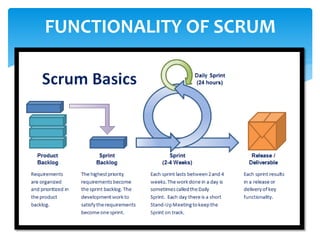
FUNCTIONALITY OF SCRUM
1. SCRUM ROLES
2.THE PROCESS
3.SCRUM ARTIFACTS
COMPONENTS OF SCRUM
1.SCRUM ROLES
 SCRUM MASTER:
 Coach for scrum team.
 Enacting scrum values.
 Ensure team's productivity.
 Build winning team.
 Apply agile principles and make system
effective.
SCRUM ROLES
 SCRUM TEAM:
 Typically 5-10 people
 Cross-functional (QA, Programmers, UI
Designers, etc.)
 Members should be full-time
 Team is self-organizing
 Membership can change only between sprints
SCRUM ROLES
 PRODUCT OWNER:
 Product Owner (PO) is client's representative.
 Define features of product.
 Decide release date and content.
 Priorities features according to market value.
 Be responsible for the profitability of product.
 Accept or reject work items.
SCRUM ROLES
 SPRINT
 No changes are made that would endanger the Sprint
Goal.
 Quality does not decrease.
 The Product Backlog is refined as needed.
 Scope may be clarified and renegotiated with
the Product Owner as more is learned.
2.THE PROCESS
 SPRINT PLANNING MEETING :
 A collaborative meeting in the beginning of each
Sprint between the Product Owner, the Scrum
Master and the Team
 Takes 8 hours and consists of 2 parts (“before
lunch and after lunch”)
THE PROCESS
 DAILY SCRUM:
 Is a short (15minutes long) meeting, whichis
held every day before theTeam starts working
 Participants: Scrum Master (which is the chairman),
Scrum Team
 Every Team member should answer on 3 questions
THE PROCESS
 What did you do since the last Scrum?
 What are you doing until the next Scrum?
 What is stopping you getting on with the work?
QUESTIONS
3. SCRUM ARTIFACTS
 PRODUCT BACKLOG:
 Requirements for a system, expressed as a
prioritized list of Backlog Items.
 Is managed and owned by a Product Owner
 Spreadsheet (typically).
 Usually is created during theSprint Planning
Meeting.
 Can be changed and re-prioritized before each
planning meet.
SCRUM ARTIFACTS
 SPRINT BACKLOG:
 A subset of Product Backlog Items, which definethe
work for a Sprint
 No more then 300 tasks in the list
 If a task requires more than 16 hours, it should
be broken down
 Team can add or subtract items from the list.
Product Owner is not allowed to do it
 Should be updated everyday
SCRUM ARTIFACTS
 PRODUCT INCREMENT:
 Every sprint produces a product increment, the
most important Scrum artifact. A product
Increment is the "goal line" for each sprint
and, at the end of the sprint,
 Be of high enough quality to be given to users.
 Meet the Scrum team's current definition of
done.
 Be acceptable to the product owner.
SCRUM ARTIFACTS
 http://www.wilsisney.com/archive/2012/03/scrum/
 https://www.scrum.org/resources/what-is-scrum
REFERENCE LINK
THANKYOU.

Scrum (406,439)

  • 1.
    SCRUM MADE BY: HUSAIN SAIFY-406 AYUSH DUDHABADE -439
  • 2.
     WHAT ISSCRUM?  FUNCTIONALITY OF SCRUM  COMPONENTES OF SCRUM 1. SCRUM ROLES 2. THE PROCESS 3. SCRUM ARTIFACTS  REFRENCE SLIDE INDEX
  • 3.
    Definition from rugbyfootball:  a Scrum is a way to restart the game after an interruption, where the forwards of each side come together in a tight formation and struggle to gain possession of the ball when it is tossed in among them. WHAT IS SCRUM?
  • 4.
     SCRUM isan agile, lightweight process for managing and controlling software and product development in rapidly changing environments. Team-based approach developing systems/ products withrapidly changing requirements Improve communication and maximizecooperation Protecting the team form disruptions and impediments Away to maximize productivity Scrum- anAgileprocess
  • 5.
  • 7.
    1. SCRUM ROLES 2.THEPROCESS 3.SCRUM ARTIFACTS COMPONENTS OF SCRUM
  • 8.
  • 9.
     SCRUM MASTER: Coach for scrum team.  Enacting scrum values.  Ensure team's productivity.  Build winning team.  Apply agile principles and make system effective. SCRUM ROLES
  • 10.
     SCRUM TEAM: Typically 5-10 people  Cross-functional (QA, Programmers, UI Designers, etc.)  Members should be full-time  Team is self-organizing  Membership can change only between sprints SCRUM ROLES
  • 11.
     PRODUCT OWNER: Product Owner (PO) is client's representative.  Define features of product.  Decide release date and content.  Priorities features according to market value.  Be responsible for the profitability of product.  Accept or reject work items. SCRUM ROLES
  • 12.
     SPRINT  Nochanges are made that would endanger the Sprint Goal.  Quality does not decrease.  The Product Backlog is refined as needed.  Scope may be clarified and renegotiated with the Product Owner as more is learned. 2.THE PROCESS
  • 13.
     SPRINT PLANNINGMEETING :  A collaborative meeting in the beginning of each Sprint between the Product Owner, the Scrum Master and the Team  Takes 8 hours and consists of 2 parts (“before lunch and after lunch”) THE PROCESS
  • 14.
     DAILY SCRUM: Is a short (15minutes long) meeting, whichis held every day before theTeam starts working  Participants: Scrum Master (which is the chairman), Scrum Team  Every Team member should answer on 3 questions THE PROCESS
  • 15.
     What didyou do since the last Scrum?  What are you doing until the next Scrum?  What is stopping you getting on with the work? QUESTIONS
  • 16.
  • 17.
     PRODUCT BACKLOG: Requirements for a system, expressed as a prioritized list of Backlog Items.  Is managed and owned by a Product Owner  Spreadsheet (typically).  Usually is created during theSprint Planning Meeting.  Can be changed and re-prioritized before each planning meet. SCRUM ARTIFACTS
  • 18.
     SPRINT BACKLOG: A subset of Product Backlog Items, which definethe work for a Sprint  No more then 300 tasks in the list  If a task requires more than 16 hours, it should be broken down  Team can add or subtract items from the list. Product Owner is not allowed to do it  Should be updated everyday SCRUM ARTIFACTS
  • 19.
     PRODUCT INCREMENT: Every sprint produces a product increment, the most important Scrum artifact. A product Increment is the "goal line" for each sprint and, at the end of the sprint,  Be of high enough quality to be given to users.  Meet the Scrum team's current definition of done.  Be acceptable to the product owner. SCRUM ARTIFACTS
  • 20.
  • 21.