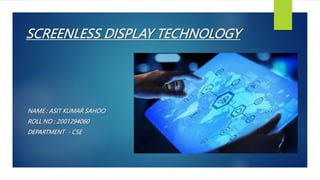
SCREENLESS DISPLAY TECHNOLOGY
NAME : ASIT KUMAR SAHOO
ROLL NO : 2001294060
DEPARTMENT - CSE
CONTENT
 INTRODUCTION
 TYPES OF SCREENLESS DISPLAY TECHNOLOGY (STD)
 WORKING PRINCIPLE OF STD
 APPLICATION OF STD
 ADVANTAGES & DISADVANTAGES
INTRODUCTION
 Screenless Display technology (STD) is a system of transferring information/data
through an electronic video source without screen.
 Screenless Display Technology (STD) has the main aim of displaying or
transmitting information without any help of the screen (or) the projector.
 There are many types of Screenless display that are under development which are
described below :
 Visual Image Display
 Retinal Direct Display
 Synaptic Interface.
WORKING PRINCIPLE OF STD
 The working principle of this display states that the light gets reflected by the intermediate
object before reaching the retina or the eye.
 The intermediate object can be a Hologram, liquid Crystal Displays (LCD)s or even windows
TYPES OF SCREENLESS DISPLAY TECHNOLOGY
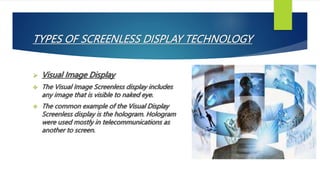
 Visual Image Display
 The Visual Image Screenless display includes
any image that is visible to naked eye.
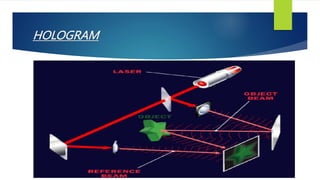
 The common example of the Visual Display
Screenless display is the hologram. Hologram
were used mostly in telecommunications as
another to screen.
HOLOGRAM
RETINAL DIRECT DISPLAY
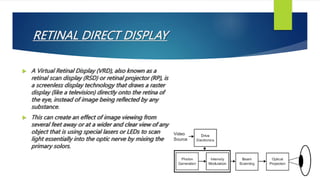
 A Virtual Retinal Display (VRD), also known as a
retinal scan display (RSD) or retinal projector (RP), is
a screenless display technology that draws a raster
display (like a television) directly onto the retina of
the eye, instead of image being reflected by any
substance.
 This can create an effect of image viewing from
several feet away or at a wider and clear view of any
object that is using special lasers or LEDs to scan
light essentially into the optic nerve by mixing the
primary solors.
SYNAPTIC INTERFACE
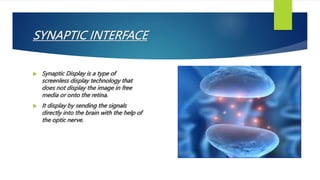
 Synaptic Display is a type of
screenless display technology that
does not display the image in free
media or onto the retina.
 It display by sending the signals
directly into the brain with the help of
the optic nerve.
APPLICATION OF STD
 Medical field: By allowing the physician to view a virtual X-Ray of infected areas information that is
concerning that patient during surgery. Virtual images produced by VRD could be laid-down with the
patient by tracking the view of the physician in relation to the position of the patient.
 Manufacturing field: The same concept as that is used in medical field can be used in manufacturing
environment by viewing virtual blue print that uses C3 images to identify parts placement and operation
information.
 Transportation system: It can be beneficial in any transportation system by proving the display that can
project virtual map of the surrounding area therefore in siding vision of providing reference state train
characteristics and craft instrumentation
ADVANTAGES & DISADVANTAGES
 Advantages
 Low power requirements.
 High resolution image.
 Larger portability.
 Wider viewing angle.
 Ability for display 3D images.
 Disadvantages
 The (VRD) is not yet present in the significant quantity.
 Cost is very high.
 The VRD technology is under Development.
SCREENLESS DISPLAY TECHNOLOGY.pptx

SCREENLESS DISPLAY TECHNOLOGY.pptx

  • 1.
    SCREENLESS DISPLAY TECHNOLOGY NAME: ASIT KUMAR SAHOO ROLL NO : 2001294060 DEPARTMENT - CSE
  • 2.
    CONTENT  INTRODUCTION  TYPESOF SCREENLESS DISPLAY TECHNOLOGY (STD)  WORKING PRINCIPLE OF STD  APPLICATION OF STD  ADVANTAGES & DISADVANTAGES
  • 3.
    INTRODUCTION  Screenless Displaytechnology (STD) is a system of transferring information/data through an electronic video source without screen.  Screenless Display Technology (STD) has the main aim of displaying or transmitting information without any help of the screen (or) the projector.  There are many types of Screenless display that are under development which are described below :  Visual Image Display  Retinal Direct Display  Synaptic Interface.
  • 4.
    WORKING PRINCIPLE OFSTD  The working principle of this display states that the light gets reflected by the intermediate object before reaching the retina or the eye.  The intermediate object can be a Hologram, liquid Crystal Displays (LCD)s or even windows
  • 5.
    TYPES OF SCREENLESSDISPLAY TECHNOLOGY  Visual Image Display  The Visual Image Screenless display includes any image that is visible to naked eye.  The common example of the Visual Display Screenless display is the hologram. Hologram were used mostly in telecommunications as another to screen.
  • 6.
  • 7.
    RETINAL DIRECT DISPLAY A Virtual Retinal Display (VRD), also known as a retinal scan display (RSD) or retinal projector (RP), is a screenless display technology that draws a raster display (like a television) directly onto the retina of the eye, instead of image being reflected by any substance.  This can create an effect of image viewing from several feet away or at a wider and clear view of any object that is using special lasers or LEDs to scan light essentially into the optic nerve by mixing the primary solors.
  • 8.
    SYNAPTIC INTERFACE  SynapticDisplay is a type of screenless display technology that does not display the image in free media or onto the retina.  It display by sending the signals directly into the brain with the help of the optic nerve.
  • 9.
    APPLICATION OF STD Medical field: By allowing the physician to view a virtual X-Ray of infected areas information that is concerning that patient during surgery. Virtual images produced by VRD could be laid-down with the patient by tracking the view of the physician in relation to the position of the patient.  Manufacturing field: The same concept as that is used in medical field can be used in manufacturing environment by viewing virtual blue print that uses C3 images to identify parts placement and operation information.  Transportation system: It can be beneficial in any transportation system by proving the display that can project virtual map of the surrounding area therefore in siding vision of providing reference state train characteristics and craft instrumentation
  • 10.
    ADVANTAGES & DISADVANTAGES Advantages  Low power requirements.  High resolution image.  Larger portability.  Wider viewing angle.  Ability for display 3D images.  Disadvantages  The (VRD) is not yet present in the significant quantity.  Cost is very high.  The VRD technology is under Development.