Screenless Display
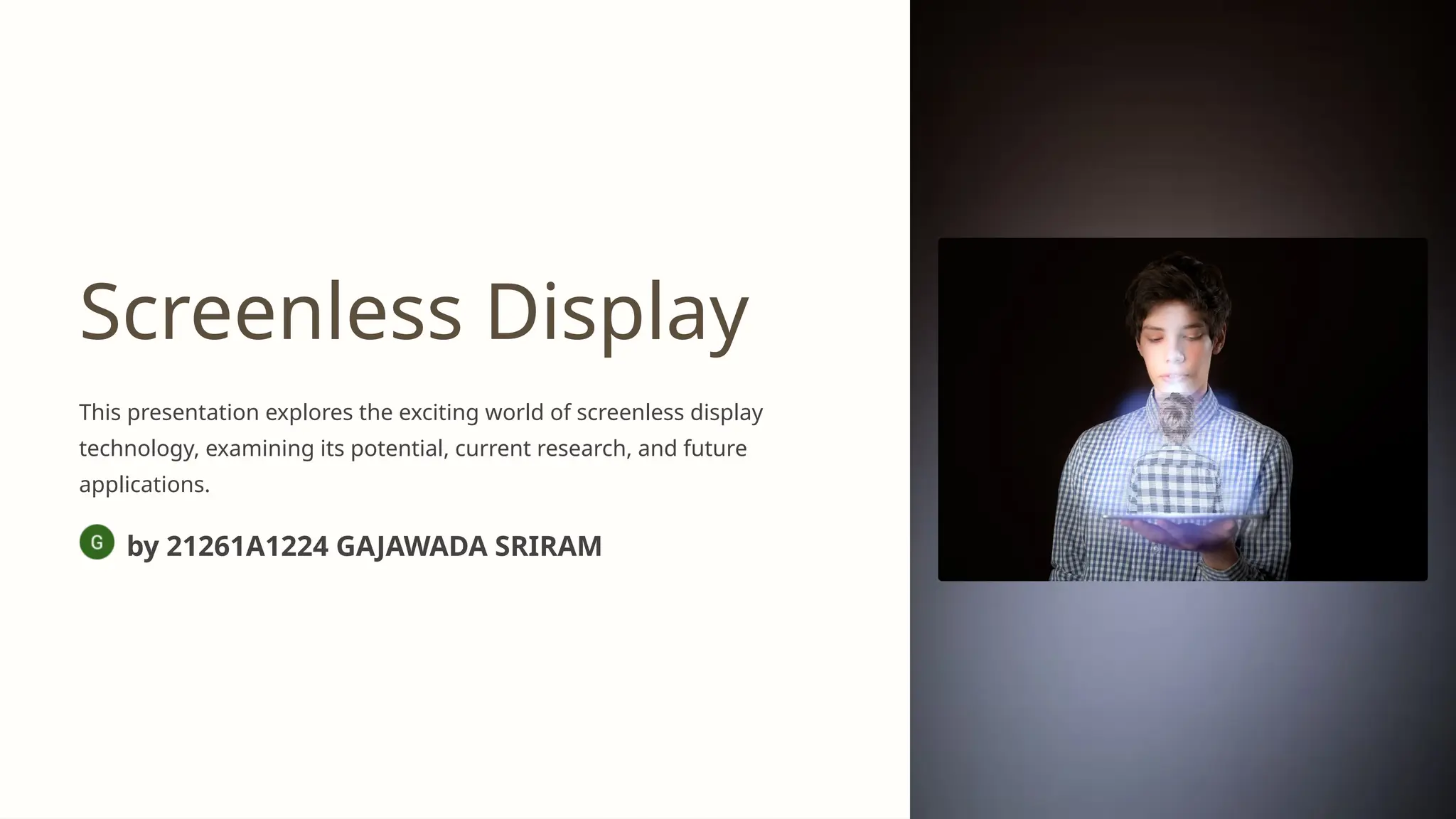
This presentation explores the exciting world of screenless display
technology, examining its potential, current research, and future
applications.
by 21261A1224 GAJAWADA SRIRAM
Outline
1 Abstract 2 Introduction
3 Literature Survey 4 Applications
5 Advantages 6 References
Abstract
• Screenless display is an innovative display technology that projects visual information
directly onto the user's environment without the need for a physical screen.
•This technology leverages various methods, such as holography, light field displays, and
retinal
projection, to create immersive and interactive visual experiences.
•Screenless displays can be used in a range of applications, from augmented reality and
virtual
reality systems to heads- up displays in automotive and aerospace industries.
•By eliminating the need for traditional screens, screenless displays offer advantages in terms
of
space efficiency, adaptability to different surfaces, and enhanced user engagement.
Introduction
• Screenless display technology transmits and displays visual information without traditional
screens or projectors.
• Key principles include holograms, virtual retinal displays, and synaptic interfaces for
immersive
viewing experiences.
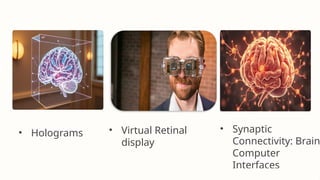
• Holograms provide three-dimensional representations of data, enhancing perception and
interaction.
• Virtual retinal display projects images directly onto the retina, creating a more direct and
engaging viewing experience.
• Synaptic interface transmits visual information directly to the brain, potentially revolutionizing
digital content perception.
• Used in various fields, including augmented reality, virtual reality, mobile devices, and notably
• Virtual Retinal
display
• Synaptic
Connectivity: Brain
Computer
Interfaces
• Holograms
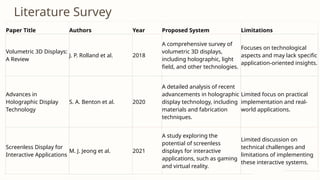
Literature Survey
Paper Title Authors Year Proposed System Limitations
Volumetric 3D Displays:
A Review
J. P. Rolland et al. 2018
A comprehensive survey of
volumetric 3D displays,
including holographic, light
field, and other technologies.
Focuses on technological
aspects and may lack specific
application-oriented insights.
Advances in
Holographic Display
Technology
S. A. Benton et al. 2020
A detailed analysis of recent
advancements in holographic
display technology, including
materials and fabrication
techniques.
Limited focus on practical
implementation and real-
world applications.
Screenless Display for
Interactive Applications
M. J. Jeong et al. 2021
A study exploring the
potential of screenless
displays for interactive
applications, such as gaming
and virtual reality.
Limited discussion on
technical challenges and
limitations of implementing
these interactive systems.
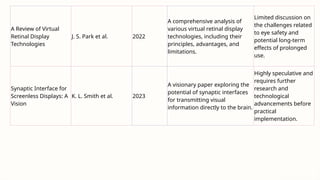
A Review of Virtual
Retinal Display
Technologies
J. S. Park et al. 2022
A comprehensive analysis of
various virtual retinal display
technologies, including their
principles, advantages, and
limitations.
Limited discussion on
the challenges related
to eye safety and
potential long-term
effects of prolonged
use.
Synaptic Interface for
Screenless Displays: A
Vision
K. L. Smith et al. 2023
A visionary paper exploring the
potential of synaptic interfaces
for transmitting visual
information directly to the brain.
Highly speculative and
requires further
research and
technological
advancements before
practical
implementation.
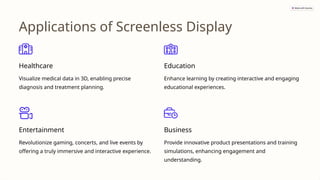
Applications of Screenless Display
Healthcare
Visualize medical data in 3D, enabling precise
diagnosis and treatment planning.
Education
Enhance learning by creating interactive and engaging
educational experiences.
Entertainment
Revolutionize gaming, concerts, and live events by
offering a truly immersive and interactive experience.
Business
Provide innovative product presentations and training
simulations, enhancing engagement and
understanding.
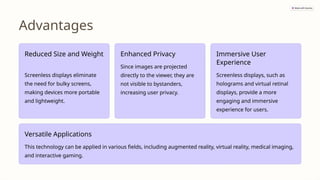
Advantages
Reduced Size and Weight
Screenless displays eliminate
the need for bulky screens,
making devices more portable
and lightweight.
Enhanced Privacy
Since images are projected
directly to the viewer, they are
not visible to bystanders,
increasing user privacy.
Immersive User
Experience
Screenless displays, such as
holograms and virtual retinal
displays, provide a more
engaging and immersive
experience for users.
Versatile Applications
This technology can be applied in various fields, including augmented reality, virtual reality, medical imaging,
and interactive gaming.
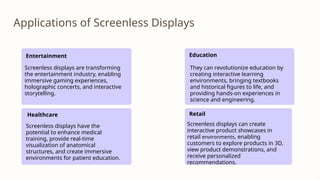
Applications of Screenless Displays
Entertainment
Screenless displays are transforming
the entertainment industry, enabling
immersive gaming experiences,
holographic concerts, and interactive
storytelling.
Education
They can revolutionize education by
creating interactive learning
environments, bringing textbooks
and historical figures to life, and
providing hands-on experiences in
science and engineering.
Healthcare
Screenless displays have the
potential to enhance medical
training, provide real-time
visualization of anatomical
structures, and create immersive
environments for patient education.
Retail
Screenless displays can create
interactive product showcases in
retail environments, enabling
customers to explore products in 3D,
view product demonstrations, and
receive personalized
recommendations.
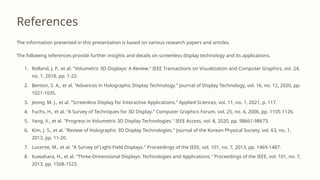
References
The information presented in this presentation is based on various research papers and articles.
The following references provide further insights and details on screenless display technology and its applications.
1. Rolland, J. P., et al. "Volumetric 3D Displays: A Review." IEEE Transactions on Visualization and Computer Graphics, vol. 24,
no. 1, 2018, pp. 1-22.
2. Benton, S. A., et al. "Advances in Holographic Display Technology." Journal of Display Technology, vol. 16, no. 12, 2020, pp.
1021-1035.
3. Jeong, M. J., et al. "Screenless Display for Interactive Applications." Applied Sciences, vol. 11, no. 1, 2021, p. 117.
4. Fuchs, H., et al. "A Survey of Techniques for 3D Display." Computer Graphics Forum, vol. 25, no. 4, 2006, pp. 1105-1126.
5. Yang, X., et al. "Progress in Volumetric 3D Display Technologies." IEEE Access, vol. 8, 2020, pp. 98661-98673.
6. Kim, J. S., et al. "Review of Holographic 3D Display Technologies." Journal of the Korean Physical Society, vol. 63, no. 1,
2013, pp. 11-20.
7. Lucente, M., et al. "A Survey of Light-Field Displays." Proceedings of the IEEE, vol. 101, no. 7, 2013, pp. 1469-1487.
8. Kuwahara, H., et al. "Three-Dimensional Displays: Technologies and Applications." Proceedings of the IEEE, vol. 101, no. 7,
2013, pp. 1508-1523.
Thank You
We hope this presentation has provided a valuable insight into the
exciting world of screenless displays. As technology continues to
advance, we can expect to see even more innovative and immersive
applications of this emerging technology.

Screenless Display in the advanced world

  • 1.
    Screenless Display This presentationexplores the exciting world of screenless display technology, examining its potential, current research, and future applications. by 21261A1224 GAJAWADA SRIRAM
  • 2.
    Outline 1 Abstract 2Introduction 3 Literature Survey 4 Applications 5 Advantages 6 References
  • 3.
    Abstract • Screenless displayis an innovative display technology that projects visual information directly onto the user's environment without the need for a physical screen. •This technology leverages various methods, such as holography, light field displays, and retinal projection, to create immersive and interactive visual experiences. •Screenless displays can be used in a range of applications, from augmented reality and virtual reality systems to heads- up displays in automotive and aerospace industries. •By eliminating the need for traditional screens, screenless displays offer advantages in terms of space efficiency, adaptability to different surfaces, and enhanced user engagement.
  • 4.
    Introduction • Screenless displaytechnology transmits and displays visual information without traditional screens or projectors. • Key principles include holograms, virtual retinal displays, and synaptic interfaces for immersive viewing experiences. • Holograms provide three-dimensional representations of data, enhancing perception and interaction. • Virtual retinal display projects images directly onto the retina, creating a more direct and engaging viewing experience. • Synaptic interface transmits visual information directly to the brain, potentially revolutionizing digital content perception. • Used in various fields, including augmented reality, virtual reality, mobile devices, and notably
  • 5.
    • Virtual Retinal display •Synaptic Connectivity: Brain Computer Interfaces • Holograms
  • 6.
    Literature Survey Paper TitleAuthors Year Proposed System Limitations Volumetric 3D Displays: A Review J. P. Rolland et al. 2018 A comprehensive survey of volumetric 3D displays, including holographic, light field, and other technologies. Focuses on technological aspects and may lack specific application-oriented insights. Advances in Holographic Display Technology S. A. Benton et al. 2020 A detailed analysis of recent advancements in holographic display technology, including materials and fabrication techniques. Limited focus on practical implementation and real- world applications. Screenless Display for Interactive Applications M. J. Jeong et al. 2021 A study exploring the potential of screenless displays for interactive applications, such as gaming and virtual reality. Limited discussion on technical challenges and limitations of implementing these interactive systems.
  • 7.
    A Review ofVirtual Retinal Display Technologies J. S. Park et al. 2022 A comprehensive analysis of various virtual retinal display technologies, including their principles, advantages, and limitations. Limited discussion on the challenges related to eye safety and potential long-term effects of prolonged use. Synaptic Interface for Screenless Displays: A Vision K. L. Smith et al. 2023 A visionary paper exploring the potential of synaptic interfaces for transmitting visual information directly to the brain. Highly speculative and requires further research and technological advancements before practical implementation.
  • 8.
    Applications of ScreenlessDisplay Healthcare Visualize medical data in 3D, enabling precise diagnosis and treatment planning. Education Enhance learning by creating interactive and engaging educational experiences. Entertainment Revolutionize gaming, concerts, and live events by offering a truly immersive and interactive experience. Business Provide innovative product presentations and training simulations, enhancing engagement and understanding.
  • 9.
    Advantages Reduced Size andWeight Screenless displays eliminate the need for bulky screens, making devices more portable and lightweight. Enhanced Privacy Since images are projected directly to the viewer, they are not visible to bystanders, increasing user privacy. Immersive User Experience Screenless displays, such as holograms and virtual retinal displays, provide a more engaging and immersive experience for users. Versatile Applications This technology can be applied in various fields, including augmented reality, virtual reality, medical imaging, and interactive gaming.
  • 10.
    Applications of ScreenlessDisplays Entertainment Screenless displays are transforming the entertainment industry, enabling immersive gaming experiences, holographic concerts, and interactive storytelling. Education They can revolutionize education by creating interactive learning environments, bringing textbooks and historical figures to life, and providing hands-on experiences in science and engineering. Healthcare Screenless displays have the potential to enhance medical training, provide real-time visualization of anatomical structures, and create immersive environments for patient education. Retail Screenless displays can create interactive product showcases in retail environments, enabling customers to explore products in 3D, view product demonstrations, and receive personalized recommendations.
  • 11.
    References The information presentedin this presentation is based on various research papers and articles. The following references provide further insights and details on screenless display technology and its applications. 1. Rolland, J. P., et al. "Volumetric 3D Displays: A Review." IEEE Transactions on Visualization and Computer Graphics, vol. 24, no. 1, 2018, pp. 1-22. 2. Benton, S. A., et al. "Advances in Holographic Display Technology." Journal of Display Technology, vol. 16, no. 12, 2020, pp. 1021-1035. 3. Jeong, M. J., et al. "Screenless Display for Interactive Applications." Applied Sciences, vol. 11, no. 1, 2021, p. 117. 4. Fuchs, H., et al. "A Survey of Techniques for 3D Display." Computer Graphics Forum, vol. 25, no. 4, 2006, pp. 1105-1126. 5. Yang, X., et al. "Progress in Volumetric 3D Display Technologies." IEEE Access, vol. 8, 2020, pp. 98661-98673. 6. Kim, J. S., et al. "Review of Holographic 3D Display Technologies." Journal of the Korean Physical Society, vol. 63, no. 1, 2013, pp. 11-20. 7. Lucente, M., et al. "A Survey of Light-Field Displays." Proceedings of the IEEE, vol. 101, no. 7, 2013, pp. 1469-1487. 8. Kuwahara, H., et al. "Three-Dimensional Displays: Technologies and Applications." Proceedings of the IEEE, vol. 101, no. 7, 2013, pp. 1508-1523.
  • 12.
    Thank You We hopethis presentation has provided a valuable insight into the exciting world of screenless displays. As technology continues to advance, we can expect to see even more innovative and immersive applications of this emerging technology.