Screencasting:Adobe CaptivateLSU LibrariesStaff PresentationRebecca K. MillerAugust 4, 2009
Interactive tutorials“Passive” tutorials
Import directly from PowerPointExample from LIS 1001 Course
Edit the size of the slidesSelect which slides to includeDecide how your tutorial will progress
With these tools, you can add (from left-right):CaptionsRollover captionsHighlight boxesRollover slideletZoom areasText entriesClick boxesButtonsText animationsImagesRollover ImagesAnimationsVideosMouse movements
Capturing Screen MovementDetermine where you’d like to add the captureYou can add the recording at any point in the tutorial you’ve already created
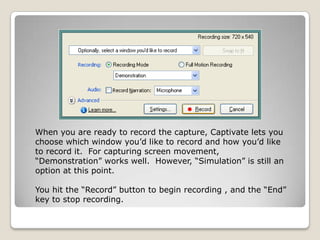
When you are ready to record the capture, Captivate lets you choose which window you’d like to record and how you’d like to record it.  For capturing screen movement, “Demonstration” works well.  However, “Simulation” is still an option at this point.You hit the “Record” button to begin recording , and the “End” key to stop recording.
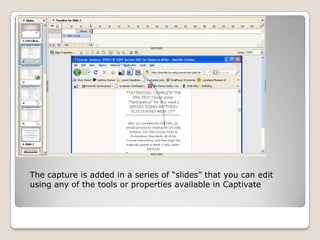
The capture is added in a series of “slides” that you can edit using any of the tools or properties available in Captivate
Publishing the Tutorial
Flash is the most popular file format for publishing tutorials, since it is viewable across various platforms.	Placing the media file you just created on a plain web page is, likewise, the most popular choice for disseminating tutorials…Tutorial with screencapture from LIS 1001
The Summer 2009 LIS 1001 online course was built entirely with Captivate software to explain material and demonstrate methods through digital tutorials.A total of 19 tutorials, ranging from 1:00 minute to 9:00 minutes, were created.  No audio was associated with these files, for various reasonsBoth students and instructors found benefits in this method.
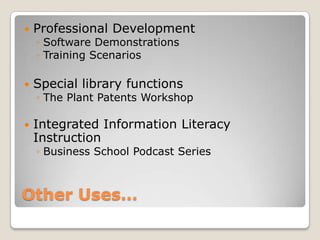
Other Uses…Professional DevelopmentSoftware DemonstrationsTraining ScenariosSpecial library functions The Plant Patents WorkshopIntegrated Information Literacy InstructionBusiness School Podcast Series

Screencasting with Captivate

  • 1.
    Screencasting:Adobe CaptivateLSU LibrariesStaffPresentationRebecca K. MillerAugust 4, 2009
  • 3.
  • 4.
    Import directly fromPowerPointExample from LIS 1001 Course
  • 5.
    Edit the sizeof the slidesSelect which slides to includeDecide how your tutorial will progress
  • 7.
    With these tools,you can add (from left-right):CaptionsRollover captionsHighlight boxesRollover slideletZoom areasText entriesClick boxesButtonsText animationsImagesRollover ImagesAnimationsVideosMouse movements
  • 8.
    Capturing Screen MovementDeterminewhere you’d like to add the captureYou can add the recording at any point in the tutorial you’ve already created
  • 9.
    When you areready to record the capture, Captivate lets you choose which window you’d like to record and how you’d like to record it. For capturing screen movement, “Demonstration” works well. However, “Simulation” is still an option at this point.You hit the “Record” button to begin recording , and the “End” key to stop recording.
  • 10.
    The capture isadded in a series of “slides” that you can edit using any of the tools or properties available in Captivate
  • 11.
  • 12.
    Flash is themost popular file format for publishing tutorials, since it is viewable across various platforms. Placing the media file you just created on a plain web page is, likewise, the most popular choice for disseminating tutorials…Tutorial with screencapture from LIS 1001
  • 13.
    The Summer 2009LIS 1001 online course was built entirely with Captivate software to explain material and demonstrate methods through digital tutorials.A total of 19 tutorials, ranging from 1:00 minute to 9:00 minutes, were created. No audio was associated with these files, for various reasonsBoth students and instructors found benefits in this method.
  • 14.
    Other Uses…Professional DevelopmentSoftwareDemonstrationsTraining ScenariosSpecial library functions The Plant Patents WorkshopIntegrated Information Literacy InstructionBusiness School Podcast Series