


© Copyright 2014 Quintiles
Engage and Retain Patients in Long-Term
Observational Studies
Marlene Smurzynski, PhD, MSPH
Epidemiologist
Real-World & Late Phase Research
John Reites
Sr. Director, Product and
Strategy
Health Engagement &
Communications
2
• Identify design and operational considerations when
conducting long-term observational research
• Understand challenges with site and patient
engagement/retention
• Examine engagement strategies and opportunities
for improving retention and compliance
Agenda
3
Site and Patient Engagement
Design Considerations for Long-term Observational
Studies
4
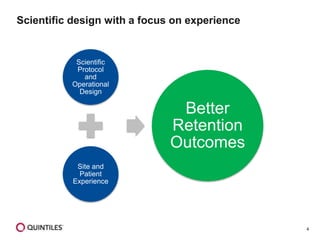
Scientific design with a focus on experience
Scientific
Protocol
and
Operational
Design
Site and
Patient
Experience
Better
Retention
Outcomes
5
Features
> Non-randomized
> Non-interventional
> Patient registries may
focus on disease, product
or exposure
> Monitor cohort(s) over time
Prospective observational cohort studies & registries
Primary data capture & design
6
Features
> Non-randomized
> Non-interventional
> Patient registries may
focus on disease, product
or exposure
> Monitor cohort(s) over time
Advantages
> Examine longer-term
outcomes in populations
typically excluded from
clinical trials
> Examine potential risk
factors for uncommon
harms
> Collect more
representative data on a
range of outcomes
(compared to data you
capture in a clinical trial)
> Assess actual use
(including off-label) to
identify potential new
indications
Prospective observational cohort studies & registries
Primary data capture & design
7
Features
> Non-randomized
> Non-interventional
> Patient registries may
focus on disease, product
or exposure
> Monitor cohort(s) over time
Advantages
> Examine longer-term
outcomes in populations
typically excluded from
clinical trials
> Examine potential risk
factors for uncommon
harms
> Collect more
representative data on a
range of outcomes
(compared to data you
capture in a clinical trial)
> Assess actual use
(including off-label) to
identify potential new
indications
Disadvantages
> Prone to bias and
confounding; not a
controlled environment
> The incorrect design,
conduct or analysis can
prevent you from producing
strong evidence
Prospective observational cohort studies & registries
Primary data capture & design
8
• Follow established good practices
› Objectives will guide study design and conduct
• Determine appropriate target population, sample size, and duration of follow-
up for outcomes of interest
• Formulate a research question(s)/define goals and objectives
› Prioritize & be succinct – create a list of “must have” objectives/endpoints
› Ensure outcomes are clinically meaningful, relevant, can reasonably support clinical
decision-making
› Translate questions of clinical interest into measurable exposures and outcomes
› Create a clear path that leads from objectives to data collection to analysis
Key observational study design considerations
9
• Create a protocol that addresses observational study scientific considerations
› Follow observational study protocol guidelines; steer away from creating your
observational study in RCT templates
» RCT templates are more complex than observational study protocols
› Create a relevant background section; simply copying a background from pre-
approval RCT protocols will not be relevant
• Streamline & simplify
› Create broad inclusion/exclusion criteria
› Align data collection assessments with routine care
• Make it easy for sites & patients
› Retention difficulties can have profound impact on validity and generalizability of study
findings
Start with a successful protocol
10
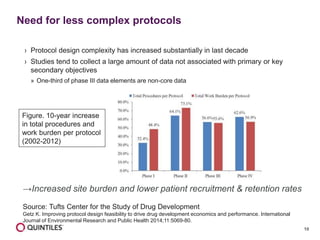
› Protocol design complexity has increased substantially in last decade
› Studies tend to collect a large amount of data not associated with primary or key
secondary objectives
» One-third of phase III data elements are non-core data
Need for less complex protocols
Figure. 10-year increase
in total procedures and
work burden per protocol
(2002-2012)
→Increased site burden and lower patient recruitment & retention rates
Source: Tufts Center for the Study of Drug Development
Getz K. Improving protocol design feasibility to drive drug development economics and performance. International
Journal of Environmental Research and Public Health 2014;11:5069-80.
11
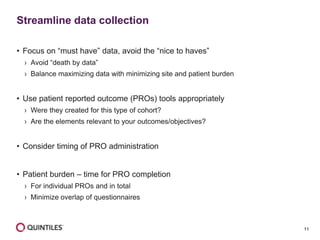
• Focus on “must have” data, avoid the “nice to haves”
› Avoid “death by data”
› Balance maximizing data with minimizing site and patient burden
• Use patient reported outcome (PROs) tools appropriately
› Were they created for this type of cohort?
› Are the elements relevant to your outcomes/objectives?
• Consider timing of PRO administration
• Patient burden – time for PRO completion
› For individual PROs and in total
› Minimize overlap of questionnaires
Streamline data collection
12
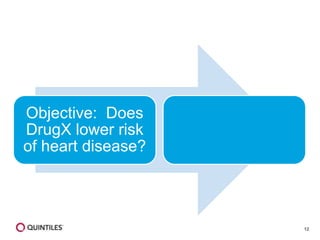
Objective: Does
DrugX lower risk
of heart disease?
13
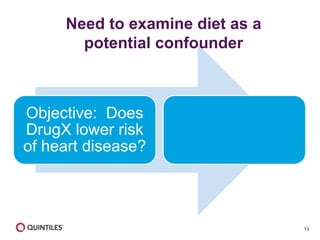
Objective: Does
DrugX lower risk
of heart disease?
Need to examine diet as a
potential confounder
14
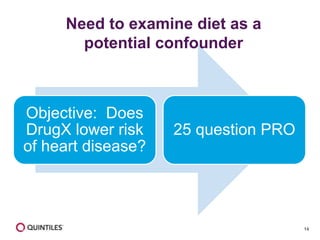
Objective: Does
DrugX lower risk
of heart disease?
25 question PRO
Need to examine diet as a
potential confounder
15
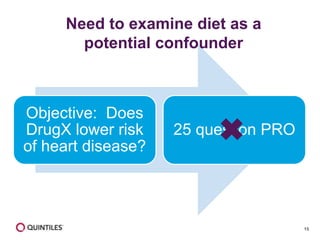
Objective: Does
DrugX lower risk
of heart disease?
25 question PRO
Need to examine diet as a
potential confounder
16
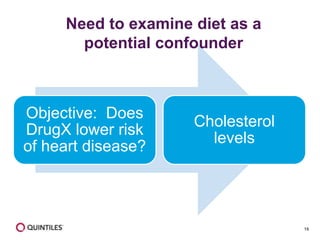
Objective: Does
DrugX lower risk
of heart disease?
Cholesterol
levels
Need to examine diet as a
potential confounder
17
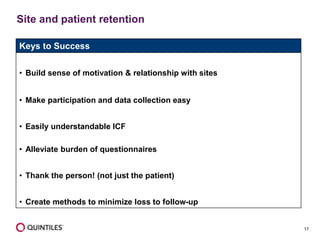
Site and patient retention
Keys to Success
• Build sense of motivation & relationship with sites
• Make participation and data collection easy
• Easily understandable ICF
• Alleviate burden of questionnaires
• Thank the person! (not just the patient)
• Create methods to minimize loss to follow-up
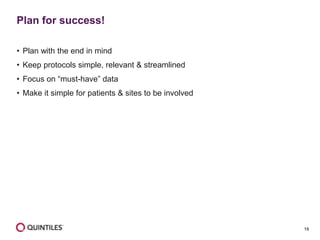
18
• Plan with the end in mind
• Keep protocols simple, relevant & streamlined
• Focus on “must-have” data
• Make it simple for patients & sites to be involved
Plan for success!
19
Site and Patient Engagement
Strategies for improving retention
20
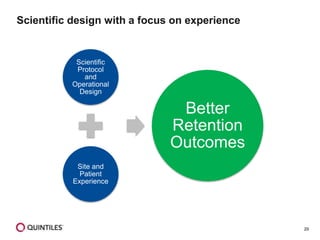
Scientific design with a focus on experience
Scientific
Protocol
and
Operational
Design
Site and
Patient
Experience
Better
Retention
Outcomes
21
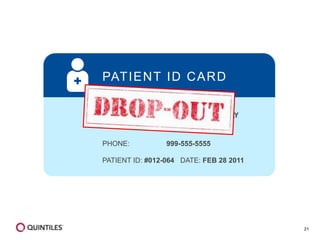
PATIENT: John Reites
ADDRESS: 123 ANYWHERE WAY
HERE, NC 00000
PATIENT ID: #012-064 DATE: FEB 28 2011
PHONE: 999-555-5555
PATIENT ID CARD
22
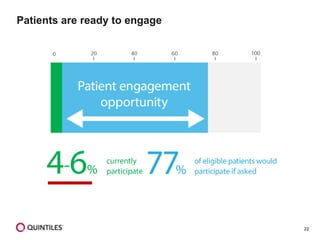
Patients are ready to engage
23
“Give me six hours to chop
down a tree and I will spend
the first four sharpening
the axe.”
Abraham Lincoln
24
Connect insights
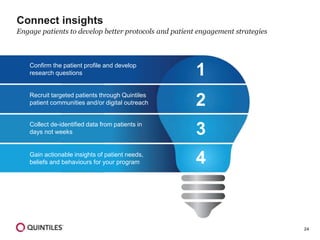
Engage patients to develop better protocols and patient engagement strategies
Recruit targeted patients through Quintiles
patient communities and/or digital outreach
Collect de-identified data from patients in
days not weeks
Confirm the patient profile and develop
research questions
2
3
Gain actionable insights of patient needs,
beliefs and behaviours for your program 4
1
25
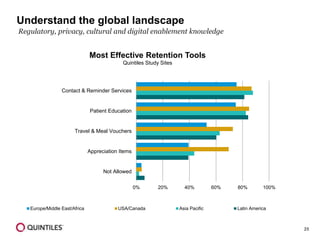
Understand the global landscape
0% 20% 40% 60% 80% 100%
Not Allowed
Appreciation Items
Travel & Meal Vouchers
Patient Education
Contact & Reminder Services
Most Effective Retention Tools
Quintiles Study Sites
Europe/Middle East/Africa USA/Canada Asia Pacific Latin America
Quintiles Site Intelligence Investigator Profile Questionnaire
Regulatory, privacy, cultural and digital enablement knowledge
26
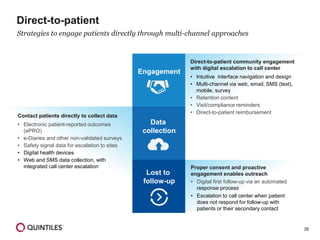
Direct-to-patient
Strategies to engage patients directly through multi-channel approaches
Direct-to-patient community engagement
with digital escalation to call center
• Intuitive interface navigation and design
• Multi-channel via web, email, SMS (text),
mobile, survey
• Retention content
• Visit/compliance reminders
• Direct-to-patient reimbursement
Contact patients directly to collect data
• Electronic patient-reported outcomes
(ePRO)
• e-Diaries and other non-validated surveys
• Safety signal data for escalation to sites
• Digital health devices
• Web and SMS data collection, with
integrated call center escalation Proper consent and proactive
engagement enables outreach
• Digital first follow-up via an automated
response process
• Escalation to call center when patient
does not respond for follow-up with
patients or their secondary contact
Engagement
Data
collection
Lost to
follow-up
27
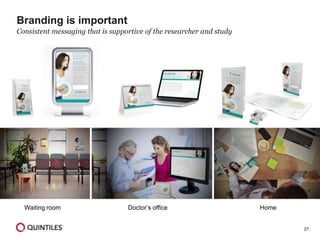
Branding is important
Waiting room Doctor’s office Home
Consistent messaging that is supportive of the researcher and study
28
Data system
integration
Investigator registers
& consents patient
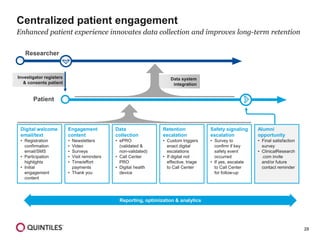
Centralized patient engagement
Enhanced patient experience innovates data collection and improves long-term retention
Researcher
Patient v
Reporting, optimization & analytics
Digital welcome
email/text
• Registration
confirmation
email/SMS
• Participation
highlights
• Initial
engagement
content
Engagement
content
• Newsletters
• Video
• Surveys
• Visit reminders
• Time/effort
payments
• Thank you
Retention
escalation
• Custom triggers
enact digital
escalations
• If digital not
effective, triage
to Call Center
Safety signaling
escalation
• Survey to
confirm if key
safety event
occurred
• If yes, escalate
to Call Center
for follow-up
Alumni
opportunity
• Final satisfaction
survey
• ClinicalResearch
.com invite
and/or future
contact reminder
Data
collection
• ePRO
(validated &
non-validated)
• Call Center
PRO
• Digital health
device
v
29
Source: http://sethgodin.com
“What matters now is trust,
permission, remarkability,
leadership, stories that spread
and humanity: connection,
compassion, and humility”
– Seth Godin
The Icarus Deception
30
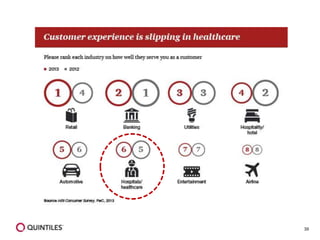
Source: HRI Consumer Survey, PwC, 2013
31
Thank you

Engage and Retain Patients in Long-term Observational Studies

  • 1.
    © Copyright 2014Quintiles Engage and Retain Patients in Long-Term Observational Studies Marlene Smurzynski, PhD, MSPH Epidemiologist Real-World & Late Phase Research John Reites Sr. Director, Product and Strategy Health Engagement & Communications
  • 2.
    2 • Identify designand operational considerations when conducting long-term observational research • Understand challenges with site and patient engagement/retention • Examine engagement strategies and opportunities for improving retention and compliance Agenda
  • 3.
    3 Site and PatientEngagement Design Considerations for Long-term Observational Studies
  • 4.
    4 Scientific design witha focus on experience Scientific Protocol and Operational Design Site and Patient Experience Better Retention Outcomes
  • 5.
    5 Features > Non-randomized > Non-interventional >Patient registries may focus on disease, product or exposure > Monitor cohort(s) over time Prospective observational cohort studies & registries Primary data capture & design
  • 6.
    6 Features > Non-randomized > Non-interventional >Patient registries may focus on disease, product or exposure > Monitor cohort(s) over time Advantages > Examine longer-term outcomes in populations typically excluded from clinical trials > Examine potential risk factors for uncommon harms > Collect more representative data on a range of outcomes (compared to data you capture in a clinical trial) > Assess actual use (including off-label) to identify potential new indications Prospective observational cohort studies & registries Primary data capture & design
  • 7.
    7 Features > Non-randomized > Non-interventional >Patient registries may focus on disease, product or exposure > Monitor cohort(s) over time Advantages > Examine longer-term outcomes in populations typically excluded from clinical trials > Examine potential risk factors for uncommon harms > Collect more representative data on a range of outcomes (compared to data you capture in a clinical trial) > Assess actual use (including off-label) to identify potential new indications Disadvantages > Prone to bias and confounding; not a controlled environment > The incorrect design, conduct or analysis can prevent you from producing strong evidence Prospective observational cohort studies & registries Primary data capture & design
  • 8.
    8 • Follow establishedgood practices › Objectives will guide study design and conduct • Determine appropriate target population, sample size, and duration of follow- up for outcomes of interest • Formulate a research question(s)/define goals and objectives › Prioritize & be succinct – create a list of “must have” objectives/endpoints › Ensure outcomes are clinically meaningful, relevant, can reasonably support clinical decision-making › Translate questions of clinical interest into measurable exposures and outcomes › Create a clear path that leads from objectives to data collection to analysis Key observational study design considerations
  • 9.
    9 • Create aprotocol that addresses observational study scientific considerations › Follow observational study protocol guidelines; steer away from creating your observational study in RCT templates » RCT templates are more complex than observational study protocols › Create a relevant background section; simply copying a background from pre- approval RCT protocols will not be relevant • Streamline & simplify › Create broad inclusion/exclusion criteria › Align data collection assessments with routine care • Make it easy for sites & patients › Retention difficulties can have profound impact on validity and generalizability of study findings Start with a successful protocol
  • 10.
    10 › Protocol designcomplexity has increased substantially in last decade › Studies tend to collect a large amount of data not associated with primary or key secondary objectives » One-third of phase III data elements are non-core data Need for less complex protocols Figure. 10-year increase in total procedures and work burden per protocol (2002-2012) →Increased site burden and lower patient recruitment & retention rates Source: Tufts Center for the Study of Drug Development Getz K. Improving protocol design feasibility to drive drug development economics and performance. International Journal of Environmental Research and Public Health 2014;11:5069-80.
  • 11.
    11 • Focus on“must have” data, avoid the “nice to haves” › Avoid “death by data” › Balance maximizing data with minimizing site and patient burden • Use patient reported outcome (PROs) tools appropriately › Were they created for this type of cohort? › Are the elements relevant to your outcomes/objectives? • Consider timing of PRO administration • Patient burden – time for PRO completion › For individual PROs and in total › Minimize overlap of questionnaires Streamline data collection
  • 12.
    12 Objective: Does DrugX lowerrisk of heart disease?
  • 13.
    13 Objective: Does DrugX lowerrisk of heart disease? Need to examine diet as a potential confounder
  • 14.
    14 Objective: Does DrugX lowerrisk of heart disease? 25 question PRO Need to examine diet as a potential confounder
  • 15.
    15 Objective: Does DrugX lowerrisk of heart disease? 25 question PRO Need to examine diet as a potential confounder
  • 16.
    16 Objective: Does DrugX lowerrisk of heart disease? Cholesterol levels Need to examine diet as a potential confounder
  • 17.
    17 Site and patientretention Keys to Success • Build sense of motivation & relationship with sites • Make participation and data collection easy • Easily understandable ICF • Alleviate burden of questionnaires • Thank the person! (not just the patient) • Create methods to minimize loss to follow-up
  • 18.
    18 • Plan withthe end in mind • Keep protocols simple, relevant & streamlined • Focus on “must-have” data • Make it simple for patients & sites to be involved Plan for success!
  • 19.
    19 Site and PatientEngagement Strategies for improving retention
  • 20.
    20 Scientific design witha focus on experience Scientific Protocol and Operational Design Site and Patient Experience Better Retention Outcomes
  • 21.
    21 PATIENT: John Reites ADDRESS:123 ANYWHERE WAY HERE, NC 00000 PATIENT ID: #012-064 DATE: FEB 28 2011 PHONE: 999-555-5555 PATIENT ID CARD
  • 22.
  • 23.
    23 “Give me sixhours to chop down a tree and I will spend the first four sharpening the axe.” Abraham Lincoln
  • 24.
    24 Connect insights Engage patientsto develop better protocols and patient engagement strategies Recruit targeted patients through Quintiles patient communities and/or digital outreach Collect de-identified data from patients in days not weeks Confirm the patient profile and develop research questions 2 3 Gain actionable insights of patient needs, beliefs and behaviours for your program 4 1
  • 25.
    25 Understand the globallandscape 0% 20% 40% 60% 80% 100% Not Allowed Appreciation Items Travel & Meal Vouchers Patient Education Contact & Reminder Services Most Effective Retention Tools Quintiles Study Sites Europe/Middle East/Africa USA/Canada Asia Pacific Latin America Quintiles Site Intelligence Investigator Profile Questionnaire Regulatory, privacy, cultural and digital enablement knowledge
  • 26.
    26 Direct-to-patient Strategies to engagepatients directly through multi-channel approaches Direct-to-patient community engagement with digital escalation to call center • Intuitive interface navigation and design • Multi-channel via web, email, SMS (text), mobile, survey • Retention content • Visit/compliance reminders • Direct-to-patient reimbursement Contact patients directly to collect data • Electronic patient-reported outcomes (ePRO) • e-Diaries and other non-validated surveys • Safety signal data for escalation to sites • Digital health devices • Web and SMS data collection, with integrated call center escalation Proper consent and proactive engagement enables outreach • Digital first follow-up via an automated response process • Escalation to call center when patient does not respond for follow-up with patients or their secondary contact Engagement Data collection Lost to follow-up
  • 27.
    27 Branding is important Waitingroom Doctor’s office Home Consistent messaging that is supportive of the researcher and study
  • 28.
    28 Data system integration Investigator registers &consents patient Centralized patient engagement Enhanced patient experience innovates data collection and improves long-term retention Researcher Patient v Reporting, optimization & analytics Digital welcome email/text • Registration confirmation email/SMS • Participation highlights • Initial engagement content Engagement content • Newsletters • Video • Surveys • Visit reminders • Time/effort payments • Thank you Retention escalation • Custom triggers enact digital escalations • If digital not effective, triage to Call Center Safety signaling escalation • Survey to confirm if key safety event occurred • If yes, escalate to Call Center for follow-up Alumni opportunity • Final satisfaction survey • ClinicalResearch .com invite and/or future contact reminder Data collection • ePRO (validated & non-validated) • Call Center PRO • Digital health device v
  • 29.
    29 Source: http://sethgodin.com “What mattersnow is trust, permission, remarkability, leadership, stories that spread and humanity: connection, compassion, and humility” – Seth Godin The Icarus Deception
  • 30.
    30 Source: HRI ConsumerSurvey, PwC, 2013
  • 31.

Editor's Notes

  • #2 To change this title, go to Notes Master
  • #5 Balance to achieve both protocol rigor and differentiated experience is the key
  • #6 Some of the advantages of long-term observational studies include the ability to: Examine longer-term outcomes in populations typically excluded from trials and risks for uncommon harms. They can reduce more representative data on a range of outcomes, And they also allow assessment of actual use including off-label use. The main disadvantage is that these studies are prone to bias and confounding. Only the most well designed studies are considered to provide strong evidence, and so this make the design, conduct and analysis critical.
  • #7 Some of the advantages of long-term observational studies include the ability to: Examine longer-term outcomes in populations typically excluded from trials and risks for uncommon harms. They can reduce more representative data on a range of outcomes, And they also allow assessment of actual use including off-label use. The main disadvantage is that these studies are prone to bias and confounding. Only the most well designed studies are considered to provide strong evidence, and so this make the design, conduct and analysis critical.
  • #8 Some of the advantages of long-term observational studies include the ability to: Examine longer-term outcomes in populations typically excluded from trials and risks for uncommon harms. They can reduce more representative data on a range of outcomes, And they also allow assessment of actual use including off-label use. The main disadvantage is that these studies are prone to bias and confounding. Only the most well designed studies are considered to provide strong evidence, and so this make the design, conduct and analysis critical.
  • #19 s
  • #20 To change this title, go to Notes Master
  • #21 Balance to achieve both protocol rigor and differentiated experience is the key
  • #22 This is a replica of my patient ID card. Tell story of finding study, enrolling, but then becoming a clinical study drop-out. Who has enrolled in a clinical study before? Personally found the process to enroll not complicated Post enrollment is when the challenges started
  • #23 According to CSCRIPT survey in 2013
  • #24 We have conducted over 400 direct-to-patient programs since 2008 and over 475 RWLP programs since 2011. In all of our experience, the first lesson is that planning is the key to success.
  • #25 Story about “Brain Donor” Patient Insight work in rare condition utilizing our Quintiles Patient Communities Ask and answer the WIFM question directly Incorporate the feedback into ICFs, protocol design, schedule of events, etc.
  • #26 Patient materials are a simple way to help site staff to build the bond with the patient with a view to making the patient feel part of the study and part of a wider team. It is important to understand which tools and techniques you can utilize based on the Late Phase study design (i.e. observational vs. interventional), length of study, etc. The materials should be developed with the patient in mind. What are the patients needs? Why did they want to join the study? What will maintain the attention of the patient and make them feel part of the study community? In developing materials we should again consider the patient and any regional or cultural variations in patients motivations or expectations. The chart presented here is however interesting as research has shown that contrary to what many may expect, the various patient retention tools, materials or initiatives are similarly accepted in the majority of regions.
  • #27 Key messages: These are ways we more specifically engage patients to enable engagement, innovatively collect data and minimize lost-to-follow-up with patients directly. Engage patients more effectively with regular, relevant communications delivered via preferred channels Provide support and tools throughout the research phase to ensure effective data collection
  • #28 Build a brand that connects to show consistency in information from the Investigator Remarkable content Multi-channel with choice on email, text, newsletter, content, etc. Long-term means that we have to plan for years out – review how we prepare content in IRB packets (started out with focus on Year 1, but now expanded to 1 – 3 Years)
  • #29 Key messages: Mixed direct-to-patient engagement methods for a study defined schedule of events Approach can be adapted and translated for use in local countries Multi-channel communication modes = email, bi-directional SMS text, mobile responsive, call center
  • #30 One of my favorite authors Connection economy changes the question from “ask, ask, ask, give” to “give, give, give, ask” PAUSE
  • #31 Although I am focusing on solution oriented habits, I could not help but note this recent research from Dec-2013 Customer experience rankings for our industry have dropped again We are now behind the automotive industry, but lucky still ahead of airlines – as we strive to improve this ranking, we must habitually design for the patient experience Let’s work to change this experience perception and move up in the customer experience value chain.