
Uploaded byJohn Reites
Recruitment Metrics from a Direct-to-Patient Approach to Enroll Patients in a Diabetes Practice-based Research Network
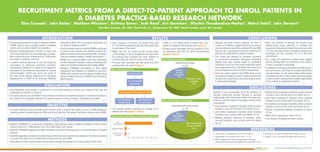
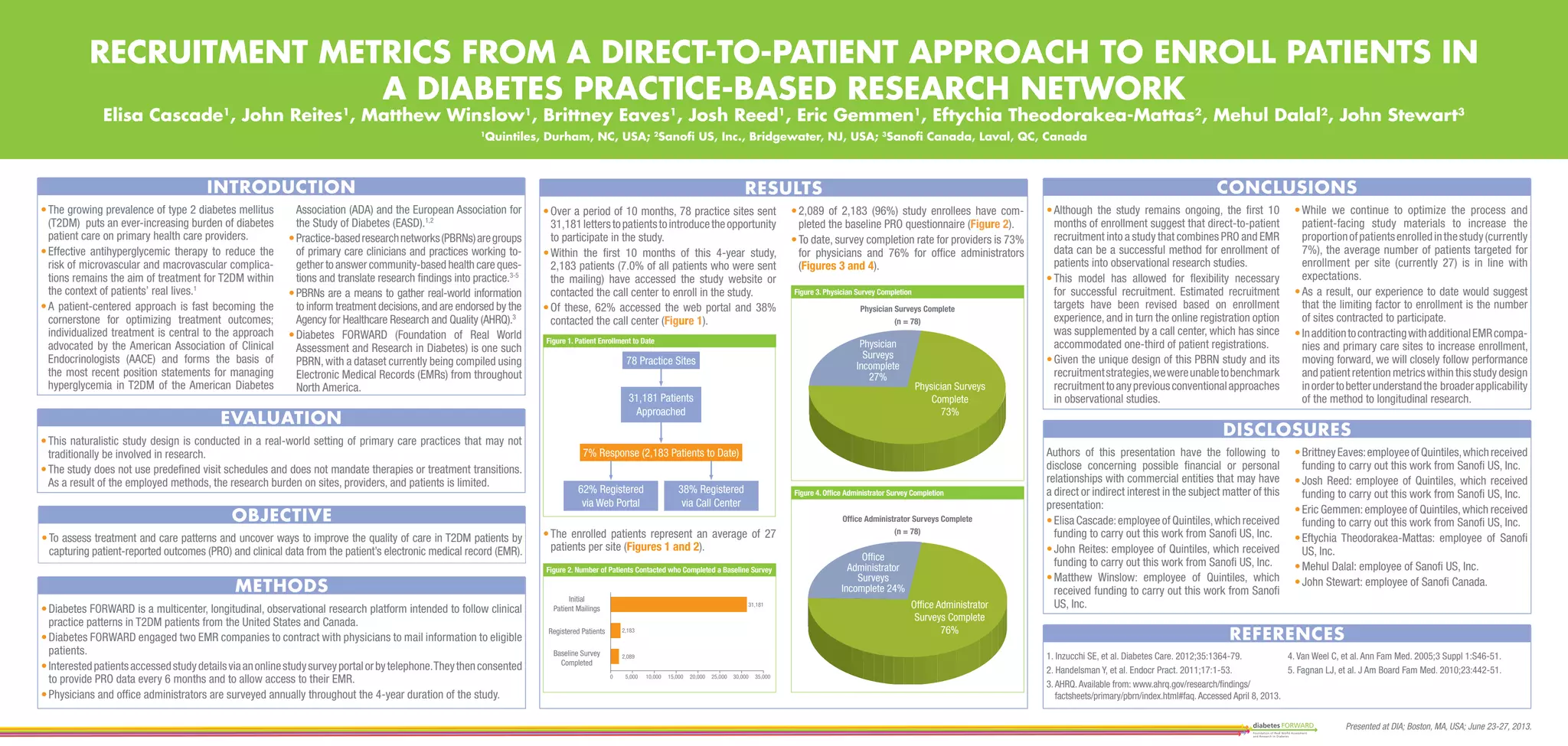
1) Researchers recruited patients into a diabetes practice-based research network using a direct-to-patient recruitment approach which involved mailing eligible patients and allowing them to enroll online or by phone. 2) Over 10 months, 78 practice sites mailed letters to 31,181 patients, resulting in 2,183 patients (7%) enrolling in the study by accessing the website or calling. 3) The enrolled patients represent an average of 27 patients per site. Baseline surveys were completed by 96% of enrolled patients. Physician and office administrator survey completion rates were 73% and 76% respectively.
More Related Content


Similar to Recruitment Metrics from a Direct-to-Patient Approach to Enroll Patients in a Diabetes Practice-based Research Network


![CASE_PRESENTATION_ON_subdural_hematoma(SDH)[1 FINAL PPT]-1.pptx](https://cdn.slidesharecdn.com/ss_thumbnails/casepresentationonsubduralhematomasdh1finalppt-1-260129172522-d405d375-thumbnail.jpg?width=640&height=640&fit=bounds)


Recruitment Metrics from a Direct-to-Patient Approach to Enroll Patients in a Diabetes Practice-based Research Network
- 1. Presented at DIA;Boston, MA, USA; June 23-27, 2013. Recruitment metrics from a direct-to-patient approach to enroll patients in a diabetes practice-based research network Elisa Cascade1 , John Reites1 , Matthew Winslow1 , Brittney Eaves1 , Josh Reed1 , Eric Gemmen1 , Eftychia Theodorakea-Mattas2 , Mehul Dalal2 , John Stewart3 1 Quintiles, Durham, NC, USA; 2 Sanofi US, Inc., Bridgewater, NJ, USA; 3 Sanofi Canada, Laval, QC, Canada INTRODUCTION • The growing prevalence of type 2 diabetes mellitus (T2DM) puts an ever-increasing burden of diabetes patient care on primary health care providers. • Effective antihyperglycemic therapy to reduce the risk of microvascular and macrovascular complica- tions remains the aim of treatment for T2DM within the context of patients’ real lives.1 • A patient-centered approach is fast becoming the cornerstone for optimizing treatment outcomes; individualized treatment is central to the approach advocated by the American Association of Clinical Endocrinologists (AACE) and forms the basis of the most recent position statements for managing hyperglycemia in T2DM of the American Diabetes Association (ADA) and the European Association for the Study of Diabetes (EASD).1,2 • Practice-basedresearchnetworks(PBRNs)aregroups of primary care clinicians and practices working to- gether to answer community-based health care ques- tions and translate research findings into practice.3-5 • PBRNs are a means to gather real-world information to inform treatment decisions,and are endorsed by the Agency for Healthcare Research and Quality (AHRQ).3 • Diabetes FORWARD (Foundation of Real World Assessment and Research in Diabetes) is one such PBRN, with a dataset currently being compiled using Electronic Medical Records (EMRs) from throughout North America. Evaluation • This naturalistic study design is conducted in a real-world setting of primary care practices that may not traditionally be involved in research. • The study does not use predefined visit schedules and does not mandate therapies or treatment transitions. As a result of the employed methods, the research burden on sites, providers, and patients is limited. Conclusions • Although the study remains ongoing, the first 10 months of enrollment suggest that direct-to-patient recruitment into a study that combines PRO and EMR data can be a successful method for enrollment of patients into observational research studies. • This model has allowed for flexibility necessary for successful recruitment. Estimated recruitment targets have been revised based on enrollment experience, and in turn the online registration option was supplemented by a call center, which has since accommodated one-third of patient registrations. • Given the unique design of this PBRN study and its recruitmentstrategies,wewereunabletobenchmark recruitmenttoanypreviousconventionalapproaches in observational studies. • While we continue to optimize the process and patient-facing study materials to increase the proportionofpatientsenrolledinthestudy(currently 7%), the average number of patients targeted for enrollment per site (currently 27) is in line with expectations. • As a result, our experience to date would suggest that the limiting factor to enrollment is the number of sites contracted to participate. • InadditiontocontractingwithadditionalEMRcompa- nies and primary care sites to increase enrollment, moving forward, we will closely follow performance and patient retention metrics within this study design inordertobetterunderstandthe broaderapplicability of the method to longitudinal research. Disclosures Authors of this presentation have the following to disclose concerning possible financial or personal relationships with commercial entities that may have a direct or indirect interest in the subject matter of this presentation: • Elisa Cascade:employee of Quintiles,which received funding to carry out this work from Sanofi US, Inc. • John Reites: employee of Quintiles, which received funding to carry out this work from Sanofi US, Inc. • Matthew Winslow: employee of Quintiles, which received funding to carry out this work from Sanofi US, Inc. • BrittneyEaves:employeeofQuintiles,whichreceived funding to carry out this work from Sanofi US, Inc. • Josh Reed: employee of Quintiles, which received funding to carry out this work from Sanofi US, Inc. • Eric Gemmen:employee of Quintiles,which received funding to carry out this work from Sanofi US, Inc. • Eftychia Theodorakea-Mattas: employee of Sanofi US, Inc. • Mehul Dalal: employee of Sanofi US, Inc. • John Stewart: employee of Sanofi Canada. References 1. Inzucchi SE, et al. Diabetes Care. 2012;35:1364-79. 2. Handelsman Y, et al. Endocr Pract. 2011;17:1-53. 3. AHRQ.Available from: www.ahrq.gov/research/findings/ factsheets/primary/pbrn/index.html#faq.Accessed April 8, 2013. 4. Van Weel C, et al. Ann Fam Med. 2005;3 Suppl 1:S46-51. 5. Fagnan LJ, et al. J Am Board Fam Med. 2010;23:442-51. Results • Over a period of 10 months, 78 practice sites sent 31,181letterstopatientstointroducetheopportunity to participate in the study. • Within the first 10 months of this 4-year study, 2,183 patients (7.0% of all patients who were sent the mailing) have accessed the study website or contacted the call center to enroll in the study. • Of these, 62% accessed the web portal and 38% contacted the call center (Figure 1). • The enrolled patients represent an average of 27 patients per site (Figures 1 and 2). • 2,089 of 2,183 (96%) study enrollees have com- pleted the baseline PRO questionnaire (Figure 2). • To date, survey completion rate for providers is 73% for physicians and 76% for office administrators (Figures 3 and 4). Objective • To assess treatment and care patterns and uncover ways to improve the quality of care in T2DM patients by capturing patient-reported outcomes (PRO) and clinical data from the patient’s electronic medical record (EMR). Methods • Diabetes FORWARD is a multicenter, longitudinal, observational research platform intended to follow clinical practice patterns in T2DM patients from the United States and Canada. • Diabetes FORWARD engaged two EMR companies to contract with physicians to mail information to eligible patients. • Interestedpatientsaccessedstudydetailsviaanonlinestudysurveyportalorbytelephone.Theythenconsented to provide PRO data every 6 months and to allow access to their EMR. • Physicians and office administrators are surveyed annually throughout the 4-year duration of the study. Figure 2. Number of Patients Contacted who Completed a Baseline Survey Initial Patient Mailings Registered Patients Baseline Survey Completed 0 5,000 10,000 15,000 20,000 25,000 30,000 35,000 31,181 2,183 2,089 Figure 3. Physician Survey Completion Physician Surveys Incomplete 27% Physician Surveys Complete 73% Physician Surveys Complete (n = 78) Figure 4. Office Administrator Survey Completion Office Administrator Surveys Complete (n = 78) Office Administrator Surveys Incomplete 24% Office Administrator Surveys Complete 76% Figure 1. Patient Enrollment to Date 7% Response (2,183 Patients to Date) 62% Registered via Web Portal 38% Registered via Call Center 78 Practice Sites 31,181 Patients Approached