THE ANTEPARTAL PERIODBY:Zosi Farah w. Fernandez, RN
Anatomy and PhysiologyUterusServes as an organ of implantation for the fertilized ovum that becomes the fetus
Responsible for expulsion of the fetus during childbirth from the strong muscle contractions as well as menstruation
Fundal height 	a. At the level of the sypmphysis at 12-14 weeks	b. Rises at 1 cm/week until 36 weeks of gestation	c. At the level of umbilicus at 20 weeks
b. CervixGoodell’s Sign
Chadwick’s signc. VaginaSlight acidic pH (4-5) to decrease risk of infections
Functions include out passage for menstrual flow from the endometrium of the uterus, the female organ for intercourse, and a passageway for vaginal childbirth
During pregnancy the mucosa of the vagina may have a bluish violet color, has increased vascularity, and increase vaginal mucus discharged. External structureExternal genitals organs, or vulva, include all the structure found externally between the pubis and the perineum
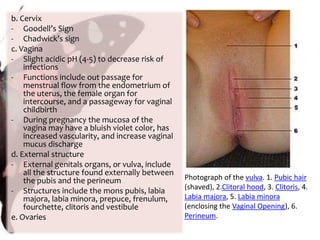
Structures include the mons pubis, labia majora, labia minora, prepuce, frenulum, fourchette, clitoris and vestibulee. OvariesPhotograph of the vulva. 1. Pubic hair (shaved), 2.Clitoral hood, 3. Clitoris, 4. Labia majora, 5. Labia minora (enclosing the Vaginal Opening), 6. Perineum.
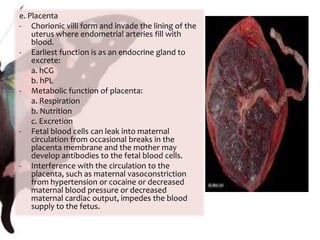
e. PlacentaChorionic villi form and invade the lining of the uterus where endometrial arteries fill with blood.
Earliest function is as an endocrine gland to excrete:	a. hCG	b. hPLMetabolic function of placenta:	a. Respiration	b. Nutrition	c. ExcretionFetal blood cells can leak into maternal circulation from occasional breaks in the placenta membrane and the mother may develop antibodies to the fetal blood cells.
Interference with the circulation to the placenta, such as maternal vasoconstriction from hypertension or cocaine or decreased maternal blood pressure or decreased maternal cardiac output, impedes the blood supply to the fetus.g. Membraneh. Umbilical cordTwo arteries
One vein
Wharton’s jelly
Usually located centrally as the placenta develops from the chorionic villiAmniotic fluidFunctions include fetal lung development, protection of the cord, and allows for normal limb development and development of GI and renal Systemj. Cardiovascular SystemVena caval syndrome
Blood volume increases 30-50% during pregnancyk. Gastrointestinal system- Constipation and gastroesophageal reflux
l. Urinary SystemSimilar relaxation of the urinary tract places the pregnant client at risk for UTI or pyelonephritis from bacteria ascending from perineumm. Endocrine systemPancreasThyroidPituitaryn. Respiratory systemIncreased BMR requires more oxygen for the pregnant body
Tidal volume and minute ventilation increase until the third trimester when the large uterus may impede lung expansion
CO2 output increases, resulting in slight respiratory alkalosiso. Hematologic systemRBC increased by one-third
Plasma volume increase is greater, resulting in physiologic anemia of pregnancy
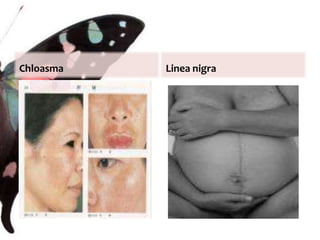
Clotting factors increase in pregnancy, which increase the client’s risk for blood clotsp. Breastq. SkinIncreased pigmentation
Chloasma
Linea nigra
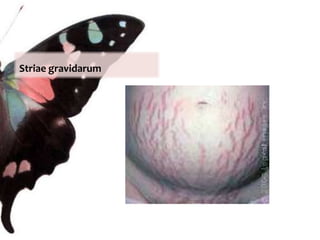
StriaegravidarumChloasmaLinea nigra
Striaegravidarum
r. Fetal developmentFertilizationImplantationPlacental developmentDevelopmental landmarks	a. Fetal heart tones	b. Quickening5. Infants at genetic risk of abnormalitiesa. African American:  sickle cell diseaseb. Jewish ethnicity of Northern European descent: Tay-sachs diseasec. Mediterranean: Thalassemiad. Family history of hereditary condition such as cystiic fibrosis or cleft lip palatee. Born to a woman of advanced maternal agef. Parents are closely related blood relatives
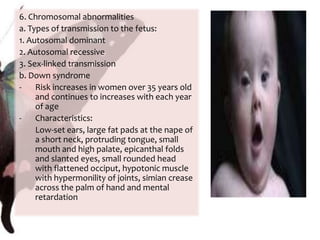
6. Chromosomal abnormalitiesa. Types of transmission to the fetus:1. Autosomal dominant2. Autosomal recessive3. Sex-linked transmissionb. Down syndromeRisk increases in women over 35 years old and continues to increases with each year of age
Characteristics:	Low-set ears, large fat pads at the nape of a short neck, protruding tongue, small mouth and high palate, epicanthal folds and slanted eyes, small rounded head with flattened occiput, hypotonic muscle with hypermonility of joints, simian crease across the palm of hand and mental retardation
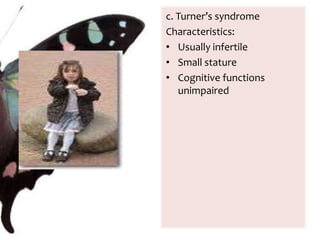
c. Turner’s syndromeCharacteristics:Usually infertile
Small stature
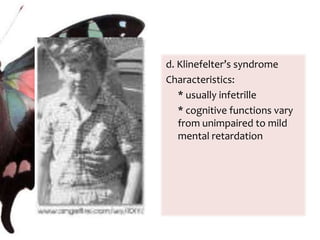
Cognitive functions unimpairedd. Klinefelter’s syndromeCharacteristics:	* usually infetrille	* cognitive functions vary from unimpaired to mild mental retardation
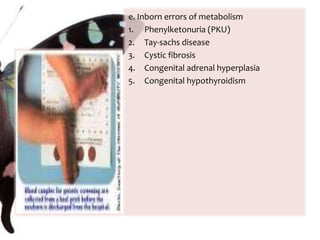
e. Inborn errors of metabolismPhenylketonuria (PKU)Tay-sachs diseaseCystic fibrosisCongenital adrenal hyperplasiaCongenital hypothyroidism
AssessmentPrenatal careAssessment of positive pregnancy
2. Naegele’s ruleTo determine the estimated date of confinement or estimated date of delivery, count back 3 months from the first day of the last menstrual cycle and then add1 year and 7 days3. Obstetrical classificationGrvidaPara or parityG-T-P-A-L4. Frequency and elements of maternal and fetal assessmentInitial visita.1 Intake assessmenta.2 Lab evaluationa.3 Client educationb. Period specific evaluation in pregnancyb.1 Every 4 weeks until 28 weeks AOGb.2 5-20 weeks of gestation:Maternal alpha-feto protein, begin preterm birth prevention education and review warning signsb.3 20-24 weeks of gestation:Preterm prevention education
b.4 24-28 weeks of gestation:1 hour glucose tolerance test, cervical exam, begin education and treatment if diabetic, and review preterm birth prevention and warning signsb.5 every 2 weeks from 28 to 36 weeks of gestationb.6 28-36 weeks of gestation:CBC, blood group antibody screen if Rh negative, give Rh immune globulin; cervical examination, follow up with a dietician if diabetic, breast assessment and education preparation for breastfeeding, review of warning sign, and begin parenting classb.7 35-37 weeks of gestation:Vaginal and rectal group B beta strep cultureb.8 weekly visits from 36 weeks of gestation until deliveryb.9 36-40 weeks of gestation:CBC, repeat gonorrhea, chlamydia, RPR,HIV, hepatitis B screen if indicated, educate about sign of labor and begin childbirth preparation
Assessment of psychosocial aspect of pregnancyEconomic statusMarital statusAgePerceived supportSelf-esteemCultureReligion and importance of faith beliefsStability of living conditionAssess mood	i.1 ambivalence	i.2 Increased sensitivity and irritability	i.3 sense of vulnerability	i.4 fear
j. Assess developmental task of pregnancy	1. Pregnancy validation	2. Fetal embodiment	3. Fetal distinction	4. role transition
B. Assessment of High-Risk PregnancyHealth historySocial historyProblems with pregnancyPhysical examInspectionAuscultationPalpitationVital signs
Diagnostic Studiesa. Sterile Speculum ExamIndicated for suspected ruptured membranes
Amniotic fluid will turn Nitrazine paper blue because of the alkaline pH
Free flow of fluid may be seen coming through the cervix when the clients is asked to cough or perform a valsalva maneuverPreprocedure:Client is assisted into the lithotomy positionGather supplies
b. Urinalysis with reagent stripsUrine is tested with a reagent strip to test for the presence of components in the urine such as WBC, blood, protein, bilirubin, leukocytes, ketones, glucose, specific gravity, pH, urobilinogen and nitrite.PreprocedureInstruct the client not to discard urinePostprocedureCompare the result with the legend on the side of the bottle to determine normal or abnormal findingsDiscard the urine and record the resultc. 24 hour UrineThe clients total urine output for 24 hours is collected and analyzed for amount, specific gravity, pH, presence and amount of protein and creatinine clearance.PreprocedureInstruct the client not to discard any urine for 24 hoursObtain specimen on ice for the duration of the testHave the client empty the bladder and record the start timePost sign in the bathroom to remind the client, family, and all staff that the test is in progress
Postprocedure:Send the entire specimen to the labRecord the end timed. Urinalysis and cultureThey are useful in determining the presence of a UTI, which during pregnancy can result in preterm laborPreprocedureObtain the specimen as orderedLable the specimen and send it to the labe. Laboratory Serum EvaluationCBCMetabolic panelLiver proofileD-dimer and fibrinogenKleinhauer-BetkeC-reactive protein (CRP)Beta hCGMaternal serum alpha-fetoprotein (AFP or MS-AFP)OB panelTORCH
f. Fetal FibronectinA protein found in amniotic fluid, the placental tissue itself and following injury to membranes-either mechanical or inflammatory
Used to gauge the risk of preterm birth for client hospitalized with PTLPreprocedure:1. Assist the client in assuming the lithotomy position 2. Gather the equipmentsg. Oral glucose tolerance test (OGTT or GTT)Blood glucose greater than or equal to 140 indicates an abnormal screen, and the 3 hour GTT is indicated
3-hour GTT: 100 grams of glucose is given to the client to drink in a liquid form in 5 minutes; fasting is now required for 12 hours before the test as well as for 3 hours after, serum glucose levels are evaluated at 1,2, and 3 hours after drinking the glucose solutionPreprocedure:Obtain the glucose solution and arrange for the blood draw on schedule
h. Daily Fetal Movement countAdvised to do daily or twice daily in high-risk client
Counting 10 movements in 1hour is reassuring kick counti. Electronic fetal monitoring (EFM)j. UltrasoundUltrasound scanning can be either transvaginally or transabdominally
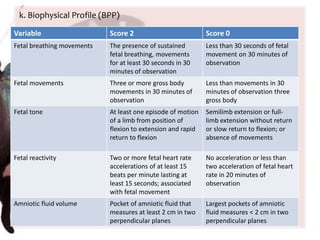
Indication for antepartum care include estimation of fetal age, fetal weight and fetal presentation, placenta position and integrity, or a follow-up of fetal anomalies or well beingk. Biophysical Profile (BPP)
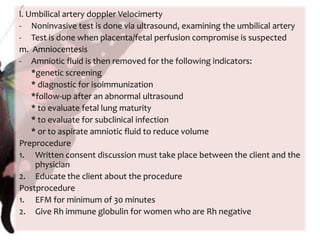
l. Umbilical artery dopplerVelocimertyNoninvasive test is done via ultrasound, examining the umbilical artery
Test is done when placenta/fetal perfusion compromise is suspectedm.  AmniocentesisAmniotic fluid is then removed for the following indicators:	*genetic screening	* diagnostic for isoimmunization	*follow-up after an abnormal ultrasound	* to evaluate fetal lung maturity	* to evaluate for subclinical infection	* or to aspirate amniotic fluid to reduce volumePreprocedureWritten consent discussion must take place between the client and the physicianEducate the client about the procedurePostprocedureEFM for minimum of 30 minutesGive Rh immune globulin for women who are Rh negative
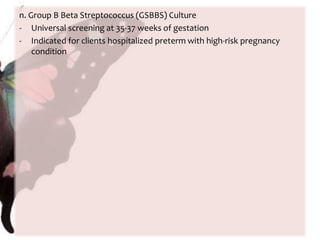
n. Group B Beta Streptococcus (GSBBS) Culture Universal screening at 35-37 weeks of gestation

The Antepartal Period

  • 1.
    THE ANTEPARTAL PERIODBY:ZosiFarah w. Fernandez, RN
  • 2.
    Anatomy and PhysiologyUterusServesas an organ of implantation for the fertilized ovum that becomes the fetus
  • 3.
    Responsible for expulsionof the fetus during childbirth from the strong muscle contractions as well as menstruation
  • 4.
    Fundal height a.At the level of the sypmphysis at 12-14 weeks b. Rises at 1 cm/week until 36 weeks of gestation c. At the level of umbilicus at 20 weeks
  • 5.
  • 6.
    Chadwick’s signc. VaginaSlightacidic pH (4-5) to decrease risk of infections
  • 7.
    Functions include outpassage for menstrual flow from the endometrium of the uterus, the female organ for intercourse, and a passageway for vaginal childbirth
  • 8.
    During pregnancy themucosa of the vagina may have a bluish violet color, has increased vascularity, and increase vaginal mucus discharged. External structureExternal genitals organs, or vulva, include all the structure found externally between the pubis and the perineum
  • 9.
    Structures include themons pubis, labia majora, labia minora, prepuce, frenulum, fourchette, clitoris and vestibulee. OvariesPhotograph of the vulva. 1. Pubic hair (shaved), 2.Clitoral hood, 3. Clitoris, 4. Labia majora, 5. Labia minora (enclosing the Vaginal Opening), 6. Perineum.
  • 10.
    e. PlacentaChorionic villiform and invade the lining of the uterus where endometrial arteries fill with blood.
  • 11.
    Earliest function isas an endocrine gland to excrete: a. hCG b. hPLMetabolic function of placenta: a. Respiration b. Nutrition c. ExcretionFetal blood cells can leak into maternal circulation from occasional breaks in the placenta membrane and the mother may develop antibodies to the fetal blood cells.
  • 12.
    Interference with thecirculation to the placenta, such as maternal vasoconstriction from hypertension or cocaine or decreased maternal blood pressure or decreased maternal cardiac output, impedes the blood supply to the fetus.g. Membraneh. Umbilical cordTwo arteries
  • 13.
  • 14.
  • 15.
    Usually located centrallyas the placenta develops from the chorionic villiAmniotic fluidFunctions include fetal lung development, protection of the cord, and allows for normal limb development and development of GI and renal Systemj. Cardiovascular SystemVena caval syndrome
  • 16.
    Blood volume increases30-50% during pregnancyk. Gastrointestinal system- Constipation and gastroesophageal reflux
  • 17.
    l. Urinary SystemSimilarrelaxation of the urinary tract places the pregnant client at risk for UTI or pyelonephritis from bacteria ascending from perineumm. Endocrine systemPancreasThyroidPituitaryn. Respiratory systemIncreased BMR requires more oxygen for the pregnant body
  • 18.
    Tidal volume andminute ventilation increase until the third trimester when the large uterus may impede lung expansion
  • 19.
    CO2 output increases,resulting in slight respiratory alkalosiso. Hematologic systemRBC increased by one-third
  • 20.
    Plasma volume increaseis greater, resulting in physiologic anemia of pregnancy
  • 21.
    Clotting factors increasein pregnancy, which increase the client’s risk for blood clotsp. Breastq. SkinIncreased pigmentation
  • 22.
  • 23.
  • 24.
  • 25.
  • 26.
    r. Fetal developmentFertilizationImplantationPlacentaldevelopmentDevelopmental landmarks a. Fetal heart tones b. Quickening5. Infants at genetic risk of abnormalitiesa. African American: sickle cell diseaseb. Jewish ethnicity of Northern European descent: Tay-sachs diseasec. Mediterranean: Thalassemiad. Family history of hereditary condition such as cystiic fibrosis or cleft lip palatee. Born to a woman of advanced maternal agef. Parents are closely related blood relatives
  • 27.
    6. Chromosomal abnormalitiesa.Types of transmission to the fetus:1. Autosomal dominant2. Autosomal recessive3. Sex-linked transmissionb. Down syndromeRisk increases in women over 35 years old and continues to increases with each year of age
  • 28.
    Characteristics: Low-set ears, largefat pads at the nape of a short neck, protruding tongue, small mouth and high palate, epicanthal folds and slanted eyes, small rounded head with flattened occiput, hypotonic muscle with hypermonility of joints, simian crease across the palm of hand and mental retardation
  • 29.
  • 30.
  • 31.
    Cognitive functions unimpairedd.Klinefelter’s syndromeCharacteristics: * usually infetrille * cognitive functions vary from unimpaired to mild mental retardation
  • 32.
    e. Inborn errorsof metabolismPhenylketonuria (PKU)Tay-sachs diseaseCystic fibrosisCongenital adrenal hyperplasiaCongenital hypothyroidism
  • 33.
  • 34.
    2. Naegele’s ruleTodetermine the estimated date of confinement or estimated date of delivery, count back 3 months from the first day of the last menstrual cycle and then add1 year and 7 days3. Obstetrical classificationGrvidaPara or parityG-T-P-A-L4. Frequency and elements of maternal and fetal assessmentInitial visita.1 Intake assessmenta.2 Lab evaluationa.3 Client educationb. Period specific evaluation in pregnancyb.1 Every 4 weeks until 28 weeks AOGb.2 5-20 weeks of gestation:Maternal alpha-feto protein, begin preterm birth prevention education and review warning signsb.3 20-24 weeks of gestation:Preterm prevention education
  • 35.
    b.4 24-28 weeksof gestation:1 hour glucose tolerance test, cervical exam, begin education and treatment if diabetic, and review preterm birth prevention and warning signsb.5 every 2 weeks from 28 to 36 weeks of gestationb.6 28-36 weeks of gestation:CBC, blood group antibody screen if Rh negative, give Rh immune globulin; cervical examination, follow up with a dietician if diabetic, breast assessment and education preparation for breastfeeding, review of warning sign, and begin parenting classb.7 35-37 weeks of gestation:Vaginal and rectal group B beta strep cultureb.8 weekly visits from 36 weeks of gestation until deliveryb.9 36-40 weeks of gestation:CBC, repeat gonorrhea, chlamydia, RPR,HIV, hepatitis B screen if indicated, educate about sign of labor and begin childbirth preparation
  • 36.
    Assessment of psychosocialaspect of pregnancyEconomic statusMarital statusAgePerceived supportSelf-esteemCultureReligion and importance of faith beliefsStability of living conditionAssess mood i.1 ambivalence i.2 Increased sensitivity and irritability i.3 sense of vulnerability i.4 fear
  • 37.
    j. Assess developmentaltask of pregnancy 1. Pregnancy validation 2. Fetal embodiment 3. Fetal distinction 4. role transition
  • 38.
    B. Assessment ofHigh-Risk PregnancyHealth historySocial historyProblems with pregnancyPhysical examInspectionAuscultationPalpitationVital signs
  • 39.
    Diagnostic Studiesa. SterileSpeculum ExamIndicated for suspected ruptured membranes
  • 40.
    Amniotic fluid willturn Nitrazine paper blue because of the alkaline pH
  • 41.
    Free flow offluid may be seen coming through the cervix when the clients is asked to cough or perform a valsalva maneuverPreprocedure:Client is assisted into the lithotomy positionGather supplies
  • 42.
    b. Urinalysis withreagent stripsUrine is tested with a reagent strip to test for the presence of components in the urine such as WBC, blood, protein, bilirubin, leukocytes, ketones, glucose, specific gravity, pH, urobilinogen and nitrite.PreprocedureInstruct the client not to discard urinePostprocedureCompare the result with the legend on the side of the bottle to determine normal or abnormal findingsDiscard the urine and record the resultc. 24 hour UrineThe clients total urine output for 24 hours is collected and analyzed for amount, specific gravity, pH, presence and amount of protein and creatinine clearance.PreprocedureInstruct the client not to discard any urine for 24 hoursObtain specimen on ice for the duration of the testHave the client empty the bladder and record the start timePost sign in the bathroom to remind the client, family, and all staff that the test is in progress
  • 43.
    Postprocedure:Send the entirespecimen to the labRecord the end timed. Urinalysis and cultureThey are useful in determining the presence of a UTI, which during pregnancy can result in preterm laborPreprocedureObtain the specimen as orderedLable the specimen and send it to the labe. Laboratory Serum EvaluationCBCMetabolic panelLiver proofileD-dimer and fibrinogenKleinhauer-BetkeC-reactive protein (CRP)Beta hCGMaternal serum alpha-fetoprotein (AFP or MS-AFP)OB panelTORCH
  • 44.
    f. Fetal FibronectinAprotein found in amniotic fluid, the placental tissue itself and following injury to membranes-either mechanical or inflammatory
  • 45.
    Used to gaugethe risk of preterm birth for client hospitalized with PTLPreprocedure:1. Assist the client in assuming the lithotomy position 2. Gather the equipmentsg. Oral glucose tolerance test (OGTT or GTT)Blood glucose greater than or equal to 140 indicates an abnormal screen, and the 3 hour GTT is indicated
  • 46.
    3-hour GTT: 100grams of glucose is given to the client to drink in a liquid form in 5 minutes; fasting is now required for 12 hours before the test as well as for 3 hours after, serum glucose levels are evaluated at 1,2, and 3 hours after drinking the glucose solutionPreprocedure:Obtain the glucose solution and arrange for the blood draw on schedule
  • 47.
    h. Daily FetalMovement countAdvised to do daily or twice daily in high-risk client
  • 48.
    Counting 10 movementsin 1hour is reassuring kick counti. Electronic fetal monitoring (EFM)j. UltrasoundUltrasound scanning can be either transvaginally or transabdominally
  • 49.
    Indication for antepartumcare include estimation of fetal age, fetal weight and fetal presentation, placenta position and integrity, or a follow-up of fetal anomalies or well beingk. Biophysical Profile (BPP)
  • 50.
    l. Umbilical arterydopplerVelocimertyNoninvasive test is done via ultrasound, examining the umbilical artery
  • 51.
    Test is donewhen placenta/fetal perfusion compromise is suspectedm. AmniocentesisAmniotic fluid is then removed for the following indicators: *genetic screening * diagnostic for isoimmunization *follow-up after an abnormal ultrasound * to evaluate fetal lung maturity * to evaluate for subclinical infection * or to aspirate amniotic fluid to reduce volumePreprocedureWritten consent discussion must take place between the client and the physicianEducate the client about the procedurePostprocedureEFM for minimum of 30 minutesGive Rh immune globulin for women who are Rh negative
  • 52.
    n. Group BBeta Streptococcus (GSBBS) Culture Universal screening at 35-37 weeks of gestation