SnT – Interdisciplinary Centre for Security, Reliability and Trust
University of Luxembourg
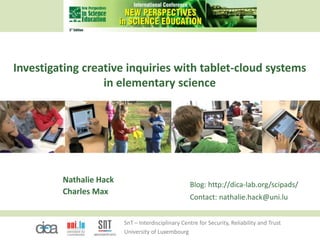
Investigating creative inquiries with tablet-cloud systems
in elementary science
Nathalie Hack
Charles Max
Blog: http://dica-lab.org/scipads/
Contact: nathalie.hack@uni.lu
SnT – Interdisciplinary Centre for Security, Reliability and Trust
University of Luxembourg
“Inquiry-based learning is a process where students
- are involved in their learning,
- formulate questions,
- investigate widely
- and then build new understandings, meanings and knowledge.
That knowledge is new to the students and may be used to answer a
question, to develop a solution or to support a position or point of view.
The knowledge is usually presented to others and may result in some sort of
action.” (Alberta, 2004, p. 1)*
*Alberta. Alberta Learning. (2004). Focus on Inquiry. A Teacher’s Guide to Implementing Inquiry-based Learning.
Retrieved from http://education.alberta.ca/media/313361/focusoninquiry.pdf
Inquiry-based science learning
SnT – Interdisciplinary Centre for Security, Reliability and Trust
University of Luxembourg
“General inquiry abilities include:
• posing and refining research questions,
• planning and managing an investigation,
• analyzing and communicating results.
Inquiry activities provide the opportunity to develop and exercise these
general inquiry abilities.” (Edelson, Gordon & Pea, 1999, p. 393)*
*Edelson, D.C., Gordin, D.N., Pea, R.D. (1999). Addressing the Challenges of Inquiry-Based Learning through
Technology and Curriculum Design. Journal of the Learning Sciences 8, 391-450
Inquiry-based science learning
SnT – Interdisciplinary Centre for Security, Reliability and Trust
University of Luxembourg
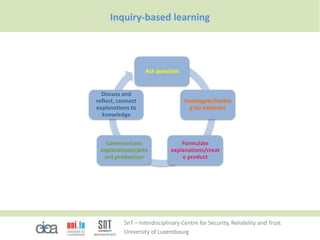
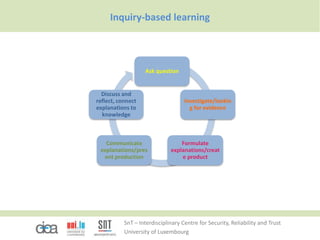
Ask question
Investigate/lookin
g for evidence
Formulate
explanations/creat
e product
Communicate
explanations/pres
ent production
Discuss and
reflect, connect
explanations to
knowledge
Inquiry-based learning
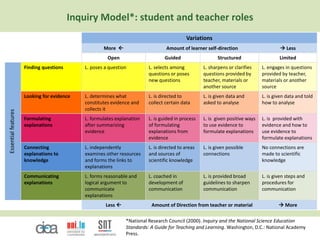
Variations
More  Amount of learner self-direction  Less
Open Guided Structured Limited
Essentialfeatures
Finding questions L. poses a question L. selects among
questions or poses
new questions
L. sharpens or clarifies
questions provided by
teacher, materials or
another source
L. engages in questions
provided by teacher,
materials or another
source
Looking for evidence L. determines what
constitutes evidence and
collects it
L. is directed to
collect certain data
L. is given data and
asked to analyse
L. is given data and told
how to analyse
Formulating
explanations
L. formulates explanation
after summarizing
evidence
L. is guided in process
of formulating
explanations from
evidence
L. is given positive ways
to use evidence to
formulate explanations
L. is provided with
evidence and how to
use evidence to
formulate explanations
Connecting
explanations to
knowledge
L. independently
examines other resources
and forms the links to
explanations
L. is directed to areas
and sources of
scientific knowledge
L. is given possible
connections
No connections are
made to scientific
knowledge
Communicating
explanations
L. forms reasonable and
logical argument to
communicate
explanations
L. coached in
development of
communication
L. is provided broad
guidelines to sharpen
communication
L. is given steps and
procedures for
communication
Less  Amount of Direction from teacher or material  More
Inquiry Model*: student and teacher roles
*National Research Council (2000). Inquiry and the National Science Education
Standards: A Guide for Teaching and Learning. Washington, D.C.: National Academy
Press.
SnT – Interdisciplinary Centre for Security, Reliability and Trust
University of Luxembourg
Overview of science activity 1
Science activity 1: dangers of the electric circuit
- 18 children aged between 10 and 11 years
- Groups of 2 children
- 10 tablets
- Classroom activity realized in 1 day (2 school lessons)
- Goal: find out the dangers of the electric circuit
SnT – Interdisciplinary Centre for Security, Reliability and Trust
University of Luxembourg
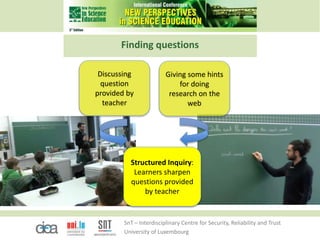
Discussing
question
provided by
teacher
Giving some hints
for doing
research on the
web
Structured Inquiry:
Learners sharpen
questions provided
by teacher
Finding questions
SnT – Interdisciplinary Centre for Security, Reliability and Trust
University of Luxembourg
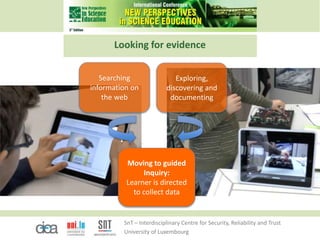
Looking for evidence
Moving to guided
Inquiry:
Learner is directed
to collect data
Searching
information on
the web
Exploring,
discovering and
documenting
SnT – Interdisciplinary Centre for Security, Reliability and Trust
University of Luxembourg
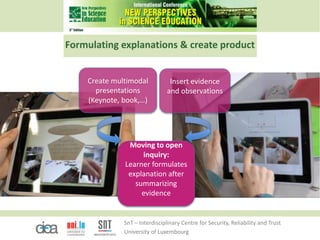
Formulating explanations & create product
Create multimodal
presentations
(Keynote, book,…)
Moving to open
inquiry:
Learner formulates
explanation after
summarizing
evidence
Insert evidence
and observations
SnT – Interdisciplinary Centre for Security, Reliability and Trust
University of Luxembourg
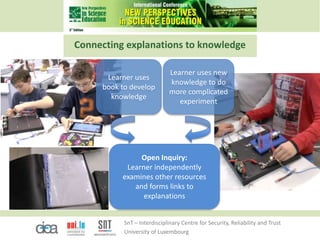
Connecting explanations to knowledge
Learner uses
book to develop
knowledge
Learner uses new
knowledge to do
more complicated
experiment
Open Inquiry:
Learner independently
examines other resources
and forms links to
explanations
SnT – Interdisciplinary Centre for Security, Reliability and Trust
University of Luxembourg
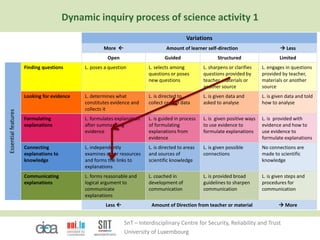
Variations
More  Amount of learner self-direction  Less
Open Guided Structured Limited
Essentialfeatures
Finding questions L. poses a question L. selects among
questions or poses
new questions
L. sharpens or clarifies
questions provided by
teacher, materials or
another source
L. engages in questions
provided by teacher,
materials or another
source
Looking for evidence L. determines what
constitutes evidence and
collects it
L. is directed to
collect certain data
L. is given data and
asked to analyse
L. is given data and told
how to analyse
Formulating
explanations
L. formulates explanation
after summarizing
evidence
L. is guided in process
of formulating
explanations from
evidence
L. is given positive ways
to use evidence to
formulate explanations
L. is provided with
evidence and how to
use evidence to
formulate explanations
Connecting
explanations to
knowledge
L. independently
examines other resources
and forms the links to
explanations
L. is directed to areas
and sources of
scientific knowledge
L. is given possible
connections
No connections are
made to scientific
knowledge
Communicating
explanations
L. forms reasonable and
logical argument to
communicate
explanations
L. coached in
development of
communication
L. is provided broad
guidelines to sharpen
communication
L. is given steps and
procedures for
communication
Less  Amount of Direction from teacher or material  More
Dynamic inquiry process of science activity 1
SnT – Interdisciplinary Centre for Security, Reliability and Trust
University of Luxembourg
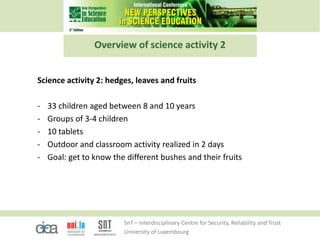
Overview of science activity 2
Science activity 2: hedges, leaves and fruits
- 33 children aged between 8 and 10 years
- Groups of 3-4 children
- 10 tablets
- Outdoor and classroom activity realized in 2 days
- Goal: get to know the different bushes and their fruits
SnT – Interdisciplinary Centre for Security, Reliability and Trust
University of Luxembourg
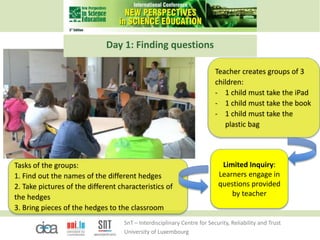
Tasks of the groups:
1. Find out the names of the different hedges
2. Take pictures of the different characteristics of
the hedges
3. Bring pieces of the hedges to the classroom
Teacher creates groups of 3
children:
- 1 child must take the iPad
- 1 child must take the book
- 1 child must take the
plastic bag
Limited Inquiry:
Learners engage in
questions provided
by teacher
Day 1: Finding questions
SnT – Interdisciplinary Centre for Security, Reliability and Trust
University of Luxembourg
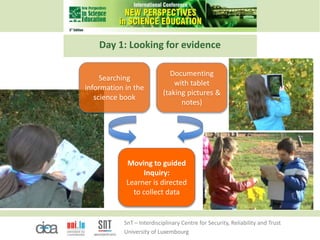
Day 1: Looking for evidence
Moving to guided
Inquiry:
Learner is directed
to collect data
Searching
information in the
science book
Documenting
with tablet
(taking pictures &
notes)
SnT – Interdisciplinary Centre for Security, Reliability and Trust
University of Luxembourg
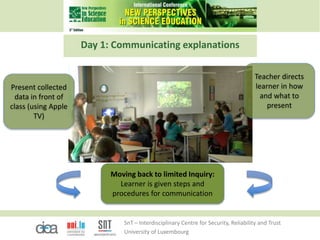
Present collected
data in front of
class (using Apple
TV)
Teacher directs
learner in how
and what to
present
Moving back to limited Inquiry:
Learner is given steps and
procedures for communication
Day 1: Communicating explanations
SnT – Interdisciplinary Centre for Security, Reliability and Trust
University of Luxembourg
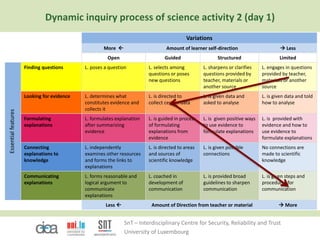
Variations
More  Amount of learner self-direction  Less
Open Guided Structured Limited
Essentialfeatures
Finding questions L. poses a question L. selects among
questions or poses
new questions
L. sharpens or clarifies
questions provided by
teacher, materials or
another source
L. engages in questions
provided by teacher,
materials or another
source
Looking for evidence L. determines what
constitutes evidence and
collects it
L. is directed to
collect certain data
L. is given data and
asked to analyse
L. is given data and told
how to analyse
Formulating
explanations
L. formulates explanation
after summarizing
evidence
L. is guided in process
of formulating
explanations from
evidence
L. is given positive ways
to use evidence to
formulate explanations
L. is provided with
evidence and how to
use evidence to
formulate explanations
Connecting
explanations to
knowledge
L. independently
examines other resources
and forms the links to
explanations
L. is directed to areas
and sources of
scientific knowledge
L. is given possible
connections
No connections are
made to scientific
knowledge
Communicating
explanations
L. forms reasonable and
logical argument to
communicate
explanations
L. coached in
development of
communication
L. is provided broad
guidelines to sharpen
communication
L. is given steps and
procedures for
communication
Less  Amount of Direction from teacher or material  More
Dynamic inquiry process of science activity 2 (day 1)
SnT – Interdisciplinary Centre for Security, Reliability and Trust
University of Luxembourg
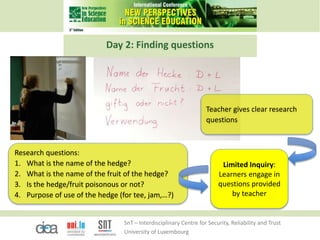
Research questions:
1. What is the name of the hedge?
2. What is the name of the fruit of the hedge?
3. Is the hedge/fruit poisonous or not?
4. Purpose of use of the hedge (for tee, jam,…?)
Teacher gives clear research
questions
Limited Inquiry:
Learners engage in
questions provided
by teacher
Day 2: Finding questions
SnT – Interdisciplinary Centre for Security, Reliability and Trust
University of Luxembourg
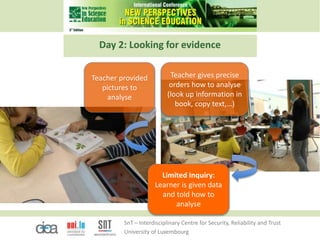
Day 2: Looking for evidence
Limited Inquiry:
Learner is given data
and told how to
analyse
Teacher provided
pictures to
analyse
Teacher gives precise
orders how to analyse
(look up information in
book, copy text,…)
SnT – Interdisciplinary Centre for Security, Reliability and Trust
University of Luxembourg
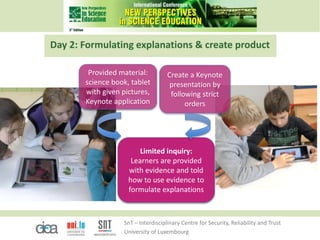
Day 2: Formulating explanations & create product
Provided material:
science book, tablet
with given pictures,
Keynote application
Limited inquiry:
Learners are provided
with evidence and told
how to use evidence to
formulate explanations
Create a Keynote
presentation by
following strict
orders
SnT – Interdisciplinary Centre for Security, Reliability and Trust
University of Luxembourg
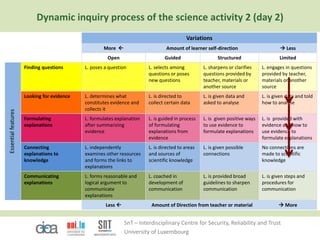
Variations
More  Amount of learner self-direction  Less
Open Guided Structured Limited
Essentialfeatures
Finding questions L. poses a question L. selects among
questions or poses
new questions
L. sharpens or clarifies
questions provided by
teacher, materials or
another source
L. engages in questions
provided by teacher,
materials or another
source
Looking for evidence L. determines what
constitutes evidence and
collects it
L. is directed to
collect certain data
L. is given data and
asked to analyse
L. is given data and told
how to analyse
Formulating
explanations
L. formulates explanation
after summarizing
evidence
L. is guided in process
of formulating
explanations from
evidence
L. is given positive ways
to use evidence to
formulate explanations
L. is provided with
evidence and how to
use evidence to
formulate explanations
Connecting
explanations to
knowledge
L. independently
examines other resources
and forms the links to
explanations
L. is directed to areas
and sources of
scientific knowledge
L. is given possible
connections
No connections are
made to scientific
knowledge
Communicating
explanations
L. forms reasonable and
logical argument to
communicate
explanations
L. coached in
development of
communication
L. is provided broad
guidelines to sharpen
communication
L. is given steps and
procedures for
communication
Less  Amount of Direction from teacher or material  More
Dynamic inquiry process of the science activity 2 (day 2)
SnT – Interdisciplinary Centre for Security, Reliability and Trust
University of Luxembourg
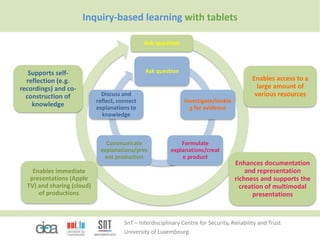
Ask question
Investigate/lookin
g for evidence
Formulate
explanations/creat
e product
Communicate
explanations/pres
ent production
Discuss and
reflect, connect
explanations to
knowledge
Inquiry-based learning
Ask question
Enables access to a
large amount of
various resources
Enhances documentation
and representation
richness and supports the
creation of multimodal
presentations
Enables immediate
presentations (Apple
TV) and sharing (cloud)
of productions
Supports self-
reflection (e.g.
recordings) and co-
construction of
knowledge
SnT – Interdisciplinary Centre for Security, Reliability and Trust
University of Luxembourg
Ask question
Investigate/lookin
g for evidence
Formulate
explanations/creat
e product
Communicate
explanations/pres
ent production
Discuss and
reflect, connect
explanations to
knowledge
Inquiry-based learning with tablets
SnT – Interdisciplinary Centre for Security, Reliability and Trust
University of Luxembourg
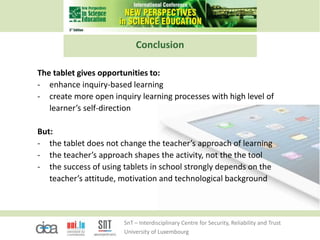
Conclusion
The tablet gives opportunities to:
- enhance inquiry-based learning
- create more open inquiry learning processes with high level of
learner’s self-direction
But:
- the tablet does not change the teacher’s approach of learning
- the teacher’s approach shapes the activity, not the the tool
- the success of using tablets in school strongly depends on the
teacher’s attitude, motivation and technological background
SnT – Interdisciplinary Centre for Security, Reliability and Trust
University of Luxembourg
Thank you for your attention!
Nathalie Hack
Charles Max
More info:
Blog: http://dica-lab.org/scipads/
Contact: nathalie.hack@uni.lu

sciPADS presentation @ NPSE conference 2014 in Florence, Italy

  • 1.
    SnT – InterdisciplinaryCentre for Security, Reliability and Trust University of Luxembourg Investigating creative inquiries with tablet-cloud systems in elementary science Nathalie Hack Charles Max Blog: http://dica-lab.org/scipads/ Contact: nathalie.hack@uni.lu
  • 2.
    SnT – InterdisciplinaryCentre for Security, Reliability and Trust University of Luxembourg “Inquiry-based learning is a process where students - are involved in their learning, - formulate questions, - investigate widely - and then build new understandings, meanings and knowledge. That knowledge is new to the students and may be used to answer a question, to develop a solution or to support a position or point of view. The knowledge is usually presented to others and may result in some sort of action.” (Alberta, 2004, p. 1)* *Alberta. Alberta Learning. (2004). Focus on Inquiry. A Teacher’s Guide to Implementing Inquiry-based Learning. Retrieved from http://education.alberta.ca/media/313361/focusoninquiry.pdf Inquiry-based science learning
  • 3.
    SnT – InterdisciplinaryCentre for Security, Reliability and Trust University of Luxembourg “General inquiry abilities include: • posing and refining research questions, • planning and managing an investigation, • analyzing and communicating results. Inquiry activities provide the opportunity to develop and exercise these general inquiry abilities.” (Edelson, Gordon & Pea, 1999, p. 393)* *Edelson, D.C., Gordin, D.N., Pea, R.D. (1999). Addressing the Challenges of Inquiry-Based Learning through Technology and Curriculum Design. Journal of the Learning Sciences 8, 391-450 Inquiry-based science learning
  • 4.
    SnT – InterdisciplinaryCentre for Security, Reliability and Trust University of Luxembourg Ask question Investigate/lookin g for evidence Formulate explanations/creat e product Communicate explanations/pres ent production Discuss and reflect, connect explanations to knowledge Inquiry-based learning
  • 5.
    Variations More  Amountof learner self-direction  Less Open Guided Structured Limited Essentialfeatures Finding questions L. poses a question L. selects among questions or poses new questions L. sharpens or clarifies questions provided by teacher, materials or another source L. engages in questions provided by teacher, materials or another source Looking for evidence L. determines what constitutes evidence and collects it L. is directed to collect certain data L. is given data and asked to analyse L. is given data and told how to analyse Formulating explanations L. formulates explanation after summarizing evidence L. is guided in process of formulating explanations from evidence L. is given positive ways to use evidence to formulate explanations L. is provided with evidence and how to use evidence to formulate explanations Connecting explanations to knowledge L. independently examines other resources and forms the links to explanations L. is directed to areas and sources of scientific knowledge L. is given possible connections No connections are made to scientific knowledge Communicating explanations L. forms reasonable and logical argument to communicate explanations L. coached in development of communication L. is provided broad guidelines to sharpen communication L. is given steps and procedures for communication Less  Amount of Direction from teacher or material  More Inquiry Model*: student and teacher roles *National Research Council (2000). Inquiry and the National Science Education Standards: A Guide for Teaching and Learning. Washington, D.C.: National Academy Press.
  • 6.
    SnT – InterdisciplinaryCentre for Security, Reliability and Trust University of Luxembourg Overview of science activity 1 Science activity 1: dangers of the electric circuit - 18 children aged between 10 and 11 years - Groups of 2 children - 10 tablets - Classroom activity realized in 1 day (2 school lessons) - Goal: find out the dangers of the electric circuit
  • 7.
    SnT – InterdisciplinaryCentre for Security, Reliability and Trust University of Luxembourg Discussing question provided by teacher Giving some hints for doing research on the web Structured Inquiry: Learners sharpen questions provided by teacher Finding questions
  • 8.
    SnT – InterdisciplinaryCentre for Security, Reliability and Trust University of Luxembourg Looking for evidence Moving to guided Inquiry: Learner is directed to collect data Searching information on the web Exploring, discovering and documenting
  • 9.
    SnT – InterdisciplinaryCentre for Security, Reliability and Trust University of Luxembourg Formulating explanations & create product Create multimodal presentations (Keynote, book,…) Moving to open inquiry: Learner formulates explanation after summarizing evidence Insert evidence and observations
  • 10.
    SnT – InterdisciplinaryCentre for Security, Reliability and Trust University of Luxembourg Connecting explanations to knowledge Learner uses book to develop knowledge Learner uses new knowledge to do more complicated experiment Open Inquiry: Learner independently examines other resources and forms links to explanations
  • 11.
    SnT – InterdisciplinaryCentre for Security, Reliability and Trust University of Luxembourg Variations More  Amount of learner self-direction  Less Open Guided Structured Limited Essentialfeatures Finding questions L. poses a question L. selects among questions or poses new questions L. sharpens or clarifies questions provided by teacher, materials or another source L. engages in questions provided by teacher, materials or another source Looking for evidence L. determines what constitutes evidence and collects it L. is directed to collect certain data L. is given data and asked to analyse L. is given data and told how to analyse Formulating explanations L. formulates explanation after summarizing evidence L. is guided in process of formulating explanations from evidence L. is given positive ways to use evidence to formulate explanations L. is provided with evidence and how to use evidence to formulate explanations Connecting explanations to knowledge L. independently examines other resources and forms the links to explanations L. is directed to areas and sources of scientific knowledge L. is given possible connections No connections are made to scientific knowledge Communicating explanations L. forms reasonable and logical argument to communicate explanations L. coached in development of communication L. is provided broad guidelines to sharpen communication L. is given steps and procedures for communication Less  Amount of Direction from teacher or material  More Dynamic inquiry process of science activity 1
  • 12.
    SnT – InterdisciplinaryCentre for Security, Reliability and Trust University of Luxembourg Overview of science activity 2 Science activity 2: hedges, leaves and fruits - 33 children aged between 8 and 10 years - Groups of 3-4 children - 10 tablets - Outdoor and classroom activity realized in 2 days - Goal: get to know the different bushes and their fruits
  • 13.
    SnT – InterdisciplinaryCentre for Security, Reliability and Trust University of Luxembourg Tasks of the groups: 1. Find out the names of the different hedges 2. Take pictures of the different characteristics of the hedges 3. Bring pieces of the hedges to the classroom Teacher creates groups of 3 children: - 1 child must take the iPad - 1 child must take the book - 1 child must take the plastic bag Limited Inquiry: Learners engage in questions provided by teacher Day 1: Finding questions
  • 14.
    SnT – InterdisciplinaryCentre for Security, Reliability and Trust University of Luxembourg Day 1: Looking for evidence Moving to guided Inquiry: Learner is directed to collect data Searching information in the science book Documenting with tablet (taking pictures & notes)
  • 15.
    SnT – InterdisciplinaryCentre for Security, Reliability and Trust University of Luxembourg Present collected data in front of class (using Apple TV) Teacher directs learner in how and what to present Moving back to limited Inquiry: Learner is given steps and procedures for communication Day 1: Communicating explanations
  • 16.
    SnT – InterdisciplinaryCentre for Security, Reliability and Trust University of Luxembourg Variations More  Amount of learner self-direction  Less Open Guided Structured Limited Essentialfeatures Finding questions L. poses a question L. selects among questions or poses new questions L. sharpens or clarifies questions provided by teacher, materials or another source L. engages in questions provided by teacher, materials or another source Looking for evidence L. determines what constitutes evidence and collects it L. is directed to collect certain data L. is given data and asked to analyse L. is given data and told how to analyse Formulating explanations L. formulates explanation after summarizing evidence L. is guided in process of formulating explanations from evidence L. is given positive ways to use evidence to formulate explanations L. is provided with evidence and how to use evidence to formulate explanations Connecting explanations to knowledge L. independently examines other resources and forms the links to explanations L. is directed to areas and sources of scientific knowledge L. is given possible connections No connections are made to scientific knowledge Communicating explanations L. forms reasonable and logical argument to communicate explanations L. coached in development of communication L. is provided broad guidelines to sharpen communication L. is given steps and procedures for communication Less  Amount of Direction from teacher or material  More Dynamic inquiry process of science activity 2 (day 1)
  • 17.
    SnT – InterdisciplinaryCentre for Security, Reliability and Trust University of Luxembourg Research questions: 1. What is the name of the hedge? 2. What is the name of the fruit of the hedge? 3. Is the hedge/fruit poisonous or not? 4. Purpose of use of the hedge (for tee, jam,…?) Teacher gives clear research questions Limited Inquiry: Learners engage in questions provided by teacher Day 2: Finding questions
  • 18.
    SnT – InterdisciplinaryCentre for Security, Reliability and Trust University of Luxembourg Day 2: Looking for evidence Limited Inquiry: Learner is given data and told how to analyse Teacher provided pictures to analyse Teacher gives precise orders how to analyse (look up information in book, copy text,…)
  • 19.
    SnT – InterdisciplinaryCentre for Security, Reliability and Trust University of Luxembourg Day 2: Formulating explanations & create product Provided material: science book, tablet with given pictures, Keynote application Limited inquiry: Learners are provided with evidence and told how to use evidence to formulate explanations Create a Keynote presentation by following strict orders
  • 20.
    SnT – InterdisciplinaryCentre for Security, Reliability and Trust University of Luxembourg Variations More  Amount of learner self-direction  Less Open Guided Structured Limited Essentialfeatures Finding questions L. poses a question L. selects among questions or poses new questions L. sharpens or clarifies questions provided by teacher, materials or another source L. engages in questions provided by teacher, materials or another source Looking for evidence L. determines what constitutes evidence and collects it L. is directed to collect certain data L. is given data and asked to analyse L. is given data and told how to analyse Formulating explanations L. formulates explanation after summarizing evidence L. is guided in process of formulating explanations from evidence L. is given positive ways to use evidence to formulate explanations L. is provided with evidence and how to use evidence to formulate explanations Connecting explanations to knowledge L. independently examines other resources and forms the links to explanations L. is directed to areas and sources of scientific knowledge L. is given possible connections No connections are made to scientific knowledge Communicating explanations L. forms reasonable and logical argument to communicate explanations L. coached in development of communication L. is provided broad guidelines to sharpen communication L. is given steps and procedures for communication Less  Amount of Direction from teacher or material  More Dynamic inquiry process of the science activity 2 (day 2)
  • 21.
    SnT – InterdisciplinaryCentre for Security, Reliability and Trust University of Luxembourg Ask question Investigate/lookin g for evidence Formulate explanations/creat e product Communicate explanations/pres ent production Discuss and reflect, connect explanations to knowledge Inquiry-based learning
  • 22.
    Ask question Enables accessto a large amount of various resources Enhances documentation and representation richness and supports the creation of multimodal presentations Enables immediate presentations (Apple TV) and sharing (cloud) of productions Supports self- reflection (e.g. recordings) and co- construction of knowledge SnT – Interdisciplinary Centre for Security, Reliability and Trust University of Luxembourg Ask question Investigate/lookin g for evidence Formulate explanations/creat e product Communicate explanations/pres ent production Discuss and reflect, connect explanations to knowledge Inquiry-based learning with tablets
  • 23.
    SnT – InterdisciplinaryCentre for Security, Reliability and Trust University of Luxembourg Conclusion The tablet gives opportunities to: - enhance inquiry-based learning - create more open inquiry learning processes with high level of learner’s self-direction But: - the tablet does not change the teacher’s approach of learning - the teacher’s approach shapes the activity, not the the tool - the success of using tablets in school strongly depends on the teacher’s attitude, motivation and technological background
  • 24.
    SnT – InterdisciplinaryCentre for Security, Reliability and Trust University of Luxembourg Thank you for your attention! Nathalie Hack Charles Max More info: Blog: http://dica-lab.org/scipads/ Contact: nathalie.hack@uni.lu