Methodology and Tools for Research:
Being a researcher
Yannick Prié
Polytech Nantes, University of Nantes
Master DMKM, 2013-2014
Attribution-ShareAlike 4.0
International (CC BY-SA 4.0)
•  This course "Methodology and Tools for Research: Being a
Researcher" by Yannick Prié is licensed CC BY-SA 4.0
•  This license covers the general organization of the material, the
textual content, the figures, etc. except where indicated.
•  This license means that you can share and adapt this course,
provided you give appropriate credit to the author and distribute your
contributions under the same license as the original
◦  for more information about this license, see
http://creativecommons.org/licenses/by-sa/4.0/
•  For any comment on this course, do not hesitate to contact me:
yannick.prie@univ-nantes.fr or @yprie
Objectives of this course
•  Discover some researchers workflows
◦  and the associated tools (if not already seen)
•  Q/A with researchers
◦  visit researcher websites
◦  prepare your questions!
•  Ressources for the course
http://www.scoop.it/t/toolsandmethodologyforresearch
Outline
•  Workflows
•  Putting it all together
•  A job like the others?
Outline
•  Workflows
•  Putting it all together
•  A job like the others?
Workflow 1: write a paper
•  Duration:
◦  2 months to several
years
•  From
◦  “I/we should write
something on that
topic”
•  To
◦  “the final version of the
paper was send
yesterday”
2	results	from	google	image:		"write	a	paper"	
2008-01-26	(Edi,ng	a	paper)	-	31		
by	Nic	McPhee	is	CC	BY	SA	2.0	
Line	art	representa,on	of	a	Quill		
by	Pearson	ScoJ	Foresman	is	Public	Domain
Workflow 2: supervise PhD students
•  Duration
◦  several months to 5
years
•  From
◦  “ok I will take you as a
PhD student”
•  To
◦  “congrats for getting
your PhD!”
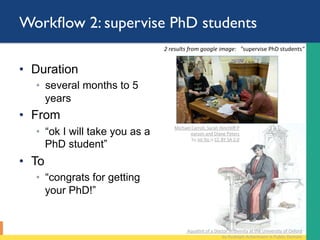
2	results	from	google	image:			"supervise	PhD	students"	
		
	Aqua,nt	of	a	Doctor	in	divinity	at	the	University	of	Oxford		
by	Rudolph	Ackermann	is	Public	Domain	
Michael	Carroll,	Sarah	Hinchliff	P	
earson	and	Diane	Peters		
by	Joi	Ito	is	CC	BY	SA	2.0
Workflow 3: write a grant proposal
•  Duration
◦  several days to several
months
•  From
◦  “this call should be for us”
•  To
◦  “the last signature for the
proposal deposit has
been sent”
1	result	from	google	image:		"write	a	grant	proposal"	
A	ball	point	pen	in	use		
by	Ildar	Sagdejev	is	CC	BY	SA	3.0
Workflow 4: participate to a research project
•  Duration
◦  duration of the project +
several months
•  From
◦  “we have been accepted”
•  To
◦  “final report has been sent”
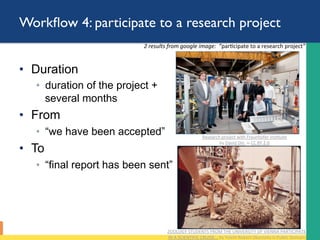
2	results	from	google	image:		”par,cipate	to	a	research	project"	
ZOOLOGY	STUDENTS	FROM	THE	UNIVERSITY	OF	VIENNA	PARTICIPATE		
IN	A	SCIENTIFIC	CRUISE...	by	Yoichi	Robert	Okamoto	is	Public	Domain	
Research	project	with	Fraunhofer	Ins,tute		
by	David	Din		is	CC	BY	2.0
Workflow 5: attend a conference
•  Duration
◦  several days
•  From
◦  “where is that cab?”
•  To
◦  “welcome home!”
2	results	from	google	image:		"a6end	a	conference"	
Web	Summit	2013	In	The	RDS	In	Dublin	[Ireland]	-	Day	One		
by	William	Murphy	is	CC	BY	SA	2.0	
Web	Summit	2013	In	The	RDS	In	Dublin	[Ireland]	-	Day	One		
by	William	Murphy	is	CC	BY	SA	2.0
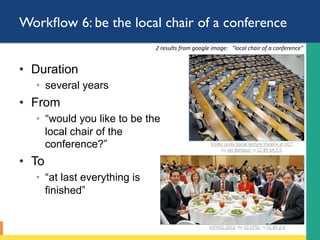
Workflow 6: be the local chair of a conference
•  Duration
◦  several years
•  From
◦  “would you like to be the
local chair of the
conference?”
•  To
◦  “at last everything is
finished”
2	results	from	google	image:			"local	chair	of	a	conference"	
Inside	Leslie	Social	lecture	theatre	at	UCT		
by	Ian	Barbour		is	CC	BY	SA	2.0	
ICPHSO	2012		by	US	CPSC		is	CC	BY	2.0
Workflow 7: drive the community
•  Duration
◦  (permanent)
◦  several months/years
•  Examples
◦  be at the board of a
scholar society
◦  organize workshops/conferences
◦  do some lobbying with funding
agencies
◦  participate to forums, mailing-lists
◦  …
1	result	from	google	image:		"drive	the	scien,fic	community"	
Valedictory	session	of	the	100th	Indian	Science	Congress		
by	Biswarup	Gangulyis		CC	BY	3.0
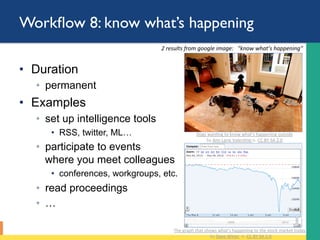
Workflow 8: know what’s happening
•  Duration
◦  permanent
•  Examples
◦  set up intelligence tools
•  RSS, twitter, ML…
◦  participate to events
where you meet colleagues
•  conferences, workgroups, etc.
◦  read proceedings
◦  …
2	results	from	google	image:			"know	what’s	happening"	
The	graph	that	shows	what's	happening	to	the	stock	market	today		
by	Dave	Winer		is		CC	BY	SA	2.0	
Dogs	wan,ng	to	know	what's	happening	outside		
by	Ann	Larie	Valen,ne	is		CC	BY	SA	2.0
Others workflows
•  Read a paper, a book
•  Present a communication
◦  workshop, invited conference
•  Do a research trip in another laboratory
•  Prepare an evaluation
◦  oneself, team, lab
Others workflows (cont.)
•  Promote research
◦  popularize science
•  “fête de la science”, cultural events, etc.
◦  write books
•  teaching or research
◦  have your courses/seminar recorded and broadcasted
◦  write patents
◦  create companies
◦  …
Others workflows
•  Do some networking
◦  communicate about oneself and one’s research
•  more or less J
•  webpage, blog, twitter…
◦  be present where it is important to be
◦  take responsibilities
•  organize, helping organize
◦  know (or trying to) know the good persons
•  get access to information
◦  …
◦  (but try not to be be perceived as only doing that for
your career)
Outline
•  Workflows
•  Putting it all together
•  A job like the others?
A day of a researcher
all these workflows…
+
teaching
+
administrative work
Teaching
•  Every researcher does some teaching
◦  one’s university or others
◦  summer schools
•  Workflows
◦  Preparing courses
•  Syllabus
•  Course material
◦  Giving lectures
◦  Correcting assignments
Administrative work
•  Related to teaching
◦  Managing degree courses (e.g. DMKM master)
◦  Preparing evolution / evaluation
•  Related to team, lab, institution, university
◦  Weekly/monthly team meetings
•  scientific presentations + administrative decisions
◦  Lab councils
•  decide, evaluate, animate, etc.
◦  Institution, university councils
•  prepare the future
•  Related to funding bodies
◦  Participate to national programs committees
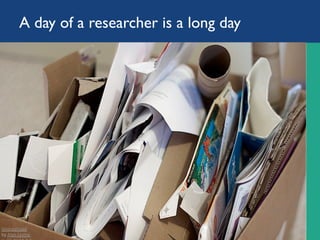
A day of a researcher is a long day
Unorganized		
by	Alan	Levine		
is		CC	BY	SA	2.0
Outline
•  Workflows
•  Putting it all together
•  A job like the others?
Knowledge work
•  Activity based on data and documents that
mainly produces new data and documents
◦  Engineers, business intelligence workers,
researchers, teachers, designers, etc.
23
Science as knowledge work
•  Read documents
◦  Literature
•  Articles, books, journals,
PhD thesis
◦  Reports
◦  Blogs
◦  Reports
◦  Grant description
◦  Mails
◦  Meeting minutes
◦  …
•  Produce documents
◦  Literature
•  Articles, books, PhD thesis,
etc.
◦  Slides
◦  Reports
◦  Reviews
◦  Grant proposal
◦  PhD thesis subjects
◦  Mails
◦  Memos
◦  Budgets
◦  Minutes
◦  Experimental data
◦  …
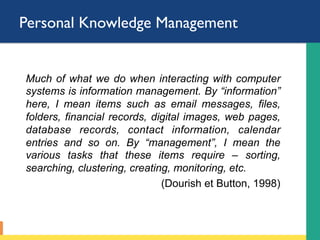
Personal Knowledge Management
Much of what we do when interacting with computer
systems is information management. By “information”
here, I mean items such as email messages, files,
folders, financial records, digital images, web pages,
database records, contact information, calendar
entries and so on. By “management”, I mean the
various tasks that these items require – sorting,
searching, clustering, creating, monitoring, etc.
(Dourish et Button, 1998)
Scientific activity as PKM
Read documents Produce documents
Manage
(keep, sort, search)
◦  Documents
◦  Personal notes
◦  Data
Monitor the outside
◦  Documents
◦  Data
Nothing	really	original,	except	the	publica,on	workflows
A job like the others?
•  In some ways: yes
◦  Not exciting all the time
•  In other ways: no
◦  Freedom
◦  Peer evaluation
◦  Travels
◦  Sometimes you find something really interesting
Important qualities for being a researcher
•  Logical thinking
◦  especially for writing
•  Synthesis spirit
◦  Being able to make sense out of a large body of works
•  Critical spirit
◦  Being able to see the flaws in other’s work
•  Reflexivity
◦  Being able to honestly assess one’s processes and production
•  Eliminate bad ideas without remorses
•  Organize one’s objectives
•  Know how to “sell” one’s production
Important qualities (cont.)
•  Curiosity
◦  What others do could be interesting
•  Mobility
◦  Both intellectual and geographical
•  Tenacity
◦  If you believe in what you are doing, do not give up
You never stop doing research
•  The mind does not stop
◦  travel, shower, sleep, etc.
•  In modern connected life solicitations never stop
◦  step outside of the day to day routine
◦  step completely outside of the job once in a while
Choosing a good research topic
•  Permits to build from previous work/knowledge
◦  Changing from one’s sub-discipline to another takes a
lot of time and energy
•  Suited to publishing
•  Has a good duration
◦  At least several years
•  Fashionable
•  Not too close to industrial R&D
◦  Could you compete with 10 or 100 engineers and
researchers at Google or IBM?
Researcher AND teacher
•  Every researcher does some teaching
◦  Even “pure” researchers
◦  Teaching is a necessity to fully understand one’s
research domain
•  Universities are the places for research and
teaching
◦  What is taught evolves with the evolution of scientific
knowledge
•  Teaching is based on recent research
◦  Even undergraduates benefit from courses by
researchers
Pros / cons (Colin de la Higuera)
•  Contact with young
brilliant people
•  Feeling to do something
useful
•  Meeting interestingg /
exceptional people
•  Top research questions
•  Travels
•  Freedom
•  Many travels
◦  Day to day
◦  From one job to another
•  Frustrations
◦  Unmotivated students
◦  Research ideas than
remain ideas
◦  Funding problems
•  Good ideas that do not
function
Outline
•  Workflows
•  Putting it all together
•  A job like the others?
•  Questions and Answers!

Tools and Methodology for Research: Being a Researcher

  • 1.
    Methodology and Toolsfor Research: Being a researcher Yannick Prié Polytech Nantes, University of Nantes Master DMKM, 2013-2014
  • 2.
    Attribution-ShareAlike 4.0 International (CCBY-SA 4.0) •  This course "Methodology and Tools for Research: Being a Researcher" by Yannick Prié is licensed CC BY-SA 4.0 •  This license covers the general organization of the material, the textual content, the figures, etc. except where indicated. •  This license means that you can share and adapt this course, provided you give appropriate credit to the author and distribute your contributions under the same license as the original ◦  for more information about this license, see http://creativecommons.org/licenses/by-sa/4.0/ •  For any comment on this course, do not hesitate to contact me: yannick.prie@univ-nantes.fr or @yprie
  • 3.
    Objectives of thiscourse •  Discover some researchers workflows ◦  and the associated tools (if not already seen) •  Q/A with researchers ◦  visit researcher websites ◦  prepare your questions! •  Ressources for the course http://www.scoop.it/t/toolsandmethodologyforresearch
  • 4.
    Outline •  Workflows •  Puttingit all together •  A job like the others?
  • 5.
    Outline •  Workflows •  Puttingit all together •  A job like the others?
  • 6.
    Workflow 1: writea paper •  Duration: ◦  2 months to several years •  From ◦  “I/we should write something on that topic” •  To ◦  “the final version of the paper was send yesterday” 2 results from google image: "write a paper" 2008-01-26 (Edi,ng a paper) - 31 by Nic McPhee is CC BY SA 2.0 Line art representa,on of a Quill by Pearson ScoJ Foresman is Public Domain
  • 7.
    Workflow 2: supervisePhD students •  Duration ◦  several months to 5 years •  From ◦  “ok I will take you as a PhD student” •  To ◦  “congrats for getting your PhD!” 2 results from google image: "supervise PhD students" Aqua,nt of a Doctor in divinity at the University of Oxford by Rudolph Ackermann is Public Domain Michael Carroll, Sarah Hinchliff P earson and Diane Peters by Joi Ito is CC BY SA 2.0
  • 8.
    Workflow 3: writea grant proposal •  Duration ◦  several days to several months •  From ◦  “this call should be for us” •  To ◦  “the last signature for the proposal deposit has been sent” 1 result from google image: "write a grant proposal" A ball point pen in use by Ildar Sagdejev is CC BY SA 3.0
  • 9.
    Workflow 4: participateto a research project •  Duration ◦  duration of the project + several months •  From ◦  “we have been accepted” •  To ◦  “final report has been sent” 2 results from google image: ”par,cipate to a research project" ZOOLOGY STUDENTS FROM THE UNIVERSITY OF VIENNA PARTICIPATE IN A SCIENTIFIC CRUISE... by Yoichi Robert Okamoto is Public Domain Research project with Fraunhofer Ins,tute by David Din is CC BY 2.0
  • 10.
    Workflow 5: attenda conference •  Duration ◦  several days •  From ◦  “where is that cab?” •  To ◦  “welcome home!” 2 results from google image: "a6end a conference" Web Summit 2013 In The RDS In Dublin [Ireland] - Day One by William Murphy is CC BY SA 2.0 Web Summit 2013 In The RDS In Dublin [Ireland] - Day One by William Murphy is CC BY SA 2.0
  • 11.
    Workflow 6: bethe local chair of a conference •  Duration ◦  several years •  From ◦  “would you like to be the local chair of the conference?” •  To ◦  “at last everything is finished” 2 results from google image: "local chair of a conference" Inside Leslie Social lecture theatre at UCT by Ian Barbour is CC BY SA 2.0 ICPHSO 2012 by US CPSC is CC BY 2.0
  • 12.
    Workflow 7: drivethe community •  Duration ◦  (permanent) ◦  several months/years •  Examples ◦  be at the board of a scholar society ◦  organize workshops/conferences ◦  do some lobbying with funding agencies ◦  participate to forums, mailing-lists ◦  … 1 result from google image: "drive the scien,fic community" Valedictory session of the 100th Indian Science Congress by Biswarup Gangulyis CC BY 3.0
  • 13.
    Workflow 8: knowwhat’s happening •  Duration ◦  permanent •  Examples ◦  set up intelligence tools •  RSS, twitter, ML… ◦  participate to events where you meet colleagues •  conferences, workgroups, etc. ◦  read proceedings ◦  … 2 results from google image: "know what’s happening" The graph that shows what's happening to the stock market today by Dave Winer is CC BY SA 2.0 Dogs wan,ng to know what's happening outside by Ann Larie Valen,ne is CC BY SA 2.0
  • 14.
    Others workflows •  Reada paper, a book •  Present a communication ◦  workshop, invited conference •  Do a research trip in another laboratory •  Prepare an evaluation ◦  oneself, team, lab
  • 15.
    Others workflows (cont.) • Promote research ◦  popularize science •  “fête de la science”, cultural events, etc. ◦  write books •  teaching or research ◦  have your courses/seminar recorded and broadcasted ◦  write patents ◦  create companies ◦  …
  • 16.
    Others workflows •  Dosome networking ◦  communicate about oneself and one’s research •  more or less J •  webpage, blog, twitter… ◦  be present where it is important to be ◦  take responsibilities •  organize, helping organize ◦  know (or trying to) know the good persons •  get access to information ◦  … ◦  (but try not to be be perceived as only doing that for your career)
  • 17.
    Outline •  Workflows •  Puttingit all together •  A job like the others?
  • 18.
    A day ofa researcher all these workflows… + teaching + administrative work
  • 19.
    Teaching •  Every researcherdoes some teaching ◦  one’s university or others ◦  summer schools •  Workflows ◦  Preparing courses •  Syllabus •  Course material ◦  Giving lectures ◦  Correcting assignments
  • 20.
    Administrative work •  Relatedto teaching ◦  Managing degree courses (e.g. DMKM master) ◦  Preparing evolution / evaluation •  Related to team, lab, institution, university ◦  Weekly/monthly team meetings •  scientific presentations + administrative decisions ◦  Lab councils •  decide, evaluate, animate, etc. ◦  Institution, university councils •  prepare the future •  Related to funding bodies ◦  Participate to national programs committees
  • 21.
    A day ofa researcher is a long day Unorganized by Alan Levine is CC BY SA 2.0
  • 22.
    Outline •  Workflows •  Puttingit all together •  A job like the others?
  • 23.
    Knowledge work •  Activitybased on data and documents that mainly produces new data and documents ◦  Engineers, business intelligence workers, researchers, teachers, designers, etc. 23
  • 24.
    Science as knowledgework •  Read documents ◦  Literature •  Articles, books, journals, PhD thesis ◦  Reports ◦  Blogs ◦  Reports ◦  Grant description ◦  Mails ◦  Meeting minutes ◦  … •  Produce documents ◦  Literature •  Articles, books, PhD thesis, etc. ◦  Slides ◦  Reports ◦  Reviews ◦  Grant proposal ◦  PhD thesis subjects ◦  Mails ◦  Memos ◦  Budgets ◦  Minutes ◦  Experimental data ◦  …
  • 25.
    Personal Knowledge Management Muchof what we do when interacting with computer systems is information management. By “information” here, I mean items such as email messages, files, folders, financial records, digital images, web pages, database records, contact information, calendar entries and so on. By “management”, I mean the various tasks that these items require – sorting, searching, clustering, creating, monitoring, etc. (Dourish et Button, 1998)
  • 26.
    Scientific activity asPKM Read documents Produce documents Manage (keep, sort, search) ◦  Documents ◦  Personal notes ◦  Data Monitor the outside ◦  Documents ◦  Data Nothing really original, except the publica,on workflows
  • 27.
    A job likethe others? •  In some ways: yes ◦  Not exciting all the time •  In other ways: no ◦  Freedom ◦  Peer evaluation ◦  Travels ◦  Sometimes you find something really interesting
  • 28.
    Important qualities forbeing a researcher •  Logical thinking ◦  especially for writing •  Synthesis spirit ◦  Being able to make sense out of a large body of works •  Critical spirit ◦  Being able to see the flaws in other’s work •  Reflexivity ◦  Being able to honestly assess one’s processes and production •  Eliminate bad ideas without remorses •  Organize one’s objectives •  Know how to “sell” one’s production
  • 29.
    Important qualities (cont.) • Curiosity ◦  What others do could be interesting •  Mobility ◦  Both intellectual and geographical •  Tenacity ◦  If you believe in what you are doing, do not give up
  • 30.
    You never stopdoing research •  The mind does not stop ◦  travel, shower, sleep, etc. •  In modern connected life solicitations never stop ◦  step outside of the day to day routine ◦  step completely outside of the job once in a while
  • 31.
    Choosing a goodresearch topic •  Permits to build from previous work/knowledge ◦  Changing from one’s sub-discipline to another takes a lot of time and energy •  Suited to publishing •  Has a good duration ◦  At least several years •  Fashionable •  Not too close to industrial R&D ◦  Could you compete with 10 or 100 engineers and researchers at Google or IBM?
  • 32.
    Researcher AND teacher • Every researcher does some teaching ◦  Even “pure” researchers ◦  Teaching is a necessity to fully understand one’s research domain •  Universities are the places for research and teaching ◦  What is taught evolves with the evolution of scientific knowledge •  Teaching is based on recent research ◦  Even undergraduates benefit from courses by researchers
  • 33.
    Pros / cons(Colin de la Higuera) •  Contact with young brilliant people •  Feeling to do something useful •  Meeting interestingg / exceptional people •  Top research questions •  Travels •  Freedom •  Many travels ◦  Day to day ◦  From one job to another •  Frustrations ◦  Unmotivated students ◦  Research ideas than remain ideas ◦  Funding problems •  Good ideas that do not function
  • 34.
    Outline •  Workflows •  Puttingit all together •  A job like the others? •  Questions and Answers!