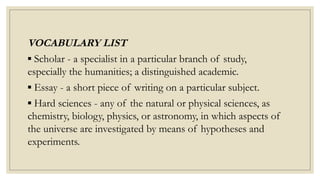
VOCABULARY LIST
▪ Scholar- a specialist in a particular branch of study,
especially the humanities; a distinguished academic.
▪ Essay - a short piece of writing on a particular subject.
▪ Hard sciences - any of the natural or physical sciences, as
chemistry, biology, physics, or astronomy, in which aspects of
the universe are investigated by means of hypotheses and
experiments.
5.
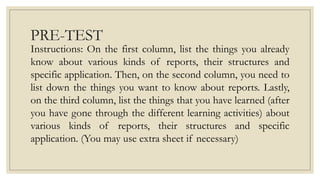
PRE-TEST
Instructions: On thefirst column, list the things you already
know about various kinds of reports, their structures and
specific application. Then, on the second column, you need to
list down the things you want to know about reports. Lastly,
on the third column, list the things that you have learned (after
you have gone through the different learning activities) about
various kinds of reports, their structures and specific
application. (You may use extra sheet if necessary)
6.
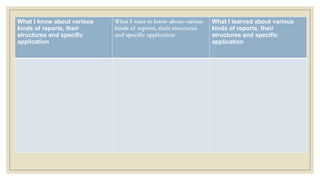
What I knowabout various
kinds of reports, their
structures and specific
application
What I want to know about various
kinds of reports, their structures
and specific application
What I learned about various
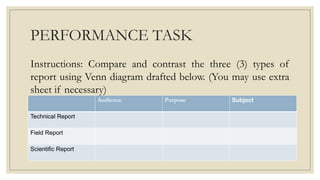
kinds of reports, their
structures and specific
application
7.
Many scholars havedefined report as any
informational work made with an intention to
relay information or recounting certain events in a
presentable manner. These are often conveyed in
writing, speech, television, or film.
8.
A key featureof report is that it is formally structured
in sections. Hence, the use of sections makes it easy for
the reader to jump straight to the information they
need. Unlike an essay which is written in a single
narrative style from start to finish, each section of a
report has its own purpose and will need to be written
in an appropriate style to suit – for example, the
methods and results sections are mainly descriptive,
whereas the discussion section needs to be analytical.
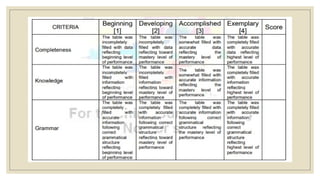
9.
Reports communicate informationwhich has
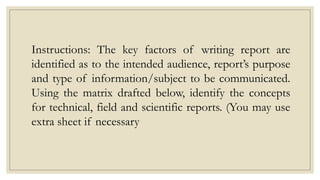
been compiled as a result of research and analysis
of data and of issues. Please note however that
reports can cover a wide range of topics, but
usually focus on transmitting information with a
clear purpose, to a specific audience.
10.
Good reports aredocuments that are
accurate, objective and complete. They
should also be well-written, clearly structured
and expressed in a way that holds the reader's
attention and meets their expectations.
11.
GUIDE QUESTIONS
1.What arethe different types of report writing?
2.What are its purposes?
3.Who are its target audience?
4.How is a particular type of report being written?
12.
[1]TECHNICAL AND BUSINESSdisciplines with
an applied focus such as Engineering, Information
Technology, Commerce, Accounting and Finance, will
set report writing assignments that simulate the process
of report writing in industry. Assignments are set in the
form of a problem or a case study. The students
research the problem, and present the results of the
research in a report format
13.
Technical writing isform of writing technical
communication or documentation in science and
technology or applied science that helps people
understand a product or service. The main purpose of
technical writing is to inform and to trigger the person
into action such as purchasing a product or service. Its
purpose may also be instruct persuade, but never to
entertain. The content is factual and straightforward. It
is expressed in formal, standard or academic language.
14.
[2]FIELD REPORTS arecommon in
disciplines such as Law, Industrial Relations,
Psychology, Nursing, History and Education.
These types of reports require the student to
analyse his or her observations of
phenomena or events in the real world in
light of theories studied in the course.
15.
The purpose ofa field report in the social sciences is to describe
the observation of people, places, and/or events and to analyze that
observation data in order to identify What are the different types of
report writing? What are its purposes? Who are its target audience?
How is a particular type of report being written? Guide Questions
www.shsph.blogspot.com 6 and categorize common themes in
relation to the research problem underpinning the study. The
content represents the researcher's interpretation of meaning found
in data that has been gathered during one or more observational
events.
16.
When writing afield report you need
to:
●Systematically observe and accurately record the
varying aspects of a situation. Always approach your
field study with a detailed protocol about what you will
observe, where you should conduct your observations,
and the method by which you will collect and record
your data.
17.
● Continuously analyzeyour observations. Always
look for the meaning underlying the actions you
observe. Ask yourself: What's going on here?
What does this observed activity mean? What else
does this relate to? Note that this is an on-going
process of reflection and analysis taking place for
the duration of your field research.
18.
●Keep the report’saims in mind while you
are observing. Recording what you observe
should not be done randomly or
haphazardly; you must be focused and pay
attention to details.
19.
● Consciously observe,record, and analyze what you hear
and see in the context of a theoretical framework. This is
what separates data gatherings from reporting. The
theoretical framework guiding your field research should
determine what, when, and www.shsph.blogspot.com 7
how you observe and act as the foundation from which you
interpret your findings in relation to the underlying
assumptions embedded in the theoretical framework.
20.
Techniques to recordyour observations: Although there is
no limit to the type of data gathering techniques you can
use, these are the most frequently used methods:
21.
Note taking
This isthe most common and easiest method of recording
your observations. Tips for taking notes include: organizing
some shorthand symbols beforehand so that recording basic
or repeated actions does not impede your ability to observe,
using many small paragraphs, which reflect changes in
activities, who is talking, etc., and, leaving space on the page
so you can write down additional thoughts and ideas about
what’s being observed, any theoretical insights, and notes to
yourself that are set aside for further investigation.
22.
Photography With theadvent of smart phones, an
almost unlimited number of high quality photographs can
be taken of the objects, events, and people observed during
a field study. Photographs can help capture an important
moment in time as well as document details about the space
where your observation takes place. Taking a photograph
can save you time in documenting the details of a space
that would otherwise require extensive note taking.
23.
Video & AudioRecordings
Video or audio recording your observations has the
positive effect of giving you an unfiltered record of
the observation event. It also facilitates repeated
analysis of your observations. This can be
particularly helpful as you gather additional
information or insights during your research.
24.
Illustrations
This does notrefer to an artistic endeavor but, rather,
refers to the possible need, for example, to draw a
map of the observation setting or illustrating objects
in relation to people's behavior.
25.
REMEMBER
Please note thattechniques of deliberate observation and data
gathering are not innate skills; they are skills that must be
learned and practiced in order to achieve proficiency.
26.
[3]SCIENTIFIC REPORTS areanother kind of report.
They are common in all the Sciences and Social Sciences.
These reports use a standard scientific report format
describing methods, results and conclusions to report upon an
empirical investigation. The purpose of a science report is to
clearly communicate your key message about why your
scientific findings are meaningful.
27.
REMEMBER
The scope andstyle of reports varies widely.
It depends on three key factors: the report's
intended audience, the report's purpose
and the type of information/subject to be
communicated.
28.
Although the exactnature will vary according
to the discipline you are studying, the general
structure is broadly similar for all disciplines.
Now, one good example of report that you
should know which is commonly used in the
field of hard sciences is referred as Research
Report.
29.
The different partsof the research report include the following:
1. Introductory Phase
2. Review of Literature
3. Research Methodology
4. Body of the Report
5. Conclusion
6. Recommendation
30.
Introductory Phase Introductionis as important as the main
parts of a research report. It contextualizes and sets the tone
and direction of research writing. It is like a road map that
guides you in your research journey. According to Reidman
(2001), it answers the following questions:
● What was I was studying?
● What did we know about this topic before we study?
● And, how this study advance new knowledge or new ways
of understanding?
31.
Research Title
A researchtitle has to get the attention of the readers. In other
words, it must be “catchy.” Being catchy does not mean sacrificing
the main message or idea of your report. Hence, according to
Silverman (2006, 339) choose “a title that catches the reader’s
attention while properly informing them about the main focus on
your research.” Siverman (2006, 206) is suggesting a “two-part title”
containing a stimulating title applying a present participle signifying
action and a subtitle which is more descriptive. Example: Stimulating
title: Have you ever experience being bullied? Descriptive title: A
study on the perception of the victims of bullying in the primary
schools.
32.
Research Abstract Aresearch abstract is a vital component of a report
as it provides the readers with a snap view of what you will expect from
it. The abstract gives a synopsis of the objectives and results of the
report to be described in detailed from in the body of the report.
Silverman (2006) identified what an abstract should contain:
1. research problem
2. significance and value of the problem
3. data and methods utilized
4. main findings
5. implication in the light of other research
33.
A research abstracthas a word limit. The
most common word limit is 100. This is a
challenging part of writing a report because it
is difficult to write the many things that you
want to impart in just a few words
34.
List of Contents
Alist of contents is a useful component of a report as it
guides the readers to find their way through the different
parts of the report. Hence, the consistency of the page
numbers with the parts of the report is vital.
Inconsistent page numbering would result to the reader’s
confusion.
35.
Introduction
The introduction acquaintsthe readers with the what, why and
how of the report. According to Murcott (1997, p. 1) as cited in
Silverman (2006), answering the questions below would lead you
to the development of the introduction:
1. What is the research all about?
2. Why have you chosen this topic rather than the other topics?
3. Why are you interested in this topic?
4. How will you undertake the research?
5. What kind of research approach will you utilize?
6. What are your research questions or problems?
36.
Review of Literature
TheReview of Related Literature (RRL) provides study
background and environment. The intention of the
RRL is to locate the study in its area of discipline and
reveal its relevance and significance in the environment.
The RRL would indicate if your topic is building on
previous researchers or if it is a new area of inquiry.
The RRL should make one realize that a study is worth
pursuing or not.
37.
According to Silverman(2006), RRL is not a “litany” of all studies
done related to the topic. It is also not an inventory of the
accomplishments of other authors on the same topic nor it is a map
of projects similar to the area of study. Rather, it is an
environmental or disciplinal context that leads one to locate one’s
study. Hence, Silverman (2008) recommends the following points:
●Focus only on studies that are vital and relevant in defining your
research problem.
●Organize what you say in the form of an argument rather than a
simple description of other studies.
38.
Research Methodology Inresearch, the research process is as
important as the research content. Thus, a research report must also
contain a description of the research strategy. The readers will be
interested in finding how you arrived at a particular study result.
Siverman (2008) pointed out that the readers would be interested to
know the following:
1. Research topic
2. Case (s) you have studied
3. Research methods you have chosen to use www.shsph.blogspot.com 12
4. How you have analyzed the data
39.
This part ofthe research report is sensitive hence must be dealt with caution.
In order for you to answer questions such as: Is your methodology
appropriate for the research problem? How did you reach that conclusion?
Silverman suggested that to be able to answer methodological questions, you
have to be familiar with and knowledgeable about the following:
● Data you have studied
● How you obtained those data
● What claims you are making about the data
● Methods you have used to gather the data
● Why you have chosen this methods
● How you have analyzed your data
40.
Writing Your Data
Themost essential part of the report is writing about the data
collected through your research. There are two important areas of
consideration in the writing up of the data, namely, data analysis, and
data presentation. In the data analysis, there is no right or wrong way.
Creswell (1994, 153) only requires the researcher to:
1. “be comfortable with developing categories and making
comparisons and contrast”
2. “be open to possibilities and see contrary or alternative
explanations for the findings
41.
To assist theresearcher in the data analysis,
attention must be given to
(a)sorting information into categories,
(b)formatting the information into a story or
picture,
(c)actual data analysis and write up.
42.
Writing the Conclusion
Howdo you characterize conclusions?
Conclusion are inferences, deductions, abstraction,
implications, interpretations, general statements, and/or
generalizations based on findings. An example of which is:
“All the teachers were qualified to teach in the high school
but the majority of them were not qualified to teach
science. ” (Khemer, 2009).
43.
Writing The Recommendation
Theresearch recommendation is a part of the
paper where you make suggestions about some
resolutions as a response to the research problem.
It must be consistent part of the conclusion. It
proposes specific solutions connected with the
findings and must be supported by relevant data
and specific data from the findings.
44.
Below are sometips from Teljlingen (2011) on how to write
recommendations:
● “You should not recommend anything that you have not
previously discussed in the discussion. The rule ‘no new material’ in
your conclusion is also applicable to your ‘Recommendations.’”
● “Recommendations are not the same as conclusions. Consider
recommendations go one step further than conclusions as
(a)‘something’;
(b)‘someone; and
(c)‘needs to do.’’”
45.
● There maybe different levels within your set
recommendations: for (a) academic (i.e., research is
needed into…),
(b) for policy-makers (e,g., data protection act needs to
change to accommodate…); for
(c) practitioners (i.e., managers in local government need
to consider the mental well-being of their staff); or
recommendation for
(d) training/education.
46.
PRACTICE TASKS
If youare reading this now, it means that you have
advanced yourself from the basics of writing report.
This part of the module focus on different activities
that would help strengthen your understanding about
the topic. Your answers from the activities will be rated
based from the below listed rubrics.
48.
Instructions: The keyfactors of writing report are
identified as to the intended audience, report’s purpose
and type of information/subject to be communicated.
Using the matrix drafted below, identify the concepts
for technical, field and scientific reports. (You may use
extra sheet if necessary
49.
PERFORMANCE TASK
Instructions: Compareand contrast the three (3) types of
report using Venn diagram drafted below. (You may use extra
sheet if necessary)
Audience Purpose Subject
Technical Report
Field Report
Scientific Report
50.
PERFORMANCE TASK
Instructions: Howis research report different
from laboratory report? Discuss your answer
using the space provided.
(You may use extra sheet if necessary) You will be
rated based from the given rubrics.
51.
A. TRUE ORFALSE
Instructions: Carefully read through the following
statement/s. Write the word TRUE if the statement is
correct, otherwise, FALSE. Write your answer on the
space provided. (You may use another sheet of paper if
necessary)
52.
__________ 1. Reportis written in a single
narrative style from start to finish, each section
of a report has its own purpose and will need
to be written in an appropriate style to suit.
__________ 2. The purpose of a scientific
report is to clearly communicate your key
message about why your scientific findings are
meaningful.
53.
__________ 3. Laboratoryreports are assigned with
the intention of improving your understanding of key
theoretical concepts by applying methods of careful
and structured observation of and reflection about,
people, places, or phenomena existing in their natural
settings.
__________ 4. Technical writing is a form of writing
technical communication or documentation in science
and technology or applied science that helps people
understand a product or service
54.
__________ 5. Themain purpose of technical
writing is to inform and to trigger the person into
action such as purchasing a product or service. Its
purpose may also be instruct persuade, but never to
entertain.
__________ 6. The research abstract provides study
background and environment. The intention of the
research abstract is to locate the study in its area of
discipline and reveal its relevance and significance in
the environment
55.
__________ 7. Aresearch abstract is a vital
component of a report as it provides the readers
with a snap view of what you will expect from it.
__________ 8. Field reports facilitate the
development of data collection techniques and
observation skills and they help you to understand
how theory applies to real world situations.
56.
__________ 9. Fieldreports use a standard
scientific report format describing methods,
results and conclusions to report upon an
empirical investigation.
__________ 10. Field reports require the student
to analyze his or her observations of phenomena
or events in the real world in light of theories
studied in the course.
57.
ASSIGNMENT
Below is anexample of report lifted from
https://www.dlsweb.rmit.edu.au/lsu/content
/2_AssessmentTasks/assess_tuts/reports_L
L/report.pdf. Go over the link and read through
the said report and answer the given questions.



![[1]TECHNICAL AND BUSINESS disciplines with
an applied focus such as Engineering, Information
Technology, Commerce, Accounting and Finance, will
set report writing assignments that simulate the process
of report writing in industry. Assignments are set in the
form of a problem or a case study. The students
research the problem, and present the results of the
research in a report format](https://image.slidesharecdn.com/eapp-q2-week4-250803102143-a0a439fa/85/Academic-and-Professional-Purposes-pptx-12-320.jpg)
![[2]FIELD REPORTS are common in
disciplines such as Law, Industrial Relations,
Psychology, Nursing, History and Education.
These types of reports require the student to
analyse his or her observations of
phenomena or events in the real world in
light of theories studied in the course.](https://image.slidesharecdn.com/eapp-q2-week4-250803102143-a0a439fa/85/Academic-and-Professional-Purposes-pptx-14-320.jpg)
![[3]SCIENTIFIC REPORTS are another kind of report.
They are common in all the Sciences and Social Sciences.
These reports use a standard scientific report format
describing methods, results and conclusions to report upon an
empirical investigation. The purpose of a science report is to
clearly communicate your key message about why your
scientific findings are meaningful.](https://image.slidesharecdn.com/eapp-q2-week4-250803102143-a0a439fa/85/Academic-and-Professional-Purposes-pptx-26-320.jpg)