1
www.kaysun.com
800-852-9786
2
Manufacturers of critical-use devices
cannot afford to lose any time in
getting their products to market. Advances
in technology come rapidly, and other
companies are vying for the majority of the
market share. To ensure success, products
must be designed and produced with ultimate
precision and efficiency. That efficiency
depends on eliminating production delays
caused by flaws and inconsistencies in the
manufacturing process.
Companies that design and produce critical-
use devices containing precision-molded
plastic parts must be certain that those parts
will be formed with repeatable freedom from
defect. The manufacturing process itself must
also be repeatable across multiple production
runs. Today’s scientific molding procedures,
when performed by molding personnel with
thorough training and the proper certification,
virtually guarantee top quality by removing
all guesswork from the injection-molding
process. Because all data associated with
a manufacturing process are recorded, that
process can then be replicated as needed,
even when production is transferred from one
machine to another.
This white paper:
•	 Explains how specialized molding
engineers oversee their respective
phase—design, process, or production—
in the development and manufacture of
precision-molded plastic parts to develop
templates for repeatable production.
•	 Examines the key benefits provided by
today’s scientific molding procedures,
in general terms as well as with specific
examples.
•	 Explains the importance of injection-
molding engineers’ proper training and
certification in state-of-the-art scientific
molding practices that optimize all aspects
of part production.
What is Scientific Molding?
Scientific molding uses the key steps of the
scientific method – developing a hypothesis,
testing it, analyzing the results to draw a
conclusion, and proving the results are
reproducible – to develop a tightly controlled
and repeatable manufacturing process
that results in parts consistently free of
defects. Compared to traditional “trial and
error” molding that relies on guesswork to
bring parts within specification – scientific
molding uses sophisticated data collection
and analysis techniques to document the
specifications, settings and steps required to
ensure reproducibility over time and across
equipment.
This practice is invaluable in designing
and producing components for critical-
use products—medical devices, high-
tech defense equipment, automotive
components—where precision can mean life
or death. The complex system of scientific
molding is not necessary in manufacturing
simple plastic pieces, such as food-storage
containers, toys, or other basic molded parts.
Scientific molding principles must be applied
across all phases of part manufacture: design
of the part, design and building of the tool,
debugging of the tool, material selection,
and the injection-molding process. Different
engineers with specialized expertise oversee
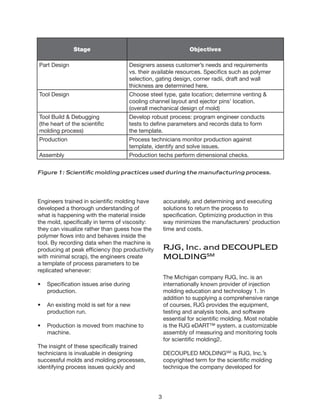
each of these phases, as shown in the
following diagram:
3
Engineers trained in scientific molding have
developed a thorough understanding of
what is happening with the material inside
the mold, specifically in terms of viscosity:
they can visualize rather than guess how the
polymer flows into and behaves inside the
tool. By recording data when the machine is
producing at peak efficiency (top productivity
with minimal scrap), the engineers create
a template of process parameters to be
replicated whenever:
•	 Specification issues arise during
production.
•	 An existing mold is set for a new
production run.
•	 Production is moved from machine to
machine.
The insight of these specifically trained
technicians is invaluable in designing
successful molds and molding processes,
identifying process issues quickly and
accurately, and determining and executing
solutions to return the process to
specification. Optimizing production in this
way minimizes the manufacturers’ production
time and costs.
RJG, Inc. and DECOUPLED
MOLDINGSM
The Michigan company RJG, Inc. is an
internationally known provider of injection
molding education and technology 1. In
addition to supplying a comprehensive range
of courses, RJG provides the equipment,
testing and analysis tools, and software
essential for scientific molding. Most notable
is the RJG eDART™ system, a customizable
assembly of measuring and monitoring tools
for scientific molding2.
DECOUPLED MOLDINGSM
is RJG, Inc.’s
copyrighted term for the scientific molding
technique the company developed for
Stage Objectives
Part Design Designers assess customer’s needs and requirements
vs. their available resources. Specifics such as polymer
selection, gating design, corner radii, draft and wall
thickness are determined here.
Tool Design Choose steel type, gate location; determine venting &
cooling channel layout and ejector pins’ location.
(overall mechanical design of mold)
Tool Build & Debugging
(the heart of the scientific
molding process)
Develop robust process: program engineer conducts
tests to define parameters and records data to form
the template.
Production Process technicians monitor production against
template, identify and solve issues.
Assembly Production techs perform dimensional checks.
Figure 1: Scientific molding practices used during the manufacturing process.
4
the highest level of process control3. The
term applies to the molding phase of the
process, after the tool has been developed
and debugged. It is scientific molding that
provides the most repeatable method of
molding.
In DECOUPLED MOLDING, the fill, pack, and
hold stages are separated to give the molder
the highest degree of control. By contrast,
in the outdated, traditional molding method
(known as DECOUPLED I) the mold was
filled completely with first-stage pressure;
the unrestrained kinetic energy produced by
the fast fill made the packing phase difficult
to control. This lack of precision caused an
increased rate of mold flash and other flaws,
meaning fewer acceptable parts.
DECOUPLED II (fully decoupled) and
DECOUPLED III (totally decoupled) are the
methods in use today. In DECOUPLED II, the
fill and pack stages are separated completely
to control the speed of the fill and prevent an
undesirable pressure level. The material still
fills the cavity quickly, to 95-to 99•percent
capacity, but since the pack stage is separate,
the kinetic energy is spent before the material
can flash the mold. The remainder of the
polymer is then injected with precise control in
the pack-and-hold stage, using second-stage
pressure to pack out the mold and hold until
gate seal.
In DECOUPLED III, the process is further
separated in that the pack-and-hold stage
is also decoupled (the fill stage is the same
as in DECOUPLED II). The pack rate goes
at a low and precisely controlled speed
until cavity pressure reaches the correct
level, as recorded on the unique template
for that production run. Sensors in the mold
then take over process control, reading the
material’s behavior within the tool. Molds for
DECOUPLED III must be specially built or
modified with cavity-pressure transducers
that are electronically interfaced with both the
injection-molding machine and a monitoring
system. Since the kinetic energy is lowered
more gradually than in DECOUPLED II, the
pack rate in this more complex molding
method I is even more precise.
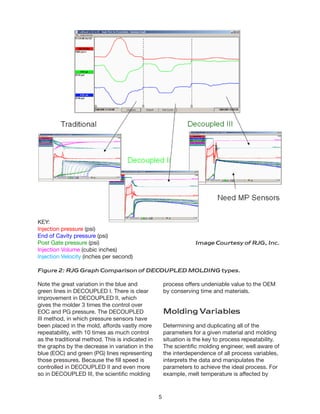
The graphs on page 5, figure 2, were taken
from an RJG capability study on a specific
polymer after the introduction of a 20-percent
change in viscosity. Each graph contains an
overlay of 10 consecutive shots in each of
the three DECOUPLED MOLDING methods.
The blue and green lines, representing End of
Cavity (EOC) and Post Gate (PG) pressure,
respectively, illustrate the increasing level
of control from DECOUPLED I through
DECOUPLED III when any viscosity change
is introduced. For instance, the viscosity
of a given plastic can vary from lot to lot,
requiring adjustments to the molding process
parameters.
5
Note the great variation in the blue and
green lines in DECOUPLED I. There is clear
improvement in DECOUPLED II, which
gives the molder 3 times the control over
EOC and PG pressure. The DECOUPLED
III method, in which pressure sensors have
been placed in the mold, affords vastly more
repeatability, with 10 times as much control
as the traditional method. This is indicated in
the graphs by the decrease in variation in the
blue (EOC) and green (PG) lines representing
those pressures. Because the fill speed is
controlled in DECOUPLED II and even more
so in DECOUPLED III, the scientific molding
process offers undeniable value to the OEM
by conserving time and materials.
Molding Variables
Determining and duplicating all of the
parameters for a given material and molding
situation is the key to process repeatability.
The scientific molding engineer, well aware of
the interdependence of all process variables,
interprets the data and manipulates the
parameters to achieve the ideal process. For
example, melt temperature is affected by
KEY:
Injection pressure (psi)
End of Cavity pressure (psi)
Post Gate pressure (psi)
Injection Volume (cubic inches)
Injection Velocity (inches per second)
Figure 2: RJG Graph Comparison of DECOUPLED MOLDING types.
Image Courtesy of RJG, Inc.
6
barrel temperature and screw speed and back
pressure, to name a few factors. The main
molding variables are:
•	 temperature (of material and mold)
•	 material flow rate
•	 pressure (pack and hold)
•	 cooling time and rate
Other factors include material moisture rate,
fill time, and mold conductivity. Each of these
factors is in turn affected by others in this
highly complex process. Cooling time, for
example, is influenced by the heat level in the
material, the conductivity of the tool steel, and
the geometry of the part. Since the engineer
has been trained to consider everything from
the perspective of the plastic, he is prepared
to manipulate the variables as needed to
return the process to conformation.
Debugging the Mold
Debugging of the mold is the heart of the
scientific molding process. In order to ensure
manufacturing success through consistent
and repeatable production of flawless
molded parts, the mold must be challenged
completely before it’s called into action. This
is how its weaknesses are identified and
corrected.
The process begins with the tool being
put into the press so that the toolmaker
and process engineer can thoroughly and
systematically check every aspect of its
mechanical functionality. For a starting
point, they use the recommendations
specified by the supplier of the material to
be molded; those settings are entered in to
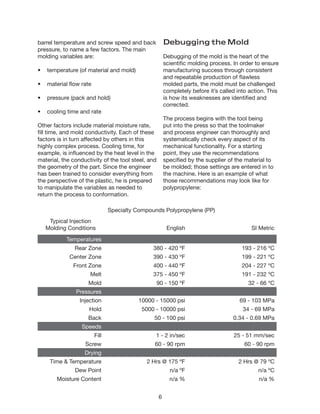
the machine. Here is an example of what
those recommendations may look like for
polypropylene:
Specialty Compounds Polypropylene (PP)
Typical Injection
Molding Conditions English SI Metric
Temperatures
Rear Zone 380 - 420 ºF 193 - 216 ºC
Center Zone 390 - 430 ºF 199 - 221 ºC
Front Zone 400 - 440 ºF 204 - 227 ºC
Melt 375 - 450 ºF 191 - 232 ºC
Mold 90 - 150 ºF 32 - 66 ºC
Pressures
Injection 10000 - 15000 psi 69 - 103 MPa
Hold 5000 - 10000 psi 34 - 69 MPa
Back 50 - 100 psi 0.34 - 0.69 MPa
Speeds
Fill 1 - 2 in/sec 25 - 51 mm/sec
Screw 60 - 90 rpm 60 - 90 rpm
Drying
Time & Temperature 2 Hrs @ 175 ºF 2 Hrs @ 79 ºC
Dew Point n/a ºF n/a ºC
Moisture Content n/a % n/a %
7
Next, the engineers conduct short-shot
testing to assess the dynamic pressure loss
and, in a multiple-cavity mold, to check for
any imbalance among the cavities. This
step is also the stage for a crucial objective:
establishing the rheology curve (or viscosity
curve) to indicate the best fill rate and pattern.
After this, the decoupled process is set up
so that further testing can be done. Gate seal
studies are performed from both the pressure
curve and the weight of the sample parts;
these tests show if the gates seal fully, and
at what point, on the mold cavity (or multiple
cavities). The engineers examine the test parts
for any defects and then record their findings
along with recommendations for adjustments
in the process or the tool in order to correct
the defects. They also record data on the
melt temperature, fill time, mold temperature,
coolant flow, cycle time, and pressure curves.
The parts then go to quality control for
examination of their measurements, shot-
to-shot consistencies, and overall quality.
That information is used for any necessary
adjustments to the tool, before new samples
are made. The new samples then undergo
the same quality testing, with necessary
adjustments made again as needed.
All of the process parameters are recorded,
with their acceptable ranges shown, to form
the template. This template will be followed
throughout production to ensure top quality,
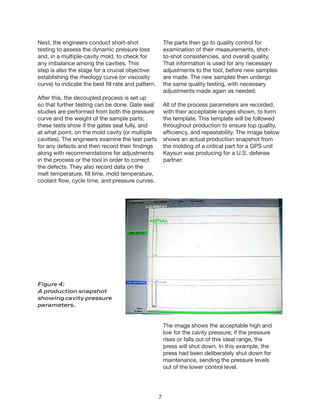
efficiency, and repeatability. The image below
shows an actual production snapshot from
the molding of a critical part for a GPS unit
Kaysun was producing for a U.S. defense
partner:
The image shows the acceptable high and
low for the cavity pressure; if the pressure
rises or falls out of this ideal range, the
press will shut down. In this example, the
press had been deliberately shut down for
maintenance, sending the pressure levels
out of the lower control level.
Figure 4:
A production snapshot
showing cavity pressure
parameters.
8
How Scientific Molding
Benefits the Manufacturer
Reproducibility is another fundamental of
science, and in terms of scientific molding,
that factor is most desirable in manufacturing.
Because their method is governed by science
rather than art, the molding engineers can
ensure consistency and repeatability in
production—the OEM can count on getting
the highest-quality parts and products time
after time. A predictably efficient process
delivers those defect-free parts with minimal
loss of materials at minimal time and cost.
Such an outcome is especially important
in manufacturing critical-use parts and
components.
Scientific molding done by qualified
engineers virtually eliminates repeated non-
conformance issues with a part’s dimensional
specifications. Obviously, this maximization of
quality is what every manufacturer of critical-
use devices strives for.
The Importance of
Scientific Molding Training
and Certification
The required training for scientific molding
engineers is rigorous and extensive.
Depending on his specialty, the engineer
completes successive certification levels
in order to develop the comprehensive
understanding necessary for reaching the
objectives in any given precision-molding
situation. Kaysun’s scientific molding
specialists receive most of their ongoing
training in the discipline from industry leader
RJG, Inc. Some of their notable certification
levels include Systematic Molding, Master
Molder I, and Master Molder II.
Successful scientific molding requires a
combination of knowledge, experience,
analytical skills, and the proper equipment
and tools. The capable engineer applies these
resources to each unique molding situation.
Just as each manufacturing situation is one
of a kind, so is each mold. It is the engineers’
job to work with any given tool and its unique
“fingerprint” and all of the molding variables
to make the best part for the client. Specially
trained scientific molding engineers specialize
in each phase of product development: tool
design, building, and function, or molding
production, ensuring process conformation
to the template. Through their expert analysis
and interpretation of the collected process
data and their sharp ability to solve issues,
they employ a scientific approach to design
and document a robust and repeatable
process that delivers consistently defect-free
parts.
Tools for Testing
and Monitoring
After the process engineer has verified that
the mold is functioning optimally, production
begins. The production engineer monitors
process parameters according to the
template, with ongoing quality testing. If
issues are identified, the specialist analyzes
the data and forms a solution to return the
process to conformation.
Some of the testing and monitoring tools
used during tool development and production
include:
•	 Rheology curve (or viscosity curve)
•	 Velocity profiling
•	 Cavity pressure readings
•	 Gate seal (or gate freeze) studies
•	 RJG graph comparison
•	 Design of Experiments
Design of Experiments (or Experimental
Design) refers to a related group of tests used
in setting up the process parameters and
9
troubleshooting process issues. It allows the
molder to make simultaneous adjustments
to the variables, saving significant time—
sometimes days—over earlier troubleshooting
methods based on intuition and guesswork
instead of informed analysis of scientific data.
The process engineer conducts his analysis of
the RJG graphs showing the current process
parameters (using solid lines) compared to the
template parameters (shown in dotted lines).
Rheology testing helps to determine the
optimal viscosity and injection speed, making
it a crucial part of scientific molding. Velocity
profiling helps to determine the fastest fill
rate that can be used without causing flash
or other aesthetic flaws. Cavity pressure
readings show the actual pressure inside the
mold, making this the best tool for indicating
the material’s behavior where the eye can’t
actually see.
This is really the core of scientific molding:
the specialized training allows the engineer
to visualize what’s happening to the plastic
inside the tool.
During rheology studies, data measured
during short-shot injections is used to create a
viscosity curve that shows the ideal viscosity
and first-stage injection speed. By analyzing
injection speed, pressure, and fill time
along with gate-seal studies, the engineer
determines the optimal mold parameters.
Once these parameters are recorded as the
template, it can be used to replicate the
process across different machines.
The eDART™ system may be used
throughout the phases of scientific molding
for testing as well as troubleshooting. The
system is essentially a computer on wheels
that can be rolled where needed to monitor
molding variables, verify conformance to
template, adjust process conditions, set
timing and alarms, among other functions
crucial to successful molding4. The system
is a collection of tools that can be configured
to the job at hand. It contains software that
holds and organizes the process data for
the molding job, forming the templates and
yielding the RJG graphs that the technicians
use to achieve the robust and repeatable
process. While the eDART is used only at
particular points in the majority of molding
situations, 30 percent of jobs are run with it
constantly connected.
Case Study: Faucet
Manufacturer
Here is an example of how the scientific
molding practice helped Kaysun solve a
dimensional issue with a manufacturing
partner, a producer of faucets. Kaysun had
previously designed a four-cavity mold to
meet tight-tolerance requirements while also
increasing efficiency by producing the four
valve bodies at a time.
During the molding process, the fourth cavity
fell out of tolerance due to an issue with its
diverter bore related to the part’s complexity
(there was a sink at the bore’s end). The
engineers made adjustments for the most
likely causes, but when the issue remained
unsolved they looked at the recorded data on
the cavity pressure transducer graphs. Cavity
#4’s graph showed a cooling rate different
from the other three. Seeing this, the mold
technician checked the oil manifolds and
found that a ball valve had been turned off.
Shortly after it was turned back on, cavity #4
was back to performing at specification.
Because the engineers were thoroughly
trained in scientific molding principles and
they had the pertinent data at hand, they
were able to efficiently correct the problem
and return the manufacturing process to
specification. The production run continued
with minimal loss of time and material.
10
Kaysun Corporation:
The Know-How
to Ensure Success
Scientific molding is a complex process that
runs through every phase in the production
of precision-molded plastic parts. A mold
with robust-process capabilities gives the
manufacturer the assurance of consistent
quality and top efficiency. The OEM reaps the
full benefits by enlisting a qualified molding
partner early on, as the design phases—for
both the part and the tool—begin. Through
their rigorous training and certification, the
design engineers at Kaysun Corporation
design successful parts and tools, and the
production engineers promptly detect and
solve issues to save precious time and
materials.
Citations:
1.	 RJG, Inc., http://en.rjginc.com/, Company
Overview
2.	 RJG, Inc., http://en.rjginc.com/, eDART
System™ Overview
3.	 RJG, Inc., http://www.rjginc.com/
company/history, Company History
4.	 RJG, Inc., http://en.rjginc.com/, eDART
System™ Overview

Scientific Molding Whitepaper

  • 1.
  • 2.
    2 Manufacturers of critical-usedevices cannot afford to lose any time in getting their products to market. Advances in technology come rapidly, and other companies are vying for the majority of the market share. To ensure success, products must be designed and produced with ultimate precision and efficiency. That efficiency depends on eliminating production delays caused by flaws and inconsistencies in the manufacturing process. Companies that design and produce critical- use devices containing precision-molded plastic parts must be certain that those parts will be formed with repeatable freedom from defect. The manufacturing process itself must also be repeatable across multiple production runs. Today’s scientific molding procedures, when performed by molding personnel with thorough training and the proper certification, virtually guarantee top quality by removing all guesswork from the injection-molding process. Because all data associated with a manufacturing process are recorded, that process can then be replicated as needed, even when production is transferred from one machine to another. This white paper: • Explains how specialized molding engineers oversee their respective phase—design, process, or production— in the development and manufacture of precision-molded plastic parts to develop templates for repeatable production. • Examines the key benefits provided by today’s scientific molding procedures, in general terms as well as with specific examples. • Explains the importance of injection- molding engineers’ proper training and certification in state-of-the-art scientific molding practices that optimize all aspects of part production. What is Scientific Molding? Scientific molding uses the key steps of the scientific method – developing a hypothesis, testing it, analyzing the results to draw a conclusion, and proving the results are reproducible – to develop a tightly controlled and repeatable manufacturing process that results in parts consistently free of defects. Compared to traditional “trial and error” molding that relies on guesswork to bring parts within specification – scientific molding uses sophisticated data collection and analysis techniques to document the specifications, settings and steps required to ensure reproducibility over time and across equipment. This practice is invaluable in designing and producing components for critical- use products—medical devices, high- tech defense equipment, automotive components—where precision can mean life or death. The complex system of scientific molding is not necessary in manufacturing simple plastic pieces, such as food-storage containers, toys, or other basic molded parts. Scientific molding principles must be applied across all phases of part manufacture: design of the part, design and building of the tool, debugging of the tool, material selection, and the injection-molding process. Different engineers with specialized expertise oversee each of these phases, as shown in the following diagram:
  • 3.
    3 Engineers trained inscientific molding have developed a thorough understanding of what is happening with the material inside the mold, specifically in terms of viscosity: they can visualize rather than guess how the polymer flows into and behaves inside the tool. By recording data when the machine is producing at peak efficiency (top productivity with minimal scrap), the engineers create a template of process parameters to be replicated whenever: • Specification issues arise during production. • An existing mold is set for a new production run. • Production is moved from machine to machine. The insight of these specifically trained technicians is invaluable in designing successful molds and molding processes, identifying process issues quickly and accurately, and determining and executing solutions to return the process to specification. Optimizing production in this way minimizes the manufacturers’ production time and costs. RJG, Inc. and DECOUPLED MOLDINGSM The Michigan company RJG, Inc. is an internationally known provider of injection molding education and technology 1. In addition to supplying a comprehensive range of courses, RJG provides the equipment, testing and analysis tools, and software essential for scientific molding. Most notable is the RJG eDART™ system, a customizable assembly of measuring and monitoring tools for scientific molding2. DECOUPLED MOLDINGSM is RJG, Inc.’s copyrighted term for the scientific molding technique the company developed for Stage Objectives Part Design Designers assess customer’s needs and requirements vs. their available resources. Specifics such as polymer selection, gating design, corner radii, draft and wall thickness are determined here. Tool Design Choose steel type, gate location; determine venting & cooling channel layout and ejector pins’ location. (overall mechanical design of mold) Tool Build & Debugging (the heart of the scientific molding process) Develop robust process: program engineer conducts tests to define parameters and records data to form the template. Production Process technicians monitor production against template, identify and solve issues. Assembly Production techs perform dimensional checks. Figure 1: Scientific molding practices used during the manufacturing process.
  • 4.
    4 the highest levelof process control3. The term applies to the molding phase of the process, after the tool has been developed and debugged. It is scientific molding that provides the most repeatable method of molding. In DECOUPLED MOLDING, the fill, pack, and hold stages are separated to give the molder the highest degree of control. By contrast, in the outdated, traditional molding method (known as DECOUPLED I) the mold was filled completely with first-stage pressure; the unrestrained kinetic energy produced by the fast fill made the packing phase difficult to control. This lack of precision caused an increased rate of mold flash and other flaws, meaning fewer acceptable parts. DECOUPLED II (fully decoupled) and DECOUPLED III (totally decoupled) are the methods in use today. In DECOUPLED II, the fill and pack stages are separated completely to control the speed of the fill and prevent an undesirable pressure level. The material still fills the cavity quickly, to 95-to 99•percent capacity, but since the pack stage is separate, the kinetic energy is spent before the material can flash the mold. The remainder of the polymer is then injected with precise control in the pack-and-hold stage, using second-stage pressure to pack out the mold and hold until gate seal. In DECOUPLED III, the process is further separated in that the pack-and-hold stage is also decoupled (the fill stage is the same as in DECOUPLED II). The pack rate goes at a low and precisely controlled speed until cavity pressure reaches the correct level, as recorded on the unique template for that production run. Sensors in the mold then take over process control, reading the material’s behavior within the tool. Molds for DECOUPLED III must be specially built or modified with cavity-pressure transducers that are electronically interfaced with both the injection-molding machine and a monitoring system. Since the kinetic energy is lowered more gradually than in DECOUPLED II, the pack rate in this more complex molding method I is even more precise. The graphs on page 5, figure 2, were taken from an RJG capability study on a specific polymer after the introduction of a 20-percent change in viscosity. Each graph contains an overlay of 10 consecutive shots in each of the three DECOUPLED MOLDING methods. The blue and green lines, representing End of Cavity (EOC) and Post Gate (PG) pressure, respectively, illustrate the increasing level of control from DECOUPLED I through DECOUPLED III when any viscosity change is introduced. For instance, the viscosity of a given plastic can vary from lot to lot, requiring adjustments to the molding process parameters.
  • 5.
    5 Note the greatvariation in the blue and green lines in DECOUPLED I. There is clear improvement in DECOUPLED II, which gives the molder 3 times the control over EOC and PG pressure. The DECOUPLED III method, in which pressure sensors have been placed in the mold, affords vastly more repeatability, with 10 times as much control as the traditional method. This is indicated in the graphs by the decrease in variation in the blue (EOC) and green (PG) lines representing those pressures. Because the fill speed is controlled in DECOUPLED II and even more so in DECOUPLED III, the scientific molding process offers undeniable value to the OEM by conserving time and materials. Molding Variables Determining and duplicating all of the parameters for a given material and molding situation is the key to process repeatability. The scientific molding engineer, well aware of the interdependence of all process variables, interprets the data and manipulates the parameters to achieve the ideal process. For example, melt temperature is affected by KEY: Injection pressure (psi) End of Cavity pressure (psi) Post Gate pressure (psi) Injection Volume (cubic inches) Injection Velocity (inches per second) Figure 2: RJG Graph Comparison of DECOUPLED MOLDING types. Image Courtesy of RJG, Inc.
  • 6.
    6 barrel temperature andscrew speed and back pressure, to name a few factors. The main molding variables are: • temperature (of material and mold) • material flow rate • pressure (pack and hold) • cooling time and rate Other factors include material moisture rate, fill time, and mold conductivity. Each of these factors is in turn affected by others in this highly complex process. Cooling time, for example, is influenced by the heat level in the material, the conductivity of the tool steel, and the geometry of the part. Since the engineer has been trained to consider everything from the perspective of the plastic, he is prepared to manipulate the variables as needed to return the process to conformation. Debugging the Mold Debugging of the mold is the heart of the scientific molding process. In order to ensure manufacturing success through consistent and repeatable production of flawless molded parts, the mold must be challenged completely before it’s called into action. This is how its weaknesses are identified and corrected. The process begins with the tool being put into the press so that the toolmaker and process engineer can thoroughly and systematically check every aspect of its mechanical functionality. For a starting point, they use the recommendations specified by the supplier of the material to be molded; those settings are entered in to the machine. Here is an example of what those recommendations may look like for polypropylene: Specialty Compounds Polypropylene (PP) Typical Injection Molding Conditions English SI Metric Temperatures Rear Zone 380 - 420 ºF 193 - 216 ºC Center Zone 390 - 430 ºF 199 - 221 ºC Front Zone 400 - 440 ºF 204 - 227 ºC Melt 375 - 450 ºF 191 - 232 ºC Mold 90 - 150 ºF 32 - 66 ºC Pressures Injection 10000 - 15000 psi 69 - 103 MPa Hold 5000 - 10000 psi 34 - 69 MPa Back 50 - 100 psi 0.34 - 0.69 MPa Speeds Fill 1 - 2 in/sec 25 - 51 mm/sec Screw 60 - 90 rpm 60 - 90 rpm Drying Time & Temperature 2 Hrs @ 175 ºF 2 Hrs @ 79 ºC Dew Point n/a ºF n/a ºC Moisture Content n/a % n/a %
  • 7.
    7 Next, the engineersconduct short-shot testing to assess the dynamic pressure loss and, in a multiple-cavity mold, to check for any imbalance among the cavities. This step is also the stage for a crucial objective: establishing the rheology curve (or viscosity curve) to indicate the best fill rate and pattern. After this, the decoupled process is set up so that further testing can be done. Gate seal studies are performed from both the pressure curve and the weight of the sample parts; these tests show if the gates seal fully, and at what point, on the mold cavity (or multiple cavities). The engineers examine the test parts for any defects and then record their findings along with recommendations for adjustments in the process or the tool in order to correct the defects. They also record data on the melt temperature, fill time, mold temperature, coolant flow, cycle time, and pressure curves. The parts then go to quality control for examination of their measurements, shot- to-shot consistencies, and overall quality. That information is used for any necessary adjustments to the tool, before new samples are made. The new samples then undergo the same quality testing, with necessary adjustments made again as needed. All of the process parameters are recorded, with their acceptable ranges shown, to form the template. This template will be followed throughout production to ensure top quality, efficiency, and repeatability. The image below shows an actual production snapshot from the molding of a critical part for a GPS unit Kaysun was producing for a U.S. defense partner: The image shows the acceptable high and low for the cavity pressure; if the pressure rises or falls out of this ideal range, the press will shut down. In this example, the press had been deliberately shut down for maintenance, sending the pressure levels out of the lower control level. Figure 4: A production snapshot showing cavity pressure parameters.
  • 8.
    8 How Scientific Molding Benefitsthe Manufacturer Reproducibility is another fundamental of science, and in terms of scientific molding, that factor is most desirable in manufacturing. Because their method is governed by science rather than art, the molding engineers can ensure consistency and repeatability in production—the OEM can count on getting the highest-quality parts and products time after time. A predictably efficient process delivers those defect-free parts with minimal loss of materials at minimal time and cost. Such an outcome is especially important in manufacturing critical-use parts and components. Scientific molding done by qualified engineers virtually eliminates repeated non- conformance issues with a part’s dimensional specifications. Obviously, this maximization of quality is what every manufacturer of critical- use devices strives for. The Importance of Scientific Molding Training and Certification The required training for scientific molding engineers is rigorous and extensive. Depending on his specialty, the engineer completes successive certification levels in order to develop the comprehensive understanding necessary for reaching the objectives in any given precision-molding situation. Kaysun’s scientific molding specialists receive most of their ongoing training in the discipline from industry leader RJG, Inc. Some of their notable certification levels include Systematic Molding, Master Molder I, and Master Molder II. Successful scientific molding requires a combination of knowledge, experience, analytical skills, and the proper equipment and tools. The capable engineer applies these resources to each unique molding situation. Just as each manufacturing situation is one of a kind, so is each mold. It is the engineers’ job to work with any given tool and its unique “fingerprint” and all of the molding variables to make the best part for the client. Specially trained scientific molding engineers specialize in each phase of product development: tool design, building, and function, or molding production, ensuring process conformation to the template. Through their expert analysis and interpretation of the collected process data and their sharp ability to solve issues, they employ a scientific approach to design and document a robust and repeatable process that delivers consistently defect-free parts. Tools for Testing and Monitoring After the process engineer has verified that the mold is functioning optimally, production begins. The production engineer monitors process parameters according to the template, with ongoing quality testing. If issues are identified, the specialist analyzes the data and forms a solution to return the process to conformation. Some of the testing and monitoring tools used during tool development and production include: • Rheology curve (or viscosity curve) • Velocity profiling • Cavity pressure readings • Gate seal (or gate freeze) studies • RJG graph comparison • Design of Experiments Design of Experiments (or Experimental Design) refers to a related group of tests used in setting up the process parameters and
  • 9.
    9 troubleshooting process issues.It allows the molder to make simultaneous adjustments to the variables, saving significant time— sometimes days—over earlier troubleshooting methods based on intuition and guesswork instead of informed analysis of scientific data. The process engineer conducts his analysis of the RJG graphs showing the current process parameters (using solid lines) compared to the template parameters (shown in dotted lines). Rheology testing helps to determine the optimal viscosity and injection speed, making it a crucial part of scientific molding. Velocity profiling helps to determine the fastest fill rate that can be used without causing flash or other aesthetic flaws. Cavity pressure readings show the actual pressure inside the mold, making this the best tool for indicating the material’s behavior where the eye can’t actually see. This is really the core of scientific molding: the specialized training allows the engineer to visualize what’s happening to the plastic inside the tool. During rheology studies, data measured during short-shot injections is used to create a viscosity curve that shows the ideal viscosity and first-stage injection speed. By analyzing injection speed, pressure, and fill time along with gate-seal studies, the engineer determines the optimal mold parameters. Once these parameters are recorded as the template, it can be used to replicate the process across different machines. The eDART™ system may be used throughout the phases of scientific molding for testing as well as troubleshooting. The system is essentially a computer on wheels that can be rolled where needed to monitor molding variables, verify conformance to template, adjust process conditions, set timing and alarms, among other functions crucial to successful molding4. The system is a collection of tools that can be configured to the job at hand. It contains software that holds and organizes the process data for the molding job, forming the templates and yielding the RJG graphs that the technicians use to achieve the robust and repeatable process. While the eDART is used only at particular points in the majority of molding situations, 30 percent of jobs are run with it constantly connected. Case Study: Faucet Manufacturer Here is an example of how the scientific molding practice helped Kaysun solve a dimensional issue with a manufacturing partner, a producer of faucets. Kaysun had previously designed a four-cavity mold to meet tight-tolerance requirements while also increasing efficiency by producing the four valve bodies at a time. During the molding process, the fourth cavity fell out of tolerance due to an issue with its diverter bore related to the part’s complexity (there was a sink at the bore’s end). The engineers made adjustments for the most likely causes, but when the issue remained unsolved they looked at the recorded data on the cavity pressure transducer graphs. Cavity #4’s graph showed a cooling rate different from the other three. Seeing this, the mold technician checked the oil manifolds and found that a ball valve had been turned off. Shortly after it was turned back on, cavity #4 was back to performing at specification. Because the engineers were thoroughly trained in scientific molding principles and they had the pertinent data at hand, they were able to efficiently correct the problem and return the manufacturing process to specification. The production run continued with minimal loss of time and material.
  • 10.
    10 Kaysun Corporation: The Know-How toEnsure Success Scientific molding is a complex process that runs through every phase in the production of precision-molded plastic parts. A mold with robust-process capabilities gives the manufacturer the assurance of consistent quality and top efficiency. The OEM reaps the full benefits by enlisting a qualified molding partner early on, as the design phases—for both the part and the tool—begin. Through their rigorous training and certification, the design engineers at Kaysun Corporation design successful parts and tools, and the production engineers promptly detect and solve issues to save precious time and materials. Citations: 1. RJG, Inc., http://en.rjginc.com/, Company Overview 2. RJG, Inc., http://en.rjginc.com/, eDART System™ Overview 3. RJG, Inc., http://www.rjginc.com/ company/history, Company History 4. RJG, Inc., http://en.rjginc.com/, eDART System™ Overview