International Research Journal of Engineering and Technology (IRJET) e-ISSN: 2395-0056
Volume: 05 Issue: 04 | Apr-2018 www.irjet.net p-ISSN: 2395-0072
© 2018, IRJET | Impact Factor value: 6.171 | ISO 9001:2008 Certified Journal | Page 433
Development Of Ejection System To Improve Productivity
Avinash Wagh1, Maruti Shelke2, Tushar Kale3, Amol Barde4, Pardeshi RH5
1,2,3,4 BE Mechanical, SND COE & RC, YEOLA, NASIK, MH
5 Asst. Prof. Mechanical Engg, SND COE & RC YEOLA, NASIK, MH
---------------------------------------------------------------------------***-------------------------------------------------------------------------
Abstract - The production of casing of bag is done by
Injection moulding process. In that process after completion of
moulding operation moulding component is removed from
mould by two ejectors. In our sponsored company moulding
machine has two ejectors . But it takes more time and workers
involvement for the completion of operation and the cycle
time is more .This effects on productivity and workers
efficiency. So to avoid this some modification in ejection
system will solve the problem. So in our project we are going
to use additional two ejectors which will remove moulded
component easily from the mould .So we will assemble two
new ejectors at the corner of the ejector plate. By this
assembly only one stroke is required for the ejection of
moulded component. In this efforts of the workers is reduced.
In this project, cycle time is reduced, simultaneously increases
the production rate .It will also improve the shell quality.
Ejection time is also reduced, which will lead to increase in the
productivity, less human effort require, and as the human
efforts are reduced the efficiency of production get increased.
Key words: ejection system, spring action, reduce non-
productive time, injection moulding, ejectors, ejector
rods, etc.
1. INTRODUCTION
Since moulds have been expensive to manufacture, they
were usually only used in mass production where thousands
of parts were being produced. Typical moulds are
constructed from hardened steel, pre-hardened steel,
aluminium or beryllium-copper alloy. The choice of material
to build a mould from is primarily one of economics; in
general, steel moulds cost more to construct, but their
longer lifespan will offset the higher initial cost over a higher
number of parts made before wearing out. Pre-hardened
steel moulds are less wear-resistant and are used for lower
volume requirements or larger components; their typical
steel hardness is 38–45 on the Rockwell-C scale. Aluminium
moulds can cost substantially less, and when designed and
machined with modern computerised equipment can be
economical for moulding tens or even hundreds of
thousands of parts. Beryllium copper is used in areas of the
mould that require fast heat removal or areas that see the
most shear heat generated. The moulds can be manufactured
either by CNC machining or by using EDM processes.
Injection moulding is a manufacturing process for producing
parts by injecting material into mould. The sequence of
events during the injection mould of a plastic part is called
the injection moulding cycle. The cycle begins when the
mould closes, followed by the injection of the polymer into
the mould cavity. Once the cavity is filled, a holding pressure
is maintained to compensate for material shrinkage. In the
next step, the screw turns, feeding the next shot to the front
screw. This causes the screw to retract as the next shot is
prepared. Once the part is sufficiently cool, the mould opens
and the part is ejected. As the ejection of part requires more
cycle time and gives the low production rate due to the
increased cycle time. The new ejection system is developed.
In this project work there are two ejector are available for
removing moulded part. But it require more ejection force
and more cycle time. This lagre force effect on the workers
efficiency and increased production time. This project
includes designing a unique ejector system which is simple
and affordable to assemble with minimum maintenance. As
mechanical engineer our main objective is to optimize the
production time, thus making impetus in the production.
Our project mainly targets in reducing the production time.
The project of automated ejection system helps to tackle the
total production time occurring in the industries. This
project of automated ejection system helps to reduce the
idle time and also acts as a safety device. Injection moulds
for technical applications are usually quite complex pieces of
equipment to which high dimensional accuracy is
associated. Furthermore the design process of these moulds
and their manufacture must be made more efficiently and
quickly, without compromising the product quality. To
guarantee the quality of technical parts made by injection
moulding a precise characterisation and monitoring of the
injection process is required. In the design of such moulds,
the accurate prediction of the ejection force may contribute
for a more precise and economically efficient decision of the
ejection system. In fact, if the designer knows the force likely
to be required during the moulding ejection, he will be able
to make a proper decision for a less complex and cheaper
ejection system: mechanical, pneumatic, or hydraulic. The
capability of predicting the ejection force may also help to
optimising the mould design and to guaranteeing the
structural integrity of the mouldings.
1.1 PROBLEM DEFINATION
Tool-Room department receives feedback of mould
operation from production department time to time. As per
feedback of production department, there are different
types of problems, which are directly affected to rate of
production or efficiency. Out of this, some problems are
International Research Journal of Engineering and Technology (IRJET) e-ISSN: 2395-0056
Volume: 05 Issue: 04 | Apr-2018 www.irjet.net p-ISSN: 2395-0072
© 2018, IRJET | Impact Factor value: 6.171 | ISO 9001:2008 Certified Journal | Page 434
related to maintenance department, some problems are
related to production department and some problems are
related to mould.
Major problems are as follows:
 Improper ejection system
 Excessive cooling time
 Improper flow balancing
 Air trapping problem
 Flow line
1.2 OBJECTIVES OF PROJECT
The ejection time is reduced by 10 seconds. Balanced
ejection takes place. Shell catching problem is eliminated.
Forcefully ejection by the operator is avoided. Rejection is
minimized. Achieve auto falling of components Cycle time is
reduced, Production rate enhanced due to reduced cycle
time. Improved shell quality.
1. To study about mould making in luggage industry.
2. To study ejection system in mould manufacturing.
3. To analyze function of ejection system and
subsequent effect.
4. To analyze rejection percentage due to poor
ejection system.
5. To improve product quality by providing effective
ejection system.
2. METHODOLOGY
The project starts with identification of problem in
industrial processes and some major and minor problems
were identified. And the work for modification of ejection
system starts. It begins with the tool designer's ideas and
carried through to the completion of the tool. Design details
should be carefully studied to find ways to reduce costs and
still maintain part quality.
3. LITERATURE REVIEW
1) AG Smith, LC Wrobel (2014) “Optimisation of
Continuous and Pulsed Cooling Injection Moulding
Processes.”
In this paper the realistic numerical model of cooling phase
of injection moulding process is done. In this the processes
which are require such as appropriate mesh, boundary &
initial conditions are justified and discussed. The validity of
final model is done using the earlier study and experiments.
This model is usefull for the optimizing the the cooling phase
of injection moulding processes.
2) Aditya Shirish Joshi(2014) “ A survey on methods used
for optimization of injection moulding”
In plastic industry the injection moulding is widely used.
Thermoplastics and thermosetting plastics material used to
produce parts. For the injection moulding process cooling is
most important part. Proper and uniform cooling method
should be implemented so as to optimize the injection
moulding process.
3) PR Hornsby(2003) “ A computational model for the
cooling phase of injection moulding”
In this paper the pulse cooling method in injection moulding
is implemented. In this pulse cooling method the coolant not
flow continuously as conventional but flow through channel
throughout the entire process. It is seen from the
experiment that using pulse cooling, with reduced
temperature coolant, may reduced cycle time & overall
energy consumption for injection molding process when
compared to continuous cooling process.
4) SHAILESHBHAI PATEL (2017) “A simulation study of
conformal cooling channels in plastic injection molding)
The plastic injection molding is most widely used process in
production industry. The cooling of the plastic in injection
molding plays important role because it directly effect on
the production rate and the quality of manufactured part.
Their project works define that how does in order to reduce
the cycle time & increased production rate the conformal
cooling plays important role.
5) CHIRAG R. KALADIYIL(2017) “ Design of press machine
with Automatic workpiece ejection system”
In industries the press machine is considered as the chip
less manufacturing process by which the different product
are manufactured. Conventional press machine are manual
operated and requires more cycle time and reduces the
production rate for this reason the conventional system are
modified to automatically operated ejection system.
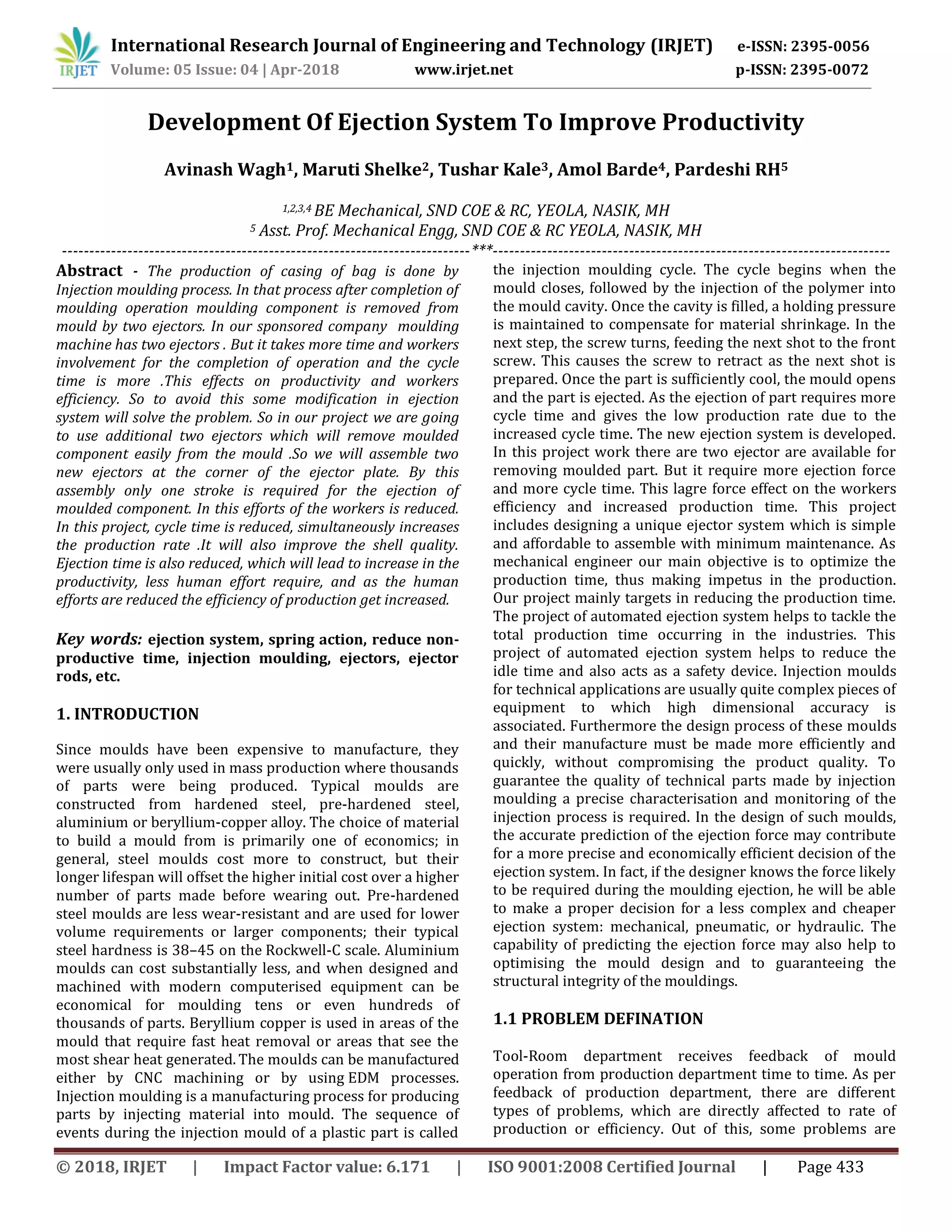
4. CYCLE TIME ANALYSIS CHART
Fig. 4.1 Cycle Time Analysis
From above analysis, it is clear that ejection time is more
important factor in all over cycle time of component. Then
started new concept for modification in ejection system.
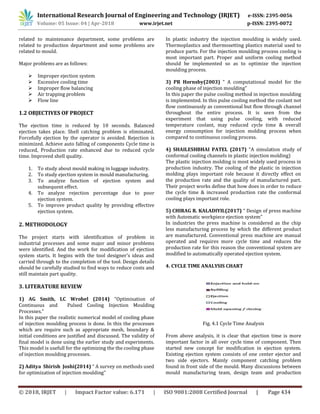
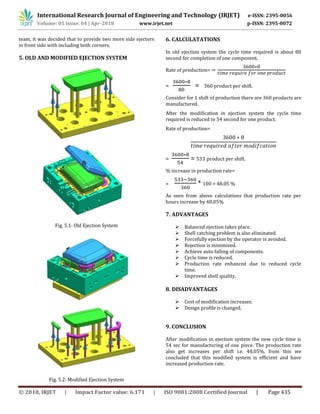
Existing ejection system consists of one center ejector and
two side ejectors. Mainly component catching problem
found in front side of the mould. Many discussions between
mould manufacturing team, design team and production
International Research Journal of Engineering and Technology (IRJET) e-ISSN: 2395-0056
Volume: 05 Issue: 04 | Apr-2018 www.irjet.net p-ISSN: 2395-0072
© 2018, IRJET | Impact Factor value: 6.171 | ISO 9001:2008 Certified Journal | Page 435
team, it was decided that to provide two more side ejectors
in front side with including both corners.
5. OLD AND MODIFIED EJECTION SYSTEM
Fig. 5.1: Old Ejection System
Fig. 5.2: Modified Ejection System
6. CALCULATATIONS
In old ejection system the cycle time required is about 80
second for completion of one component.
Rate of production=
= = 360 product per shift.
Consider for 1 shift of production there are 360 products are
manufactured.
After the modification in ejection system the cycle time
required is reduced to 54 second for one product.
Rate of production=
= = 533 product per shift.
% increase in production rate=
= * 100 = 48.05 %
As seen from above calculations that production rate per
hours increase by 48.05%
7. ADVANTAGES
 Balanced ejection takes place.
 Shell catching problem is also eliminated.
 Forcefully ejection by the operator is avoided.
 Rejection is minimized.
 Achieve auto falling of components.
 Cycle time is reduced.
 Production rate enhanced due to reduced cycle
time.
 Improved shell quality.
8. DISADVANTAGES
 Cost of modification increases.
 Design profile is changed.
9. CONCLUSION
After modification in ejection system the new cycle time is
54 sec for manufacturing of one piece. The production rate
also get increases per shift i.e. 48.05%. from this we
concluded that this modified system is efficient and have
increased production rate.
International Research Journal of Engineering and Technology (IRJET) e-ISSN: 2395-0056
Volume: 05 Issue: 04 | Apr-2018 www.irjet.net p-ISSN: 2395-0072
© 2018, IRJET | Impact Factor value: 6.171 | ISO 9001:2008 Certified Journal | Page 436
10. REFERENCES
[1] A G Smith, L C Wrobel, B A McCalla, P S Allan, P R
Hornsby, “Optimisation of Continuous and Pulsed Coolingin
Injection Moulding Processes.”
[2] B.A. McCalla, P.S. Allan, P.R. Hornsby, A.G. Smith, L.C
Wrobel, A.L. Kelly and P.D. Coates, Evaluation ofpulsed
cooling in injection mould tools, Polymer Process
Engineering 03, pp. 52–71, Bradford, UK, 2003
[3] Muhammad Khan, S. Kamran Afaq, NizarUllah Khan and
Saboor Ahmed, “Cycle Time Reduction in Injection Molding
Procss by Selection of Robust Cooling Channel Design,” Vol.
2014, Article ID 968484, ISRN Mechanical Engineering,
Hindawi Publishing Corporation.
[4] Omar A. Mohamed, S.H. Masood, AbulSaifullah, “A
Simulation Study of Conformal Cooling Channels in
PlasticInjection Molding.” , International Journal of
Engineering Research ISSN : 23196890 Volume No.2, Issue
No. 5,pp : 344-348
[5] Chirag R. Kaladiyil, Rupesh K. Hatui “Design of Press
Machine with Automatic Workpiece Ejection System”
Volume 5 Issue VI, June 2017 ISSN: 2321-9653, pp. 527-542.

IRJET- Development of Ejection System to Improve Productivity

  • 1.
    International Research Journalof Engineering and Technology (IRJET) e-ISSN: 2395-0056 Volume: 05 Issue: 04 | Apr-2018 www.irjet.net p-ISSN: 2395-0072 © 2018, IRJET | Impact Factor value: 6.171 | ISO 9001:2008 Certified Journal | Page 433 Development Of Ejection System To Improve Productivity Avinash Wagh1, Maruti Shelke2, Tushar Kale3, Amol Barde4, Pardeshi RH5 1,2,3,4 BE Mechanical, SND COE & RC, YEOLA, NASIK, MH 5 Asst. Prof. Mechanical Engg, SND COE & RC YEOLA, NASIK, MH ---------------------------------------------------------------------------***------------------------------------------------------------------------- Abstract - The production of casing of bag is done by Injection moulding process. In that process after completion of moulding operation moulding component is removed from mould by two ejectors. In our sponsored company moulding machine has two ejectors . But it takes more time and workers involvement for the completion of operation and the cycle time is more .This effects on productivity and workers efficiency. So to avoid this some modification in ejection system will solve the problem. So in our project we are going to use additional two ejectors which will remove moulded component easily from the mould .So we will assemble two new ejectors at the corner of the ejector plate. By this assembly only one stroke is required for the ejection of moulded component. In this efforts of the workers is reduced. In this project, cycle time is reduced, simultaneously increases the production rate .It will also improve the shell quality. Ejection time is also reduced, which will lead to increase in the productivity, less human effort require, and as the human efforts are reduced the efficiency of production get increased. Key words: ejection system, spring action, reduce non- productive time, injection moulding, ejectors, ejector rods, etc. 1. INTRODUCTION Since moulds have been expensive to manufacture, they were usually only used in mass production where thousands of parts were being produced. Typical moulds are constructed from hardened steel, pre-hardened steel, aluminium or beryllium-copper alloy. The choice of material to build a mould from is primarily one of economics; in general, steel moulds cost more to construct, but their longer lifespan will offset the higher initial cost over a higher number of parts made before wearing out. Pre-hardened steel moulds are less wear-resistant and are used for lower volume requirements or larger components; their typical steel hardness is 38–45 on the Rockwell-C scale. Aluminium moulds can cost substantially less, and when designed and machined with modern computerised equipment can be economical for moulding tens or even hundreds of thousands of parts. Beryllium copper is used in areas of the mould that require fast heat removal or areas that see the most shear heat generated. The moulds can be manufactured either by CNC machining or by using EDM processes. Injection moulding is a manufacturing process for producing parts by injecting material into mould. The sequence of events during the injection mould of a plastic part is called the injection moulding cycle. The cycle begins when the mould closes, followed by the injection of the polymer into the mould cavity. Once the cavity is filled, a holding pressure is maintained to compensate for material shrinkage. In the next step, the screw turns, feeding the next shot to the front screw. This causes the screw to retract as the next shot is prepared. Once the part is sufficiently cool, the mould opens and the part is ejected. As the ejection of part requires more cycle time and gives the low production rate due to the increased cycle time. The new ejection system is developed. In this project work there are two ejector are available for removing moulded part. But it require more ejection force and more cycle time. This lagre force effect on the workers efficiency and increased production time. This project includes designing a unique ejector system which is simple and affordable to assemble with minimum maintenance. As mechanical engineer our main objective is to optimize the production time, thus making impetus in the production. Our project mainly targets in reducing the production time. The project of automated ejection system helps to tackle the total production time occurring in the industries. This project of automated ejection system helps to reduce the idle time and also acts as a safety device. Injection moulds for technical applications are usually quite complex pieces of equipment to which high dimensional accuracy is associated. Furthermore the design process of these moulds and their manufacture must be made more efficiently and quickly, without compromising the product quality. To guarantee the quality of technical parts made by injection moulding a precise characterisation and monitoring of the injection process is required. In the design of such moulds, the accurate prediction of the ejection force may contribute for a more precise and economically efficient decision of the ejection system. In fact, if the designer knows the force likely to be required during the moulding ejection, he will be able to make a proper decision for a less complex and cheaper ejection system: mechanical, pneumatic, or hydraulic. The capability of predicting the ejection force may also help to optimising the mould design and to guaranteeing the structural integrity of the mouldings. 1.1 PROBLEM DEFINATION Tool-Room department receives feedback of mould operation from production department time to time. As per feedback of production department, there are different types of problems, which are directly affected to rate of production or efficiency. Out of this, some problems are
  • 2.
    International Research Journalof Engineering and Technology (IRJET) e-ISSN: 2395-0056 Volume: 05 Issue: 04 | Apr-2018 www.irjet.net p-ISSN: 2395-0072 © 2018, IRJET | Impact Factor value: 6.171 | ISO 9001:2008 Certified Journal | Page 434 related to maintenance department, some problems are related to production department and some problems are related to mould. Major problems are as follows:  Improper ejection system  Excessive cooling time  Improper flow balancing  Air trapping problem  Flow line 1.2 OBJECTIVES OF PROJECT The ejection time is reduced by 10 seconds. Balanced ejection takes place. Shell catching problem is eliminated. Forcefully ejection by the operator is avoided. Rejection is minimized. Achieve auto falling of components Cycle time is reduced, Production rate enhanced due to reduced cycle time. Improved shell quality. 1. To study about mould making in luggage industry. 2. To study ejection system in mould manufacturing. 3. To analyze function of ejection system and subsequent effect. 4. To analyze rejection percentage due to poor ejection system. 5. To improve product quality by providing effective ejection system. 2. METHODOLOGY The project starts with identification of problem in industrial processes and some major and minor problems were identified. And the work for modification of ejection system starts. It begins with the tool designer's ideas and carried through to the completion of the tool. Design details should be carefully studied to find ways to reduce costs and still maintain part quality. 3. LITERATURE REVIEW 1) AG Smith, LC Wrobel (2014) “Optimisation of Continuous and Pulsed Cooling Injection Moulding Processes.” In this paper the realistic numerical model of cooling phase of injection moulding process is done. In this the processes which are require such as appropriate mesh, boundary & initial conditions are justified and discussed. The validity of final model is done using the earlier study and experiments. This model is usefull for the optimizing the the cooling phase of injection moulding processes. 2) Aditya Shirish Joshi(2014) “ A survey on methods used for optimization of injection moulding” In plastic industry the injection moulding is widely used. Thermoplastics and thermosetting plastics material used to produce parts. For the injection moulding process cooling is most important part. Proper and uniform cooling method should be implemented so as to optimize the injection moulding process. 3) PR Hornsby(2003) “ A computational model for the cooling phase of injection moulding” In this paper the pulse cooling method in injection moulding is implemented. In this pulse cooling method the coolant not flow continuously as conventional but flow through channel throughout the entire process. It is seen from the experiment that using pulse cooling, with reduced temperature coolant, may reduced cycle time & overall energy consumption for injection molding process when compared to continuous cooling process. 4) SHAILESHBHAI PATEL (2017) “A simulation study of conformal cooling channels in plastic injection molding) The plastic injection molding is most widely used process in production industry. The cooling of the plastic in injection molding plays important role because it directly effect on the production rate and the quality of manufactured part. Their project works define that how does in order to reduce the cycle time & increased production rate the conformal cooling plays important role. 5) CHIRAG R. KALADIYIL(2017) “ Design of press machine with Automatic workpiece ejection system” In industries the press machine is considered as the chip less manufacturing process by which the different product are manufactured. Conventional press machine are manual operated and requires more cycle time and reduces the production rate for this reason the conventional system are modified to automatically operated ejection system. 4. CYCLE TIME ANALYSIS CHART Fig. 4.1 Cycle Time Analysis From above analysis, it is clear that ejection time is more important factor in all over cycle time of component. Then started new concept for modification in ejection system. Existing ejection system consists of one center ejector and two side ejectors. Mainly component catching problem found in front side of the mould. Many discussions between mould manufacturing team, design team and production
  • 3.
    International Research Journalof Engineering and Technology (IRJET) e-ISSN: 2395-0056 Volume: 05 Issue: 04 | Apr-2018 www.irjet.net p-ISSN: 2395-0072 © 2018, IRJET | Impact Factor value: 6.171 | ISO 9001:2008 Certified Journal | Page 435 team, it was decided that to provide two more side ejectors in front side with including both corners. 5. OLD AND MODIFIED EJECTION SYSTEM Fig. 5.1: Old Ejection System Fig. 5.2: Modified Ejection System 6. CALCULATATIONS In old ejection system the cycle time required is about 80 second for completion of one component. Rate of production= = = 360 product per shift. Consider for 1 shift of production there are 360 products are manufactured. After the modification in ejection system the cycle time required is reduced to 54 second for one product. Rate of production= = = 533 product per shift. % increase in production rate= = * 100 = 48.05 % As seen from above calculations that production rate per hours increase by 48.05% 7. ADVANTAGES  Balanced ejection takes place.  Shell catching problem is also eliminated.  Forcefully ejection by the operator is avoided.  Rejection is minimized.  Achieve auto falling of components.  Cycle time is reduced.  Production rate enhanced due to reduced cycle time.  Improved shell quality. 8. DISADVANTAGES  Cost of modification increases.  Design profile is changed. 9. CONCLUSION After modification in ejection system the new cycle time is 54 sec for manufacturing of one piece. The production rate also get increases per shift i.e. 48.05%. from this we concluded that this modified system is efficient and have increased production rate.
  • 4.
    International Research Journalof Engineering and Technology (IRJET) e-ISSN: 2395-0056 Volume: 05 Issue: 04 | Apr-2018 www.irjet.net p-ISSN: 2395-0072 © 2018, IRJET | Impact Factor value: 6.171 | ISO 9001:2008 Certified Journal | Page 436 10. REFERENCES [1] A G Smith, L C Wrobel, B A McCalla, P S Allan, P R Hornsby, “Optimisation of Continuous and Pulsed Coolingin Injection Moulding Processes.” [2] B.A. McCalla, P.S. Allan, P.R. Hornsby, A.G. Smith, L.C Wrobel, A.L. Kelly and P.D. Coates, Evaluation ofpulsed cooling in injection mould tools, Polymer Process Engineering 03, pp. 52–71, Bradford, UK, 2003 [3] Muhammad Khan, S. Kamran Afaq, NizarUllah Khan and Saboor Ahmed, “Cycle Time Reduction in Injection Molding Procss by Selection of Robust Cooling Channel Design,” Vol. 2014, Article ID 968484, ISRN Mechanical Engineering, Hindawi Publishing Corporation. [4] Omar A. Mohamed, S.H. Masood, AbulSaifullah, “A Simulation Study of Conformal Cooling Channels in PlasticInjection Molding.” , International Journal of Engineering Research ISSN : 23196890 Volume No.2, Issue No. 5,pp : 344-348 [5] Chirag R. Kaladiyil, Rupesh K. Hatui “Design of Press Machine with Automatic Workpiece Ejection System” Volume 5 Issue VI, June 2017 ISSN: 2321-9653, pp. 527-542.