CO_Q2_Science 6_ Module 1
Science
Quarter 2 – Module 1:
The Human Body Systems
(Skeletal, Integumentary and Digestive System)
6
6
Science
Quarter 2 – Module 1:
The Human Body Systems
(Skeletal, Integumentary and Digestive System)
Science – Grade 6
Alternative Delivery Mode
Quarter 2 – Module 1: The Human Body Systems: Skeletal Systems
First Edition, 2019
Republic Act 8293, section 176 states that: No copyright shall subsist in any work of
the Governmentof the Philippines. However,prior approval of the governmentagency or office
wherein the work is created shall be necessary for exploitation of such work for profit. Such
agency or office may, among other things, impose as a condition the payment of royalties.
Borrowed materials (i.e., songs, stories, poems, pictures, photos, brand names,
trademarks, etc.) included in this module are owned by their respective copyright holders.
Every effort has been exerted to locate and seek permission to use these materials from their
respective copyright owners. The publisher and authors do not represent nor claim ownership
over them.
Published by the Department of Education
Secretary: Leonor Magtolis Briones
Undersecretary: Diosdado M. San Antonio
Printed in the Philippines by ________________________
Department of Education – Region VI-Western Visayas
Office Address: Duran Street, Iloilo City, Philippines, 5000
Telefax: (033) 336-2816, (033) 509-7653
E-mail Address: deped6@deped.gov.ph
Development Team of the Module
Authors: Nancy N. Torres, Judy C. Villanueva,
Jamicah,B. Barcenal, Juliemar D. Lestimoso
Editors: Rovel R. Salcedo, Ma. Ana C. Ebon,
Reviewers: Marilou D. Aribas, Ana Maria M. Espende, Eleah Joy T. Poneles,
Girlie A. Panaguiton, Ester I. Posadas
Illustrators: Ronald R. Castillo, Kharlo L. Gambale
Layout Artist: Roxan E. Del Castillo, Armand D. Subingsubing
Graphic Artist: Gilbert Paulo C. Pagapang
Management Team:
Ma. Gemma M. Ledesma, Josilyn S. Solana, Allan B. Yap,
Lynee A. Peñaflor Elena P. Gonzaga, Donald T. Ginine,
Rovel R. Salcedo, Ma. Lourdes V. Teodoro, Ma. Ana C. Ebon,
Raymund L. Santiago
1
CO_Q2_Science 6_ Module 1
What I Need to Know
This module was designed and written with you in mind. It is here
to help you master the human body systems. The scope of this module is
used in many different learning situations. The language used recognizes
the diversevocabulary level of students. The lessons are arranged to follow
the standard sequence of the course. But the order in which you read
them can be changed to correspond with the textbook you are now using.
This module is divided into three lessons:
Lesson 1: Identifying the major parts of skeletal system
Explaining how each organ of the skeletal system works
together
Lesson 2: Describing the parts of the integumentary system
Explaining how each part of the integumentary system works
together
Lesson 3: Naming the major parts of digestive system
Explaining how each part of the digestive system works
together
After going through this module, you are expected to:
1. Identify the major parts of skeletal system
2. Explain how each organ of the skeletal system works together
3. Describe the parts of the integumentary system
4. Explain how each part of the integumentary system works together
5. Name the major parts of the digestive system
6. Explain how each part of the digestive system works together
2
CO_Q2_Science 6_ Module 1
What I Know
Directions: Read the following questions/items. Choose the correct
answer from the given choices. Write your answer in your Science
journal.
1. The following are the functions of the skeletal system, except
a. It gives shape to the body.
b. It serves as the framework of the body.
c. It protects the internal organ of the body.
d. It circulates oxygen and removes carbon dioxide.
2. Why is bone marrow important to the body?
a. It stores much fat.
b. It makes the bone strong.
c. It produces red blood c e l l .
d. It produces new bone cell.
3. It manufactures the blood cells in the body.
a. bone marrow
b. blood
c. blood cell
d. hinge joints
4. Which body system that protects the organs of the
body such as the heart, lungs, and brain?
a. skeletal system
b. circulatory system
c. muscular system
d. digestive system
5. The skin is the largest organ in your body. Which of the
following describe the function of the skin?
I. Protects the body from physical and chemical injuries
II. Makes the skin darker
III. Acts as sensory response
IV. Helps in the formation of Vitamin D
V. Regulates body temperature
VI. Carries the body wastes
3
CO_Q2_Science 6_ Module 1
a. I, III, V, VI c. II, III, IV, VI
b. I, II, III, IV, V d. I, II, III, V, VI
6. What is the integumentary system made of?
I. Teeth
II. Skin
III. Bones
IV. Nails
V. Hair
VI. Eyes
VII. Sweat Glands
a. II, III, IV, V c. III, IV, V, VI
b. II, IV, V, VII d. I, IV, V, VII
7. What is the skin’s natural oil?
a. Sweat c. Sebum
b. Melanin d. Vegetable oil
8. What system is composed of the mouth, esophagus, stomach,
small intestine, and large intestine?
a. Digestive System
b. Respiratory System
c. Circulatory System
d. Excretory System
9.Where does digestion begin?
a. nose
b. esophagus
c. mouth
d. rectum
10.Where does final digestion take place?
a. small intestine
b. large intestine
c. esophagus
d. mouth
4
CO_Q2_Science 6_ Module 1
In your Grade 4 Science, you have learned the major
organs of the body and how these organs work together to make
the body function properly. You have also learned that plants
and animals have body structures that help them survive in their
particular habitat.
In the succeeding lessons, you will learn that the organs of
the body are organized into different systems that perform
specific functions.
What’s In
A. Directions: Read the statements carefully. Write TRUE if the statement is
correct and FALSE if it is wrong. Write your answer in your Science journal.
1. The heart is the organ of the body that pumps the blood.
2. The liver is the smallest gland in the body.
3. The kidneys are two bean-shaped organs in the renal system.
4. The small intestine is the narrow-coiled tube connected to the
stomach.
5. The bones are important parts of the body.
6. The hinge joints are the joints that can be bent back and forth.
7. Ball and socket joints are the joints that allow circular and free
movement.
8. Cartilages are soft, bony, and elastic pads between bones that
serve as cushion.
9. The appendicular skeleton is composed of the fore limbs.
10. The axial skeleton is composed of the shoulder, pelvic girdle,
backbone, skull, and rib cage.
The Skeletal System
Lesson
1
5
CO_Q2_Science 6_ Module 1
What’s New
The human body is made up of different kinds of bones. These
bones are called skeleton. The human skeleton is the internal framework
of the body. The adult human skeleton consists of 206 bones that are
connected to one another by ligaments. At birth, infants have around 300
bones fused together when they become adults. These bones work
together as a system called a skeletal system.
The skeletal system serves as the framework of the body. Its major
functions are body support, facilitation of movement, protection of internal
organs, storage of minerals and fats, and blood cell formation.
Activity
Directions: Label the parts of skeletal system. Write your answer
in your Science journal.
What Is It
The skeletal system is mainly composed of bones which are
classified into two divisions, the axial and the appendicular skeleton.
6
CO_Q2_Science 6_ Module 1
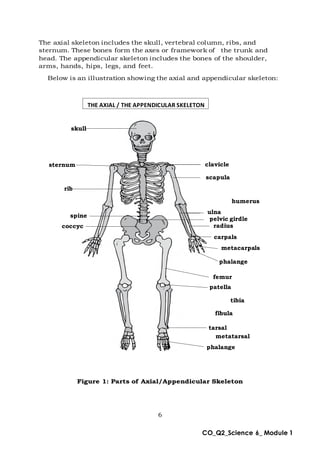
The axial skeleton includes the skull, vertebral column, ribs, and
sternum. These bones form the axes or framework of the trunk and
head. The appendicular skeleton includes the bones of the shoulder,
arms, hands, hips, legs, and feet.
Below is an illustration showing the axial and appendicular skeleton:
Figure 1: Parts of Axial/Appendicular Skeleton
THE AXIAL / THE APPENDICULAR SKELETON
skull
clavicle
scapula
humerus
sternum
rib
pelvic girdle
radius
ulna
carpals
metacarpals
phalange
femur
patella
tibia
fibula
tarsal
metatarsal
phalange
spine
coccyc
7
CO_Q2_Science 6_ Module 1
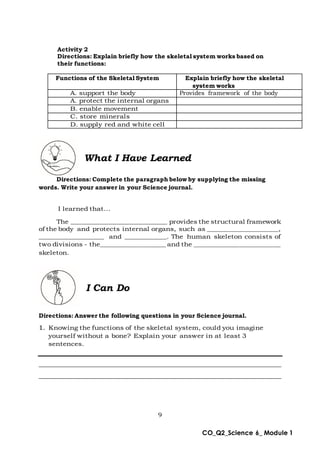
All other bones of skeletal system are classified into 4 as shown in the
table below:
Classification of Bones Illustration Location
Long bones
limbs like arms
and legs
Short bones wrist and ankles
Flat bones shoulder blades
and skull
Irregular bones face and vertebrae
Figure 2: Classification of Bones
One of the axial skeletons is the skull which consists of cranium
and facial bones. The cranium is made up of eight bones joined together
to form a rigid case that protects the brain. The face is made up of 14
facial bones. The eye socket protects the eyeball while mandible or
jawbone is movable bone that holds the teeth.
The spinal column or vertebrae (neck and backbone) are irregular
bones that protect the spinal cord while the ribcage protects the lungs
and the heart. Vertebrae are arranged on top of the other and move over
each other slightly.
There are 33 vertebrae in the spinal column of a child and 26 in an adult.
This is so because as the child grows, the last seven bones join together
to form just two bones. Ribs are the bones at the side of the chest. There
are 12 pairs of ribs.
The upper 7 pairs are the true ribs because they are connected to the
breastbone and the last two pairs are not connected. These ribs are
called floating ribs. The shoulder has the collarbone found in front of
it. Scapula is the shoulder bone found at the back of your shoulder.
The appendages found in the lower extremities are composed of
pelvic bones. Pelvic bones support the lower parts of the body and aid the
movement of the legs. The upper arms have one long bone called the
8
CO_Q2_Science 6_ Module 1
humerus and two bones in the lower arm are known as the radius and
ulna. Radius or radial bone is one of the two large bones of the forearm.
The other bone is the ulna. The ulna is usually slightly longer than the
radius while the latter is usually thicker.
The wrist connects the hand to the forearm. Each wrist
or carpal consists of 8 bones. The palm or metacarpal has 5
bones.
Inside the bones are bone marrows that are very
important for the body to manufacture blood cells. Bone
marrows are of two types, the red bonemarrow and the yellow
bone marrow. The red bone marrow is found in the humerus,
femur, pelvis and vertebrae while the yellow bone marrow is
found in many other bones.
The human skeletal system has several important functions.
1. Support -The skeletal system provides the
framework which supports and maintains shape of
the body. It gives the body much needed support.
2. Protection -The skeletal system protects the internal organ of
the body.
3. Movement- The skeletal system provides an
attachment for the muscle which makes body
movements possible.
4. Storage andSupply- The skeletal system stores
important minerals like calcium and phosphorus and
produces both red and white blood cells.
What’s More
Activity 1
Directions: Study the name of the bones inside the box. Classify them into
Axial or Appendicular. Write your answer in your Science Journal.
Skull humerus Carpal femur ribs
tibia spine scapula tarsal ulna
Axial Appendicular
Ex. Skull femur
9
CO_Q2_Science 6_ Module 1
Activity 2
Directions: Explain briefly how the skeletal system works based on
their functions:
Functions of the Skeletal System Explain briefly how the skeletal
system works
A. support the body Provides framework of the body
A. protect the internal organs
B. enable movement
C. store minerals
D. supply red and white cell
What I Have Learned
Directions: Complete the paragraph below by supplying the missing
words. Write your answer in your Science journal.
I learned that…
The ____________________________ provides the structural framework
of the body and protects internal organs, such as _____________________,
__________________ and ____________. The human skeleton consists of
two divisions - the______________________ and the _____________________________
skeleton.
What I Can Do
Directions: Answer the following questions in your Science journal.
1. Knowing the functions of the skeletal system, could you imagine
yourself without a bone? Explain your answer in at least 3
sentences.
______________________________________________________________________________________
______________________________________________________________________________________
10
CO_Q2_Science 6_ Module 1
2. The table below shows some common bone injuries.
Supply practices/activities that can help avoid these
injuries.
Bone Injuries Practices/Activitieson How To
Avoid the Injuries
Fracture
Dislocation
Sprain
Additional Activities
Direction: Make a model of human skeletal system using recyclable materials.
Then explain the importance of the materials used in making the model in
relation to the function of the skeletal system.
(Rubrics for Skeletal Model): The output will be based on the Rubrics given
below.
1 2 3 4
Creativity The invention
shows little or
no evidence
of original
thought.
The student’s
works lacks
sincere
originality.
The student
demonstrates
originality.
The student
demonstrates
a unique level
of originality.
Effort The student
does not
finish the
work in a
satisfactory
answer.
The student
finishes the
project, but it
lacks
finishing
touches or
can be
improved
with little
effort.
The student
completes the
project in an
above average
manner, yet
more could
have been
done.
The student
gives effort
beyond the
requirements
of this
project.
Skill The student
shows poor
craftmanship.
The student
shows
average
craftmanship.
The student
shows above
average
craftmanship.
The student
shows
outstanding
craftmanship.
11
CO_Q2_Science 6_ Module 1
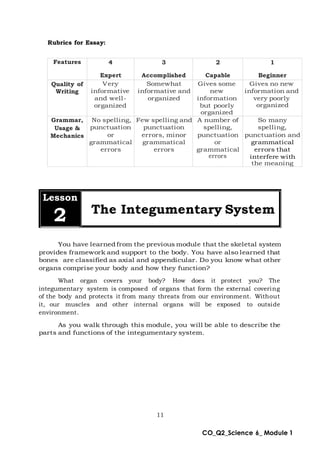
Rubrics for Essay:
Features 4
Expert
3
Accomplished
2
Capable
1
Beginner
Quality of
Writing
Very
informative
and well-
organized
Somewhat
informative and
organized
Gives some
new
information
but poorly
organized
Gives no new
information and
very poorly
organized
Grammar,
Usage &
Mechanics
No spelling,
punctuation
or
grammatical
errors
Few spelling and
punctuation
errors, minor
grammatical
errors
A number of
spelling,
punctuation
or
grammatical
errors
So many
spelling,
punctuation and
grammatical
errors that
interfere with
the meaning
You have learned from the previous module that the skeletal system
provides framework and support to the body. You have also learned that
bones are classified as axial and appendicular. Do you know what other
organs comprise your body and how they function?
What organ covers your body? How does it protect you? The
integumentary system is composed of organs that form the external covering
of the body and protects it from many threats from our environment. Without
it, our muscles and other internal organs will be exposed to outside
environment.
As you walk through this module, you will be able to describe the
parts and functions of the integumentary system.
The Integumentary System
Lesson
2
12
CO_Q2_Science 6_ Module 1
What’s In
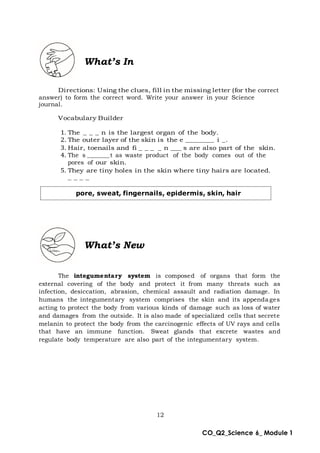
Directions: Using the clues, fill in the missing letter (for the correct
answer) to form the correct word. Write your answer in your Science
journal.
Vocabulary Builder
1. The _ _ _ n is the largest organ of the body.
2. The outer layer of the skin is the e ________ i _.
3. Hair, toenails and fi _ _ _ _ n ___ s are also part of the skin.
4. The s _______t as waste product of the body comes out of the
pores of our skin.
5. They are tiny holes in the skin where tiny hairs are located.
_ _ _ _
What’s New
The integumentary system is composed of organs that form the
external covering of the body and protect it from many threats such as
infection, desiccation, abrasion, chemical assault and radiation damage. In
humans the integumentary system comprises the skin and its appenda ges
acting to protect the body from various kinds of damage such as loss of water
and damages from the outside. It is also made of specialized cells that secrete
melanin to protect the body from the carcinogenic effects of UV rays and cells
that have an immune function. Sweat glands that excrete wastes and
regulate body temperature are also part of the integumentary system.
pore, sweat, fingernails, epidermis, skin, hair
13
CO_Q2_Science 6_ Module 1
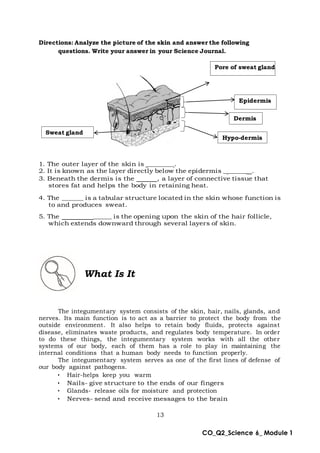
Directions: Analyze the picture of the skin and answer the following
questions. Write your answer in your Science Journal.
1. The outer layer of the skin is _______ .
2. It is known as the layer directly below the epidermis _ _____ .
3. Beneath the dermis is the , a layer of connective tissue that
stores fat and helps the body in retaining heat.
4. The ______ is a tabular structure located in the skin whose function is
to and produces sweat.
5. The _____ is the opening upon the skin of the hair follicle,
which extends downward through several layers of skin.
What Is It
The integumentary system consists of the skin, hair, nails, glands, and
nerves. Its main function is to act as a barrier to protect the body from the
outside environment. It also helps to retain body fluids, protects against
disease, eliminates waste products, and regulates body temperature. In order
to do these things, the integumentary system works with all the other
systems of our body, each of them has a role to play in maintaining the
internal conditions that a human body needs to function properly.
The integumentary system serves as one of the first lines of defense of
our body against pathogens.
• Hair-helps keep you warm
• Nails- give structure to the ends of our fingers
• Glands- release oils for moisture and protection
• Nerves- send and receive messages to the brain
Hypo-dermis
Sweat gland
Dermis
Epidermis
Pore of sweat gland
14
CO_Q2_Science 6_ Module 1
the Skin
FUNCTIONS OF THE INTEGUMENTARY SYSTEM
The integumentary system has many functions, most of
them are involved in protecting you and regulating your body’s
internal functions in a variety of ways:
1. Protects the body's internal living tissues and organs
2. Protects against invasion by infectious organisms
3. Protects the body from dehydration
4. Protects the body against abrupt changes in temperature
5. Helps in disposing waste materials
6. Acts as a receptor for touch, pressure, pain, heat, and cold
7. Stores water and fat
Layers of
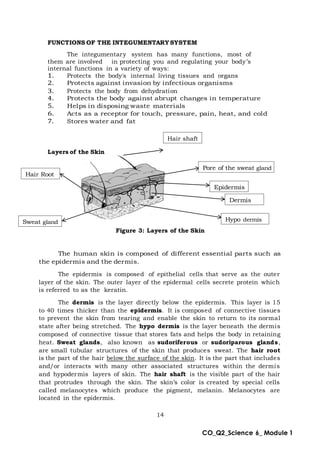
Figure 3: Layers of the Skin
The human skin is composed of different essential parts such as
the epidermis and the dermis.
The epidermis is composed of epithelial cells that serve as the outer
layer of the skin. The outer layer of the epidermal cells secrete protein which
is referred to as the keratin.
The dermis is the layer directly below the epidermis. This layer is 15
to 40 times thicker than the epidermis. It is composed of connective tissues
to prevent the skin from tearing and enable the skin to return to its normal
state after being stretched. The hypo dermis is the layer beneath the dermis
composed of connective tissue that stores fats and helps the body in retaining
heat. Sweat glands, also known as sudoriferous or sudoriparous glands,
are small tubular structures of the skin that produces sweat. The hair root
is the part of the hair below the surface of the skin. It is the part that includes
and/or interacts with many other associated structures within the dermis
and hypodermis layers of skin. The hair shaft is the visible part of the hair
that protrudes through the skin. The skin’s color is created by special cells
called melanocytes which produce the pigment, melanin. Melanocytes are
located in the epidermis.
Hair shaft
15
CO_Q2_Science 6_ Module 1
What’s More
Directions: Study each question carefully and explain your answer briefly. Write
your answer in your Science Journal.
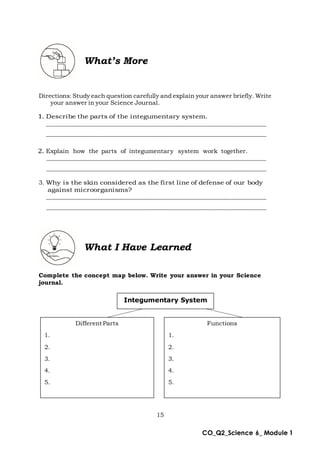
1. Describe the parts of the integumentary system.
__________________________________________________________________________
__________________________________________________________________________
2. Explain how the parts of integumentary system work together.
__________________________________________________________________________
__________________________________________________________________________
3. Why is the skin considered as the first line of defense of our body
against microorganisms?
__________________________________________________________________________
__________________________________________________________________________
What I Have Learned
Complete the concept map below. Write your answer in your Science
journal.
Different Parts
1.
2.
3.
4.
5.
Functions
1.
2.
3.
4.
5.
Integumentary System
16
CO_Q2_Science 6_ Module 1
What I Can Do
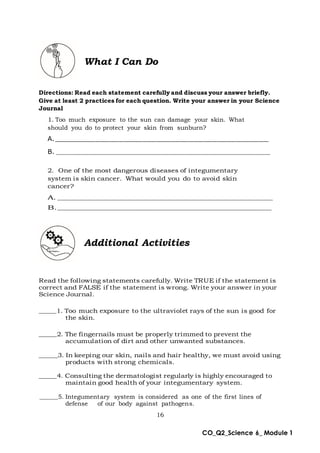
Directions: Read each statement carefully and discuss your answer briefly.
Give at least 2 practices for each question. Write your answer in your Science
Journal
1. Too much exposure to the sun can damage your skin. What
should you do to protect your skin from sunburn?
A.______________________________________________
B. ________________________________________________________________________
2. One of the most dangerous diseases of integumentary
system is skin cancer. What would you do to avoid skin
cancer?
A. __________________________________________________
B.________________________________________________________________________
Additional Activities
Read the following statements carefully. Write TRUE if the statement is
correct and FALSE if the statement is wrong. Write your answer in your
Science Journal.
____1. Too much exposure to the ultraviolet rays of the sun is good for
the skin.
_____2. The fingernails must be properly trimmed to prevent the
accumulation of dirt and other unwanted substances.
______3. In keeping our skin, nails and hair healthy, we must avoid using
products with strong chemicals.
_____4. Consulting the dermatologist regularly is highly encouraged to
maintain good health of your integumentary system.
_____5. Integumentary system is considered as one of the first lines of
defense of our body against pathogens.
17
CO_Q2_Science 6_ Module 1
Did you ever wonder how the food we eat breaks down into smaller
pieces? This is the work of the different organs of our digestive system. The
substances which are needed by our body cannot be absorbed into our blood
until they have broken down further into smaller pieces. The digestive system
is composed of the mouth, esophagus, stomach, small intestine, and large
intestine. These organs work together to break down the food we eat into
smaller pieces for the use of our body.
What’s In
Encircle the parts of the digestive system. Write your answer in
your Science Journal.
mouth lungs trachea
nose esophagus anus
large intestine bronchi dermis
small intestine alveoli stomach
The Digestive System
Lesson
3
18
CO_Q2_Science 6_ Module 1
What’s New
Whatever you do, you need energy. To have energy, you have
to eat. You have learned that you get energy from the food you eat.
Before food can be distributed and absorbed by the cells of the body,
it must be changed first to soluble materials. The process of
breaking down and dissolving the food so that it can be taken
into the blood to be used by the body is called digestion.
The organs that do work for digestion make up the
Digestive System. It includes the mouth, esophagus, stomach,
and small and large intestines.
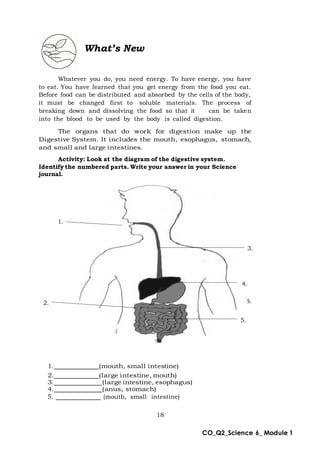
Activity: Look at the diagram of the digestive system.
Identify the numbered parts. Write your answer in your Science
journal.
1. (mouth, small intestine)
2. (large intestine, mouth)
3. (large intestine, esophagus)
4. (anus, stomach)
5. (mouth, small intestine)
2.
1.
3.
4.
5.
19
CO_Q2_Science 6_ Module 1
What Is It
STOMACH
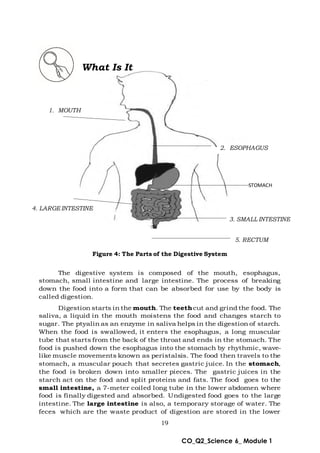
Figure 4: The Parts of the Digestive System
The digestive system is composed of the mouth, esophagus,
stomach, small intestine and large intestine. The process of breaking
down the food into a form that can be absorbed for use by the body is
called digestion.
Digestion starts in the mouth. The teethcut and grind the food. The
saliva, a liquid in the mouth moistens the food and changes starch to
sugar. The ptyalin as an enzyme in saliva helps in the digestion of starch.
When the food is swallowed, it enters the esophagus, a long muscular
tube that starts from the back of the throat and ends in the stomach. The
food is pushed down the esophagus into the stomach by rhythmic, wave-
like muscle movements known as peristalsis. The food then travels to the
stomach, a muscular pouch that secretes gastric juice. In the stomach,
the food is broken down into smaller pieces. The gastric juices in the
starch act on the food and split proteins and fats. The food goes to the
small intestine, a 7-meter coiled long tube in the lower abdomen where
food is finally digested and absorbed. Undigested food goes to the large
intestine. The large intestine is also, a temporary storage of water. The
feces which are the waste product of digestion are stored in the lower
1. MOUTH
2. ESOPHAGUS
3. SMALL INTESTINE
4. LARGE INTESTINE
5. RECTUM
20
CO_Q2_Science6_ Module1
part of the large intestine called rectum. The rectum stores this waste
until it is eliminated through the anus.
What’s More
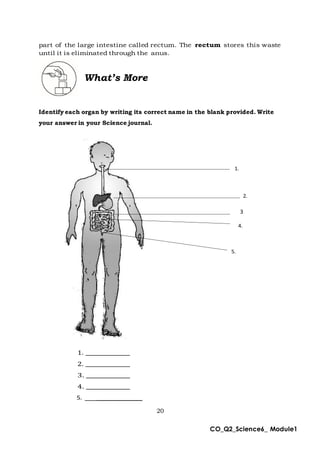
Identify each organ by writing its correct name in the blank provided. Write
your answer in your Science journal.
1. ________
2. ________
3. ________
4. ________
5. _______________
3
21
CO_Q2_Science6_ Module1
What I Have Learned
Complete the statements below. Choose your answer from the given
list. Write your answer in your Science journal.
small intestine large intestine stomach anus rectum
esophagus mouth ptyalin peristalsis digestion
The process of breaking down the food that can be absorbed for the
use of the body is called________. Digestion starts in the _________. The
_________as an enzyme moistens the food. From the mouth, the food
enters a long muscular tube that starts from the back of your throat. The
food then travels to the _________where it is broken down into smaller
pieces. The food is pushed down the esophagus into the stomach by
rhythmic, wave-like movements known as _________. The food goes to
the ________, a 7-meter coiled long tube in the lower abdomen where final
digestion takes place. Undigested food goes to the__________. The
undigested food is eliminated through the___________.
What I Can Do
Read the situation below and explain your answer briefly.
1. Maja accidentally swallowed the santol seed. What do you think will
happen to the seed as it reaches the small intestine?
2. Why do you need to chew the food well?
22
CO_Q2_Science6_ Module1
Additional Activities
Put check under the YES column if the statement agrees with the
function of each organ of the Digestive System and check under the NO
column if not.
ORGANS FUNCTIONS YES NO
Mouth It is where the food is
chewed and cut into
smaller pieces.
Esophagus It is the passageway for
air.
Large Intestine It stores the undigested
food.
Rectum It is where the food
enters.
Small Intestine It is where the final
digestion of food takes
place.
Assessment
Choose the letter of the correct answer. Write your answer on a separate
sheet.
1. It provides the structural framework of the body and protects
internal organs such as heart, lungs and brain.
a. skeletal system
b. muscular system
c. heart
d. bones
23
CO_Q2_Science6_ Module1
2. Which of the following bones protects the lungs?
a. clavicle
b. ribs
c. scapula
d. sternum
3. Which is not a function of the skeletal system?
a. It controls movement and balance of the body.
b. It serves as the framework of the body.
c. It protects the internal organ of the body.
d. It gives support to the body.
4. In which part does digestion begin?
a. esophagus
b. mouth
c. anus
d. intestine
5. Which of the following statements best describes the skin?
a. the largest sense organ
b. receives information about your environment
c. protects your body in any way
d. all of the above
6. Which one of the following is NOT a primary function of
the integumentary system?
a. protection c. reproduction
b. secretion d. sensation
7. Which is affected when a person suffers from first degree burns?
a. epidermis
b. excoriation
c. dermis
d. subcutaneous layer
8.Where is food finally digested and absorbed?
a. small intestine
b. esophagus
c. large intestine
d. mouth
24
CO_Q2_Science6_ Module1
9.Which shows the correct order of food travelling through the digestive
system after it is swallowed?
a. stomach, esophagus, large intestine, small intestine
b. small intestine, large intestine, esophagus, stomach
c. esophagus, stomach, large intestine, small intestine
d. esophagus, stomach, small intestine, large intestine
10. Which of the following statements best describes the
function of the digestive system?
a. It releases acids and mixes food.
b. It aids in absorption of nutrients from food.
c. It carries food from stomach to the intestine.
d. It breaks down food so that the body can absorb food nutrients.
25
CO_Q2_Science6_ Module1
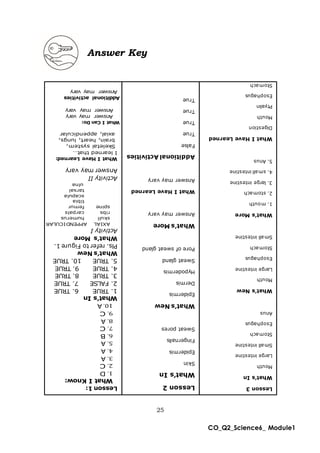
Answer Key
Lesson
1:
What’s
New
Pls.
refer
to
Figure
1.
What’s
More
Activity
I
Activity
II
Answer
may
vary
Lesson
2
What’s
In
Skin
Epidermis
Fingernails
Sweat
pores
What’s
New
Epidermis
Dermis
Hypodermis
Sweat
gland
Pore
of
sweat
gland
What’s
More
Answer
may
vary
What
I
Have
Learned
Answer
may
vary
Additional
Activities
False
True
True
True
True
Lesson
3
What’s
In
Mouth
Large
intestine
Sm
all
intestine
Stom
ach
Esophagus
Anus
What’s
New
Mouth
Large
intestine
Esophagus
Stom
ach
Sm
all
intestine
What’s
More
1.
m
outh
2.
stom
ach
3.
large
intestine
4.
sm
all
intestine
5.
Anus
What
I
Have
Learned
Digestion
Mouth
Ptyalin
Esophagus
Stom
ach
26
CO_Q2_Science6_ Module1
References
A. Book
Abutay, Lelani R. et al. Science-Grade 4 Teacher’s Guide. 5th Floor
Mabini Building, DepEd Complex Meralco Avenue, Pasig City,
Philippines: Lexicon Press, INC., 2015.
Abutay, Lelani R. et al. Science-Grade 4 Learner’s Material. 5th Floor
Mabini Building, DepEd Complex Meralco Avenue, Pasig City,
Philippines: Lexicon Press, INC., 2015.
Lozada, Buena A., Augusto T. Mendoza. Science for Daily Use Textbook
4. Wonders of Integrated Science and Health. K-6th Streets, East
Kamias, Quezo City: St. Matthew’s Publishing, 2016.
Curriculum Guide in Science S66LTIIa-b-2.
Cruz, Juanita M. et al. Into the Future: Science and Health 6. 4th
Floor SEDCCO 1 Bldg. 120 Thailand Corner, Legaspi St., Legaspi
Village, Makati City, Philippines: Lexicon Press INC., 2010.
Dela Cruz, Agnes B. et al. SciENEGERY (TIMSS-based Learning
Materials) For Elementary Level. 28b Venus St., Merryland Village,
Namayan, Mandaluyong City: B2G2 Enterprises, 2008.
Padpad, Evelyn Castante. The New Science Links Worktext in Science
and Technology 6. 856 Nicanor Reyes, Sr. St, Manila Philippines:
Rex Book Store INC., 2017.
Reyes, Hap S. et al. Lesson Plan in Science 5. 2350 Leyte Street, San
Andres, Malate, Manila: Reevee Book Supply, 2017.
Tan, Conchita T. Science for Daily Use 5. 16 Horizon St., Rim View
Park, SSS Village, Marikina City: JICA Enterprises, 2012.
National Geographic Kids Almanac, 2016.
Scholastic Almanac for Kids, 1200 Westlake Ave. North Seattle, WA
98109 Scholastic Inc., 2014.
B. Electronic Resources
Google. “Google Privacy Policy.” Accessed July 15, 2020.
http:// www.humanbodysystem.com /types.com/intl /en /privacy
policy.html.
Google. “Google Privacy Policy.” Accessed June 15, 2020.
http:// www.skeletalsystem.com /intl/en/privacypolicy.html.
For inquiries or feedback, please write or call:
Department of Education – Bureau of Leaning Resources (DepEd-BLR)
Ground Floor, Bonifacio Bldg. DepEd Complex
Meralco Avenue, Pasig City, Philippines 1600
Telefax: (632) 8634-1072; 8634-1054; 8631-4985
Email Address: blr.lrqad@deped.gov.ph * blr.lrpd@deped.gov.ph

Science6_Q2_Mod1_TheHumanBodySystems_V4 (2).pdf

  • 1.
    CO_Q2_Science 6_ Module1 Science Quarter 2 – Module 1: The Human Body Systems (Skeletal, Integumentary and Digestive System) 6
  • 2.
    6 Science Quarter 2 –Module 1: The Human Body Systems (Skeletal, Integumentary and Digestive System)
  • 3.
    Science – Grade6 Alternative Delivery Mode Quarter 2 – Module 1: The Human Body Systems: Skeletal Systems First Edition, 2019 Republic Act 8293, section 176 states that: No copyright shall subsist in any work of the Governmentof the Philippines. However,prior approval of the governmentagency or office wherein the work is created shall be necessary for exploitation of such work for profit. Such agency or office may, among other things, impose as a condition the payment of royalties. Borrowed materials (i.e., songs, stories, poems, pictures, photos, brand names, trademarks, etc.) included in this module are owned by their respective copyright holders. Every effort has been exerted to locate and seek permission to use these materials from their respective copyright owners. The publisher and authors do not represent nor claim ownership over them. Published by the Department of Education Secretary: Leonor Magtolis Briones Undersecretary: Diosdado M. San Antonio Printed in the Philippines by ________________________ Department of Education – Region VI-Western Visayas Office Address: Duran Street, Iloilo City, Philippines, 5000 Telefax: (033) 336-2816, (033) 509-7653 E-mail Address: deped6@deped.gov.ph Development Team of the Module Authors: Nancy N. Torres, Judy C. Villanueva, Jamicah,B. Barcenal, Juliemar D. Lestimoso Editors: Rovel R. Salcedo, Ma. Ana C. Ebon, Reviewers: Marilou D. Aribas, Ana Maria M. Espende, Eleah Joy T. Poneles, Girlie A. Panaguiton, Ester I. Posadas Illustrators: Ronald R. Castillo, Kharlo L. Gambale Layout Artist: Roxan E. Del Castillo, Armand D. Subingsubing Graphic Artist: Gilbert Paulo C. Pagapang Management Team: Ma. Gemma M. Ledesma, Josilyn S. Solana, Allan B. Yap, Lynee A. Peñaflor Elena P. Gonzaga, Donald T. Ginine, Rovel R. Salcedo, Ma. Lourdes V. Teodoro, Ma. Ana C. Ebon, Raymund L. Santiago
  • 4.
    1 CO_Q2_Science 6_ Module1 What I Need to Know This module was designed and written with you in mind. It is here to help you master the human body systems. The scope of this module is used in many different learning situations. The language used recognizes the diversevocabulary level of students. The lessons are arranged to follow the standard sequence of the course. But the order in which you read them can be changed to correspond with the textbook you are now using. This module is divided into three lessons: Lesson 1: Identifying the major parts of skeletal system Explaining how each organ of the skeletal system works together Lesson 2: Describing the parts of the integumentary system Explaining how each part of the integumentary system works together Lesson 3: Naming the major parts of digestive system Explaining how each part of the digestive system works together After going through this module, you are expected to: 1. Identify the major parts of skeletal system 2. Explain how each organ of the skeletal system works together 3. Describe the parts of the integumentary system 4. Explain how each part of the integumentary system works together 5. Name the major parts of the digestive system 6. Explain how each part of the digestive system works together
  • 5.
    2 CO_Q2_Science 6_ Module1 What I Know Directions: Read the following questions/items. Choose the correct answer from the given choices. Write your answer in your Science journal. 1. The following are the functions of the skeletal system, except a. It gives shape to the body. b. It serves as the framework of the body. c. It protects the internal organ of the body. d. It circulates oxygen and removes carbon dioxide. 2. Why is bone marrow important to the body? a. It stores much fat. b. It makes the bone strong. c. It produces red blood c e l l . d. It produces new bone cell. 3. It manufactures the blood cells in the body. a. bone marrow b. blood c. blood cell d. hinge joints 4. Which body system that protects the organs of the body such as the heart, lungs, and brain? a. skeletal system b. circulatory system c. muscular system d. digestive system 5. The skin is the largest organ in your body. Which of the following describe the function of the skin? I. Protects the body from physical and chemical injuries II. Makes the skin darker III. Acts as sensory response IV. Helps in the formation of Vitamin D V. Regulates body temperature VI. Carries the body wastes
  • 6.
    3 CO_Q2_Science 6_ Module1 a. I, III, V, VI c. II, III, IV, VI b. I, II, III, IV, V d. I, II, III, V, VI 6. What is the integumentary system made of? I. Teeth II. Skin III. Bones IV. Nails V. Hair VI. Eyes VII. Sweat Glands a. II, III, IV, V c. III, IV, V, VI b. II, IV, V, VII d. I, IV, V, VII 7. What is the skin’s natural oil? a. Sweat c. Sebum b. Melanin d. Vegetable oil 8. What system is composed of the mouth, esophagus, stomach, small intestine, and large intestine? a. Digestive System b. Respiratory System c. Circulatory System d. Excretory System 9.Where does digestion begin? a. nose b. esophagus c. mouth d. rectum 10.Where does final digestion take place? a. small intestine b. large intestine c. esophagus d. mouth
  • 7.
    4 CO_Q2_Science 6_ Module1 In your Grade 4 Science, you have learned the major organs of the body and how these organs work together to make the body function properly. You have also learned that plants and animals have body structures that help them survive in their particular habitat. In the succeeding lessons, you will learn that the organs of the body are organized into different systems that perform specific functions. What’s In A. Directions: Read the statements carefully. Write TRUE if the statement is correct and FALSE if it is wrong. Write your answer in your Science journal. 1. The heart is the organ of the body that pumps the blood. 2. The liver is the smallest gland in the body. 3. The kidneys are two bean-shaped organs in the renal system. 4. The small intestine is the narrow-coiled tube connected to the stomach. 5. The bones are important parts of the body. 6. The hinge joints are the joints that can be bent back and forth. 7. Ball and socket joints are the joints that allow circular and free movement. 8. Cartilages are soft, bony, and elastic pads between bones that serve as cushion. 9. The appendicular skeleton is composed of the fore limbs. 10. The axial skeleton is composed of the shoulder, pelvic girdle, backbone, skull, and rib cage. The Skeletal System Lesson 1
  • 8.
    5 CO_Q2_Science 6_ Module1 What’s New The human body is made up of different kinds of bones. These bones are called skeleton. The human skeleton is the internal framework of the body. The adult human skeleton consists of 206 bones that are connected to one another by ligaments. At birth, infants have around 300 bones fused together when they become adults. These bones work together as a system called a skeletal system. The skeletal system serves as the framework of the body. Its major functions are body support, facilitation of movement, protection of internal organs, storage of minerals and fats, and blood cell formation. Activity Directions: Label the parts of skeletal system. Write your answer in your Science journal. What Is It The skeletal system is mainly composed of bones which are classified into two divisions, the axial and the appendicular skeleton.
  • 9.
    6 CO_Q2_Science 6_ Module1 The axial skeleton includes the skull, vertebral column, ribs, and sternum. These bones form the axes or framework of the trunk and head. The appendicular skeleton includes the bones of the shoulder, arms, hands, hips, legs, and feet. Below is an illustration showing the axial and appendicular skeleton: Figure 1: Parts of Axial/Appendicular Skeleton THE AXIAL / THE APPENDICULAR SKELETON skull clavicle scapula humerus sternum rib pelvic girdle radius ulna carpals metacarpals phalange femur patella tibia fibula tarsal metatarsal phalange spine coccyc
  • 10.
    7 CO_Q2_Science 6_ Module1 All other bones of skeletal system are classified into 4 as shown in the table below: Classification of Bones Illustration Location Long bones limbs like arms and legs Short bones wrist and ankles Flat bones shoulder blades and skull Irregular bones face and vertebrae Figure 2: Classification of Bones One of the axial skeletons is the skull which consists of cranium and facial bones. The cranium is made up of eight bones joined together to form a rigid case that protects the brain. The face is made up of 14 facial bones. The eye socket protects the eyeball while mandible or jawbone is movable bone that holds the teeth. The spinal column or vertebrae (neck and backbone) are irregular bones that protect the spinal cord while the ribcage protects the lungs and the heart. Vertebrae are arranged on top of the other and move over each other slightly. There are 33 vertebrae in the spinal column of a child and 26 in an adult. This is so because as the child grows, the last seven bones join together to form just two bones. Ribs are the bones at the side of the chest. There are 12 pairs of ribs. The upper 7 pairs are the true ribs because they are connected to the breastbone and the last two pairs are not connected. These ribs are called floating ribs. The shoulder has the collarbone found in front of it. Scapula is the shoulder bone found at the back of your shoulder. The appendages found in the lower extremities are composed of pelvic bones. Pelvic bones support the lower parts of the body and aid the movement of the legs. The upper arms have one long bone called the
  • 11.
    8 CO_Q2_Science 6_ Module1 humerus and two bones in the lower arm are known as the radius and ulna. Radius or radial bone is one of the two large bones of the forearm. The other bone is the ulna. The ulna is usually slightly longer than the radius while the latter is usually thicker. The wrist connects the hand to the forearm. Each wrist or carpal consists of 8 bones. The palm or metacarpal has 5 bones. Inside the bones are bone marrows that are very important for the body to manufacture blood cells. Bone marrows are of two types, the red bonemarrow and the yellow bone marrow. The red bone marrow is found in the humerus, femur, pelvis and vertebrae while the yellow bone marrow is found in many other bones. The human skeletal system has several important functions. 1. Support -The skeletal system provides the framework which supports and maintains shape of the body. It gives the body much needed support. 2. Protection -The skeletal system protects the internal organ of the body. 3. Movement- The skeletal system provides an attachment for the muscle which makes body movements possible. 4. Storage andSupply- The skeletal system stores important minerals like calcium and phosphorus and produces both red and white blood cells. What’s More Activity 1 Directions: Study the name of the bones inside the box. Classify them into Axial or Appendicular. Write your answer in your Science Journal. Skull humerus Carpal femur ribs tibia spine scapula tarsal ulna Axial Appendicular Ex. Skull femur
  • 12.
    9 CO_Q2_Science 6_ Module1 Activity 2 Directions: Explain briefly how the skeletal system works based on their functions: Functions of the Skeletal System Explain briefly how the skeletal system works A. support the body Provides framework of the body A. protect the internal organs B. enable movement C. store minerals D. supply red and white cell What I Have Learned Directions: Complete the paragraph below by supplying the missing words. Write your answer in your Science journal. I learned that… The ____________________________ provides the structural framework of the body and protects internal organs, such as _____________________, __________________ and ____________. The human skeleton consists of two divisions - the______________________ and the _____________________________ skeleton. What I Can Do Directions: Answer the following questions in your Science journal. 1. Knowing the functions of the skeletal system, could you imagine yourself without a bone? Explain your answer in at least 3 sentences. ______________________________________________________________________________________ ______________________________________________________________________________________
  • 13.
    10 CO_Q2_Science 6_ Module1 2. The table below shows some common bone injuries. Supply practices/activities that can help avoid these injuries. Bone Injuries Practices/Activitieson How To Avoid the Injuries Fracture Dislocation Sprain Additional Activities Direction: Make a model of human skeletal system using recyclable materials. Then explain the importance of the materials used in making the model in relation to the function of the skeletal system. (Rubrics for Skeletal Model): The output will be based on the Rubrics given below. 1 2 3 4 Creativity The invention shows little or no evidence of original thought. The student’s works lacks sincere originality. The student demonstrates originality. The student demonstrates a unique level of originality. Effort The student does not finish the work in a satisfactory answer. The student finishes the project, but it lacks finishing touches or can be improved with little effort. The student completes the project in an above average manner, yet more could have been done. The student gives effort beyond the requirements of this project. Skill The student shows poor craftmanship. The student shows average craftmanship. The student shows above average craftmanship. The student shows outstanding craftmanship.
  • 14.
    11 CO_Q2_Science 6_ Module1 Rubrics for Essay: Features 4 Expert 3 Accomplished 2 Capable 1 Beginner Quality of Writing Very informative and well- organized Somewhat informative and organized Gives some new information but poorly organized Gives no new information and very poorly organized Grammar, Usage & Mechanics No spelling, punctuation or grammatical errors Few spelling and punctuation errors, minor grammatical errors A number of spelling, punctuation or grammatical errors So many spelling, punctuation and grammatical errors that interfere with the meaning You have learned from the previous module that the skeletal system provides framework and support to the body. You have also learned that bones are classified as axial and appendicular. Do you know what other organs comprise your body and how they function? What organ covers your body? How does it protect you? The integumentary system is composed of organs that form the external covering of the body and protects it from many threats from our environment. Without it, our muscles and other internal organs will be exposed to outside environment. As you walk through this module, you will be able to describe the parts and functions of the integumentary system. The Integumentary System Lesson 2
  • 15.
    12 CO_Q2_Science 6_ Module1 What’s In Directions: Using the clues, fill in the missing letter (for the correct answer) to form the correct word. Write your answer in your Science journal. Vocabulary Builder 1. The _ _ _ n is the largest organ of the body. 2. The outer layer of the skin is the e ________ i _. 3. Hair, toenails and fi _ _ _ _ n ___ s are also part of the skin. 4. The s _______t as waste product of the body comes out of the pores of our skin. 5. They are tiny holes in the skin where tiny hairs are located. _ _ _ _ What’s New The integumentary system is composed of organs that form the external covering of the body and protect it from many threats such as infection, desiccation, abrasion, chemical assault and radiation damage. In humans the integumentary system comprises the skin and its appenda ges acting to protect the body from various kinds of damage such as loss of water and damages from the outside. It is also made of specialized cells that secrete melanin to protect the body from the carcinogenic effects of UV rays and cells that have an immune function. Sweat glands that excrete wastes and regulate body temperature are also part of the integumentary system. pore, sweat, fingernails, epidermis, skin, hair
  • 16.
    13 CO_Q2_Science 6_ Module1 Directions: Analyze the picture of the skin and answer the following questions. Write your answer in your Science Journal. 1. The outer layer of the skin is _______ . 2. It is known as the layer directly below the epidermis _ _____ . 3. Beneath the dermis is the , a layer of connective tissue that stores fat and helps the body in retaining heat. 4. The ______ is a tabular structure located in the skin whose function is to and produces sweat. 5. The _____ is the opening upon the skin of the hair follicle, which extends downward through several layers of skin. What Is It The integumentary system consists of the skin, hair, nails, glands, and nerves. Its main function is to act as a barrier to protect the body from the outside environment. It also helps to retain body fluids, protects against disease, eliminates waste products, and regulates body temperature. In order to do these things, the integumentary system works with all the other systems of our body, each of them has a role to play in maintaining the internal conditions that a human body needs to function properly. The integumentary system serves as one of the first lines of defense of our body against pathogens. • Hair-helps keep you warm • Nails- give structure to the ends of our fingers • Glands- release oils for moisture and protection • Nerves- send and receive messages to the brain Hypo-dermis Sweat gland Dermis Epidermis Pore of sweat gland
  • 17.
    14 CO_Q2_Science 6_ Module1 the Skin FUNCTIONS OF THE INTEGUMENTARY SYSTEM The integumentary system has many functions, most of them are involved in protecting you and regulating your body’s internal functions in a variety of ways: 1. Protects the body's internal living tissues and organs 2. Protects against invasion by infectious organisms 3. Protects the body from dehydration 4. Protects the body against abrupt changes in temperature 5. Helps in disposing waste materials 6. Acts as a receptor for touch, pressure, pain, heat, and cold 7. Stores water and fat Layers of Figure 3: Layers of the Skin The human skin is composed of different essential parts such as the epidermis and the dermis. The epidermis is composed of epithelial cells that serve as the outer layer of the skin. The outer layer of the epidermal cells secrete protein which is referred to as the keratin. The dermis is the layer directly below the epidermis. This layer is 15 to 40 times thicker than the epidermis. It is composed of connective tissues to prevent the skin from tearing and enable the skin to return to its normal state after being stretched. The hypo dermis is the layer beneath the dermis composed of connective tissue that stores fats and helps the body in retaining heat. Sweat glands, also known as sudoriferous or sudoriparous glands, are small tubular structures of the skin that produces sweat. The hair root is the part of the hair below the surface of the skin. It is the part that includes and/or interacts with many other associated structures within the dermis and hypodermis layers of skin. The hair shaft is the visible part of the hair that protrudes through the skin. The skin’s color is created by special cells called melanocytes which produce the pigment, melanin. Melanocytes are located in the epidermis. Hair shaft
  • 18.
    15 CO_Q2_Science 6_ Module1 What’s More Directions: Study each question carefully and explain your answer briefly. Write your answer in your Science Journal. 1. Describe the parts of the integumentary system. __________________________________________________________________________ __________________________________________________________________________ 2. Explain how the parts of integumentary system work together. __________________________________________________________________________ __________________________________________________________________________ 3. Why is the skin considered as the first line of defense of our body against microorganisms? __________________________________________________________________________ __________________________________________________________________________ What I Have Learned Complete the concept map below. Write your answer in your Science journal. Different Parts 1. 2. 3. 4. 5. Functions 1. 2. 3. 4. 5. Integumentary System
  • 19.
    16 CO_Q2_Science 6_ Module1 What I Can Do Directions: Read each statement carefully and discuss your answer briefly. Give at least 2 practices for each question. Write your answer in your Science Journal 1. Too much exposure to the sun can damage your skin. What should you do to protect your skin from sunburn? A.______________________________________________ B. ________________________________________________________________________ 2. One of the most dangerous diseases of integumentary system is skin cancer. What would you do to avoid skin cancer? A. __________________________________________________ B.________________________________________________________________________ Additional Activities Read the following statements carefully. Write TRUE if the statement is correct and FALSE if the statement is wrong. Write your answer in your Science Journal. ____1. Too much exposure to the ultraviolet rays of the sun is good for the skin. _____2. The fingernails must be properly trimmed to prevent the accumulation of dirt and other unwanted substances. ______3. In keeping our skin, nails and hair healthy, we must avoid using products with strong chemicals. _____4. Consulting the dermatologist regularly is highly encouraged to maintain good health of your integumentary system. _____5. Integumentary system is considered as one of the first lines of defense of our body against pathogens.
  • 20.
    17 CO_Q2_Science 6_ Module1 Did you ever wonder how the food we eat breaks down into smaller pieces? This is the work of the different organs of our digestive system. The substances which are needed by our body cannot be absorbed into our blood until they have broken down further into smaller pieces. The digestive system is composed of the mouth, esophagus, stomach, small intestine, and large intestine. These organs work together to break down the food we eat into smaller pieces for the use of our body. What’s In Encircle the parts of the digestive system. Write your answer in your Science Journal. mouth lungs trachea nose esophagus anus large intestine bronchi dermis small intestine alveoli stomach The Digestive System Lesson 3
  • 21.
    18 CO_Q2_Science 6_ Module1 What’s New Whatever you do, you need energy. To have energy, you have to eat. You have learned that you get energy from the food you eat. Before food can be distributed and absorbed by the cells of the body, it must be changed first to soluble materials. The process of breaking down and dissolving the food so that it can be taken into the blood to be used by the body is called digestion. The organs that do work for digestion make up the Digestive System. It includes the mouth, esophagus, stomach, and small and large intestines. Activity: Look at the diagram of the digestive system. Identify the numbered parts. Write your answer in your Science journal. 1. (mouth, small intestine) 2. (large intestine, mouth) 3. (large intestine, esophagus) 4. (anus, stomach) 5. (mouth, small intestine) 2. 1. 3. 4. 5.
  • 22.
    19 CO_Q2_Science 6_ Module1 What Is It STOMACH Figure 4: The Parts of the Digestive System The digestive system is composed of the mouth, esophagus, stomach, small intestine and large intestine. The process of breaking down the food into a form that can be absorbed for use by the body is called digestion. Digestion starts in the mouth. The teethcut and grind the food. The saliva, a liquid in the mouth moistens the food and changes starch to sugar. The ptyalin as an enzyme in saliva helps in the digestion of starch. When the food is swallowed, it enters the esophagus, a long muscular tube that starts from the back of the throat and ends in the stomach. The food is pushed down the esophagus into the stomach by rhythmic, wave- like muscle movements known as peristalsis. The food then travels to the stomach, a muscular pouch that secretes gastric juice. In the stomach, the food is broken down into smaller pieces. The gastric juices in the starch act on the food and split proteins and fats. The food goes to the small intestine, a 7-meter coiled long tube in the lower abdomen where food is finally digested and absorbed. Undigested food goes to the large intestine. The large intestine is also, a temporary storage of water. The feces which are the waste product of digestion are stored in the lower 1. MOUTH 2. ESOPHAGUS 3. SMALL INTESTINE 4. LARGE INTESTINE 5. RECTUM
  • 23.
    20 CO_Q2_Science6_ Module1 part ofthe large intestine called rectum. The rectum stores this waste until it is eliminated through the anus. What’s More Identify each organ by writing its correct name in the blank provided. Write your answer in your Science journal. 1. ________ 2. ________ 3. ________ 4. ________ 5. _______________ 3
  • 24.
    21 CO_Q2_Science6_ Module1 What IHave Learned Complete the statements below. Choose your answer from the given list. Write your answer in your Science journal. small intestine large intestine stomach anus rectum esophagus mouth ptyalin peristalsis digestion The process of breaking down the food that can be absorbed for the use of the body is called________. Digestion starts in the _________. The _________as an enzyme moistens the food. From the mouth, the food enters a long muscular tube that starts from the back of your throat. The food then travels to the _________where it is broken down into smaller pieces. The food is pushed down the esophagus into the stomach by rhythmic, wave-like movements known as _________. The food goes to the ________, a 7-meter coiled long tube in the lower abdomen where final digestion takes place. Undigested food goes to the__________. The undigested food is eliminated through the___________. What I Can Do Read the situation below and explain your answer briefly. 1. Maja accidentally swallowed the santol seed. What do you think will happen to the seed as it reaches the small intestine? 2. Why do you need to chew the food well?
  • 25.
    22 CO_Q2_Science6_ Module1 Additional Activities Putcheck under the YES column if the statement agrees with the function of each organ of the Digestive System and check under the NO column if not. ORGANS FUNCTIONS YES NO Mouth It is where the food is chewed and cut into smaller pieces. Esophagus It is the passageway for air. Large Intestine It stores the undigested food. Rectum It is where the food enters. Small Intestine It is where the final digestion of food takes place. Assessment Choose the letter of the correct answer. Write your answer on a separate sheet. 1. It provides the structural framework of the body and protects internal organs such as heart, lungs and brain. a. skeletal system b. muscular system c. heart d. bones
  • 26.
    23 CO_Q2_Science6_ Module1 2. Whichof the following bones protects the lungs? a. clavicle b. ribs c. scapula d. sternum 3. Which is not a function of the skeletal system? a. It controls movement and balance of the body. b. It serves as the framework of the body. c. It protects the internal organ of the body. d. It gives support to the body. 4. In which part does digestion begin? a. esophagus b. mouth c. anus d. intestine 5. Which of the following statements best describes the skin? a. the largest sense organ b. receives information about your environment c. protects your body in any way d. all of the above 6. Which one of the following is NOT a primary function of the integumentary system? a. protection c. reproduction b. secretion d. sensation 7. Which is affected when a person suffers from first degree burns? a. epidermis b. excoriation c. dermis d. subcutaneous layer 8.Where is food finally digested and absorbed? a. small intestine b. esophagus c. large intestine d. mouth
  • 27.
    24 CO_Q2_Science6_ Module1 9.Which showsthe correct order of food travelling through the digestive system after it is swallowed? a. stomach, esophagus, large intestine, small intestine b. small intestine, large intestine, esophagus, stomach c. esophagus, stomach, large intestine, small intestine d. esophagus, stomach, small intestine, large intestine 10. Which of the following statements best describes the function of the digestive system? a. It releases acids and mixes food. b. It aids in absorption of nutrients from food. c. It carries food from stomach to the intestine. d. It breaks down food so that the body can absorb food nutrients.
  • 28.
  • 29.
    26 CO_Q2_Science6_ Module1 References A. Book Abutay,Lelani R. et al. Science-Grade 4 Teacher’s Guide. 5th Floor Mabini Building, DepEd Complex Meralco Avenue, Pasig City, Philippines: Lexicon Press, INC., 2015. Abutay, Lelani R. et al. Science-Grade 4 Learner’s Material. 5th Floor Mabini Building, DepEd Complex Meralco Avenue, Pasig City, Philippines: Lexicon Press, INC., 2015. Lozada, Buena A., Augusto T. Mendoza. Science for Daily Use Textbook 4. Wonders of Integrated Science and Health. K-6th Streets, East Kamias, Quezo City: St. Matthew’s Publishing, 2016. Curriculum Guide in Science S66LTIIa-b-2. Cruz, Juanita M. et al. Into the Future: Science and Health 6. 4th Floor SEDCCO 1 Bldg. 120 Thailand Corner, Legaspi St., Legaspi Village, Makati City, Philippines: Lexicon Press INC., 2010. Dela Cruz, Agnes B. et al. SciENEGERY (TIMSS-based Learning Materials) For Elementary Level. 28b Venus St., Merryland Village, Namayan, Mandaluyong City: B2G2 Enterprises, 2008. Padpad, Evelyn Castante. The New Science Links Worktext in Science and Technology 6. 856 Nicanor Reyes, Sr. St, Manila Philippines: Rex Book Store INC., 2017. Reyes, Hap S. et al. Lesson Plan in Science 5. 2350 Leyte Street, San Andres, Malate, Manila: Reevee Book Supply, 2017. Tan, Conchita T. Science for Daily Use 5. 16 Horizon St., Rim View Park, SSS Village, Marikina City: JICA Enterprises, 2012. National Geographic Kids Almanac, 2016. Scholastic Almanac for Kids, 1200 Westlake Ave. North Seattle, WA 98109 Scholastic Inc., 2014. B. Electronic Resources Google. “Google Privacy Policy.” Accessed July 15, 2020. http:// www.humanbodysystem.com /types.com/intl /en /privacy policy.html. Google. “Google Privacy Policy.” Accessed June 15, 2020. http:// www.skeletalsystem.com /intl/en/privacypolicy.html.
  • 30.
    For inquiries orfeedback, please write or call: Department of Education – Bureau of Leaning Resources (DepEd-BLR) Ground Floor, Bonifacio Bldg. DepEd Complex Meralco Avenue, Pasig City, Philippines 1600 Telefax: (632) 8634-1072; 8634-1054; 8631-4985 Email Address: blr.lrqad@deped.gov.ph * blr.lrpd@deped.gov.ph