Science 6
Week 1
Day 1
HOW THE ORGANS OF EACH ORGAN
SYSTEM WORK TOGETHER
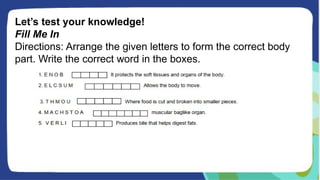
Let’s test your knowledge!
Fill Me In
Directions: Arrange the given letters to form the correct body
part. Write the correct word in the boxes.
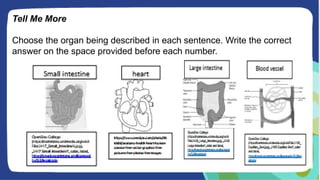
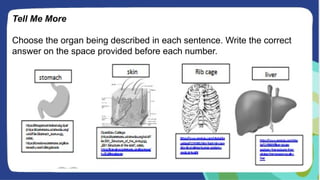
Tell Me More
Choose the organ being described in each sentence. Write the correct
answer on the space provided before each number.
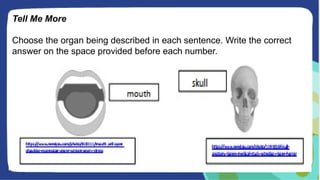
Tell Me More
Choose the organ being described in each sentence. Write the correct
answer on the space provided before each number.
Tell Me More
Choose the organ being described in each sentence. Write the correct
answer on the space provided before each number.
_______ 1. It protects the brain.
_______ 2. It protects the heart and lungs.
_______ 3. It covers the entire body to protect
tissues against injuries.
_______ 4. This is the entry point of food.
_______ 5. Absorption of nutrients occurs here with
the help of villi.
_______ 6. The largest organ in the body that
secretes bile.
_______ 7. It is a hollow muscular bag that twists,
squeezes and churns the food.
_______ 8. It is where undigested food stays and
is eliminated through the anus.
_______ 9. It is found at the center of your chest
behind the breastbone that pumps blood
_______ 10. These are hollow tubes that serve as
pathways of blood.
TRUE OR FALSE TEST
1.The skin is the largest organ of the human
body.
2.The rib cage protects the heart and lungs.
3.The stomach is responsible for absorbing
most nutrients from food.
4.The small intestine has tiny fingerlike parts
called villi that help absorb nutrients.
5.The large intestine absorbs water from
undigested food.
TRUE OR FALSE TEST
6. Blood vessels carry blood throughout
the body.
7. The liver produces bile which helps in
digesting fats.
8. The skull protects the brain.
9. The mouth is where food digestion
begins.
10. The heart pumps blood to the whole
body.
Say: The human body is a wonderful machine. Everything works
together to keep the body alive and functioning well.
Have you observed how houses are built?
What will the construction worker do first?
Is there a framework in our body just like in building a house?
What do you call the framework in human that provides structure to the
human body?
Today we will learn about skeletal system.
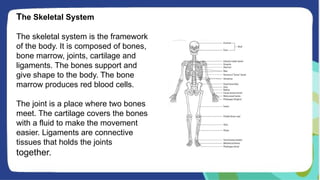
The Skeletal System
The skeletal system is the framework of the
body. It is composed of bones, bone marrow,
joints, cartilage and ligaments. The bones support
and give shape to the body. The bone marrow
produces red blood cells.
The joint is a place where two bones meet. The
cartilage covers the bones with a fluid to make the
movement easier. Ligaments are connective
tissues that holds the joints together.
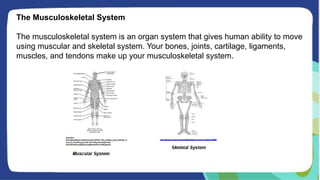
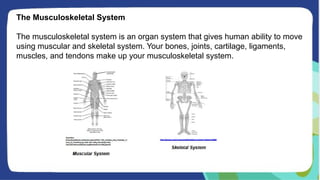
The Musculoskeletal System
The musculoskeletal system is an organ system that gives human ability to move
using muscular and skeletal system. Your bones, joints, cartilage, ligaments,
muscles, and tendons make up your musculoskeletal system.
A bone is a tough structure in the body that is
made up of connective tissues surrounded by
minerals. An infant has 350 bones, a child has 208
bones and a normal adult has 206 bones. The
bones support and give shape to the body. Without
them the body will collapse. Bones also protect the
soft tissues and the organ of the body. The skull
protects the brain; the ribs protect the heart and
lungs; and the backbone protects spinal cord.
Bones contain a soft tissue called bone marrow that
produces red blood cells.
To allow motion, different bones are
connected by joints. Joints are held
together by Connective tissues that can
stretch called ligaments. In order to
make movement easier, the ends of the
bones are covered with a layer of
cartilage with fluid in the space
between them to protect joints and
facilitates movement.
Muscles keep bones in place and also
play a role in the movement of bones.
A tendon is a band of tissue that
connects muscle to the bone. Muscles
contract to move the bone attached
at the joint. Muscles that move your
bones work in pairs. When one
contracts, the other must relax.
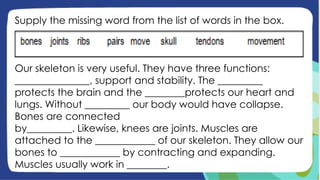
Supply the missing word from the list of words in the box.
Our skeleton is very useful. They have three functions:
_______________, support and stability. The _________
protects the brain and the ________protects our heart and
lungs. Without _________ our body would have collapse.
Bones are connected
by_________. Likewise, knees are joints. Muscles are
attached to the ____________ of our skeleton. They allow our
bones to ____________ by contracting and expanding.
Muscles usually work in ________.
Why should bones be strong? Why is it important to prevent falls and
other accidents that could injure the bones?
Why is it dangerous to move a person with spinal fracture?
How will you take care of your bones?
Did you know?
Bones are alive. They are made of living cells capable of growing and
repairing themselves.
What are ideas did you learn in the lesson?
What are the parts and functions of the skeletal system?
Describe the potential consequences if all bone tissues in humans were
made of spongy bones & no compact bones.
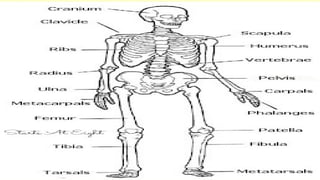
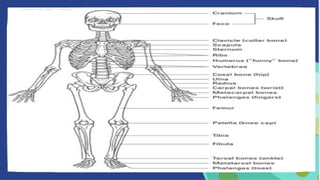
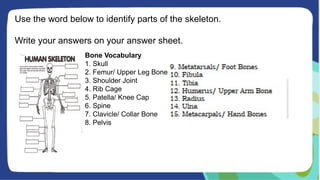
Use the word below to identify parts of the skeleton.
Write your answers on your answer sheet.
Bone Vocabulary
1. Skull
2. Femur/ Upper Leg Bone
3. Shoulder Joint
4. Rib Cage
5. Patella/ Knee Cap
6. Spine
7. Clavicle/ Collar Bone
8. Pelvis
THANK YOU FOR LITESNING!
Day 2
HOW THE ORGANS OF EACH ORGAN
SYSTEM WORK TOGETHER
Review on Skeletal System
What are the parts of skeletal system?
Let the pupils to touch their face, arms, palms, fingers and legs.
What can you feel?
How do they feel?
Are they hard or soft?
Our bones are covered with muscles. Can you imagine yourself
without muscles and other internal organs?
That would be scarry.
Continue lesson.
The Skeletal System
The skeletal system is the framework
of the body. It is composed of bones,
bone marrow, joints, cartilage and
ligaments. The bones support and
give shape to the body. The bone
marrow produces red blood cells.
The joint is a place where two bones
meet. The cartilage covers the bones
with a fluid to make the movement
easier. Ligaments are connective
tissues that holds the joints
together.
The Musculoskeletal System
The musculoskeletal system is an organ system that gives human ability to move
using muscular and skeletal system. Your bones, joints, cartilage, ligaments,
muscles, and tendons make up your musculoskeletal system.
A bone is a tough structure in the body that is made up of connective tissues
surrounded by minerals. An infant has 350 bones, a child has 208 bones and a
normal adult has 206 bones. The bones support and give shape to the body.
Without them the body will collapse. Bones also protect the soft tissues and the
organ of the body. The skull protects
the brain; the ribs protect the heart and lungs; and the backbone protects spinal
cord. Bones contain a soft tissue called bone marrow that produces red blood
cells.
To allow motion, different bones are connected by joints. Joints are held together
by Connective tissues that can stretch called ligaments. In order to make
movement easier, the ends of the bones are covered with a layer of cartilage with
fluid in the space between them to protect joints and facilitates movement.
Muscles keep bones in place and also play a role in the movement of bones. A
tendon is a band of tissue that connects muscle to the bone. Muscles contract to
move the bone attached at the joint. Muscles that move your bones work in pairs.
When one contracts, the other must relax.
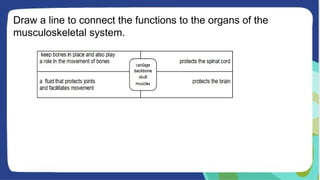
Draw a line to connect the functions to the organs of the
musculoskeletal system.
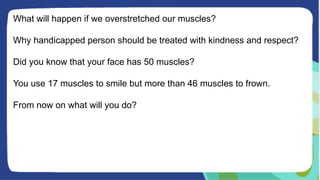
What will happen if we overstretched our muscles?
Why handicapped person should be treated with kindness and respect?
Did you know that your face has 50 muscles?
You use 17 muscles to smile but more than 46 muscles to frown.
From now on what will you do?
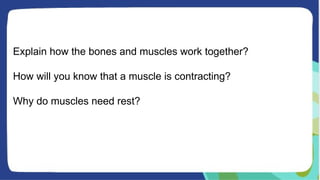
Explain how the bones and muscles work together?
How will you know that a muscle is contracting?
Why do muscles need rest?
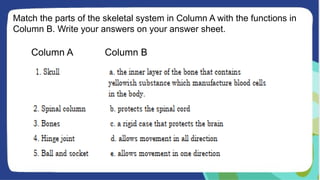
Match the parts of the skeletal system in Column A with the functions in
Column B. Write your answers on your answer sheet.
Column A Column B
THANK YOU FOR LISTENING!
Day 3
HOW THE ORGANS OF EACH ORGAN
SYSTEM WORK TOGETHER
Review on Musculo-skeletal system.
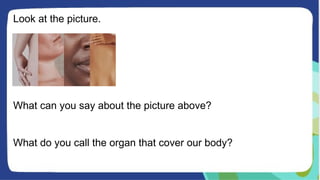
Look at the picture.
What can you say about the picture above?
What do you call the organ that cover our body?
Integumentary is one of the systems which play an important
role in the body. It is made up of different organs that we cannot
live without.
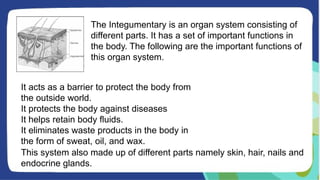
The Integumentary is an organ system consisting of
different parts. It has a set of important functions in
the body. The following are the important functions of
this organ system.
It acts as a barrier to protect the body from
the outside world.
It protects the body against diseases
It helps retain body fluids.
It eliminates waste products in the body in
the form of sweat, oil, and wax.
This system also made up of different parts namely skin, hair, nails and
endocrine glands.
SKIN
It is the largest organ of the body but only a few millimeters thick.
It forms body’s outer covering. It protects the body from
chemicals, diseases, ultraviolet rays of the sun and the physical
damage. It is the body’s first line of defense. It is divided into 3
sub-parts hypodermis.
A. Epidermis. It is the outermost layer of the skin that covers
almost entire body surface. It is the thinnest layer of the skin. It
also provides a waterproof barrier for the body and creates the
skin tone. It is made up of special cells called keratinocytes.
B. Dermis. It is a deeper layer of the skin found beneath the epidermis
and the thickest layer of the skin. It also gives the skin strength and
elasticity. It is made up of dense irregular connective tissue , nervous
tissue, blood and blood vessels.
C. Hypodermis. It is the deepest layer of the skin. It is made up of fats
and connective tissues which attaches the skin from other parts.
HAIR. It is an accessory organ of the integumentary system. It aids in a
person’s social functioning. It is made up of columns of tightly packed
dead keratinocytes and is found and scattered all over the body. It is
divided into different parts namely hair follicle and hair bulb.
A. Hair follicle
It anchors the hair into the skin.
It regulates hair growth.
It opens the sebaceous glands.
It lets the oil and wax from the body to go out.
B. Hair bulb
It forms the base of the hair follicle.
It is made up of living cells that divide and grow to build the hair
shaft.
It modify hair growth and structure at different times of life.
NAILS. It covers the tips of the fingers and toes. It is also an accessory
organ of the integumentary system that is made up of sheets of
hardened keratinocytes.
It protects the fingers and toes from environmental damage.
It is made up of several parts namely nail plate and nail cuticle.
A. Nail plate
It is the actual fingernail.
It is made up of translucent keratin.
B. Cuticle
It is a layer of clear skin located at the bottom edge of the fingers
and toes.
EXOCRINE GLANDS. It helps produce body sweat, oil and wax, helps
cool down the skin surface, helps protect the skin and moisturizes the
skin surface. It is divided into 2 parts namely sebaceous gland and
sweat gland.
A. Sebaceous gland
A small-oil producing gland found in the dermis.
It is attached to the hair follicles.
It produces oil sebum, and waxy substance.
B. Sweat Gland
It is a small tubular structure of the skin that produce sweat
found in the dermis and goes out of the skin pores.
Complete the sentences in the paragraph. Write your
answers on your answer sheet.
The ______________ is a part of the integumentary system which
covers almost the entire body. Another part of it is the ______ which is an
accessory that is made up of layers of dead keratinocytes. Another
accessory of the integumentary system is the _____________ which is
found at the end of the fingers and toes. The exocrine glands has 2
parts, these are the ___________ glands and the _______________
which produces the sweat and sebum respectively.
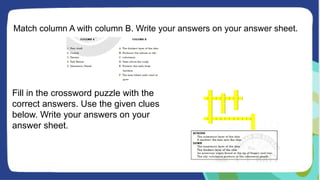
Match column A with column B. Write your answers on your answer sheet.
Fill in the crossword puzzle with the
correct answers. Use the given clues
below. Write your answers on your
answer sheet.
The Integumentary system consists of the skin, hair, fingernails, glands
and nerves.
The main function of the integumentary system is to act as a barrier to
protect the body from the outside world. It also functions to retain body
fluids, protect against diseases, eliminate waste products and regulate
body temperature.
Encourage pupils to ask question about the lesson.
Answer the questions below. Write the letter of your answer on your
answer sheet.
1. What is the thinnest and outermost layer of the skin?
a. Sebaceous gland c. Epidermis
b. Sweat gland d. Dermis
2. Which of the following is the function of the integumentary system?
a. It protects the body against UV rays.
b. It serves as the barrier of the body from physical damage.
c. It is body’s outer covering
d. All of the above
3. Which of the following is an accessory organ of the integumentary
system is made up of columns of tightly packed dead keratinocytes
found all over of the body?
a. Skin c. nails
b. Hair d. exocrine glands
4. Which part of the integumentary system is an accessory organ that is
made up of sheets of hardened keratinocytes?
a. Skin c. nails
b. Hair d. exocrine glands
5. Which part of the integumentary system do the sweat, oil and wax go
out?
a. Skin c. nails
b. Hair d. exocrine gland
THANK YOU FOR LISTENING!
Day 4
HOW THE ORGANS OF EACH ORGAN
SYSTEM WORK TOGETHER
Review on the parts of integumentary system.
Ask the pupils:
1. Have you eaten your breakfast?
2. Why do we need to eat food?
3. How do you feel when your hungry?
4. Have you ever wondered what happened to the food you have just
eaten?
5. What process it undergoes until it becomes the nutrients that will
nourish your body?
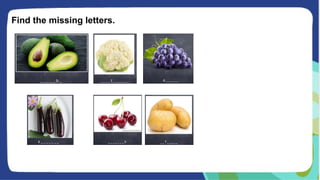
Find the missing letters.
What is the magic word?
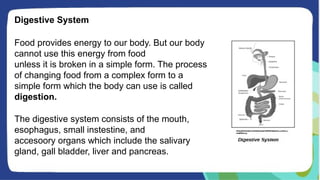
Digestive System
Food provides energy to our body. But our body
cannot use this energy from food
unless it is broken in a simple form. The process
of changing food from a complex form to a
simple form which the body can use is called
digestion.
The digestive system consists of the mouth,
esophagus, small instestine, and
accesoory organs which include the salivary
gland, gall bladder, liver and pancreas.
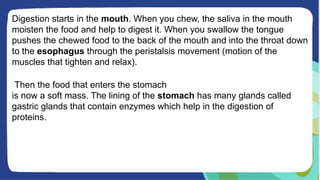
Digestion starts in the mouth. When you chew, the saliva in the mouth
moisten the food and help to digest it. When you swallow the tongue
pushes the chewed food to the back of the mouth and into the throat down
to the esophagus through the peristalsis movement (motion of the
muscles that tighten and relax).
Then the food that enters the stomach
is now a soft mass. The lining of the stomach has many glands called
gastric glands that contain enzymes which help in the digestion of
proteins.
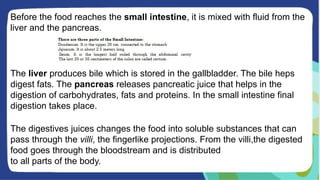
Before the food reaches the small intestine, it is mixed with fluid from the
liver and the pancreas.
The liver produces bile which is stored in the gallbladder. The bile heps
digest fats. The pancreas releases pancreatic juice that helps in the
digestion of carbohydrates, fats and proteins. In the small intestine final
digestion takes place.
The digestives juices changes the food into soluble substances that can
pass through the villi, the fingerlike projections. From the villi,the digested
food goes through the bloodstream and is distributed
to all parts of the body.
The undigested food moves to the large intestine. The walls of the large
intestine absorbs water that leaves a solid mass.This waste collects at
the rectum and is carried out in the anus when the sphincter muscle
contracts.The solids becomes feces and the liquid becomes urine.
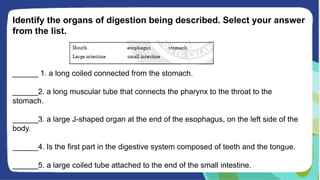
Identify the organs of digestion being described. Select your answer
from the list.
______ 1. a long coiled connected from the stomach.
______2. a long muscular tube that connects the pharynx to the throat to the
stomach.
______3. a large J-shaped organ at the end of the esophagus, on the left side of the
body.
______4. Is the first part in the digestive system composed of teeth and the tongue.
______5. a large coiled tube attached to the end of the small intestine.
Place the events in the correct order. Number each
sentence 1-5.
___ 1. Food ends up in the small intestine.
___ 2. Food is chewed up.
___ 3. Food is in the large intestine.
___ 4. Food travels through the esophagus.
___ 5. Food waste leaves the body.
Why is breakfast considered as the most important meal of the day?
TRIVIA: Borborygmus
Borborygmus is the rumbling sound in the stomach. When you hear your
stomach rumbling, it is the signal from your brain that the stomach has
begun the digestion.
What are the parts of the digestive system? How does the digestive
system work?
Choose the letter of the correct answer. Do this on your
answer sheet
1. Which moves the food from the esophagus to the stomach?
a. Swallowing b. fluid c. peristalsis d. digestion
2. It is the organ where digestion starts
a. Mouth c. stomach
b. Small intestine d. large intestine
3. Which organ takes nutrients from your food and puts it in your
bloodstream?
a. Stomach b. esophagus c. small intestine d. large intestine
4. In which part of the digestive system are proteins digested
completely?
a. Stomach c. small intestine
b. Large intestine d. esophagus
5. In which part of the digestion system does digestion end?
a. Mouth c. stomach
b. Small intestine d. large intestine
THANK YOU FOR LISTENING!
Day 5
HOW THE ORGANS OF EACH ORGAN
SYSTEM WORK TOGETHER
Review on the parts of the digestive
system.
Show the pupil pictures of children playing.
Ask the pupils:
What are the parts of the body involved in playing?
How do you feel after running?
What makes the body function well when doing activities?
Show picture of heart, blood, and blood vessels.
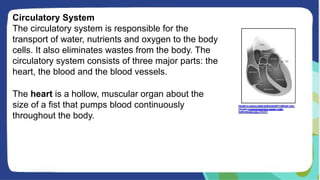
Circulatory System
The circulatory system is responsible for the
transport of water, nutrients and oxygen to the body
cells. It also eliminates wastes from the body. The
circulatory system consists of three major parts: the
heart, the blood and the blood vessels.
The heart is a hollow, muscular organ about the
size of a fist that pumps blood continuously
throughout the body.
It has four chambers: the left and right atria in the upper chamber; and
the left and right ventricles in the lower chamber.
The atria are the receiving chambers. When the atria contracts, blood is
pumped into the ventricles.
The ventricles are the pumping chambers of the heart. When
they contract, oxygen-rich blood is forced away from the heart
for the distribution to the different body parts. The valves in
the heart prevent the blood from flowing back.
The blood vessels are hollow tubes that permit the blood to flow from
the heart to thebody cells The three kinds of blood vessels are the
arteries, veins and capillaries.
Arteries have thicker walls because the blood flowing through them is
flowing rapidly under very high pressure since it has just come from the
heart. Arteries branch out into tinier tubes called arterioles which end up
in capillaries.
It is in the capillaries that exchange of oxygenated and
deoxygenated blood takes place.
Veins transport blood back to the heart.
The blood is the transport sytem of the
body. After it is pumped from the heart, it
carries the essential supplies all over the
body. Blood is composed of plasma, red
and white blood cells and platelets. .
The red blood cell carries oxygen and
nutrients; the white blood cells fight
againts infection and the platelets help in
clotting of the blood.
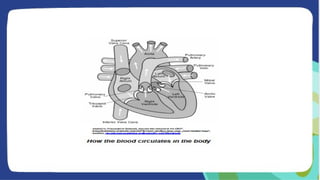
How Does Blood Flow Through the Heart?
The left atrium receives oxygen richblood from the lungs. The blood flows
down to the left ventricle through the mitral valve.
The atria contracts and pushes the blood into the ventricle, then the
ventricle contracts pushing the blood into the arteries through the aortic
valve.
The arteries carry the blood to all parts of
the body.
After delivering the oxygen and the nutrients to the cells of the body, the
blood goes back to the heart contains carbon dioxide and wastes
substances is transportred by the veins from the different parts of the
body to the right atrium. Blood passes through the right atrium
into the right ventricle through the tricuspid valve.
As the right ventricle contracts, it pushes the blood into the lungs
passing through thepulmonary valve and in the pulmonary
arteries.During the contraction, the blood is prevented from going back
by the one-way valves of the of the heart.
Remember This
Supply the missing word from the list of words in the box.
The circulatory is the __________system of the body. The heart
________blood continuously throughout the body. The blood
________digested food and oxygen and collects wastes and carbon
dioxide from the cells. The blood vessels are _________of
blood.
The human circulatory system functions to transport blood
and oxygen from the lungs to the various tissues of the body.
The heart pumps the blood throughout the body.
Encourage pupils to ask question about the lesson..
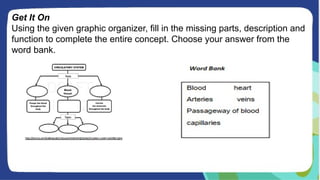
Get It On
Using the given graphic organizer, fill in the missing parts, description and
function to complete the entire concept. Choose your answer from the
word bank.
THANK YOU FOR LISTENING!

Power Point in Science-Grade Six-Week-1.

  • 1.
  • 2.
  • 3.
    HOW THE ORGANSOF EACH ORGAN SYSTEM WORK TOGETHER
  • 4.
    Let’s test yourknowledge! Fill Me In Directions: Arrange the given letters to form the correct body part. Write the correct word in the boxes.
  • 5.
    Tell Me More Choosethe organ being described in each sentence. Write the correct answer on the space provided before each number.
  • 6.
    Tell Me More Choosethe organ being described in each sentence. Write the correct answer on the space provided before each number.
  • 7.
    Tell Me More Choosethe organ being described in each sentence. Write the correct answer on the space provided before each number.
  • 8.
    _______ 1. Itprotects the brain. _______ 2. It protects the heart and lungs. _______ 3. It covers the entire body to protect tissues against injuries. _______ 4. This is the entry point of food. _______ 5. Absorption of nutrients occurs here with the help of villi.
  • 9.
    _______ 6. Thelargest organ in the body that secretes bile. _______ 7. It is a hollow muscular bag that twists, squeezes and churns the food. _______ 8. It is where undigested food stays and is eliminated through the anus. _______ 9. It is found at the center of your chest behind the breastbone that pumps blood _______ 10. These are hollow tubes that serve as pathways of blood.
  • 10.
    TRUE OR FALSETEST 1.The skin is the largest organ of the human body. 2.The rib cage protects the heart and lungs. 3.The stomach is responsible for absorbing most nutrients from food. 4.The small intestine has tiny fingerlike parts called villi that help absorb nutrients. 5.The large intestine absorbs water from undigested food.
  • 11.
    TRUE OR FALSETEST 6. Blood vessels carry blood throughout the body. 7. The liver produces bile which helps in digesting fats. 8. The skull protects the brain. 9. The mouth is where food digestion begins. 10. The heart pumps blood to the whole body.
  • 12.
    Say: The humanbody is a wonderful machine. Everything works together to keep the body alive and functioning well. Have you observed how houses are built? What will the construction worker do first? Is there a framework in our body just like in building a house? What do you call the framework in human that provides structure to the human body? Today we will learn about skeletal system.
  • 13.
    The Skeletal System Theskeletal system is the framework of the body. It is composed of bones, bone marrow, joints, cartilage and ligaments. The bones support and give shape to the body. The bone marrow produces red blood cells. The joint is a place where two bones meet. The cartilage covers the bones with a fluid to make the movement easier. Ligaments are connective tissues that holds the joints together.
  • 16.
    The Musculoskeletal System Themusculoskeletal system is an organ system that gives human ability to move using muscular and skeletal system. Your bones, joints, cartilage, ligaments, muscles, and tendons make up your musculoskeletal system.
  • 17.
    A bone isa tough structure in the body that is made up of connective tissues surrounded by minerals. An infant has 350 bones, a child has 208 bones and a normal adult has 206 bones. The bones support and give shape to the body. Without them the body will collapse. Bones also protect the soft tissues and the organ of the body. The skull protects the brain; the ribs protect the heart and lungs; and the backbone protects spinal cord. Bones contain a soft tissue called bone marrow that produces red blood cells.
  • 18.
    To allow motion,different bones are connected by joints. Joints are held together by Connective tissues that can stretch called ligaments. In order to make movement easier, the ends of the bones are covered with a layer of cartilage with fluid in the space between them to protect joints and facilitates movement.
  • 19.
    Muscles keep bonesin place and also play a role in the movement of bones. A tendon is a band of tissue that connects muscle to the bone. Muscles contract to move the bone attached at the joint. Muscles that move your bones work in pairs. When one contracts, the other must relax.
  • 21.
    Supply the missingword from the list of words in the box. Our skeleton is very useful. They have three functions: _______________, support and stability. The _________ protects the brain and the ________protects our heart and lungs. Without _________ our body would have collapse. Bones are connected by_________. Likewise, knees are joints. Muscles are attached to the ____________ of our skeleton. They allow our bones to ____________ by contracting and expanding. Muscles usually work in ________.
  • 22.
    Why should bonesbe strong? Why is it important to prevent falls and other accidents that could injure the bones? Why is it dangerous to move a person with spinal fracture? How will you take care of your bones? Did you know? Bones are alive. They are made of living cells capable of growing and repairing themselves.
  • 23.
    What are ideasdid you learn in the lesson? What are the parts and functions of the skeletal system? Describe the potential consequences if all bone tissues in humans were made of spongy bones & no compact bones.
  • 24.
    Use the wordbelow to identify parts of the skeleton. Write your answers on your answer sheet. Bone Vocabulary 1. Skull 2. Femur/ Upper Leg Bone 3. Shoulder Joint 4. Rib Cage 5. Patella/ Knee Cap 6. Spine 7. Clavicle/ Collar Bone 8. Pelvis
  • 25.
    THANK YOU FORLITESNING!
  • 26.
  • 27.
    HOW THE ORGANSOF EACH ORGAN SYSTEM WORK TOGETHER
  • 28.
    Review on SkeletalSystem What are the parts of skeletal system?
  • 29.
    Let the pupilsto touch their face, arms, palms, fingers and legs. What can you feel? How do they feel? Are they hard or soft? Our bones are covered with muscles. Can you imagine yourself without muscles and other internal organs? That would be scarry.
  • 30.
  • 31.
    The Skeletal System Theskeletal system is the framework of the body. It is composed of bones, bone marrow, joints, cartilage and ligaments. The bones support and give shape to the body. The bone marrow produces red blood cells. The joint is a place where two bones meet. The cartilage covers the bones with a fluid to make the movement easier. Ligaments are connective tissues that holds the joints together.
  • 32.
    The Musculoskeletal System Themusculoskeletal system is an organ system that gives human ability to move using muscular and skeletal system. Your bones, joints, cartilage, ligaments, muscles, and tendons make up your musculoskeletal system.
  • 33.
    A bone isa tough structure in the body that is made up of connective tissues surrounded by minerals. An infant has 350 bones, a child has 208 bones and a normal adult has 206 bones. The bones support and give shape to the body. Without them the body will collapse. Bones also protect the soft tissues and the organ of the body. The skull protects the brain; the ribs protect the heart and lungs; and the backbone protects spinal cord. Bones contain a soft tissue called bone marrow that produces red blood cells. To allow motion, different bones are connected by joints. Joints are held together by Connective tissues that can stretch called ligaments. In order to make movement easier, the ends of the bones are covered with a layer of cartilage with fluid in the space between them to protect joints and facilitates movement. Muscles keep bones in place and also play a role in the movement of bones. A tendon is a band of tissue that connects muscle to the bone. Muscles contract to move the bone attached at the joint. Muscles that move your bones work in pairs. When one contracts, the other must relax.
  • 35.
    Draw a lineto connect the functions to the organs of the musculoskeletal system.
  • 36.
    What will happenif we overstretched our muscles? Why handicapped person should be treated with kindness and respect? Did you know that your face has 50 muscles? You use 17 muscles to smile but more than 46 muscles to frown. From now on what will you do?
  • 37.
    Explain how thebones and muscles work together? How will you know that a muscle is contracting? Why do muscles need rest?
  • 38.
    Match the partsof the skeletal system in Column A with the functions in Column B. Write your answers on your answer sheet. Column A Column B
  • 39.
    THANK YOU FORLISTENING!
  • 40.
  • 41.
    HOW THE ORGANSOF EACH ORGAN SYSTEM WORK TOGETHER
  • 42.
  • 43.
    Look at thepicture. What can you say about the picture above? What do you call the organ that cover our body?
  • 44.
    Integumentary is oneof the systems which play an important role in the body. It is made up of different organs that we cannot live without.
  • 45.
    The Integumentary isan organ system consisting of different parts. It has a set of important functions in the body. The following are the important functions of this organ system. It acts as a barrier to protect the body from the outside world. It protects the body against diseases It helps retain body fluids. It eliminates waste products in the body in the form of sweat, oil, and wax. This system also made up of different parts namely skin, hair, nails and endocrine glands.
  • 46.
    SKIN It is thelargest organ of the body but only a few millimeters thick. It forms body’s outer covering. It protects the body from chemicals, diseases, ultraviolet rays of the sun and the physical damage. It is the body’s first line of defense. It is divided into 3 sub-parts hypodermis.
  • 47.
    A. Epidermis. Itis the outermost layer of the skin that covers almost entire body surface. It is the thinnest layer of the skin. It also provides a waterproof barrier for the body and creates the skin tone. It is made up of special cells called keratinocytes.
  • 48.
    B. Dermis. Itis a deeper layer of the skin found beneath the epidermis and the thickest layer of the skin. It also gives the skin strength and elasticity. It is made up of dense irregular connective tissue , nervous tissue, blood and blood vessels. C. Hypodermis. It is the deepest layer of the skin. It is made up of fats and connective tissues which attaches the skin from other parts.
  • 49.
    HAIR. It isan accessory organ of the integumentary system. It aids in a person’s social functioning. It is made up of columns of tightly packed dead keratinocytes and is found and scattered all over the body. It is divided into different parts namely hair follicle and hair bulb. A. Hair follicle It anchors the hair into the skin. It regulates hair growth. It opens the sebaceous glands. It lets the oil and wax from the body to go out. B. Hair bulb It forms the base of the hair follicle. It is made up of living cells that divide and grow to build the hair shaft. It modify hair growth and structure at different times of life.
  • 50.
    NAILS. It coversthe tips of the fingers and toes. It is also an accessory organ of the integumentary system that is made up of sheets of hardened keratinocytes. It protects the fingers and toes from environmental damage. It is made up of several parts namely nail plate and nail cuticle. A. Nail plate It is the actual fingernail. It is made up of translucent keratin. B. Cuticle It is a layer of clear skin located at the bottom edge of the fingers and toes.
  • 51.
    EXOCRINE GLANDS. Ithelps produce body sweat, oil and wax, helps cool down the skin surface, helps protect the skin and moisturizes the skin surface. It is divided into 2 parts namely sebaceous gland and sweat gland. A. Sebaceous gland A small-oil producing gland found in the dermis. It is attached to the hair follicles. It produces oil sebum, and waxy substance. B. Sweat Gland It is a small tubular structure of the skin that produce sweat found in the dermis and goes out of the skin pores.
  • 52.
    Complete the sentencesin the paragraph. Write your answers on your answer sheet. The ______________ is a part of the integumentary system which covers almost the entire body. Another part of it is the ______ which is an accessory that is made up of layers of dead keratinocytes. Another accessory of the integumentary system is the _____________ which is found at the end of the fingers and toes. The exocrine glands has 2 parts, these are the ___________ glands and the _______________ which produces the sweat and sebum respectively.
  • 53.
    Match column Awith column B. Write your answers on your answer sheet. Fill in the crossword puzzle with the correct answers. Use the given clues below. Write your answers on your answer sheet.
  • 54.
    The Integumentary systemconsists of the skin, hair, fingernails, glands and nerves. The main function of the integumentary system is to act as a barrier to protect the body from the outside world. It also functions to retain body fluids, protect against diseases, eliminate waste products and regulate body temperature. Encourage pupils to ask question about the lesson.
  • 55.
    Answer the questionsbelow. Write the letter of your answer on your answer sheet. 1. What is the thinnest and outermost layer of the skin? a. Sebaceous gland c. Epidermis b. Sweat gland d. Dermis 2. Which of the following is the function of the integumentary system? a. It protects the body against UV rays. b. It serves as the barrier of the body from physical damage. c. It is body’s outer covering d. All of the above
  • 56.
    3. Which ofthe following is an accessory organ of the integumentary system is made up of columns of tightly packed dead keratinocytes found all over of the body? a. Skin c. nails b. Hair d. exocrine glands 4. Which part of the integumentary system is an accessory organ that is made up of sheets of hardened keratinocytes? a. Skin c. nails b. Hair d. exocrine glands 5. Which part of the integumentary system do the sweat, oil and wax go out? a. Skin c. nails b. Hair d. exocrine gland
  • 57.
    THANK YOU FORLISTENING!
  • 58.
  • 59.
    HOW THE ORGANSOF EACH ORGAN SYSTEM WORK TOGETHER
  • 60.
    Review on theparts of integumentary system.
  • 61.
    Ask the pupils: 1.Have you eaten your breakfast? 2. Why do we need to eat food? 3. How do you feel when your hungry? 4. Have you ever wondered what happened to the food you have just eaten? 5. What process it undergoes until it becomes the nutrients that will nourish your body?
  • 62.
  • 63.
    What is themagic word?
  • 64.
    Digestive System Food providesenergy to our body. But our body cannot use this energy from food unless it is broken in a simple form. The process of changing food from a complex form to a simple form which the body can use is called digestion. The digestive system consists of the mouth, esophagus, small instestine, and accesoory organs which include the salivary gland, gall bladder, liver and pancreas.
  • 65.
    Digestion starts inthe mouth. When you chew, the saliva in the mouth moisten the food and help to digest it. When you swallow the tongue pushes the chewed food to the back of the mouth and into the throat down to the esophagus through the peristalsis movement (motion of the muscles that tighten and relax). Then the food that enters the stomach is now a soft mass. The lining of the stomach has many glands called gastric glands that contain enzymes which help in the digestion of proteins.
  • 66.
    Before the foodreaches the small intestine, it is mixed with fluid from the liver and the pancreas. The liver produces bile which is stored in the gallbladder. The bile heps digest fats. The pancreas releases pancreatic juice that helps in the digestion of carbohydrates, fats and proteins. In the small intestine final digestion takes place. The digestives juices changes the food into soluble substances that can pass through the villi, the fingerlike projections. From the villi,the digested food goes through the bloodstream and is distributed to all parts of the body.
  • 67.
    The undigested foodmoves to the large intestine. The walls of the large intestine absorbs water that leaves a solid mass.This waste collects at the rectum and is carried out in the anus when the sphincter muscle contracts.The solids becomes feces and the liquid becomes urine.
  • 68.
    Identify the organsof digestion being described. Select your answer from the list. ______ 1. a long coiled connected from the stomach. ______2. a long muscular tube that connects the pharynx to the throat to the stomach. ______3. a large J-shaped organ at the end of the esophagus, on the left side of the body. ______4. Is the first part in the digestive system composed of teeth and the tongue. ______5. a large coiled tube attached to the end of the small intestine.
  • 69.
    Place the eventsin the correct order. Number each sentence 1-5. ___ 1. Food ends up in the small intestine. ___ 2. Food is chewed up. ___ 3. Food is in the large intestine. ___ 4. Food travels through the esophagus. ___ 5. Food waste leaves the body.
  • 70.
    Why is breakfastconsidered as the most important meal of the day? TRIVIA: Borborygmus Borborygmus is the rumbling sound in the stomach. When you hear your stomach rumbling, it is the signal from your brain that the stomach has begun the digestion.
  • 71.
    What are theparts of the digestive system? How does the digestive system work?
  • 72.
    Choose the letterof the correct answer. Do this on your answer sheet 1. Which moves the food from the esophagus to the stomach? a. Swallowing b. fluid c. peristalsis d. digestion 2. It is the organ where digestion starts a. Mouth c. stomach b. Small intestine d. large intestine
  • 73.
    3. Which organtakes nutrients from your food and puts it in your bloodstream? a. Stomach b. esophagus c. small intestine d. large intestine 4. In which part of the digestive system are proteins digested completely? a. Stomach c. small intestine b. Large intestine d. esophagus 5. In which part of the digestion system does digestion end? a. Mouth c. stomach b. Small intestine d. large intestine
  • 74.
    THANK YOU FORLISTENING!
  • 75.
  • 76.
    HOW THE ORGANSOF EACH ORGAN SYSTEM WORK TOGETHER
  • 77.
    Review on theparts of the digestive system.
  • 78.
    Show the pupilpictures of children playing. Ask the pupils: What are the parts of the body involved in playing? How do you feel after running? What makes the body function well when doing activities?
  • 79.
    Show picture ofheart, blood, and blood vessels.
  • 80.
    Circulatory System The circulatorysystem is responsible for the transport of water, nutrients and oxygen to the body cells. It also eliminates wastes from the body. The circulatory system consists of three major parts: the heart, the blood and the blood vessels. The heart is a hollow, muscular organ about the size of a fist that pumps blood continuously throughout the body.
  • 81.
    It has fourchambers: the left and right atria in the upper chamber; and the left and right ventricles in the lower chamber. The atria are the receiving chambers. When the atria contracts, blood is pumped into the ventricles. The ventricles are the pumping chambers of the heart. When they contract, oxygen-rich blood is forced away from the heart for the distribution to the different body parts. The valves in the heart prevent the blood from flowing back. The blood vessels are hollow tubes that permit the blood to flow from the heart to thebody cells The three kinds of blood vessels are the arteries, veins and capillaries.
  • 82.
    Arteries have thickerwalls because the blood flowing through them is flowing rapidly under very high pressure since it has just come from the heart. Arteries branch out into tinier tubes called arterioles which end up in capillaries. It is in the capillaries that exchange of oxygenated and deoxygenated blood takes place. Veins transport blood back to the heart.
  • 83.
    The blood isthe transport sytem of the body. After it is pumped from the heart, it carries the essential supplies all over the body. Blood is composed of plasma, red and white blood cells and platelets. . The red blood cell carries oxygen and nutrients; the white blood cells fight againts infection and the platelets help in clotting of the blood.
  • 84.
    How Does BloodFlow Through the Heart? The left atrium receives oxygen richblood from the lungs. The blood flows down to the left ventricle through the mitral valve. The atria contracts and pushes the blood into the ventricle, then the ventricle contracts pushing the blood into the arteries through the aortic valve. The arteries carry the blood to all parts of the body.
  • 85.
    After delivering theoxygen and the nutrients to the cells of the body, the blood goes back to the heart contains carbon dioxide and wastes substances is transportred by the veins from the different parts of the body to the right atrium. Blood passes through the right atrium into the right ventricle through the tricuspid valve. As the right ventricle contracts, it pushes the blood into the lungs passing through thepulmonary valve and in the pulmonary arteries.During the contraction, the blood is prevented from going back by the one-way valves of the of the heart.
  • 87.
    Remember This Supply themissing word from the list of words in the box. The circulatory is the __________system of the body. The heart ________blood continuously throughout the body. The blood ________digested food and oxygen and collects wastes and carbon dioxide from the cells. The blood vessels are _________of blood.
  • 88.
    The human circulatorysystem functions to transport blood and oxygen from the lungs to the various tissues of the body. The heart pumps the blood throughout the body. Encourage pupils to ask question about the lesson..
  • 89.
    Get It On Usingthe given graphic organizer, fill in the missing parts, description and function to complete the entire concept. Choose your answer from the word bank.

  • 90.
    THANK YOU FORLISTENING!