SCIENCE
QUARTER 2 WEEK 1
DAY 1
R E V I E W
Directions: Give at least five (5)
separating mixture techniques.
1.
2.
3.
4.
5.
Let us dance the skeleton dance.
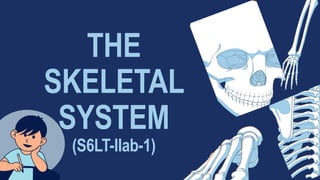
THE
SKELETAL
SYSTEM
(S6LT-IIab-1)
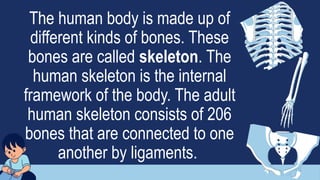
The human body is made up of
different kinds of bones. These
bones are called skeleton. The
human skeleton is the internal
framework of the body. The adult
human skeleton consists of 206
bones that are connected to one
another by ligaments.
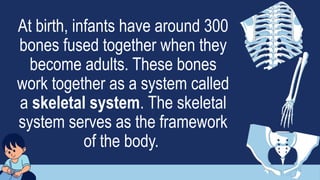
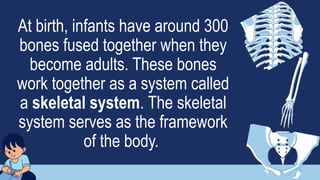
At birth, infants have around 300
bones fused together when they
become adults. These bones
work together as a system called
a skeletal system. The skeletal
system serves as the framework
of the body.
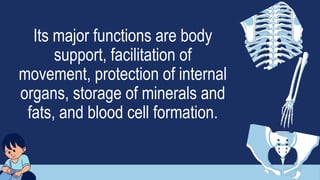
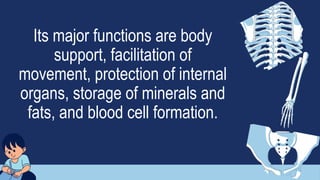
Its major functions are body
support, facilitation of
movement, protection of internal
organs, storage of minerals and
fats, and blood cell formation.
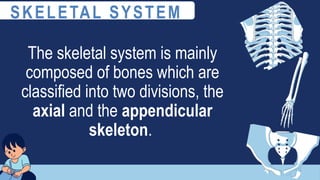
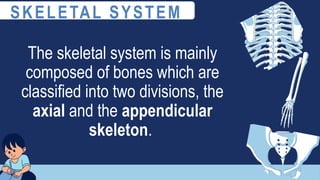
The skeletal system is mainly
composed of bones which are
classified into two divisions, the
axial and the appendicular
skeleton.
SKELETAL SYSTEM
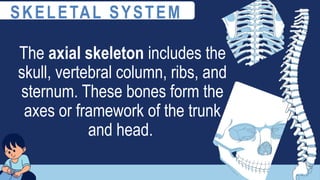
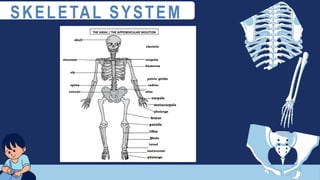
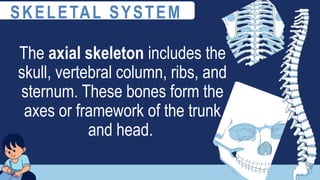
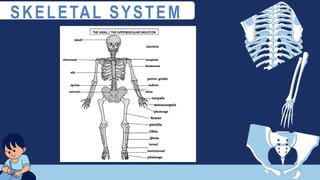
The axial skeleton includes the
skull, vertebral column, ribs, and
sternum. These bones form the
axes or framework of the trunk
and head.
SKELETAL SYSTEM
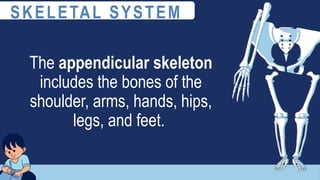
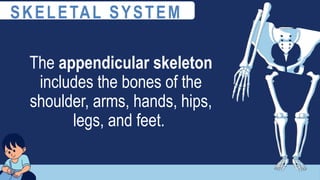
The appendicular skeleton
includes the bones of the
shoulder, arms, hands, hips,
legs, and feet.
SKELETAL SYSTEM
SKELETAL SYSTEM
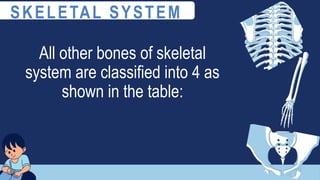
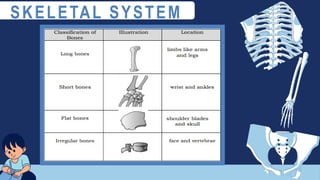
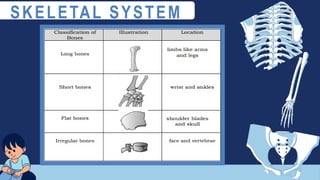
All other bones of skeletal
system are classified into 4 as
shown in the table:
SKELETAL SYSTEM
SKELETAL SYSTEM
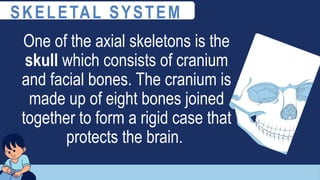
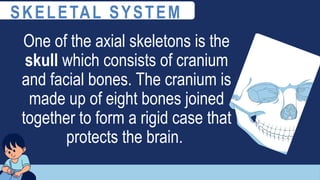
One of the axial skeletons is the
skull which consists of cranium
and facial bones. The cranium is
made up of eight bones joined
together to form a rigid case that
protects the brain.
SKELETAL SYSTEM
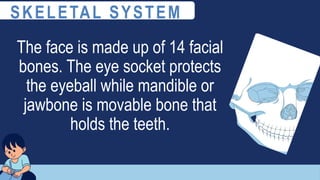
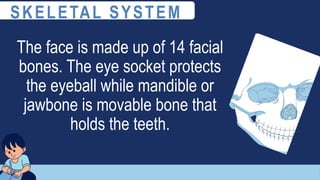
The face is made up of 14 facial
bones. The eye socket protects
the eyeball while mandible or
jawbone is movable bone that
holds the teeth.
SKELETAL SYSTEM
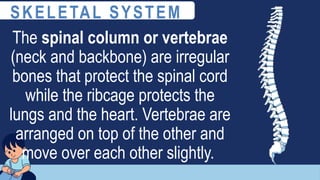
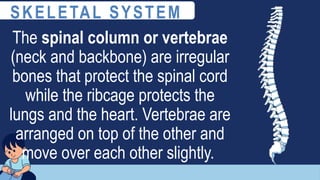
The spinal column or vertebrae
(neck and backbone) are irregular
bones that protect the spinal cord
while the ribcage protects the
lungs and the heart. Vertebrae are
arranged on top of the other and
move over each other slightly.
SKELETAL SYSTEM
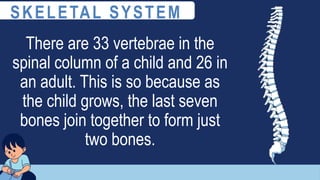
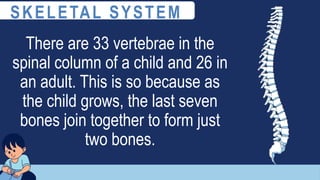
There are 33 vertebrae in the
spinal column of a child and 26 in
an adult. This is so because as
the child grows, the last seven
bones join together to form just
two bones.
SKELETAL SYSTEM
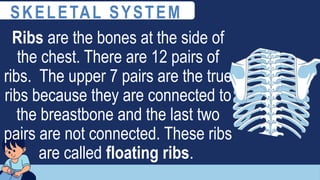
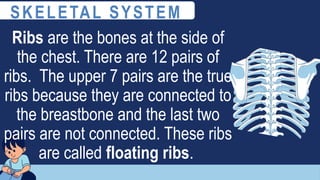
Ribs are the bones at the side of
the chest. There are 12 pairs of
ribs. The upper 7 pairs are the true
ribs because they are connected to
the breastbone and the last two
pairs are not connected. These ribs
are called floating ribs.
SKELETAL SYSTEM
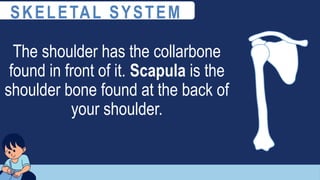
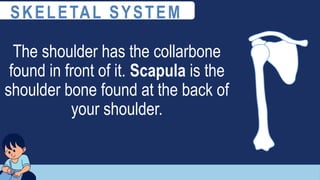
The shoulder has the collarbone
found in front of it. Scapula is the
shoulder bone found at the back of
your shoulder.
SKELETAL SYSTEM
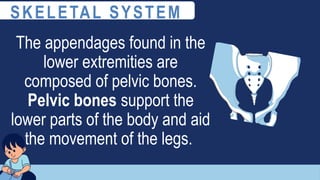
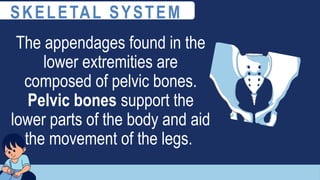
The appendages found in the
lower extremities are
composed of pelvic bones.
Pelvic bones support the
lower parts of the body and aid
the movement of the legs.
SKELETAL SYSTEM
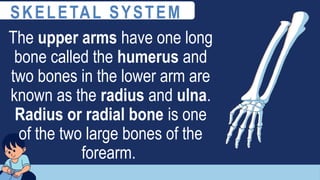
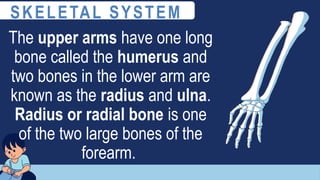
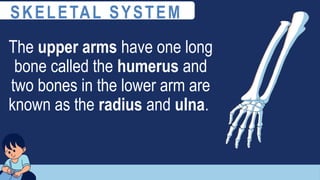
The upper arms have one long
bone called the humerus and
two bones in the lower arm are
known as the radius and ulna.
Radius or radial bone is one
of the two large bones of the
forearm.
SKELETAL SYSTEM
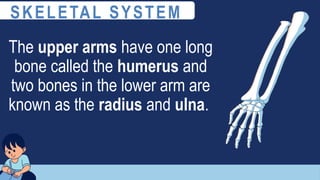
The upper arms have one long
bone called the humerus and
two bones in the lower arm are
known as the radius and ulna.
SKELETAL SYSTEM
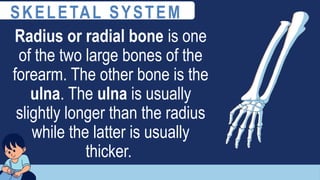
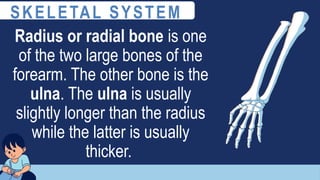
Radius or radial bone is one
of the two large bones of the
forearm. The other bone is the
ulna. The ulna is usually
slightly longer than the radius
while the latter is usually
thicker.
SKELETAL SYSTEM
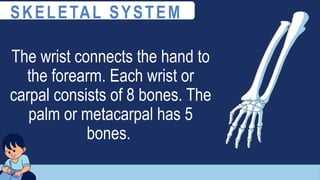
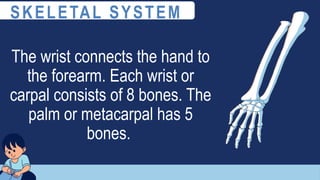
The wrist connects the hand to
the forearm. Each wrist or
carpal consists of 8 bones. The
palm or metacarpal has 5
bones.
SKELETAL SYSTEM
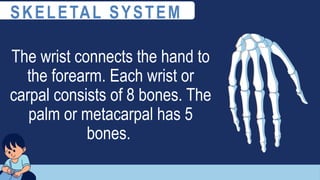
The wrist connects the hand to
the forearm. Each wrist or
carpal consists of 8 bones. The
palm or metacarpal has 5
bones.
SKELETAL SYSTEM
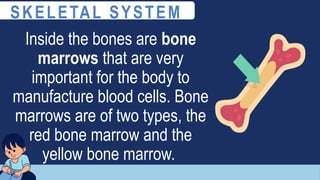
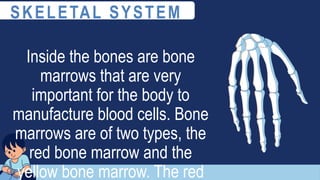
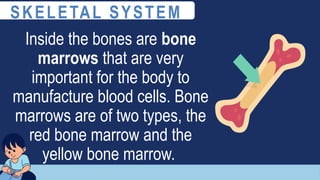
Inside the bones are bone
marrows that are very
important for the body to
manufacture blood cells. Bone
marrows are of two types, the
red bone marrow and the
yellow bone marrow.
SKELETAL SYSTEM
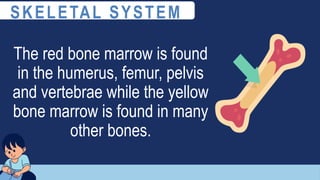
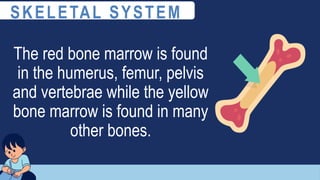
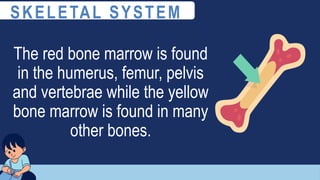
The red bone marrow is found
in the humerus, femur, pelvis
and vertebrae while the yellow
bone marrow is found in many
other bones.
SKELETAL SYSTEM
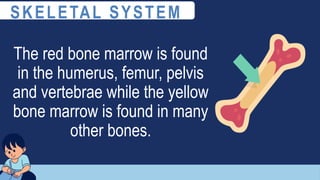
The red bone marrow is found
in the humerus, femur, pelvis
and vertebrae while the yellow
bone marrow is found in many
other bones.
SKELETAL SYSTEM
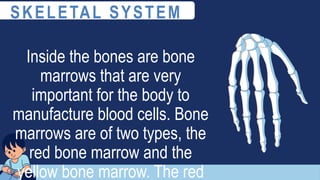
Inside the bones are bone
marrows that are very
important for the body to
manufacture blood cells. Bone
marrows are of two types, the
red bone marrow and the
yellow bone marrow. The red
SKELETAL SYSTEM
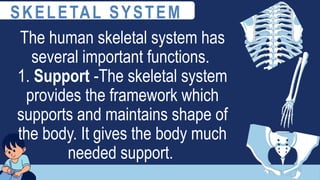
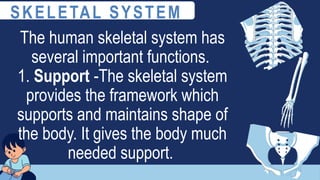
The human skeletal system has
several important functions.
1. Support -The skeletal system
provides the framework which
supports and maintains shape of
the body. It gives the body much
needed support.
SKELETAL SYSTEM
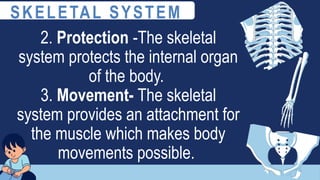
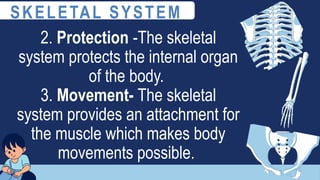
2. Protection -The skeletal
system protects the internal organ
of the body.
3. Movement- The skeletal
system provides an attachment for
the muscle which makes body
movements possible.
SKELETAL SYSTEM
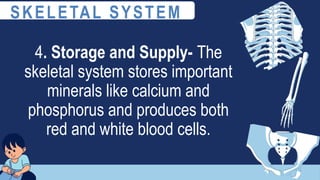
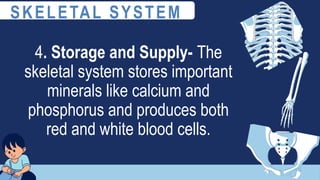
4. Storage and Supply- The
skeletal system stores important
minerals like calcium and
phosphorus and produces both
red and white blood cells.
SKELETAL SYSTEM
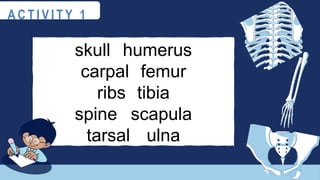
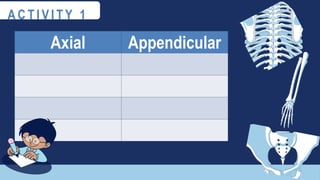
Directions: Study the name of the
bones inside the box. Classify
them into Axial or Appendicular.
A C T I V I T Y 1
skull humerus
carpal femur
ribs tibia
spine scapula
tarsal ulna
A C T I V I T Y 1
Axial Appendicular
A C T I V I T Y 1
Directions: Explain briefly how
the skeletal system works based
on their functions:
A S S E S S M E N T
Functions of the Skeletal
System
Explain briefly how
the skeletal system
works
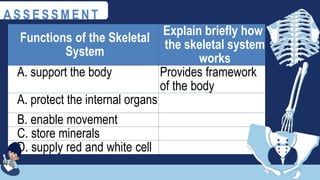
A. support the body Provides framework
of the body
A. protect the internal organs
B. enable movement
C. store minerals
D. supply red and white cell
A S S E S S M E N T
SCIENCE
QUARTER 2 WEEK 1
DAY 2
R E V I E W
Directions: Answer the following questions in
your Science journal.
1. Knowing the functions of the skeletal system,
could you imagine yourself without a bone?
Explain your answer in at least 3 sentences.
R E V I E W
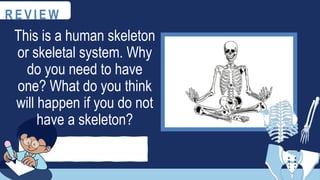
This is a human skeleton
or skeletal system. Why
do you need to have
one? What do you think
will happen if you do not
have a skeleton?
THE
SKELETAL
SYSTEM
(S6LT-IIab-1)
The human body is made up of
different kinds of bones. These
bones are called skeleton. The
human skeleton is the internal
framework of the body. The adult
human skeleton consists of 206
bones that are connected to one
another by ligaments.
At birth, infants have around 300
bones fused together when they
become adults. These bones
work together as a system called
a skeletal system. The skeletal
system serves as the framework
of the body.
Its major functions are body
support, facilitation of
movement, protection of internal
organs, storage of minerals and
fats, and blood cell formation.
The skeletal system is mainly
composed of bones which are
classified into two divisions, the
axial and the appendicular
skeleton.
SKELETAL SYSTEM
The axial skeleton includes the
skull, vertebral column, ribs, and
sternum. These bones form the
axes or framework of the trunk
and head.
SKELETAL SYSTEM
The appendicular skeleton
includes the bones of the
shoulder, arms, hands, hips,
legs, and feet.
SKELETAL SYSTEM
SKELETAL SYSTEM
All other bones of skeletal
system are classified into 4 as
shown in the table:
SKELETAL SYSTEM
SKELETAL SYSTEM
One of the axial skeletons is the
skull which consists of cranium
and facial bones. The cranium is
made up of eight bones joined
together to form a rigid case that
protects the brain.
SKELETAL SYSTEM
The face is made up of 14 facial
bones. The eye socket protects
the eyeball while mandible or
jawbone is movable bone that
holds the teeth.
SKELETAL SYSTEM
The spinal column or vertebrae
(neck and backbone) are irregular
bones that protect the spinal cord
while the ribcage protects the
lungs and the heart. Vertebrae are
arranged on top of the other and
move over each other slightly.
SKELETAL SYSTEM
There are 33 vertebrae in the
spinal column of a child and 26 in
an adult. This is so because as
the child grows, the last seven
bones join together to form just
two bones.
SKELETAL SYSTEM
Ribs are the bones at the side of
the chest. There are 12 pairs of
ribs. The upper 7 pairs are the true
ribs because they are connected to
the breastbone and the last two
pairs are not connected. These ribs
are called floating ribs.
SKELETAL SYSTEM
The shoulder has the collarbone
found in front of it. Scapula is the
shoulder bone found at the back of
your shoulder.
SKELETAL SYSTEM
The appendages found in the
lower extremities are
composed of pelvic bones.
Pelvic bones support the
lower parts of the body and aid
the movement of the legs.
SKELETAL SYSTEM
The upper arms have one long
bone called the humerus and
two bones in the lower arm are
known as the radius and ulna.
Radius or radial bone is one
of the two large bones of the
forearm.
SKELETAL SYSTEM
The upper arms have one long
bone called the humerus and
two bones in the lower arm are
known as the radius and ulna.
SKELETAL SYSTEM
Radius or radial bone is one
of the two large bones of the
forearm. The other bone is the
ulna. The ulna is usually
slightly longer than the radius
while the latter is usually
thicker.
SKELETAL SYSTEM
The wrist connects the hand to
the forearm. Each wrist or
carpal consists of 8 bones. The
palm or metacarpal has 5
bones.
SKELETAL SYSTEM
The wrist connects the hand to
the forearm. Each wrist or
carpal consists of 8 bones. The
palm or metacarpal has 5
bones.
SKELETAL SYSTEM
Inside the bones are bone
marrows that are very
important for the body to
manufacture blood cells. Bone
marrows are of two types, the
red bone marrow and the
yellow bone marrow.
SKELETAL SYSTEM
The red bone marrow is found
in the humerus, femur, pelvis
and vertebrae while the yellow
bone marrow is found in many
other bones.
SKELETAL SYSTEM
The red bone marrow is found
in the humerus, femur, pelvis
and vertebrae while the yellow
bone marrow is found in many
other bones.
SKELETAL SYSTEM
Inside the bones are bone
marrows that are very
important for the body to
manufacture blood cells. Bone
marrows are of two types, the
red bone marrow and the
yellow bone marrow. The red
SKELETAL SYSTEM
The human skeletal system has
several important functions.
1. Support -The skeletal system
provides the framework which
supports and maintains shape of
the body. It gives the body much
needed support.
SKELETAL SYSTEM
2. Protection -The skeletal
system protects the internal organ
of the body.
3. Movement- The skeletal
system provides an attachment for
the muscle which makes body
movements possible.
SKELETAL SYSTEM
4. Storage and Supply- The
skeletal system stores important
minerals like calcium and
phosphorus and produces both
red and white blood cells.
SKELETAL SYSTEM
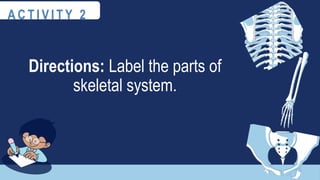
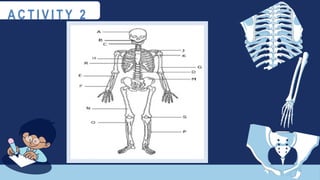
Directions: Label the parts of
skeletal system.
A C T I V I T Y 2
A C T I V I T Y 2
Directions: Draw the skeletal
system and label its parts on a
clean sheet of paper. Then write a
short description just below your
drawing.
A S S E S S M E N T
A S S E S S M E N T
SCIENCE
QUARTER 2 WEEK 1
DAY 3
R E V I E W
Directions: The table below shows some
common bone injuries. Supply
practices/activities that can help avoid
these injuries.
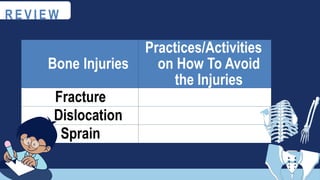
Bone Injuries
Practices/Activities
on How To Avoid
the Injuries
Fracture
Dislocation
Sprain
R E V I E W
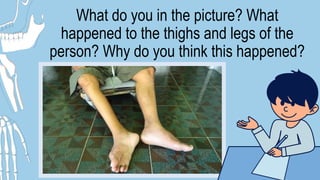
What do you in the picture? What
happened to the thighs and legs of the
person? Why do you think this happened?
THE
MUSCUSKELETAL
SYSTEM
(S6LT-IIab-1)
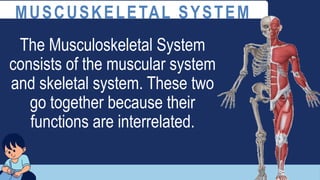
The Musculoskeletal System
consists of the muscular system
and skeletal system. These two
go together because their
functions are interrelated.
MUSCUSKELETAL SYSTEM
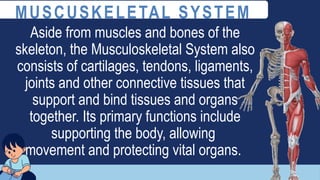
Aside from muscles and bones of the
skeleton, the Musculoskeletal System also
consists of cartilages, tendons, ligaments,
joints and other connective tissues that
support and bind tissues and organs
together. Its primary functions include
supporting the body, allowing
movement and protecting vital organs.
MUSCUSKELETAL SYSTEM
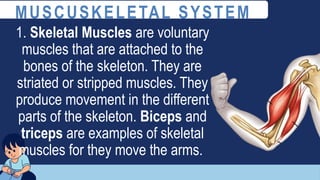
1. Skeletal Muscles are voluntary
muscles that are attached to the
bones of the skeleton. They are
striated or stripped muscles. They
produce movement in the different
parts of the skeleton. Biceps and
triceps are examples of skeletal
muscles for they move the arms.
MUSCUSKELETAL SYSTEM
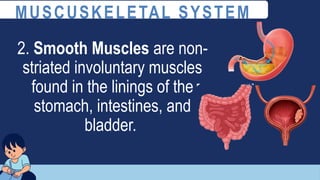
2. Smooth Muscles are non-
striated involuntary muscles
found in the linings of the
stomach, intestines, and
bladder.
MUSCUSKELETAL SYSTEM
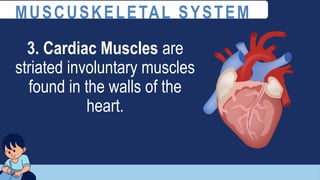
3. Cardiac Muscles are
striated involuntary muscles
found in the walls of the
heart.
MUSCUSKELETAL SYSTEM
To allow movements, different bones are
connected by joints which are connected
to other bones and muscle fibers through
connective tissues such as tendon,
ligament, cartilage and joint.
MUSCUSKELETAL SYSTEM
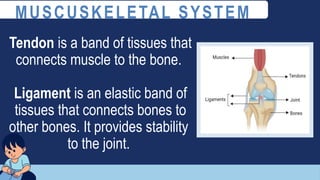
Tendon is a band of tissues that
connects muscle to the bone.
Ligament is an elastic band of
tissues that connects bones to
other bones. It provides stability
to the joint.
MUSCUSKELETAL SYSTEM
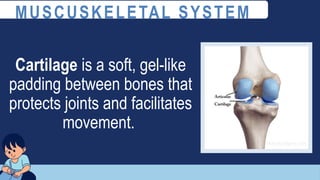
Cartilage is a soft, gel-like
padding between bones that
protects joints and facilitates
movement.
MUSCUSKELETAL SYSTEM
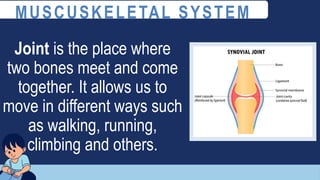
Joint is the place where
two bones meet and come
together. It allows us to
move in different ways such
as walking, running,
climbing and others.
MUSCUSKELETAL SYSTEM
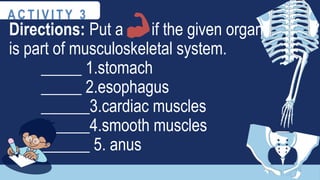
Directions: Put a if the given organ
is part of musculoskeletal system.
_____ 1.stomach
_____ 2.esophagus
______3.cardiac muscles
______4.smooth muscles
______ 5. anus
A C T I V I T Y 3
Directions: Draw the
musculoskeletal system and label
its parts on a clean sheet of paper.
Then write a short description just
below your drawing.
A S S E S S M E N T
Q2_SCIENCE_PPT_WEEK 1.pptx PPT..PPT WEEK

  • 1.
  • 2.
    R E VI E W Directions: Give at least five (5) separating mixture techniques. 1. 2. 3. 4. 5.
  • 3.
    Let us dancethe skeleton dance.
  • 4.
  • 5.
    The human bodyis made up of different kinds of bones. These bones are called skeleton. The human skeleton is the internal framework of the body. The adult human skeleton consists of 206 bones that are connected to one another by ligaments.
  • 6.
    At birth, infantshave around 300 bones fused together when they become adults. These bones work together as a system called a skeletal system. The skeletal system serves as the framework of the body.
  • 7.
    Its major functionsare body support, facilitation of movement, protection of internal organs, storage of minerals and fats, and blood cell formation.
  • 8.
    The skeletal systemis mainly composed of bones which are classified into two divisions, the axial and the appendicular skeleton. SKELETAL SYSTEM
  • 9.
    The axial skeletonincludes the skull, vertebral column, ribs, and sternum. These bones form the axes or framework of the trunk and head. SKELETAL SYSTEM
  • 10.
    The appendicular skeleton includesthe bones of the shoulder, arms, hands, hips, legs, and feet. SKELETAL SYSTEM
  • 11.
  • 12.
    All other bonesof skeletal system are classified into 4 as shown in the table: SKELETAL SYSTEM
  • 13.
  • 14.
    One of theaxial skeletons is the skull which consists of cranium and facial bones. The cranium is made up of eight bones joined together to form a rigid case that protects the brain. SKELETAL SYSTEM
  • 15.
    The face ismade up of 14 facial bones. The eye socket protects the eyeball while mandible or jawbone is movable bone that holds the teeth. SKELETAL SYSTEM
  • 16.
    The spinal columnor vertebrae (neck and backbone) are irregular bones that protect the spinal cord while the ribcage protects the lungs and the heart. Vertebrae are arranged on top of the other and move over each other slightly. SKELETAL SYSTEM
  • 17.
    There are 33vertebrae in the spinal column of a child and 26 in an adult. This is so because as the child grows, the last seven bones join together to form just two bones. SKELETAL SYSTEM
  • 18.
    Ribs are thebones at the side of the chest. There are 12 pairs of ribs. The upper 7 pairs are the true ribs because they are connected to the breastbone and the last two pairs are not connected. These ribs are called floating ribs. SKELETAL SYSTEM
  • 19.
    The shoulder hasthe collarbone found in front of it. Scapula is the shoulder bone found at the back of your shoulder. SKELETAL SYSTEM
  • 20.
    The appendages foundin the lower extremities are composed of pelvic bones. Pelvic bones support the lower parts of the body and aid the movement of the legs. SKELETAL SYSTEM
  • 21.
    The upper armshave one long bone called the humerus and two bones in the lower arm are known as the radius and ulna. Radius or radial bone is one of the two large bones of the forearm. SKELETAL SYSTEM
  • 22.
    The upper armshave one long bone called the humerus and two bones in the lower arm are known as the radius and ulna. SKELETAL SYSTEM
  • 23.
    Radius or radialbone is one of the two large bones of the forearm. The other bone is the ulna. The ulna is usually slightly longer than the radius while the latter is usually thicker. SKELETAL SYSTEM
  • 24.
    The wrist connectsthe hand to the forearm. Each wrist or carpal consists of 8 bones. The palm or metacarpal has 5 bones. SKELETAL SYSTEM
  • 25.
    The wrist connectsthe hand to the forearm. Each wrist or carpal consists of 8 bones. The palm or metacarpal has 5 bones. SKELETAL SYSTEM
  • 26.
    Inside the bonesare bone marrows that are very important for the body to manufacture blood cells. Bone marrows are of two types, the red bone marrow and the yellow bone marrow. SKELETAL SYSTEM
  • 27.
    The red bonemarrow is found in the humerus, femur, pelvis and vertebrae while the yellow bone marrow is found in many other bones. SKELETAL SYSTEM
  • 28.
    The red bonemarrow is found in the humerus, femur, pelvis and vertebrae while the yellow bone marrow is found in many other bones. SKELETAL SYSTEM
  • 29.
    Inside the bonesare bone marrows that are very important for the body to manufacture blood cells. Bone marrows are of two types, the red bone marrow and the yellow bone marrow. The red SKELETAL SYSTEM
  • 30.
    The human skeletalsystem has several important functions. 1. Support -The skeletal system provides the framework which supports and maintains shape of the body. It gives the body much needed support. SKELETAL SYSTEM
  • 31.
    2. Protection -Theskeletal system protects the internal organ of the body. 3. Movement- The skeletal system provides an attachment for the muscle which makes body movements possible. SKELETAL SYSTEM
  • 32.
    4. Storage andSupply- The skeletal system stores important minerals like calcium and phosphorus and produces both red and white blood cells. SKELETAL SYSTEM
  • 33.
    Directions: Study thename of the bones inside the box. Classify them into Axial or Appendicular. A C T I V I T Y 1
  • 34.
    skull humerus carpal femur ribstibia spine scapula tarsal ulna A C T I V I T Y 1
  • 35.
  • 36.
    Directions: Explain brieflyhow the skeletal system works based on their functions: A S S E S S M E N T
  • 37.
    Functions of theSkeletal System Explain briefly how the skeletal system works A. support the body Provides framework of the body A. protect the internal organs B. enable movement C. store minerals D. supply red and white cell A S S E S S M E N T
  • 38.
  • 39.
    R E VI E W Directions: Answer the following questions in your Science journal. 1. Knowing the functions of the skeletal system, could you imagine yourself without a bone? Explain your answer in at least 3 sentences.
  • 40.
    R E VI E W This is a human skeleton or skeletal system. Why do you need to have one? What do you think will happen if you do not have a skeleton?
  • 41.
  • 42.
    The human bodyis made up of different kinds of bones. These bones are called skeleton. The human skeleton is the internal framework of the body. The adult human skeleton consists of 206 bones that are connected to one another by ligaments.
  • 43.
    At birth, infantshave around 300 bones fused together when they become adults. These bones work together as a system called a skeletal system. The skeletal system serves as the framework of the body.
  • 44.
    Its major functionsare body support, facilitation of movement, protection of internal organs, storage of minerals and fats, and blood cell formation.
  • 45.
    The skeletal systemis mainly composed of bones which are classified into two divisions, the axial and the appendicular skeleton. SKELETAL SYSTEM
  • 46.
    The axial skeletonincludes the skull, vertebral column, ribs, and sternum. These bones form the axes or framework of the trunk and head. SKELETAL SYSTEM
  • 47.
    The appendicular skeleton includesthe bones of the shoulder, arms, hands, hips, legs, and feet. SKELETAL SYSTEM
  • 48.
  • 49.
    All other bonesof skeletal system are classified into 4 as shown in the table: SKELETAL SYSTEM
  • 50.
  • 51.
    One of theaxial skeletons is the skull which consists of cranium and facial bones. The cranium is made up of eight bones joined together to form a rigid case that protects the brain. SKELETAL SYSTEM
  • 52.
    The face ismade up of 14 facial bones. The eye socket protects the eyeball while mandible or jawbone is movable bone that holds the teeth. SKELETAL SYSTEM
  • 53.
    The spinal columnor vertebrae (neck and backbone) are irregular bones that protect the spinal cord while the ribcage protects the lungs and the heart. Vertebrae are arranged on top of the other and move over each other slightly. SKELETAL SYSTEM
  • 54.
    There are 33vertebrae in the spinal column of a child and 26 in an adult. This is so because as the child grows, the last seven bones join together to form just two bones. SKELETAL SYSTEM
  • 55.
    Ribs are thebones at the side of the chest. There are 12 pairs of ribs. The upper 7 pairs are the true ribs because they are connected to the breastbone and the last two pairs are not connected. These ribs are called floating ribs. SKELETAL SYSTEM
  • 56.
    The shoulder hasthe collarbone found in front of it. Scapula is the shoulder bone found at the back of your shoulder. SKELETAL SYSTEM
  • 57.
    The appendages foundin the lower extremities are composed of pelvic bones. Pelvic bones support the lower parts of the body and aid the movement of the legs. SKELETAL SYSTEM
  • 58.
    The upper armshave one long bone called the humerus and two bones in the lower arm are known as the radius and ulna. Radius or radial bone is one of the two large bones of the forearm. SKELETAL SYSTEM
  • 59.
    The upper armshave one long bone called the humerus and two bones in the lower arm are known as the radius and ulna. SKELETAL SYSTEM
  • 60.
    Radius or radialbone is one of the two large bones of the forearm. The other bone is the ulna. The ulna is usually slightly longer than the radius while the latter is usually thicker. SKELETAL SYSTEM
  • 61.
    The wrist connectsthe hand to the forearm. Each wrist or carpal consists of 8 bones. The palm or metacarpal has 5 bones. SKELETAL SYSTEM
  • 62.
    The wrist connectsthe hand to the forearm. Each wrist or carpal consists of 8 bones. The palm or metacarpal has 5 bones. SKELETAL SYSTEM
  • 63.
    Inside the bonesare bone marrows that are very important for the body to manufacture blood cells. Bone marrows are of two types, the red bone marrow and the yellow bone marrow. SKELETAL SYSTEM
  • 64.
    The red bonemarrow is found in the humerus, femur, pelvis and vertebrae while the yellow bone marrow is found in many other bones. SKELETAL SYSTEM
  • 65.
    The red bonemarrow is found in the humerus, femur, pelvis and vertebrae while the yellow bone marrow is found in many other bones. SKELETAL SYSTEM
  • 66.
    Inside the bonesare bone marrows that are very important for the body to manufacture blood cells. Bone marrows are of two types, the red bone marrow and the yellow bone marrow. The red SKELETAL SYSTEM
  • 67.
    The human skeletalsystem has several important functions. 1. Support -The skeletal system provides the framework which supports and maintains shape of the body. It gives the body much needed support. SKELETAL SYSTEM
  • 68.
    2. Protection -Theskeletal system protects the internal organ of the body. 3. Movement- The skeletal system provides an attachment for the muscle which makes body movements possible. SKELETAL SYSTEM
  • 69.
    4. Storage andSupply- The skeletal system stores important minerals like calcium and phosphorus and produces both red and white blood cells. SKELETAL SYSTEM
  • 70.
    Directions: Label theparts of skeletal system. A C T I V I T Y 2
  • 71.
    A C TI V I T Y 2
  • 72.
    Directions: Draw theskeletal system and label its parts on a clean sheet of paper. Then write a short description just below your drawing. A S S E S S M E N T
  • 73.
    A S SE S S M E N T
  • 74.
  • 75.
    R E VI E W Directions: The table below shows some common bone injuries. Supply practices/activities that can help avoid these injuries.
  • 76.
    Bone Injuries Practices/Activities on HowTo Avoid the Injuries Fracture Dislocation Sprain R E V I E W
  • 77.
    What do youin the picture? What happened to the thighs and legs of the person? Why do you think this happened?
  • 78.
  • 79.
    The Musculoskeletal System consistsof the muscular system and skeletal system. These two go together because their functions are interrelated. MUSCUSKELETAL SYSTEM
  • 80.
    Aside from musclesand bones of the skeleton, the Musculoskeletal System also consists of cartilages, tendons, ligaments, joints and other connective tissues that support and bind tissues and organs together. Its primary functions include supporting the body, allowing movement and protecting vital organs. MUSCUSKELETAL SYSTEM
  • 81.
    1. Skeletal Musclesare voluntary muscles that are attached to the bones of the skeleton. They are striated or stripped muscles. They produce movement in the different parts of the skeleton. Biceps and triceps are examples of skeletal muscles for they move the arms. MUSCUSKELETAL SYSTEM
  • 82.
    2. Smooth Musclesare non- striated involuntary muscles found in the linings of the stomach, intestines, and bladder. MUSCUSKELETAL SYSTEM
  • 83.
    3. Cardiac Musclesare striated involuntary muscles found in the walls of the heart. MUSCUSKELETAL SYSTEM
  • 84.
    To allow movements,different bones are connected by joints which are connected to other bones and muscle fibers through connective tissues such as tendon, ligament, cartilage and joint. MUSCUSKELETAL SYSTEM
  • 85.
    Tendon is aband of tissues that connects muscle to the bone. Ligament is an elastic band of tissues that connects bones to other bones. It provides stability to the joint. MUSCUSKELETAL SYSTEM
  • 86.
    Cartilage is asoft, gel-like padding between bones that protects joints and facilitates movement. MUSCUSKELETAL SYSTEM
  • 87.
    Joint is theplace where two bones meet and come together. It allows us to move in different ways such as walking, running, climbing and others. MUSCUSKELETAL SYSTEM
  • 88.
    Directions: Put aif the given organ is part of musculoskeletal system. _____ 1.stomach _____ 2.esophagus ______3.cardiac muscles ______4.smooth muscles ______ 5. anus A C T I V I T Y 3
  • 89.
    Directions: Draw the musculoskeletalsystem and label its parts on a clean sheet of paper. Then write a short description just below your drawing. A S S E S S M E N T