SCIENCE
PROJECT
by
Kaushik P.K
IX – C
Roll No. 16
GDGPS, Patna
WHAT IS OSMOSIS?
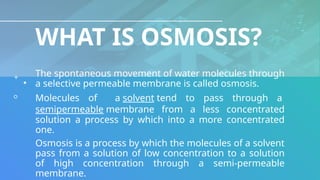
The spontaneous movement of water molecules through
a selective permeable membrane is called osmosis.
Molecules of a solvent tend to pass through a
semipermeable membrane from a less concentrated
solution a process by which into a more concentrated
one.
Osmosis is a process by which the molecules of a solvent
pass from a solution of low concentration to a solution
of high concentration through a semi-permeable
membrane.
‘OSMOSIS’
EXAMPLES OF OSMOSIS
Factors on which osmosis depends and different type
of solution affecting osmosis
•Isotonic Solutions: These have the same concentration of solutes (dissolved
substances) as the cell or environment they are compared to. Water moves
equally in and out of the cell, maintaining cell size and shape.
•Hypotonic Solutions: These solutions have a lower concentration of solutes
compared to another solution (e.g., inside a cell). Water moves into the cell,
which may cause it to swell or even burst (lyse) in extreme cases.
•Hypertonic Solutions: These have a higher concentration of solutes than
another solution (e.g., inside a cell). Water moves out of the cell, causing it to
shrink (crenate in red blood cells or plasmolyze in plant cells).
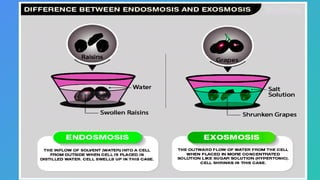
Activity: Osmosis with raisins and
apricots
• Dried raisins and apricots in pure water and leave them for
some time.
• Then place them into a concentrated solution of sugar and
salt.
• Since water is a hypotonic solution, each gains water and
swells when placed in pure water due to endosmosis.
• When such swollen raisins/apricots are placed in the
concentrated solution (hypertonic) each of them loses water,
consequently shrinks again (due to exosmosis).
Osmosis with raisins and apricots in Different Type of
Solutions
Science Project.pptxffffffffffffffffffff

Science Project.pptxffffffffffffffffffff

  • 1.
    SCIENCE PROJECT by Kaushik P.K IX –C Roll No. 16 GDGPS, Patna
  • 2.
    WHAT IS OSMOSIS? Thespontaneous movement of water molecules through a selective permeable membrane is called osmosis. Molecules of a solvent tend to pass through a semipermeable membrane from a less concentrated solution a process by which into a more concentrated one. Osmosis is a process by which the molecules of a solvent pass from a solution of low concentration to a solution of high concentration through a semi-permeable membrane.
  • 3.
  • 4.
  • 5.
    Factors on whichosmosis depends and different type of solution affecting osmosis •Isotonic Solutions: These have the same concentration of solutes (dissolved substances) as the cell or environment they are compared to. Water moves equally in and out of the cell, maintaining cell size and shape. •Hypotonic Solutions: These solutions have a lower concentration of solutes compared to another solution (e.g., inside a cell). Water moves into the cell, which may cause it to swell or even burst (lyse) in extreme cases. •Hypertonic Solutions: These have a higher concentration of solutes than another solution (e.g., inside a cell). Water moves out of the cell, causing it to shrink (crenate in red blood cells or plasmolyze in plant cells).
  • 8.
    Activity: Osmosis withraisins and apricots • Dried raisins and apricots in pure water and leave them for some time. • Then place them into a concentrated solution of sugar and salt. • Since water is a hypotonic solution, each gains water and swells when placed in pure water due to endosmosis. • When such swollen raisins/apricots are placed in the concentrated solution (hypertonic) each of them loses water, consequently shrinks again (due to exosmosis).
  • 10.
    Osmosis with raisinsand apricots in Different Type of Solutions