Scientific Method
Ask a Question		The scientific method starts when you ask a question about something that you observe: How, What, When, Who, Which, Why, or Where?
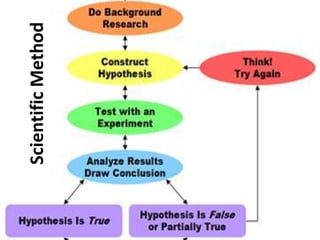
Do Background ResearchRather than starting from scratch in putting together a plan for answering your question, you want to be a savvy scientist using library and Internet research to help you find the best way to do things and insure that you don't repeat mistakes from the past.
Construct a HypothesisA hypothesis is an educated guess about how things work:"If _____[I do this] _____, then _____[this]_____ will happen."
Test Hypothesis with an ExperimentYour experiment tests whether your hypothesis is true or false. It is important for your experiment to be a fair test. You conduct a fair test by making sure that you change only one factor at a time while keeping all other conditions the same.
Analyze Data & Draw a ConclusionOnce your experiment is complete, you collect your measurements and analyze them to see if your hypothesis is true or false.
Communicate ResultsTo complete your science fair project you will communicate your results to others in a final report and/or a display board. Professional scientists do almost exactly the same thing by publishing their final report in a scientific journal or by presenting their results on a poster at a scientific meeting.

Scientific method

  • 1.
  • 2.
    Ask a Question Thescientific method starts when you ask a question about something that you observe: How, What, When, Who, Which, Why, or Where?
  • 3.
    Do Background ResearchRatherthan starting from scratch in putting together a plan for answering your question, you want to be a savvy scientist using library and Internet research to help you find the best way to do things and insure that you don't repeat mistakes from the past.
  • 4.
    Construct a HypothesisAhypothesis is an educated guess about how things work:"If _____[I do this] _____, then _____[this]_____ will happen."
  • 5.
    Test Hypothesis withan ExperimentYour experiment tests whether your hypothesis is true or false. It is important for your experiment to be a fair test. You conduct a fair test by making sure that you change only one factor at a time while keeping all other conditions the same.
  • 6.
    Analyze Data &Draw a ConclusionOnce your experiment is complete, you collect your measurements and analyze them to see if your hypothesis is true or false.
  • 7.
    Communicate ResultsTo completeyour science fair project you will communicate your results to others in a final report and/or a display board. Professional scientists do almost exactly the same thing by publishing their final report in a scientific journal or by presenting their results on a poster at a scientific meeting.