KINETIC MOLECULAR
THEORY (KMT)
This model is used to describe the
behavior of gases.
It is used to explain properties of
gases, such as pressure,
temperature, and volume, in terms of
atoms.
KINETIC MOLECULAR
THEORY (KMT)
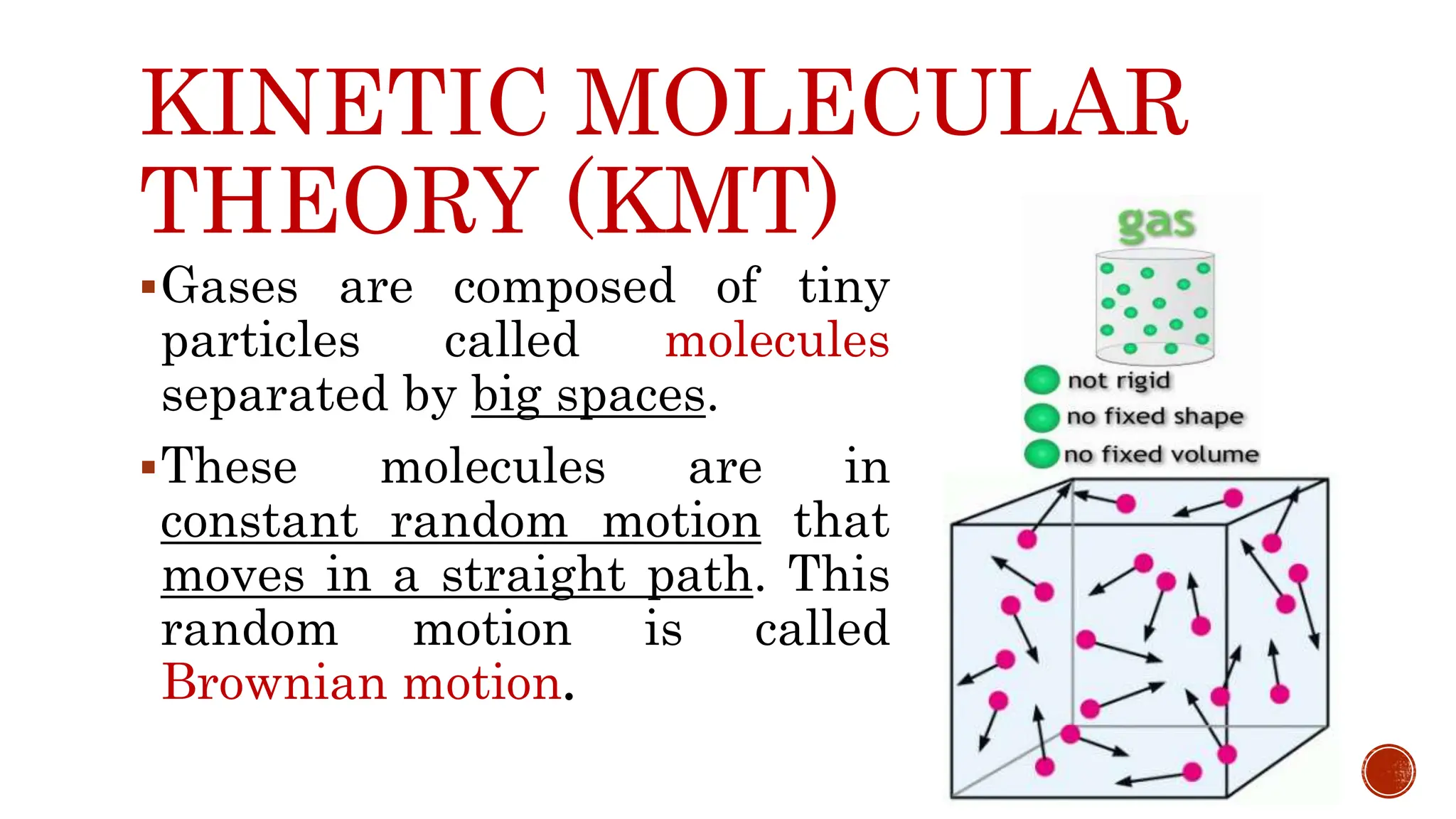
Gases are composed of tiny
particles called molecules
separated by big spaces.
These molecules are in
constant random motion that
moves in a straight path. This
random motion is called
Brownian motion.
KINETIC MOLECULAR
THEORY (KMT)
Due to movement, gas
molecules also hit the walls
of its container. The force
exerted on the wall is called
gas pressure.
Gases have masses, so they
are affected by gravity.
KINETIC MOLECULAR
THEORY (KMT)
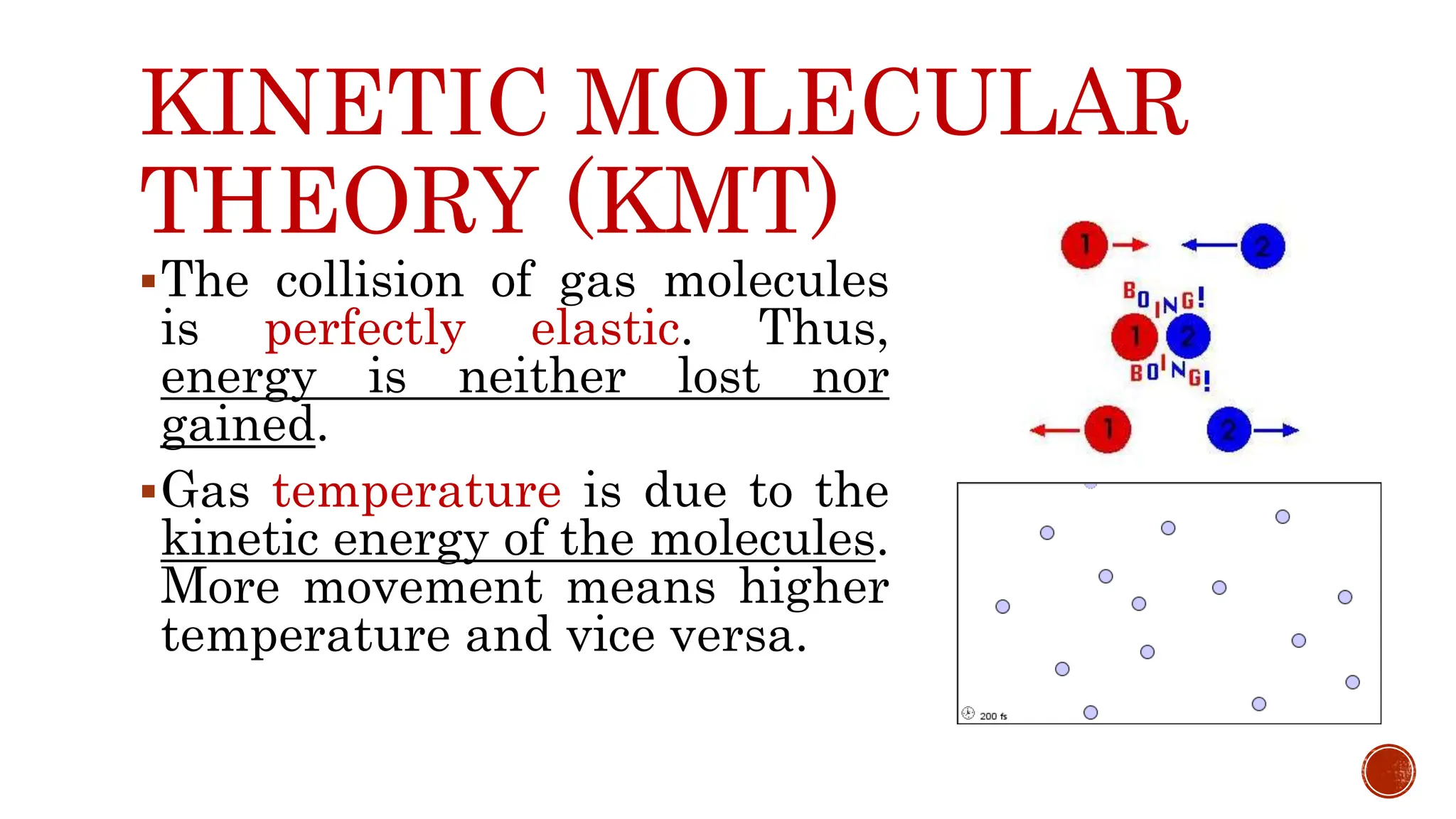
The collision of gas molecules
is perfectly elastic. Thus,
energy is neither lost nor
gained.
Gas temperature is due to the
kinetic energy of the molecules.
More movement means higher
temperature and vice versa.
GASES
• Gas is a state
of matter that
has no fixed
shape and no
fixed volume.
• Gases have a
lower density
than other
states of
matter, such
as solids and
liquids.
THE PROPERTIES
OF GASES
Temperature
The temperature of a gas is the
measure of its hotness or coldness.
It is related to the average kinetic
energy of its molecules.
It can be measured in Celsius or Kelvin.
Kelvin is the absolute scale.
THE PROPERTIES
OF GASES
Mass
The amount of gas or its mass
could be expressed in moles
or grams.
THE PROPERTIES
OF GASES
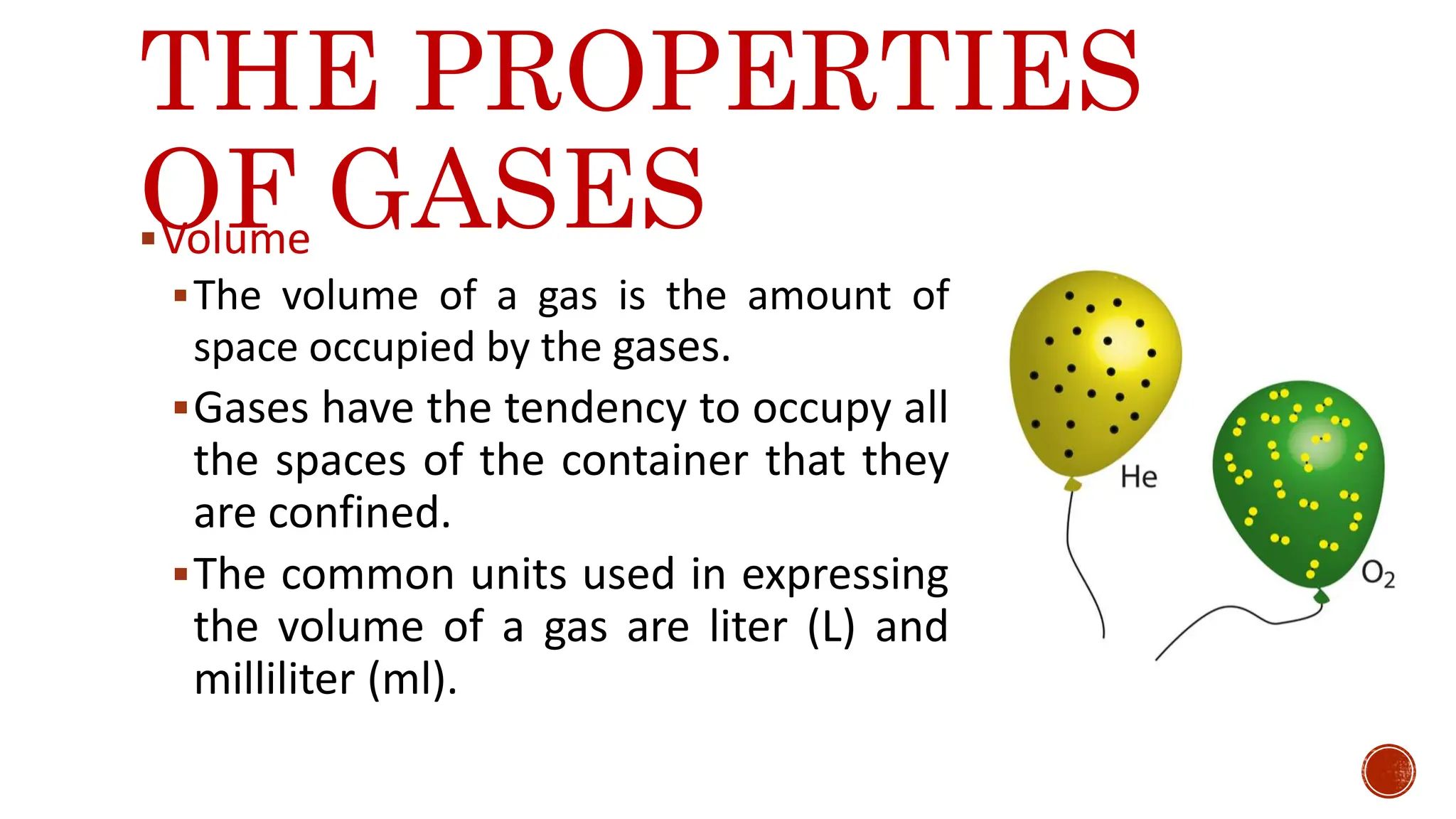
Volume
The volume of a gas is the amount of
space occupied by the gases.
Gases have the tendency to occupy all
the spaces of the container that they
are confined.
The common units used in expressing
the volume of a gas are liter (L) and
milliliter (ml).
THE PROPERTIES
OF GASES
Pressure
The pressure of a confined gas
is the average effect of the
forces of the colliding
molecules.
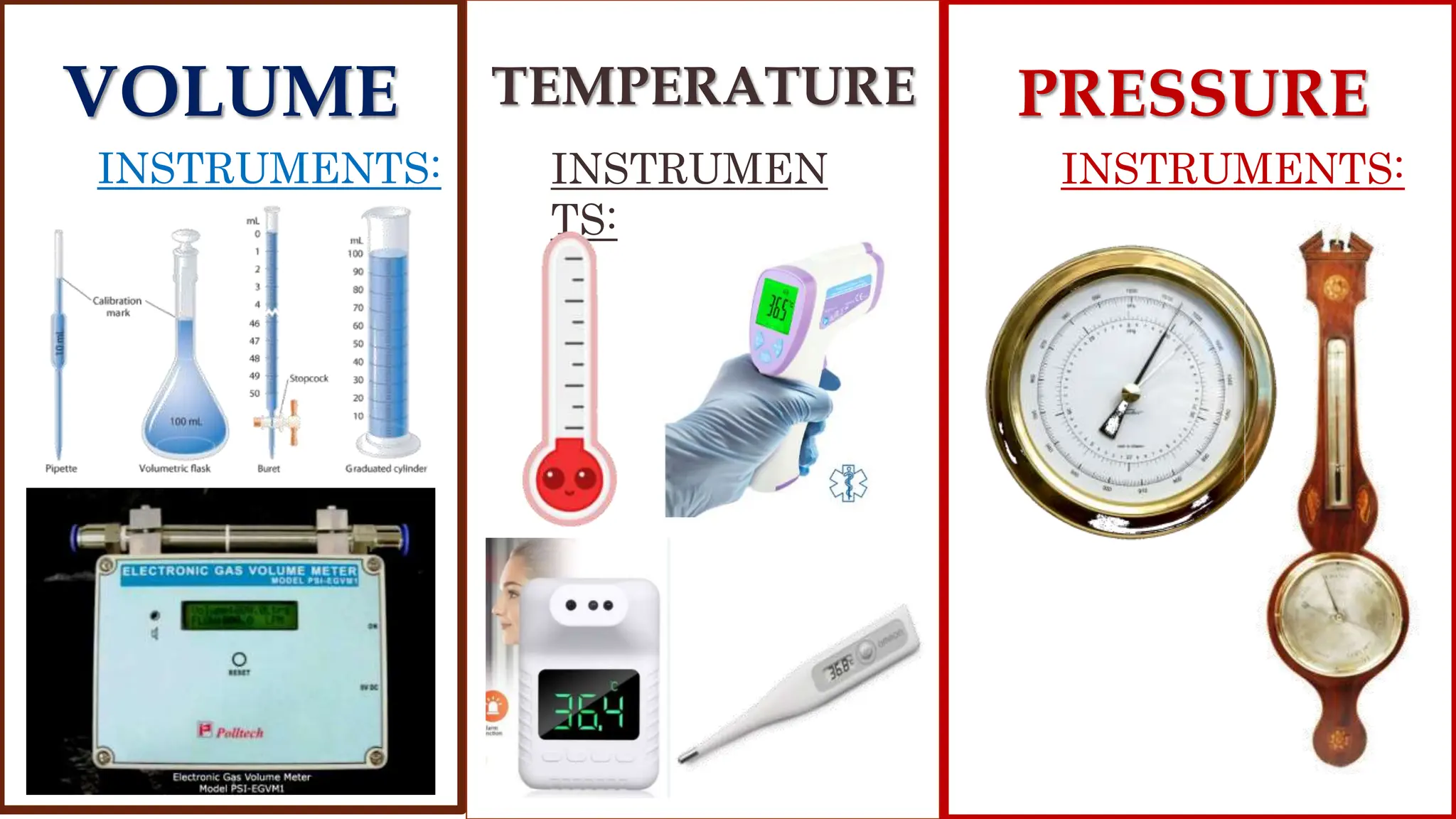
INSTRUMENTS: INSTRUMEN
TS:
INSTRUMENTS:
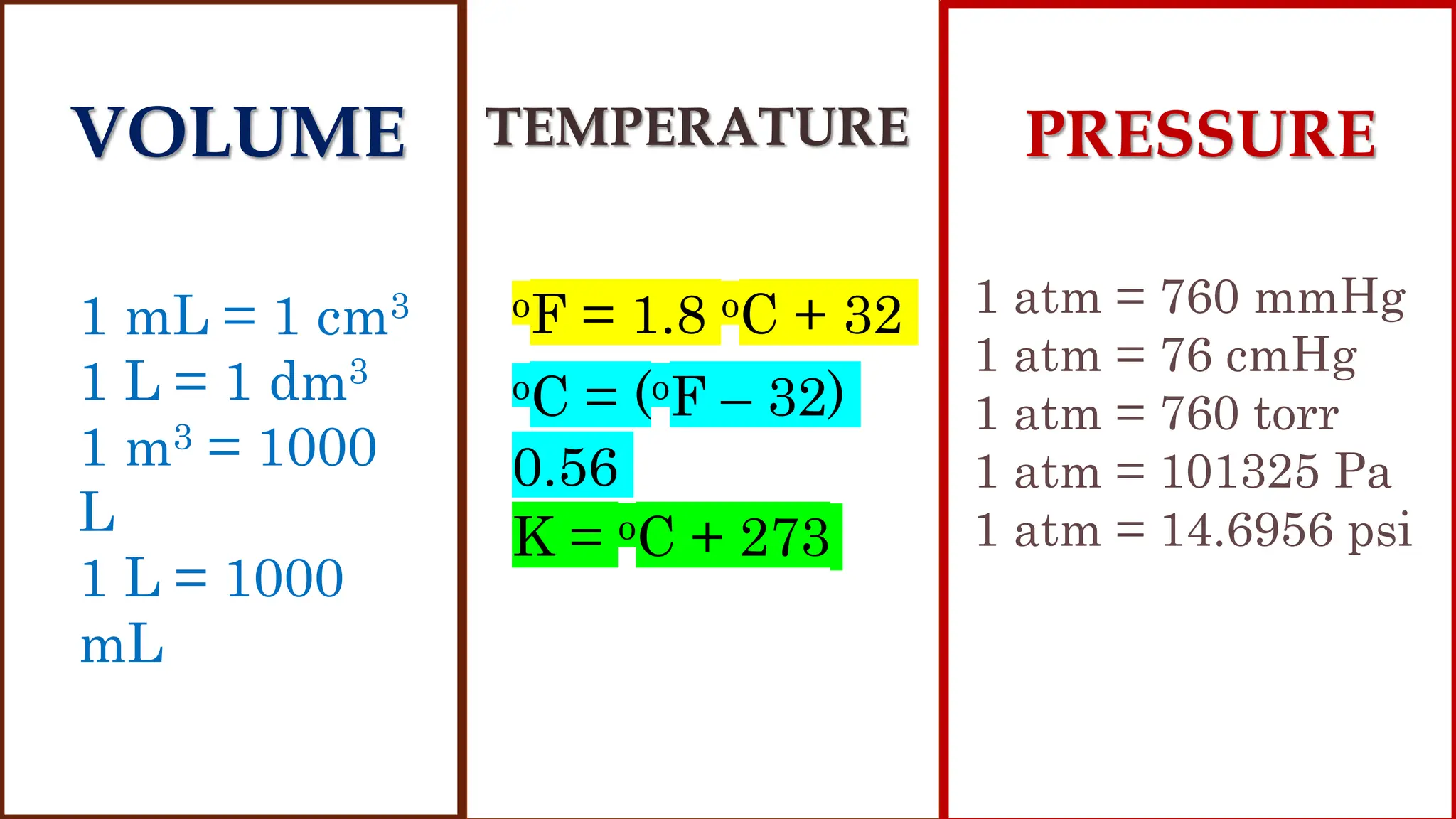
VOLUME TEMPERATURE PRESSURE
1 mL = 1 cm3
1 L = 1 dm3
1 m3 = 1000
L
1 L = 1000
mL
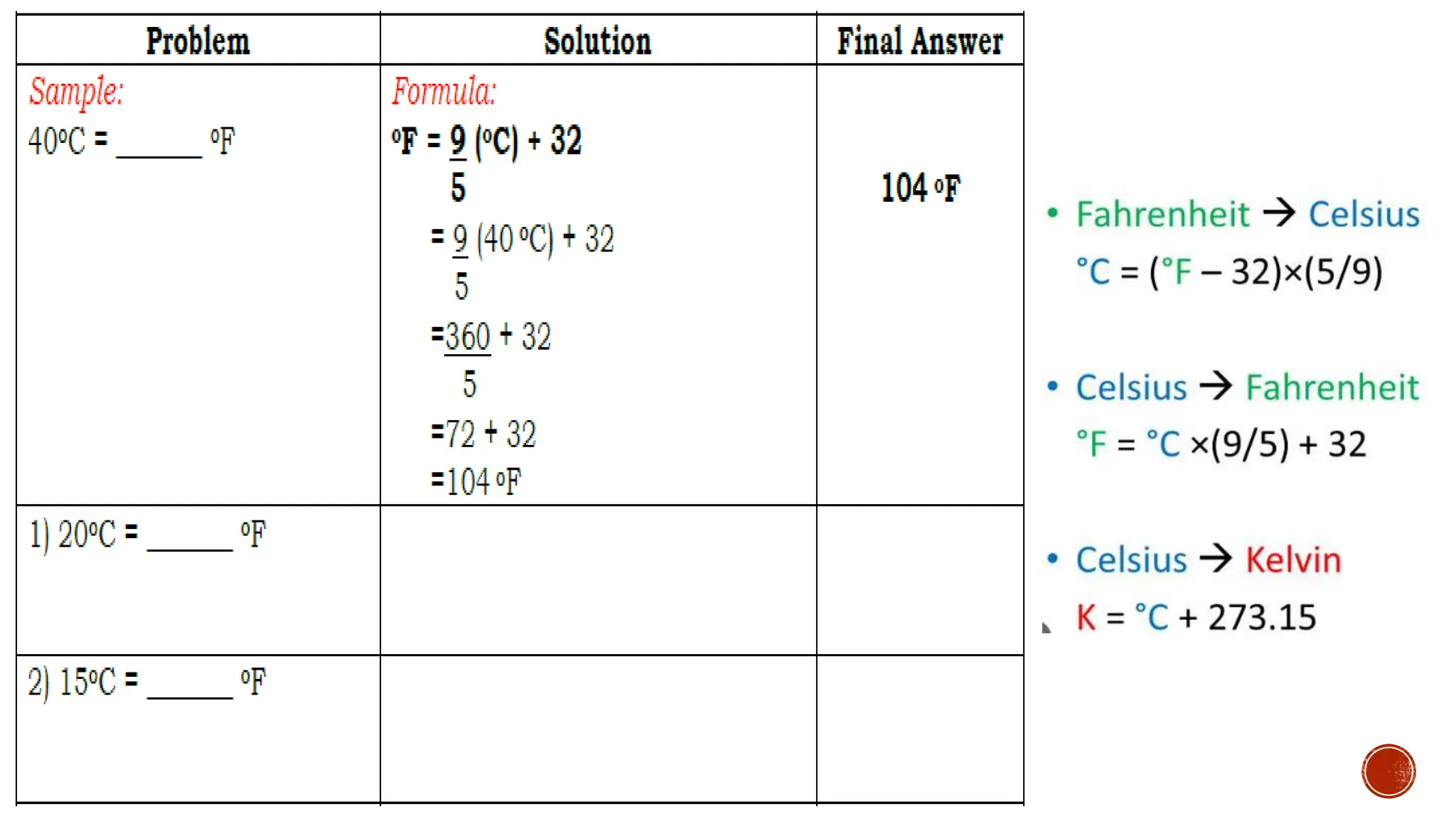
oF = 1.8 oC + 32
oC = (oF – 32)
0.56
K = oC + 273
1 atm = 760 mmHg
1 atm = 76 cmHg
1 atm = 760 torr
1 atm = 101325 Pa
1 atm = 14.6956 psi
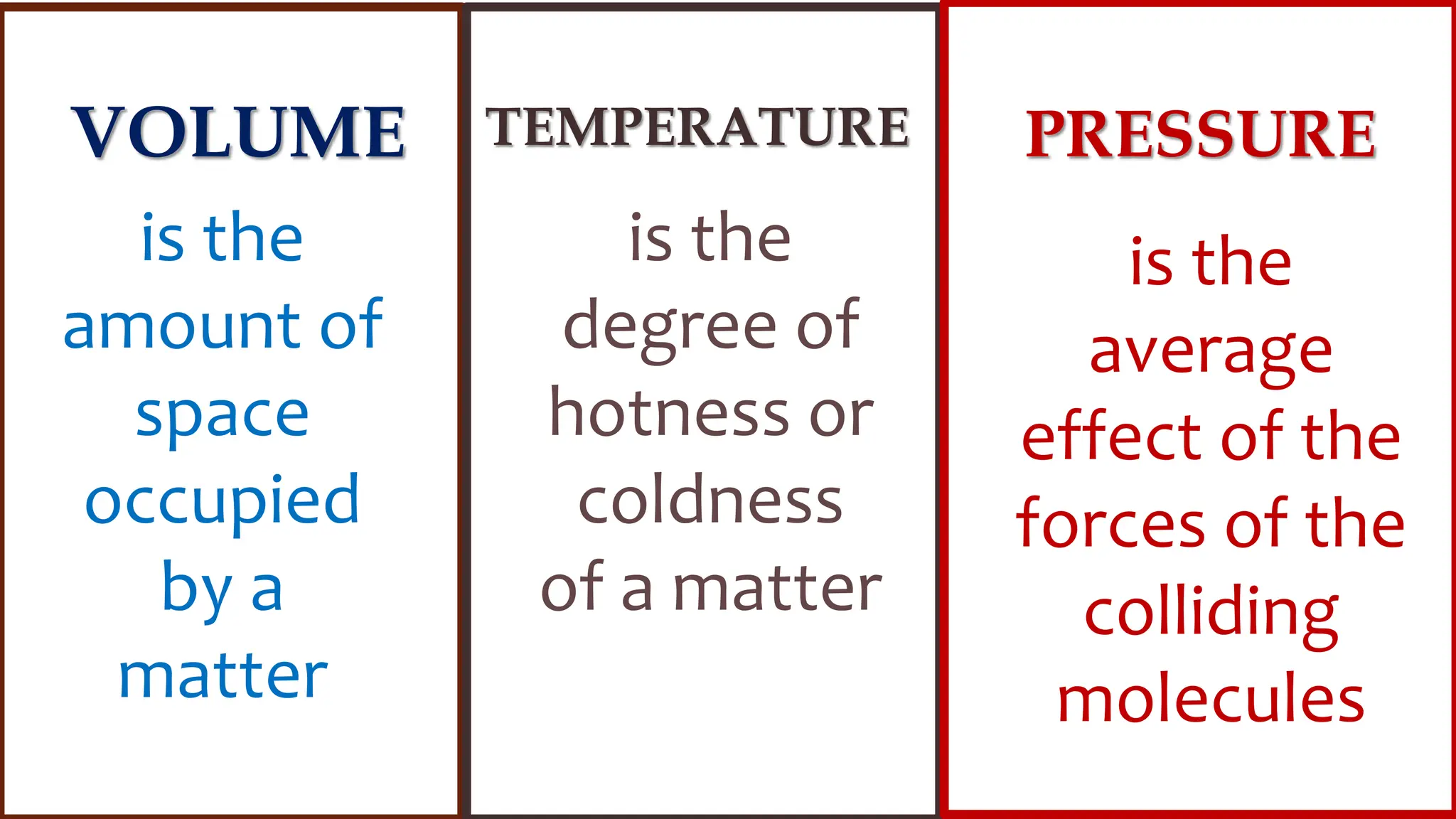
VOLUME TEMPERATURE PRESSURE
is the
amount of
space
occupied
by a
matter
is the
degree of
hotness or
coldness
of a matter
is the
average
effect of the
forces of the
colliding
molecules
Robert Boyle
The pressure of a gas is
inversely proportional with
its volume.
“As the pressure increases,
the volume of a gas decreases
at constant temperature or
vice versa.”
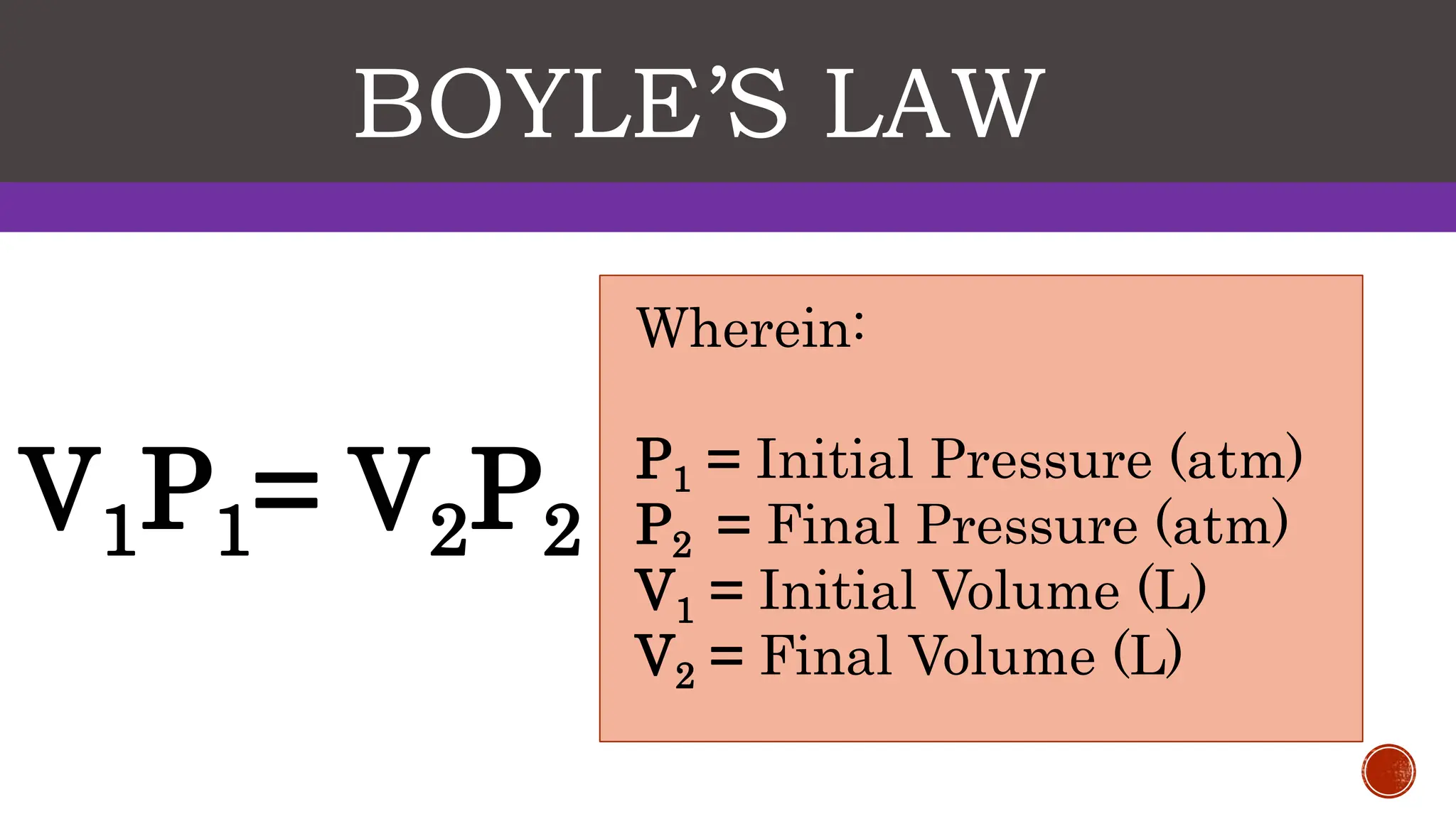
BOYLE’S LAW
Wherein:
P1 = Initial Pressure (atm)
P2 = Final Pressure (atm)
V1 = Initial Volume (L)
V2 = Final Volume (L)
V1P1= V2P2
BOYLE’S LAW
BOYLE’S LAW
How much pressure is needed to change the volume of
a dry gas from 70 L to 10 L keeping the temperature
constant? The original pressure is 1 atm.
Given:
Required:
Equation:
Solution:
Answer:
70 L
10 L
1 atm
= V1
= V2
= P1
P2 = ?
70L(1 atm)
10 L
70 atm
V1 P1
V2
P2 =
P2 = =
10
P2 = 7
Oxygen gas inside a 1.5 L gas tank has a pressure of 0.95 atm.
Provided that the temperature remains constant, how much
pressure is needed to reduce its volume by ½.
Given:
Required:
Equation:
Solution:
Answer:
1.5 L
0.95
atm
= V1
= P1
= V2
P2 = ?
1.5 L(0.95 atm)
0.75 L
V1 P1
V2
P2 =
P2 =
P2 = 1.9 atm
BOYLE’S LAW
0.75 L
APPLICATION OF BOYLE’S LAW
When you squeeze the
balloon, you are increasing
the pressure which
decreases the volume.
As you push air into the
tire, the increasing
pressure reduces the
volume of the air molecules
by packing them together.
APPLICATION OF BOYLE’S LAW
CHARLES’ LAW
Jacques Charles
The volume of a gas is
directly proportional with
its temperature.
“As the temperature
increases, the volume of a gas
increases at constant pressure
or vice versa.”
Wherein:
T1 = Initial Temperature
(K)
T2 = Final Temperature
(K)
V1 = Initial Volume (L)
V = Final Volume (L)
APPLICATION OF CHARLES’ LAW
V1T2= V2T1
The volume of a gas sample at 273 K is 2 L. At
what temperature would the gas be to increase
its volume to 4 L?
Given:
Required:
Equation:
Solution:
Answer:
273 K
2 L
4 L
= T1
= V1
= V2
T2 = ?
4 L (273 K)
2 L
V2 T1
V1
T2 =
T2 =
T2 = 546 K
CHARLES’ LAW
At 215 K, the volume of chlorine gas is 250 L.
Compute for the resulting volume if the temperature
is adjusted to 318K provided that the pressure
remains the same.
Given:
Required:
Equation:
Solution:
Answer:
215 K
250 L
318 K
= T1
= V1
= T2
V2 = ?
250
L
(318 K)
215 K
V1 T2
T1
V2 =
V2 =
T2 = 369.77
CHARLES’ LAW
GAY-LUSSAC’S LAW
Joseph Louis Gay-Lussac
The pressure of a gas is
directly proportional with
its temperature at
constant volume.
“As the temperature
increases, the pressure of a
gas increases at constant
volume or vice versa.”
GAY-LUSSAC’S LAW
P1T2 P2T1
=
Wherein:
P1= Initial Pressure
T1= Initial Temperature
P2= Final Pressure
T2= Final Temperature
The pressure of a nitrogen gas inside a rigid tank is 1.5
atmosphere at 30°C. What will be the resulting pressure
if the tank is cooled to 0°C?
GAY-LUSSAC’S LAW
Given:
Required:
Equation:
Solution:
Answer:
1.5 atm = P1
= T1
= T2
P2 = ?
1.5
atm
(273 K)
303 K
P1 T2
T1
P2 =
P2 =
P2 = 1.35 atm
30 °C
0°C
+
273
303 K
+ 273
273 K
A certain light bulb containing argon has a pressure of 1.20
atm at 18°C. If it will be heated to 85°C at constant
volume, what will be the resulting pressure?
GAY-LUSSAC’S LAW
Given:
Required:
Equation:
Solution:
Answer:
1.20
atm
= P1
= T1
= T2
P2 = ?
1.20 atm
(358 K)
291 K
P1 T2
T1
P2 =
P2 =
P2 = 1.48 atm
18 °C
85°C
+
273
291 K
+ 273
358 K
APPLICATION OF GAY-LUSSAC’S LAW
• Firing a bullet
When gunpowder burns, it
creates a significant amount
of superheated gas. The high
pressure of the hot gas
behind the bullet forces it
out of the barrel of the gun.
APPLICATION OF GAY-LUSSAC’S LAW
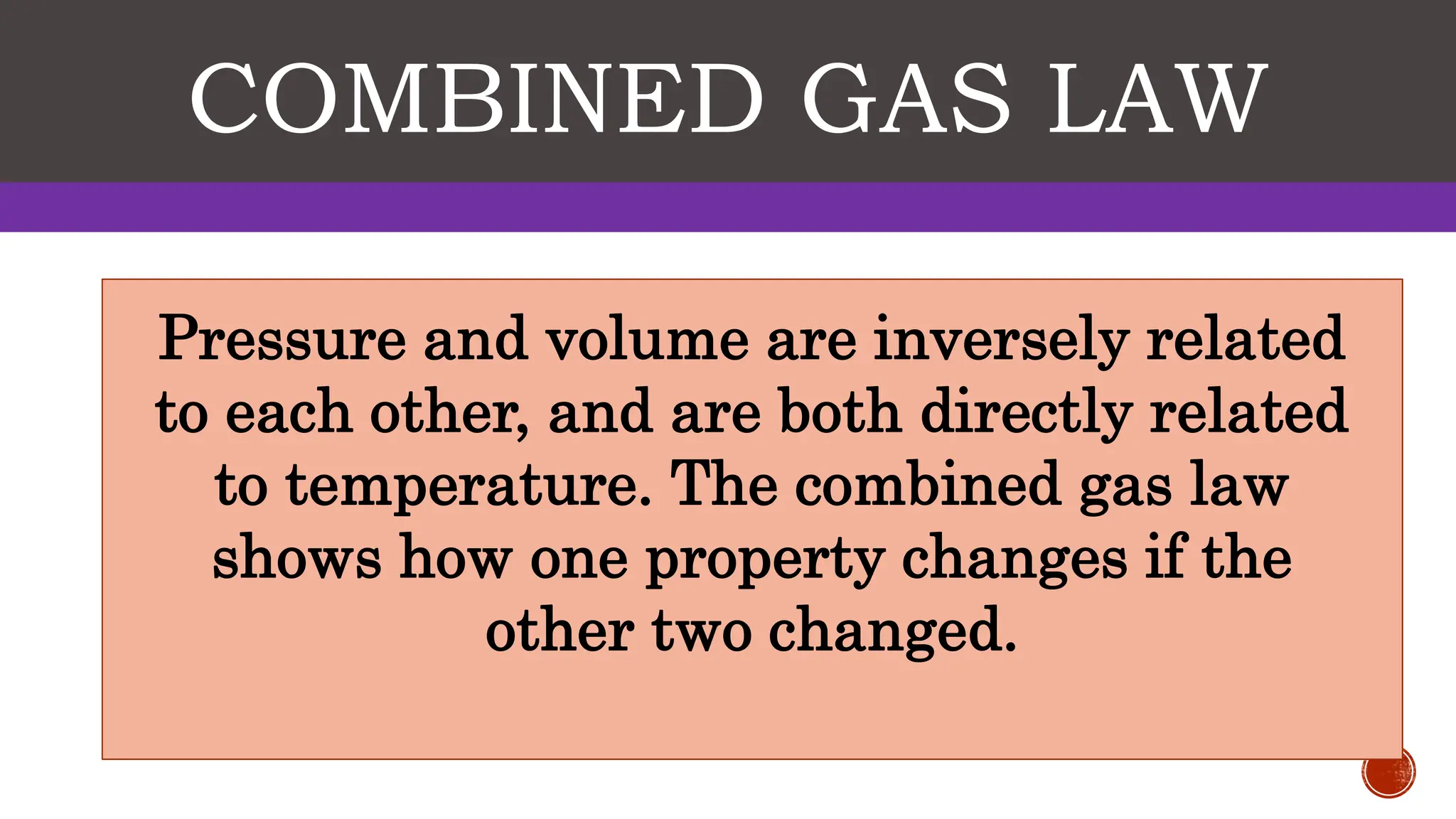
Pressure and volume are inversely related
to each other, and are both directly related
to temperature. The combined gas law
shows how one property changes if the
other two changed.
COMBINED GAS LAW
Wherein:
P1 = Initial Pressure
(atm)
P2 = Final Pressure
(atm)
T1 = Initial
Temperature(K)
T2 = Final
P1V1T2= P2V2T
1
COMBINED GAS LAW
P1V1T2
=P2V2T
1
COMBINED GAS LAW
The volume of a gas at 300 K and 2 atm is 0.6 L.
What is the volume of the gas at 253 K and 1 atm?
COMBINED GAS LAW
Given:
Required:
Equation:
Solution:
Answer:
300 K
2 atm
0.6 L
253 K
1 atm
= T1
= P1
= V1
V2 = ?
2 atm(0.6 L )
1 atm
P1 V1T2
P2 T1
V2 =
V2 =
V2 = 1.01 L
= T2
= P2
(253 K )
(300 K)
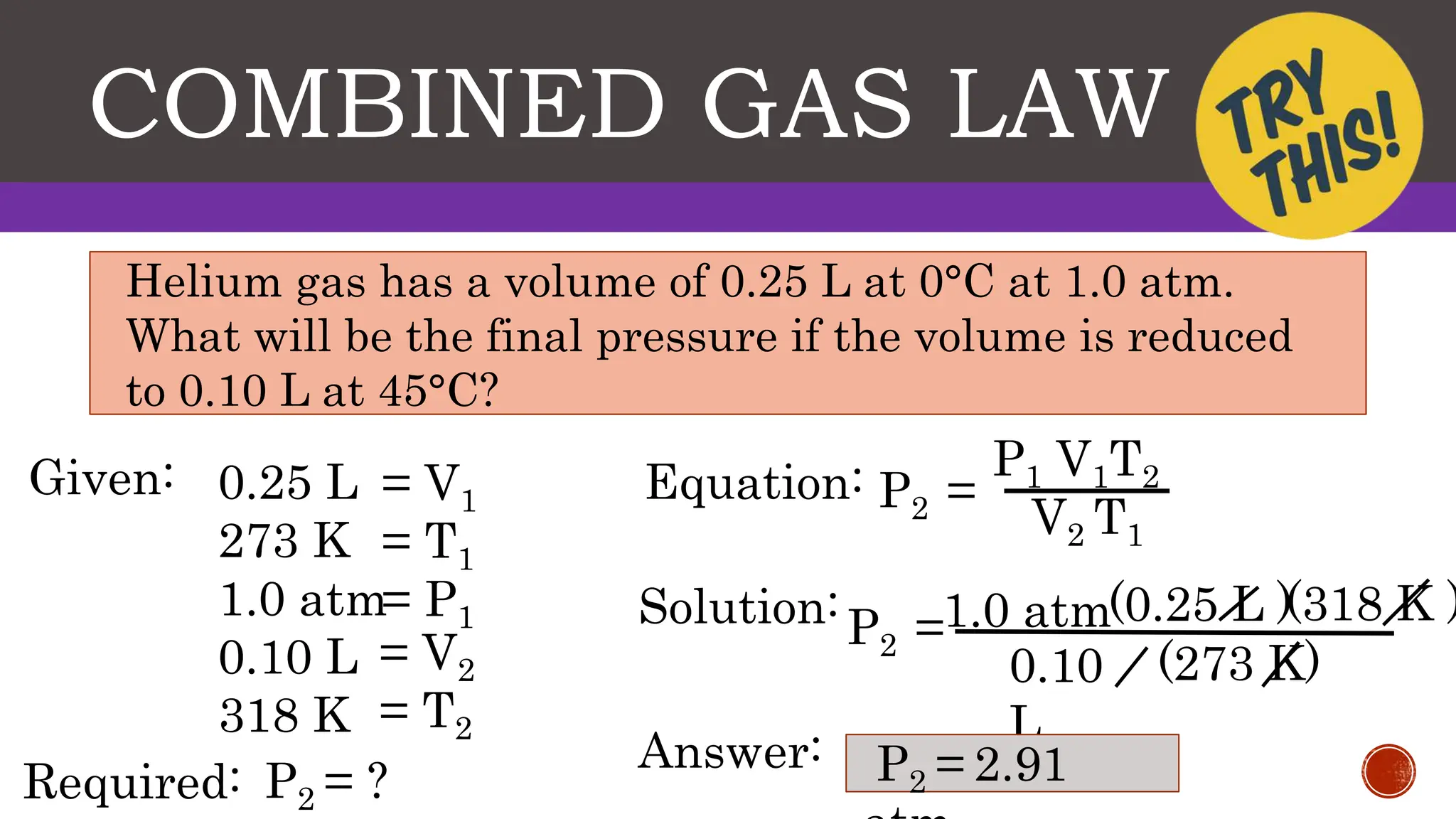
Helium gas has a volume of 0.25 L at 0°C at 1.0 atm.
What will be the final pressure if the volume is reduced
to 0.10 L at 45°C?
COMBINED GAS LAW
Given:
Required:
Equation:
Solution:
Answer:
0.25 L
273 K
1.0 atm
0.10 L
318 K
= V1
= T1
= P1
P2 = ?
1.0 atm(0.25 L )
0.10
L
P1 V1T2
V2 T1
P2 =
P2 =
P2 = 2.91
= V2
= T2
(318 K )
(273 K)
APPLICATIONS OF COMBINED GAS LAW
In lifestyle, the combined gas
law has applications. When
the quantity of gas remains
constant, but the pressure,
volume, and temperature
fluctuate, this rule
applies. Cloud formation,
refrigerators, and air
conditioners, for instance, are

SCIENCE GRADE 10 4TH QUARTER REVIEW.pptx

  • 2.
    KINETIC MOLECULAR THEORY (KMT) Thismodel is used to describe the behavior of gases. It is used to explain properties of gases, such as pressure, temperature, and volume, in terms of atoms.
  • 3.
    KINETIC MOLECULAR THEORY (KMT) Gasesare composed of tiny particles called molecules separated by big spaces. These molecules are in constant random motion that moves in a straight path. This random motion is called Brownian motion.
  • 4.
    KINETIC MOLECULAR THEORY (KMT) Dueto movement, gas molecules also hit the walls of its container. The force exerted on the wall is called gas pressure. Gases have masses, so they are affected by gravity.
  • 5.
    KINETIC MOLECULAR THEORY (KMT) Thecollision of gas molecules is perfectly elastic. Thus, energy is neither lost nor gained. Gas temperature is due to the kinetic energy of the molecules. More movement means higher temperature and vice versa.
  • 6.
    GASES • Gas isa state of matter that has no fixed shape and no fixed volume. • Gases have a lower density than other states of matter, such as solids and liquids.
  • 7.
    THE PROPERTIES OF GASES Temperature Thetemperature of a gas is the measure of its hotness or coldness. It is related to the average kinetic energy of its molecules. It can be measured in Celsius or Kelvin. Kelvin is the absolute scale.
  • 8.
    THE PROPERTIES OF GASES Mass Theamount of gas or its mass could be expressed in moles or grams.
  • 9.
    THE PROPERTIES OF GASES Volume Thevolume of a gas is the amount of space occupied by the gases. Gases have the tendency to occupy all the spaces of the container that they are confined. The common units used in expressing the volume of a gas are liter (L) and milliliter (ml).
  • 10.
    THE PROPERTIES OF GASES Pressure Thepressure of a confined gas is the average effect of the forces of the colliding molecules.
  • 11.
  • 12.
    1 mL =1 cm3 1 L = 1 dm3 1 m3 = 1000 L 1 L = 1000 mL oF = 1.8 oC + 32 oC = (oF – 32) 0.56 K = oC + 273 1 atm = 760 mmHg 1 atm = 76 cmHg 1 atm = 760 torr 1 atm = 101325 Pa 1 atm = 14.6956 psi VOLUME TEMPERATURE PRESSURE
  • 20.
    VOLUME TEMPERATURE PRESSURE isthe amount of space occupied by a matter is the degree of hotness or coldness of a matter is the average effect of the forces of the colliding molecules
  • 21.
    Robert Boyle The pressureof a gas is inversely proportional with its volume. “As the pressure increases, the volume of a gas decreases at constant temperature or vice versa.” BOYLE’S LAW
  • 22.
    Wherein: P1 = InitialPressure (atm) P2 = Final Pressure (atm) V1 = Initial Volume (L) V2 = Final Volume (L) V1P1= V2P2 BOYLE’S LAW
  • 23.
    BOYLE’S LAW How muchpressure is needed to change the volume of a dry gas from 70 L to 10 L keeping the temperature constant? The original pressure is 1 atm. Given: Required: Equation: Solution: Answer: 70 L 10 L 1 atm = V1 = V2 = P1 P2 = ? 70L(1 atm) 10 L 70 atm V1 P1 V2 P2 = P2 = = 10 P2 = 7
  • 24.
    Oxygen gas insidea 1.5 L gas tank has a pressure of 0.95 atm. Provided that the temperature remains constant, how much pressure is needed to reduce its volume by ½. Given: Required: Equation: Solution: Answer: 1.5 L 0.95 atm = V1 = P1 = V2 P2 = ? 1.5 L(0.95 atm) 0.75 L V1 P1 V2 P2 = P2 = P2 = 1.9 atm BOYLE’S LAW 0.75 L
  • 25.
    APPLICATION OF BOYLE’SLAW When you squeeze the balloon, you are increasing the pressure which decreases the volume.
  • 26.
    As you pushair into the tire, the increasing pressure reduces the volume of the air molecules by packing them together. APPLICATION OF BOYLE’S LAW
  • 27.
    CHARLES’ LAW Jacques Charles Thevolume of a gas is directly proportional with its temperature. “As the temperature increases, the volume of a gas increases at constant pressure or vice versa.”
  • 28.
    Wherein: T1 = InitialTemperature (K) T2 = Final Temperature (K) V1 = Initial Volume (L) V = Final Volume (L) APPLICATION OF CHARLES’ LAW V1T2= V2T1
  • 29.
    The volume ofa gas sample at 273 K is 2 L. At what temperature would the gas be to increase its volume to 4 L? Given: Required: Equation: Solution: Answer: 273 K 2 L 4 L = T1 = V1 = V2 T2 = ? 4 L (273 K) 2 L V2 T1 V1 T2 = T2 = T2 = 546 K CHARLES’ LAW
  • 30.
    At 215 K,the volume of chlorine gas is 250 L. Compute for the resulting volume if the temperature is adjusted to 318K provided that the pressure remains the same. Given: Required: Equation: Solution: Answer: 215 K 250 L 318 K = T1 = V1 = T2 V2 = ? 250 L (318 K) 215 K V1 T2 T1 V2 = V2 = T2 = 369.77 CHARLES’ LAW
  • 31.
    GAY-LUSSAC’S LAW Joseph LouisGay-Lussac The pressure of a gas is directly proportional with its temperature at constant volume. “As the temperature increases, the pressure of a gas increases at constant volume or vice versa.”
  • 32.
    GAY-LUSSAC’S LAW P1T2 P2T1 = Wherein: P1=Initial Pressure T1= Initial Temperature P2= Final Pressure T2= Final Temperature
  • 33.
    The pressure ofa nitrogen gas inside a rigid tank is 1.5 atmosphere at 30°C. What will be the resulting pressure if the tank is cooled to 0°C? GAY-LUSSAC’S LAW Given: Required: Equation: Solution: Answer: 1.5 atm = P1 = T1 = T2 P2 = ? 1.5 atm (273 K) 303 K P1 T2 T1 P2 = P2 = P2 = 1.35 atm 30 °C 0°C + 273 303 K + 273 273 K
  • 34.
    A certain lightbulb containing argon has a pressure of 1.20 atm at 18°C. If it will be heated to 85°C at constant volume, what will be the resulting pressure? GAY-LUSSAC’S LAW Given: Required: Equation: Solution: Answer: 1.20 atm = P1 = T1 = T2 P2 = ? 1.20 atm (358 K) 291 K P1 T2 T1 P2 = P2 = P2 = 1.48 atm 18 °C 85°C + 273 291 K + 273 358 K
  • 35.
  • 36.
    • Firing abullet When gunpowder burns, it creates a significant amount of superheated gas. The high pressure of the hot gas behind the bullet forces it out of the barrel of the gun. APPLICATION OF GAY-LUSSAC’S LAW
  • 37.
    Pressure and volumeare inversely related to each other, and are both directly related to temperature. The combined gas law shows how one property changes if the other two changed. COMBINED GAS LAW
  • 38.
    Wherein: P1 = InitialPressure (atm) P2 = Final Pressure (atm) T1 = Initial Temperature(K) T2 = Final P1V1T2= P2V2T 1 COMBINED GAS LAW
  • 39.
  • 40.
    The volume ofa gas at 300 K and 2 atm is 0.6 L. What is the volume of the gas at 253 K and 1 atm? COMBINED GAS LAW Given: Required: Equation: Solution: Answer: 300 K 2 atm 0.6 L 253 K 1 atm = T1 = P1 = V1 V2 = ? 2 atm(0.6 L ) 1 atm P1 V1T2 P2 T1 V2 = V2 = V2 = 1.01 L = T2 = P2 (253 K ) (300 K)
  • 41.
    Helium gas hasa volume of 0.25 L at 0°C at 1.0 atm. What will be the final pressure if the volume is reduced to 0.10 L at 45°C? COMBINED GAS LAW Given: Required: Equation: Solution: Answer: 0.25 L 273 K 1.0 atm 0.10 L 318 K = V1 = T1 = P1 P2 = ? 1.0 atm(0.25 L ) 0.10 L P1 V1T2 V2 T1 P2 = P2 = P2 = 2.91 = V2 = T2 (318 K ) (273 K)
  • 42.
    APPLICATIONS OF COMBINEDGAS LAW In lifestyle, the combined gas law has applications. When the quantity of gas remains constant, but the pressure, volume, and temperature fluctuate, this rule applies. Cloud formation, refrigerators, and air conditioners, for instance, are