2
2
2 Quarter
Quarter
Quarter
Science Notes
Science Notes
Science Notes
nd
nd
nd
The History
of The Atomic
Model
- An Atom is a fundamental thing in matter as
it serves so much purpose from being the basic
unit and defining structure of an element to
making up everything in the universe. This is
also the source of nuclear energy.
Atom:[ˈadəm] Greek - Indivisible, Uncuttable
({atomos} )
Quantum Mechanical Model
Democritus' Model
Examples of Atomic Models
Bhor's Model
https://www.timetoast.com/timelines/old-dudes-timeline
http://marshscience7.blogspot.com/2014/04/the-modern-atomic-model.html
https://en.wikipedia.org/wiki/Bohr_model
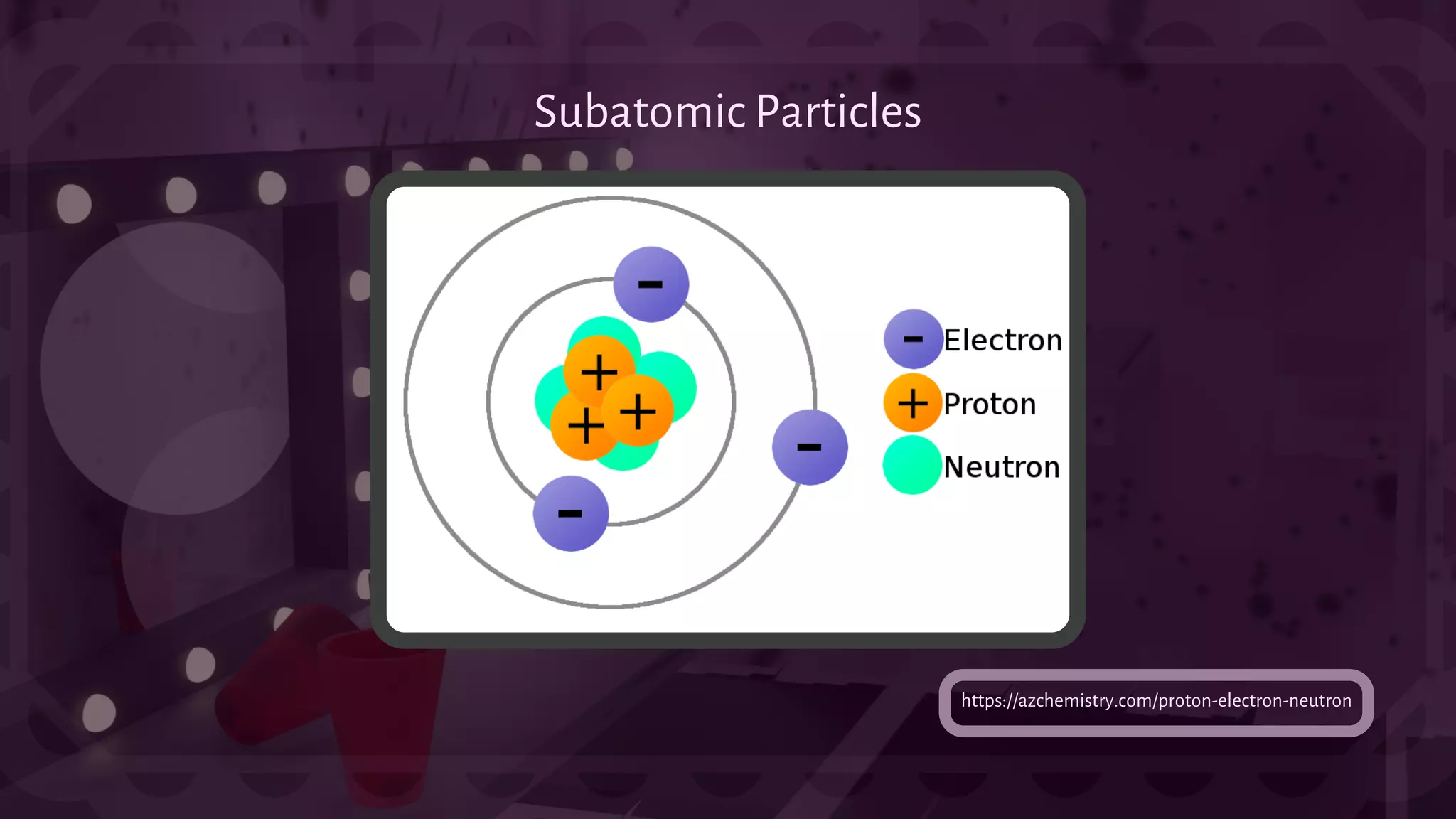
- An Atom is made up of subatomic particles, more specifically called Proton [prō
ˌtän], Neutron [n(y)o͞ oträn], and Electron [əˈlekˌträn]. (May not be accurate.) The
Greek words and meaning for each particles (If there are any.) respectively are:
({prôtos} First), ({elektron?} Amber).
- In the center of the Atom, protons and neutrons reside inside a part of an Atom
called a nucleus. The electrons however, are located over the nucleus, flying
around in a tiny cloud. Protons have a positive charge, neutrons have no net
charge, and electrons have a negative charge. A neutral atom consists of equal
amounts of protons and electrons, these also often consist of an equal amount of
neutrons.
Subatomic Particles:
Subatomic Particles
https://azchemistry.com/proton-electron-neutron
- This is the first concept of an atomic model and also the first concept of an Atom.
The idea of the atom was created by both Democritus and his mentor, Leukippus
(More by Democritus).
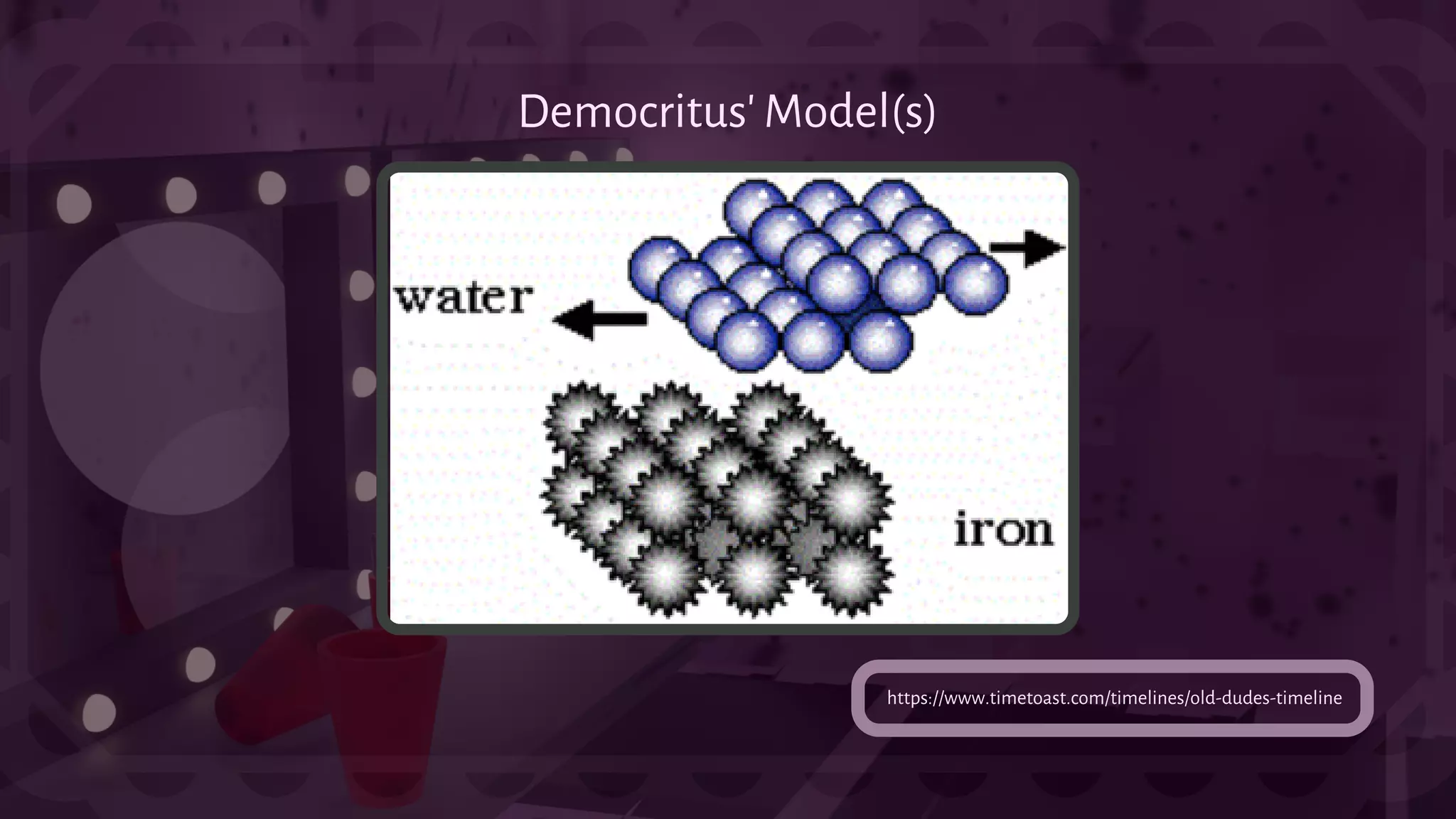
- These were small and hard particles that are all "Cut from the same cloth". Each
and every one of these are diverse from one another in shapes and sizes.
- In these times, no one believed the existence of the Atom because of Aristotle's
beliefs about having no limit in dividing matter. He also believed that everything
is made purely or a fusion up of four elements which are water, earth, air, and fire.
Democritus' Model 460 BC
Democritus' Model(s)
https://www.timetoast.com/timelines/old-dudes-timeline
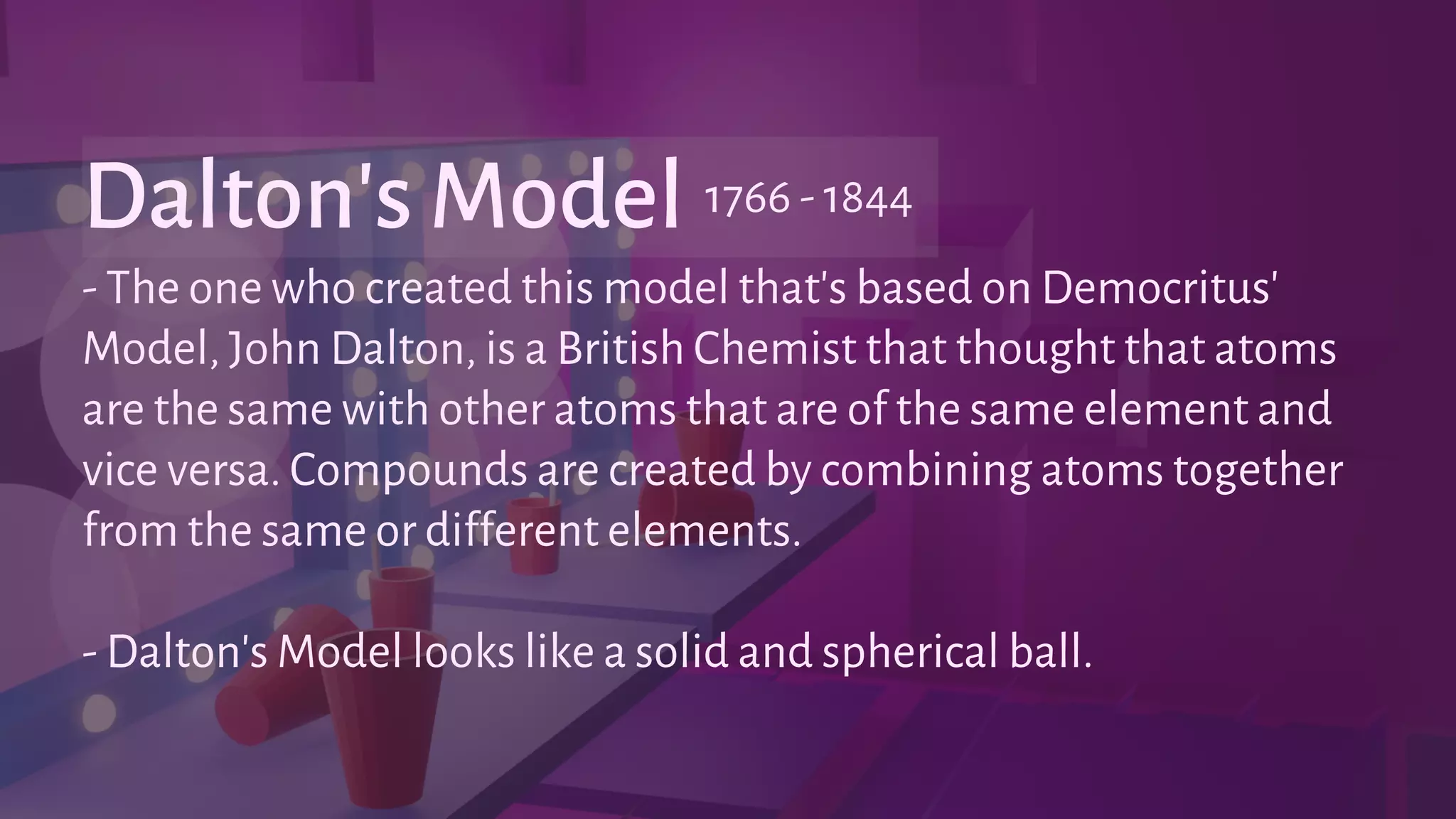
- The one who created this model that's based on Democritus'
Model, John Dalton, is a British Chemist that thought that atoms
are the same with other atoms that are of the same element and
vice versa. Compounds are created by combining atoms together
from the same or different elements.
- Dalton's Model looks like a solid and spherical ball.
Dalton's Model 1766 - 1844
Dalton's Model
https://www.kindpng.com/imgv/wJhiw_democritus-atomic-model-hd-png-download
- J.J. Thomson is an English Chemist and Physicist that's
the first one to discover one of the subatomic particles,
which is the electron.
- Electrons are surrounded by positively charged
matter in the Atom. Was reffered to as Plum Pudding
Model or Raisin Bun Model.
Thomson's Model 1856 - 1940
Thomson's Model / Plum Pudding Model / Raisin Bun Model
https://www.timetoast.com/timelines/atom-models
- The discovery of the nucleus has been done by Ernest
Rutherford, a Physicist from New Zealand. Also kind of
discovered that a proton is a subatomic particle.
- The protons are actually all located in the nucleus of the
Atom and the electrons are all scattered and are travelling
around the Atom's edge but where they exactly are can't be
determined nor described.
Rutherford's Model 1871-1937
Rutherford's Model
http://www.youtube.com/watch?v=dYnlwmTEBGU
- Niels Bohr is a Danish Physicist that discovered energy levels.
- This model is what schools and other mediums use to explain what an
atom is in a simple manner. Also a more dumbed down version of what
an Atom looks like.
- Electrons travel around the nucleus in definite paths and fixed distances.
These can jump from one level to a path in another level. When electrons
move in fixed orbits, they go in a constant speed around the nucleus.
These can also move from one level to another level.
Bohr's Model 1871-1937
Bohr's Model
https://www.sciencefacts.net/atom-2.html
- There is a person that modified Bohr's atomic theory
so that it can include elliptical orbits, Arnold
Sommerfel, a German Physicist.
- Orbits don't have to be spherical but can also be
elliptical in this version of the Atom.
Sommerfeld's Work ???
Sommerfeld's Work
https://www.researchgate.net/figure/Sommerfeld-atomic-orbits-for-case-n-14-4-with-the-zero-angular-momentum-m-14-0-case_fig1_295226267
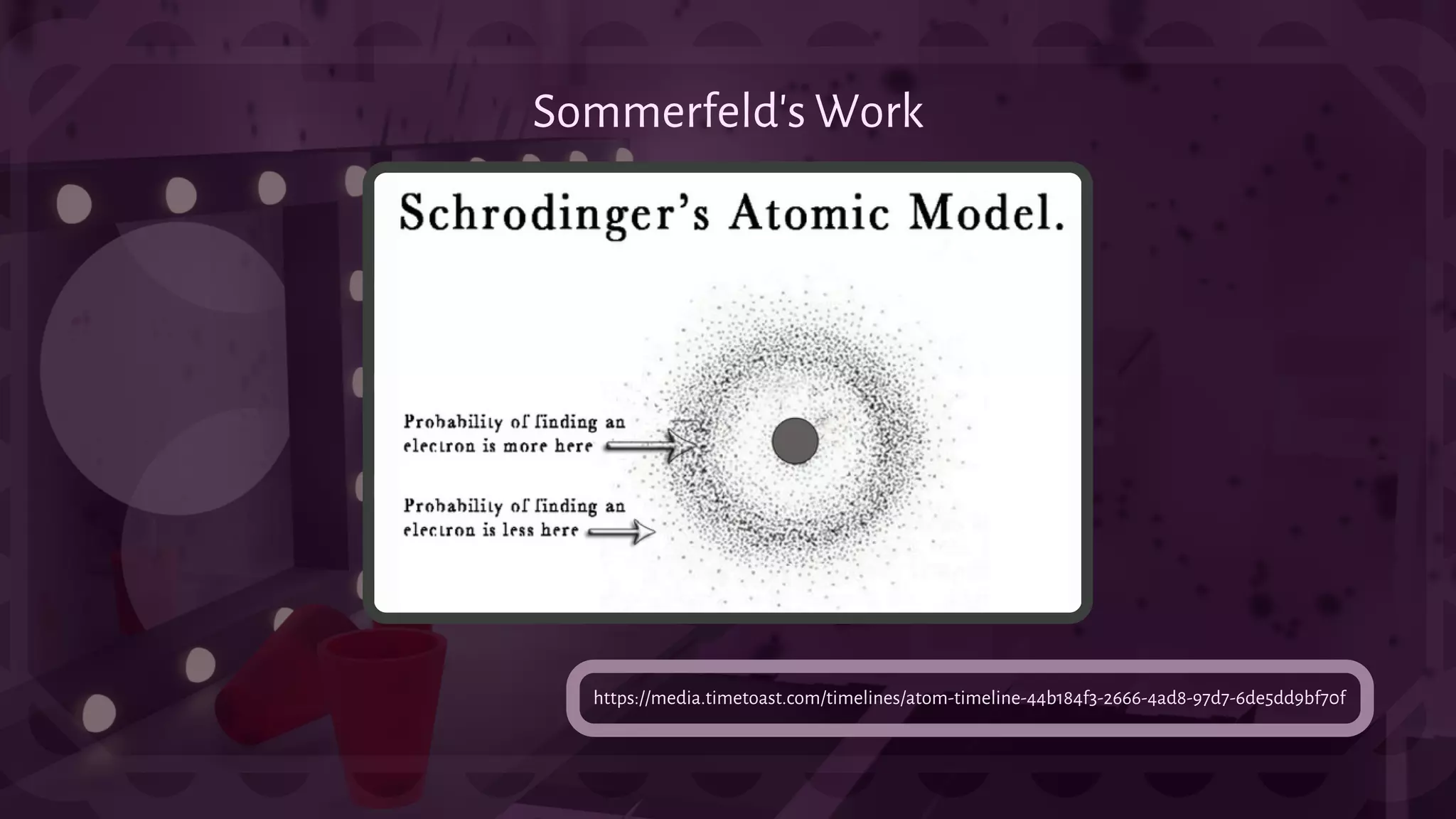
- An area around the nucleus is called an Electron
Cloud. It's an area that electrons would likely be found.
- Path of electrons can't be predicted, that's the
Austrian physicist, Erwin Shrodinger's theory is about
the Atom.
Shrodinger's Model 1924
Sommerfeld's Work
https://media.timetoast.com/timelines/atom-timeline-44b184f3-2666-4ad8-97d7-6de5dd9bf70f
- Neutrons are particles that have no electrical charge and is said
to nearly equivalent to a proton's mass.
- He also made a unit of measurement for subatomic particles. It's
dubbed as atomic mass unit or amu for short.
- Someone by the name of James Chadwick, an English Physicist
had discovered the last of one of the subatomic particles that's
part of the Atom, the neutron.
Chadwick's Work 1932
- The mass of an atom is concentrated into the nucleus of an Atom which is located in the
center of this.
- Two out of the three subatomic particles - protons and neutrons - are located in the nucleus.
The neutrons act like a sort of glue to keep the protons from repelling each other and make the
nucleus stable. The electrons are located outside of the nucleus.
- The number of protons and electrons are equivalent in Stable Atoms and Neutral Atoms. The
number of protons are also equivalent to the atomic number of an Atom (Z).
- The sum of protons and neutrons is equal to the mass number of an Atom (M).
- The amount of neutrons is equal to the difference between the mass number of the atom (M)
and the atomic number (Z).
Additional Information About Atoms
Electrons
and Energy
Levels
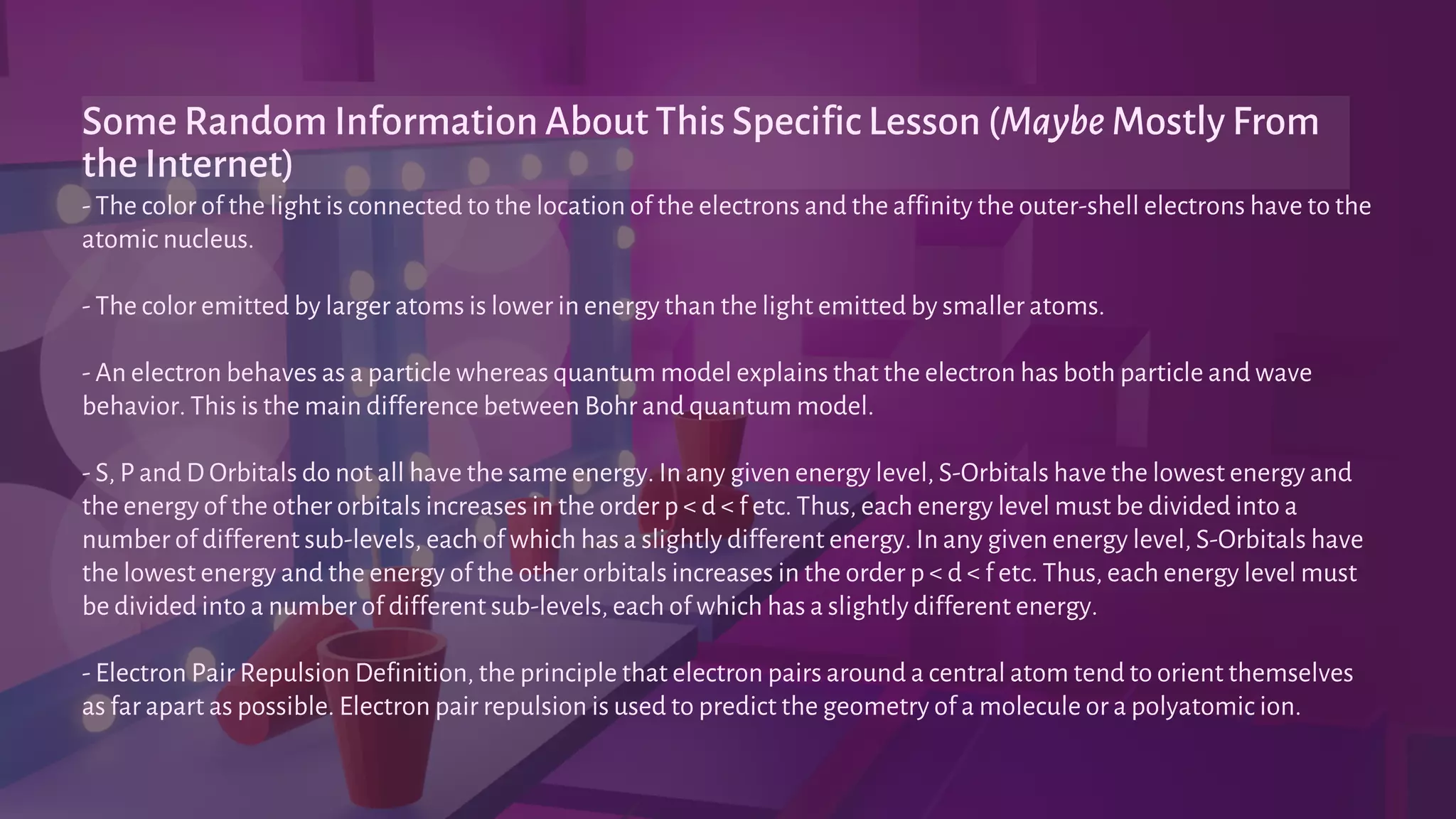
- The color of the light is connected to the location of the electrons and the affinity the outer-shell electrons have to the
atomic nucleus.
- The color emitted by larger atoms is lower in energy than the light emitted by smaller atoms.
- An electron behaves as a particle whereas quantum model explains that the electron has both particle and wave
behavior. This is the main difference between Bohr and quantum model.
- S, P and D Orbitals do not all have the same energy. In any given energy level, S-Orbitals have the lowest energy and
the energy of the other orbitals increases in the order p < d < f etc. Thus, each energy level must be divided into a
number of different sub-levels, each of which has a slightly different energy. In any given energy level, S-Orbitals have
the lowest energy and the energy of the other orbitals increases in the order p < d < f etc. Thus, each energy level must
be divided into a number of different sub-levels, each of which has a slightly different energy.
- Electron Pair Repulsion Definition, the principle that electron pairs around a central atom tend to orient themselves
as far apart as possible. Electron pair repulsion is used to predict the geometry of a molecule or a polyatomic ion.
Some Random Information About This Specific Lesson (Maybe Mostly From
the Internet)
https://ryancormacksdp.weebly.com/flame-test-lab.html
Flame
Test
Table
http://www.sliderbase.com/spitem-104-2.html
SPDF
Table
http://poozacreations.blogspot.com/2012/03/types-
of-emission-and-absorption.html
Atomic
Emission
Spectrum
Wave-Particle Duality of Matter Uncertainty Principle Quantum Mechanical Model
Electrons do not have
an exact orbit
De Broglie Hypothesis
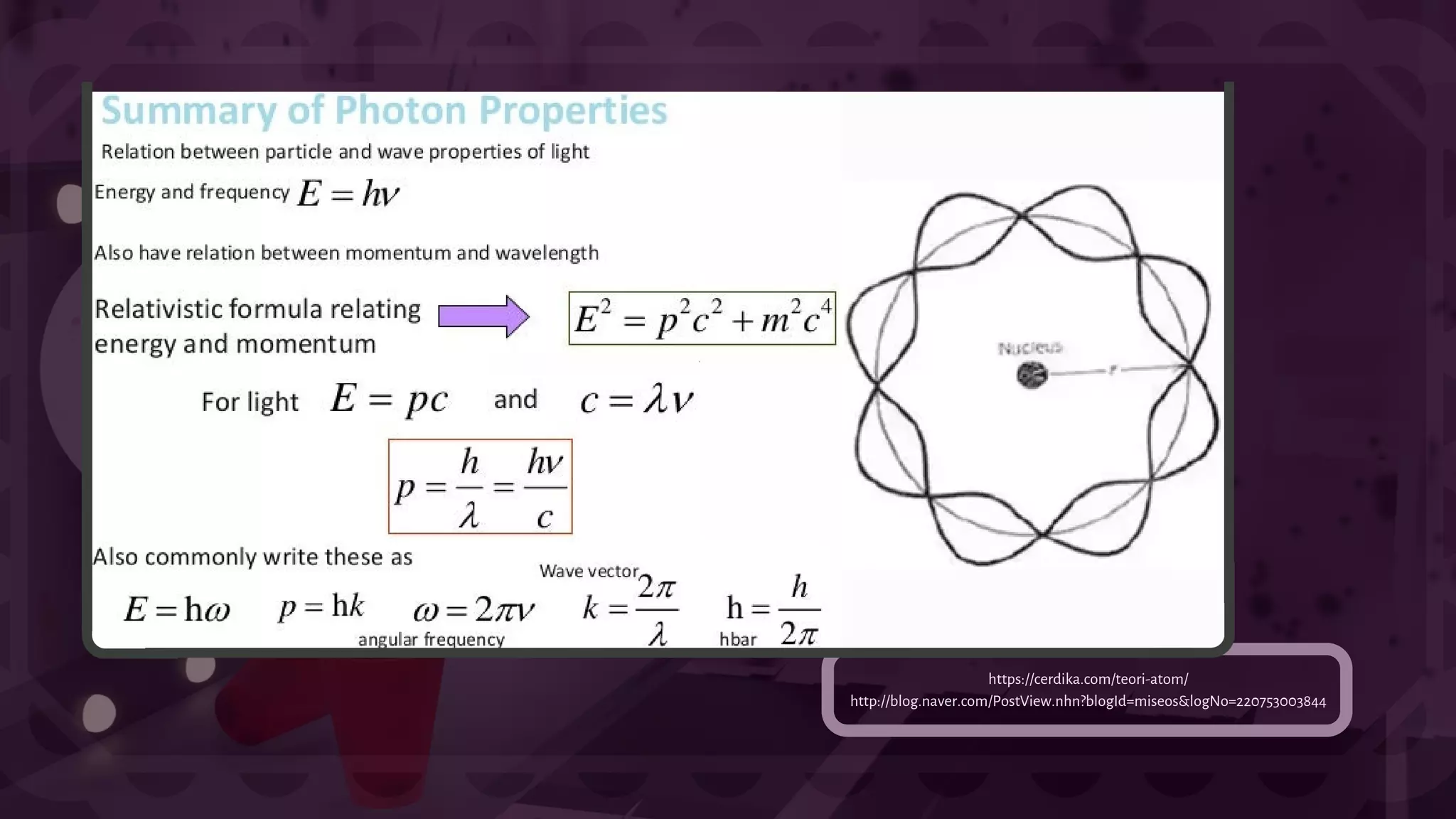
- Proposes that all matter exhibits wave-like properties and relates the
observed wavelength of matter to its momentum. After Albert Einstein's
photon theory became accepted, the question became whether this was true
only for light or whether material objects also exhibited wave-like behavior.
Louie de Broglie
https://cerdika.com/teori-atom/
http://blog.naver.com/PostView.nhn?blogId=miseos&logNo=220753003844
https://www.4piacademy.com/heisenberg-uncertainity-principle/
Uncertainty
Principle
- It is impossible to predict the movement
nor the position of an electron at the same
time.
Werner
Heisenberg
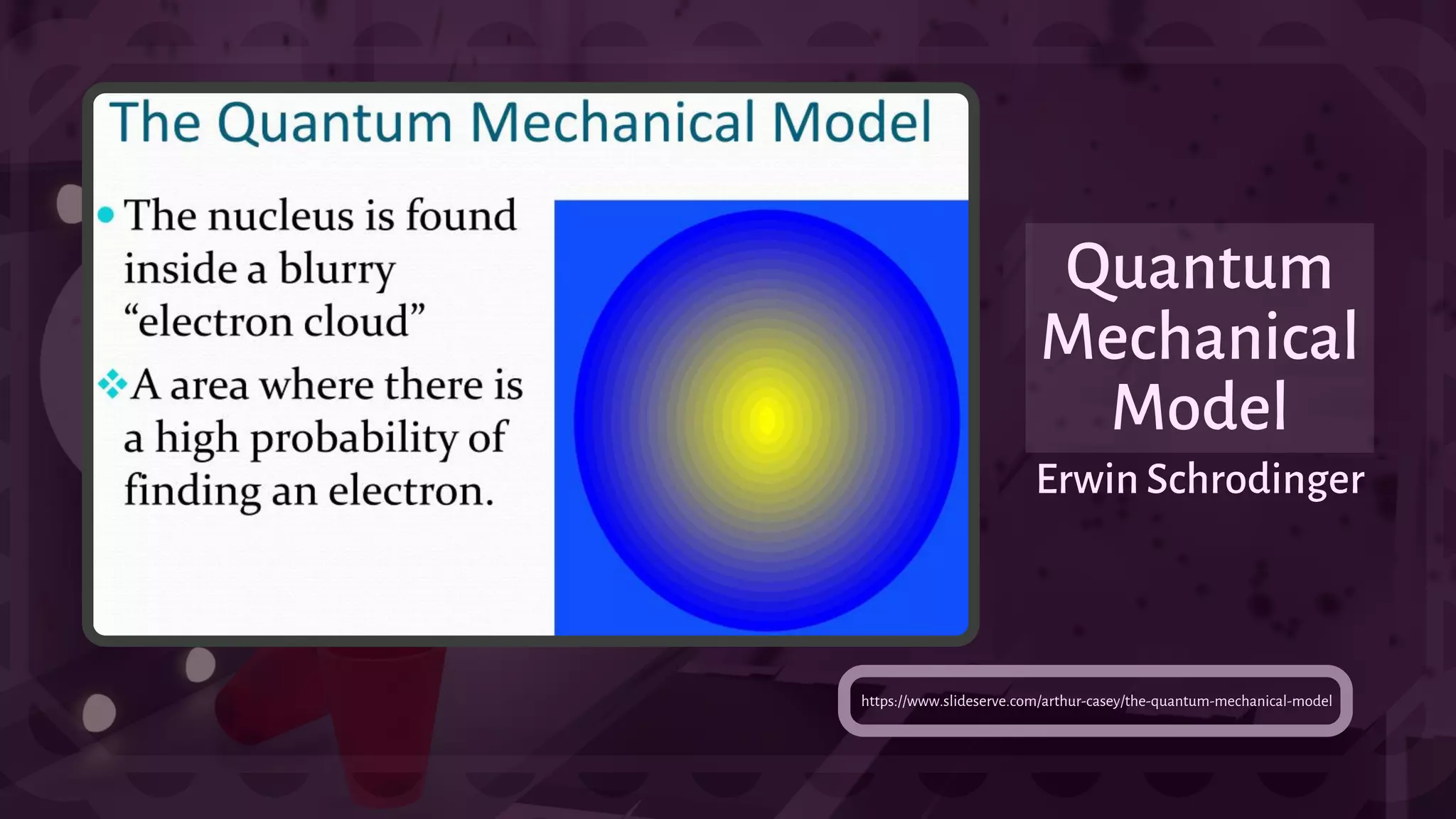
https://www.slideserve.com/arthur-casey/the-quantum-mechanical-model
Quantum
Mechanical
Model
Erwin Schrodinger
- Quantum Numbers are used to the most probable position of electrons in atoms.
- A.) The energy and the relative size of atomic orbitals are Principal Energy Level (n). when (n) increases, energy
levels increase and orbitals become larger.
- B.) Energy Sublevels cointain orbital and defines the orbital shape which could be s.p.d.f.
Other Random Information About This Specific Lesson
http://www.slideserve.com/vanida/electrons-in-atoms
https://www.pinterest.com/pin/584623595364719244/
Some picture next slide (You can see I'm cramming right now.)
Other Random Information About This Specific Lesson
https://www.quora.com/How-is-the-concept-of-atomic-orbital-introduced
Other Random Information About This Specific Lesson
Examples of Atomic Models
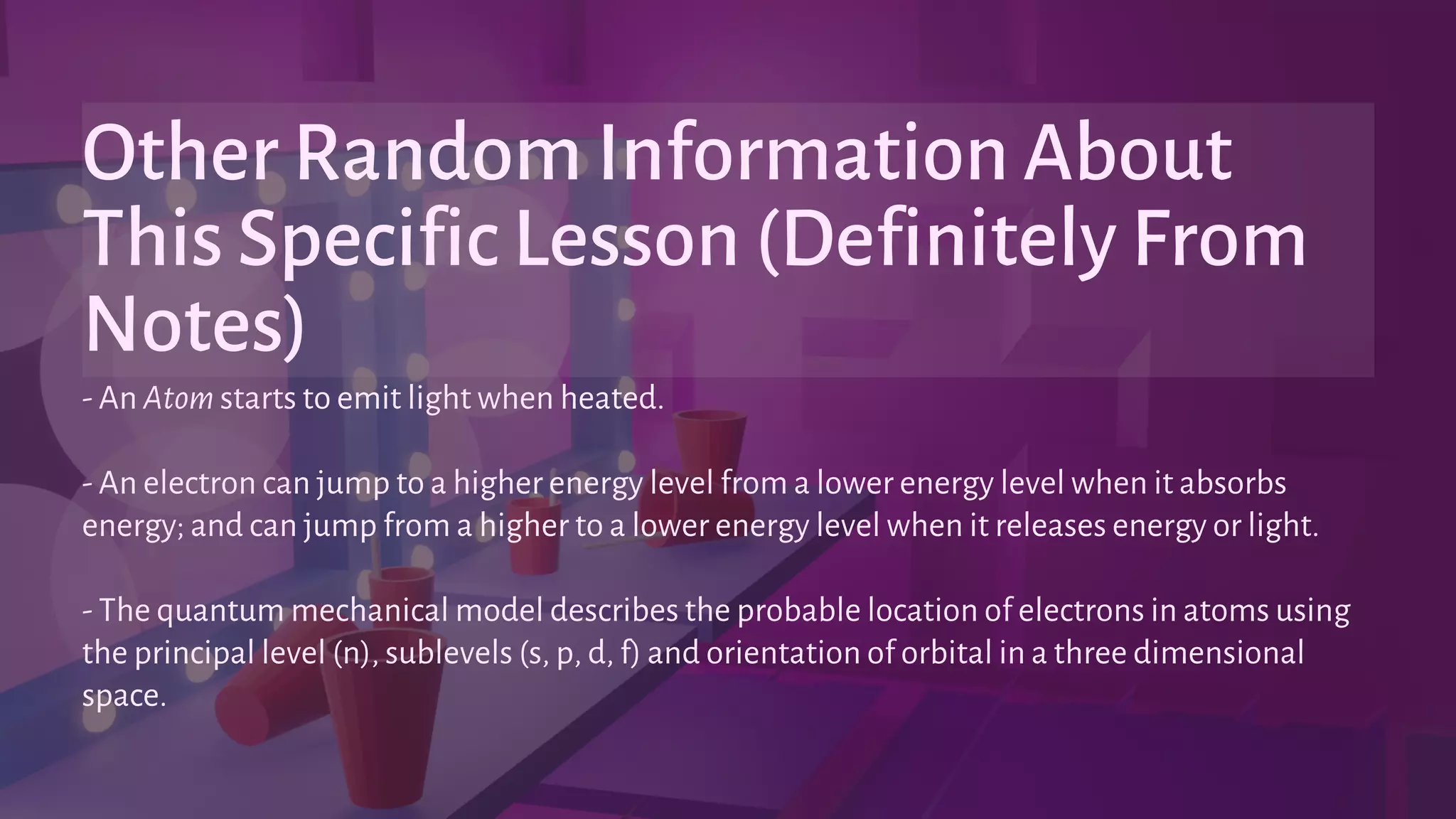
- An Atom starts to emit light when heated.
- An electron can jump to a higher energy level from a lower energy level when it absorbs
energy; and can jump from a higher to a lower energy level when it releases energy or light.
- The quantum mechanical model describes the probable location of electrons in atoms using
the principal level (n), sublevels (s, p, d, f) and orientation of orbital in a three dimensional
space.
Other Random Information About
This Specific Lesson (Definitely From
Notes)
Electron
ConFiguration
- Determining the atomic number of the specific element you want to find the electron
configuration of.
- Determine the element symbol of the element.
- Determine the number of electrons present in the Atom to get the electron configuration of
this.
Steps in Identifying Electron
Configuration
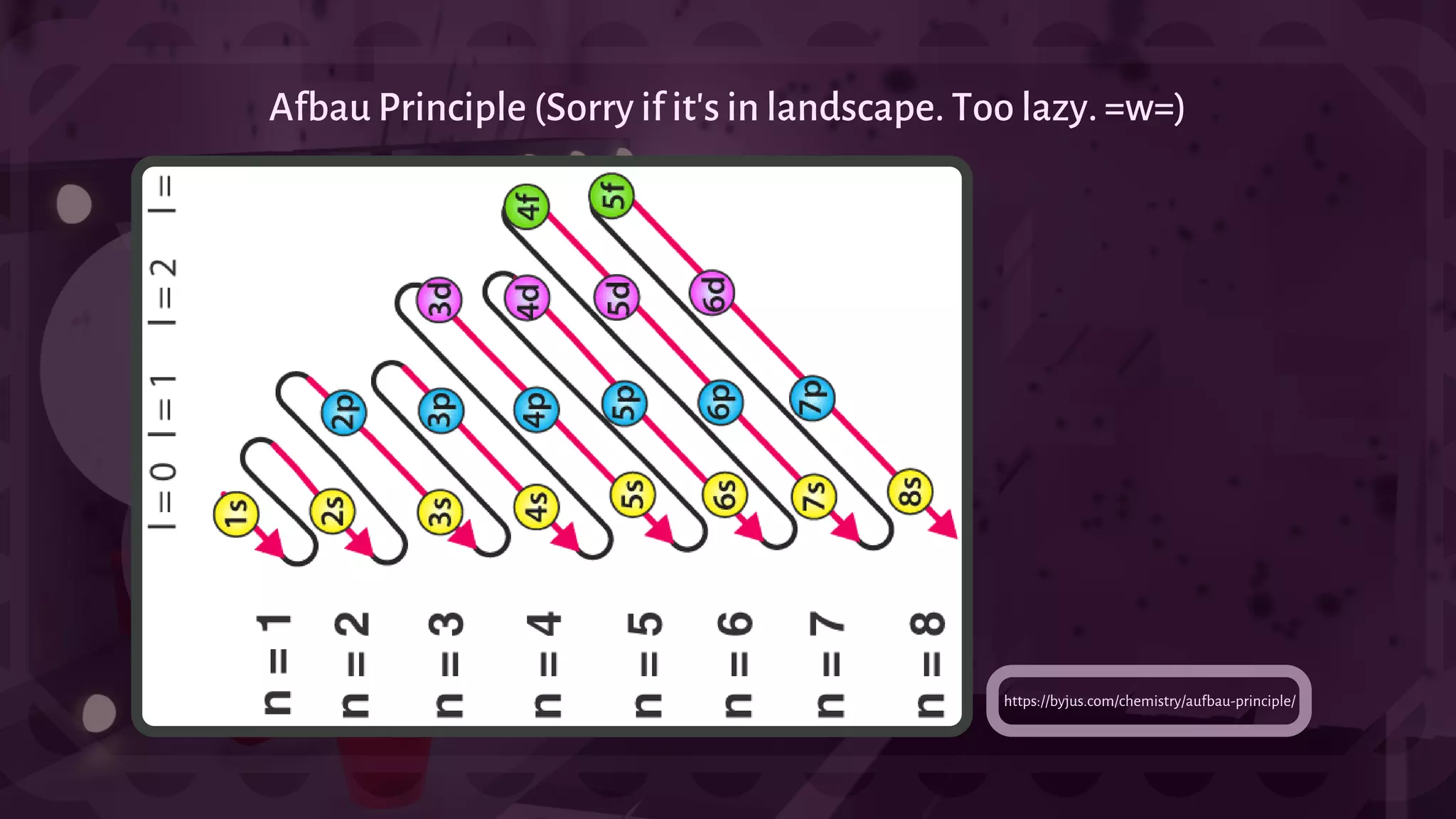
- The Aufbau principle dictates the manner in which electrons are filled in the atomic orbitals
of an Atom in its ground state. It states that electrons are filled into atomic orbitals in the
increasing order of orbital energy level. According to the Aufbau principle, the available atomic
orbitals with the lowest energy levels are occupied before those with higher energy levels.
- The word ‘Aufbau’ has German roots and can be roughly translated as ‘construct’ or ‘build up’.
A diagram illustrating the order in which atomic orbitals are filled is provided below. Here, ‘n’
refers to the principal quantum number and ‘l’ is the azimuthal quantum number.
Afbau Principle (Super Copied From the Internet)
Afbau Principle (Sorry if it's in landscape. Too lazy. =w=)
https://byjus.com/chemistry/aufbau-principle/
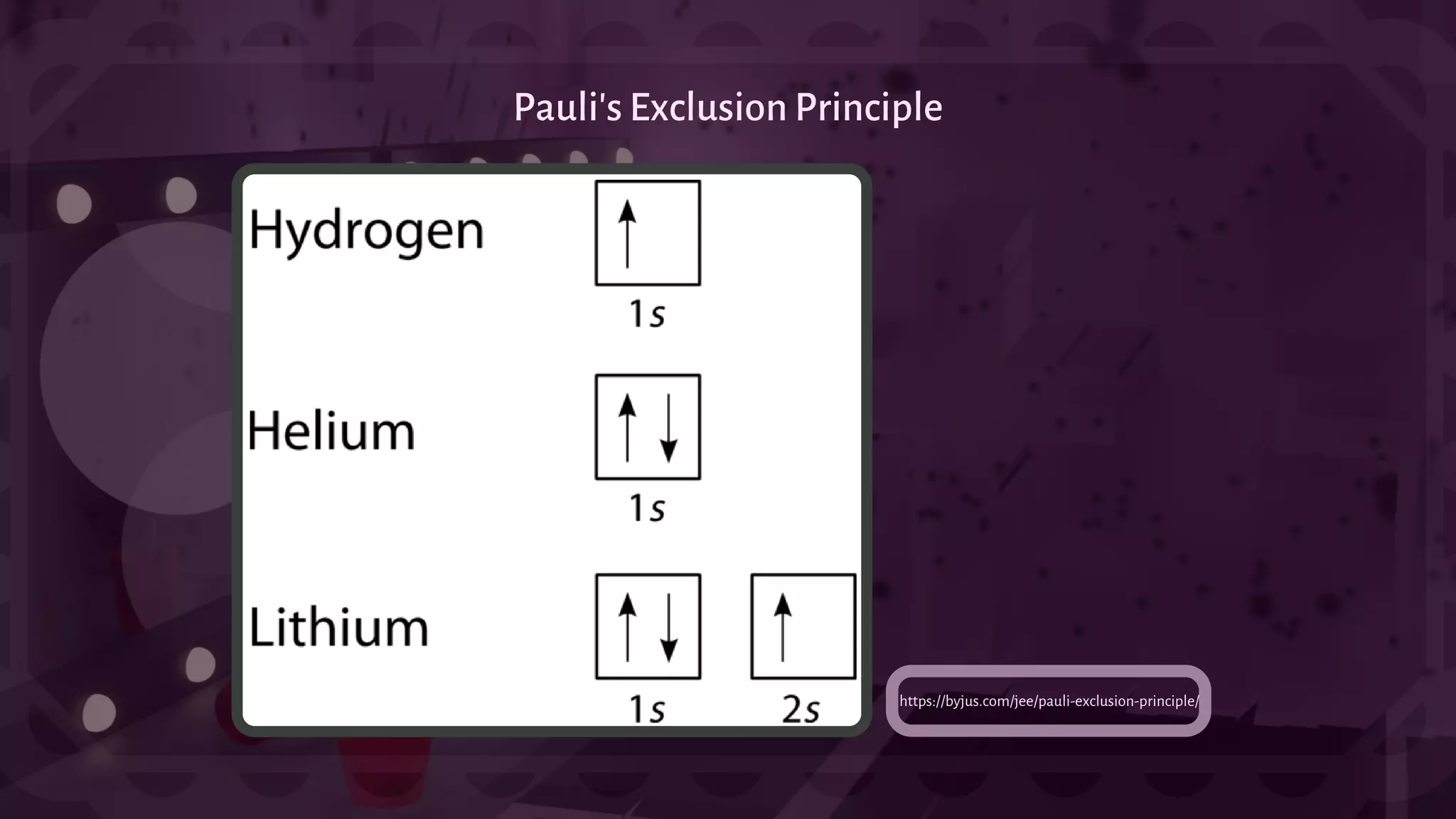
- States that in a single atom, no two electrons will have an identical set or the same quantum numbers (n, l,
ml, and ms). Every electron should be in its own unique state (singlet state). The two salient rules that the
Pauli's Exclusion Principle are; Only two electrons can occupy the same orbital; and two electrons that are
present in the same orbital must have opposite spins or they should be antiparallel.
- This does not only apply to electrons. It applies to other particles of half-integer spin such as fermions. It is not
relevant for particles with an integer spin such as bosons which have symmetric wave functions. Moreover,
bosons can share or have the same quantum states, unlike fermions. As far as the nomenclature goes,
fermions are named after the Fermi–Dirac statistical distribution that they follow. Bosons, on the other hand,
get their name from the Bose-Einstein distribution function.
- An Austrian physicist named Wolfgang Pauli formulated the principle in 1925. He basically described the
behaviour of the electrons. Later in 1940, he expanded on the principle to cover all fermions under his spin-
statistics theorem. Meanwhile, fermions that are described by the principle include elementary particles such
as quarks, electrons, neutrinos, and baryons.
Pauli's Exclusion Principle (Also From the Internet)
https://byjus.com/jee/pauli-exclusion-principle/
Pauli's Exclusion Principle
https://byjus.com/jee/pauli-exclusion-principle/
Pauli's Exclusion Principle
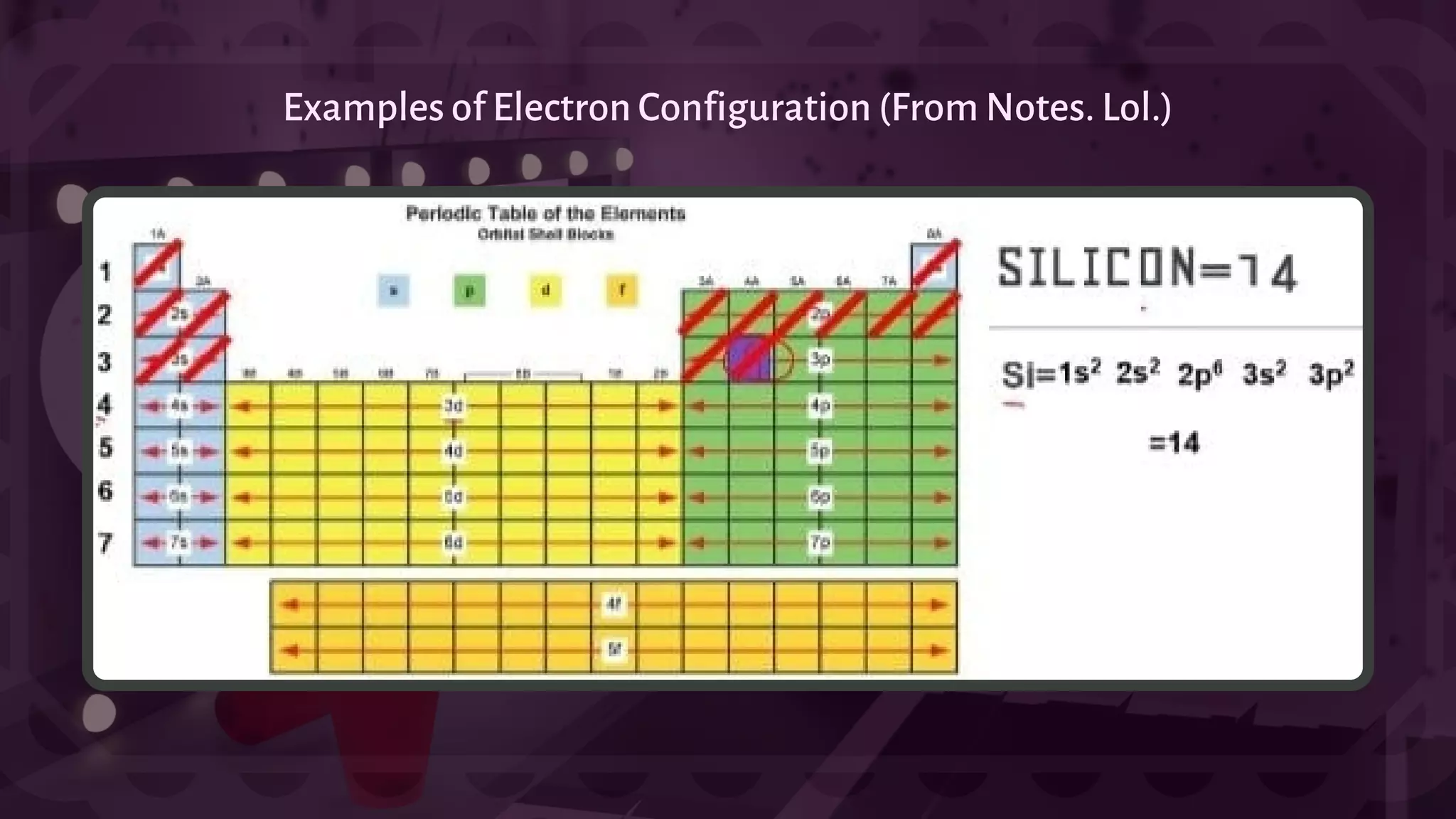
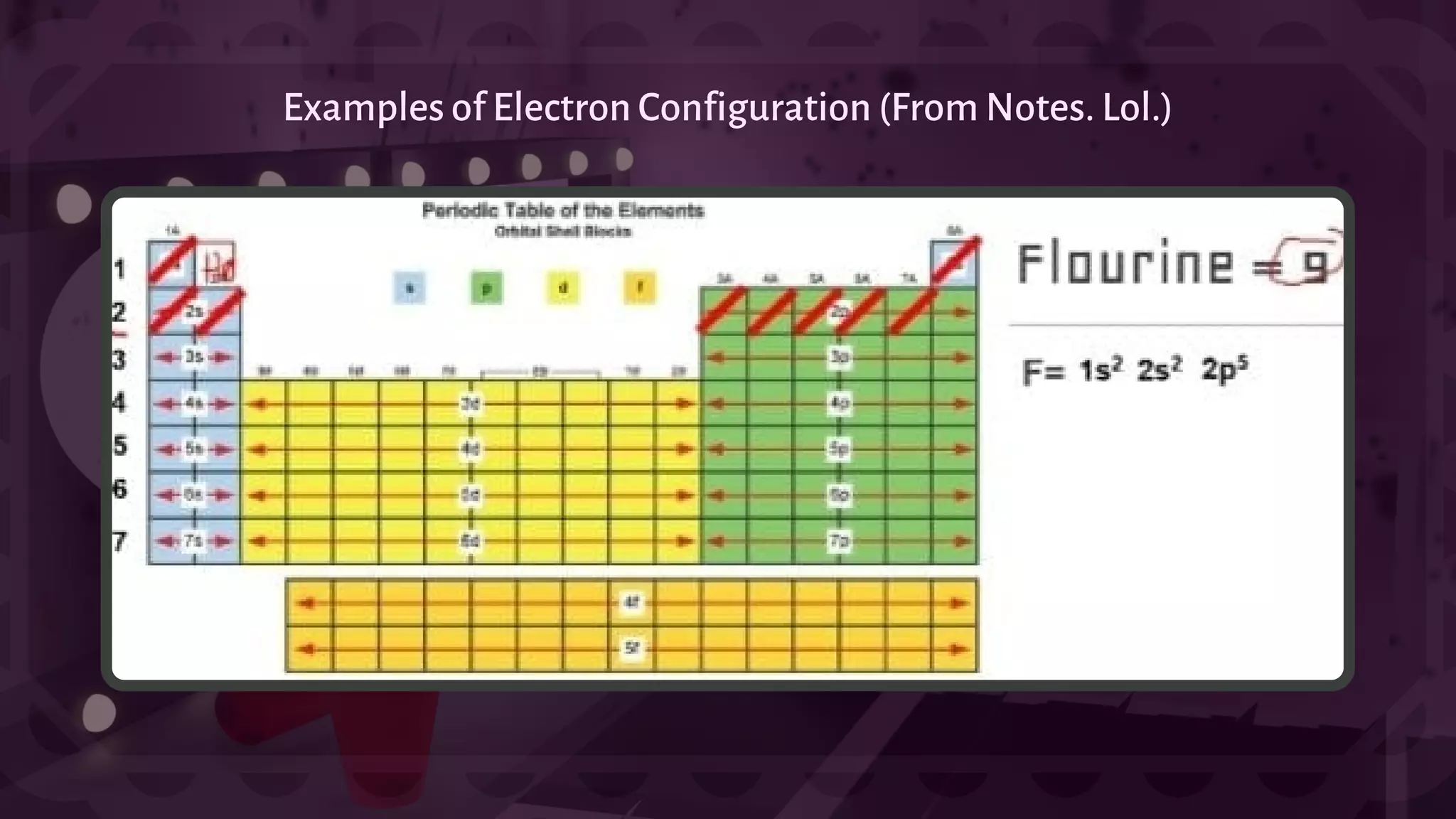
Examples of Electron Configuration (From Notes. Lol.)
- Created and developed the periodic table,
aranging chemical elements by atomic mass.
Dimitri Mendeleev
http://www.youtube.com/watch?v=OoooStZQHdA
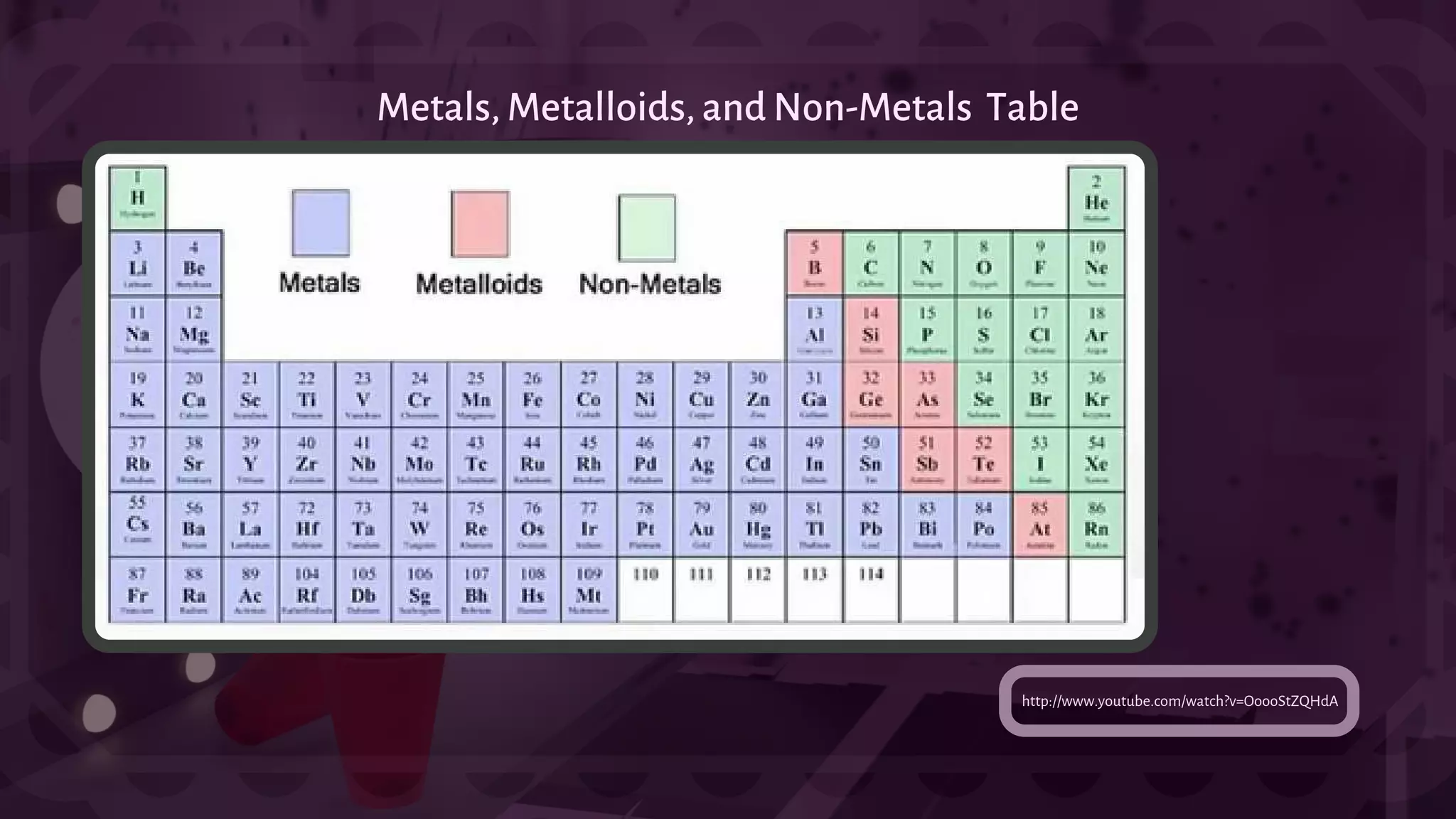
Metals, Metalloids, and Non-Metals Table
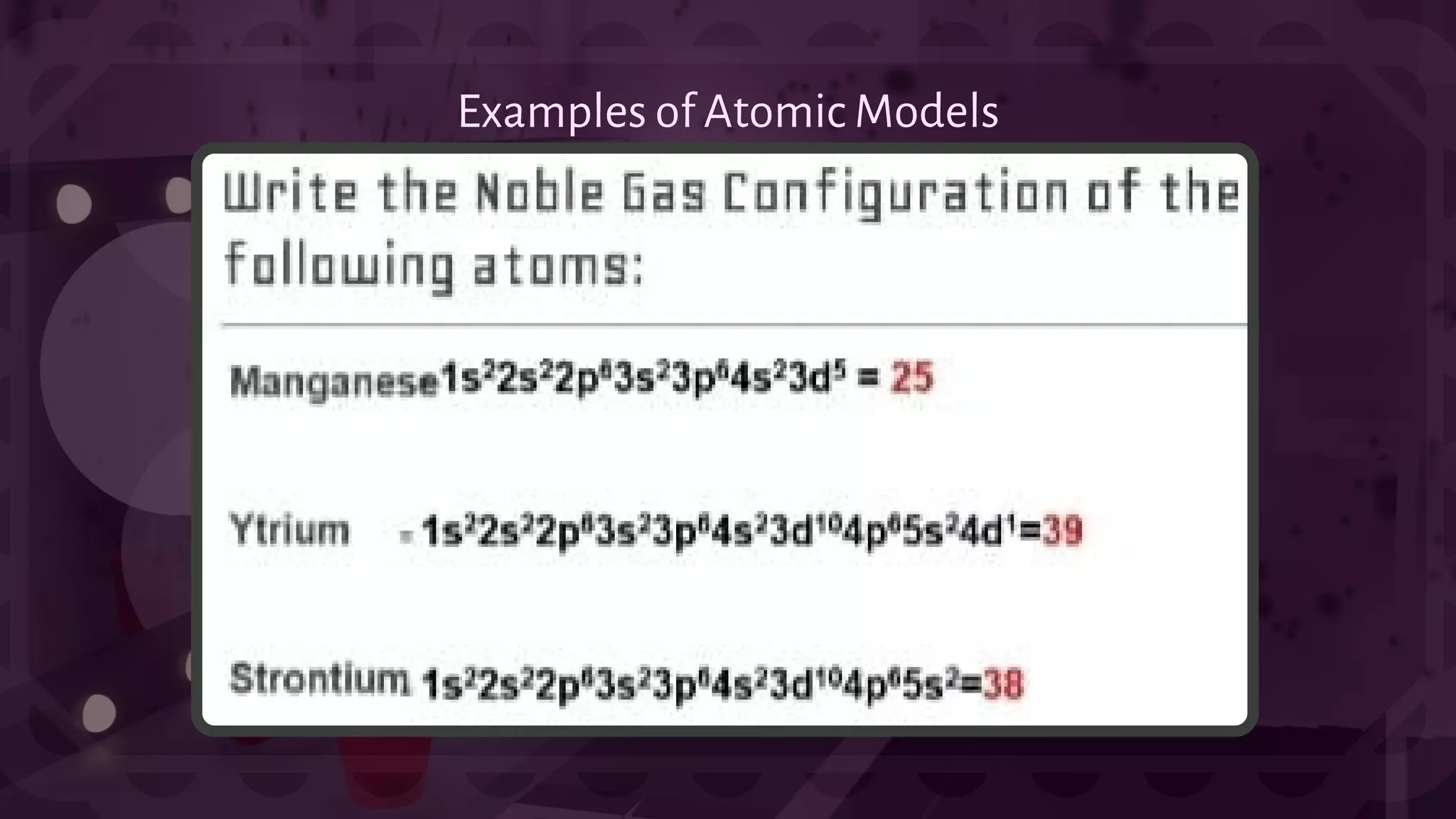
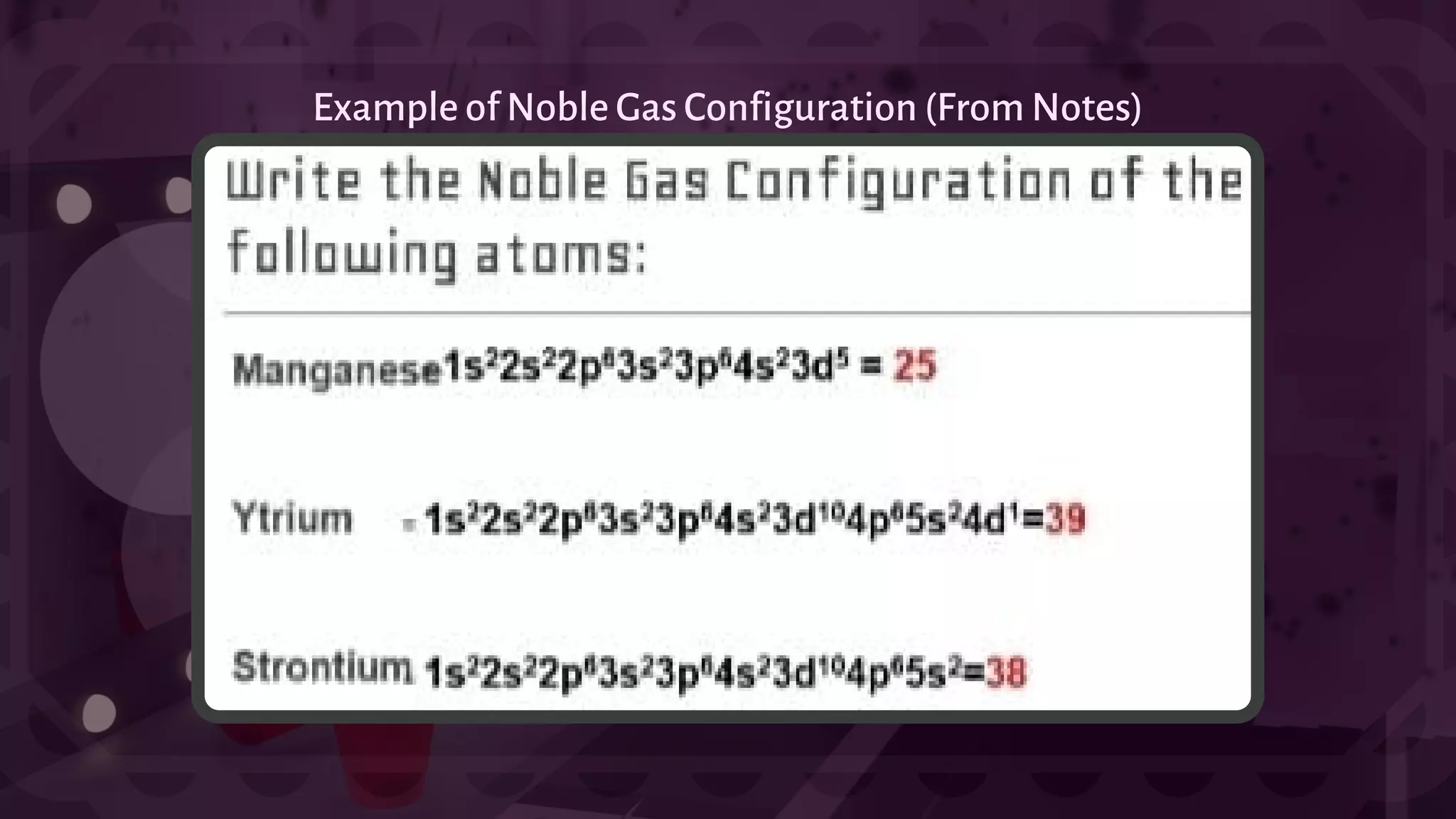
Example of Noble Gas Configuration (From Notes)
Due to overestimating myself on doing notes - and
procrastinating too much - I'll be skipping some information that
doesn't hold much significance... Also because there was actually
this MAPEH hw that I had to do that I wasn't aware off until
recently.
NOTICE!
It's sadge that Ma'am Moquerio makes assignments and not marking them as ones in the GClass. Lesser peeps would see them, specially if
they're using laptops. WHY MA'AM?! WHY?!?!?! T^T (Please don't tell ma'am this. I'm trusting you, Y/N with this information.)
P.S. Please don't lower my grades, I gave as much effort as I can
with this easily distractable bum-bum of mine. ;-;
- A type of chemical bonding called Ionic Bonding that involves the electrostatic attraction between
oppositely charged ions, or between two atoms with sharply different electronegativities,[1] and is the primary
interaction occurring in ionic compounds.
- Metallic bond is a term used to describe the collective sharing of a sea of valence electrons between several
positively charged metal ions.
- Covalent Bonding is formed by equal sharing of electrons from both the participating atoms. The pair of
electrons participating in this type of bonding is called shared pair or bonding pair. The covalent bonds are also
termed as molecular bonds. Sharing of bonding pairs will ensure that the atoms achieve stability in their outer
shell which is similar to the atoms of noble gases.
Three Major Types of Chemical Bonding
- Electron Dot Structures or Lewis Dot Formula
can be drawn if the molecular formula of the
compound is known.
Electron Dot Structures
of
of
of
Notes
Notes
Notes
The
The
The
End
End
End
Used
Used
Used
Backgrounds
Backgrounds
Backgrounds
Credits to me. 'v'
Credits to me. 'v'
Credits to me. 'v'
I made this one in IbisPaintX for so long,
this is also the basis of the theme for the
other backgrounds. It was so hard for me
to not use lineart for this one
Btw, I relearned how to use
Blender in a day just to
make this specific and cute
background for my Science
Notes. I still really like it.
Please notice my efforts. ;-;
This is just the same
background from before
but something happened to
the peeps who run the
show and everything's
abandoned.
This
background
is just
uninspired...
Because I
got bored.
:P
I literally made
bookshelves, but they
can't be seen here
much since I don't have
foresight. T^T

Science | Grade 9 - 2nd Quarter

  • 1.
  • 2.
    The History of TheAtomic Model
  • 3.
    - An Atomis a fundamental thing in matter as it serves so much purpose from being the basic unit and defining structure of an element to making up everything in the universe. This is also the source of nuclear energy. Atom:[ˈadəm] Greek - Indivisible, Uncuttable ({atomos} )
  • 4.
    Quantum Mechanical Model Democritus'Model Examples of Atomic Models Bhor's Model https://www.timetoast.com/timelines/old-dudes-timeline http://marshscience7.blogspot.com/2014/04/the-modern-atomic-model.html https://en.wikipedia.org/wiki/Bohr_model
  • 5.
    - An Atomis made up of subatomic particles, more specifically called Proton [prō ˌtän], Neutron [n(y)o͞ oträn], and Electron [əˈlekˌträn]. (May not be accurate.) The Greek words and meaning for each particles (If there are any.) respectively are: ({prôtos} First), ({elektron?} Amber). - In the center of the Atom, protons and neutrons reside inside a part of an Atom called a nucleus. The electrons however, are located over the nucleus, flying around in a tiny cloud. Protons have a positive charge, neutrons have no net charge, and electrons have a negative charge. A neutral atom consists of equal amounts of protons and electrons, these also often consist of an equal amount of neutrons. Subatomic Particles:
  • 6.
  • 7.
    - This isthe first concept of an atomic model and also the first concept of an Atom. The idea of the atom was created by both Democritus and his mentor, Leukippus (More by Democritus). - These were small and hard particles that are all "Cut from the same cloth". Each and every one of these are diverse from one another in shapes and sizes. - In these times, no one believed the existence of the Atom because of Aristotle's beliefs about having no limit in dividing matter. He also believed that everything is made purely or a fusion up of four elements which are water, earth, air, and fire. Democritus' Model 460 BC
  • 8.
  • 9.
    - The onewho created this model that's based on Democritus' Model, John Dalton, is a British Chemist that thought that atoms are the same with other atoms that are of the same element and vice versa. Compounds are created by combining atoms together from the same or different elements. - Dalton's Model looks like a solid and spherical ball. Dalton's Model 1766 - 1844
  • 10.
  • 11.
    - J.J. Thomsonis an English Chemist and Physicist that's the first one to discover one of the subatomic particles, which is the electron. - Electrons are surrounded by positively charged matter in the Atom. Was reffered to as Plum Pudding Model or Raisin Bun Model. Thomson's Model 1856 - 1940
  • 12.
    Thomson's Model /Plum Pudding Model / Raisin Bun Model https://www.timetoast.com/timelines/atom-models
  • 13.
    - The discoveryof the nucleus has been done by Ernest Rutherford, a Physicist from New Zealand. Also kind of discovered that a proton is a subatomic particle. - The protons are actually all located in the nucleus of the Atom and the electrons are all scattered and are travelling around the Atom's edge but where they exactly are can't be determined nor described. Rutherford's Model 1871-1937
  • 14.
  • 15.
    - Niels Bohris a Danish Physicist that discovered energy levels. - This model is what schools and other mediums use to explain what an atom is in a simple manner. Also a more dumbed down version of what an Atom looks like. - Electrons travel around the nucleus in definite paths and fixed distances. These can jump from one level to a path in another level. When electrons move in fixed orbits, they go in a constant speed around the nucleus. These can also move from one level to another level. Bohr's Model 1871-1937
  • 16.
  • 17.
    - There isa person that modified Bohr's atomic theory so that it can include elliptical orbits, Arnold Sommerfel, a German Physicist. - Orbits don't have to be spherical but can also be elliptical in this version of the Atom. Sommerfeld's Work ???
  • 18.
  • 19.
    - An areaaround the nucleus is called an Electron Cloud. It's an area that electrons would likely be found. - Path of electrons can't be predicted, that's the Austrian physicist, Erwin Shrodinger's theory is about the Atom. Shrodinger's Model 1924
  • 20.
  • 21.
    - Neutrons areparticles that have no electrical charge and is said to nearly equivalent to a proton's mass. - He also made a unit of measurement for subatomic particles. It's dubbed as atomic mass unit or amu for short. - Someone by the name of James Chadwick, an English Physicist had discovered the last of one of the subatomic particles that's part of the Atom, the neutron. Chadwick's Work 1932
  • 22.
    - The massof an atom is concentrated into the nucleus of an Atom which is located in the center of this. - Two out of the three subatomic particles - protons and neutrons - are located in the nucleus. The neutrons act like a sort of glue to keep the protons from repelling each other and make the nucleus stable. The electrons are located outside of the nucleus. - The number of protons and electrons are equivalent in Stable Atoms and Neutral Atoms. The number of protons are also equivalent to the atomic number of an Atom (Z). - The sum of protons and neutrons is equal to the mass number of an Atom (M). - The amount of neutrons is equal to the difference between the mass number of the atom (M) and the atomic number (Z). Additional Information About Atoms
  • 23.
  • 24.
    - The colorof the light is connected to the location of the electrons and the affinity the outer-shell electrons have to the atomic nucleus. - The color emitted by larger atoms is lower in energy than the light emitted by smaller atoms. - An electron behaves as a particle whereas quantum model explains that the electron has both particle and wave behavior. This is the main difference between Bohr and quantum model. - S, P and D Orbitals do not all have the same energy. In any given energy level, S-Orbitals have the lowest energy and the energy of the other orbitals increases in the order p < d < f etc. Thus, each energy level must be divided into a number of different sub-levels, each of which has a slightly different energy. In any given energy level, S-Orbitals have the lowest energy and the energy of the other orbitals increases in the order p < d < f etc. Thus, each energy level must be divided into a number of different sub-levels, each of which has a slightly different energy. - Electron Pair Repulsion Definition, the principle that electron pairs around a central atom tend to orient themselves as far apart as possible. Electron pair repulsion is used to predict the geometry of a molecule or a polyatomic ion. Some Random Information About This Specific Lesson (Maybe Mostly From the Internet)
  • 25.
  • 26.
  • 27.
  • 29.
    Wave-Particle Duality ofMatter Uncertainty Principle Quantum Mechanical Model Electrons do not have an exact orbit De Broglie Hypothesis - Proposes that all matter exhibits wave-like properties and relates the observed wavelength of matter to its momentum. After Albert Einstein's photon theory became accepted, the question became whether this was true only for light or whether material objects also exhibited wave-like behavior. Louie de Broglie
  • 30.
  • 31.
    https://www.4piacademy.com/heisenberg-uncertainity-principle/ Uncertainty Principle - It isimpossible to predict the movement nor the position of an electron at the same time. Werner Heisenberg
  • 32.
  • 33.
    - Quantum Numbersare used to the most probable position of electrons in atoms. - A.) The energy and the relative size of atomic orbitals are Principal Energy Level (n). when (n) increases, energy levels increase and orbitals become larger. - B.) Energy Sublevels cointain orbital and defines the orbital shape which could be s.p.d.f. Other Random Information About This Specific Lesson http://www.slideserve.com/vanida/electrons-in-atoms https://www.pinterest.com/pin/584623595364719244/ Some picture next slide (You can see I'm cramming right now.)
  • 34.
    Other Random InformationAbout This Specific Lesson https://www.quora.com/How-is-the-concept-of-atomic-orbital-introduced
  • 35.
    Other Random InformationAbout This Specific Lesson
  • 36.
    Other Random InformationAbout This Specific Lesson
  • 37.
  • 38.
    - An Atomstarts to emit light when heated. - An electron can jump to a higher energy level from a lower energy level when it absorbs energy; and can jump from a higher to a lower energy level when it releases energy or light. - The quantum mechanical model describes the probable location of electrons in atoms using the principal level (n), sublevels (s, p, d, f) and orientation of orbital in a three dimensional space. Other Random Information About This Specific Lesson (Definitely From Notes)
  • 39.
  • 40.
    - Determining theatomic number of the specific element you want to find the electron configuration of. - Determine the element symbol of the element. - Determine the number of electrons present in the Atom to get the electron configuration of this. Steps in Identifying Electron Configuration
  • 41.
    - The Aufbauprinciple dictates the manner in which electrons are filled in the atomic orbitals of an Atom in its ground state. It states that electrons are filled into atomic orbitals in the increasing order of orbital energy level. According to the Aufbau principle, the available atomic orbitals with the lowest energy levels are occupied before those with higher energy levels. - The word ‘Aufbau’ has German roots and can be roughly translated as ‘construct’ or ‘build up’. A diagram illustrating the order in which atomic orbitals are filled is provided below. Here, ‘n’ refers to the principal quantum number and ‘l’ is the azimuthal quantum number. Afbau Principle (Super Copied From the Internet)
  • 42.
    Afbau Principle (Sorryif it's in landscape. Too lazy. =w=) https://byjus.com/chemistry/aufbau-principle/
  • 43.
    - States thatin a single atom, no two electrons will have an identical set or the same quantum numbers (n, l, ml, and ms). Every electron should be in its own unique state (singlet state). The two salient rules that the Pauli's Exclusion Principle are; Only two electrons can occupy the same orbital; and two electrons that are present in the same orbital must have opposite spins or they should be antiparallel. - This does not only apply to electrons. It applies to other particles of half-integer spin such as fermions. It is not relevant for particles with an integer spin such as bosons which have symmetric wave functions. Moreover, bosons can share or have the same quantum states, unlike fermions. As far as the nomenclature goes, fermions are named after the Fermi–Dirac statistical distribution that they follow. Bosons, on the other hand, get their name from the Bose-Einstein distribution function. - An Austrian physicist named Wolfgang Pauli formulated the principle in 1925. He basically described the behaviour of the electrons. Later in 1940, he expanded on the principle to cover all fermions under his spin- statistics theorem. Meanwhile, fermions that are described by the principle include elementary particles such as quarks, electrons, neutrinos, and baryons. Pauli's Exclusion Principle (Also From the Internet)
  • 44.
  • 45.
  • 46.
    Examples of ElectronConfiguration (From Notes. Lol.)
  • 47.
    Examples of ElectronConfiguration (From Notes. Lol.)
  • 48.
    - Created anddeveloped the periodic table, aranging chemical elements by atomic mass. Dimitri Mendeleev
  • 49.
  • 50.
    Example of NobleGas Configuration (From Notes)
  • 51.
    Due to overestimatingmyself on doing notes - and procrastinating too much - I'll be skipping some information that doesn't hold much significance... Also because there was actually this MAPEH hw that I had to do that I wasn't aware off until recently. NOTICE! It's sadge that Ma'am Moquerio makes assignments and not marking them as ones in the GClass. Lesser peeps would see them, specially if they're using laptops. WHY MA'AM?! WHY?!?!?! T^T (Please don't tell ma'am this. I'm trusting you, Y/N with this information.) P.S. Please don't lower my grades, I gave as much effort as I can with this easily distractable bum-bum of mine. ;-;
  • 52.
    - A typeof chemical bonding called Ionic Bonding that involves the electrostatic attraction between oppositely charged ions, or between two atoms with sharply different electronegativities,[1] and is the primary interaction occurring in ionic compounds. - Metallic bond is a term used to describe the collective sharing of a sea of valence electrons between several positively charged metal ions. - Covalent Bonding is formed by equal sharing of electrons from both the participating atoms. The pair of electrons participating in this type of bonding is called shared pair or bonding pair. The covalent bonds are also termed as molecular bonds. Sharing of bonding pairs will ensure that the atoms achieve stability in their outer shell which is similar to the atoms of noble gases. Three Major Types of Chemical Bonding
  • 53.
    - Electron DotStructures or Lewis Dot Formula can be drawn if the molecular formula of the compound is known. Electron Dot Structures
  • 54.
  • 55.
  • 56.
    I made thisone in IbisPaintX for so long, this is also the basis of the theme for the other backgrounds. It was so hard for me to not use lineart for this one
  • 57.
    Btw, I relearnedhow to use Blender in a day just to make this specific and cute background for my Science Notes. I still really like it. Please notice my efforts. ;-;
  • 58.
    This is justthe same background from before but something happened to the peeps who run the show and everything's abandoned.
  • 59.
    This background is just uninspired... Because I gotbored. :P I literally made bookshelves, but they can't be seen here much since I don't have foresight. T^T