Department of Education
Region V
Division of Camarines
EUSEBIA PAZ ARROYO MEMORIAL NATIONAL HIGH SCHOOL
Buluang, Baao, Camarines Sur
PROJECT PROPOSAL
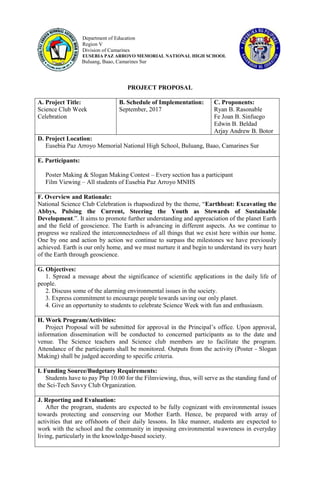
A. Project Title:
Science Club Week
Celebration
B. Schedule of Implementation:
September, 2017
C. Proponents:
Ryan B. Rasonable
Fe Joan B. Sinfuego
Edwin B. Beldad
Arjay Andrew B. Botor
D. Project Location:
Eusebia Paz Arroyo Memorial National High School, Buluang, Baao, Camarines Sur
E. Participants:
Poster Making & Slogan Making Contest – Every section has a participant
Film Viewing – All students of Eusebia Paz Arroyo MNHS
F. Overview and Rationale:
National Science Club Celebration is rhapsodized by the theme, “Earthbeat: Excavating the
Abbys, Pulsing the Current, Steering the Youth as Stewards of Sustainable
Development.”. It aims to promote further understanding and appreaciation of the planet Earth
and the field of geoscience. The Earth is advancing in different aspects. As we continue to
progress we realized the interconnectedness of all things that we exist here within our home.
One by one and action by action we continue to surpass the milestones we have previously
achieved. Earth is our only home, and we must nurture it and begin to understand its very heart
of the Earth through geoscience.
G. Objectives:
1. Spread a message about the significance of scientific applications in the daily life of
people.
2. Discuss some of the alarming environmental issues in the society.
3. Express commitment to encourage people towards saving our only planet.
4. Give an opportunity to students to celebrate Science Week with fun and enthusiasm.
H. Work Program/Activities:
Project Proposal will be submitted for approval in the Principal’s office. Upon approval,
information dissemination will be conducted to concerned participants as to the date and
venue. The Science teachers and Science club members are to facilitate the program.
Attendance of the participants shall be monitored. Outputs from the activity (Poster - Slogan
Making) shall be judged according to specific criteria.
I. Funding Source/Budgetary Requirements:
Students have to pay Php 10.00 for the Filmviewing, thus, will serve as the standing fund of
the Sci-Tech Savvy Club Organization.
J. Reporting and Evaluation:
After the program, students are expected to be fully cognizant with environmental issues
towards protecting and conserving our Mother Earth. Hence, be prepared with array of
activities that are offshoots of their daily lessons. In like manner, students are expected to
work with the school and the community in imposing environmental wawreness in everyday
living, particularly in the knowledge-based society.
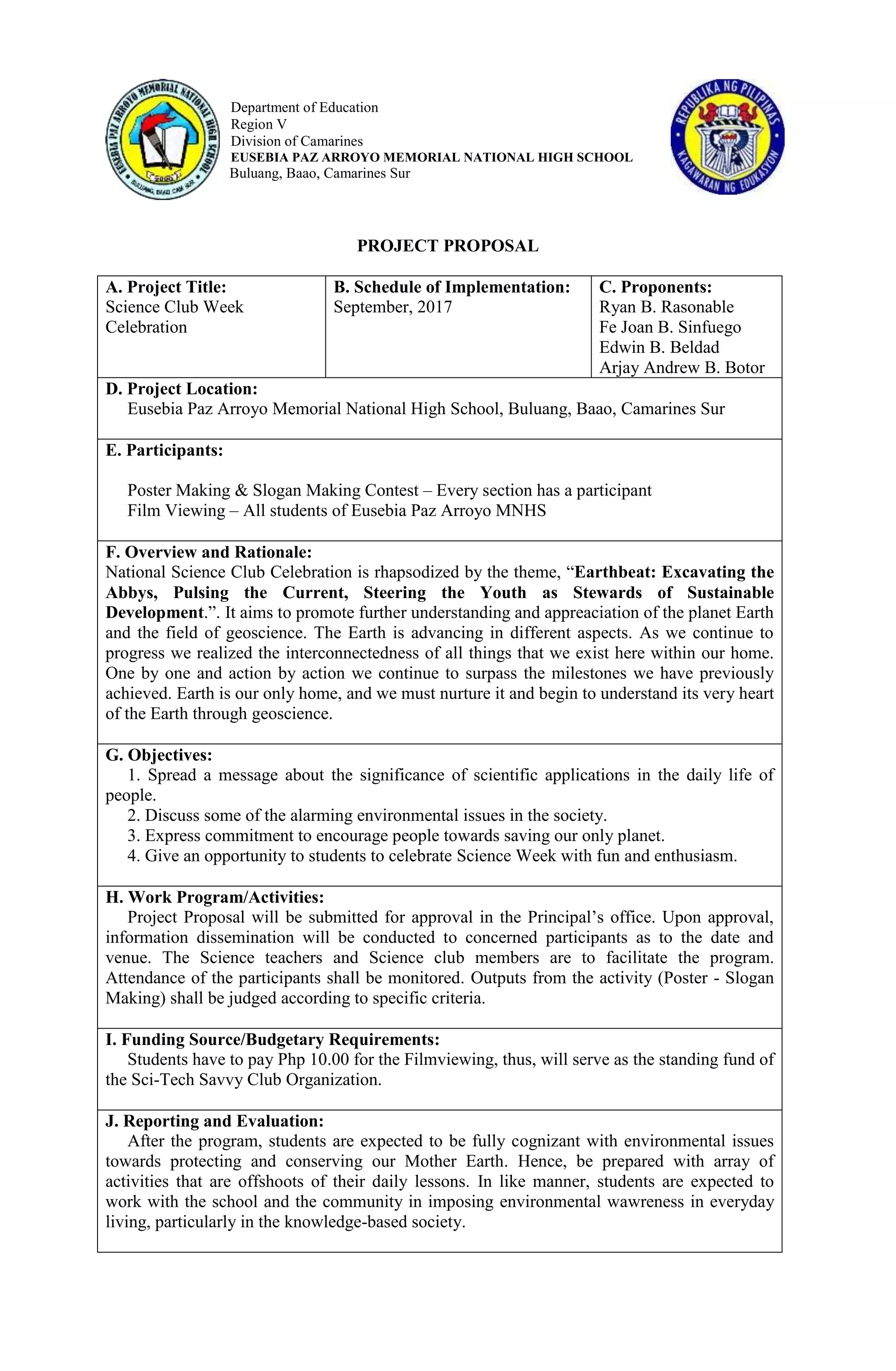
Prepared by:
RYAN B. RASONABLE
Science Coordinator
Approved:
EVELYN B. FABRIGAS
Principal I
SCIENCE QUIZBEE MECHANICS
I. General Rules
1. The EUSEBIANS Search for Science Wizard will be a team competition. Each team must have
four (4) members, well-represented by each year level.
2. The Contest will be divided into three (3) rounds: the Easy, Average and Difficult round.
3. The questions for the entire contest will cover the field of Sciences, namely; (1) Earth Science,
(2) Biology, (3) Chemistry, and (4) Physics.
These questions will be from the Committee of the quiz bee. It may be conceptual and/or
computational type questions.
4. The Quiz Bee will be in language of English.
5. No calculators, conversion tables, and the like will be allowed during contest.
6. The contestants should be at the place of the competition fifteen (15) minutes before the
scheduled time. Immediate disqualification will be implemented to those contestants who failed
to show up to (10) minutes after the supposed start of the quiz bee.
7. Clarifications regarding the rules of the competition shall be entertained by the Committee before
the start of the Contest.
II. Easy and Average Rounds
1. The contestant for the Easy and Average Round shall be in the form of a team(s) per course.
2. The Easy and Average round consists twenty (20) questions (ten (10) per round).
3. Each questions shall be given a predetermined number of points corresponding to its round. For
the easy, 1 point and for the average 2 points.
4. The questions shall be read twice. Afterwards, the quiz master will say “GO”, only then the
contestants may start writing their answer on the illustration boards given to them and, at the
same time, the start of the countdown timer. All teams should raise their pens and show their final
answers after the time allotted for the specified question.
5. Each team must write their final answer to the illustration boards provided by the Science Club
members.
6. The following cases will be considered as an incorrect answer:
a. An answer without its correct unit or with incorrect unit (even with correct value)
b. An answer with incorrect spelling.
7. Misbehavior of a team during contest, as determined by the proctors, is a sufficient condition for
disqualification of this team.
8. No questions shall be entertained during the contest proper.
9. Top five (5) teams with the highest scores gathered shall advance to the difficult round.
10. Should a tie exist, the match shall go into a “Sudden Death”. The team first to answer two (2)
questions correctly shall advance to the difficult round.
III. Difficult Round
1. The difficult round consist ten (10) questions.
2. Each question shall be given a predetermined number of points corresponding to its round. For
the difficult round, 3 points.
3. The questions shall be read twice. Afterwards, the quiz master will say “GO”, only then the
contestants may start writing their answer on the illustration boards given to them and, at the
same time, the start of the countdown timer. All teams should raise their pens and show their final
answers after the time allotted for the specified question.
4. The following cases will be considered as an incorrect answer:
a. An answer without its correct unit or with incorrect unit (even with correct value)
b. An answer with incorrect spelling.
5. Misbehavior of an individual contestant during contest, as determined by the proctors, is a
sufficient condition for his/her disqualification.
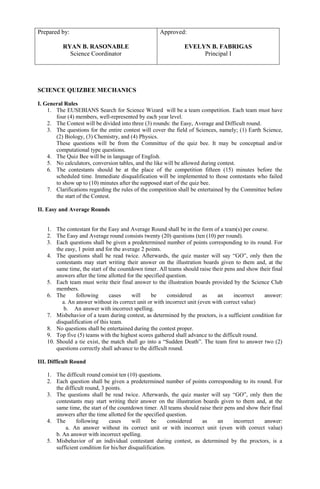
6. No questions shall be entertained during the contest proper.
7. Top three (3) teams with the highest scores gathered shall be declared the Champion, 1st placer,
2nd placer.
8. Should a tie exist, the match shall go into a “Sudden Death”. The individual contestant first to
answer two (2) questions correctly shall be declared the winner of the tie.
POSTER & SLOGAN MAKING CONTEST MECHANICS
1. Each Section must have one representative for the Poster and Slogan making contest.
2. All participants must be at the venue at least 15 minutes prior to the scheduled Contest briefing. If
a participant comes late before the briefing at the specified venue, s/he shall be disqualified.
3. Once the contest starts, no participant shall be allowed to enter or leave the premises for
whichever reason or purpose.
4. The poster and slogan must expound on the theme, “Earthbeat: Excavating the Abbys,
Pulsing the Current, Steering the Youth as Stewards of Sustainable Development.”
Posters and slogans are to be completed within 1hour and 15 minutes in designated venues
together with assigned proctor.
5. Each contestant shall provide ¼ white cartolina and a set of oil pastels (red,blue,yellow,black).
6. A slogan, which shall serve as the title of the artwork, must not exceed 12 words.
7. For purposes of anonymity, the contestants’ real name, must only appear in the official
registration form.
8. The serial number which corresponds to the name in the registration form shall be written on the
top portion of the paper provided for the slogan.
9. The posters will be judged according to the following criteria:
Creativity and presentation – 40%
Originality – 30%
Relevance to the theme – 30%
10. Three winners will be chosen from among the entries and shall be declared 1st Place, 2nd Place
and 3rd Place.
FILM VIEWING
1. Each section is required to watch the movie, .
2. Each student has to pay the amount of Php 10.00 as an admission fee. The collected amount
will serve as the Sci-Tech Savvy Club Organization’s standing fund.
(MOVIE SYNOPSIS)
World War Z
Retired U.N. investigator Gerry Lane (Brad Pitt) and his family are sitting in what appears to be a
typical Philadelphia traffic jam when helicopters began to circle ominously overhead, and an explosion
throws the city into panic. In the blink of an eye, the streets are consumed by chaos. When Gerry learns
that the catalyst for the turmoil is a highly contagious virus that transforms those who contract it into
rampaging maniacs, and that legions of the infected are growing on all continents, he agrees to join his
former colleagues in discovering the source of the rampant plague so that his wife and two daughters will
be guaranteed safety aboard a UN fleet in the Atlantic Ocean. Upon tracing a crucial e-mail to a U.S.
military base in South Korea, Gerry learns that the infection has spread more rapidly than anyone realizes.
Although a subsequent trip to Jerusalem, where the government has constructed a massive wall to keep
the public safe, initially offers hope that the growing horde can be kept at bay, an unexpected breach
sends Gerry back into the sky in search of patient zero. Just when Gerry thinks he's traced the origins of
the virus, however, the unthinkable happens. Subsequently stranded in Cardiff with a fearless Israeli
soldier, Gerry quickly makes his way to a World Health Organization outpost where the few remaining
scientists have hit a dead end in their search for a cure. But the struggle is far from over, and after
recalling an unusual scene witnessed in Jerusalem, Gerry prepares to make a leap of faith that could
prevent the downfall of humanity.
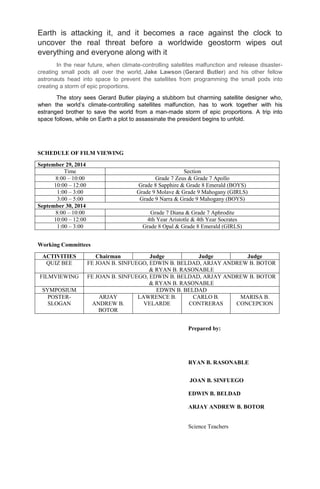
After an unprecedented series of natural disasters threatened
the planet, the world's leaders came together to create an intricate
network of satellites to control the global climate and keep everyone
safe. But now, something has gone wrong: the system built to protect
Earth is attacking it, and it becomes a race against the clock to
uncover the real threat before a worldwide geostorm wipes out
everything and everyone along with it
In the near future, when climate-controlling satellites malfunction and release disaster-
creating small pods all over the world, Jake Lawson (Gerard Butler) and his other fellow
astronauts head into space to prevent the satellites from programming the small pods into
creating a storm of epic proportions.
The story sees Gerard Butler playing a stubborn but charming satellite designer who,
when the world’s climate-controlling satellites malfunction, has to work together with his
estranged brother to save the world from a man-made storm of epic proportions. A trip into
space follows, while on Earth a plot to assassinate the president begins to unfold.
SCHEDULE OF FILM VIEWING
September 29, 2014
Time Section
8:00 – 10:00 Grade 7 Zeus & Grade 7 Apollo
10:00 – 12:00 Grade 8 Sapphire & Grade 8 Emerald (BOYS)
1:00 – 3:00 Grade 9 Molave & Grade 9 Mahogany (GIRLS)
3:00 – 5:00 Grade 9 Narra & Grade 9 Mahogany (BOYS)
September 30, 2014
8:00 – 10:00 Grade 7 Diana & Grade 7 Aphrodite
10:00 – 12:00 4th Year Aristotle & 4th Year Socrates
1:00 – 3:00 Grade 8 Opal & Grade 8 Emerald (GIRLS)
Working Committees
ACTIVITIES Chairman Judge Judge Judge
QUIZ BEE FE JOAN B. SINFUEGO, EDWIN B. BELDAD, ARJAY ANDREW B. BOTOR
& RYAN B. RASONABLE
FILMVIEWING FE JOAN B. SINFUEGO, EDWIN B. BELDAD, ARJAY ANDREW B. BOTOR
& RYAN B. RASONABLE
SYMPOSIUM EDWIN B. BELDAD
POSTER-
SLOGAN
ARJAY
ANDREW B.
BOTOR
LAWRENCE B.
VELARDE
CARLO B.
CONTRERAS
MARISA B.
CONCEPCION
Prepared by:
RYAN B. RASONABLE
JOAN B. SINFUEGO
EDWIN B. BELDAD
ARJAY ANDREW B. BOTOR
Science Teachers
Noted:
EVELYN B. FABRIGAS
Principal I
Ebola virus disease
From Wikipedia, the free encyclopedia
(Redirected from Ebola)
"Ebola" redirects here. For other uses, see Ebola (disambiguation).
Ebola virus disease
Classification and external resources
A 1976 photograph of two nurses standing in front of
Mayinga N., a person with Ebola virus disease; she died
only a few days later due to severe internal hemorrhaging.
ICD-10 A98.4
ICD-9 065.8
DiseasesDB 18043
MedlinePlus 001339
eMedicine med/626
MeSH D019142
Ebola virus disease (EVD), Ebola hemorrhagic fever (EHF), or simply Ebola is a disease of
humans and other primates caused by an ebolavirus. Symptoms start two days to three weeks
after contracting the virus, with a fever, sore throat, muscle pain and headaches. Typically,
vomiting, diarrhea and rash follow, along with decreased functioning of the liver and kidneys.
Around this time, affected people may begin to bleed both within the body and externally.[1]
The virus may be acquired upon contact with blood or bodily fluids of an infected animal.[1]
Spreading through the air has not been documented in the natural environment.[2]
Fruit bats are
believed to carry and spread the virus without being affected. Once human infection occurs, the
disease may spread between people, as well. Male survivors may be able to transmit the disease
via semen for nearly two months. To make the diagnosis, typically other diseases with similar
symptoms such as malaria, cholera and other viral hemorrhagic fevers are first excluded. To
confirm the diagnosis, blood samples are tested for viral antibodies, viral RNA, or the virus
itself.[1]
Prevention includes decreasing the spread of disease from infected animals to humans. This may
be done by checking such animals for infection and killing and properly disposing of the bodies
if the disease is discovered. Properly cooking meat and wearing protective clothing when
handling meat may also be helpful, as are wearing protective clothing and washing hands when
around a person with the disease. Samples of bodily fluids and tissues from people with the
disease should be handled with special caution.[1]
No specific treatment for the disease is yet available.[1]
Efforts to help those who are infected are
supportive and include giving either oral rehydration therapy (slightly sweet and salty water to
drink) or intravenous fluids.[1]
The disease has a high risk of death, killing between 50% and
90% of those infected with the virus.[1][3]
EVD was first identified in Sudan (now South Sudan)
and the Democratic Republic of the Congo. The disease typically occurs in outbreaks in tropical
regions of sub-Saharan Africa.[1]
From 1976 (when it was first identified) through 2013, the
World Health Organization reported a total of 1,716 cases.[1][4]
The largest outbreak to date is the
ongoing 2014 West Africa Ebola outbreak, which is affecting Guinea, Sierra Leone, Liberia and
Nigeria.[5][6]
As of 26 August 2014, 3,069 suspected cases resulting in the deaths of 1,552 have
been reported.[7]
Efforts are under way to develop a vaccine; however, none yet exists.[1]
Contents
 1Signs and symptoms
 2Causes
o 2.1Transmission
o 2.2Reservoir
o 2.3Virology
 3Pathophysiology
 4Diagnosis
o 4.1Classification
o 4.2Differential diagnosis
 5Prevention
o 5.1Infection control and containment
o 5.2Quarantine
o 5.3Vaccine
o 5.4Laboratory
 6Treatment
 7Prognosis
 8Epidemiology
o 8.11976
o 8.21995 to 2013
o 8.32014 outbreak
 9History
 10Society and culture
o 10.1Literature
 11Other animals
o 11.1Wild animals
o 11.2Domesticated animals
 12Research
o 12.1Medications and vaccines
o 12.2Blood transfusion
 13See also
 14References
 15External links
Signs and symptoms
Symptoms of Ebola.[8]
Signs and symptoms of Ebola usually begin suddenly with an influenza-like stage characterized
by fatigue, fever, headaches, joint, muscle and abdominal pain.[9][10]
Vomiting, diarrhea and loss
of appetite are also common.[10]
Less common symptoms include the following: sore throat,
chest pain, hiccups, shortness of breath and trouble swallowing.[10]
The average time between
contracting the infection and the start of symptoms (incubation period) is 8 to 10 days, but it can
vary between 2 and 21 days.[10][11]
Skin manifestations may include a maculopapular rash (in
about 50% of cases).[12]
Early symptoms of EVD may be similar to those of malaria, dengue
fever or other tropical fevers, before the disease progresses to the bleeding phase.[9]
In 40–50% of cases, bleeding from puncture sites and mucous membranes (e.g. gastrointestinal
tract, nose, vagina and gums) has been reported.[13]
In the bleeding phase, which typically starts 5
to 7 days after first symptoms[14]
internal and subcutaneous bleeding may present itself through
reddening of the eyes and bloody vomit.[9]
Bleeding into the skin may create petechiae, purpura,
ecchymoses and hematomas (especially around needle injection sites). Types of bleeding known
to occur with Ebola virus disease include vomiting blood, coughing it up or blood in the stool.
Heavy bleeding is rare and is usually confined to the gastrointestinal tract.[12][15]
In general, the
development of bleeding symptoms often indicates a worse prognosis and this blood loss can
result in death.[9]
All people infected show some symptoms of circulatory system involvement,
including impaired blood clotting.[12]
If the infected person does not recover, death due to
multiple organ dysfunction syndrome occurs within 7 to 16 days (usually between days 8 and 9)
after first symptoms.[14]
Causes
Main articles: Ebolavirus (taxonomic group) and Ebola virus (specific virus)
Life cycles of the Ebolavirus
EVD is caused by four of five viruses classified in the genus Ebolavirus, family Filoviridae,
order Mononegavirales. The four disease-causing viruses are Bundibugyo virus (BDBV), Sudan
virus (SUDV), Taï Forest virus (TAFV), and one called simply, Ebola virus (EBOV, formerly
Zaire Ebola virus)). Ebola virus is the sole member of the Zaire ebolavirus species, and the most
dangerous of the known Ebola disease-causing viruses, as well as being responsible for the
largest number of outbreaks.[16]
The fifth virus, Reston virus (RESTV), is not thought to be
disease-causing in humans. The five Ebola viruses are closely related to the Marburg viruses.
Transmission
Human-to-human transmission can occurs via direct contact with blood or bodily fluids from an
infected person (including embalming of an infected dead person) or by contact with objects
contaminated by the virus, particularly needles and syringes.[17]
The potential for widespread
EVD infections is considered low as the disease is only spread by direct contact with the
secretions from someone who is showing signs of infection.[17]
The symptoms limit a person's
ability to spread the disease as they are often too sick to travel.[18]
Because dead bodies are still
infectious local traditional burial rituals may spread the disease.[19]
Semen may be infectious in
survivors for up to 3 months.[20]
It is not entirely clear how an Ebola outbreak is initially
started.[21]
The initial infection is believed to occur after ebola virus is transmitted to a human by
contact with an infected animal's body fluids.
One of the primary reasons for spread is that the health systems in the part of Africa were the
disease occurs function poorly.[22]
Medical workers who do not wear appropriate protective
clothing may contract the disease.[23]
Hospital-acquired transmission has occurred in African due
to the reuse of needles and lack of universal precautions.[24][25]
Some health care centers caring
for people with the disease do not have running water.[20]
Airborne transmission has not been documented during EVD outbreaks.[2]
They are, however,
infectious as breathable 0.8– to 1.2-μm laboratory-generated droplets.[26]
The virus has been
shown to travel, without contact, from pigs to primates, although the same study failed to
demonstrate similar transmission between non-human primates.[27]
Bats drop partially eaten fruits and pulp, then land mammals such as gorillas and duikers feed on
these fallen fruits. This chain of events forms a possible indirect means of transmission from the
natural host to animal populations, which has led to research towards viral shedding in the saliva
of bats. Fruit production, animal behavior, and other factors vary at different times and places
that may trigger outbreaks among animal populations.[28]
Reservoir
Treatment
A hospital isolation ward in Gulu, Uganda, during the October 2000 outbreak
No ebolavirus-specific treatment exists.[72]
Treatment is primarily supportive in nature.[90]
These
measures may includes: pain management, medications for nausea, fever and anxiety, as well as
fluids by mouth or by intravenous.[90]
Blood products such as packed red blood cells, platelets or
fresh frozen plasma may also be used.[90]
Other regulators of coagulation have also been tried
including heparin in an effort to prevent disseminated intravascular coagulation and clotting
factors to decrease bleeding.[90]
Medication for malaria and bacterial infections have often been
used as initially the diagnosis is usually not clear.[90]
Early treatment may increase the chance of
survival.[91]
A number of experimental treatments are being studied.[92]
In the United States, the FDA's
animal efficacy rule is being used to demonstrate reasonable safety to obtain permission to treat
people who are infected with Ebola. It is being used as the normal path for testing drugs is not
possible for diseases caused by dangerous pathogens or toxins. Experimental drugs are made
available for use with the approval of regulatory agencies under named patient programs, known
in the US as "expanded access".[93]
The FDA has allowed two drugs, ZMapp and an RNA
interference drug called TKM-Ebola, to be used in people infected with Ebola under these
programs during the 2014 outbreak.[94]
2014 outbreak
Main article: 2014 West Africa Ebola virus outbreak
Increase over time in the cases and deaths during the 2014 outbreak
In March 2014, the World Health Organization (WHO) reported a major Ebola outbreak in
Guinea, a western African nation; it is the largest ever documented, and the first recorded in the
region.[109]
Researchers traced the outbreak to a two-year old child who died on 6 December
2013.[110]
On 8 August 2014, the WHO declared the epidemic to be an international public health
emergency. Urging the world to offer aid to the affected regions, the Director-General said,
"Countries affected to date simply do not have the capacity to manage an outbreak of this size
and complexity on their own. I urge the international community to provide this support on the
most urgent basis possible."[111][112]
By mid-August 2014, Doctors Without Borders reported the
situation in Liberia's capital Monrovia as "catastrophic" and "deteriorating daily". They report
that fears of Ebola among staff members and patients has shut down much of the city’s health
system which has resulted in leaving many people without treatment for other conditions.[113]
By
late August 2014, the disease had spread to Nigeria.[114][115]
By 6 September 2014, 4,293 suspected cases including 2,296 deaths had been reported, however
the World Health Organization has said that these numbers may be vastly underestimated.[116]
Additionally the outbreak has resulted in more than 120 healthcare worker deaths partly due to
the lack of equipment and long hours.[117]
On 8 September 2014, WHO warned the number of
new cases in Liberia was increasing exponentially, and would increase by "many thousands" in
the following 3 weeks.[118]
Aside from the human cost, the outbreak has severely eroded the economies of the affected
countries. In August 2014, attempts to contain the outbreak were enacted by placing troops on
roads to cordon off the infected areas and stop those who may be infected from leaving and
further spreading the virus.[119]
By September, with the closure of borders, the cancellation of
airline flights, the evacuation of foreign workers and a collapse of cross-border trade, the
national deficits of Guinea, Sierra Leone and Liberia were widening to the point where the IMF
was considering expanding its financial support to the 3 countries. The WHO, Médecins Sans
Frontières, and UN health care workers have all critized the travel restrictions saying they are not
justified and are potentially worsening the crisis. [120][121]
A Financial Times report suggested the
economic impact of the outbreak could kill more people than the virus itself.[122]

project proposal in science week.docx

  • 1.
    Department of Education RegionV Division of Camarines EUSEBIA PAZ ARROYO MEMORIAL NATIONAL HIGH SCHOOL Buluang, Baao, Camarines Sur PROJECT PROPOSAL A. Project Title: Science Club Week Celebration B. Schedule of Implementation: September, 2017 C. Proponents: Ryan B. Rasonable Fe Joan B. Sinfuego Edwin B. Beldad Arjay Andrew B. Botor D. Project Location: Eusebia Paz Arroyo Memorial National High School, Buluang, Baao, Camarines Sur E. Participants: Poster Making & Slogan Making Contest – Every section has a participant Film Viewing – All students of Eusebia Paz Arroyo MNHS F. Overview and Rationale: National Science Club Celebration is rhapsodized by the theme, “Earthbeat: Excavating the Abbys, Pulsing the Current, Steering the Youth as Stewards of Sustainable Development.”. It aims to promote further understanding and appreaciation of the planet Earth and the field of geoscience. The Earth is advancing in different aspects. As we continue to progress we realized the interconnectedness of all things that we exist here within our home. One by one and action by action we continue to surpass the milestones we have previously achieved. Earth is our only home, and we must nurture it and begin to understand its very heart of the Earth through geoscience. G. Objectives: 1. Spread a message about the significance of scientific applications in the daily life of people. 2. Discuss some of the alarming environmental issues in the society. 3. Express commitment to encourage people towards saving our only planet. 4. Give an opportunity to students to celebrate Science Week with fun and enthusiasm. H. Work Program/Activities: Project Proposal will be submitted for approval in the Principal’s office. Upon approval, information dissemination will be conducted to concerned participants as to the date and venue. The Science teachers and Science club members are to facilitate the program. Attendance of the participants shall be monitored. Outputs from the activity (Poster - Slogan Making) shall be judged according to specific criteria. I. Funding Source/Budgetary Requirements: Students have to pay Php 10.00 for the Filmviewing, thus, will serve as the standing fund of the Sci-Tech Savvy Club Organization. J. Reporting and Evaluation: After the program, students are expected to be fully cognizant with environmental issues towards protecting and conserving our Mother Earth. Hence, be prepared with array of activities that are offshoots of their daily lessons. In like manner, students are expected to work with the school and the community in imposing environmental wawreness in everyday living, particularly in the knowledge-based society.
  • 2.
    Prepared by: RYAN B.RASONABLE Science Coordinator Approved: EVELYN B. FABRIGAS Principal I SCIENCE QUIZBEE MECHANICS I. General Rules 1. The EUSEBIANS Search for Science Wizard will be a team competition. Each team must have four (4) members, well-represented by each year level. 2. The Contest will be divided into three (3) rounds: the Easy, Average and Difficult round. 3. The questions for the entire contest will cover the field of Sciences, namely; (1) Earth Science, (2) Biology, (3) Chemistry, and (4) Physics. These questions will be from the Committee of the quiz bee. It may be conceptual and/or computational type questions. 4. The Quiz Bee will be in language of English. 5. No calculators, conversion tables, and the like will be allowed during contest. 6. The contestants should be at the place of the competition fifteen (15) minutes before the scheduled time. Immediate disqualification will be implemented to those contestants who failed to show up to (10) minutes after the supposed start of the quiz bee. 7. Clarifications regarding the rules of the competition shall be entertained by the Committee before the start of the Contest. II. Easy and Average Rounds 1. The contestant for the Easy and Average Round shall be in the form of a team(s) per course. 2. The Easy and Average round consists twenty (20) questions (ten (10) per round). 3. Each questions shall be given a predetermined number of points corresponding to its round. For the easy, 1 point and for the average 2 points. 4. The questions shall be read twice. Afterwards, the quiz master will say “GO”, only then the contestants may start writing their answer on the illustration boards given to them and, at the same time, the start of the countdown timer. All teams should raise their pens and show their final answers after the time allotted for the specified question. 5. Each team must write their final answer to the illustration boards provided by the Science Club members. 6. The following cases will be considered as an incorrect answer: a. An answer without its correct unit or with incorrect unit (even with correct value) b. An answer with incorrect spelling. 7. Misbehavior of a team during contest, as determined by the proctors, is a sufficient condition for disqualification of this team. 8. No questions shall be entertained during the contest proper. 9. Top five (5) teams with the highest scores gathered shall advance to the difficult round. 10. Should a tie exist, the match shall go into a “Sudden Death”. The team first to answer two (2) questions correctly shall advance to the difficult round. III. Difficult Round 1. The difficult round consist ten (10) questions. 2. Each question shall be given a predetermined number of points corresponding to its round. For the difficult round, 3 points. 3. The questions shall be read twice. Afterwards, the quiz master will say “GO”, only then the contestants may start writing their answer on the illustration boards given to them and, at the same time, the start of the countdown timer. All teams should raise their pens and show their final answers after the time allotted for the specified question. 4. The following cases will be considered as an incorrect answer: a. An answer without its correct unit or with incorrect unit (even with correct value) b. An answer with incorrect spelling. 5. Misbehavior of an individual contestant during contest, as determined by the proctors, is a sufficient condition for his/her disqualification.
  • 3.
    6. No questionsshall be entertained during the contest proper. 7. Top three (3) teams with the highest scores gathered shall be declared the Champion, 1st placer, 2nd placer. 8. Should a tie exist, the match shall go into a “Sudden Death”. The individual contestant first to answer two (2) questions correctly shall be declared the winner of the tie. POSTER & SLOGAN MAKING CONTEST MECHANICS 1. Each Section must have one representative for the Poster and Slogan making contest. 2. All participants must be at the venue at least 15 minutes prior to the scheduled Contest briefing. If a participant comes late before the briefing at the specified venue, s/he shall be disqualified. 3. Once the contest starts, no participant shall be allowed to enter or leave the premises for whichever reason or purpose. 4. The poster and slogan must expound on the theme, “Earthbeat: Excavating the Abbys, Pulsing the Current, Steering the Youth as Stewards of Sustainable Development.” Posters and slogans are to be completed within 1hour and 15 minutes in designated venues together with assigned proctor. 5. Each contestant shall provide ¼ white cartolina and a set of oil pastels (red,blue,yellow,black). 6. A slogan, which shall serve as the title of the artwork, must not exceed 12 words. 7. For purposes of anonymity, the contestants’ real name, must only appear in the official registration form. 8. The serial number which corresponds to the name in the registration form shall be written on the top portion of the paper provided for the slogan. 9. The posters will be judged according to the following criteria: Creativity and presentation – 40% Originality – 30% Relevance to the theme – 30% 10. Three winners will be chosen from among the entries and shall be declared 1st Place, 2nd Place and 3rd Place. FILM VIEWING 1. Each section is required to watch the movie, . 2. Each student has to pay the amount of Php 10.00 as an admission fee. The collected amount will serve as the Sci-Tech Savvy Club Organization’s standing fund. (MOVIE SYNOPSIS) World War Z Retired U.N. investigator Gerry Lane (Brad Pitt) and his family are sitting in what appears to be a typical Philadelphia traffic jam when helicopters began to circle ominously overhead, and an explosion throws the city into panic. In the blink of an eye, the streets are consumed by chaos. When Gerry learns that the catalyst for the turmoil is a highly contagious virus that transforms those who contract it into rampaging maniacs, and that legions of the infected are growing on all continents, he agrees to join his former colleagues in discovering the source of the rampant plague so that his wife and two daughters will be guaranteed safety aboard a UN fleet in the Atlantic Ocean. Upon tracing a crucial e-mail to a U.S. military base in South Korea, Gerry learns that the infection has spread more rapidly than anyone realizes. Although a subsequent trip to Jerusalem, where the government has constructed a massive wall to keep the public safe, initially offers hope that the growing horde can be kept at bay, an unexpected breach sends Gerry back into the sky in search of patient zero. Just when Gerry thinks he's traced the origins of the virus, however, the unthinkable happens. Subsequently stranded in Cardiff with a fearless Israeli soldier, Gerry quickly makes his way to a World Health Organization outpost where the few remaining scientists have hit a dead end in their search for a cure. But the struggle is far from over, and after recalling an unusual scene witnessed in Jerusalem, Gerry prepares to make a leap of faith that could prevent the downfall of humanity. After an unprecedented series of natural disasters threatened the planet, the world's leaders came together to create an intricate network of satellites to control the global climate and keep everyone safe. But now, something has gone wrong: the system built to protect
  • 4.
    Earth is attackingit, and it becomes a race against the clock to uncover the real threat before a worldwide geostorm wipes out everything and everyone along with it In the near future, when climate-controlling satellites malfunction and release disaster- creating small pods all over the world, Jake Lawson (Gerard Butler) and his other fellow astronauts head into space to prevent the satellites from programming the small pods into creating a storm of epic proportions. The story sees Gerard Butler playing a stubborn but charming satellite designer who, when the world’s climate-controlling satellites malfunction, has to work together with his estranged brother to save the world from a man-made storm of epic proportions. A trip into space follows, while on Earth a plot to assassinate the president begins to unfold. SCHEDULE OF FILM VIEWING September 29, 2014 Time Section 8:00 – 10:00 Grade 7 Zeus & Grade 7 Apollo 10:00 – 12:00 Grade 8 Sapphire & Grade 8 Emerald (BOYS) 1:00 – 3:00 Grade 9 Molave & Grade 9 Mahogany (GIRLS) 3:00 – 5:00 Grade 9 Narra & Grade 9 Mahogany (BOYS) September 30, 2014 8:00 – 10:00 Grade 7 Diana & Grade 7 Aphrodite 10:00 – 12:00 4th Year Aristotle & 4th Year Socrates 1:00 – 3:00 Grade 8 Opal & Grade 8 Emerald (GIRLS) Working Committees ACTIVITIES Chairman Judge Judge Judge QUIZ BEE FE JOAN B. SINFUEGO, EDWIN B. BELDAD, ARJAY ANDREW B. BOTOR & RYAN B. RASONABLE FILMVIEWING FE JOAN B. SINFUEGO, EDWIN B. BELDAD, ARJAY ANDREW B. BOTOR & RYAN B. RASONABLE SYMPOSIUM EDWIN B. BELDAD POSTER- SLOGAN ARJAY ANDREW B. BOTOR LAWRENCE B. VELARDE CARLO B. CONTRERAS MARISA B. CONCEPCION Prepared by: RYAN B. RASONABLE JOAN B. SINFUEGO EDWIN B. BELDAD ARJAY ANDREW B. BOTOR Science Teachers
  • 5.
    Noted: EVELYN B. FABRIGAS PrincipalI Ebola virus disease From Wikipedia, the free encyclopedia (Redirected from Ebola) "Ebola" redirects here. For other uses, see Ebola (disambiguation). Ebola virus disease Classification and external resources
  • 6.
    A 1976 photographof two nurses standing in front of Mayinga N., a person with Ebola virus disease; she died only a few days later due to severe internal hemorrhaging. ICD-10 A98.4 ICD-9 065.8 DiseasesDB 18043 MedlinePlus 001339 eMedicine med/626 MeSH D019142 Ebola virus disease (EVD), Ebola hemorrhagic fever (EHF), or simply Ebola is a disease of humans and other primates caused by an ebolavirus. Symptoms start two days to three weeks after contracting the virus, with a fever, sore throat, muscle pain and headaches. Typically, vomiting, diarrhea and rash follow, along with decreased functioning of the liver and kidneys. Around this time, affected people may begin to bleed both within the body and externally.[1] The virus may be acquired upon contact with blood or bodily fluids of an infected animal.[1] Spreading through the air has not been documented in the natural environment.[2] Fruit bats are believed to carry and spread the virus without being affected. Once human infection occurs, the disease may spread between people, as well. Male survivors may be able to transmit the disease via semen for nearly two months. To make the diagnosis, typically other diseases with similar symptoms such as malaria, cholera and other viral hemorrhagic fevers are first excluded. To confirm the diagnosis, blood samples are tested for viral antibodies, viral RNA, or the virus itself.[1] Prevention includes decreasing the spread of disease from infected animals to humans. This may be done by checking such animals for infection and killing and properly disposing of the bodies if the disease is discovered. Properly cooking meat and wearing protective clothing when handling meat may also be helpful, as are wearing protective clothing and washing hands when around a person with the disease. Samples of bodily fluids and tissues from people with the disease should be handled with special caution.[1]
  • 7.
    No specific treatmentfor the disease is yet available.[1] Efforts to help those who are infected are supportive and include giving either oral rehydration therapy (slightly sweet and salty water to drink) or intravenous fluids.[1] The disease has a high risk of death, killing between 50% and 90% of those infected with the virus.[1][3] EVD was first identified in Sudan (now South Sudan) and the Democratic Republic of the Congo. The disease typically occurs in outbreaks in tropical regions of sub-Saharan Africa.[1] From 1976 (when it was first identified) through 2013, the World Health Organization reported a total of 1,716 cases.[1][4] The largest outbreak to date is the ongoing 2014 West Africa Ebola outbreak, which is affecting Guinea, Sierra Leone, Liberia and Nigeria.[5][6] As of 26 August 2014, 3,069 suspected cases resulting in the deaths of 1,552 have been reported.[7] Efforts are under way to develop a vaccine; however, none yet exists.[1] Contents  1Signs and symptoms  2Causes o 2.1Transmission o 2.2Reservoir o 2.3Virology  3Pathophysiology  4Diagnosis o 4.1Classification o 4.2Differential diagnosis  5Prevention o 5.1Infection control and containment o 5.2Quarantine o 5.3Vaccine o 5.4Laboratory  6Treatment  7Prognosis  8Epidemiology o 8.11976 o 8.21995 to 2013 o 8.32014 outbreak  9History  10Society and culture o 10.1Literature  11Other animals o 11.1Wild animals o 11.2Domesticated animals  12Research o 12.1Medications and vaccines o 12.2Blood transfusion  13See also  14References  15External links Signs and symptoms
  • 8.
    Symptoms of Ebola.[8] Signsand symptoms of Ebola usually begin suddenly with an influenza-like stage characterized by fatigue, fever, headaches, joint, muscle and abdominal pain.[9][10] Vomiting, diarrhea and loss of appetite are also common.[10] Less common symptoms include the following: sore throat, chest pain, hiccups, shortness of breath and trouble swallowing.[10] The average time between contracting the infection and the start of symptoms (incubation period) is 8 to 10 days, but it can vary between 2 and 21 days.[10][11] Skin manifestations may include a maculopapular rash (in about 50% of cases).[12] Early symptoms of EVD may be similar to those of malaria, dengue fever or other tropical fevers, before the disease progresses to the bleeding phase.[9] In 40–50% of cases, bleeding from puncture sites and mucous membranes (e.g. gastrointestinal tract, nose, vagina and gums) has been reported.[13] In the bleeding phase, which typically starts 5 to 7 days after first symptoms[14] internal and subcutaneous bleeding may present itself through reddening of the eyes and bloody vomit.[9] Bleeding into the skin may create petechiae, purpura, ecchymoses and hematomas (especially around needle injection sites). Types of bleeding known to occur with Ebola virus disease include vomiting blood, coughing it up or blood in the stool. Heavy bleeding is rare and is usually confined to the gastrointestinal tract.[12][15] In general, the development of bleeding symptoms often indicates a worse prognosis and this blood loss can result in death.[9] All people infected show some symptoms of circulatory system involvement, including impaired blood clotting.[12] If the infected person does not recover, death due to multiple organ dysfunction syndrome occurs within 7 to 16 days (usually between days 8 and 9) after first symptoms.[14] Causes Main articles: Ebolavirus (taxonomic group) and Ebola virus (specific virus) Life cycles of the Ebolavirus EVD is caused by four of five viruses classified in the genus Ebolavirus, family Filoviridae, order Mononegavirales. The four disease-causing viruses are Bundibugyo virus (BDBV), Sudan virus (SUDV), Taï Forest virus (TAFV), and one called simply, Ebola virus (EBOV, formerly Zaire Ebola virus)). Ebola virus is the sole member of the Zaire ebolavirus species, and the most dangerous of the known Ebola disease-causing viruses, as well as being responsible for the largest number of outbreaks.[16] The fifth virus, Reston virus (RESTV), is not thought to be disease-causing in humans. The five Ebola viruses are closely related to the Marburg viruses. Transmission Human-to-human transmission can occurs via direct contact with blood or bodily fluids from an infected person (including embalming of an infected dead person) or by contact with objects contaminated by the virus, particularly needles and syringes.[17] The potential for widespread EVD infections is considered low as the disease is only spread by direct contact with the secretions from someone who is showing signs of infection.[17] The symptoms limit a person's ability to spread the disease as they are often too sick to travel.[18] Because dead bodies are still infectious local traditional burial rituals may spread the disease.[19] Semen may be infectious in survivors for up to 3 months.[20] It is not entirely clear how an Ebola outbreak is initially
  • 9.
    started.[21] The initial infectionis believed to occur after ebola virus is transmitted to a human by contact with an infected animal's body fluids. One of the primary reasons for spread is that the health systems in the part of Africa were the disease occurs function poorly.[22] Medical workers who do not wear appropriate protective clothing may contract the disease.[23] Hospital-acquired transmission has occurred in African due to the reuse of needles and lack of universal precautions.[24][25] Some health care centers caring for people with the disease do not have running water.[20] Airborne transmission has not been documented during EVD outbreaks.[2] They are, however, infectious as breathable 0.8– to 1.2-μm laboratory-generated droplets.[26] The virus has been shown to travel, without contact, from pigs to primates, although the same study failed to demonstrate similar transmission between non-human primates.[27] Bats drop partially eaten fruits and pulp, then land mammals such as gorillas and duikers feed on these fallen fruits. This chain of events forms a possible indirect means of transmission from the natural host to animal populations, which has led to research towards viral shedding in the saliva of bats. Fruit production, animal behavior, and other factors vary at different times and places that may trigger outbreaks among animal populations.[28] Reservoir Treatment A hospital isolation ward in Gulu, Uganda, during the October 2000 outbreak No ebolavirus-specific treatment exists.[72] Treatment is primarily supportive in nature.[90] These measures may includes: pain management, medications for nausea, fever and anxiety, as well as fluids by mouth or by intravenous.[90] Blood products such as packed red blood cells, platelets or fresh frozen plasma may also be used.[90] Other regulators of coagulation have also been tried including heparin in an effort to prevent disseminated intravascular coagulation and clotting factors to decrease bleeding.[90] Medication for malaria and bacterial infections have often been used as initially the diagnosis is usually not clear.[90] Early treatment may increase the chance of survival.[91] A number of experimental treatments are being studied.[92] In the United States, the FDA's animal efficacy rule is being used to demonstrate reasonable safety to obtain permission to treat people who are infected with Ebola. It is being used as the normal path for testing drugs is not possible for diseases caused by dangerous pathogens or toxins. Experimental drugs are made available for use with the approval of regulatory agencies under named patient programs, known in the US as "expanded access".[93] The FDA has allowed two drugs, ZMapp and an RNA interference drug called TKM-Ebola, to be used in people infected with Ebola under these programs during the 2014 outbreak.[94] 2014 outbreak Main article: 2014 West Africa Ebola virus outbreak
  • 10.
    Increase over timein the cases and deaths during the 2014 outbreak In March 2014, the World Health Organization (WHO) reported a major Ebola outbreak in Guinea, a western African nation; it is the largest ever documented, and the first recorded in the region.[109] Researchers traced the outbreak to a two-year old child who died on 6 December 2013.[110] On 8 August 2014, the WHO declared the epidemic to be an international public health emergency. Urging the world to offer aid to the affected regions, the Director-General said, "Countries affected to date simply do not have the capacity to manage an outbreak of this size and complexity on their own. I urge the international community to provide this support on the most urgent basis possible."[111][112] By mid-August 2014, Doctors Without Borders reported the situation in Liberia's capital Monrovia as "catastrophic" and "deteriorating daily". They report that fears of Ebola among staff members and patients has shut down much of the city’s health system which has resulted in leaving many people without treatment for other conditions.[113] By late August 2014, the disease had spread to Nigeria.[114][115] By 6 September 2014, 4,293 suspected cases including 2,296 deaths had been reported, however the World Health Organization has said that these numbers may be vastly underestimated.[116] Additionally the outbreak has resulted in more than 120 healthcare worker deaths partly due to the lack of equipment and long hours.[117] On 8 September 2014, WHO warned the number of new cases in Liberia was increasing exponentially, and would increase by "many thousands" in the following 3 weeks.[118] Aside from the human cost, the outbreak has severely eroded the economies of the affected countries. In August 2014, attempts to contain the outbreak were enacted by placing troops on roads to cordon off the infected areas and stop those who may be infected from leaving and further spreading the virus.[119] By September, with the closure of borders, the cancellation of airline flights, the evacuation of foreign workers and a collapse of cross-border trade, the national deficits of Guinea, Sierra Leone and Liberia were widening to the point where the IMF was considering expanding its financial support to the 3 countries. The WHO, Médecins Sans Frontières, and UN health care workers have all critized the travel restrictions saying they are not justified and are potentially worsening the crisis. [120][121] A Financial Times report suggested the economic impact of the outbreak could kill more people than the virus itself.[122]