Earth’s Atmosphere
Why is it so important to life on
earth?
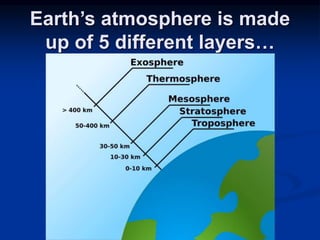
Earth’s atmosphere is made
up of 5 different layers…
Did you know that The
Science Monkey’s Took
Evan?
 The
 Science
 Monkey’s
 Took
 Evan
Say it with
me…
I know you are thinking…what
is he talking about???
 The
 Science
 Monkey’s
 Took
 Evan
 MEANS….
 Troposphere
 Stratosphere
 Mesosphere
 Thermosphere
 Exosphere
 THE FIVE LAYERS
OF THE EARTH’S
ATMOSPHERE
FROM THE EARTH
OUT!
Why is the atmosphere
divided into 5 different
layers?  Any guesses?
 The atmosphere is divided into
five different layers because the
atmosphere is not uniform, its
properties change with altitude.
 Two properties change with
altitude, the AIR PRESSURE
and the AIR TEMPERATURE
 Lets look at each layer
individually.
The first layer of the atmosphere
is the…
 The troposphere is the layer of the atmosphere nearest
to earth.
 The troposphere goes from 0km to 16km.
 All weather happens in the troposphere.
 More than half the air in the total atmosphere is in this
layer.
 The temperature drops as the altitude increases.
 Harmful ozone is found here…IT CREATES SMOG!
TROPOSPHERE
What is OZONE?
 A gaseous layer in the upper
atmosphere that protects the earth
from harmful ultraviolet radiation. At
lower levels, ozone becomes a major
pollutant.
What is SMOG?
 Pollution formed by the
interaction of pollutants and
sunlight (photochemical
smog), usually restricting
visibility, and occasionally
hazardous to health.
The second layer of the
atmosphere is the…
 The stratosphere goes from
16km to 50 km.
 The temperature goes up
with altitude.
 Most jets fly in this layer.
 The protective ozone is at
the top of the atmosphere (It
protects us from the
ultraviolet radiation of the
sun.)
 Rivers of air, called Jet
Streams, can be found at
the base of this layer.
STRATOSPHERE
The third layer of the atmosphere
is the…
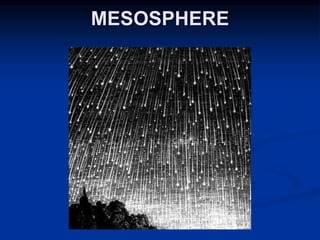
 The Mesosphere goes from
50km to 90km.
 In the mesosphere, the
temperature drops with
altitude.
 The mesosphere is the
coldest layer of the
atmosphere.
 Meteors burn up in this layer.
 Radio waves are reflected
back to earth in the
mesosphere.
MESOSPHERE
The fourth layer of the
atmosphere is the…
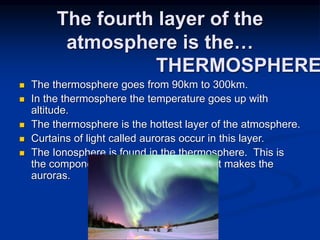
 The thermosphere goes from 90km to 300km.
 In the thermosphere the temperature goes up with
altitude.
 The thermosphere is the hottest layer of the atmosphere.
 Curtains of light called auroras occur in this layer.
 The Ionosphere is found in the thermosphere. This is
the component of the thermosphere that makes the
auroras.
THERMOSPHERE
The last layer of the atmosphere
is the…
 The exosphere is the
outermost layer of the
atmosphere.
 The temperature in
the exosphere goes
up with altitude.
 Satellites orbit earth
in the exosphere.
EXOSPHERE
GOOD LUCK!
It is important to understand the different
characteristics of the earth’s atmosphere. As
you go through the following slides, challenge
your partner to see who can name the correct
layer in which each characteristic can be
found.
EXOSPHERE
MESOSPHERE
THERMOSPHERE
TROPOSPHERE
STRATOSPHERE
THERMOSPHERE
OR THE IONOSPHERE
MESOSPHERE
Now that you are all
experts on the
atmosphere…continue
with your study of
meteorology!

science atmosphere.ppt

  • 1.
    Earth’s Atmosphere Why isit so important to life on earth?
  • 2.
    Earth’s atmosphere ismade up of 5 different layers…
  • 3.
    Did you knowthat The Science Monkey’s Took Evan?  The  Science  Monkey’s  Took  Evan Say it with me…
  • 4.
    I know youare thinking…what is he talking about???  The  Science  Monkey’s  Took  Evan  MEANS….  Troposphere  Stratosphere  Mesosphere  Thermosphere  Exosphere  THE FIVE LAYERS OF THE EARTH’S ATMOSPHERE FROM THE EARTH OUT!
  • 5.
    Why is theatmosphere divided into 5 different layers?  Any guesses?  The atmosphere is divided into five different layers because the atmosphere is not uniform, its properties change with altitude.  Two properties change with altitude, the AIR PRESSURE and the AIR TEMPERATURE  Lets look at each layer individually.
  • 6.
    The first layerof the atmosphere is the…  The troposphere is the layer of the atmosphere nearest to earth.  The troposphere goes from 0km to 16km.  All weather happens in the troposphere.  More than half the air in the total atmosphere is in this layer.  The temperature drops as the altitude increases.  Harmful ozone is found here…IT CREATES SMOG! TROPOSPHERE
  • 7.
    What is OZONE? A gaseous layer in the upper atmosphere that protects the earth from harmful ultraviolet radiation. At lower levels, ozone becomes a major pollutant. What is SMOG?  Pollution formed by the interaction of pollutants and sunlight (photochemical smog), usually restricting visibility, and occasionally hazardous to health.
  • 8.
    The second layerof the atmosphere is the…  The stratosphere goes from 16km to 50 km.  The temperature goes up with altitude.  Most jets fly in this layer.  The protective ozone is at the top of the atmosphere (It protects us from the ultraviolet radiation of the sun.)  Rivers of air, called Jet Streams, can be found at the base of this layer. STRATOSPHERE
  • 9.
    The third layerof the atmosphere is the…  The Mesosphere goes from 50km to 90km.  In the mesosphere, the temperature drops with altitude.  The mesosphere is the coldest layer of the atmosphere.  Meteors burn up in this layer.  Radio waves are reflected back to earth in the mesosphere. MESOSPHERE
  • 10.
    The fourth layerof the atmosphere is the…  The thermosphere goes from 90km to 300km.  In the thermosphere the temperature goes up with altitude.  The thermosphere is the hottest layer of the atmosphere.  Curtains of light called auroras occur in this layer.  The Ionosphere is found in the thermosphere. This is the component of the thermosphere that makes the auroras. THERMOSPHERE
  • 11.
    The last layerof the atmosphere is the…  The exosphere is the outermost layer of the atmosphere.  The temperature in the exosphere goes up with altitude.  Satellites orbit earth in the exosphere. EXOSPHERE
  • 12.
    GOOD LUCK! It isimportant to understand the different characteristics of the earth’s atmosphere. As you go through the following slides, challenge your partner to see who can name the correct layer in which each characteristic can be found.
  • 13.
  • 14.
  • 15.
  • 16.
  • 17.
  • 18.
  • 19.
  • 20.
    Now that youare all experts on the atmosphere…continue with your study of meteorology!