CHEMICAL
REACTION
Learning Competencies/Objectives
The learner should be able to:
1. Write chemical equations;
2. Apply the principles of conservation of mass to
chemical reactions;
3. Classify reactions according to the different types;
4. Identify the factors that affect reaction rates and
explain them according to collision theory; and
5. Explain how the factors affecting rates of chemical
reactions are applied in food preservation and
materials production, re control, pollution, and
corrosion.
Pre-Assessment
Multiple Choice. Choose the correct
answer.
1. During a chemical reaction,
A. atoms are destroyed
B. atoms are rearranged
C. elements are destroyed
D. new elements are produced
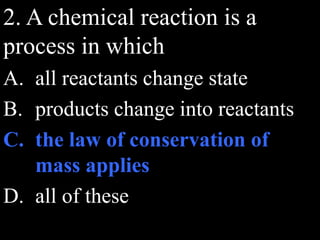
2. A chemical reaction is a
process in which
A. all reactants change state
B. products change into reactants
C. the law of conservation of mass
applies
D. all of these
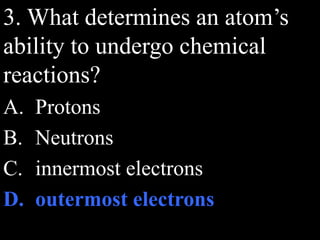
3. What determines an atom’s
ability to undergo chemical
reactions?
A. Protons
B. Neutrons
C. innermost electrons
D. outermost electrons
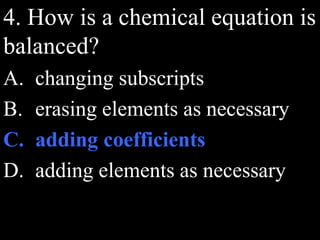
4. How is a chemical equation is
balanced?
A. changing subscripts
B. erasing elements as necessary
C. adding coefficients
D. adding elements as necessary
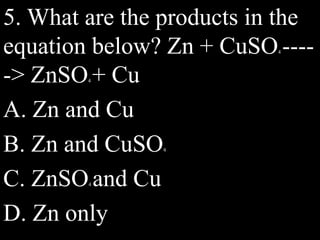
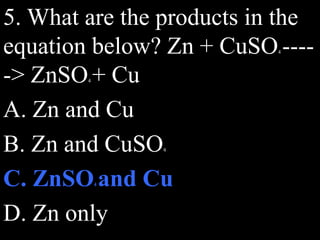
5. What are the products in the
equation below? Zn + CuSO4 ----
-> ZnSO4 + Cu
A. Zn and Cu
B. Zn and CuSO4
C. ZnSO4 and Cu
D. Zn only
6. What determines an atom’s
ability to undergo chemical
reactions?
A. Protons
B. Neutrons
C. innermost electrons
D. outermost electrons
6 -10. Write TRUE if the statement
is correct and FALSE if incorrect
and change the underlined word/s to
make the statement correct.
6. Generally, the higher the
concentration of the reacting
substances, the faster is the reaction.
7. At lower temperature,
chemical reactions occur at
slower rates.
8. The bigger the surface area of
the reactants, the faster the rate
of reaction.
9. Catalysts increase the rate of
reaction by providing a reaction
pathway with a higher
activation energy.
10. The minimum energy
required to start a reaction is
called bond energy.
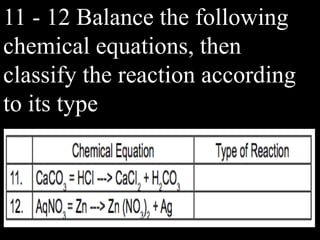
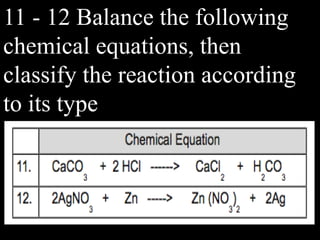
11 - 12 Balance the following
chemical equations, then
classify the reaction according
to its type
9. Catalysts increase the rate of
reaction by providing a reaction
pathway with a higher
activation energy.
10. The minimum energy
required to start a reaction is
called bond energy.
13-15 Explain in concise and
brief sentences.
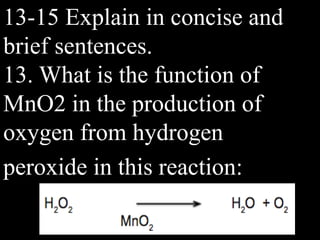
13. What is the function of
MnO2 in the production of
oxygen from hydrogen
peroxide in this reaction:
14.Why would iron fillings rust
faster than an iron nail?
15. Enzymes are in molds and
bacteria that spoil food. Explain,
using your knowledge of factors
affecting the rate of reaction, why
food doesn’t spoil as fast when it is
refrigerated as it would at room
temperature.
Pre-Assessment
Multiple Choice. Choose the correct
answer.
1. During a chemical reaction,
A. atoms are destroyed
B. atoms are rearranged
C. elements are destroyed
D. new elements are produced
2. A chemical reaction is a
process in which
A. all reactants change state
B. products change into reactants
C. the law of conservation of
mass applies
D. all of these
3. What determines an atom’s
ability to undergo chemical
reactions?
A. Protons
B. Neutrons
C. innermost electrons
D. outermost electrons
4. How is a chemical equation is
balanced?
A. changing subscripts
B. erasing elements as necessary
C. adding coefficients
D. adding elements as necessary
5. What are the products in the
equation below? Zn + CuSO4 ----
-> ZnSO4 + Cu
A. Zn and Cu
B. Zn and CuSO4
C. ZnSO4 and Cu
D. Zn only
6 -10. Write TRUE if the statement
is correct and FALSE if incorrect
and change the underlined word/s to
make the statement correct.
6. Generally, the higher the
concentration of the reacting
substances, the faster is the reaction.
TRUE
7. At lower temperature,
chemical reactions occur at
slower rates. TRUE
8. The bigger the surface area of
the reactants, the faster the rate
of reaction. TRUE
9. Catalysts increase the rate of
reaction by providing a reaction
pathway with a higher
activation energy. LOWER REACTION ENERGY (FALSE)
10. The minimum energy
required to start a reaction is
called bond energy.ACTIVATION ENERGY
(FALSE)
11 - 12 Balance the following
chemical equations, then
classify the reaction according
to its type
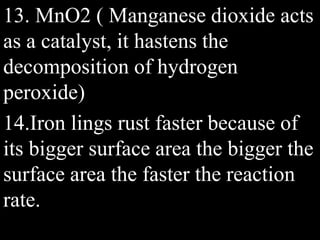
13. MnO2 ( Manganese dioxide acts
as a catalyst, it hastens the
decomposition of hydrogen
peroxide)
14.Iron lings rust faster because of
its bigger surface area the bigger the
surface area the faster the reaction
rate.
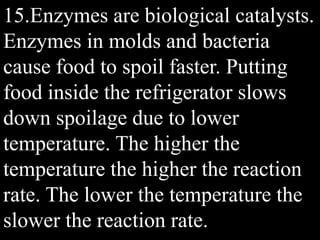
15.Enzymes are biological catalysts.
Enzymes in molds and bacteria
cause food to spoil faster. Putting
food inside the refrigerator slows
down spoilage due to lower
temperature. The higher the
temperature the higher the reaction
rate. The lower the temperature the
slower the reaction rate.

Chemical reaction (Pre test)

  • 1.
  • 2.
    Learning Competencies/Objectives The learnershould be able to: 1. Write chemical equations; 2. Apply the principles of conservation of mass to chemical reactions; 3. Classify reactions according to the different types; 4. Identify the factors that affect reaction rates and explain them according to collision theory; and 5. Explain how the factors affecting rates of chemical reactions are applied in food preservation and materials production, re control, pollution, and corrosion.
  • 3.
    Pre-Assessment Multiple Choice. Choosethe correct answer. 1. During a chemical reaction, A. atoms are destroyed B. atoms are rearranged C. elements are destroyed D. new elements are produced
  • 4.
    2. A chemicalreaction is a process in which A. all reactants change state B. products change into reactants C. the law of conservation of mass applies D. all of these
  • 5.
    3. What determinesan atom’s ability to undergo chemical reactions? A. Protons B. Neutrons C. innermost electrons D. outermost electrons
  • 6.
    4. How isa chemical equation is balanced? A. changing subscripts B. erasing elements as necessary C. adding coefficients D. adding elements as necessary
  • 7.
    5. What arethe products in the equation below? Zn + CuSO4 ---- -> ZnSO4 + Cu A. Zn and Cu B. Zn and CuSO4 C. ZnSO4 and Cu D. Zn only
  • 8.
    6. What determinesan atom’s ability to undergo chemical reactions? A. Protons B. Neutrons C. innermost electrons D. outermost electrons
  • 9.
    6 -10. WriteTRUE if the statement is correct and FALSE if incorrect and change the underlined word/s to make the statement correct. 6. Generally, the higher the concentration of the reacting substances, the faster is the reaction.
  • 10.
    7. At lowertemperature, chemical reactions occur at slower rates. 8. The bigger the surface area of the reactants, the faster the rate of reaction.
  • 11.
    9. Catalysts increasethe rate of reaction by providing a reaction pathway with a higher activation energy. 10. The minimum energy required to start a reaction is called bond energy.
  • 12.
    11 - 12Balance the following chemical equations, then classify the reaction according to its type
  • 13.
    9. Catalysts increasethe rate of reaction by providing a reaction pathway with a higher activation energy. 10. The minimum energy required to start a reaction is called bond energy.
  • 14.
    13-15 Explain inconcise and brief sentences. 13. What is the function of MnO2 in the production of oxygen from hydrogen peroxide in this reaction:
  • 15.
    14.Why would ironfillings rust faster than an iron nail? 15. Enzymes are in molds and bacteria that spoil food. Explain, using your knowledge of factors affecting the rate of reaction, why food doesn’t spoil as fast when it is refrigerated as it would at room temperature.
  • 16.
    Pre-Assessment Multiple Choice. Choosethe correct answer. 1. During a chemical reaction, A. atoms are destroyed B. atoms are rearranged C. elements are destroyed D. new elements are produced
  • 17.
    2. A chemicalreaction is a process in which A. all reactants change state B. products change into reactants C. the law of conservation of mass applies D. all of these
  • 18.
    3. What determinesan atom’s ability to undergo chemical reactions? A. Protons B. Neutrons C. innermost electrons D. outermost electrons
  • 19.
    4. How isa chemical equation is balanced? A. changing subscripts B. erasing elements as necessary C. adding coefficients D. adding elements as necessary
  • 20.
    5. What arethe products in the equation below? Zn + CuSO4 ---- -> ZnSO4 + Cu A. Zn and Cu B. Zn and CuSO4 C. ZnSO4 and Cu D. Zn only
  • 21.
    6 -10. WriteTRUE if the statement is correct and FALSE if incorrect and change the underlined word/s to make the statement correct. 6. Generally, the higher the concentration of the reacting substances, the faster is the reaction. TRUE
  • 22.
    7. At lowertemperature, chemical reactions occur at slower rates. TRUE 8. The bigger the surface area of the reactants, the faster the rate of reaction. TRUE
  • 23.
    9. Catalysts increasethe rate of reaction by providing a reaction pathway with a higher activation energy. LOWER REACTION ENERGY (FALSE) 10. The minimum energy required to start a reaction is called bond energy.ACTIVATION ENERGY (FALSE)
  • 24.
    11 - 12Balance the following chemical equations, then classify the reaction according to its type
  • 25.
    13. MnO2 (Manganese dioxide acts as a catalyst, it hastens the decomposition of hydrogen peroxide) 14.Iron lings rust faster because of its bigger surface area the bigger the surface area the faster the reaction rate.
  • 26.
    15.Enzymes are biologicalcatalysts. Enzymes in molds and bacteria cause food to spoil faster. Putting food inside the refrigerator slows down spoilage due to lower temperature. The higher the temperature the higher the reaction rate. The lower the temperature the slower the reaction rate.