DIGITAL NEWS PROJECT
FEBRUARY 2019
What do News Readers
Really Want to Read about?
How Relevance Works for
News Audiences
Kim Christian Schrøder
Contents
	
About the Author 	 4
Acknowledgements 	 4
	
Executive Summary	 5
	Introduction	 7
1. Recent Research on News Preferences	 8
2. A Bottom-Up Approach	 10
3. Results: How Relevance Works for
News Audiences	 12
4. Results: Four News Content Repertoires	 17
5. Results: Shared News Interests across
Repertoires	23
	6. Conclusion 	 26
Appendix A: News Story Cards and their
Sources	27
Appendix B: Fieldwork Participants	 30
References	31
THE REUTERS INSTITUTE FOR THE STUDY OF JOURNALISM
4
About the Author
Kim Christian Schrøder is Professor of Communication at Roskilde University, Denmark. He
was Google Digital News Senior Visiting Research Fellow at the Reuters Institute for the Study
of Journalism January–July 2018. His books in English include Audience Transformations: Shifting
Audience Positions in Late Modernity (co-edited, 2014), The Routledge Handbook of Museums, Media,
and Communication (co-edited 2019) and Researching Audiences (co-authored, 2003). His research
interests comprise the analysis of audience uses and experiences of media. His recent work
explores mixed methods for mapping news consumption.
Acknowledgements
The author would like to thank the Reuters Institute’s research team for their constructive
comments and practical help during the planning of the fieldwork, and for their feedback to a draft
version of this report. In addition to Lucas Graves, whose assistance in editing the manuscript was
invaluable, I wish to thank Nic Newman, Richard Fletcher, Joy Jenkins, Sílvia Majó-Vázquez, Antonis
Kalogeropoulos, Alessio Cornia, and Annika Sehl. Also thanks to Rebecca Edwards for invaluable
administrative help, and to Alex Reid for her expert handling of the production stage.
My thanks also go to the research team at Kantar Public, London, for constructive sparring about
the fieldwork design, especially to Nick Roberts, Lindsay Abbassian, and Jill Swindels.
I am deeply grateful to then Director of Research, Rasmus Kleis Nielsen, for hosting me as a
visiting fellow at the Reuters Institute (January–July 2018) and for making this fieldwork-based
study possible.
Finally, my warmest thanks to my long-time collaborator Christian Kobbernagel, who did the
Q-methodological factor analysis with meticulous care.
Published by the Reuters Institute for the Study of Journalism with the support of the Google
News Initiative
5
WHAT DO NEWS READERS REALLY WANT TO READ ABOUT? HOW RELEVANCE WORKS FOR NEWS AUDIENCES
Executive Summary
This report investigates how members of the public make decisions about what news to engage
with as they navigate a high-choice media environment across multiple devices and platforms.
While digital media provide a wealth of data about revealed news preferences – what stories are
most widely clicked on, shared, liked, and so forth – they tell us very little about why people make
the choices they do, or about how news fits into their lives.
To understand how audiences themselves make sense of the news, this study uses an innovative,
qualitative approach that can reveal latent patterns in the news repertoires people cultivate
as well as the factors that drive those preferences. This method sets aside the conventional
categories often relied on by the news industry as well as academic researchers – such as politics,
entertainment, sports, etc – in order to group news stories in terms drawn from the people reading
them.
We find that members of the public can very effectively articulate the role that news plays in their
lives, and that relevance is the key concept for explaining the decisions they make in a high-choice
media environment. As one study participant told us, ‘Something that affects you and your life. ...
That’s what you read, isn’t it?’ Specifically, we find that:
•	 Relevance is the paramount driver of news consumption. People find those stories most
relevant that affect their personal lives, as they impinge on members of their family, the
place where they work, their leisure activities, and their local community.
•	 Relevance is tied to sociability. It often originates in the belief that family and friends might
take an interest in the story. This is often coupled with shareability – a wish to share and tag
a friend on social media.
•	 People frequently click on stories that are amusing, trivial, or weird, with no obvious civic
focus. But they maintain a clear sense of what is trivial and what matters. On the whole
people want to stay informed about what goes on around them, at the local, national, and
international levels.
•	 News audiences make their own meanings, in ways that spring naturally from people’s
life experience. The same news story can be read by different people as an ‘international’
story, a ‘technology’ story, or a ‘financial’ story; sometimes a trivial or titillating story is
appreciated for its civic implications.
•	 News is a cross-media phenomenon characterised by high redundancy. Living in a news-
saturated culture, people often feel sufficiently informed about major ongoing news
stories; just reading the headline can be enough to bring people up to date about the latest
events.
•	 News avoidance, especially avoidance of political news, often originates in a cynical
attitude towards politicians (‘They break rules all the time and get away with it!’), coupled
with a modest civic literacy and lack of knowledge about politics.
In addition, we identified four specific types of news interest – four groups of people with common
repertoires of news stories they take an interest in. Each of these four repertoires consists of a
diverse diet of news stories that belong to many different topic areas, cutting across standard
categories such as ‘hard’ and ‘soft’ news, or politics and entertainment. Their interest profiles
THE REUTERS INSTITUTE FOR THE STUDY OF JOURNALISM
6
reflect people’s tastes for news and information that is relevant as a resource in their everyday
lives, and many of their top-ranked stories are indicative of a sustained civic, or political interest.
We define these four profiles as follows:
•	 Repertoire 1: People with political and civic interest in news
•	 Repertoire 2: People with a social-humanitarian interest in news
•	 Repertoire 3: People with a cultural interest in news
•	 Repertoire 4: People who seek (political) depth stories
The main insight provided by this study, for researchers and practitioners alike, is that we have
to complexify our understanding of news audience tastes and preferences. There are no simple
recipes for meeting the relevance thresholds of news audiences. To the extent that journalists
prioritise news stories with civic value, they should trust their instincts rather than relying on the
unreliable seismograph offered by ‘Most Read’ lists.
7
WHAT DO NEWS READERS REALLY WANT TO READ ABOUT? HOW RELEVANCE WORKS FOR NEWS AUDIENCES
Introduction
Despite well-publicised threats to the news industry, members of the public have never had
more news to choose from than they do today. With the rise of digital and social media as major
news platforms, and the potential for content to cross regional or national borders, media users
navigate a high-choice media environment where they must decide every day which of many
potentially informative or entertaining stories are worth their time.
Some members of the public respond by avoiding news altogether (Schrøder and Blach-Ørsten
2016; Toff and Nielsen 2018). But most people engage actively in building personal media
repertoires across the offline/online divide. As one influential study in this area observes, ‘A
cacophony of narratives increasingly competes with mainstream journalism to define the day’s
stories. News audiences pick and choose stories they want to attend to and believe, and select
from a seemingly endless supply of information to assemble their own versions’ (Bird 2011: 504).
How do people make these choices? It is a truism in the media business that ‘content is king’.
However, despite decades of studies analysing how journalists prioritise stories, research has only
recently begun to take seriously the question of what drives audience choices when it comes to
news, how news preferences fit into people’s everyday lives, and the implications of these choices
for democratic citizenship.
This study contributes to this emerging area of research with a qualitative analysis of the personal
news repertoires of 24 participants drawn from around Oxford, UK, during the spring and summer
of 2018. We use factor analysis coupled with in-depth interviews to understand people’s news
choices in the terms they themselves use, exploring their sense of news relevance and the level of
civic interest it reflects. Our method allows hidden patterns in people’s news story preferences to
emerge, without imposing the categories that researchers and journalists often take for granted.
As discussed below, this project offers a useful complement to studies that rely on surveys or
tracking data to measure audience preferences. It also offers a counterpoint to both popular
and academic concerns around news decisions guided by social media metrics, such as lists of
the most liked, shared, or commented articles. Such data often highlight audience interest in
sensational or entertaining news over serious news about public affairs (e.g. Harcup and O’Neill
2017, Boczkowski and Mitchelstein 2013).
Analyses of most-liked stories are illuminating but, we argue, tend to over-emphasise news
blockbusters at the expense of smaller stories that still attract substantial numbers of users. And
they don’t enlighten us about the ‘why’ and ‘how’ of the ways news inserts itself into the lives of
audiences.
In contrast, this study explores how ‘content is king’ for audiences – the ways in which people are
drawn to news that helps them make sense of themselves, shaping their identities, rationally
and emotionally, in relationships with significant people in their lives. Our approach points to
relevance as the key concept in understanding real-world news preferences, and highlights what
relevance means for news audiences.
THE REUTERS INSTITUTE FOR THE STUDY OF JOURNALISM
8
1. Recent Research on News Preferences
This study uses an innovative qualitative methodology, described in the next section, to uncover
news preferences and understand how audiences themselves make sense of their choices in a
crowded media environment. Our approach is designed to complement tools like audience surveys
and online tracking, building on the insights these methods reveal while addressing their limitations.
One source of knowledge about people’s news preferences comes from survey studies, used in
academic research and by the industry itself. A good example is the Reuters Institute Digital News
Survey, which in 2017 used panel surveys in multiple markets to ask people how interested they
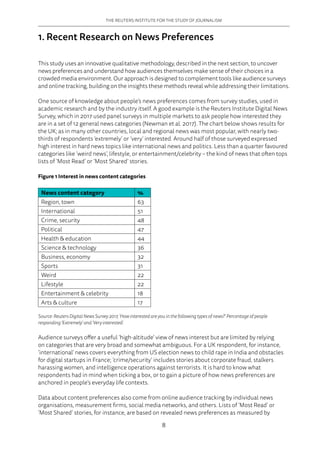
are in a set of 12 general news categories (Newman et al. 2017). The chart below shows results for
the UK; as in many other countries, local and regional news was most popular, with nearly two-
thirds of respondents ‘extremely’ or ‘very’ interested. Around half of those surveyed expressed
high interest in hard news topics like international news and politics. Less than a quarter favoured
categories like ‘weird news’, lifestyle, or entertainment/celebrity – the kind of news that often tops
lists of ‘Most Read’ or ‘Most Shared’ stories.
Figure 1 Interest in news content categories
News content category %
Region, town 63
International 51
Crime, security 48
Political 47
Health  education 44
Science  technology 36
Business, economy 32
Sports 31
Weird 22
Lifestyle 22
Entertainment  celebrity 18
Arts  culture 17
Source: Reuters Digital News Survey 2017, ‘How interested are you in the following types of news?’ Percentage of people
responding ‘Extremely’ and ‘Very interested’.
Audience surveys offer a useful ‘high-altitude’ view of news interest but are limited by relying
on categories that are very broad and somewhat ambiguous. For a UK respondent, for instance,
‘international’ news covers everything from US election news to child rape in India and obstacles
for digital startups in France; ‘crime/security’ includes stories about corporate fraud, stalkers
harassing women, and intelligence operations against terrorists. It is hard to know what
respondents had in mind when ticking a box, or to gain a picture of how news preferences are
anchored in people’s everyday life contexts.
Data about content preferences also come from online audience tracking by individual news
organisations, measurement firms, social media networks, and others. Lists of ‘Most Read’ or
‘Most Shared’ stories, for instance, are based on revealed news preferences as measured by
9
WHAT DO NEWS READERS REALLY WANT TO READ ABOUT? HOW RELEVANCE WORKS FOR NEWS AUDIENCES
click-through rates, time spent, or other forms of audience engagement with individual stories.
Researchers have raised concerns about the picture revealed by such statistics (e.g. Boczkowski
and Mitchelstein 2013). Topics like entertainment, celebrity, scandal, and ‘weird news’ dominate
‘Most Read’ lists, suggesting readers de-prioritise the public affairs stories valued by journalists in
favour of trivial stories with less democratic value.1
While these concerns should not be overlooked, the picture painted by such data is incomplete in
important ways that our approach is designed to address. As Peters (2015: 301) also notes, there
is good reason to ‘wonder if “clicking” should really be made as synonymous with “preference” or
“interest”’. The data used to build ‘Most Read’ lists don’t show the full composition of people’s news
diets because they don’t take into account that news consumption is cross-media.
This is important because in a high-choice media environment, people have an abundance of ways
to stay informed about stories that interest them. As a result, one reason people sometimes don’t
click on a given ‘hard news’ headline is that they already know the story. Major public affairs stories
are often serial, meaning they were in the news yesterday and will show up again tomorrow, and
are usually covered across mainstream media – radio, TV, print and online newspapers, and social
media. In contrast, non-public affairs stories, such as celebrity or ‘weird news’, are often one-off
reports unique to a given outlet. For the reader, they will often be new to them.
Another reason ‘Most Read’ rankings may diverge from people’s wider news interests can be found
in the push factors related to algorithmic selection, which cause more people to be exposed to
stories that are already trending upwards in terms of likes or shares. Once the ranking of a news
story rises, it enters a ‘spiral of increased visibility’ as platforms like Facebook or Twitter further
prioritise it in users’ news feeds (Fletcher and Nielsen 2018: 3).
Finally, it is important not to assume that all stories in the celebrity and ‘weird’ categories are
democratically useless. On the contrary, recent research suggests that seemingly trivial news
stories are sometimes read in ways that cross over into democratic concerns (Eide and Knight
1999) and may become a catalyst for civic engagement (Papacharissi 2010). As we shall see,
a ‘celebrity’ story about Cliff Richard allegedly having committed sexual assault was read by
participants in this study as a potential indictment of the justice system in Britain.
We agree with Cherubini and Nielsen that ‘all forms of analytics have to confront … the limitations
involved in using quantitative indicators to understand the messy and diverse realities of how
people engage with journalism, why, and what it means’ (2016: 34). As the next section lays out,
this study is designed to find alternative methods for understanding people’s interest in public
affairs news. To do this we begin with the assumption that people’s interest starts with particular
stories and topics, rather than with abstract categories like ‘politics’ or ‘international news’. We
also make room for people to offer their own accounts of the value – including potential civic or
democratic value – of the stories they choose to read.
1	
In journalism research oriented towards the improvement of the business models of online news media, it is debated whether
audience analytics are a helpful tool for understanding audience behaviour. In contrast to Zamith (2018), Lee and Tandoc (2017) find
that ‘Most Read’ metrics do influence journalistic topic agendas in favour of clickbait and non-civic stories. Rosenstiel argues that
web analytics ‘offer too little information that is useful to journalists or to publishers on the business side. They mostly measure the
wrong things. They also to a large extent measure things that are false or illusory’ (Rosenstiel 2016: 1).
THE REUTERS INSTITUTE FOR THE STUDY OF JOURNALISM
10
2. A Bottom-Up Approach
The qualitative method used in this study, a combination of factor analysis and in-depth
interviews, offers unique advantages over conventional approaches to measuring news
preferences. It allows us to discover latent patterns in people’s preferences, and offers insight
into how they are formed, without forcing responses into the standard categories favoured by
journalists and researchers.
Fieldwork for this study was carried out in the Oxford region in the UK in May–June 2018 by
research firm Kantar Public in collaboration with the author. In addition to its learned reputation,
the city of Oxford has a broad economic base including motor manufacturing, publishing, and
information technology and science-based businesses. The study interviewed 24 participants
divided equally between three life stages (18–29; 30–54; 55+), educational level, social
stratification, occupation, and gender (see Appendix B). Interviews took place in people’s homes or
at a location chosen by them (eg a canteen or an office). All participants received a £30 incentive
for talking to us. The study was approved by Oxford University’s Ethics Committee.
A distinctive feature of our method is the use of card sorting exercises (described below) in
conjunction with detailed interviews, which permits us to relate people’s media and news
preferences using factor analysis. The encounter with each research subject consisted of
three stages: (1) a day-in-the-life narrative interview about their news routines and habits; (2)
an interview about the media devices they use, based on a card sorting exercise to discover
people’s media repertoires in a broad sense; (3) an interview about news story preferences across
28 categories of news topics, based on a card sorting exercise involving 36 real-world stories
representing both ‘hard’ and ‘soft’ news.2
The 36 news stories were drawn from the cross-media, cross-platform news universe in Oxford,
spanning national as well as local outlets. All were published in April and May 2018; sources
included print and online editions of the Sunday Telegraph, The Times, BuzzFeed, Huffington Post,
Cosmopolitan, Woman’s Own, Sunday Mirror, Oxford Mail, Guardian, Daily Star, Sun, Observer, and
Mail on Sunday. The stories were selected to carry appeal in terms of diverse interests, tastes, and
styles across the social and cultural spectrum. Stories were also selected for potential long-term
interest; breaking news could not be included, since the study was carried out over several weeks.
2	
We followed Fletcher and Nielsen’s categorisation of ‘hard’ and ‘soft’ news (2018: 11) but did not use these terms during interviews.
We deliberately included examples of service and lifestyle news, which provides ‘help, advice, guidance, and information about the
management of self and everyday life’ (Hanitzsch and Vos 2018: 147).
Box 1: Examples of News Story Cards
Dog lick cost me my legs and face. Saliva got in tiny scratch. A dog lover lost his legs, five
fingers and part of his face when he got sepsis after his pet licked him.
Hunt admits breaking rules over luxury flats. Health Secretary Jeremy Hunt breached anti-
money laundering legislation brought in by his own government when he set up a company to
buy seven luxury flats.
11
WHAT DO NEWS READERS REALLY WANT TO READ ABOUT? HOW RELEVANCE WORKS FOR NEWS AUDIENCES
This report draws mainly on results of the card sorting in stage 3. For this exercise, each story was
represented on a simple card showing a headline and a brief subheading, printed in a neutral font
(see Box 1 and Appendix A). In order to focus on content preferences, the cards did not include
brand characteristics or visual elements like photographs. Participants were handed the 36 news
story cards and asked to sort them into three piles: stories they would probably want to read if
they came across them online, in print, or on social media; stories they probably would not want to
read; and in between a pile with stories they might want to read, time and place permitting.
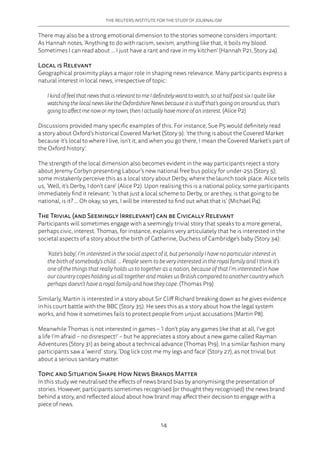
The initial sorting completed, participants were asked to refine their verdict by placing each story
card on a pyramid-shaped grid with nine columns, forming a continuum from ‘Likely to read’
to ‘Not likely to read’ (Figure 2). They were also told they could change the position of any card
until the total configuration expressed their news story preferences. When finished, the grid thus
reflected participants’ ranking of each story relative to the other 35 news stories.
Figure 2 One participant’s ranking of the 36 news story cards between ‘Likely to read’ and ‘Not likely
to read’
By mathematically relating the story rankings of the 24 participants using factor analysis, we
are able to identify four distinct clusters of study participants whose news preferences were
most similar.3
Each cluster can be seen as representing a shared news repertoire, which we then
explored and defined by considering what participants said during the sorting and in other stages
of the interviews, as well as the stories themselves. This analysis generated the model of news
relevance we discuss next, as well as four specific news content repertoires we develop in the
following section:
(1) People with political and civic interest in news;
(2) People with a social-humanitarian interest in news;
(3) People with a cultural interest in news; and
(4) People who seek (political) depth stories.
3	
In the Q-method factor analysis of the 24 participants’ sorting of the 36 news story cards, we opted for the four-factor solution,
because it was statistically superior (59% coverage of the variance; included 21 participants) and produced configurations that were
socio-culturally more meaningful.
THE REUTERS INSTITUTE FOR THE STUDY OF JOURNALISM
12
3. Results: How Relevance Works for News Audiences
From Browsing to Engagement: Towards an Anatomy of News Interest
Our in-depth interviews with study participants, including discussions that took place as they
sorted a range of news stories according to interest, confirmed that relevance is the key concept in
understanding how people make decisions about what news to attend to. As earlier research has
stressed, ‘If the discovered news post is not generally perceived as “interesting” or “relevant”, it is
rather unlikely that individuals read the linked article’ (Kümbel 2018: 14). Conversely, people are
likely to engage with news they find relevant as long as circumstances permit.
For many people ‘news’ is an elastic category. As one participant told us, referring to a BBC station
that features music and some discussion, ‘I do like Radio 2 and actually there are quite a lot of
newsy things, although it’s not the news’ (Hannah P21).4
For many, ‘news’ appears to include both
hard news (‘the news’) and softer varieties (‘newsy things’). The ultimate arbiter of whether they
end up engaging with stories is perceived relevance, irrespective of where the story falls on that
continuum.
People sometimes find it hard to come up with explicit reasons why they would, or would not, read
a story: what makes it relevant or not is decided on an intuitive basis. Commenting on a serious
editorial about election oversight in the UK (Story 32), Elizabeth P15 does not spontaneously
deliver a speech about citizenship: ‘Why would I stop and read it? Because it just interests me,
really.’5
But when prodded, she explains in a common-sense manner how relevance guides her
news consumption:
Something that affects you and your life. ... That’s what you read, isn’t it? That’s why you inform
yourself – because you want to know what’s going on and how it’s going to impact on you and your life
and your job. That’s what’s important. Because you are bombarded with information everywhere but
you only absorb the stuff that’s really – that you – that is relevant to you, unless you’re sitting there all
day watching TV. But you don’t – you don’t have to take in everything that’s there; you just pick out the
bits that affect you, I think. (Elizabeth P15)
On the whole however, participants explain their relevance priorities quite lucidly as they sort the
36 news story cards, and show a keen awareness of the commercial incentives that result in the
diverse news fare they come across daily. As one explains,
So the more likely, for me, would be either things that are going to impact on me personally, or things
that I have an active interest in. The less likely are the reality news sort of stuff, the celebrity news
sort of stuff, the stuff which I don’t think it makes a great deal of difference on. I don’t care if David
Beckham’s bought a new pair of pants [laughs]. It has no impact on my life at all and, yes, it’s just there
trying to sell papers or magazines or get viewers or likes or shares. It’s not – for me, that’s not news.
(Andrew P26)
People also describe how they may end up reading human interest or entertainment or ‘weird
news’ as an innocent pastime, but most maintain a clear sense of what is trivial and what matters.
As he takes a final evaluative glance over the stories he has sorted on the grid in front of him,
4	
Study participants are listed by first name and participant number (more details in Appendix B). See Appendix A for a full list of
stories.
5	
This intuitive perception of why a news story is valuable has a newsroom parallel in the way many journalists simply respond
‘Because it just is!’ (Harcup and O’Neill 2017: 1470).
13
WHAT DO NEWS READERS REALLY WANT TO READ ABOUT? HOW RELEVANCE WORKS FOR NEWS AUDIENCES
Michael reflects on his priorities:
I have moved the pollution to over here, moved the drone over. I am interested in technology, but I
think I am more worried about the planet and what’s left for my children. … You can sort of see school
and the environment and local elections at the top end. And then a bit of technology and a bit of world
news and TV and gaming. Racism, sport and then your sort of celebrities and music and American
news I suppose down at the bottom end. (Michael P4)
However, perceived topic relevance is not always sufficient ground for reading a story. Whether
people interrupt their browsing in order to read a relevant story also depends on whether they feel
sufficiently informed by other news media. Here Jessica reflects about an election story: ‘“There
are local elections happening soon and here’s what you need to know.” When it comes to elections,
it is everywhere. … So you don’t necessarily have to really click into things to know what’s going on.
If it’s all over telly, it’s all over radio, it’s – I don’t know, you can’t get away’ (Jessica P23).
Often, just reading a headline is enough to remind people about what they already know and bring
them up to date. As one participant noted, ‘I feel as though I get the gist of this entire article just
from the headline. … I almost don’t need to know any more about it. I already know Netflix is very
popular, becoming more popular, and the BBC is probably losing license payers.’ (Paul P25, Story 30).
Probing more deeply into these discussions, we identified five grounding principles for
understanding news relevance among everyday citizens. We conclude by distilling these into a
basic model of the factors that drive relevance.
Personal Relevance Reflects Basic Life Priorities
Personal relevance is an indispensable gate-keeper of engagement with a news story. This includes
above all potential impact on one’s own life and family. For instance, Maureen P10 finds the story
‘Teachers oppose tests’ (Story 17) very important because she associates it with her 3½ year old
grandchild; she would read an article about Airbnb (Story 1) because ‘I have never used Airbnb, but
my son does’; and a story about engineering firm GKN (Story 10) ‘if it would affect my mortgage’.
Victoria P22 reflects very precisely on her news preferences after having sorted the story cards into
the three piles: ‘I think a lot of these I’ve chosen is because of personal relevance, something that’s
happened in my life or to my family, and that’s why it’s obviously more important to you, so you
seek the information’.
Personal relevance often originates in the fact someone we care about might take an interest.
Hannah notes about an automotive story that might appeal to her young son, ‘That’s about the
Ford Mustang, so we’d have something to bond over’ (Hannah P21, Story 13). This sociability
dimension of news may extend into shareability on social media: ‘“These young people seem
pretty pleased with Labour’s free bus travel policy.“ … If it was relevant to anybody I knew I’d send it
on. I’d tag people in the post or share it via Messenger’ (Simon P14, Story 5).
Work-related matters are a frequent source of relevance. Paul, who works in the NHS, says he would
read about a scandal concerning politician Jeremy Hunt (Story 4) because of Hunt’s involvement in
NHS cuts. For similar reasons, Victoria would engage with a story about rape in India (Story 3) and
one about psychologists recommending probation for the rapist John Worboys (Story 33):
I like this especially because I worked in Sri Lanka recently. … [As a psychology student,] I would read
that because it talks about psychology and people’s everyday views about psychologists. (Victoria
P22)
THE REUTERS INSTITUTE FOR THE STUDY OF JOURNALISM
14
There may also be a strong emotional dimension to the stories someone considers important:
As Hannah notes, ‘Anything to do with racism, sexism, anything like that, it boils my blood.
Sometimes I can read about … I just have a rant and rave in my kitchen’ (Hannah P21, Story 24).
Local is Relevant
Geographical proximity plays a major role in shaping news relevance. Many participants express a
natural interest in local news, irrespective of topic:
IkindoffeelthatnewsthatisrelevanttomeIdefinitelywanttowatch,soathalfpastsixIquitelike
watchingthelocalnewsliketheOxfordshireNewsbecauseitisstuffthat’sgoingonaroundus,that’s
goingtoaffectmenowormytown,thenIactuallyhavemoreofaninterest. (Alice P2)
Discussions provided many specific examples of this. For instance, Sue P5 would definitely read
a story about Oxford’s historical Covered Market (Story 9): ‘the thing is about the Covered Market
because it’s local to where I live, isn’t it, and when you go there, I mean the Covered Market’s part of
the Oxford history’.
The strength of the local dimension also becomes evident in the way participants reject a story
about Jeremy Corbyn presenting Labour’s new national free bus policy for under-25s (Story 5);
some mistakenly perceive this as a local story about Derby, where the launch took place. Alice tells
us, ‘Well, it’s Derby, I don’t care’ (Alice P2). Upon realising this is a national policy, some participants
immediately find it relevant: ‘Is that just a local scheme to Derby, or are they, is that going to be
national, is it? … Oh okay, so yes, I will be interested to find out what that is’ (Michael P4).
The Trivial (and Seemingly Irrelevant) can be Civically Relevant
Participants will sometimes engage with a seemingly trivial story that speaks to a more general,
perhaps civic, interest. Thomas, for instance, explains very articulately that he is interested in the
societal aspects of a story about the birth of Catherine, Duchess of Cambridge’s baby (Story 34):
‘Kate’s baby’, I’m interested in the social aspect of it, but personally I have no particular interest in
the birth of somebody’s child. … People seem to be very interested in the royal family and I think it’s
one of the things that really holds us to together as a nation, because of that I’m interested in how
our country copes holding us all together and makes us British compared to another country which
perhaps doesn’t have a royal family and how they cope. (Thomas P19)
Similarly, Martin is interested in a story about Sir Cliff Richard breaking down as he gives evidence
in his court battle with the BBC (Story 35). He sees this as a story about how the legal system
works, and how it sometimes fails to protect people from unjust accusations (Martin P8).
Meanwhile Thomas is not interested in games – ‘I don’t play any games like that at all, I’ve got
a life I’m afraid – no disrespect!’ – but he appreciates a story about a new game called Rayman
Adventures (Story 31) as being about a technical advance (Thomas P19). In a similar fashion many
participants saw a ‘weird’ story, ‘Dog lick cost me my legs and face’ (Story 27), as not trivial but
about a serious sanitary matter.
Topic and Situation Shape How News Brands Matter
In this study we neutralised the effects of news brand bias by anonymising the presentation of
stories. However, participants sometimes recognised (or thought they recognised) the news brand
behind a story, and reflected aloud about how brand may affect their decision to engage with a
piece of news.
15
WHAT DO NEWS READERS REALLY WANT TO READ ABOUT? HOW RELEVANCE WORKS FOR NEWS AUDIENCES
In some cases, in line with previous research, we found that topic relevance may overrule distaste
for a particular news brand (cf. Kümbel 2018). For instance, reflecting on an editorial about
psychologists who freed a convicted rapist, Elizabeth provided a glimpse of the complicated
process of deciding whether to read a story or not (Story 33):
Interviewer: Would it matter which newspaper it was in – whether you’d read it or not? So if it was in
the Sun versus the Guardian?
Elizabeth: Well, I wouldn’t read the Sun because they’re just so – (laughs). Well, I probably – that
probably has come ‘Off their heads‘ with a title like that. … If someone said to me there was an article
in the Sun I’d go, oh, god, I’m not reading that. … But if it was on the table, with that header, I probably
would go, oh, okay, and pick it up and read it, actually. (Elizabeth P15)
Another important factor that decides if people read a news story or not is the time available in
the situation where people encounter the story, whether on social media, a news media site, or the
printed page. Ideas about the best use of time also inform how people evaluate news brands. As
Lucinda told us:
I think one of the problems with me having social media as my primary sort of source or, like, my
phone, is what comes first in terms of all these stories laid out in front of me like I’ve got now. … In the
moments where I have, like, an hour, I will go on The Economist, go on the FT, BBC News and those
– it will be more this style of stuff. … But if it’s shorter kind of like I’ve only got 20 minutes, I will be on
Facebook. (Lucinda P16)
News Story Topic is the Paramount Determinant of News Engagement
In the natural process of news selection, people are motivated in part by their familiarity with
different news brands. Some would never dream of using news from the Daily Mail or the Sun, due
to their tabloid image or political leaning; conversely, others would steer clear of the Guardian and
The Times.
In contrast, this study is designed to zoom in on content preferences. We used a non-naturalistic
design that forced participants to focus on stories themselves, without regard to news brand or
visual elements. Our approach finds support in recent research that systematically compares the
different motivational factors underlying news engagement and finds that topic – what a story is
about – is the key variable.
For instance, research by Anna Sophie Kümbel has used both qualitative and quantitative
approaches to weigh the various contextual and content factors that potentially determine
people’s engagement decisions on social media: the news provider (brand), the topic/content
of the story, and the persons acting as intermediaries through sharing or tagging behaviour.
She found that positive perceptions of the news brand were rarely decisive, while ‘the perceived
relevance of the article’s issues and topics … seems to guide news engagement decisions on
Facebook the most’ (Kümbel 2018: 12). These findings were borne out in a subsequent quantitative
experiment finding a strong link between engagement in a story and previously expressed interest
in the topic (Kümbel 2019).
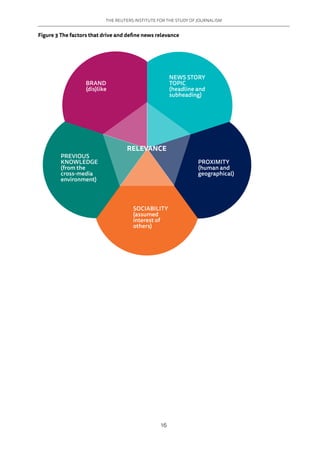
Building on such findings, and based on discussions by participants in this study, we have developed
a simple model of the factors that help to drive and define news relevance as understood by actual
members of the public. This model , depicted in Fig. 3 (below), recognises the importance of brand
but not at the expense of key factors like proximity, sociability, previous knowledge and above all
the topic of a story.
THE REUTERS INSTITUTE FOR THE STUDY OF JOURNALISM
16
Figure 3 The factors that drive and define news relevance
RELEVANCE
NEWS STORY
TOPIC
(headline and
subheading)
BRAND
(dis)like
PREVIOUS
KNOWLEDGE
(from the
cross-media
environment)
SOCIABILITY
(assumed
interest of
others)
PROXIMITY
(human and
geographical)
RELEVANCE
17
WHAT DO NEWS READERS REALLY WANT TO READ ABOUT? HOW RELEVANCE WORKS FOR NEWS AUDIENCES
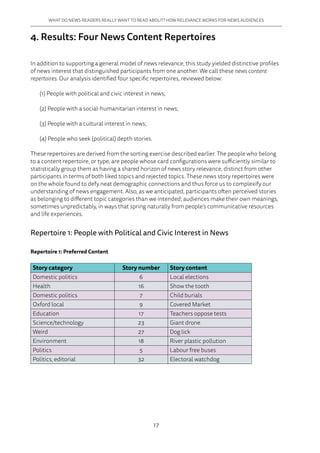
4. Results: Four News Content Repertoires
In addition to supporting a general model of news relevance, this study yielded distinctive profiles
of news interest that distinguished participants from one another. We call these news content
repertoires. Our analysis identified four specific repertoires, reviewed below:
(1) People with political and civic interest in news;
(2) People with a social-humanitarian interest in news;
(3) People with a cultural interest in news;
(4) People who seek (political) depth stories.
These repertoires are derived from the sorting exercise described earlier. The people who belong
to a content repertoire, or type, are people whose card configurations were sufficiently similar to
statistically group them as having a shared horizon of news story relevance, distinct from other
participants in terms of both liked topics and rejected topics. These news story repertoires were
on the whole found to defy neat demographic connections and thus force us to complexify our
understanding of news engagement. Also, as we anticipated, participants often perceived stories
as belonging to different topic categories than we intended; audiences make their own meanings,
sometimes unpredictably, in ways that spring naturally from people’s communicative resources
and life experiences.
Repertoire 1: People with Political and Civic Interest in News
Repertoire 1: Preferred Content
Story category Story number Story content
Domestic politics 6 Local elections
Health 16 Show the tooth
Domestic politics 7 Child burials
Oxford local 9 Covered Market
Education 17 Teachers oppose tests
Science/technology 23 Giant drone
Weird 27 Dog lick
Environment 18 River plastic pollution
Politics 5 Labour free buses
Politics, editorial 32 Electoral watchdog
THE REUTERS INSTITUTE FOR THE STUDY OF JOURNALISM
18
Repertoire 1: Dispreferred Content
Story category Story number Story content
Popular culture: music 29 Beyoncé
Lifestyle, cars 13 My must-buy
Royalty 34 Kate’s baby
Sport, cricket 20 Taylor
Personal economy 11 Animal crackers
Celebrity 36 Khloe Kardashian
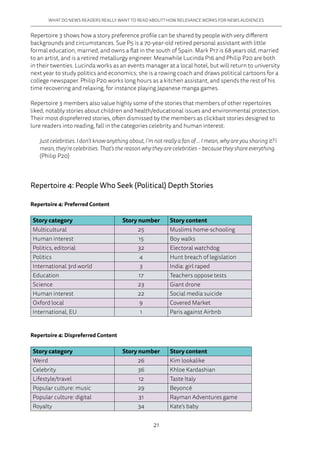
The seven people in Repertoire 1 are characterised by a distinctive political and civic interest,
as shown in their ten highest-ranked news stories. As one participant told us, he likes ‘... to
keep abreast of sort of current affairs’, and is drawn to a range of topics such as technology, the
environment, education and local politics.
Stories about local elections (Story 6) and the Prime Minister’s intervention on behalf of parents
who have lost a child (Story 7) are top of their list. They also like stories about local leaders
supporting the reinvigoration of Oxford’s historical Covered Market (Story 9), and a report on
Jeremy Corbyn launching a new transport policy initiative (Story 5).
I think local elections are very important because local councils are very accessible to the populace
and really they’ve got to listen to us so therefore, if they come up with decent plans I’ll listen to them
and I’ll make my mind upon that. (Chris P3)
Stories about health, education, and the environment, which all have a hook to the political
system, were given a high ranking. Some readily admit to being easily tempted by ‘weird’ stories,
such as the human interest story about a dog lick (Story 27), but others found serious, real-world
concerns in such coverage: ‘I think a lot of these I’ve chosen is because [of] personal relevance,
something that’s happened in my life or to my family … My mum has been bitten by my cat many
times … I don’t know why we still have a cat’ (Victoria P21).
Stories that members of Repertoire 1 declare themselves most unlikely to want to read under
most circumstances belong to the topic categories of popular culture (Beyoncé, Story 29),
celebrities (the Kardashians, Story 36), and royalty (Kate’s baby, Story 34). Some tolerate soft news
mainly for the sake of sociability, for instance relating to in-laws:
I have more recently been going on to the Daily Mail female page where you get junk about all the
celebrities. Because I am massively not in the know about any celebrities anymore. … But then I
get to, you know I go and see family, and Ben’s family specifically are really into their celebrity stuff,
know about everything, and if I don’t read it I feel like I am getting behind, yes ... keeping up with the
conversation is basically why I have the Daily Mail female app. (Alice P22)
19
WHAT DO NEWS READERS REALLY WANT TO READ ABOUT? HOW RELEVANCE WORKS FOR NEWS AUDIENCES
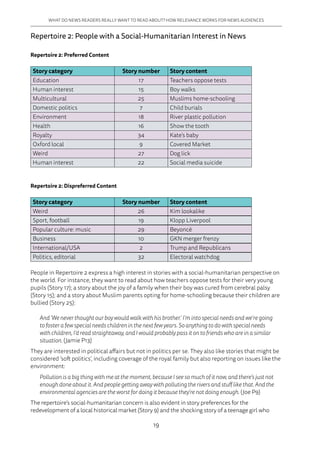
Repertoire 2: People with a Social-Humanitarian Interest in News
Repertoire 2: Preferred Content
Story category Story number Story content
Education 17 Teachers oppose tests
Human interest 15 Boy walks
Multicultural 25 Muslims home-schooling
Domestic politics 7 Child burials
Environment 18 River plastic pollution
Health 16 Show the tooth
Royalty 34 Kate’s baby
Oxford local 9 Covered Market
Weird 27 Dog lick
Human interest 22 Social media suicide
Repertoire 2: Dispreferred Content
Story category Story number Story content
Weird 26 Kim lookalike
Sport, football 19 Klopp Liverpool
Popular culture: music 29 Beyoncé
Business 10 GKN merger frenzy
International/USA 2 Trump and Republicans
Politics, editorial 32 Electoral watchdog
People in Repertoire 2 express a high interest in stories with a social-humanitarian perspective on
the world. For instance, they want to read about how teachers oppose tests for their very young
pupils (Story 17); a story about the joy of a family when their boy was cured from cerebral palsy
(Story 15); and a story about Muslim parents opting for home-schooling because their children are
bullied (Story 25):
And ‘We never thought our boy would walk with his brother.’ I’m into special needs and we’re going
to foster a few special needs children in the next few years. So anything to do with special needs
with children, I’d read straightaway, and I would probably pass it on to friends who are in a similar
situation. (Jamie P13)
They are interested in political affairs but not in politics per se. They also like stories that might be
considered ‘soft politics’, including coverage of the royal family but also reporting on issues like the
environment:
Pollution is a big thing with me at the moment, because I see so much of it now, and there’s just not
enough done about it. And people getting away with polluting the rivers and stuff like that. And the
environmental agencies are the worst for doing it because they’re not doing enough. (Joe P9)
The repertoire’s social-humanitarian concern is also evident in story preferences for the
redevelopment of a local historical market (Story 9) and the shocking story of a teenage girl who
THE REUTERS INSTITUTE FOR THE STUDY OF JOURNALISM
20
nearly committed suicide because an unknown ‘friend’ on Facebook lured her to do so (Story 22).
Meanwhile, dispreferred stories included an editorial about electoral politics (Story 32), a story about
Donald Trump (Story 2), and business mergers in the City of London (Story 10), followed by stories
from popular culture (Beyoncé, Story 29) and a ‘weird’ story (a Kim Jong-Un lookalike, Story 26).
For some, the relative lack of interest in expressly political matters originates in a somewhat
cynical attitude towards politicians – ‘They break rules all the time and they get away with it, so
it doesn’t really matter’, one notes (Maria P7). It may also reflect modest civic literacy and lack of
political knowledge:
I’mnotreallyintopolitics.Don’treallygetit.Don’tunderstanditallsothat’ssortof–Iswitchitoffassoon
astheystarttalkingaboutthingslikethat....It’smorethingsthatwillinfluencemyfamily.(Jamie P13)
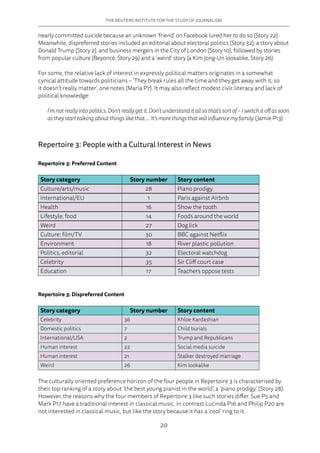
Repertoire 3: People with a Cultural Interest in News
Repertoire 3: Preferred Content
Story category Story number Story content
Culture/arts/music 28 Piano prodigy
International/EU 1 Paris against Airbnb
Health 16 Show the tooth
Lifestyle, food 14 Foods around the world
Weird 27 Dog lick
Culture: film/TV 30 BBC against Netflix
Environment 18 River plastic pollution
Politics, editorial 32 Electoral watchdog
Celebrity 35 Sir Cliff court case
Education 17 Teachers oppose tests
Repertoire 3: Dispreferred Content
Story category Story number Story content
Celebrity 36 Khloe Kardashian
Domestic politics 7 Child burials
International/USA 2 Trump and Republicans
Human interest 22 Social media suicide
Human interest 21 Stalker destroyed marriage
Weird 26 Kim lookalike
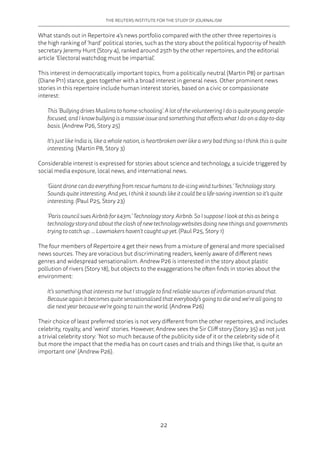
The culturally oriented preference horizon of the four people in Repertoire 3 is characterised by
their top ranking of a story about ‘the best young pianist in the world’, a ‘piano prodigy’ (Story 28).
However, the reasons why the four members of Repertoire 3 like such stories differ. Sue P5 and
Mark P17 have a traditional interest in classical music. In contrast Lucinda P16 and Philip P20 are
not interested in classical music, but like the story because it has a ‘cool’ ring to it.
21
WHAT DO NEWS READERS REALLY WANT TO READ ABOUT? HOW RELEVANCE WORKS FOR NEWS AUDIENCES
Repertoire 3 shows how a story preference profile can be shared by people with very different
backgrounds and circumstances. Sue P5 is a 70-year-old retired personal assistant with little
formal education, married, and owns a flat in the south of Spain. Mark P17 is 68 years old, married
to an artist, and is a retired metallurgy engineer. Meanwhile Lucinda P16 and Philip P20 are both
in their twenties. Lucinda works as an events manager at a local hotel, but will return to university
next year to study politics and economics; she is a rowing coach and draws political cartoons for a
college newspaper. Philip P20 works long hours as a kitchen assistant, and spends the rest of his
time recovering and relaxing, for instance playing Japanese manga games.
Repertoire 3 members also value highly some of the stories that members of other repertoires
liked, notably stories about children and health/educational issues and environmental protection.
Their most dispreferred stories, often dismissed by the members as clickbait stories designed to
lure readers into reading, fall in the categories celebrity and human interest:
Just celebrities. I don’t know anything about, I’m not really a fan of … I mean, why are you sharing it? I
mean, they’re celebrities. That’s the reason why they are celebrities – because they share everything.
(Philip P20)
Repertoire 4: People Who Seek (Political) Depth Stories
Repertoire 4: Preferred Content
Story category Story number Story content
Multicultural 25 Muslims home-schooling
Human interest 15 Boy walks
Politics, editorial 32 Electoral watchdog
Politics 4 Hunt breach of legislation
International 3rd world 3 India: girl raped
Education 17 Teachers oppose tests
Science 23 Giant drone
Human interest 22 Social media suicide
Oxford local 9 Covered Market
International, EU 1 Paris against Airbnb
Repertoire 4: Dispreferred Content
Story category Story number Story content
Weird 26 Kim lookalike
Celebrity 36 Khloe Kardashian
Lifestyle/travel 12 Taste Italy
Popular culture: music 29 Beyoncé
Popular culture: digital 31 Rayman Adventures game
Royalty 34 Kate’s baby
THE REUTERS INSTITUTE FOR THE STUDY OF JOURNALISM
22
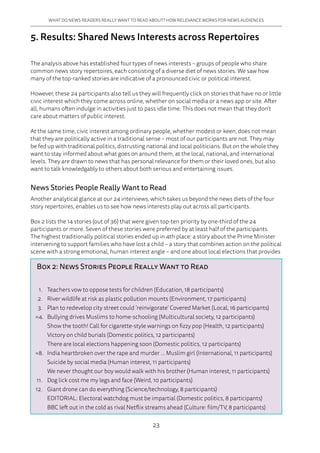
What stands out in Repertoire 4’s news portfolio compared with the other three repertoires is
the high ranking of ‘hard’ political stories, such as the story about the political hypocrisy of health
secretary Jeremy Hunt (Story 4), ranked around 25th by the other repertoires, and the editorial
article ‘Electoral watchdog must be impartial’.
This interest in democratically important topics, from a politically neutral (Martin P8) or partisan
(Diane P11) stance, goes together with a broad interest in general news. Other prominent news
stories in this repertoire include human interest stories, based on a civic or compassionate
interest:
This ‘Bullying drives Muslims to home-schooling‘. A lot of the volunteering I do is quite young people-
focused, and I know bullying is a massive issue and something that affects what I do on a day-to-day
basis. (Andrew P26, Story 25)
It’s just like India is, like a whole nation, is heartbroken over like a very bad thing so I think this is quite
interesting. (Martin P8, Story 3)
Considerable interest is expressed for stories about science and technology, a suicide triggered by
social media exposure, local news, and international news.
‘Giant drone can do everything from rescue humans to de-icing wind turbines.‘ Technology story.
Sounds quite interesting. And yes, I think it sounds like it could be a life-saving invention so it’s quite
interesting. (Paul P25, Story 23)
‘Paris council sues Airbnb for £43m.’ Technology story. Airbnb. So I suppose I look at this as being a
technology story and about the clash of new technology websites doing new things and governments
trying to catch up. … Lawmakers haven’t caught up yet. (Paul P25, Story 1)
The four members of Repertoire 4 get their news from a mixture of general and more specialised
news sources. They are voracious but discriminating readers, keenly aware of different news
genres and widespread sensationalism. Andrew P26 is interested in the story about plastic
pollution of rivers (Story 18), but objects to the exaggerations he often finds in stories about the
environment:
It’s something that interests me but I struggle to find reliable sources of information around that.
Because again it becomes quite sensationalised that everybody’s going to die and we’re all going to
die next year because we’re going to ruin the world. (Andrew P26)
Their choice of least preferred stories is not very different from the other repertoires, and includes
celebrity, royalty, and ‘weird’ stories. However, Andrew sees the Sir Cliff story (Story 35) as not just
a trivial celebrity story: ‘Not so much because of the publicity side of it or the celebrity side of it
but more the impact that the media has on court cases and trials and things like that, is quite an
important one’ (Andrew P26).
23
WHAT DO NEWS READERS REALLY WANT TO READ ABOUT? HOW RELEVANCE WORKS FOR NEWS AUDIENCES
5. Results: Shared News Interests across Repertoires
The analysis above has established four types of news interests – groups of people who share
common news story repertoires, each consisting of a diverse diet of news stories. We saw how
many of the top-ranked stories are indicative of a pronounced civic or political interest.
However, these 24 participants also tell us they will frequently click on stories that have no or little
civic interest which they come across online, whether on social media or a news app or site. After
all, humans often indulge in activities just to pass idle time. This does not mean that they don’t
care about matters of public interest.
At the same time, civic interest among ordinary people, whether modest or keen, does not mean
that they are politically active in a traditional sense – most of our participants are not. They may
be fed up with traditional politics, distrusting national and local politicians. But on the whole they
want to stay informed about what goes on around them, at the local, national, and international
levels. They are drawn to news that has personal relevance for them or their loved ones, but also
want to talk knowledgably to others about both serious and entertaining issues.
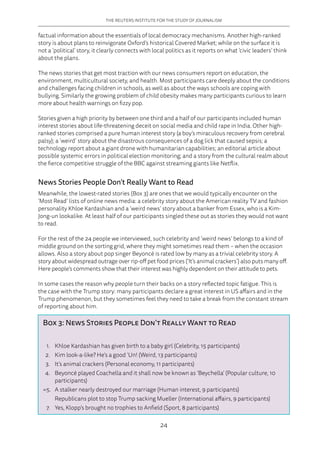
News Stories People Really Want to Read
Another analytical glance at our 24 interviews, which takes us beyond the news diets of the four
story repertoires, enables us to see how news interests play out across all participants.
Box 2 lists the 14 stories (out of 36) that were given top-ten priority by one-third of the 24
participants or more. Seven of these stories were preferred by at least half of the participants.
The highest traditionally political stories ended up in 4th place: a story about the Prime Minister
intervening to support families who have lost a child – a story that combines action on the political
scene with a strong emotional, human interest angle – and one about local elections that provides
Box 2: News Stories People Really Want to Read
	 1. 	 Teachers vow to oppose tests for children (Education, 18 participants)
	 2. 	 River wildlife at risk as plastic pollution mounts (Environment, 17 participants)
	 3. 	 Plan to redevelop city street could ‘reinvigorate’ Covered Market (Local, 16 participants)
	=4. 	 Bullying drives Muslims to home-schooling (Multicultural society, 12 participants)
		 Show the tooth! Call for cigarette-style warnings on fizzy pop (Health, 12 participants)
		 Victory on child burials (Domestic politics, 12 participants)
		 There are local elections happening soon (Domestic politics, 12 participants)
	=8. 	 India heartbroken over the rape and murder … Muslim girl (International, 11 participants)
		 Suicide by social media (Human interest, 11 participants)
		 We never thought our boy would walk with his brother (Human interest, 11 participants)
	11. 	 Dog lick cost me my legs and face (Weird, 10 participants)
	12. 	 Giant drone can do everything (Science/technology, 8 participants)
		 EDITORIAL: Electoral watchdog must be impartial (Domestic politics, 8 participants)
		 BBC left out in the cold as rival Netflix streams ahead (Culture: film/TV, 8 participants)
THE REUTERS INSTITUTE FOR THE STUDY OF JOURNALISM
24
factual information about the essentials of local democracy mechanisms. Another high-ranked
story is about plans to reinvigorate Oxford’s historical Covered Market; while on the surface it is
not a ‘political’ story, it clearly connects with local politics as it reports on what ‘civic leaders’ think
about the plans.
The news stories that get most traction with our news consumers report on education, the
environment, multicultural society, and health. Most participants care deeply about the conditions
and challenges facing children in schools, as well as about the ways schools are coping with
bullying. Similarly the growing problem of child obesity makes many participants curious to learn
more about health warnings on fizzy pop.
Stories given a high priority by between one third and a half of our participants included human
interest stories about life-threatening deceit on social media and child rape in India. Other high-
ranked stories comprised a pure human interest story (a boy’s miraculous recovery from cerebral
palsy); a ‘weird’ story about the disastrous consequences of a dog lick that caused sepsis; a
technology report about a giant drone with humanitarian capabilities; an editorial article about
possible systemic errors in political election monitoring; and a story from the cultural realm about
the fierce competitive struggle of the BBC against streaming giants like Netflix.
News Stories People Don’t Really Want to Read
Meanwhile, the lowest-rated stories (Box 3) are ones that we would typically encounter on the
‘Most Read’ lists of online news media: a celebrity story about the American reality TV and fashion
personality Khloe Kardashian and a ‘weird news’ story about a banker from Essex, who is a Kim-
Jong-un lookalike. At least half of our participants singled these out as stories they would not want
to read.
For the rest of the 24 people we interviewed, such celebrity and ‘weird news’ belongs to a kind of
middle ground on the sorting grid, where they might sometimes read them – when the occasion
allows. Also a story about pop singer Beyoncé is rated low by many as a trivial celebrity story. A
story about widespread outrage over rip-off pet food prices (‘It’s animal crackers’) also puts many off.
Here people’s comments show that their interest was highly dependent on their attitude to pets.
In some cases the reason why people turn their backs on a story reflected topic fatigue. This is
the case with the Trump story: many participants declare a great interest in US affairs and in the
Trump phenomenon, but they sometimes feel they need to take a break from the constant stream
of reporting about him.
Box 3: News Stories People Don’t Really Want to Read	
	 1. 	 Khloe Kardashian has given birth to a baby girl (Celebrity, 15 participants)
	 2. 	 Kim look-a-like? He’s a good ‘Un! (Weird, 13 participants)
	 3. 	 It’s animal crackers (Personal economy, 11 participants)
	 4. 	Beyoncé played Coachella and it shall now be known as ‘Beychella’ (Popular culture, 10
participants)
	=5. 	 A stalker nearly destroyed our marriage (Human interest, 9 participants)
		 Republicans plot to stop Trump sacking Mueller (International affairs, 9 participants)
	 7. 	 Yes, Klopp’s brought no trophies to Anfield (Sport, 8 participants)
25
WHAT DO NEWS READERS REALLY WANT TO READ ABOUT? HOW RELEVANCE WORKS FOR NEWS AUDIENCES
Our news material included two sport stories, which were both rated low overall. This is not
indicative of a low interest in following sport among our participants, but is probably a finding
created by the fieldwork requirements: because the interviews were spread over three weeks, it
would make little sense to show people football stories about specific match results and analysis,
because these would become obsolete after just a few days. The more general sport feature
articles we used did not speak to most participants’ interest in football or cricket (Story 19 and 20).
Of the 36 news stories some ended up neither among the would-like-to-read nor among the
would-not-like-to-read stories. These stories occupy a middle ground where quite a few news
consumers sometimes would take an interest in reading more than the headline. This applies,
for instance, to stories about Europe (Paris council suing Airbnb, Story 1), about national or local
politics (Labour’s new travel policy, Story 5; Tories suspending a councillor from Oxford District
Council, Story 8), about business mergers in the City (Story 10), about a computer games rating
service (Story 31), and about the royal family (Behind the scenes of Kate’s baby, Story 34).
However, quite a few such middle-ground stories were given top ranking by one or more of the
four content repertoires (see above). The lesson to be learnt from this finding is that overall
story popularity should not make news producers ignore that such stories meet the interests of
substantial segments of their audience.
THE REUTERS INSTITUTE FOR THE STUDY OF JOURNALISM
26
6. Conclusion
This report sheds new and more complex light on the ways in which people use news to keep track
of what goes on in the world around them and to build public connections in a democratic as well
as personal sense.
We have argued that research about audience news tastes based on surveys and ‘Most Read’
metrics are insufficient for understanding what people – as both citizens and consumers – really
want to inform themselves about. Our approach enabled us to detect how relevance works for
news audiences – what news stories people really want to read – in a manner that complexifies
our understanding of people’s patterned engagement with news content. The key finding is that
audience news preferences are (also) driven by civic interests. People can themselves articulate
the role that news plays in their lives.
Our findings about news relevance and the four news content repertoires were discovered in a
qualitative study of 24 news users in and around Oxford. They can therefore not be generalised
to the UK population. However, there is reason to believe that, due to the principle of maximum
variation of our sample, they are fairly typical of what we would find in other localities, with
respect to diversity and distribution of news topics.
It would be interesting to repeat the research design with a sample approximating national
representativeness, in order to discover content repertoires that could serve more forcefully as a
guideline in the newsrooms of national news media.
In-depth qualitative studies of news preferences can complement surveys and online tracking
to help news organisations address the complex balance of personal and civic concerns that
their readers care about. As one observer has recently commented, ‘much of the news currently
published online is simply not worth paying for. Some of it is hardly worth our fleeting attention,
let alone hard-earned cash. The shift thus has to be about better and more distinct journalism
in an incredibly competitive battle for attention, about a greater focus on what readers actually
value’ (Nielsen 2019).
This report about how relevance works for news audiences and about the composition of audience
content repertoires can be seen as a modest contribution to the rethinking that needs to be done
in order to accomplish these goals.
27
WHAT DO NEWS READERS REALLY WANT TO READ ABOUT? HOW RELEVANCE WORKS FOR NEWS AUDIENCES
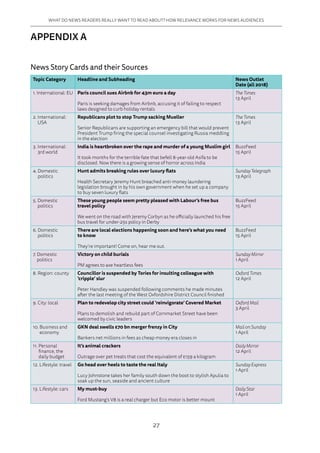
APPENDIX A
News Story Cards and their Sources
Topic Category Headline and Subheading News Outlet
Date (all 2018)
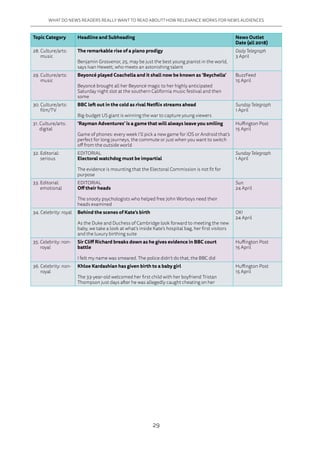
1. International: EU Paris council sues Airbnb for 43m euro a day
Paris is seeking damages from Airbnb, accusing it of failing to respect
laws designed to curb holiday rentals
The Times
13 April
2. International:
USA
Republicans plot to stop Trump sacking Mueller
Senior Republicans are supporting an emergency bill that would prevent
President Trump firing the special counsel investigating Russia meddling
in the election
The Times
13 April
3. International:
3rd world
India is heartbroken over the rape and murder of a young Muslim girl
It took months for the terrible fate that befell 8-year-old Asifa to be
disclosed. Now there is a growing sense of horror across India
BuzzFeed
15 April
4. Domestic
politics
Hunt admits breaking rules over luxury flats
Health Secretary Jeremy Hunt breached anti-money laundering
legislation brought in by his own government when he set up a company
to buy seven luxury flats
Sunday Telegraph
13 April
5. Domestic
politics
These young people seem pretty pleased with Labour’s free bus
travel policy
We went on the road with Jeremy Corbyn as he officially launched his free
bus travel for under-25s policy in Derby
BuzzFeed
15 April
6. Domestic
politics
There are local elections happening soon and here’s what you need
to know
They’re important! Come on, hear me out.
BuzzFeed
15 April
7. Domestic
politics
Victory on child burials
PM agrees to axe heartless fees
Sunday Mirror
1 April
8. Region: county Councillor is suspended by Tories for insulting colleague with
‘cripple’ slur
Peter Handley was suspended following comments he made minutes
after the last meeting of the West Oxfordshire District Council finished
Oxford Times
12 April
9. City: local Plan to redevelop city street could ‘reinvigorate’ Covered Market
Plans to demolish and rebuild part of Cornmarket Street have been
welcomed by civic leaders
Oxford Mail
3 April
10. Business and
economy
GKN deal swells £70 bn merger frenzy in City
Bankers net millions in fees as cheap money era closes in
Mail on Sunday
1 April
11. Personal
finance, the
daily budget
It’s animal crackers
Outrage over pet treats that cost the equivalent of £159 a kilogram
Daily Mirror
12 April
12. Lifestyle: travel Go head over heels to taste the real Italy
Lucy Johnstone takes her family south down the boot to stylish Apulia to
soak up the sun, seaside and ancient culture
Sunday Express
1 April
13. Lifestyle: cars My must-buy
Ford Mustang’s V8 is a real charger but Eco motor is better mount
Daily Star
1 April
THE REUTERS INSTITUTE FOR THE STUDY OF JOURNALISM
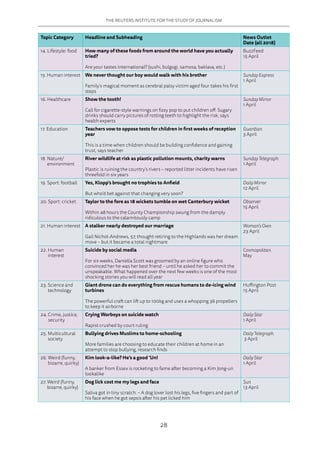
28
Topic Category Headline and Subheading News Outlet
Date (all 2018)
14. Lifestyle: food How many of these foods from around the world have you actually
tried?
Are your tastes international? (sushi, bulgogi, samosa, baklava, etc.)
BuzzFeed
15 April
15. Human interest We never thought our boy would walk with his brother
Family’s magical moment as cerebral palsy victim aged four takes his first
steps
Sunday Express
1 April
16. Healthcare Show the tooth!
Call for cigarette-style warnings on fizzy pop to put children off. Sugary
drinks should carry pictures of rotting teeth to highlight the risk, says
health experts
Sunday Mirror
1 April
17. Education Teachers vow to oppose tests for children in first weeks of reception
year
This is a time when children should be building confidence and gaining
trust, says teacher
Guardian
3 April
18. Nature/
environment
River wildlife at risk as plastic pollution mounts, charity warns
Plastic is ruining the country’s rivers – reported litter incidents have risen
threefold in six years
Sunday Telegraph
1 April
19. Sport: football Yes, Klopp’s brought no trophies to Anfield
But who’d bet against that changing very soon?
Daily Mirror
12 April
20. Sport: cricket Taylor to the fore as 18 wickets tumble on wet Canterbury wicket
Within 48 hours the County Championship swung from the damply
ridiculous to the calamitously camp
Observer
15 April
21. Human interest A stalker nearly destroyed our marriage
Gail Nichol-Andrews, 57, thought retiring to the Highlands was her dream
move – but it became a total nightmare
Woman’s Own
23 April
22. Human
interest
Suicide by social media
For six weeks, Daniella Scott was groomed by an online figure who
convinced her he was her best friend – until he asked her to commit the
unspeakable. What happened over the next few weeks is one of the most
shocking stories you will read all year
Cosmopolitan
May
23. Science and
technology
Giant drone can do everything from rescue humans to de-icing wind
turbines
The powerful craft can lift up to 100kg and uses a whopping 36 propellers
to keep it airborne
Huffington Post
15 April
24. Crime, justice,
security
Crying Worboys on suicide watch
Rapist crushed by court ruling
Daily Star
1 April
25. Multicultural
society
Bullying drives Muslims to home-schooling
More families are choosing to educate their children at home in an
attempt to stop bullying, research finds
Daily Telegraph
3 April
26. Weird (funny,
bizarre, quirky)
Kim look-a-like? He’s a good ‘Un!
A banker from Essex is rocketing to fame after becoming a Kim Jong-un
lookalike
Daily Star
1 April
27. Weird (funny,
bizarre, quirky)
Dog lick cost me my legs and face
Saliva got in tiny scratch. – A dog lover lost his legs, five fingers and part of
his face when he got sepsis after his pet licked him
Sun
13 April
29
WHAT DO NEWS READERS REALLY WANT TO READ ABOUT? HOW RELEVANCE WORKS FOR NEWS AUDIENCES
Topic Category Headline and Subheading News Outlet
Date (all 2018)
28. Culture/arts:
music
The remarkable rise of a piano prodigy
Benjamin Grosvenor, 25, may be just the best young pianist in the world,
says Ivan Hewett, who meets an astonishing talent
Daily Telegraph
3 April
29. Culture/arts:
music
Beyoncé played Coachella and it shall now be known as ‘Beychella’
Beyoncé brought all her Beyoncé magic to her highly anticipated
Saturday night slot at the southern California music festival and then
some
BuzzFeed
15 April
30. Culture/arts:
film/TV
BBC left out in the cold as rival Netflix streams ahead
Big-budget US giant is winning the war to capture young viewers
Sunday Telegraph
1 April
31. Culture/arts:
digital
‘Rayman Adventures’ is a game that will always leave you smiling
Game of phones: every week I’ll pick a new game for iOS or Android that’s
perfect for long journeys, the commute or just when you want to switch
off from the outside world
Huffington Post
15 April
32. Editorial:
serious
EDITORIAL
Electoral watchdog must be impartial
The evidence is mounting that the Electoral Commission is not fit for
purpose
Sunday Telegraph
1 April
33. Editorial:
emotional
EDITORIAL
Off their heads
The snooty psychologists who helped free John Worboys need their
heads examined
Sun
24 April
34. Celebrity: royal Behind the scenes of Kate’s birth
As the Duke and Duchess of Cambridge look forward to meeting the new
baby, we take a look at what’s inside Kate’s hospital bag, her first visitors
and the luxury birthing suite
OK!
24 April
35. Celebrity: non-
royal
Sir Cliff Richard breaks down as he gives evidence in BBC court
battle
I felt my name was smeared. The police didn’t do that, the BBC did
Huffington Post
15 April
36. Celebrity: non-
royal
Khloe Kardashian has given birth to a baby girl
The 33-year-old welcomed her first child with her boyfriend Tristan
Thompson just days after he was allegedly caught cheating on her
Huffington Post
15 April
THE REUTERS INSTITUTE FOR THE STUDY OF JOURNALISM
30
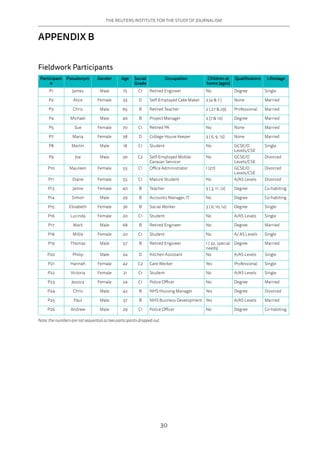
APPENDIX B
Fieldwork Participants
Participant
#
Pseudonym Gender Age Social
Grade
Occupation Children at
home (ages)
Qualificatons Lifestage
P1 James Male 75 C1 Retired Engineer No Degree Single
P2 Alice Female 33 D Self-Employed Cake Maker 2 (4  7 ) None Married
P3 Chris Male 65 B Retired Teacher 2 ( 27  29) Professional Married
P4 Michael Male 46 B Project Manager 2 (7  10) Degree Married
P5 Sue Female 70 C1 Retired PA No None Married
P7 Maria Female 38 D College House Keeper 3 ( 6, 9, 15) None Married
P8 Martin Male 18 C1 Student No GCSE/O
Levels/CSE
Single
P9 Joe Male 56 C2 Self-Employed Mobile
Caravan Servicer
No GCSE/O
Levels/CSE
Divorced
P10 Maureen Female 55 C1 Office Administrator 1 (27) GCSE/O
Levels/CSE
Divorced
P11 Diane Female 55 C1 Mature Student No A/AS Levels Divorced
P13 Jamie Female 40 B Teacher 3 ( 3, 11, 12) Degree Co-habiting
P14 Simon Male 29 B Accounts Manager, IT No Degree Co-habiting
P15 Elizabeth Female 36 B Social Worker 3 ( 6, 10, 12) Degree Single
P16 Lucinda Female 20 C1 Student No A/AS Levels Single
P17 Mark Male 68 B Retired Engineer No Degree Married
P18 Millie Female 20 C1 Student No A/ AS Levels Single
P19 Thomas Male 57 B Retired Engineer 1 ( 32, special
needs)
Degree Married
P20 Philip Male 24 D Kitchen Assistant No A/AS Levels Single
P21 Hannah Female 42 C2 Care Worker Yes Professional Single
P22 Victoria Female 21 C1 Student No A/AS Levels Single
P23 Jessica Female 24 C1 Police Officer No Degree Married
P24 Chris Male 42 B NHS Housing Manager Yes Degree Divorced
P25 Paul Male 37 B NHS Business Development Yes A/AS Levels Married
P26 Andrew Male 29 C1 Police Officer No Degree Co-habiting
Note: the numbers are not sequential as two participants dropped out.
31
WHAT DO NEWS READERS REALLY WANT TO READ ABOUT? HOW RELEVANCE WORKS FOR NEWS AUDIENCES
References
Bird, S. E. 2011. ‘Seeking the Audience for News: Response, News Talk, and Everyday Practices’, in V.
Nightingale (ed.), The Handbook of Media Audiences. Oxford: Blackwell, 489–508.
Boczkowski, P., Mitchelstein, E. 2013. The News Gap. When the Information Preferences of the Media
and the Public Diverge. Cambridge, MA: MIT Press.
Cherubini, F., Nielsen, R. K. 2016. Editorial Analytics: How News Media are Developing and Using
Audience Data and Metrics. Oxford: Reuters Institute for the Study of Journalism. https://
reutersinstitute.politics.ox.ac.uk/our-research/editorial-analytics-how-news-media-are-
developing-and-using-audience-data-and-metrics
Coleman, S., Anthony, S., Morrison, D. E. 2009. Public Trust in the News: A Constructivist Study
of the Social Life of the News. Oxford: Reuters Institute for the Study of Journalism. https://
reutersinstitute.politics.ox.ac.uk/our-research/public-trust-news
Couldry, N., Livingstone, S., Markham, T. 2007. Media Consumption and Public Engagement: Beyond
the Presumption of Attention. Basingstoke: Palgrave Macmillan.
Davis, C., Michelle, C. 2011. ‘Q Methodology in Audience Research: Bridging the Qualitative/
Quantitative “Divide”?’ Participations 8(2), 559–93.
Eide, M., Knight, G. 1999. ‘Public/Private Service: Service Journalism and the Problems of Everyday
Life’, European Journal of Communication 14(4), 525–47.
Fletcher, R., Nielsen, R. K. 2017. ‘Are News Audiences Increasingly Fragmented? A Cross-National
Comparative Analysis of Cross-Platform News Audience Fragmentation and Duplication’, Journal
of Communication 67(4), 476–98.
Fletcher, R., Nielsen, R. K. 2018. ‘Generalized Scepticism: How People Navigate News on Social
Media’, Information, Communication and Society. doi10.1080/1369118X.2018.1450887
Hanitzsch, T., Vos, T. P. 2018. ‘Journalism beyond Democracy: A New Look into Journalistic Roles in
Political and Everyday Life’, Journalism 19(2), 146–64.
Harcup, T., O’Neill, D. 2017. ‘What is News? News Values Revisited (Again)’, Journalism Studies 18(12),
1470–88.
Hess, K., Gutsche, R. 2018. ‘Journalism and the “Social Sphere”: Reclaiming a Foundational Concept
for Journalism beyond Politics and the Public Sphere’, Journalism Studies 19(4), 483–98.
Jensen, K. B., Helles, R. 2015. ‘Audiences across Media: A Comparative Agenda for Future Research
on Media Audiences’, International Journal of Communication 9, 291–8.
Kobbernagel, C., Schrøder, K. C. 2016. ‘From Everyday Communicative Figurations to Rigorous
Audience News Repertoires: A Mixed Method Approach to Cross-Media News Consumption’,
Mediekultur 32(60), 6–31.
Kümbel, A. S. 2018. ‘The Issue Takes it All? Incidental News Exposure and News Engagement on
Facebook’, Digital Journalism. doi:10.1080/21670811.2018.1465831
Kümbel, A. S. 2019. Nachrichtenrezeption auf Facebook Vom beiläufigen Kontakt zur
Auseinandersetzung. Wiesbaden: Springer VS.
Lee, E.-J., Tandoc, E. C. 2017. ‘When News Meets the Audience: How Audience Feedback Online
Affects News Production and Consumption’, Human Communication Research 43: 436–49.
THE REUTERS INSTITUTE FOR THE STUDY OF JOURNALISM
32
Meijer, I. C., Bijleveld, H. P. 2016. ‘Valuable Journalism: Measuring News Quality from a User’s
Perspective’, Journalism Studies 17(7), 827–39.
Newman, N., Fletcher, R., Kalogeropoulos, A., Levy, D. A. L., Nielsen, R. K. 2017. Reuters Institute
Digital News Report 2017. Oxford: Reuters Institute for the Study of Journalism.
Nielsen, R. K. 2019. ‘A Long Slow Slog with No-one Coming to the Rescue’, NiemanLab, Predictions
for Journalism, 4 Jan., http://www.niemanlab.org/2019/01/a-long-slow-slog-with-no-one-coming-
to-the-rescue/
Papacharissi, Z. A. 2010. A Private Sphere: Democracy in a Digital Age. Malden, MA: Polity.
Peters, C. 2015. ‘Book Review: The News Gap: Pablo J Boczkowski and Eugenia Mitchelstein’,
Journalism 16(2), 299–301.
Rogers, R. S. 1995. ‘Q Methodology’, in J. A. Smith, R. Harré, and L. V. Langenhove (eds), Rethinking
Methods in Psychology. London: Sage, 178–92.
Rosenstiel, T. 2016. Solving Journalism’s Hidden Problem: Terrible Analytics. Washington, DC:
Brookings Institution. https://www.brookings.edu/research/solving-journalisms-hidden-
problem-terrible-analytics/
Schrøder, K. C., Black-Ørsten, M. 2016. ‘The Nature of News Avoidance in a Digital World’, in Nic
Newman et al. (eds), Reuters Institute Digital News Report. Oxford: Reuters Institute for the Study
of Journalism. http://www.digitalnewsreport.org/essays/2016/nature-news-avoidance-digital-
world/
Schultz, I. 2007. ‘The Journalistic Gut Feeling’, Journalism Practice 1(2): 190–207.
Swart, J., Peters, C., Broersma, M. 2017. ‘Navigating Cross-Media News Use: Media Repertoires and
the Value of News in Everyday Life’, Journalism Studies 18(11), 1343–62.
Toff, B., Nielsen, R.K. 2018. ‘“I Just Google It”: Folk Theories of Distributed Discovery’, Journal of
Communication. doi: 10.1093/joc/jqy009
Watts, S., Stenner, P. 2012. Doing Q Methodological Research. London: Sage.
Webster, J. 2014. The Marketplace of Attention: How Audiences Take Shape in a Digital Age. Cambridge,
MA: MIT Press.
Wolf, C., Schnauber, A. 2015. ‘News Consumption in the Mobile Era’, Digital Journalism 3(5), 759–76.
Zamith, R. 2018. ‘On Metrics-Driven Homepages: Assessing the Relationship between Popularity
and Prominence’, Journalism Studies 19(8), 1116–37.
33
WHAT DO NEWS READERS REALLY WANT TO READ ABOUT? HOW RELEVANCE WORKS FOR NEWS AUDIENCES
Journalism, Media, and Technology Trends and
Predictions 2019
Nic Newman
Coming of Age: Developments in Digital-Born News
Media in Europe
Tom Nicholls, Nabeelah Shabbir, Lucas Graves, and
Rasmus Kleis Nielsen
The Future of Voice and the Implications for News
Nic Newman
Digital News Report 2018: Turkey Supplementary
Report
Servet Yanatma
Private Sector News, Social Media Distribution, and
Algorithm Change
Alessio Cornia, Annika Sehl, David A. L. Levy, and
Rasmus Kleis Nielsen
Digital News Report 2018
Nic Newman, Richard Fletcher, Antonis
Kalogeropoulos, David A. L. Levy, and Rasmus Kleis
Nielsen
The Digital Transition of Local News
Joy Jenkins and Rasmus Kleis Nielsen
Public Service News and Social Media
Annika Sehl, Alessio Cornia, and Rasmus Kleis
Nielsen
The Global Expansion of Digital-Born News Media
Tom Nicholls, Nabeelah Shabbir, and Rasmus Kleis
Nielsen
Bias, Bullshit and Lies: Audience Perspectives on Low
Trust in the Media
Nic Newman and Richard Fletcher
Digital News Report 2017: Turkey Supplementary
Report
Servet Yanatma
Going Digital: A Roadmap for Organisational
Transformation
Lucy Küng
Digital News Report 2017: Asia-Pacific Supplementary
Report
Francis Lee, Michael Chan, Hsuan-Ting Chen,
Dennis K.K. Leung, Antonis Kalogeropoulos, and
Rasmus Kleis Nielsen
Developing Digital News Projects in Private Sector
Media
Alessio Cornia, Annika Sehl, and Rasmus Kleis
Nielsen
Mapping Online News Discovery for Computer Users in
the UK
Nic Newman and Antonis Kalogeropoulos
‘I Saw the News on Facebook’: Brand Attribution when
Accessing News from Distributed Environments
Antonis Kalogeropoulos and Nic Newman
Virtual Reality and 360 Video for News
Zillah Watson
Developing Digital News Projects in Public Service
Media
Annika Sehl, Alessio Cornia, and Rasmus Kleis
Nielsen
Beyond the Article: Frontiers of Editorial and
Commercial Innovation
Kevin Anderson
Digital-Born News Media in Europe
Tom Nicholls, Nabeelah Shabbir, and Rasmus Kleis
Nielsen
News Alerts and the Battle for the Lockscreen
Nic Newman
The Rise of Fact-Checking Sites in Europe
Lucas Graves and Federica Cherubini
RISJ DIGITAL NEWS PROJECT PUBLICATIONS
THE REUTERS INSTITUTE FOR THE STUDY OF JOURNALISM
34
Private Sector Media and Digital News
Alessio Cornia, Annika Sehl, and Rasmus Kleis
Nielsen
The Future of Online News Video
Antonis Kalogeropoulos, Federica Cherubini, and
Nic Newman
What Is Happening to Television News?
Rasmus Kleis Nielsen and Richard Sambrook
Public Service News and Digital Media
Annika Sehl, Alessio Cornia, and Rasmus Kleis
Nielsen
Editorial Analytics: How News Media are Developing
and Using Audience Data and Metrics
Federica Cherubini and Rasmus Kleis Nielsen
FORTHCOMING PUBLICATIONS
India Digital News Report
Zeenab Aneez et al
Collaborative Local Journalism in Europe
Joy Jenkins and Lucas Graves
Digital News Report 2019
Nic Newman, Richard Fletcher, Antonis
Kalogeropoulos, and Rasmus Kleis Nielsen
www.reutersinstitute.politics.ac.uk www.digitalnewsreport.org
With support from:
9 781907 384578
ISBN 978-1-907384-57-8

Schroder how relevance_works_for_news_audiences_final

  • 1.
    DIGITAL NEWS PROJECT FEBRUARY2019 What do News Readers Really Want to Read about? How Relevance Works for News Audiences Kim Christian Schrøder
  • 3.
    Contents About the Author 4 Acknowledgements 4 Executive Summary 5 Introduction 7 1. Recent Research on News Preferences 8 2. A Bottom-Up Approach 10 3. Results: How Relevance Works for News Audiences 12 4. Results: Four News Content Repertoires 17 5. Results: Shared News Interests across Repertoires 23 6. Conclusion 26 Appendix A: News Story Cards and their Sources 27 Appendix B: Fieldwork Participants 30 References 31
  • 4.
    THE REUTERS INSTITUTEFOR THE STUDY OF JOURNALISM 4 About the Author Kim Christian Schrøder is Professor of Communication at Roskilde University, Denmark. He was Google Digital News Senior Visiting Research Fellow at the Reuters Institute for the Study of Journalism January–July 2018. His books in English include Audience Transformations: Shifting Audience Positions in Late Modernity (co-edited, 2014), The Routledge Handbook of Museums, Media, and Communication (co-edited 2019) and Researching Audiences (co-authored, 2003). His research interests comprise the analysis of audience uses and experiences of media. His recent work explores mixed methods for mapping news consumption. Acknowledgements The author would like to thank the Reuters Institute’s research team for their constructive comments and practical help during the planning of the fieldwork, and for their feedback to a draft version of this report. In addition to Lucas Graves, whose assistance in editing the manuscript was invaluable, I wish to thank Nic Newman, Richard Fletcher, Joy Jenkins, Sílvia Majó-Vázquez, Antonis Kalogeropoulos, Alessio Cornia, and Annika Sehl. Also thanks to Rebecca Edwards for invaluable administrative help, and to Alex Reid for her expert handling of the production stage. My thanks also go to the research team at Kantar Public, London, for constructive sparring about the fieldwork design, especially to Nick Roberts, Lindsay Abbassian, and Jill Swindels. I am deeply grateful to then Director of Research, Rasmus Kleis Nielsen, for hosting me as a visiting fellow at the Reuters Institute (January–July 2018) and for making this fieldwork-based study possible. Finally, my warmest thanks to my long-time collaborator Christian Kobbernagel, who did the Q-methodological factor analysis with meticulous care. Published by the Reuters Institute for the Study of Journalism with the support of the Google News Initiative
  • 5.
    5 WHAT DO NEWSREADERS REALLY WANT TO READ ABOUT? HOW RELEVANCE WORKS FOR NEWS AUDIENCES Executive Summary This report investigates how members of the public make decisions about what news to engage with as they navigate a high-choice media environment across multiple devices and platforms. While digital media provide a wealth of data about revealed news preferences – what stories are most widely clicked on, shared, liked, and so forth – they tell us very little about why people make the choices they do, or about how news fits into their lives. To understand how audiences themselves make sense of the news, this study uses an innovative, qualitative approach that can reveal latent patterns in the news repertoires people cultivate as well as the factors that drive those preferences. This method sets aside the conventional categories often relied on by the news industry as well as academic researchers – such as politics, entertainment, sports, etc – in order to group news stories in terms drawn from the people reading them. We find that members of the public can very effectively articulate the role that news plays in their lives, and that relevance is the key concept for explaining the decisions they make in a high-choice media environment. As one study participant told us, ‘Something that affects you and your life. ... That’s what you read, isn’t it?’ Specifically, we find that: • Relevance is the paramount driver of news consumption. People find those stories most relevant that affect their personal lives, as they impinge on members of their family, the place where they work, their leisure activities, and their local community. • Relevance is tied to sociability. It often originates in the belief that family and friends might take an interest in the story. This is often coupled with shareability – a wish to share and tag a friend on social media. • People frequently click on stories that are amusing, trivial, or weird, with no obvious civic focus. But they maintain a clear sense of what is trivial and what matters. On the whole people want to stay informed about what goes on around them, at the local, national, and international levels. • News audiences make their own meanings, in ways that spring naturally from people’s life experience. The same news story can be read by different people as an ‘international’ story, a ‘technology’ story, or a ‘financial’ story; sometimes a trivial or titillating story is appreciated for its civic implications. • News is a cross-media phenomenon characterised by high redundancy. Living in a news- saturated culture, people often feel sufficiently informed about major ongoing news stories; just reading the headline can be enough to bring people up to date about the latest events. • News avoidance, especially avoidance of political news, often originates in a cynical attitude towards politicians (‘They break rules all the time and get away with it!’), coupled with a modest civic literacy and lack of knowledge about politics. In addition, we identified four specific types of news interest – four groups of people with common repertoires of news stories they take an interest in. Each of these four repertoires consists of a diverse diet of news stories that belong to many different topic areas, cutting across standard categories such as ‘hard’ and ‘soft’ news, or politics and entertainment. Their interest profiles
  • 6.
    THE REUTERS INSTITUTEFOR THE STUDY OF JOURNALISM 6 reflect people’s tastes for news and information that is relevant as a resource in their everyday lives, and many of their top-ranked stories are indicative of a sustained civic, or political interest. We define these four profiles as follows: • Repertoire 1: People with political and civic interest in news • Repertoire 2: People with a social-humanitarian interest in news • Repertoire 3: People with a cultural interest in news • Repertoire 4: People who seek (political) depth stories The main insight provided by this study, for researchers and practitioners alike, is that we have to complexify our understanding of news audience tastes and preferences. There are no simple recipes for meeting the relevance thresholds of news audiences. To the extent that journalists prioritise news stories with civic value, they should trust their instincts rather than relying on the unreliable seismograph offered by ‘Most Read’ lists.
  • 7.
    7 WHAT DO NEWSREADERS REALLY WANT TO READ ABOUT? HOW RELEVANCE WORKS FOR NEWS AUDIENCES Introduction Despite well-publicised threats to the news industry, members of the public have never had more news to choose from than they do today. With the rise of digital and social media as major news platforms, and the potential for content to cross regional or national borders, media users navigate a high-choice media environment where they must decide every day which of many potentially informative or entertaining stories are worth their time. Some members of the public respond by avoiding news altogether (Schrøder and Blach-Ørsten 2016; Toff and Nielsen 2018). But most people engage actively in building personal media repertoires across the offline/online divide. As one influential study in this area observes, ‘A cacophony of narratives increasingly competes with mainstream journalism to define the day’s stories. News audiences pick and choose stories they want to attend to and believe, and select from a seemingly endless supply of information to assemble their own versions’ (Bird 2011: 504). How do people make these choices? It is a truism in the media business that ‘content is king’. However, despite decades of studies analysing how journalists prioritise stories, research has only recently begun to take seriously the question of what drives audience choices when it comes to news, how news preferences fit into people’s everyday lives, and the implications of these choices for democratic citizenship. This study contributes to this emerging area of research with a qualitative analysis of the personal news repertoires of 24 participants drawn from around Oxford, UK, during the spring and summer of 2018. We use factor analysis coupled with in-depth interviews to understand people’s news choices in the terms they themselves use, exploring their sense of news relevance and the level of civic interest it reflects. Our method allows hidden patterns in people’s news story preferences to emerge, without imposing the categories that researchers and journalists often take for granted. As discussed below, this project offers a useful complement to studies that rely on surveys or tracking data to measure audience preferences. It also offers a counterpoint to both popular and academic concerns around news decisions guided by social media metrics, such as lists of the most liked, shared, or commented articles. Such data often highlight audience interest in sensational or entertaining news over serious news about public affairs (e.g. Harcup and O’Neill 2017, Boczkowski and Mitchelstein 2013). Analyses of most-liked stories are illuminating but, we argue, tend to over-emphasise news blockbusters at the expense of smaller stories that still attract substantial numbers of users. And they don’t enlighten us about the ‘why’ and ‘how’ of the ways news inserts itself into the lives of audiences. In contrast, this study explores how ‘content is king’ for audiences – the ways in which people are drawn to news that helps them make sense of themselves, shaping their identities, rationally and emotionally, in relationships with significant people in their lives. Our approach points to relevance as the key concept in understanding real-world news preferences, and highlights what relevance means for news audiences.
  • 8.
    THE REUTERS INSTITUTEFOR THE STUDY OF JOURNALISM 8 1. Recent Research on News Preferences This study uses an innovative qualitative methodology, described in the next section, to uncover news preferences and understand how audiences themselves make sense of their choices in a crowded media environment. Our approach is designed to complement tools like audience surveys and online tracking, building on the insights these methods reveal while addressing their limitations. One source of knowledge about people’s news preferences comes from survey studies, used in academic research and by the industry itself. A good example is the Reuters Institute Digital News Survey, which in 2017 used panel surveys in multiple markets to ask people how interested they are in a set of 12 general news categories (Newman et al. 2017). The chart below shows results for the UK; as in many other countries, local and regional news was most popular, with nearly two- thirds of respondents ‘extremely’ or ‘very’ interested. Around half of those surveyed expressed high interest in hard news topics like international news and politics. Less than a quarter favoured categories like ‘weird news’, lifestyle, or entertainment/celebrity – the kind of news that often tops lists of ‘Most Read’ or ‘Most Shared’ stories. Figure 1 Interest in news content categories News content category % Region, town 63 International 51 Crime, security 48 Political 47 Health education 44 Science technology 36 Business, economy 32 Sports 31 Weird 22 Lifestyle 22 Entertainment celebrity 18 Arts culture 17 Source: Reuters Digital News Survey 2017, ‘How interested are you in the following types of news?’ Percentage of people responding ‘Extremely’ and ‘Very interested’. Audience surveys offer a useful ‘high-altitude’ view of news interest but are limited by relying on categories that are very broad and somewhat ambiguous. For a UK respondent, for instance, ‘international’ news covers everything from US election news to child rape in India and obstacles for digital startups in France; ‘crime/security’ includes stories about corporate fraud, stalkers harassing women, and intelligence operations against terrorists. It is hard to know what respondents had in mind when ticking a box, or to gain a picture of how news preferences are anchored in people’s everyday life contexts. Data about content preferences also come from online audience tracking by individual news organisations, measurement firms, social media networks, and others. Lists of ‘Most Read’ or ‘Most Shared’ stories, for instance, are based on revealed news preferences as measured by
  • 9.
    9 WHAT DO NEWSREADERS REALLY WANT TO READ ABOUT? HOW RELEVANCE WORKS FOR NEWS AUDIENCES click-through rates, time spent, or other forms of audience engagement with individual stories. Researchers have raised concerns about the picture revealed by such statistics (e.g. Boczkowski and Mitchelstein 2013). Topics like entertainment, celebrity, scandal, and ‘weird news’ dominate ‘Most Read’ lists, suggesting readers de-prioritise the public affairs stories valued by journalists in favour of trivial stories with less democratic value.1 While these concerns should not be overlooked, the picture painted by such data is incomplete in important ways that our approach is designed to address. As Peters (2015: 301) also notes, there is good reason to ‘wonder if “clicking” should really be made as synonymous with “preference” or “interest”’. The data used to build ‘Most Read’ lists don’t show the full composition of people’s news diets because they don’t take into account that news consumption is cross-media. This is important because in a high-choice media environment, people have an abundance of ways to stay informed about stories that interest them. As a result, one reason people sometimes don’t click on a given ‘hard news’ headline is that they already know the story. Major public affairs stories are often serial, meaning they were in the news yesterday and will show up again tomorrow, and are usually covered across mainstream media – radio, TV, print and online newspapers, and social media. In contrast, non-public affairs stories, such as celebrity or ‘weird news’, are often one-off reports unique to a given outlet. For the reader, they will often be new to them. Another reason ‘Most Read’ rankings may diverge from people’s wider news interests can be found in the push factors related to algorithmic selection, which cause more people to be exposed to stories that are already trending upwards in terms of likes or shares. Once the ranking of a news story rises, it enters a ‘spiral of increased visibility’ as platforms like Facebook or Twitter further prioritise it in users’ news feeds (Fletcher and Nielsen 2018: 3). Finally, it is important not to assume that all stories in the celebrity and ‘weird’ categories are democratically useless. On the contrary, recent research suggests that seemingly trivial news stories are sometimes read in ways that cross over into democratic concerns (Eide and Knight 1999) and may become a catalyst for civic engagement (Papacharissi 2010). As we shall see, a ‘celebrity’ story about Cliff Richard allegedly having committed sexual assault was read by participants in this study as a potential indictment of the justice system in Britain. We agree with Cherubini and Nielsen that ‘all forms of analytics have to confront … the limitations involved in using quantitative indicators to understand the messy and diverse realities of how people engage with journalism, why, and what it means’ (2016: 34). As the next section lays out, this study is designed to find alternative methods for understanding people’s interest in public affairs news. To do this we begin with the assumption that people’s interest starts with particular stories and topics, rather than with abstract categories like ‘politics’ or ‘international news’. We also make room for people to offer their own accounts of the value – including potential civic or democratic value – of the stories they choose to read. 1 In journalism research oriented towards the improvement of the business models of online news media, it is debated whether audience analytics are a helpful tool for understanding audience behaviour. In contrast to Zamith (2018), Lee and Tandoc (2017) find that ‘Most Read’ metrics do influence journalistic topic agendas in favour of clickbait and non-civic stories. Rosenstiel argues that web analytics ‘offer too little information that is useful to journalists or to publishers on the business side. They mostly measure the wrong things. They also to a large extent measure things that are false or illusory’ (Rosenstiel 2016: 1).
  • 10.
    THE REUTERS INSTITUTEFOR THE STUDY OF JOURNALISM 10 2. A Bottom-Up Approach The qualitative method used in this study, a combination of factor analysis and in-depth interviews, offers unique advantages over conventional approaches to measuring news preferences. It allows us to discover latent patterns in people’s preferences, and offers insight into how they are formed, without forcing responses into the standard categories favoured by journalists and researchers. Fieldwork for this study was carried out in the Oxford region in the UK in May–June 2018 by research firm Kantar Public in collaboration with the author. In addition to its learned reputation, the city of Oxford has a broad economic base including motor manufacturing, publishing, and information technology and science-based businesses. The study interviewed 24 participants divided equally between three life stages (18–29; 30–54; 55+), educational level, social stratification, occupation, and gender (see Appendix B). Interviews took place in people’s homes or at a location chosen by them (eg a canteen or an office). All participants received a £30 incentive for talking to us. The study was approved by Oxford University’s Ethics Committee. A distinctive feature of our method is the use of card sorting exercises (described below) in conjunction with detailed interviews, which permits us to relate people’s media and news preferences using factor analysis. The encounter with each research subject consisted of three stages: (1) a day-in-the-life narrative interview about their news routines and habits; (2) an interview about the media devices they use, based on a card sorting exercise to discover people’s media repertoires in a broad sense; (3) an interview about news story preferences across 28 categories of news topics, based on a card sorting exercise involving 36 real-world stories representing both ‘hard’ and ‘soft’ news.2 The 36 news stories were drawn from the cross-media, cross-platform news universe in Oxford, spanning national as well as local outlets. All were published in April and May 2018; sources included print and online editions of the Sunday Telegraph, The Times, BuzzFeed, Huffington Post, Cosmopolitan, Woman’s Own, Sunday Mirror, Oxford Mail, Guardian, Daily Star, Sun, Observer, and Mail on Sunday. The stories were selected to carry appeal in terms of diverse interests, tastes, and styles across the social and cultural spectrum. Stories were also selected for potential long-term interest; breaking news could not be included, since the study was carried out over several weeks. 2 We followed Fletcher and Nielsen’s categorisation of ‘hard’ and ‘soft’ news (2018: 11) but did not use these terms during interviews. We deliberately included examples of service and lifestyle news, which provides ‘help, advice, guidance, and information about the management of self and everyday life’ (Hanitzsch and Vos 2018: 147). Box 1: Examples of News Story Cards Dog lick cost me my legs and face. Saliva got in tiny scratch. A dog lover lost his legs, five fingers and part of his face when he got sepsis after his pet licked him. Hunt admits breaking rules over luxury flats. Health Secretary Jeremy Hunt breached anti- money laundering legislation brought in by his own government when he set up a company to buy seven luxury flats.
  • 11.
    11 WHAT DO NEWSREADERS REALLY WANT TO READ ABOUT? HOW RELEVANCE WORKS FOR NEWS AUDIENCES This report draws mainly on results of the card sorting in stage 3. For this exercise, each story was represented on a simple card showing a headline and a brief subheading, printed in a neutral font (see Box 1 and Appendix A). In order to focus on content preferences, the cards did not include brand characteristics or visual elements like photographs. Participants were handed the 36 news story cards and asked to sort them into three piles: stories they would probably want to read if they came across them online, in print, or on social media; stories they probably would not want to read; and in between a pile with stories they might want to read, time and place permitting. The initial sorting completed, participants were asked to refine their verdict by placing each story card on a pyramid-shaped grid with nine columns, forming a continuum from ‘Likely to read’ to ‘Not likely to read’ (Figure 2). They were also told they could change the position of any card until the total configuration expressed their news story preferences. When finished, the grid thus reflected participants’ ranking of each story relative to the other 35 news stories. Figure 2 One participant’s ranking of the 36 news story cards between ‘Likely to read’ and ‘Not likely to read’ By mathematically relating the story rankings of the 24 participants using factor analysis, we are able to identify four distinct clusters of study participants whose news preferences were most similar.3 Each cluster can be seen as representing a shared news repertoire, which we then explored and defined by considering what participants said during the sorting and in other stages of the interviews, as well as the stories themselves. This analysis generated the model of news relevance we discuss next, as well as four specific news content repertoires we develop in the following section: (1) People with political and civic interest in news; (2) People with a social-humanitarian interest in news; (3) People with a cultural interest in news; and (4) People who seek (political) depth stories. 3 In the Q-method factor analysis of the 24 participants’ sorting of the 36 news story cards, we opted for the four-factor solution, because it was statistically superior (59% coverage of the variance; included 21 participants) and produced configurations that were socio-culturally more meaningful.
  • 12.
    THE REUTERS INSTITUTEFOR THE STUDY OF JOURNALISM 12 3. Results: How Relevance Works for News Audiences From Browsing to Engagement: Towards an Anatomy of News Interest Our in-depth interviews with study participants, including discussions that took place as they sorted a range of news stories according to interest, confirmed that relevance is the key concept in understanding how people make decisions about what news to attend to. As earlier research has stressed, ‘If the discovered news post is not generally perceived as “interesting” or “relevant”, it is rather unlikely that individuals read the linked article’ (Kümbel 2018: 14). Conversely, people are likely to engage with news they find relevant as long as circumstances permit. For many people ‘news’ is an elastic category. As one participant told us, referring to a BBC station that features music and some discussion, ‘I do like Radio 2 and actually there are quite a lot of newsy things, although it’s not the news’ (Hannah P21).4 For many, ‘news’ appears to include both hard news (‘the news’) and softer varieties (‘newsy things’). The ultimate arbiter of whether they end up engaging with stories is perceived relevance, irrespective of where the story falls on that continuum. People sometimes find it hard to come up with explicit reasons why they would, or would not, read a story: what makes it relevant or not is decided on an intuitive basis. Commenting on a serious editorial about election oversight in the UK (Story 32), Elizabeth P15 does not spontaneously deliver a speech about citizenship: ‘Why would I stop and read it? Because it just interests me, really.’5 But when prodded, she explains in a common-sense manner how relevance guides her news consumption: Something that affects you and your life. ... That’s what you read, isn’t it? That’s why you inform yourself – because you want to know what’s going on and how it’s going to impact on you and your life and your job. That’s what’s important. Because you are bombarded with information everywhere but you only absorb the stuff that’s really – that you – that is relevant to you, unless you’re sitting there all day watching TV. But you don’t – you don’t have to take in everything that’s there; you just pick out the bits that affect you, I think. (Elizabeth P15) On the whole however, participants explain their relevance priorities quite lucidly as they sort the 36 news story cards, and show a keen awareness of the commercial incentives that result in the diverse news fare they come across daily. As one explains, So the more likely, for me, would be either things that are going to impact on me personally, or things that I have an active interest in. The less likely are the reality news sort of stuff, the celebrity news sort of stuff, the stuff which I don’t think it makes a great deal of difference on. I don’t care if David Beckham’s bought a new pair of pants [laughs]. It has no impact on my life at all and, yes, it’s just there trying to sell papers or magazines or get viewers or likes or shares. It’s not – for me, that’s not news. (Andrew P26) People also describe how they may end up reading human interest or entertainment or ‘weird news’ as an innocent pastime, but most maintain a clear sense of what is trivial and what matters. As he takes a final evaluative glance over the stories he has sorted on the grid in front of him, 4 Study participants are listed by first name and participant number (more details in Appendix B). See Appendix A for a full list of stories. 5 This intuitive perception of why a news story is valuable has a newsroom parallel in the way many journalists simply respond ‘Because it just is!’ (Harcup and O’Neill 2017: 1470).
  • 13.
    13 WHAT DO NEWSREADERS REALLY WANT TO READ ABOUT? HOW RELEVANCE WORKS FOR NEWS AUDIENCES Michael reflects on his priorities: I have moved the pollution to over here, moved the drone over. I am interested in technology, but I think I am more worried about the planet and what’s left for my children. … You can sort of see school and the environment and local elections at the top end. And then a bit of technology and a bit of world news and TV and gaming. Racism, sport and then your sort of celebrities and music and American news I suppose down at the bottom end. (Michael P4) However, perceived topic relevance is not always sufficient ground for reading a story. Whether people interrupt their browsing in order to read a relevant story also depends on whether they feel sufficiently informed by other news media. Here Jessica reflects about an election story: ‘“There are local elections happening soon and here’s what you need to know.” When it comes to elections, it is everywhere. … So you don’t necessarily have to really click into things to know what’s going on. If it’s all over telly, it’s all over radio, it’s – I don’t know, you can’t get away’ (Jessica P23). Often, just reading a headline is enough to remind people about what they already know and bring them up to date. As one participant noted, ‘I feel as though I get the gist of this entire article just from the headline. … I almost don’t need to know any more about it. I already know Netflix is very popular, becoming more popular, and the BBC is probably losing license payers.’ (Paul P25, Story 30). Probing more deeply into these discussions, we identified five grounding principles for understanding news relevance among everyday citizens. We conclude by distilling these into a basic model of the factors that drive relevance. Personal Relevance Reflects Basic Life Priorities Personal relevance is an indispensable gate-keeper of engagement with a news story. This includes above all potential impact on one’s own life and family. For instance, Maureen P10 finds the story ‘Teachers oppose tests’ (Story 17) very important because she associates it with her 3½ year old grandchild; she would read an article about Airbnb (Story 1) because ‘I have never used Airbnb, but my son does’; and a story about engineering firm GKN (Story 10) ‘if it would affect my mortgage’. Victoria P22 reflects very precisely on her news preferences after having sorted the story cards into the three piles: ‘I think a lot of these I’ve chosen is because of personal relevance, something that’s happened in my life or to my family, and that’s why it’s obviously more important to you, so you seek the information’. Personal relevance often originates in the fact someone we care about might take an interest. Hannah notes about an automotive story that might appeal to her young son, ‘That’s about the Ford Mustang, so we’d have something to bond over’ (Hannah P21, Story 13). This sociability dimension of news may extend into shareability on social media: ‘“These young people seem pretty pleased with Labour’s free bus travel policy.“ … If it was relevant to anybody I knew I’d send it on. I’d tag people in the post or share it via Messenger’ (Simon P14, Story 5). Work-related matters are a frequent source of relevance. Paul, who works in the NHS, says he would read about a scandal concerning politician Jeremy Hunt (Story 4) because of Hunt’s involvement in NHS cuts. For similar reasons, Victoria would engage with a story about rape in India (Story 3) and one about psychologists recommending probation for the rapist John Worboys (Story 33): I like this especially because I worked in Sri Lanka recently. … [As a psychology student,] I would read that because it talks about psychology and people’s everyday views about psychologists. (Victoria P22)
  • 14.
    THE REUTERS INSTITUTEFOR THE STUDY OF JOURNALISM 14 There may also be a strong emotional dimension to the stories someone considers important: As Hannah notes, ‘Anything to do with racism, sexism, anything like that, it boils my blood. Sometimes I can read about … I just have a rant and rave in my kitchen’ (Hannah P21, Story 24). Local is Relevant Geographical proximity plays a major role in shaping news relevance. Many participants express a natural interest in local news, irrespective of topic: IkindoffeelthatnewsthatisrelevanttomeIdefinitelywanttowatch,soathalfpastsixIquitelike watchingthelocalnewsliketheOxfordshireNewsbecauseitisstuffthat’sgoingonaroundus,that’s goingtoaffectmenowormytown,thenIactuallyhavemoreofaninterest. (Alice P2) Discussions provided many specific examples of this. For instance, Sue P5 would definitely read a story about Oxford’s historical Covered Market (Story 9): ‘the thing is about the Covered Market because it’s local to where I live, isn’t it, and when you go there, I mean the Covered Market’s part of the Oxford history’. The strength of the local dimension also becomes evident in the way participants reject a story about Jeremy Corbyn presenting Labour’s new national free bus policy for under-25s (Story 5); some mistakenly perceive this as a local story about Derby, where the launch took place. Alice tells us, ‘Well, it’s Derby, I don’t care’ (Alice P2). Upon realising this is a national policy, some participants immediately find it relevant: ‘Is that just a local scheme to Derby, or are they, is that going to be national, is it? … Oh okay, so yes, I will be interested to find out what that is’ (Michael P4). The Trivial (and Seemingly Irrelevant) can be Civically Relevant Participants will sometimes engage with a seemingly trivial story that speaks to a more general, perhaps civic, interest. Thomas, for instance, explains very articulately that he is interested in the societal aspects of a story about the birth of Catherine, Duchess of Cambridge’s baby (Story 34): ‘Kate’s baby’, I’m interested in the social aspect of it, but personally I have no particular interest in the birth of somebody’s child. … People seem to be very interested in the royal family and I think it’s one of the things that really holds us to together as a nation, because of that I’m interested in how our country copes holding us all together and makes us British compared to another country which perhaps doesn’t have a royal family and how they cope. (Thomas P19) Similarly, Martin is interested in a story about Sir Cliff Richard breaking down as he gives evidence in his court battle with the BBC (Story 35). He sees this as a story about how the legal system works, and how it sometimes fails to protect people from unjust accusations (Martin P8). Meanwhile Thomas is not interested in games – ‘I don’t play any games like that at all, I’ve got a life I’m afraid – no disrespect!’ – but he appreciates a story about a new game called Rayman Adventures (Story 31) as being about a technical advance (Thomas P19). In a similar fashion many participants saw a ‘weird’ story, ‘Dog lick cost me my legs and face’ (Story 27), as not trivial but about a serious sanitary matter. Topic and Situation Shape How News Brands Matter In this study we neutralised the effects of news brand bias by anonymising the presentation of stories. However, participants sometimes recognised (or thought they recognised) the news brand behind a story, and reflected aloud about how brand may affect their decision to engage with a piece of news.
  • 15.
    15 WHAT DO NEWSREADERS REALLY WANT TO READ ABOUT? HOW RELEVANCE WORKS FOR NEWS AUDIENCES In some cases, in line with previous research, we found that topic relevance may overrule distaste for a particular news brand (cf. Kümbel 2018). For instance, reflecting on an editorial about psychologists who freed a convicted rapist, Elizabeth provided a glimpse of the complicated process of deciding whether to read a story or not (Story 33): Interviewer: Would it matter which newspaper it was in – whether you’d read it or not? So if it was in the Sun versus the Guardian? Elizabeth: Well, I wouldn’t read the Sun because they’re just so – (laughs). Well, I probably – that probably has come ‘Off their heads‘ with a title like that. … If someone said to me there was an article in the Sun I’d go, oh, god, I’m not reading that. … But if it was on the table, with that header, I probably would go, oh, okay, and pick it up and read it, actually. (Elizabeth P15) Another important factor that decides if people read a news story or not is the time available in the situation where people encounter the story, whether on social media, a news media site, or the printed page. Ideas about the best use of time also inform how people evaluate news brands. As Lucinda told us: I think one of the problems with me having social media as my primary sort of source or, like, my phone, is what comes first in terms of all these stories laid out in front of me like I’ve got now. … In the moments where I have, like, an hour, I will go on The Economist, go on the FT, BBC News and those – it will be more this style of stuff. … But if it’s shorter kind of like I’ve only got 20 minutes, I will be on Facebook. (Lucinda P16) News Story Topic is the Paramount Determinant of News Engagement In the natural process of news selection, people are motivated in part by their familiarity with different news brands. Some would never dream of using news from the Daily Mail or the Sun, due to their tabloid image or political leaning; conversely, others would steer clear of the Guardian and The Times. In contrast, this study is designed to zoom in on content preferences. We used a non-naturalistic design that forced participants to focus on stories themselves, without regard to news brand or visual elements. Our approach finds support in recent research that systematically compares the different motivational factors underlying news engagement and finds that topic – what a story is about – is the key variable. For instance, research by Anna Sophie Kümbel has used both qualitative and quantitative approaches to weigh the various contextual and content factors that potentially determine people’s engagement decisions on social media: the news provider (brand), the topic/content of the story, and the persons acting as intermediaries through sharing or tagging behaviour. She found that positive perceptions of the news brand were rarely decisive, while ‘the perceived relevance of the article’s issues and topics … seems to guide news engagement decisions on Facebook the most’ (Kümbel 2018: 12). These findings were borne out in a subsequent quantitative experiment finding a strong link between engagement in a story and previously expressed interest in the topic (Kümbel 2019). Building on such findings, and based on discussions by participants in this study, we have developed a simple model of the factors that help to drive and define news relevance as understood by actual members of the public. This model , depicted in Fig. 3 (below), recognises the importance of brand but not at the expense of key factors like proximity, sociability, previous knowledge and above all the topic of a story.
  • 16.
    THE REUTERS INSTITUTEFOR THE STUDY OF JOURNALISM 16 Figure 3 The factors that drive and define news relevance RELEVANCE NEWS STORY TOPIC (headline and subheading) BRAND (dis)like PREVIOUS KNOWLEDGE (from the cross-media environment) SOCIABILITY (assumed interest of others) PROXIMITY (human and geographical) RELEVANCE
  • 17.
    17 WHAT DO NEWSREADERS REALLY WANT TO READ ABOUT? HOW RELEVANCE WORKS FOR NEWS AUDIENCES 4. Results: Four News Content Repertoires In addition to supporting a general model of news relevance, this study yielded distinctive profiles of news interest that distinguished participants from one another. We call these news content repertoires. Our analysis identified four specific repertoires, reviewed below: (1) People with political and civic interest in news; (2) People with a social-humanitarian interest in news; (3) People with a cultural interest in news; (4) People who seek (political) depth stories. These repertoires are derived from the sorting exercise described earlier. The people who belong to a content repertoire, or type, are people whose card configurations were sufficiently similar to statistically group them as having a shared horizon of news story relevance, distinct from other participants in terms of both liked topics and rejected topics. These news story repertoires were on the whole found to defy neat demographic connections and thus force us to complexify our understanding of news engagement. Also, as we anticipated, participants often perceived stories as belonging to different topic categories than we intended; audiences make their own meanings, sometimes unpredictably, in ways that spring naturally from people’s communicative resources and life experiences. Repertoire 1: People with Political and Civic Interest in News Repertoire 1: Preferred Content Story category Story number Story content Domestic politics 6 Local elections Health 16 Show the tooth Domestic politics 7 Child burials Oxford local 9 Covered Market Education 17 Teachers oppose tests Science/technology 23 Giant drone Weird 27 Dog lick Environment 18 River plastic pollution Politics 5 Labour free buses Politics, editorial 32 Electoral watchdog
  • 18.
    THE REUTERS INSTITUTEFOR THE STUDY OF JOURNALISM 18 Repertoire 1: Dispreferred Content Story category Story number Story content Popular culture: music 29 Beyoncé Lifestyle, cars 13 My must-buy Royalty 34 Kate’s baby Sport, cricket 20 Taylor Personal economy 11 Animal crackers Celebrity 36 Khloe Kardashian The seven people in Repertoire 1 are characterised by a distinctive political and civic interest, as shown in their ten highest-ranked news stories. As one participant told us, he likes ‘... to keep abreast of sort of current affairs’, and is drawn to a range of topics such as technology, the environment, education and local politics. Stories about local elections (Story 6) and the Prime Minister’s intervention on behalf of parents who have lost a child (Story 7) are top of their list. They also like stories about local leaders supporting the reinvigoration of Oxford’s historical Covered Market (Story 9), and a report on Jeremy Corbyn launching a new transport policy initiative (Story 5). I think local elections are very important because local councils are very accessible to the populace and really they’ve got to listen to us so therefore, if they come up with decent plans I’ll listen to them and I’ll make my mind upon that. (Chris P3) Stories about health, education, and the environment, which all have a hook to the political system, were given a high ranking. Some readily admit to being easily tempted by ‘weird’ stories, such as the human interest story about a dog lick (Story 27), but others found serious, real-world concerns in such coverage: ‘I think a lot of these I’ve chosen is because [of] personal relevance, something that’s happened in my life or to my family … My mum has been bitten by my cat many times … I don’t know why we still have a cat’ (Victoria P21). Stories that members of Repertoire 1 declare themselves most unlikely to want to read under most circumstances belong to the topic categories of popular culture (Beyoncé, Story 29), celebrities (the Kardashians, Story 36), and royalty (Kate’s baby, Story 34). Some tolerate soft news mainly for the sake of sociability, for instance relating to in-laws: I have more recently been going on to the Daily Mail female page where you get junk about all the celebrities. Because I am massively not in the know about any celebrities anymore. … But then I get to, you know I go and see family, and Ben’s family specifically are really into their celebrity stuff, know about everything, and if I don’t read it I feel like I am getting behind, yes ... keeping up with the conversation is basically why I have the Daily Mail female app. (Alice P22)
  • 19.
    19 WHAT DO NEWSREADERS REALLY WANT TO READ ABOUT? HOW RELEVANCE WORKS FOR NEWS AUDIENCES Repertoire 2: People with a Social-Humanitarian Interest in News Repertoire 2: Preferred Content Story category Story number Story content Education 17 Teachers oppose tests Human interest 15 Boy walks Multicultural 25 Muslims home-schooling Domestic politics 7 Child burials Environment 18 River plastic pollution Health 16 Show the tooth Royalty 34 Kate’s baby Oxford local 9 Covered Market Weird 27 Dog lick Human interest 22 Social media suicide Repertoire 2: Dispreferred Content Story category Story number Story content Weird 26 Kim lookalike Sport, football 19 Klopp Liverpool Popular culture: music 29 Beyoncé Business 10 GKN merger frenzy International/USA 2 Trump and Republicans Politics, editorial 32 Electoral watchdog People in Repertoire 2 express a high interest in stories with a social-humanitarian perspective on the world. For instance, they want to read about how teachers oppose tests for their very young pupils (Story 17); a story about the joy of a family when their boy was cured from cerebral palsy (Story 15); and a story about Muslim parents opting for home-schooling because their children are bullied (Story 25): And ‘We never thought our boy would walk with his brother.’ I’m into special needs and we’re going to foster a few special needs children in the next few years. So anything to do with special needs with children, I’d read straightaway, and I would probably pass it on to friends who are in a similar situation. (Jamie P13) They are interested in political affairs but not in politics per se. They also like stories that might be considered ‘soft politics’, including coverage of the royal family but also reporting on issues like the environment: Pollution is a big thing with me at the moment, because I see so much of it now, and there’s just not enough done about it. And people getting away with polluting the rivers and stuff like that. And the environmental agencies are the worst for doing it because they’re not doing enough. (Joe P9) The repertoire’s social-humanitarian concern is also evident in story preferences for the redevelopment of a local historical market (Story 9) and the shocking story of a teenage girl who
  • 20.
    THE REUTERS INSTITUTEFOR THE STUDY OF JOURNALISM 20 nearly committed suicide because an unknown ‘friend’ on Facebook lured her to do so (Story 22). Meanwhile, dispreferred stories included an editorial about electoral politics (Story 32), a story about Donald Trump (Story 2), and business mergers in the City of London (Story 10), followed by stories from popular culture (Beyoncé, Story 29) and a ‘weird’ story (a Kim Jong-Un lookalike, Story 26). For some, the relative lack of interest in expressly political matters originates in a somewhat cynical attitude towards politicians – ‘They break rules all the time and they get away with it, so it doesn’t really matter’, one notes (Maria P7). It may also reflect modest civic literacy and lack of political knowledge: I’mnotreallyintopolitics.Don’treallygetit.Don’tunderstanditallsothat’ssortof–Iswitchitoffassoon astheystarttalkingaboutthingslikethat....It’smorethingsthatwillinfluencemyfamily.(Jamie P13) Repertoire 3: People with a Cultural Interest in News Repertoire 3: Preferred Content Story category Story number Story content Culture/arts/music 28 Piano prodigy International/EU 1 Paris against Airbnb Health 16 Show the tooth Lifestyle, food 14 Foods around the world Weird 27 Dog lick Culture: film/TV 30 BBC against Netflix Environment 18 River plastic pollution Politics, editorial 32 Electoral watchdog Celebrity 35 Sir Cliff court case Education 17 Teachers oppose tests Repertoire 3: Dispreferred Content Story category Story number Story content Celebrity 36 Khloe Kardashian Domestic politics 7 Child burials International/USA 2 Trump and Republicans Human interest 22 Social media suicide Human interest 21 Stalker destroyed marriage Weird 26 Kim lookalike The culturally oriented preference horizon of the four people in Repertoire 3 is characterised by their top ranking of a story about ‘the best young pianist in the world’, a ‘piano prodigy’ (Story 28). However, the reasons why the four members of Repertoire 3 like such stories differ. Sue P5 and Mark P17 have a traditional interest in classical music. In contrast Lucinda P16 and Philip P20 are not interested in classical music, but like the story because it has a ‘cool’ ring to it.
  • 21.
    21 WHAT DO NEWSREADERS REALLY WANT TO READ ABOUT? HOW RELEVANCE WORKS FOR NEWS AUDIENCES Repertoire 3 shows how a story preference profile can be shared by people with very different backgrounds and circumstances. Sue P5 is a 70-year-old retired personal assistant with little formal education, married, and owns a flat in the south of Spain. Mark P17 is 68 years old, married to an artist, and is a retired metallurgy engineer. Meanwhile Lucinda P16 and Philip P20 are both in their twenties. Lucinda works as an events manager at a local hotel, but will return to university next year to study politics and economics; she is a rowing coach and draws political cartoons for a college newspaper. Philip P20 works long hours as a kitchen assistant, and spends the rest of his time recovering and relaxing, for instance playing Japanese manga games. Repertoire 3 members also value highly some of the stories that members of other repertoires liked, notably stories about children and health/educational issues and environmental protection. Their most dispreferred stories, often dismissed by the members as clickbait stories designed to lure readers into reading, fall in the categories celebrity and human interest: Just celebrities. I don’t know anything about, I’m not really a fan of … I mean, why are you sharing it? I mean, they’re celebrities. That’s the reason why they are celebrities – because they share everything. (Philip P20) Repertoire 4: People Who Seek (Political) Depth Stories Repertoire 4: Preferred Content Story category Story number Story content Multicultural 25 Muslims home-schooling Human interest 15 Boy walks Politics, editorial 32 Electoral watchdog Politics 4 Hunt breach of legislation International 3rd world 3 India: girl raped Education 17 Teachers oppose tests Science 23 Giant drone Human interest 22 Social media suicide Oxford local 9 Covered Market International, EU 1 Paris against Airbnb Repertoire 4: Dispreferred Content Story category Story number Story content Weird 26 Kim lookalike Celebrity 36 Khloe Kardashian Lifestyle/travel 12 Taste Italy Popular culture: music 29 Beyoncé Popular culture: digital 31 Rayman Adventures game Royalty 34 Kate’s baby
  • 22.
    THE REUTERS INSTITUTEFOR THE STUDY OF JOURNALISM 22 What stands out in Repertoire 4’s news portfolio compared with the other three repertoires is the high ranking of ‘hard’ political stories, such as the story about the political hypocrisy of health secretary Jeremy Hunt (Story 4), ranked around 25th by the other repertoires, and the editorial article ‘Electoral watchdog must be impartial’. This interest in democratically important topics, from a politically neutral (Martin P8) or partisan (Diane P11) stance, goes together with a broad interest in general news. Other prominent news stories in this repertoire include human interest stories, based on a civic or compassionate interest: This ‘Bullying drives Muslims to home-schooling‘. A lot of the volunteering I do is quite young people- focused, and I know bullying is a massive issue and something that affects what I do on a day-to-day basis. (Andrew P26, Story 25) It’s just like India is, like a whole nation, is heartbroken over like a very bad thing so I think this is quite interesting. (Martin P8, Story 3) Considerable interest is expressed for stories about science and technology, a suicide triggered by social media exposure, local news, and international news. ‘Giant drone can do everything from rescue humans to de-icing wind turbines.‘ Technology story. Sounds quite interesting. And yes, I think it sounds like it could be a life-saving invention so it’s quite interesting. (Paul P25, Story 23) ‘Paris council sues Airbnb for £43m.’ Technology story. Airbnb. So I suppose I look at this as being a technology story and about the clash of new technology websites doing new things and governments trying to catch up. … Lawmakers haven’t caught up yet. (Paul P25, Story 1) The four members of Repertoire 4 get their news from a mixture of general and more specialised news sources. They are voracious but discriminating readers, keenly aware of different news genres and widespread sensationalism. Andrew P26 is interested in the story about plastic pollution of rivers (Story 18), but objects to the exaggerations he often finds in stories about the environment: It’s something that interests me but I struggle to find reliable sources of information around that. Because again it becomes quite sensationalised that everybody’s going to die and we’re all going to die next year because we’re going to ruin the world. (Andrew P26) Their choice of least preferred stories is not very different from the other repertoires, and includes celebrity, royalty, and ‘weird’ stories. However, Andrew sees the Sir Cliff story (Story 35) as not just a trivial celebrity story: ‘Not so much because of the publicity side of it or the celebrity side of it but more the impact that the media has on court cases and trials and things like that, is quite an important one’ (Andrew P26).
  • 23.
    23 WHAT DO NEWSREADERS REALLY WANT TO READ ABOUT? HOW RELEVANCE WORKS FOR NEWS AUDIENCES 5. Results: Shared News Interests across Repertoires The analysis above has established four types of news interests – groups of people who share common news story repertoires, each consisting of a diverse diet of news stories. We saw how many of the top-ranked stories are indicative of a pronounced civic or political interest. However, these 24 participants also tell us they will frequently click on stories that have no or little civic interest which they come across online, whether on social media or a news app or site. After all, humans often indulge in activities just to pass idle time. This does not mean that they don’t care about matters of public interest. At the same time, civic interest among ordinary people, whether modest or keen, does not mean that they are politically active in a traditional sense – most of our participants are not. They may be fed up with traditional politics, distrusting national and local politicians. But on the whole they want to stay informed about what goes on around them, at the local, national, and international levels. They are drawn to news that has personal relevance for them or their loved ones, but also want to talk knowledgably to others about both serious and entertaining issues. News Stories People Really Want to Read Another analytical glance at our 24 interviews, which takes us beyond the news diets of the four story repertoires, enables us to see how news interests play out across all participants. Box 2 lists the 14 stories (out of 36) that were given top-ten priority by one-third of the 24 participants or more. Seven of these stories were preferred by at least half of the participants. The highest traditionally political stories ended up in 4th place: a story about the Prime Minister intervening to support families who have lost a child – a story that combines action on the political scene with a strong emotional, human interest angle – and one about local elections that provides Box 2: News Stories People Really Want to Read 1. Teachers vow to oppose tests for children (Education, 18 participants) 2. River wildlife at risk as plastic pollution mounts (Environment, 17 participants) 3. Plan to redevelop city street could ‘reinvigorate’ Covered Market (Local, 16 participants) =4. Bullying drives Muslims to home-schooling (Multicultural society, 12 participants) Show the tooth! Call for cigarette-style warnings on fizzy pop (Health, 12 participants) Victory on child burials (Domestic politics, 12 participants) There are local elections happening soon (Domestic politics, 12 participants) =8. India heartbroken over the rape and murder … Muslim girl (International, 11 participants) Suicide by social media (Human interest, 11 participants) We never thought our boy would walk with his brother (Human interest, 11 participants) 11. Dog lick cost me my legs and face (Weird, 10 participants) 12. Giant drone can do everything (Science/technology, 8 participants) EDITORIAL: Electoral watchdog must be impartial (Domestic politics, 8 participants) BBC left out in the cold as rival Netflix streams ahead (Culture: film/TV, 8 participants)
  • 24.
    THE REUTERS INSTITUTEFOR THE STUDY OF JOURNALISM 24 factual information about the essentials of local democracy mechanisms. Another high-ranked story is about plans to reinvigorate Oxford’s historical Covered Market; while on the surface it is not a ‘political’ story, it clearly connects with local politics as it reports on what ‘civic leaders’ think about the plans. The news stories that get most traction with our news consumers report on education, the environment, multicultural society, and health. Most participants care deeply about the conditions and challenges facing children in schools, as well as about the ways schools are coping with bullying. Similarly the growing problem of child obesity makes many participants curious to learn more about health warnings on fizzy pop. Stories given a high priority by between one third and a half of our participants included human interest stories about life-threatening deceit on social media and child rape in India. Other high- ranked stories comprised a pure human interest story (a boy’s miraculous recovery from cerebral palsy); a ‘weird’ story about the disastrous consequences of a dog lick that caused sepsis; a technology report about a giant drone with humanitarian capabilities; an editorial article about possible systemic errors in political election monitoring; and a story from the cultural realm about the fierce competitive struggle of the BBC against streaming giants like Netflix. News Stories People Don’t Really Want to Read Meanwhile, the lowest-rated stories (Box 3) are ones that we would typically encounter on the ‘Most Read’ lists of online news media: a celebrity story about the American reality TV and fashion personality Khloe Kardashian and a ‘weird news’ story about a banker from Essex, who is a Kim- Jong-un lookalike. At least half of our participants singled these out as stories they would not want to read. For the rest of the 24 people we interviewed, such celebrity and ‘weird news’ belongs to a kind of middle ground on the sorting grid, where they might sometimes read them – when the occasion allows. Also a story about pop singer Beyoncé is rated low by many as a trivial celebrity story. A story about widespread outrage over rip-off pet food prices (‘It’s animal crackers’) also puts many off. Here people’s comments show that their interest was highly dependent on their attitude to pets. In some cases the reason why people turn their backs on a story reflected topic fatigue. This is the case with the Trump story: many participants declare a great interest in US affairs and in the Trump phenomenon, but they sometimes feel they need to take a break from the constant stream of reporting about him. Box 3: News Stories People Don’t Really Want to Read 1. Khloe Kardashian has given birth to a baby girl (Celebrity, 15 participants) 2. Kim look-a-like? He’s a good ‘Un! (Weird, 13 participants) 3. It’s animal crackers (Personal economy, 11 participants) 4. Beyoncé played Coachella and it shall now be known as ‘Beychella’ (Popular culture, 10 participants) =5. A stalker nearly destroyed our marriage (Human interest, 9 participants) Republicans plot to stop Trump sacking Mueller (International affairs, 9 participants) 7. Yes, Klopp’s brought no trophies to Anfield (Sport, 8 participants)
  • 25.
    25 WHAT DO NEWSREADERS REALLY WANT TO READ ABOUT? HOW RELEVANCE WORKS FOR NEWS AUDIENCES Our news material included two sport stories, which were both rated low overall. This is not indicative of a low interest in following sport among our participants, but is probably a finding created by the fieldwork requirements: because the interviews were spread over three weeks, it would make little sense to show people football stories about specific match results and analysis, because these would become obsolete after just a few days. The more general sport feature articles we used did not speak to most participants’ interest in football or cricket (Story 19 and 20). Of the 36 news stories some ended up neither among the would-like-to-read nor among the would-not-like-to-read stories. These stories occupy a middle ground where quite a few news consumers sometimes would take an interest in reading more than the headline. This applies, for instance, to stories about Europe (Paris council suing Airbnb, Story 1), about national or local politics (Labour’s new travel policy, Story 5; Tories suspending a councillor from Oxford District Council, Story 8), about business mergers in the City (Story 10), about a computer games rating service (Story 31), and about the royal family (Behind the scenes of Kate’s baby, Story 34). However, quite a few such middle-ground stories were given top ranking by one or more of the four content repertoires (see above). The lesson to be learnt from this finding is that overall story popularity should not make news producers ignore that such stories meet the interests of substantial segments of their audience.
  • 26.
    THE REUTERS INSTITUTEFOR THE STUDY OF JOURNALISM 26 6. Conclusion This report sheds new and more complex light on the ways in which people use news to keep track of what goes on in the world around them and to build public connections in a democratic as well as personal sense. We have argued that research about audience news tastes based on surveys and ‘Most Read’ metrics are insufficient for understanding what people – as both citizens and consumers – really want to inform themselves about. Our approach enabled us to detect how relevance works for news audiences – what news stories people really want to read – in a manner that complexifies our understanding of people’s patterned engagement with news content. The key finding is that audience news preferences are (also) driven by civic interests. People can themselves articulate the role that news plays in their lives. Our findings about news relevance and the four news content repertoires were discovered in a qualitative study of 24 news users in and around Oxford. They can therefore not be generalised to the UK population. However, there is reason to believe that, due to the principle of maximum variation of our sample, they are fairly typical of what we would find in other localities, with respect to diversity and distribution of news topics. It would be interesting to repeat the research design with a sample approximating national representativeness, in order to discover content repertoires that could serve more forcefully as a guideline in the newsrooms of national news media. In-depth qualitative studies of news preferences can complement surveys and online tracking to help news organisations address the complex balance of personal and civic concerns that their readers care about. As one observer has recently commented, ‘much of the news currently published online is simply not worth paying for. Some of it is hardly worth our fleeting attention, let alone hard-earned cash. The shift thus has to be about better and more distinct journalism in an incredibly competitive battle for attention, about a greater focus on what readers actually value’ (Nielsen 2019). This report about how relevance works for news audiences and about the composition of audience content repertoires can be seen as a modest contribution to the rethinking that needs to be done in order to accomplish these goals.
  • 27.
    27 WHAT DO NEWSREADERS REALLY WANT TO READ ABOUT? HOW RELEVANCE WORKS FOR NEWS AUDIENCES APPENDIX A News Story Cards and their Sources Topic Category Headline and Subheading News Outlet Date (all 2018) 1. International: EU Paris council sues Airbnb for 43m euro a day Paris is seeking damages from Airbnb, accusing it of failing to respect laws designed to curb holiday rentals The Times 13 April 2. International: USA Republicans plot to stop Trump sacking Mueller Senior Republicans are supporting an emergency bill that would prevent President Trump firing the special counsel investigating Russia meddling in the election The Times 13 April 3. International: 3rd world India is heartbroken over the rape and murder of a young Muslim girl It took months for the terrible fate that befell 8-year-old Asifa to be disclosed. Now there is a growing sense of horror across India BuzzFeed 15 April 4. Domestic politics Hunt admits breaking rules over luxury flats Health Secretary Jeremy Hunt breached anti-money laundering legislation brought in by his own government when he set up a company to buy seven luxury flats Sunday Telegraph 13 April 5. Domestic politics These young people seem pretty pleased with Labour’s free bus travel policy We went on the road with Jeremy Corbyn as he officially launched his free bus travel for under-25s policy in Derby BuzzFeed 15 April 6. Domestic politics There are local elections happening soon and here’s what you need to know They’re important! Come on, hear me out. BuzzFeed 15 April 7. Domestic politics Victory on child burials PM agrees to axe heartless fees Sunday Mirror 1 April 8. Region: county Councillor is suspended by Tories for insulting colleague with ‘cripple’ slur Peter Handley was suspended following comments he made minutes after the last meeting of the West Oxfordshire District Council finished Oxford Times 12 April 9. City: local Plan to redevelop city street could ‘reinvigorate’ Covered Market Plans to demolish and rebuild part of Cornmarket Street have been welcomed by civic leaders Oxford Mail 3 April 10. Business and economy GKN deal swells £70 bn merger frenzy in City Bankers net millions in fees as cheap money era closes in Mail on Sunday 1 April 11. Personal finance, the daily budget It’s animal crackers Outrage over pet treats that cost the equivalent of £159 a kilogram Daily Mirror 12 April 12. Lifestyle: travel Go head over heels to taste the real Italy Lucy Johnstone takes her family south down the boot to stylish Apulia to soak up the sun, seaside and ancient culture Sunday Express 1 April 13. Lifestyle: cars My must-buy Ford Mustang’s V8 is a real charger but Eco motor is better mount Daily Star 1 April
  • 28.
    THE REUTERS INSTITUTEFOR THE STUDY OF JOURNALISM 28 Topic Category Headline and Subheading News Outlet Date (all 2018) 14. Lifestyle: food How many of these foods from around the world have you actually tried? Are your tastes international? (sushi, bulgogi, samosa, baklava, etc.) BuzzFeed 15 April 15. Human interest We never thought our boy would walk with his brother Family’s magical moment as cerebral palsy victim aged four takes his first steps Sunday Express 1 April 16. Healthcare Show the tooth! Call for cigarette-style warnings on fizzy pop to put children off. Sugary drinks should carry pictures of rotting teeth to highlight the risk, says health experts Sunday Mirror 1 April 17. Education Teachers vow to oppose tests for children in first weeks of reception year This is a time when children should be building confidence and gaining trust, says teacher Guardian 3 April 18. Nature/ environment River wildlife at risk as plastic pollution mounts, charity warns Plastic is ruining the country’s rivers – reported litter incidents have risen threefold in six years Sunday Telegraph 1 April 19. Sport: football Yes, Klopp’s brought no trophies to Anfield But who’d bet against that changing very soon? Daily Mirror 12 April 20. Sport: cricket Taylor to the fore as 18 wickets tumble on wet Canterbury wicket Within 48 hours the County Championship swung from the damply ridiculous to the calamitously camp Observer 15 April 21. Human interest A stalker nearly destroyed our marriage Gail Nichol-Andrews, 57, thought retiring to the Highlands was her dream move – but it became a total nightmare Woman’s Own 23 April 22. Human interest Suicide by social media For six weeks, Daniella Scott was groomed by an online figure who convinced her he was her best friend – until he asked her to commit the unspeakable. What happened over the next few weeks is one of the most shocking stories you will read all year Cosmopolitan May 23. Science and technology Giant drone can do everything from rescue humans to de-icing wind turbines The powerful craft can lift up to 100kg and uses a whopping 36 propellers to keep it airborne Huffington Post 15 April 24. Crime, justice, security Crying Worboys on suicide watch Rapist crushed by court ruling Daily Star 1 April 25. Multicultural society Bullying drives Muslims to home-schooling More families are choosing to educate their children at home in an attempt to stop bullying, research finds Daily Telegraph 3 April 26. Weird (funny, bizarre, quirky) Kim look-a-like? He’s a good ‘Un! A banker from Essex is rocketing to fame after becoming a Kim Jong-un lookalike Daily Star 1 April 27. Weird (funny, bizarre, quirky) Dog lick cost me my legs and face Saliva got in tiny scratch. – A dog lover lost his legs, five fingers and part of his face when he got sepsis after his pet licked him Sun 13 April
  • 29.
    29 WHAT DO NEWSREADERS REALLY WANT TO READ ABOUT? HOW RELEVANCE WORKS FOR NEWS AUDIENCES Topic Category Headline and Subheading News Outlet Date (all 2018) 28. Culture/arts: music The remarkable rise of a piano prodigy Benjamin Grosvenor, 25, may be just the best young pianist in the world, says Ivan Hewett, who meets an astonishing talent Daily Telegraph 3 April 29. Culture/arts: music Beyoncé played Coachella and it shall now be known as ‘Beychella’ Beyoncé brought all her Beyoncé magic to her highly anticipated Saturday night slot at the southern California music festival and then some BuzzFeed 15 April 30. Culture/arts: film/TV BBC left out in the cold as rival Netflix streams ahead Big-budget US giant is winning the war to capture young viewers Sunday Telegraph 1 April 31. Culture/arts: digital ‘Rayman Adventures’ is a game that will always leave you smiling Game of phones: every week I’ll pick a new game for iOS or Android that’s perfect for long journeys, the commute or just when you want to switch off from the outside world Huffington Post 15 April 32. Editorial: serious EDITORIAL Electoral watchdog must be impartial The evidence is mounting that the Electoral Commission is not fit for purpose Sunday Telegraph 1 April 33. Editorial: emotional EDITORIAL Off their heads The snooty psychologists who helped free John Worboys need their heads examined Sun 24 April 34. Celebrity: royal Behind the scenes of Kate’s birth As the Duke and Duchess of Cambridge look forward to meeting the new baby, we take a look at what’s inside Kate’s hospital bag, her first visitors and the luxury birthing suite OK! 24 April 35. Celebrity: non- royal Sir Cliff Richard breaks down as he gives evidence in BBC court battle I felt my name was smeared. The police didn’t do that, the BBC did Huffington Post 15 April 36. Celebrity: non- royal Khloe Kardashian has given birth to a baby girl The 33-year-old welcomed her first child with her boyfriend Tristan Thompson just days after he was allegedly caught cheating on her Huffington Post 15 April
  • 30.
    THE REUTERS INSTITUTEFOR THE STUDY OF JOURNALISM 30 APPENDIX B Fieldwork Participants Participant # Pseudonym Gender Age Social Grade Occupation Children at home (ages) Qualificatons Lifestage P1 James Male 75 C1 Retired Engineer No Degree Single P2 Alice Female 33 D Self-Employed Cake Maker 2 (4 7 ) None Married P3 Chris Male 65 B Retired Teacher 2 ( 27 29) Professional Married P4 Michael Male 46 B Project Manager 2 (7 10) Degree Married P5 Sue Female 70 C1 Retired PA No None Married P7 Maria Female 38 D College House Keeper 3 ( 6, 9, 15) None Married P8 Martin Male 18 C1 Student No GCSE/O Levels/CSE Single P9 Joe Male 56 C2 Self-Employed Mobile Caravan Servicer No GCSE/O Levels/CSE Divorced P10 Maureen Female 55 C1 Office Administrator 1 (27) GCSE/O Levels/CSE Divorced P11 Diane Female 55 C1 Mature Student No A/AS Levels Divorced P13 Jamie Female 40 B Teacher 3 ( 3, 11, 12) Degree Co-habiting P14 Simon Male 29 B Accounts Manager, IT No Degree Co-habiting P15 Elizabeth Female 36 B Social Worker 3 ( 6, 10, 12) Degree Single P16 Lucinda Female 20 C1 Student No A/AS Levels Single P17 Mark Male 68 B Retired Engineer No Degree Married P18 Millie Female 20 C1 Student No A/ AS Levels Single P19 Thomas Male 57 B Retired Engineer 1 ( 32, special needs) Degree Married P20 Philip Male 24 D Kitchen Assistant No A/AS Levels Single P21 Hannah Female 42 C2 Care Worker Yes Professional Single P22 Victoria Female 21 C1 Student No A/AS Levels Single P23 Jessica Female 24 C1 Police Officer No Degree Married P24 Chris Male 42 B NHS Housing Manager Yes Degree Divorced P25 Paul Male 37 B NHS Business Development Yes A/AS Levels Married P26 Andrew Male 29 C1 Police Officer No Degree Co-habiting Note: the numbers are not sequential as two participants dropped out.
  • 31.
    31 WHAT DO NEWSREADERS REALLY WANT TO READ ABOUT? HOW RELEVANCE WORKS FOR NEWS AUDIENCES References Bird, S. E. 2011. ‘Seeking the Audience for News: Response, News Talk, and Everyday Practices’, in V. Nightingale (ed.), The Handbook of Media Audiences. Oxford: Blackwell, 489–508. Boczkowski, P., Mitchelstein, E. 2013. The News Gap. When the Information Preferences of the Media and the Public Diverge. Cambridge, MA: MIT Press. Cherubini, F., Nielsen, R. K. 2016. Editorial Analytics: How News Media are Developing and Using Audience Data and Metrics. Oxford: Reuters Institute for the Study of Journalism. https:// reutersinstitute.politics.ox.ac.uk/our-research/editorial-analytics-how-news-media-are- developing-and-using-audience-data-and-metrics Coleman, S., Anthony, S., Morrison, D. E. 2009. Public Trust in the News: A Constructivist Study of the Social Life of the News. Oxford: Reuters Institute for the Study of Journalism. https:// reutersinstitute.politics.ox.ac.uk/our-research/public-trust-news Couldry, N., Livingstone, S., Markham, T. 2007. Media Consumption and Public Engagement: Beyond the Presumption of Attention. Basingstoke: Palgrave Macmillan. Davis, C., Michelle, C. 2011. ‘Q Methodology in Audience Research: Bridging the Qualitative/ Quantitative “Divide”?’ Participations 8(2), 559–93. Eide, M., Knight, G. 1999. ‘Public/Private Service: Service Journalism and the Problems of Everyday Life’, European Journal of Communication 14(4), 525–47. Fletcher, R., Nielsen, R. K. 2017. ‘Are News Audiences Increasingly Fragmented? A Cross-National Comparative Analysis of Cross-Platform News Audience Fragmentation and Duplication’, Journal of Communication 67(4), 476–98. Fletcher, R., Nielsen, R. K. 2018. ‘Generalized Scepticism: How People Navigate News on Social Media’, Information, Communication and Society. doi10.1080/1369118X.2018.1450887 Hanitzsch, T., Vos, T. P. 2018. ‘Journalism beyond Democracy: A New Look into Journalistic Roles in Political and Everyday Life’, Journalism 19(2), 146–64. Harcup, T., O’Neill, D. 2017. ‘What is News? News Values Revisited (Again)’, Journalism Studies 18(12), 1470–88. Hess, K., Gutsche, R. 2018. ‘Journalism and the “Social Sphere”: Reclaiming a Foundational Concept for Journalism beyond Politics and the Public Sphere’, Journalism Studies 19(4), 483–98. Jensen, K. B., Helles, R. 2015. ‘Audiences across Media: A Comparative Agenda for Future Research on Media Audiences’, International Journal of Communication 9, 291–8. Kobbernagel, C., Schrøder, K. C. 2016. ‘From Everyday Communicative Figurations to Rigorous Audience News Repertoires: A Mixed Method Approach to Cross-Media News Consumption’, Mediekultur 32(60), 6–31. Kümbel, A. S. 2018. ‘The Issue Takes it All? Incidental News Exposure and News Engagement on Facebook’, Digital Journalism. doi:10.1080/21670811.2018.1465831 Kümbel, A. S. 2019. Nachrichtenrezeption auf Facebook Vom beiläufigen Kontakt zur Auseinandersetzung. Wiesbaden: Springer VS. Lee, E.-J., Tandoc, E. C. 2017. ‘When News Meets the Audience: How Audience Feedback Online Affects News Production and Consumption’, Human Communication Research 43: 436–49.
  • 32.
    THE REUTERS INSTITUTEFOR THE STUDY OF JOURNALISM 32 Meijer, I. C., Bijleveld, H. P. 2016. ‘Valuable Journalism: Measuring News Quality from a User’s Perspective’, Journalism Studies 17(7), 827–39. Newman, N., Fletcher, R., Kalogeropoulos, A., Levy, D. A. L., Nielsen, R. K. 2017. Reuters Institute Digital News Report 2017. Oxford: Reuters Institute for the Study of Journalism. Nielsen, R. K. 2019. ‘A Long Slow Slog with No-one Coming to the Rescue’, NiemanLab, Predictions for Journalism, 4 Jan., http://www.niemanlab.org/2019/01/a-long-slow-slog-with-no-one-coming- to-the-rescue/ Papacharissi, Z. A. 2010. A Private Sphere: Democracy in a Digital Age. Malden, MA: Polity. Peters, C. 2015. ‘Book Review: The News Gap: Pablo J Boczkowski and Eugenia Mitchelstein’, Journalism 16(2), 299–301. Rogers, R. S. 1995. ‘Q Methodology’, in J. A. Smith, R. Harré, and L. V. Langenhove (eds), Rethinking Methods in Psychology. London: Sage, 178–92. Rosenstiel, T. 2016. Solving Journalism’s Hidden Problem: Terrible Analytics. Washington, DC: Brookings Institution. https://www.brookings.edu/research/solving-journalisms-hidden- problem-terrible-analytics/ Schrøder, K. C., Black-Ørsten, M. 2016. ‘The Nature of News Avoidance in a Digital World’, in Nic Newman et al. (eds), Reuters Institute Digital News Report. Oxford: Reuters Institute for the Study of Journalism. http://www.digitalnewsreport.org/essays/2016/nature-news-avoidance-digital- world/ Schultz, I. 2007. ‘The Journalistic Gut Feeling’, Journalism Practice 1(2): 190–207. Swart, J., Peters, C., Broersma, M. 2017. ‘Navigating Cross-Media News Use: Media Repertoires and the Value of News in Everyday Life’, Journalism Studies 18(11), 1343–62. Toff, B., Nielsen, R.K. 2018. ‘“I Just Google It”: Folk Theories of Distributed Discovery’, Journal of Communication. doi: 10.1093/joc/jqy009 Watts, S., Stenner, P. 2012. Doing Q Methodological Research. London: Sage. Webster, J. 2014. The Marketplace of Attention: How Audiences Take Shape in a Digital Age. Cambridge, MA: MIT Press. Wolf, C., Schnauber, A. 2015. ‘News Consumption in the Mobile Era’, Digital Journalism 3(5), 759–76. Zamith, R. 2018. ‘On Metrics-Driven Homepages: Assessing the Relationship between Popularity and Prominence’, Journalism Studies 19(8), 1116–37.
  • 33.
    33 WHAT DO NEWSREADERS REALLY WANT TO READ ABOUT? HOW RELEVANCE WORKS FOR NEWS AUDIENCES Journalism, Media, and Technology Trends and Predictions 2019 Nic Newman Coming of Age: Developments in Digital-Born News Media in Europe Tom Nicholls, Nabeelah Shabbir, Lucas Graves, and Rasmus Kleis Nielsen The Future of Voice and the Implications for News Nic Newman Digital News Report 2018: Turkey Supplementary Report Servet Yanatma Private Sector News, Social Media Distribution, and Algorithm Change Alessio Cornia, Annika Sehl, David A. L. Levy, and Rasmus Kleis Nielsen Digital News Report 2018 Nic Newman, Richard Fletcher, Antonis Kalogeropoulos, David A. L. Levy, and Rasmus Kleis Nielsen The Digital Transition of Local News Joy Jenkins and Rasmus Kleis Nielsen Public Service News and Social Media Annika Sehl, Alessio Cornia, and Rasmus Kleis Nielsen The Global Expansion of Digital-Born News Media Tom Nicholls, Nabeelah Shabbir, and Rasmus Kleis Nielsen Bias, Bullshit and Lies: Audience Perspectives on Low Trust in the Media Nic Newman and Richard Fletcher Digital News Report 2017: Turkey Supplementary Report Servet Yanatma Going Digital: A Roadmap for Organisational Transformation Lucy Küng Digital News Report 2017: Asia-Pacific Supplementary Report Francis Lee, Michael Chan, Hsuan-Ting Chen, Dennis K.K. Leung, Antonis Kalogeropoulos, and Rasmus Kleis Nielsen Developing Digital News Projects in Private Sector Media Alessio Cornia, Annika Sehl, and Rasmus Kleis Nielsen Mapping Online News Discovery for Computer Users in the UK Nic Newman and Antonis Kalogeropoulos ‘I Saw the News on Facebook’: Brand Attribution when Accessing News from Distributed Environments Antonis Kalogeropoulos and Nic Newman Virtual Reality and 360 Video for News Zillah Watson Developing Digital News Projects in Public Service Media Annika Sehl, Alessio Cornia, and Rasmus Kleis Nielsen Beyond the Article: Frontiers of Editorial and Commercial Innovation Kevin Anderson Digital-Born News Media in Europe Tom Nicholls, Nabeelah Shabbir, and Rasmus Kleis Nielsen News Alerts and the Battle for the Lockscreen Nic Newman The Rise of Fact-Checking Sites in Europe Lucas Graves and Federica Cherubini RISJ DIGITAL NEWS PROJECT PUBLICATIONS
  • 34.
    THE REUTERS INSTITUTEFOR THE STUDY OF JOURNALISM 34 Private Sector Media and Digital News Alessio Cornia, Annika Sehl, and Rasmus Kleis Nielsen The Future of Online News Video Antonis Kalogeropoulos, Federica Cherubini, and Nic Newman What Is Happening to Television News? Rasmus Kleis Nielsen and Richard Sambrook Public Service News and Digital Media Annika Sehl, Alessio Cornia, and Rasmus Kleis Nielsen Editorial Analytics: How News Media are Developing and Using Audience Data and Metrics Federica Cherubini and Rasmus Kleis Nielsen FORTHCOMING PUBLICATIONS India Digital News Report Zeenab Aneez et al Collaborative Local Journalism in Europe Joy Jenkins and Lucas Graves Digital News Report 2019 Nic Newman, Richard Fletcher, Antonis Kalogeropoulos, and Rasmus Kleis Nielsen
  • 36.