Complexity, Scarcity and the School of the Future
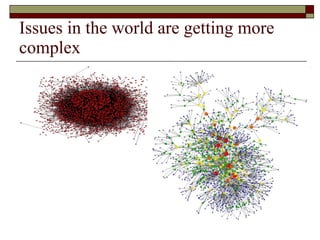
Issues in the world are getting more complex
What are issues of complexity? Cause and effect  Variables Permutations Ripple/butterfly wing effect
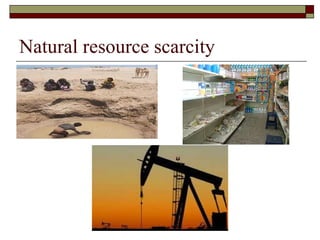
Natural resource scarcity
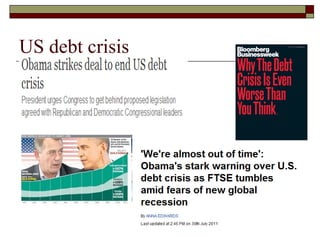
US debt crisis
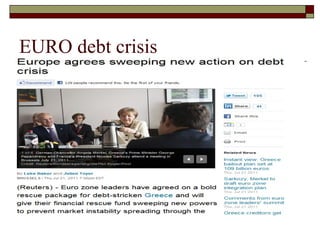
EURO debt crisis
Permanent austerity the way forward? And scarcity driving innovation  Originally refers to “retrenchment” of the social welfare system (Pierson 1999)  Are world governments heading towards permanent austerity? Why?  Global economic crisis – Ireland, Greece, Spain Ageing population  In welfare states e.g. Nordic countries, inability to deliver on promises How does this impact on education policy?
Government Policy Policy formulation is set in increasingly complex settings  Black swans (Taleb 2007) – incidents of low probability or no probability but high impact  Weak signals Don’t have all the answers  Planning 25-30 years ahead - strategic planning
Government Policy Tools and government departments Scenario planning – all agencies  Horizon scanning – Security secretariat  Futures/ futurology – PSD/PMO and strategic departments in agencies–Whole of government (WOG) Alvin and Heidi Toffler  “ Future Shock” 1970  Popularise “information overload” Predicted that people may not be able to cope with rapid industrial and technological changes
Scenario planning and futures Scenario 1: continued prosperity – status quo Scenario 2: permanent austerity (greater accountability of fiscal budget); lack of resources (non-renewable and others)
Scenario 2: permanent austerity Greater leverage on ICT because brick and mortar schools are expensive Moore’s law on technology getting cheaper with time and ICT becomes very mobile Teachers and students learn from home - telecommuting to save cost Interaction with other children and with teachers at a localised community level say with a 10 block radius A school without a building - administrative work done online and classes conducted at places of interest say a museum for social studies
References Pierson   P ., 2001, “The new politics of the welfare state”, Oxford University Press  Toffler A., 1970 “Future Shock”, Batam Press Taleb, N., 2007, The Black Swan: The Impact of the Highly Improbable, Random House

School of the Future - Challenges

  • 1.
    Complexity, Scarcity andthe School of the Future
  • 2.
    Issues in theworld are getting more complex
  • 3.
    What are issuesof complexity? Cause and effect Variables Permutations Ripple/butterfly wing effect
  • 4.
  • 5.
  • 6.
  • 7.
    Permanent austerity theway forward? And scarcity driving innovation Originally refers to “retrenchment” of the social welfare system (Pierson 1999) Are world governments heading towards permanent austerity? Why? Global economic crisis – Ireland, Greece, Spain Ageing population In welfare states e.g. Nordic countries, inability to deliver on promises How does this impact on education policy?
  • 8.
    Government Policy Policyformulation is set in increasingly complex settings Black swans (Taleb 2007) – incidents of low probability or no probability but high impact Weak signals Don’t have all the answers Planning 25-30 years ahead - strategic planning
  • 9.
    Government Policy Toolsand government departments Scenario planning – all agencies Horizon scanning – Security secretariat Futures/ futurology – PSD/PMO and strategic departments in agencies–Whole of government (WOG) Alvin and Heidi Toffler “ Future Shock” 1970 Popularise “information overload” Predicted that people may not be able to cope with rapid industrial and technological changes
  • 10.
    Scenario planning andfutures Scenario 1: continued prosperity – status quo Scenario 2: permanent austerity (greater accountability of fiscal budget); lack of resources (non-renewable and others)
  • 11.
    Scenario 2: permanentausterity Greater leverage on ICT because brick and mortar schools are expensive Moore’s law on technology getting cheaper with time and ICT becomes very mobile Teachers and students learn from home - telecommuting to save cost Interaction with other children and with teachers at a localised community level say with a 10 block radius A school without a building - administrative work done online and classes conducted at places of interest say a museum for social studies
  • 12.
    References Pierson P ., 2001, “The new politics of the welfare state”, Oxford University Press Toffler A., 1970 “Future Shock”, Batam Press Taleb, N., 2007, The Black Swan: The Impact of the Highly Improbable, Random House