The 2020 Workplacepresented byCONFIDENTIAL
October 18, 20102Our guestYour hostKarieWillyerdJay GoldmanRypple Head of Marketingrypple.comCo-Author, The 2020 Workplacethe2020workplace.com
The 2020 Workplace“The Future Isn’t What It Used To Be” – Yogi BerraDr. KarieWillyerdOctober, 20103
Agenda	What are the shifts that will affect the future?What does the workforce of the future want?What are other companies doing to address the changing workplace?Five predictions for the futureHow to prepare now4
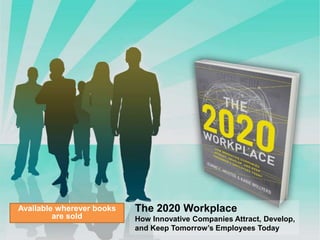
The 2020 WorkplaceHow Innovative Companies Attract, Develop,and Keep Tomorrow’s Employees TodayAvailable wherever books are sold
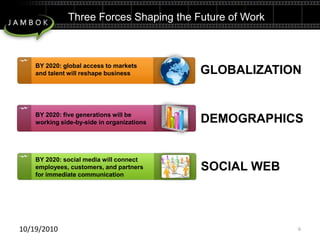
Three Forces Shaping the Future of WorkGLOBALIZATIONBY 2020: global access to markets and talent will reshape businessDEMOGRAPHICSBY 2020: five generations will be working side-by-side in organizationsBY 2020: social media will connect employees, customers, and partners for immediate communicationSOCIAL WEB610/18/10
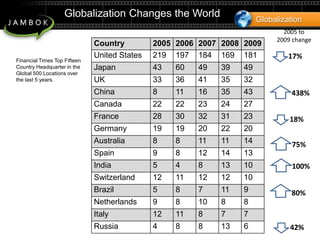
18%42%Globalization Changes the WorldGlobalization2005 to 2009 change17%Financial Times Top Fifteen Country Headquarter in the Global 500 Locations over the last 5 years.438%75%100%80%7
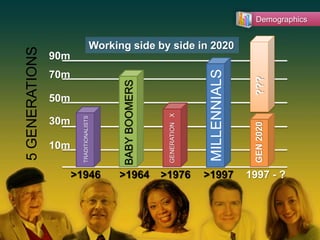
DemographicsWorking side by side in 202090m70m???50mMILLENNIALS5 GENERATIONS BABY BOOMERS30mGENERATION   XTRADITIONALISTSGEN 202010m>1946>1964>1976>19971997 - ?
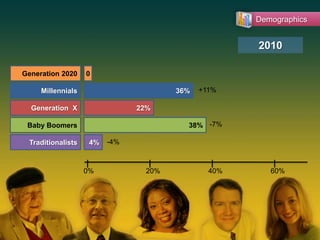
Demographics2010Generation 20200Millennials36%Generation  X22%+11%Baby Boomers38%-7%Traditionalists4%-4%0%40%60%20%
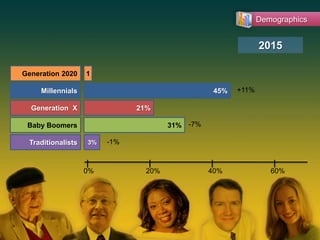
Demographics2015Generation 20201Millennials45%Generation  X21%+11%Baby Boomers31%-7%Traditionalists3%-1%0%40%60%20%
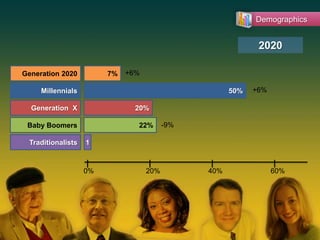
Demographics2020Generation 20207%Millennials+6%50%Generation  X20%+6%Baby Boomers22%Traditionalists1-9%0%40%60%20%
10/18/1012www.futureworkplace.com
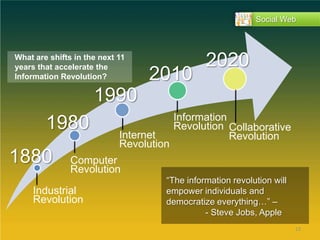
Social Web2020What are shifts in the next 11 years that accelerate the Information Revolution?201019901980Information RevolutionCollaborative RevolutionInternet Revolution1880Computer Revolution“The information revolution will empower individuals and democratize everything…” –                    - Steve Jobs, AppleIndustrial Revolution13
Examples from Forward-Thinking CompaniesUber-connected communicationsTeam-Based Learning & DevelopmentMentoring
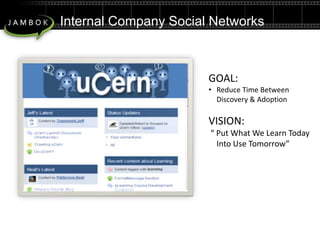
Internal Company Social NetworksuCernGOAL: Reduce Time Between Discovery & AdoptionVISION: “ Put What We Learn Today Into Use Tomorrow”
Team-Based Learning1610/18/10
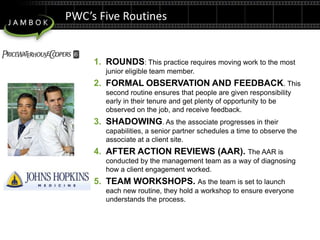
PWC’s Five RoutinesROUNDS: This practice requires moving work to the most junior eligible team member. FORMAL OBSERVATION AND FEEDBACK. This second routine ensures that people are given responsibility early in their tenure and get plenty of opportunity to be observed on the job, and receive feedback.SHADOWING. As the associate progresses in their capabilities, a senior partner schedules a time to observe the associate at a client site. AFTER ACTION REVIEWS (AAR). The AAR is conducted by the management team as a way of diagnosing how a client engagement worked. TEAM WORKSHOPS. As the team is set to launch each new routine, they hold a workshop to ensure everyone understands the process.
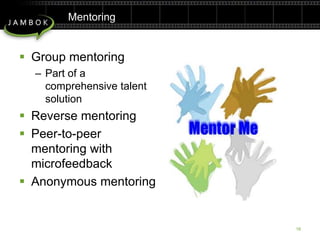
MentoringGroup mentoringPart of a comprehensive talent solutionReverse mentoringPeer-to-peer mentoring with microfeedbackAnonymous mentoring18
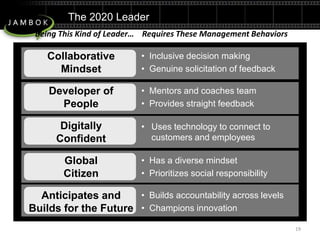
The 2020 LeaderBeing This Kind of Leader…    Requires These Management Behaviors19
20Five Predictions for the future of learning & talent management
Every Person Will Have a Reputation Score …starting with leaders10/18/10www.futureworkplace.com21
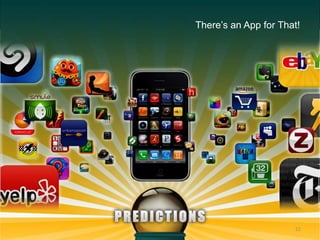
There’s an App for That!22
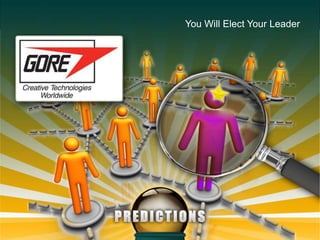
You Will Elect Your Leader23www.futureworkplace.com10/18/10
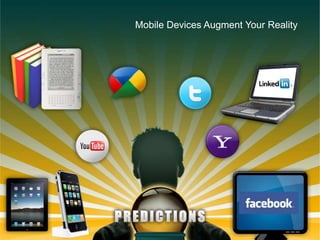
Mobile Devices Augment Your Reality
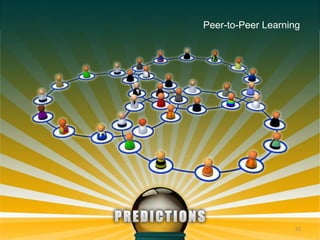
Peer-to-Peer Learning25
What You Can Do To Get Ready NowAdopt a global mind-setBuild a reputation as being socially responsibleBecome über-connectedChampion openness and transparencyBuild citizen leadershipCreate an inclusive cultureStart developing people now, fast, fast, fast!Mass mentoring programsSimulationsUser-controlled feedback 2610/18/10
Karie@Jambok.comwww.jambok.com
October 18, 201028Learn more:Rypple Townhall on ManagingWith Mozilla and Insomniac GamesOctober 28th, 1:00pm ETDetails to follow by emailpresented by
Answering your questionsOctober 18, 201029presented by

The Future of Work: 2020 Workplace with Karie Willyerd Webinar

  • 1.
  • 2.
    October 18, 20102OurguestYour hostKarieWillyerdJay GoldmanRypple Head of Marketingrypple.comCo-Author, The 2020 Workplacethe2020workplace.com
  • 3.
    The 2020 Workplace“TheFuture Isn’t What It Used To Be” – Yogi BerraDr. KarieWillyerdOctober, 20103
  • 4.
    Agenda What are theshifts that will affect the future?What does the workforce of the future want?What are other companies doing to address the changing workplace?Five predictions for the futureHow to prepare now4
  • 5.
    The 2020 WorkplaceHowInnovative Companies Attract, Develop,and Keep Tomorrow’s Employees TodayAvailable wherever books are sold
  • 6.
    Three Forces Shapingthe Future of WorkGLOBALIZATIONBY 2020: global access to markets and talent will reshape businessDEMOGRAPHICSBY 2020: five generations will be working side-by-side in organizationsBY 2020: social media will connect employees, customers, and partners for immediate communicationSOCIAL WEB610/18/10
  • 7.
    18%42%Globalization Changes theWorldGlobalization2005 to 2009 change17%Financial Times Top Fifteen Country Headquarter in the Global 500 Locations over the last 5 years.438%75%100%80%7
  • 8.
    DemographicsWorking side byside in 202090m70m???50mMILLENNIALS5 GENERATIONS BABY BOOMERS30mGENERATION XTRADITIONALISTSGEN 202010m>1946>1964>1976>19971997 - ?
  • 9.
    Demographics2010Generation 20200Millennials36%Generation X22%+11%Baby Boomers38%-7%Traditionalists4%-4%0%40%60%20%
  • 10.
    Demographics2015Generation 20201Millennials45%Generation X21%+11%Baby Boomers31%-7%Traditionalists3%-1%0%40%60%20%
  • 11.
    Demographics2020Generation 20207%Millennials+6%50%Generation X20%+6%Baby Boomers22%Traditionalists1-9%0%40%60%20%
  • 12.
  • 13.
    Social Web2020What areshifts in the next 11 years that accelerate the Information Revolution?201019901980Information RevolutionCollaborative RevolutionInternet Revolution1880Computer Revolution“The information revolution will empower individuals and democratize everything…” – - Steve Jobs, AppleIndustrial Revolution13
  • 14.
    Examples from Forward-ThinkingCompaniesUber-connected communicationsTeam-Based Learning & DevelopmentMentoring
  • 15.
    Internal Company SocialNetworksuCernGOAL: Reduce Time Between Discovery & AdoptionVISION: “ Put What We Learn Today Into Use Tomorrow”
  • 16.
  • 17.
    PWC’s Five RoutinesROUNDS:This practice requires moving work to the most junior eligible team member. FORMAL OBSERVATION AND FEEDBACK. This second routine ensures that people are given responsibility early in their tenure and get plenty of opportunity to be observed on the job, and receive feedback.SHADOWING. As the associate progresses in their capabilities, a senior partner schedules a time to observe the associate at a client site. AFTER ACTION REVIEWS (AAR). The AAR is conducted by the management team as a way of diagnosing how a client engagement worked. TEAM WORKSHOPS. As the team is set to launch each new routine, they hold a workshop to ensure everyone understands the process.
  • 18.
    MentoringGroup mentoringPart ofa comprehensive talent solutionReverse mentoringPeer-to-peer mentoring with microfeedbackAnonymous mentoring18
  • 19.
    The 2020 LeaderBeingThis Kind of Leader… Requires These Management Behaviors19
  • 20.
    20Five Predictions forthe future of learning & talent management
  • 21.
    Every Person WillHave a Reputation Score …starting with leaders10/18/10www.futureworkplace.com21
  • 22.
    There’s an Appfor That!22
  • 23.
    You Will ElectYour Leader23www.futureworkplace.com10/18/10
  • 24.
  • 25.
  • 26.
    What You CanDo To Get Ready NowAdopt a global mind-setBuild a reputation as being socially responsibleBecome über-connectedChampion openness and transparencyBuild citizen leadershipCreate an inclusive cultureStart developing people now, fast, fast, fast!Mass mentoring programsSimulationsUser-controlled feedback 2610/18/10
  • 27.
  • 28.
    October 18, 201028Learnmore:Rypple Townhall on ManagingWith Mozilla and Insomniac GamesOctober 28th, 1:00pm ETDetails to follow by emailpresented by
  • 29.
    Answering your questionsOctober18, 201029presented by

Editor's Notes

  • #18 1. Rounds. This practice requires moving work to the most junior eligible team member. “The reason for emphasizing ‘eligible’ is that any assignment requires a certain level of background. At Johns Hopkins, they would do three to four patients on their first day on the job and then present to others. A resident might flash an EKG to interns and then give them 15 seconds or less to interpret and state what needs to be seen. When you get to know EKGs, you realize that there really are a few striking things that even the newest doctor should be able to recognize and interpret almost immediately, so they get that experience on the first day.” At PwC, this means letting junior members of the team work directly with clients much earlier than they might have otherwise, but not in solo.2. Formal observation and feedback. This second routine ensures that people are given responsibility early in their tenure and get plenty of opportunity to be observed on the job, and receive feedback not only from the leader of the team, but also from other team members. The observation and feedback can be either impromptu or scheduled.3. Shadowing. As the associate progresses in their capabilities, a senior partner schedules a time to observe the associate at a client site. “It is cultural to expect feedback from multiple sources in this environment. Even though hierarchy and structure are alive in this environment, the organization structure flattens when it comes to feedback. The same thing was true at Johns Hopkins. I watched the interaction between a cardiologist with 25 years experience and a resident. When it came to discussing a patient, the resident was able to point out something to the cardiologist, who I expected to bristle and react to feedback from someone so junior. But the cardiologist listened and thanked the resident for the feedback.”4. After action reviews (AAR). The AAR is conducted by the management team as a way of diagnosing how a client engagement worked. “If we get it wrong, we talk about it and learn,” said Evans. “If we get it right and unique, we talk about it and learn. It’s very valuable to sharing when you want to bring something to the team as a new way of approaching a particular problem or client set. It also helps seal in the learning experience.”5. Team workshops. As the team is set to launch each new routine, they hold a workshop to ensure everyone understands the process and that the new routine can be easily embedded into the forthcoming natural work of the team. That way they help build an integrated approach to both work and learning, in the hopes that the routines will be sustained long after the formal program ends.According to Evans, in the places where they have conducted early pilots, “the teams are showing good results, with increased competence, good business economics, and high client satisfaction.” 
  • #19 Ch. 8, p.230Corporate App Stores Will Offer Ways to Manage Work and Personal Life BetterAs employees increasingly expect to be in control of all aspects of their lives, companies will take a page from the enormously successful iPhone App Store and create corporate app stores to help employees better manage their lives at work and at home.Today, there are more than 100,000 iPhone apps in twenty categories, including books, business, education, finance, medical, and games. Consumers have downloaded more than two billion apps, which have generated over a billion dollars in revenue for Apple and its developers. There are applications for every stage of life, from iSeniors, a program designed to locate the nearest senior living centers based on your GPS location, to myHomework, an application designed to help students keep track of their academic responsibilities, Diagnosaurus, a reference tool that diagnoses an illness based on its symptoms, and PetMD Dog First Aid, a medical encyclopedia for dog lovers that instructs you on how to respond to your pet’s medical needs and locate the nearest veterinary clinic.Now imagine the power of customized apps offered by an employer. On the business side, these could include an expense report app, a goal­tracking app, or a microfeedback app. On the personal side, if you are a working mother, apps could focus on the locations of day care centers, after­school programs, homework helpers, and fitness centers. Or a Millennial employee may want apps that feature opportunities to work and study abroad or learn a new language or tips on applying for a first mortgage. Customization and personalization will reign as employees both access and develop applications for managing their work and personal lives. Borrowing from Apple, the new motto of HR will be “Yes, there’s an app for that!”
  • #20 Ch. 8, p. 224You Will Elect Your LeaderCompanies that encourage employees to elect their leader will be seen as employers of choice, especially for team­orientedMillennials and Gen 2020s. Members of both generations have grown up with a collaborative mind­set through their heavy usage of social networks and highly interactive video games such as EVE Online. Some companies are taking this a step further by experimenting with giving employees more influence in electing leaders.Consider W. L. Gore & Associates, where senior leaders do not appoint junior leaders. Rather, associates become leaders when their peers judge them to be such. A leader gains influence by demonstrating a capacity to get things done and by excelling as a team builder. The CEO of W. L. Gore, Terri Kelly, was actually voted by her peers to become their leader when Chuck Carroll, the previous CEO, polled a cross section of employees, asking “Who would you want to follow?” This “elect your leader” mentality permeates W. L. Gore. Each team ranks every member of the team on the question “Whohas made the biggest impact on the enterprise?” The rankings are sorted through by a group of “contribution committees,” which use the rankings as a basis for compensation. The company credits this with its low turnover rate of just over 5 percent.While electing your leader may be viewed as just one company’s experimentation in citizen leadership, it may become a strong recruiting tool for companies. Ranking and polling social media tools allow an organization to see who has a followership, a necessary quality for being a leader. Millennials who have grown up learning about the merits of collaboration and teamwork place great value on them and will seek out employers that put these principles into action.
  • #21 Ch. 8, p.215Your mobile devIce Will Become Your offIce, your classroom, and your conciergeMore than 1.2 billion mobile phones are produced each year, and they are benefiting from unprecedented innovation. Mobile phones and tablets will be the primary connection tool to the Internet for most people in the world in 2020.In the words of Michael Jones, the chief technology advocate for Google, “The mobile phone is for the next decade what the computer has been for the last two or three. The whole experience of the Internet is becoming not a desktop computer experience, but a personal experience.” This is already happening in Japan, as young people equipped with mobiles see no reason to own a personal computer. The mobile phone in 2020 will become our office, our classroom, and our real­time concierge, helping us manage both our personal and professional lives. With mobility and migration on the rise, employees will no longer be limited to working in one country or region. They will be able to work anywhere, including their client locations, hotel rooms, vacation destinations, and, of course, homes. As wire­ less network speeds rise, with twenty­five cities in the United Statesexpected to double their 3G network speed in 2010, and device functionality improves to the point of merging netbooks, readers, and phones, the possibilities are endless.Already being touted as the next delivery tool for corporate learning, mobile devices are being used by companies to deliver sales training, compliance training, and up­to­date product knowledge, as well as e­coaching and e­mentoring. In 2020, if not before, look for the mobile device to be an increasingly important delivery mode for a wide variety of corporate training, new­hire orientation, mentoring, coaching, and on­the­job performance support. Coupled with improved security advances, the mobile device will be used as validation for entry into locations, citizenship, travel and expense reporting, and timekeeping for project accounting.
  • #23 Ch. 9, p. 236