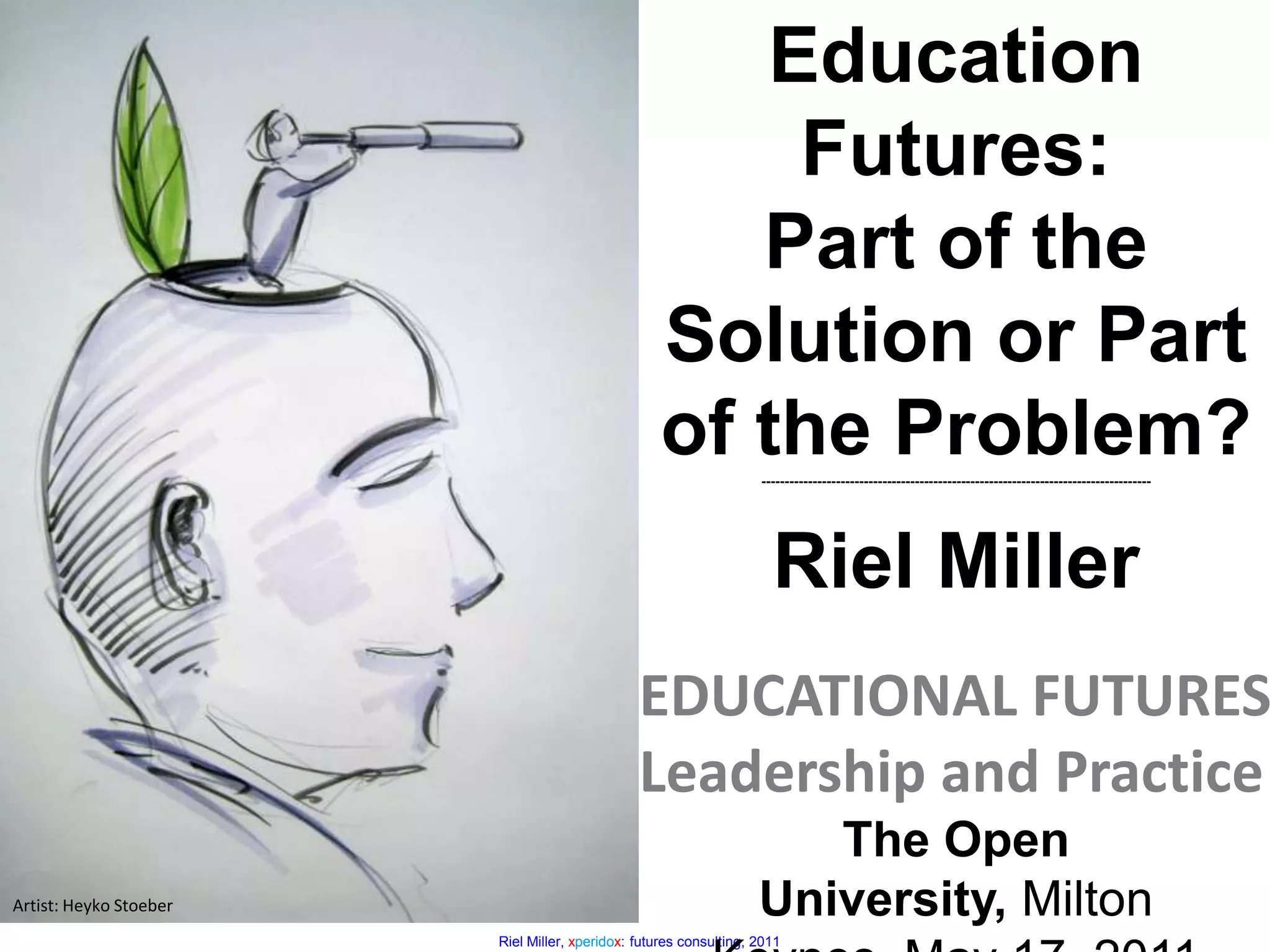
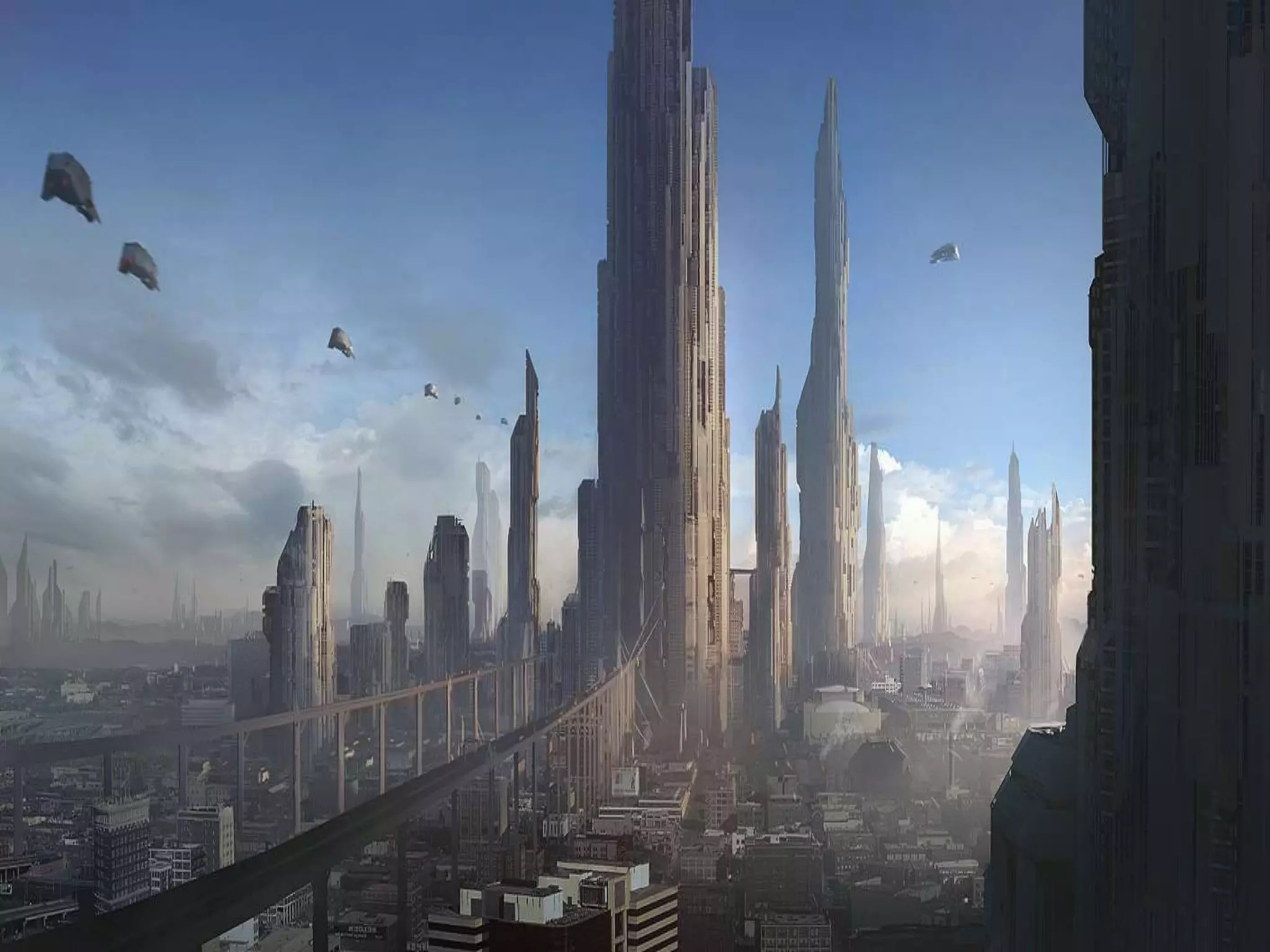
Education Futures: Part of the Solution or Part of the Problem?------------------------------------------------------------------------------------Riel MillerEDUCATIONAL FUTURESLeadership and PracticeThe Open University, Milton Keynes, May 17, 2011Artist: HeykoStoeber
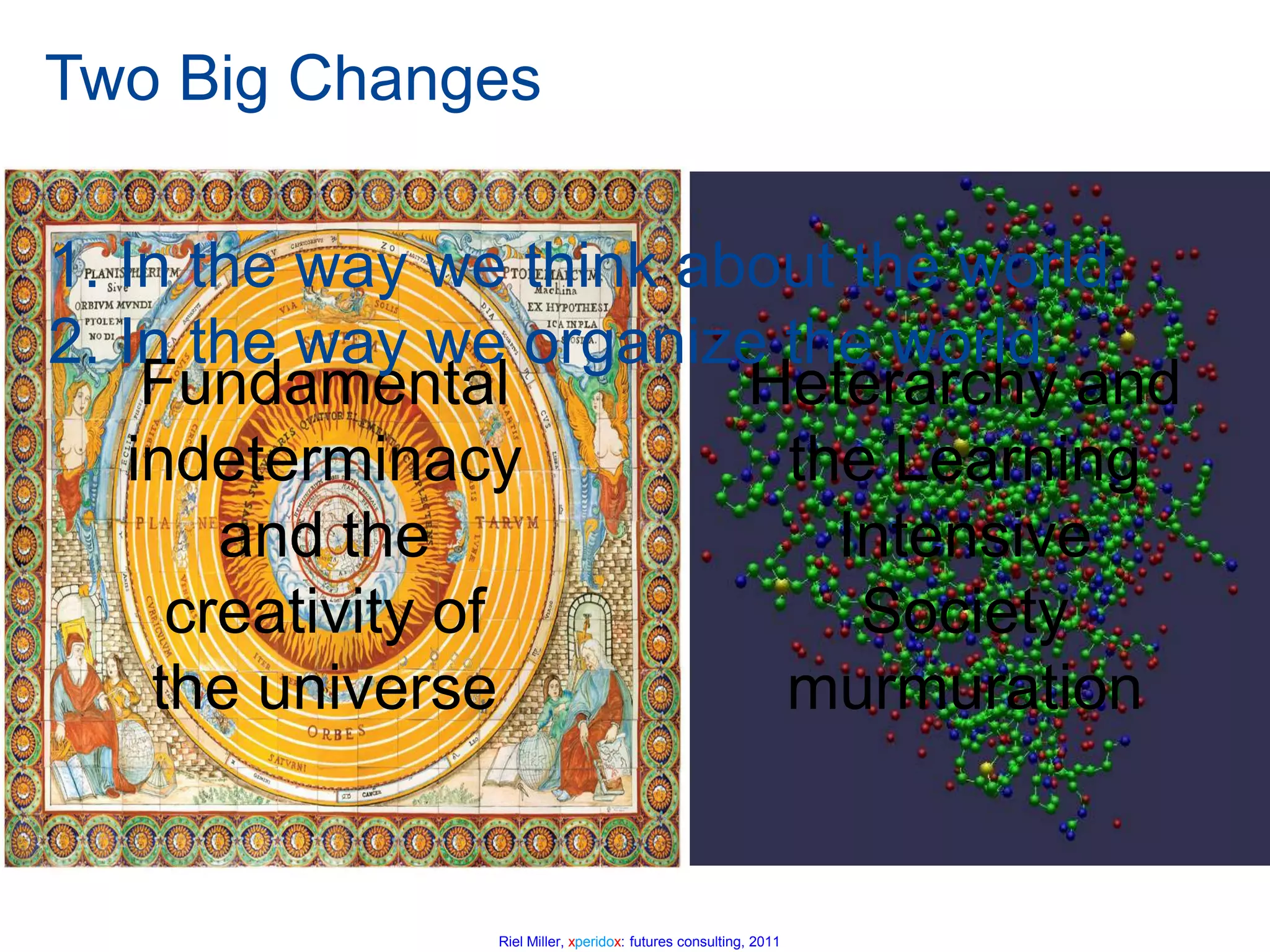
Two Big Changes1. In the way we think about the world.2. In the way we organize the world.Fundamental indeterminacy and the creativity of the universeHeterarchy and the Learning Intensive Society murmuration
1. Embracing Complexity: Changing the way we use the futurePhoto credit: Mark Schacter ©
The End of CertaintyMankind is at a turning point, the beginning of a new rationality in which science is no longer identified with certitude and probability with ignorance. … science is no longer limited to idealized and simplified situations but reflects the complexity of the real world, a science that views us and our creativity as part of a fundamental trend present at all levels of nature.Ilya Prigogine, The End of Certainty: Time, Chaos and the New Laws of Nature… we are now able to include probabilities in the formulation of the basic laws of physics. Once this is done, Newtonian determinism fails; the future is no longer determined by the present….
The possible is not in the future it is in the past.“We must resign ourselves to the inevitable: it is the real which makes itself possible, and not the possible which becomes real. But the truth is that philosophy has never frankly admitted this continuous creation of unforeseeable novelty.”Henri Bergson, The Creative Mind
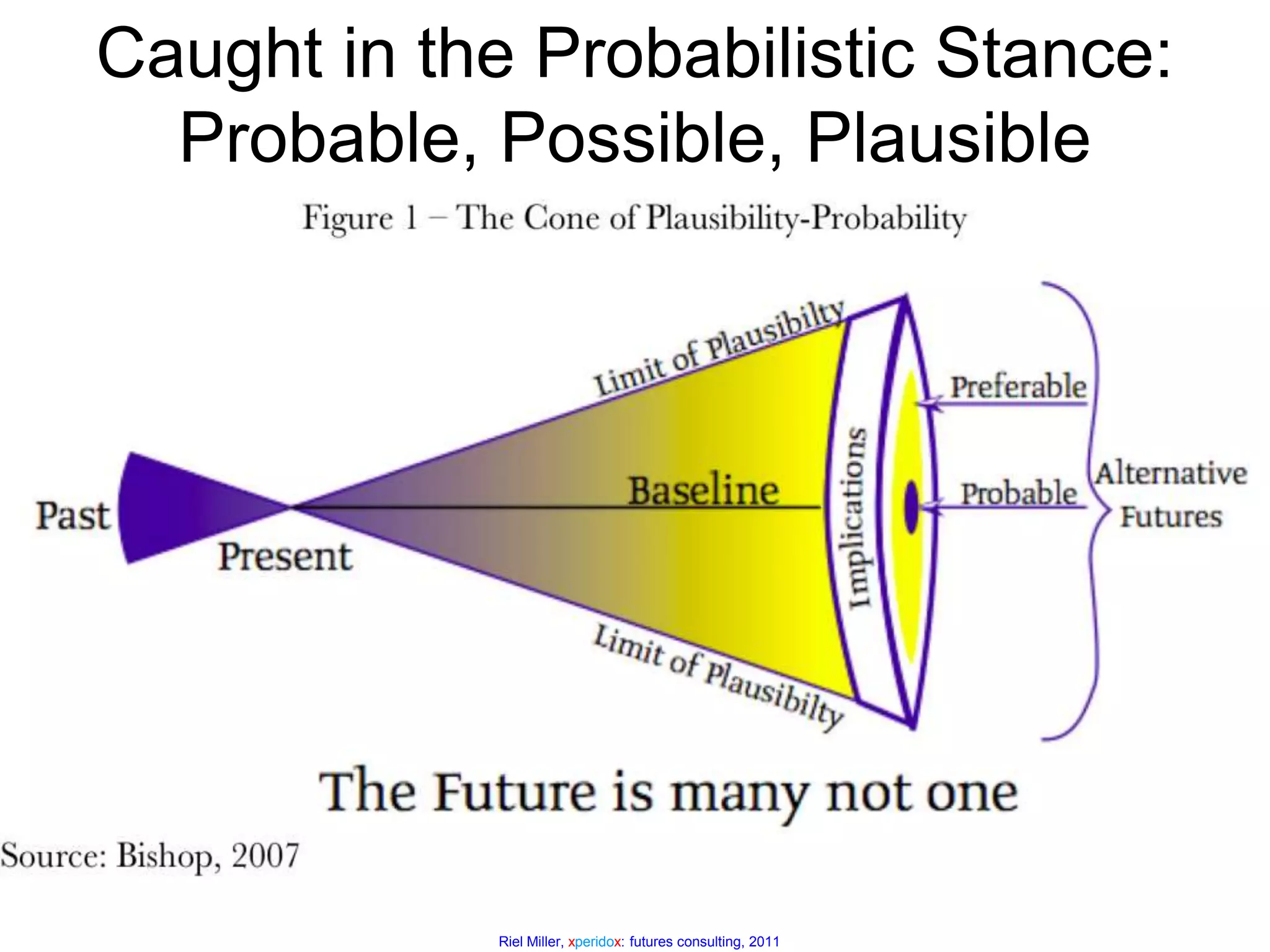
Caught in the Probabilistic Stance: Probable, Possible, Plausible
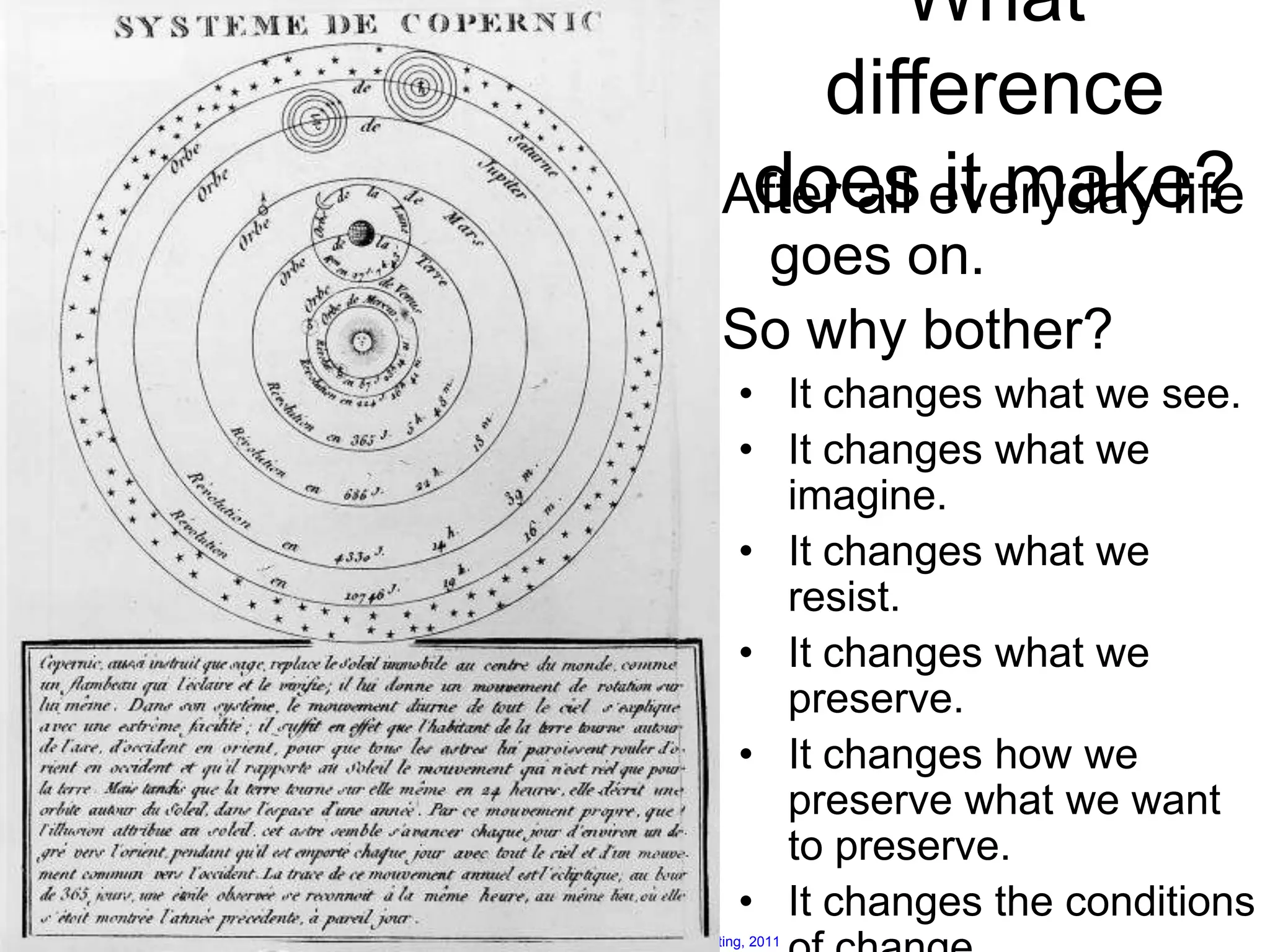
What difference does it make?After all everyday life goes on.So why bother?It changes what we see.
It changes what we imagine.
It changes what we resist.
It changes what we preserve.
It changes how we preserve what we want to preserve.
It changes the conditions of change.Then what? If we accept this ontological starting point – how to make it practical? Take an anticipatory systems perspective that encompasses both animate and inanimate anticipation.Distinguish the three ontological dimensions of the potential of the present – three ways of imagining the future and the different methods that are related to each (ontology-epistemology linked).Learning processes that use collective intelligence – action research, reframing, and narrative capacity to question anticipatory assumptions – embracing complexity, spontaneity, improvisation.
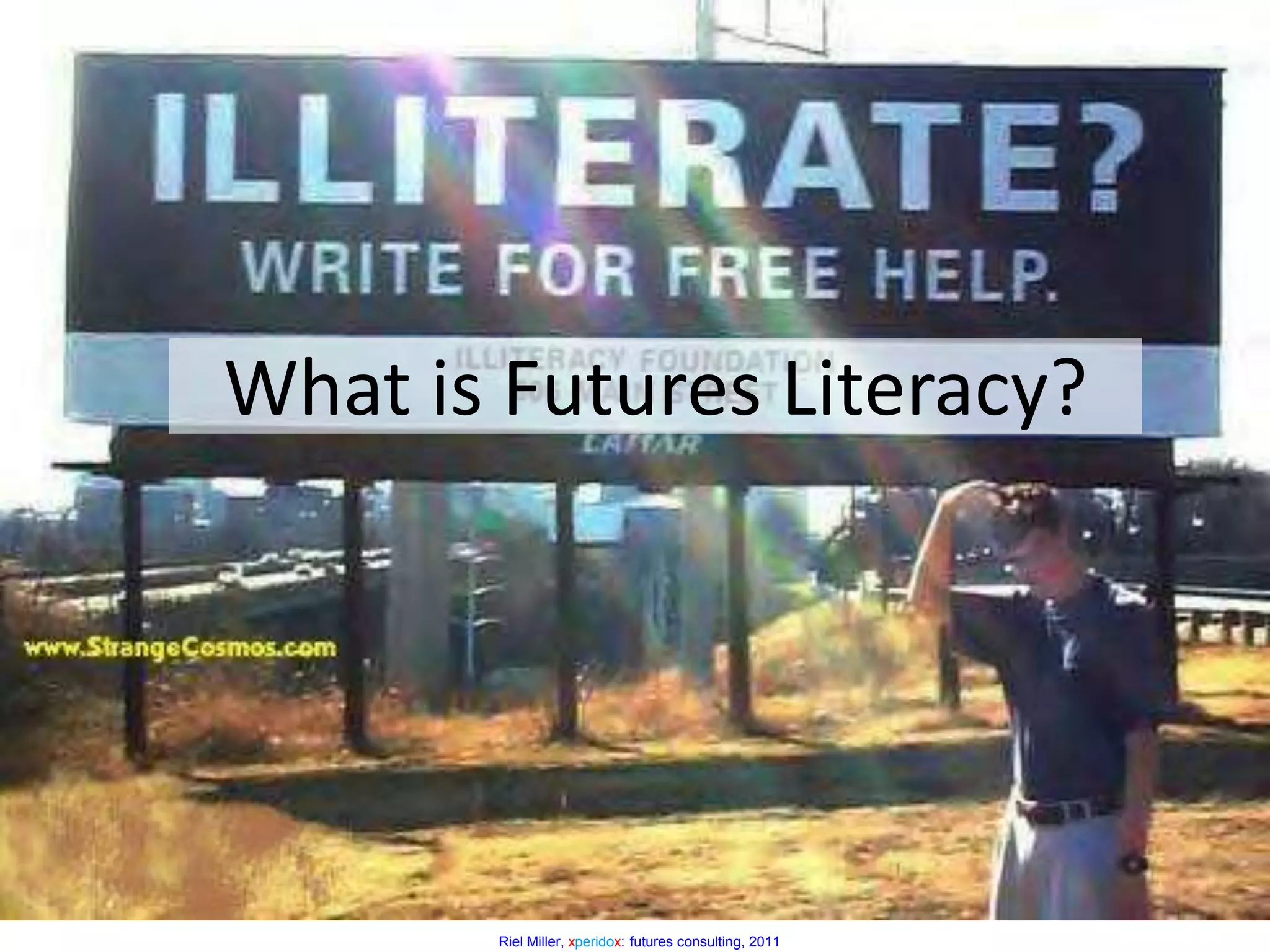
What is Futures Literacy?
Futures Literacy: ambient strategic thinkingFutures Literacy is the capacity to tell anticipatory stories using rigorous imagining based on sharing depth of knowledge from across the community. FL is a way of internalizing the constant development of our understanding of the potential of the emergent present and of changing anticipatory assumptions.
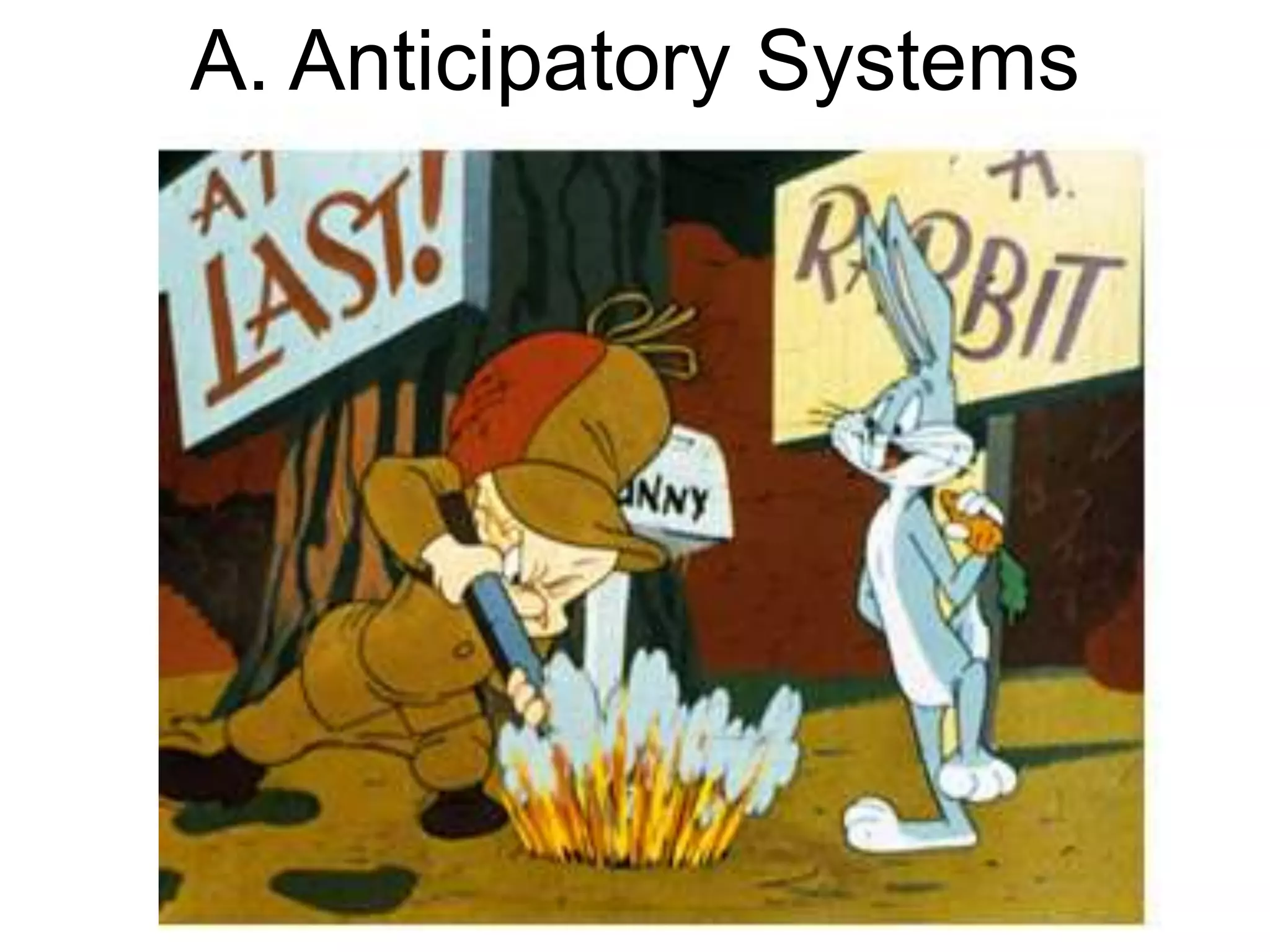
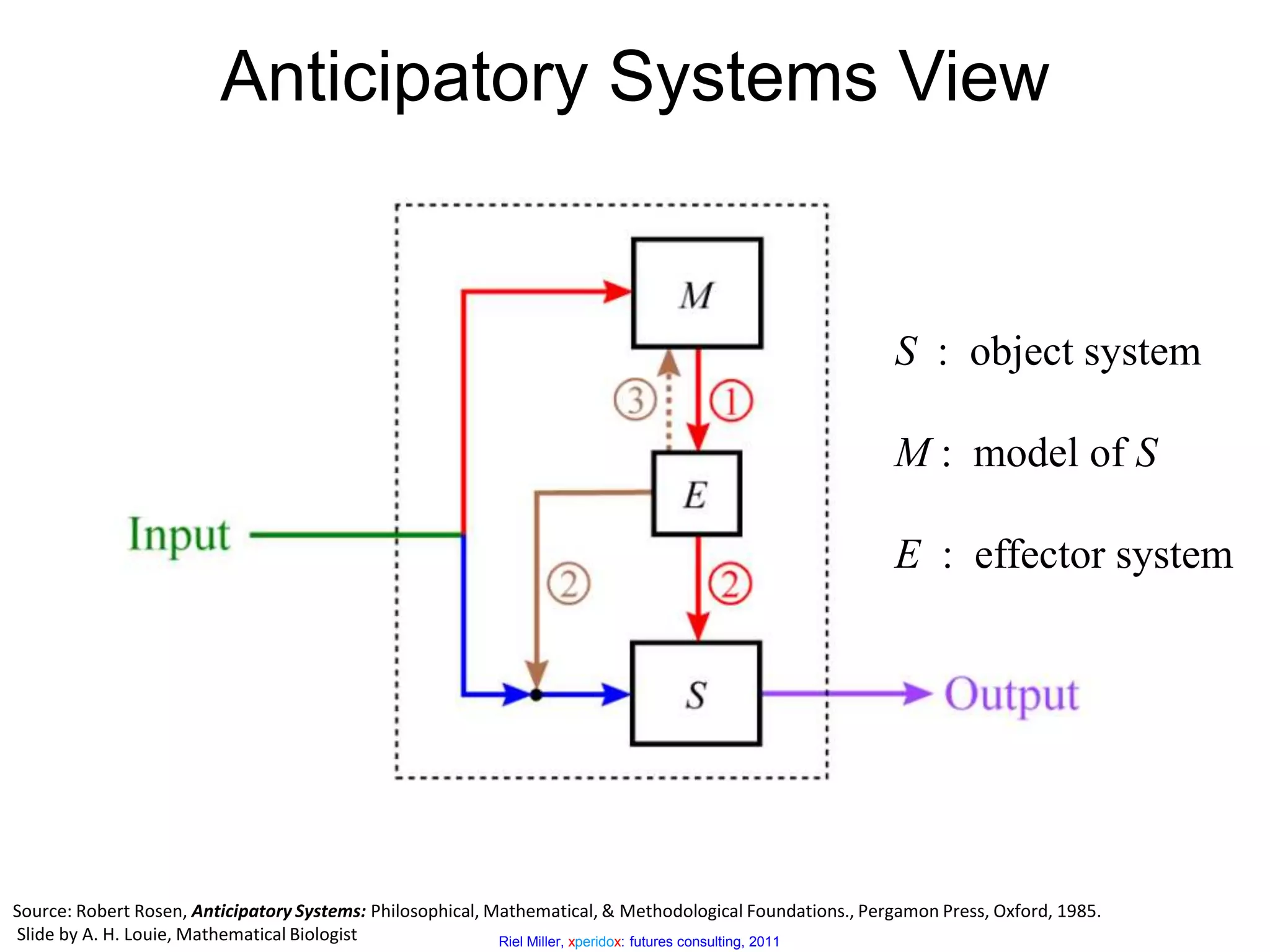
A. Anticipatory Systems
Anticipatory Systems ViewS  :  object systemM :  model of SE  :  effector systemSource: Robert Rosen, Anticipatory Systems: Philosophical, Mathematical, & Methodological Foundations., Pergamon Press, Oxford, 1985. Slide by A. H. Louie, Mathematical Biologist
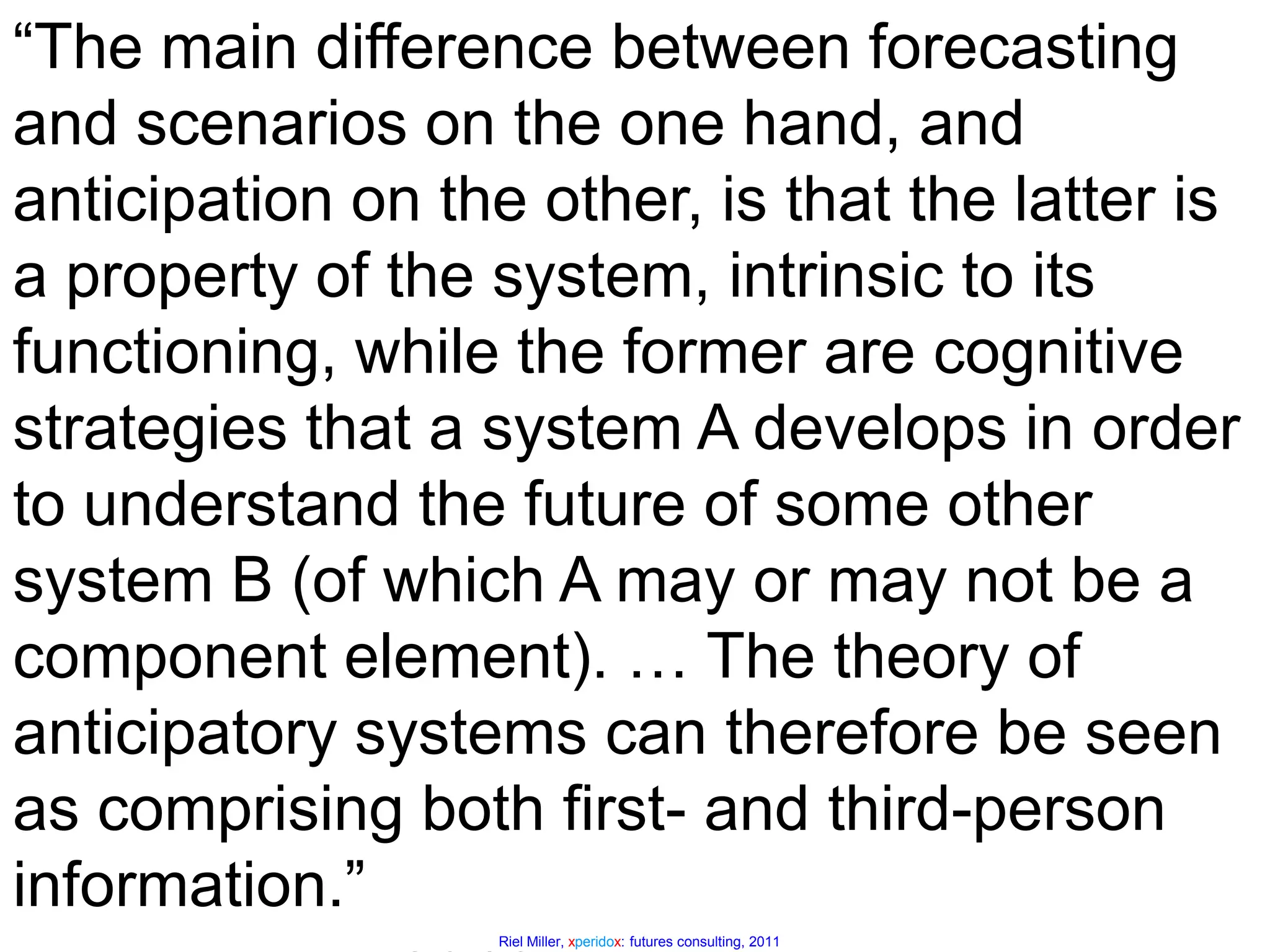
“The main difference between forecasting and scenarios on the one hand, and anticipation on the other, is that the latter is a property of the system, intrinsic to its functioning, while the former are cognitive strategies that a system A develops in order to understand the future of some other system B (of which A may or may not be a component element). … The theory of anticipatory systems can therefore be seen as comprising both first- and third-person information.”Roberto Poli, 2010
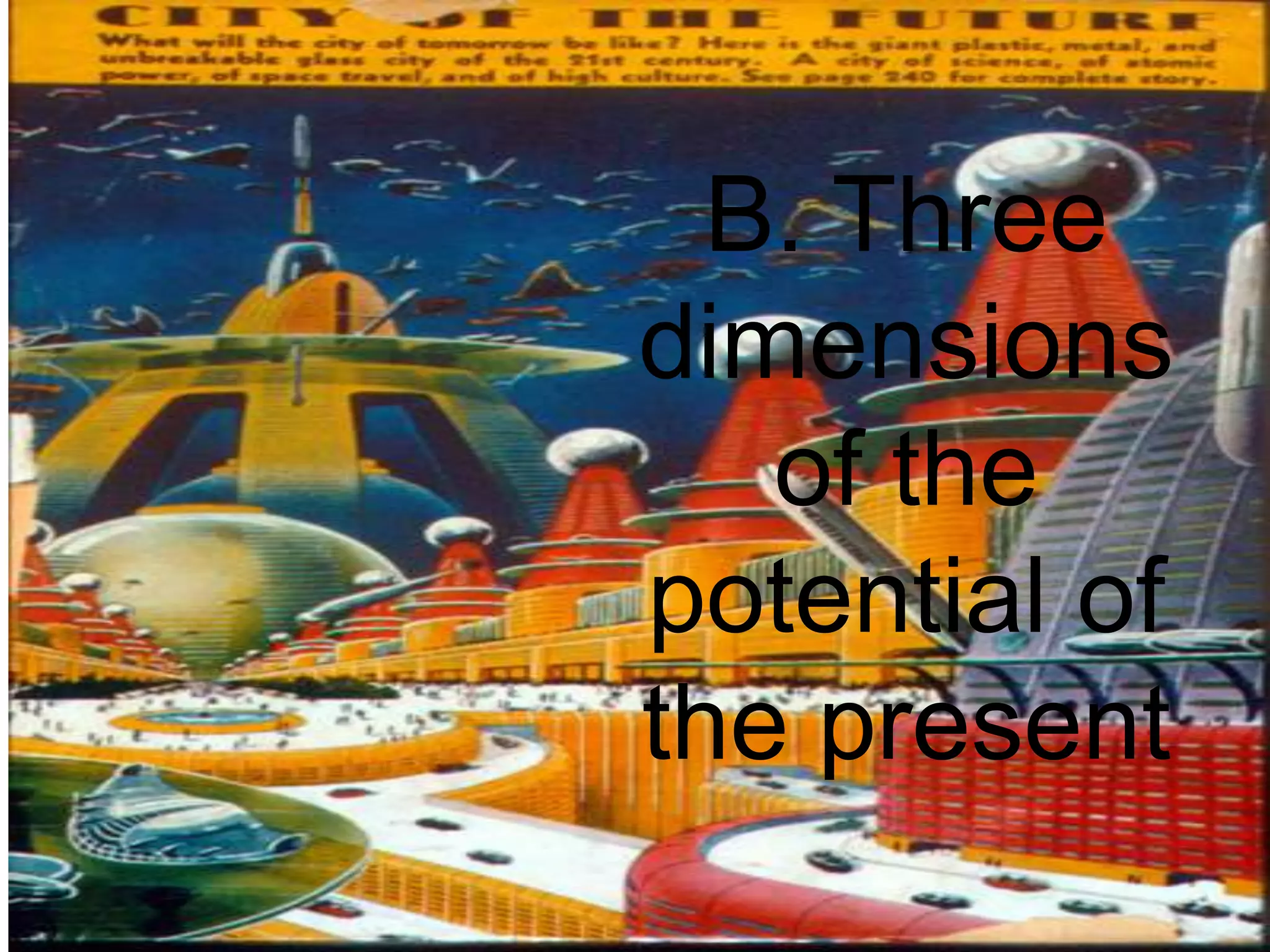
B. Three dimensions of the potential of the present
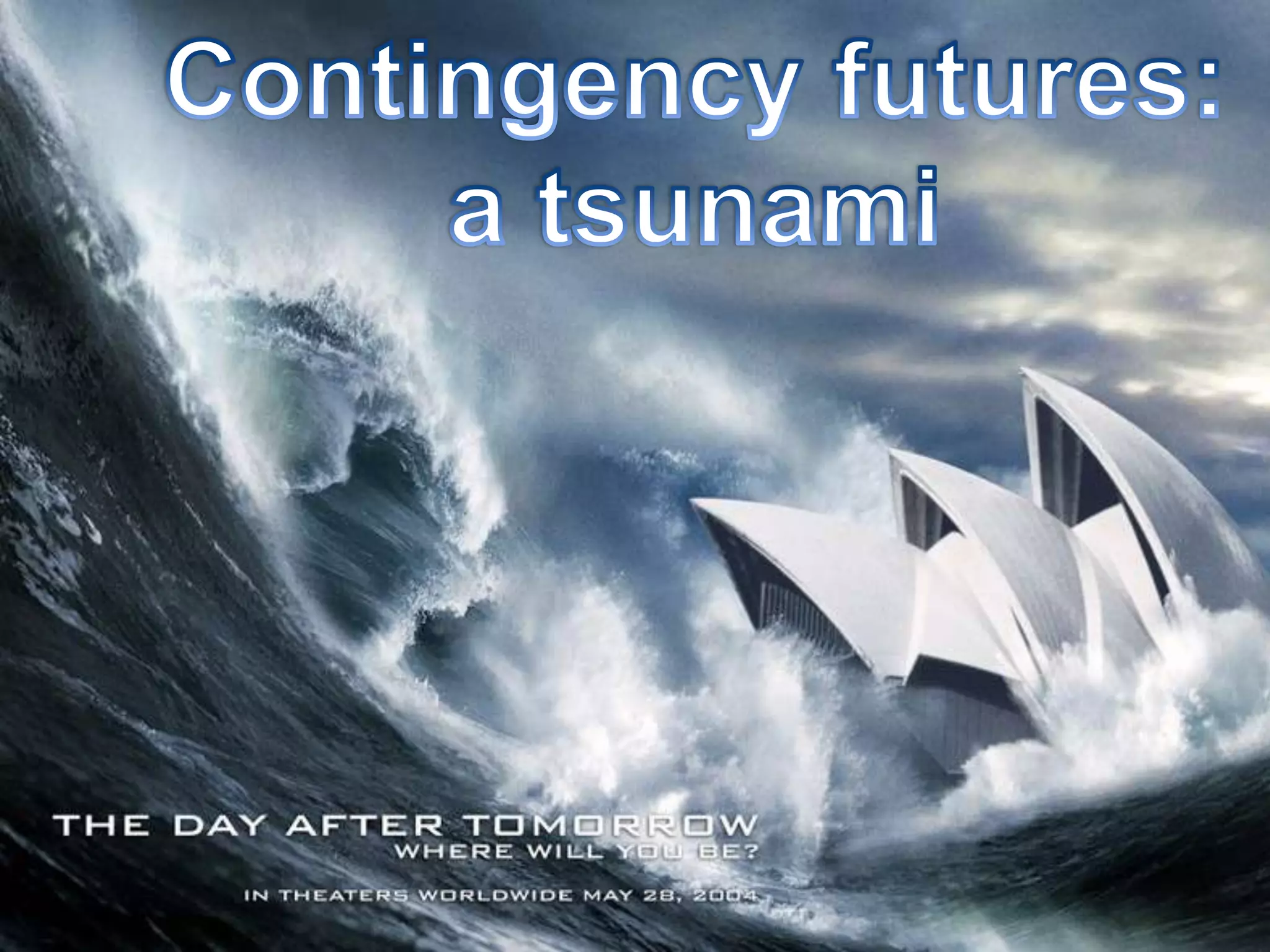
Contingency futures: a tsunami
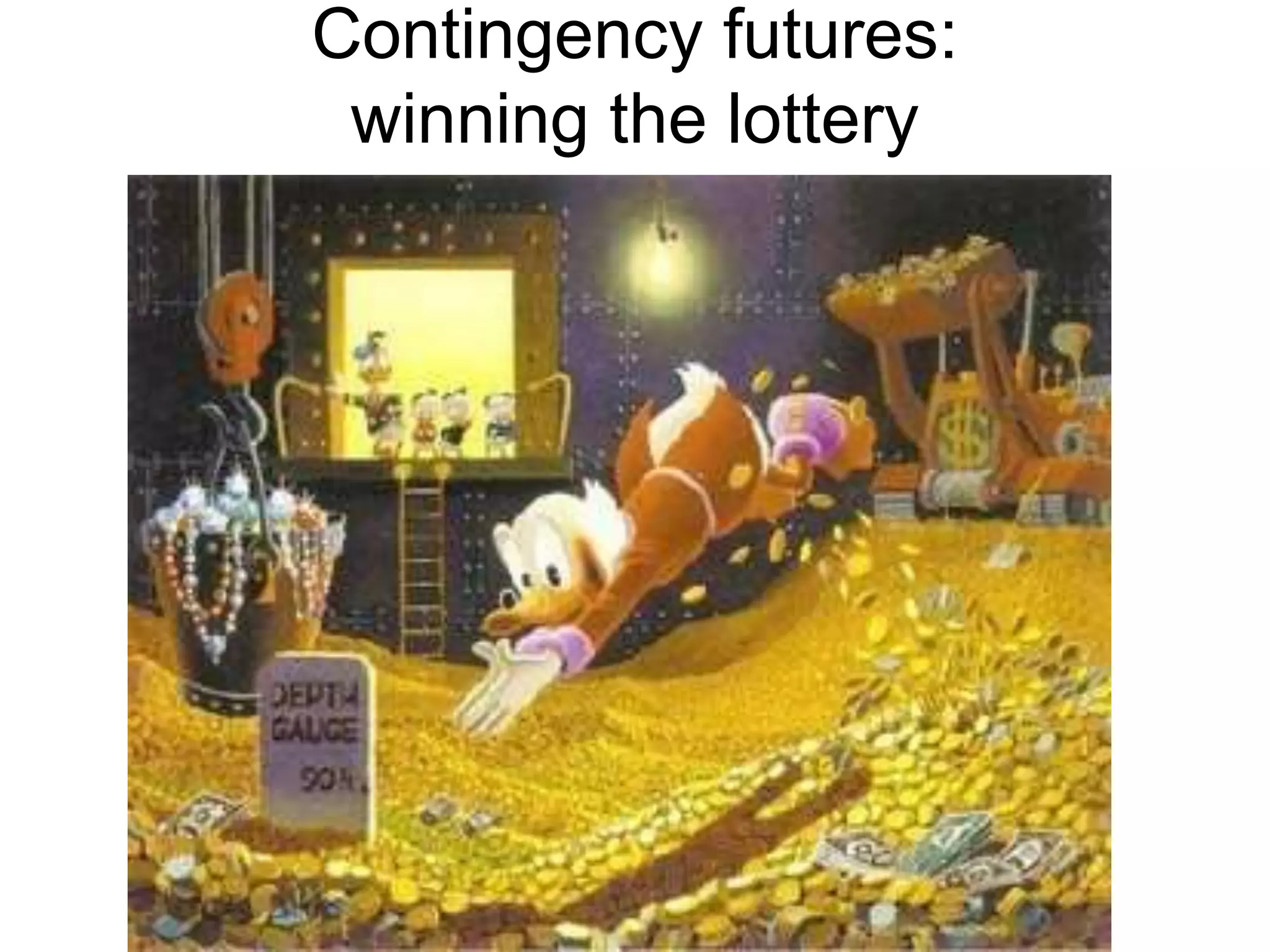
Contingency futures: winning the lottery
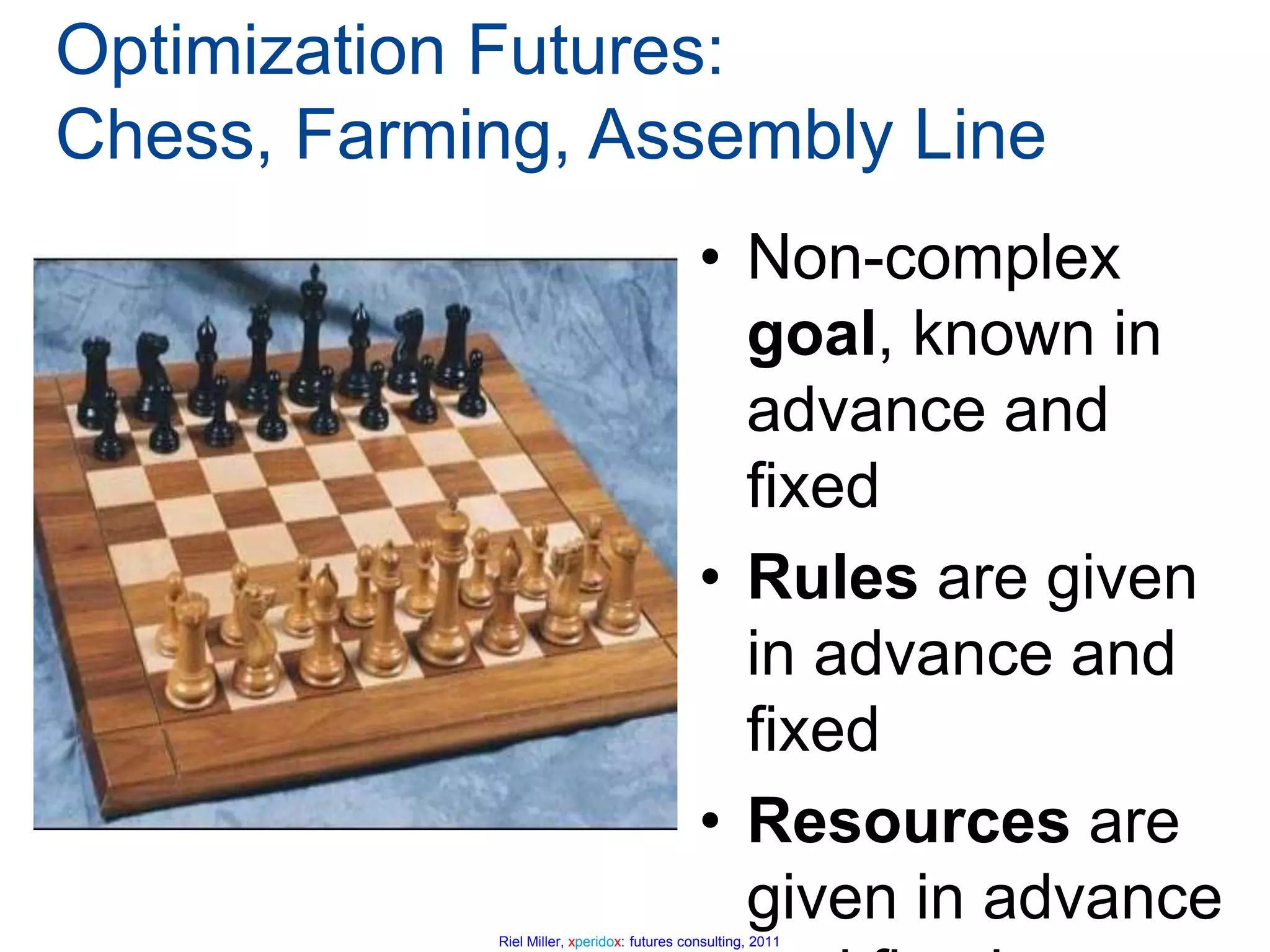
Optimization Futures: Chess, Farming, Assembly LineNon-complex goal, known in advance and fixedRules are given in advance and fixedResources are given in advance and fixed
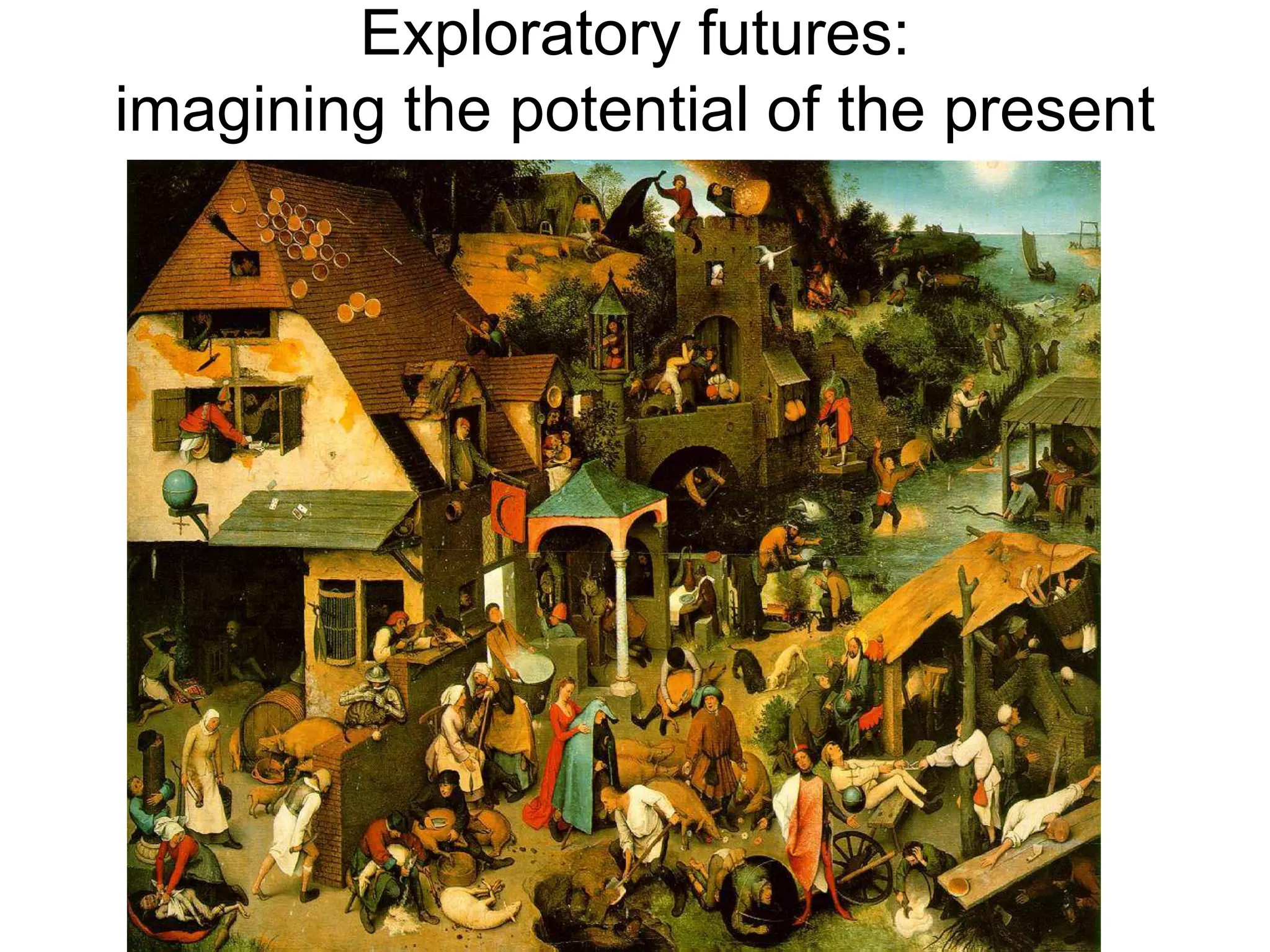
Exploratory futures: imagining the potential of the present
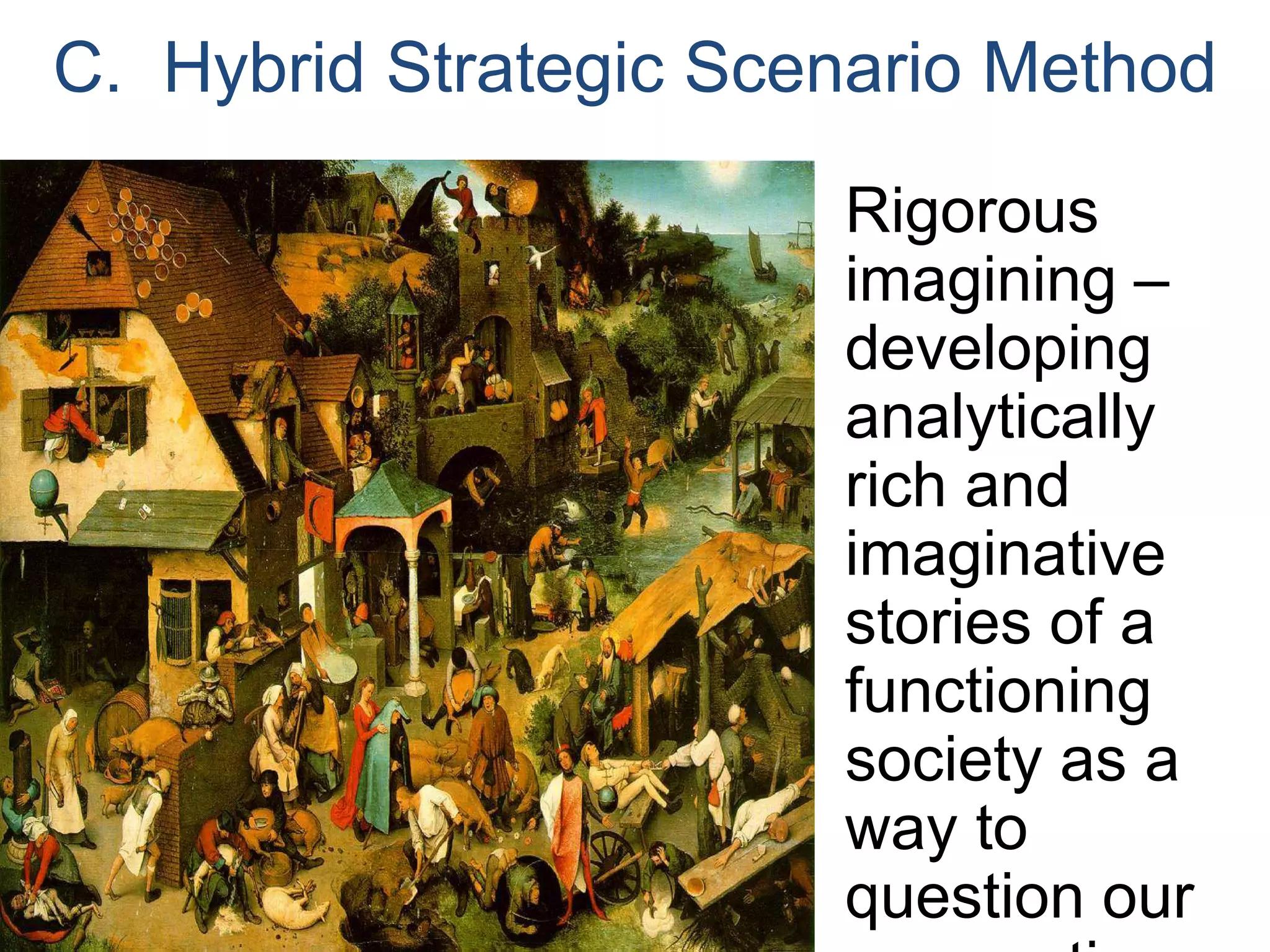
C.  Hybrid Strategic Scenario MethodRigorous imagining – developing analytically rich and imaginative stories of a functioning society as a way to question our assumptions.
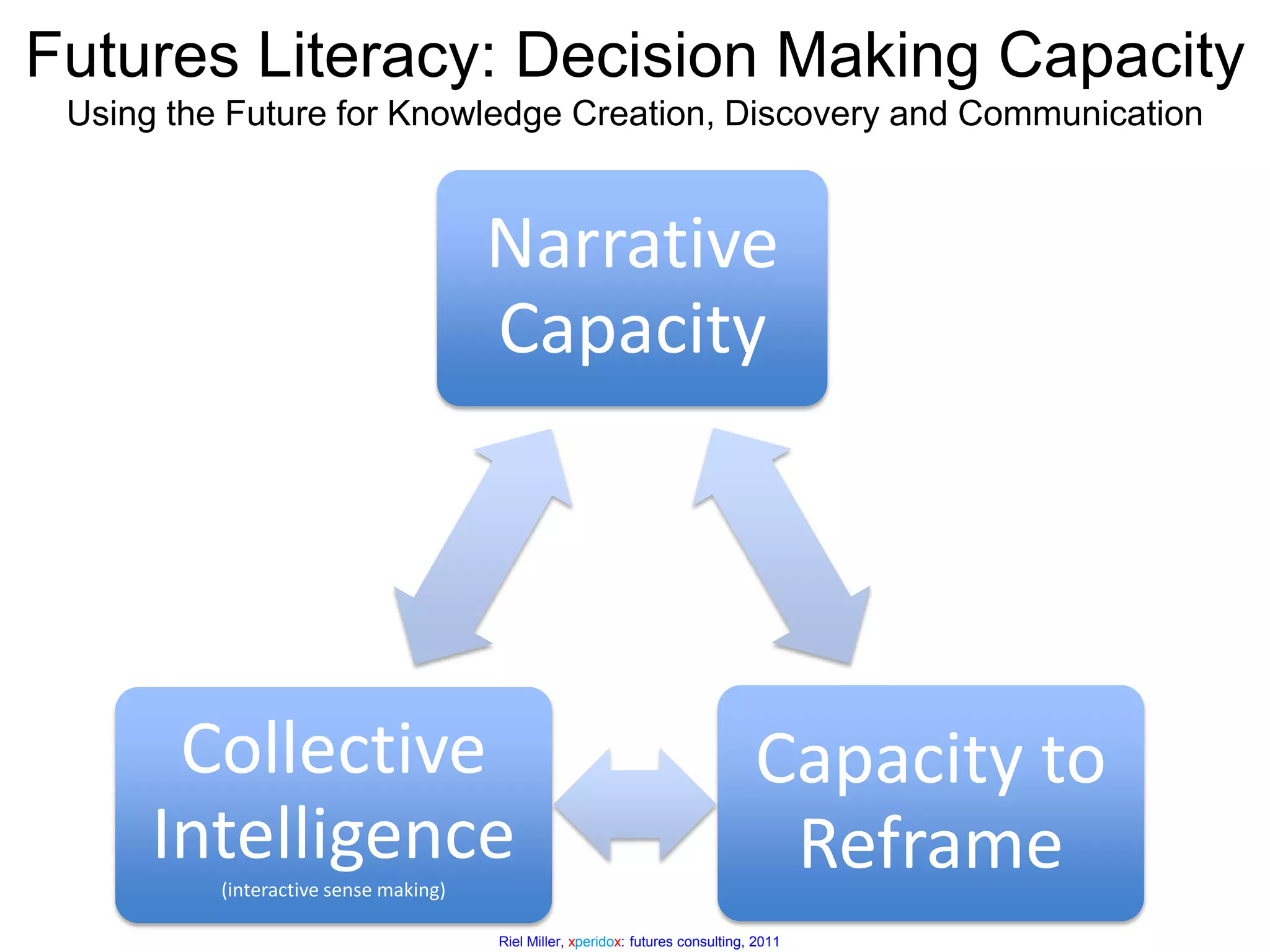
Futures Literacy: Decision Making CapacityUsing the Future for Knowledge Creation, Discovery and Communication
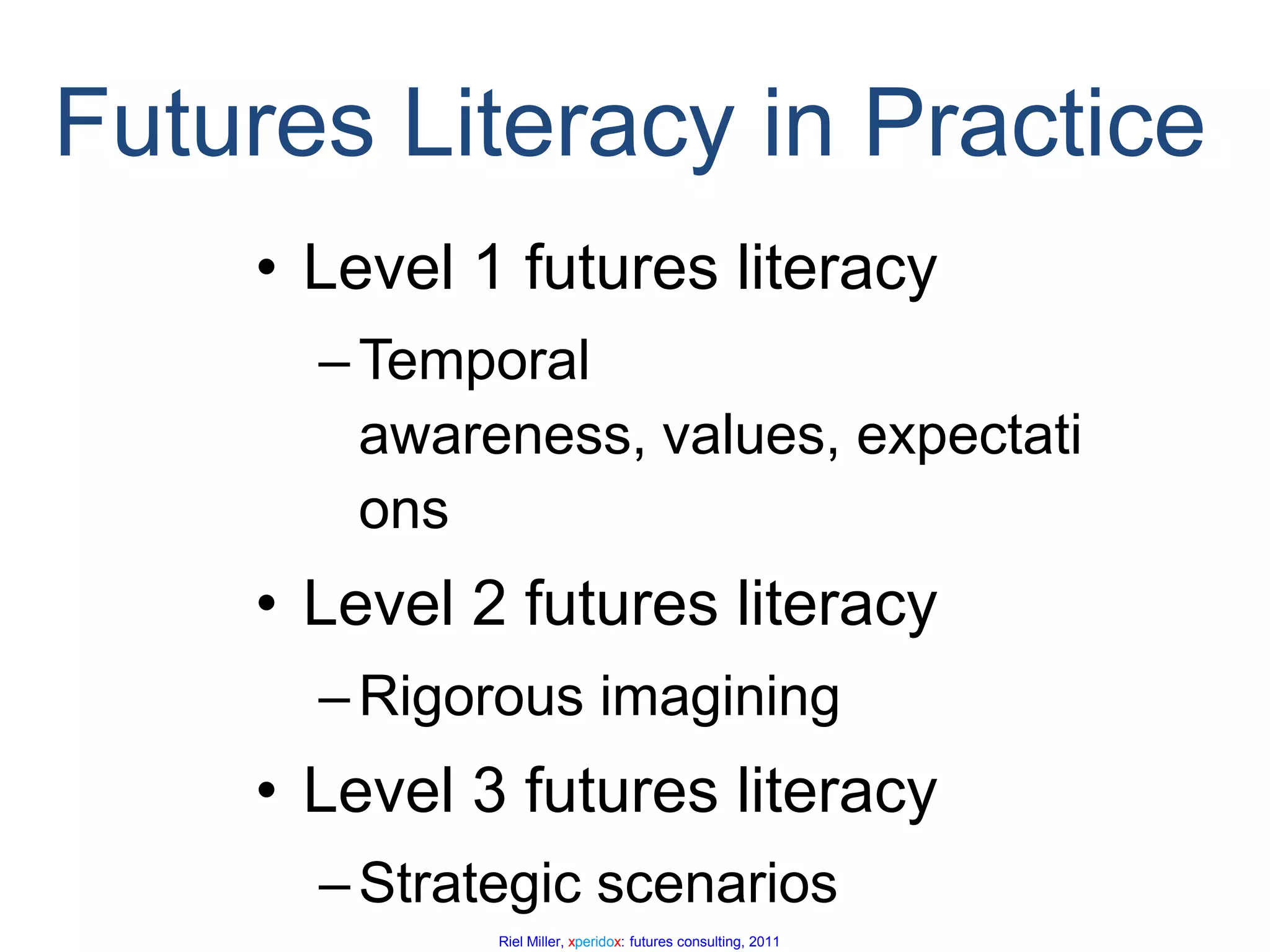
Futures Literacy in PracticeLevel 1 futures literacyTemporal awareness, values, expectationsLevel 2 futures literacyRigorous imaginingLevel 3 futures literacyStrategic scenarios
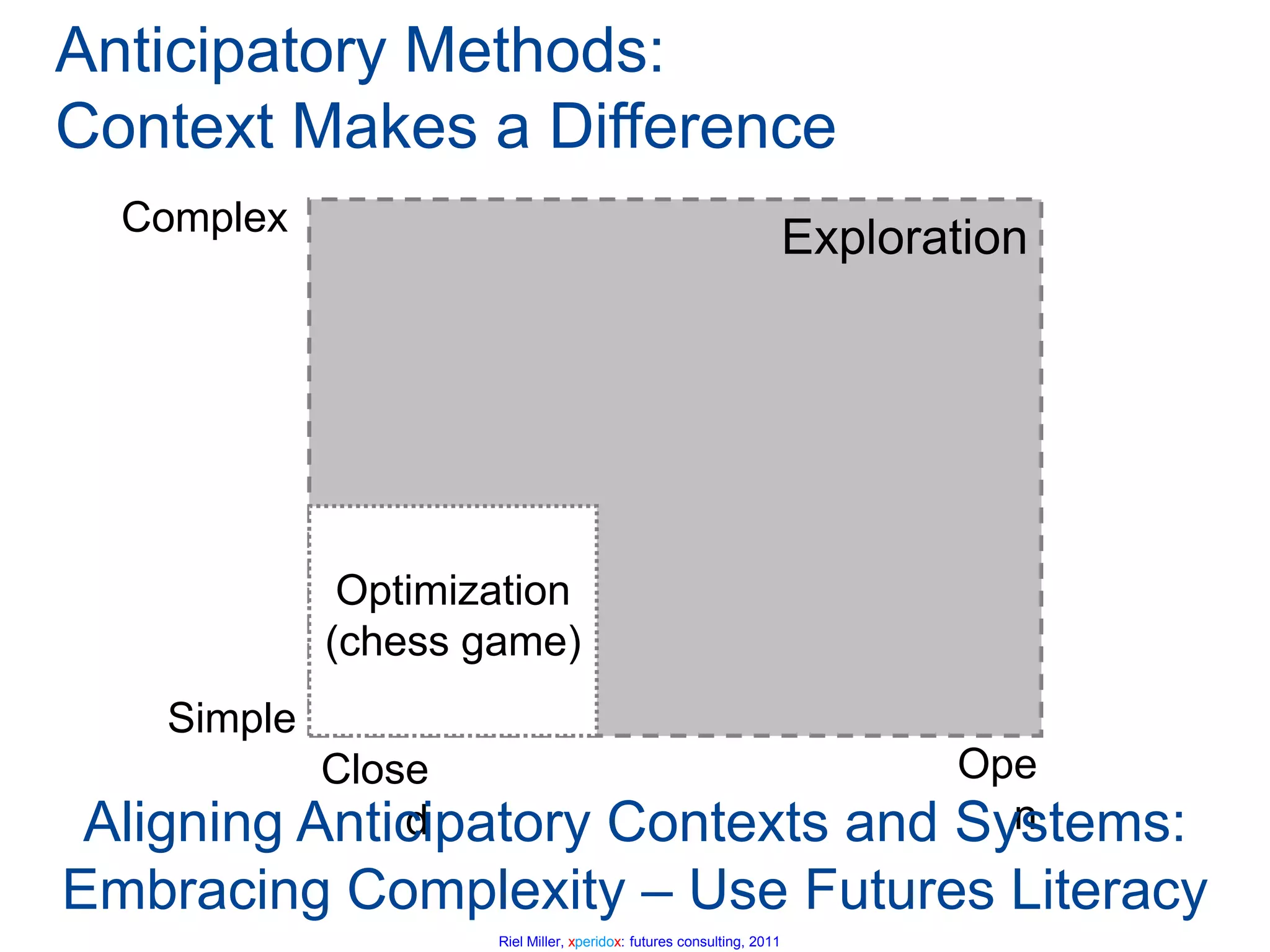
Anticipatory Methods: Context Makes a DifferenceComplexExplorationOptimization(chess game)SimpleOpenClosedAligning Anticipatory Contexts and Systems: Embracing Complexity – Use Futures Literacy
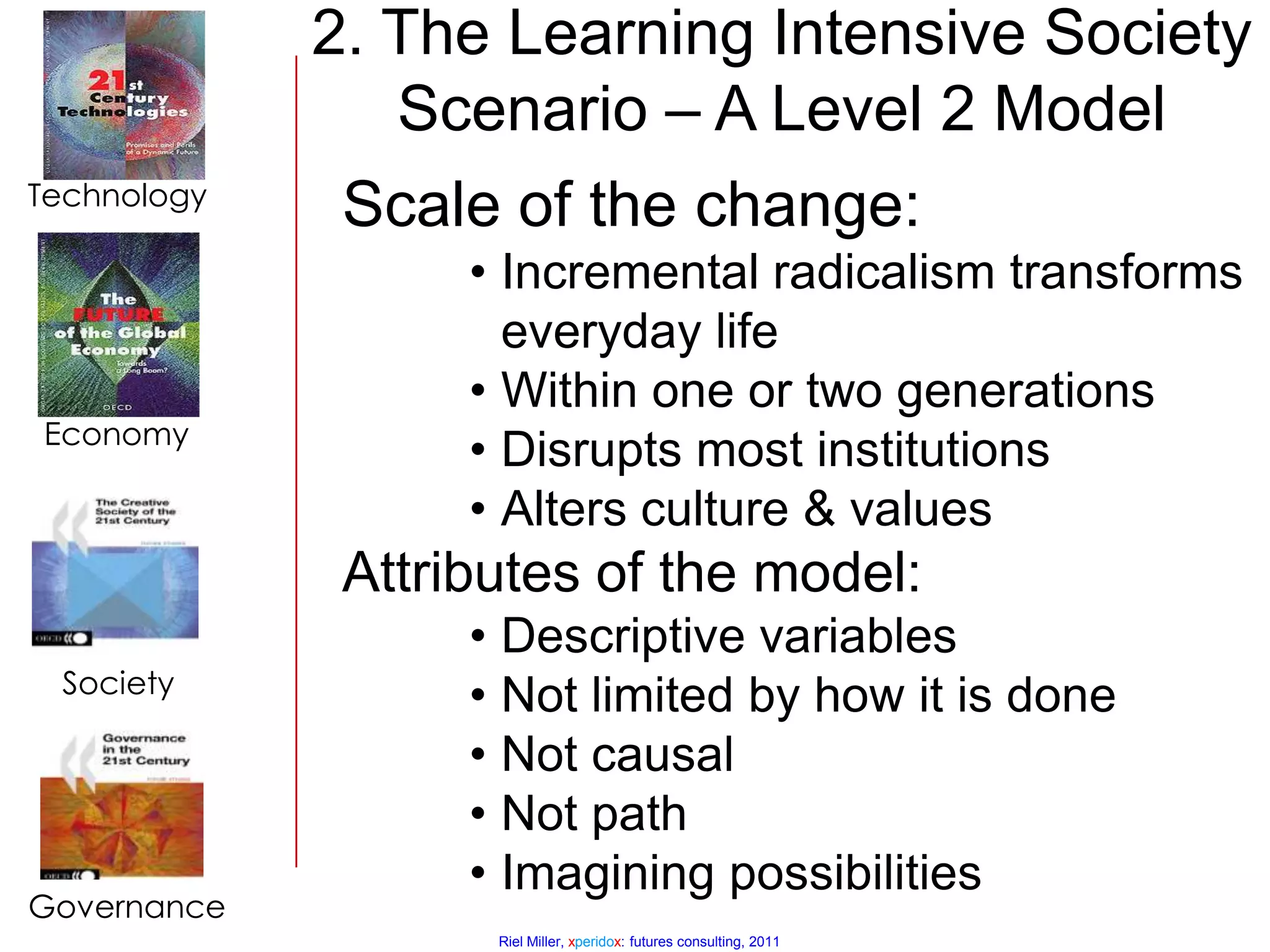
2. The Learning Intensive Society Scenario – A Level 2 ModelSocietyTechnologyEconomyGovernanceScale of the change:Incremental radicalism transforms everyday life
Within one or two generations
Disrupts most institutions
Alters culture & valuesAttributes of the model:Descriptive variablesNot limited by how it is doneNot causalNot pathImagining possibilities
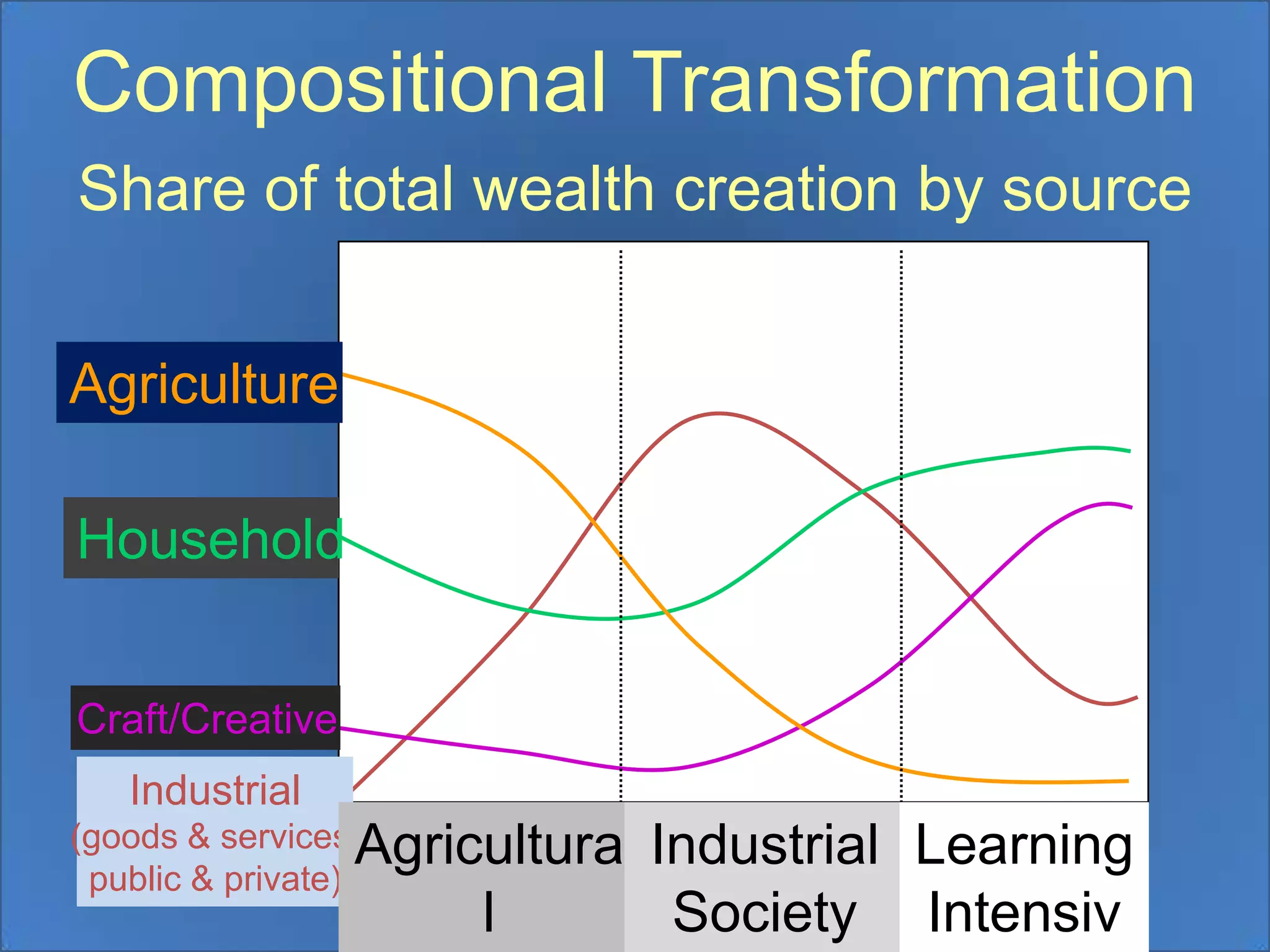
AgricultureHouseholdCraft/CreativeIndustrial(goods & services,public & private)Compositional TransformationShare of total wealth creation by sourceAgriculturalSocietyIndustrial SocietyLearningIntensive
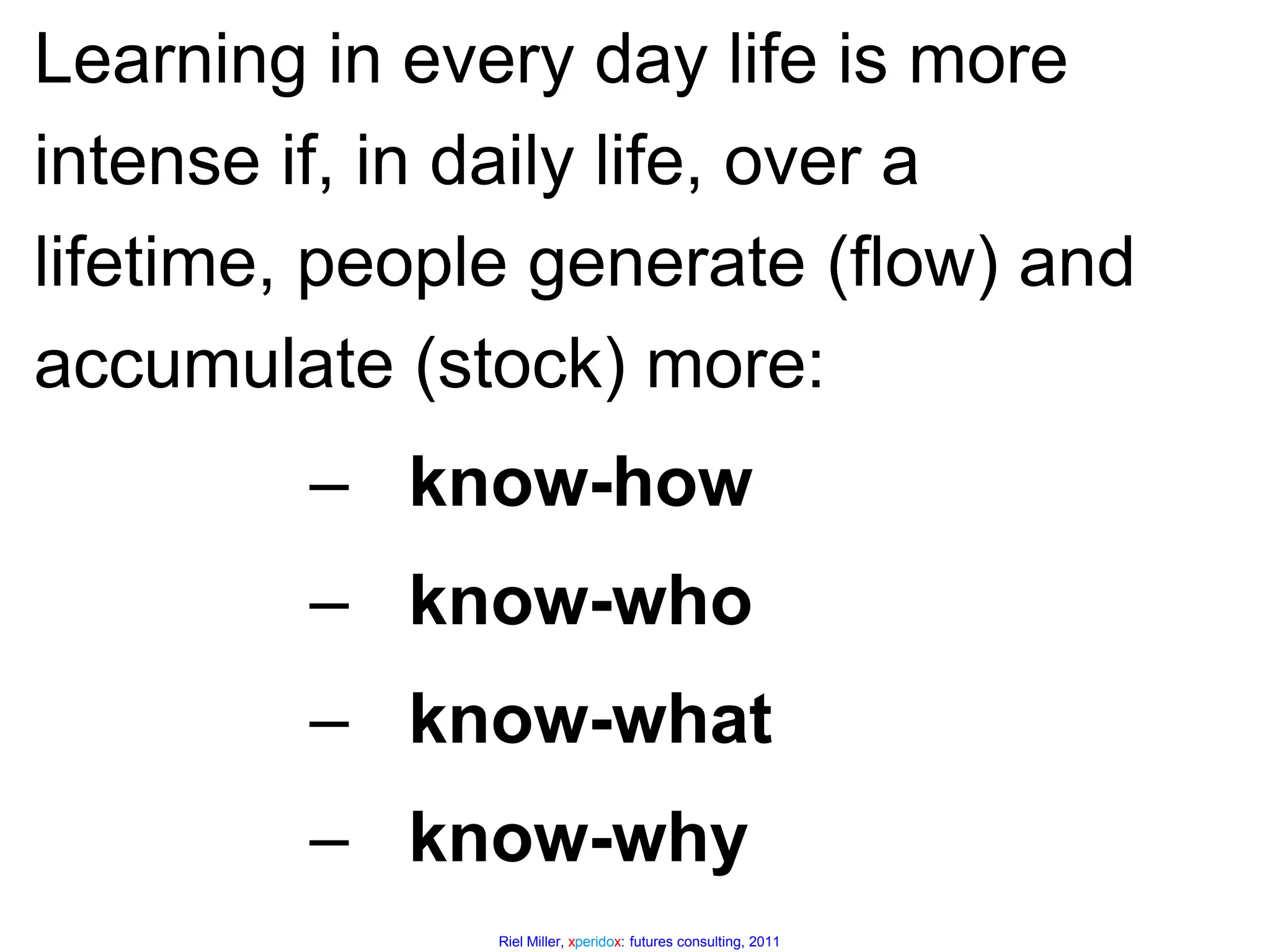
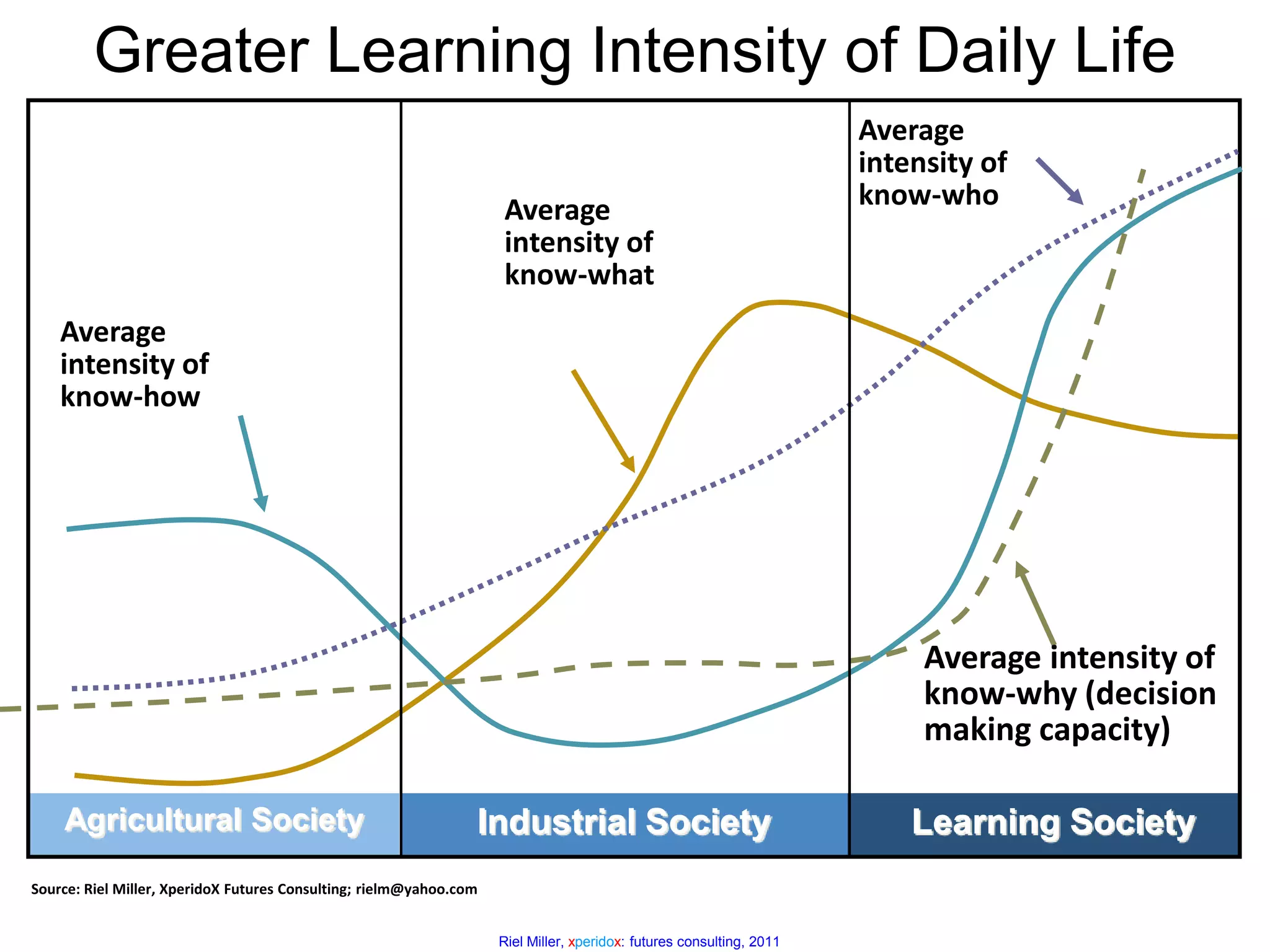
Learning in every day life is more intense if, in daily life, over a lifetime, people generate (flow) and accumulate (stock) more:know-howknow-whoknow-whatknow-why
Greater Learning Intensity of Daily LifeAverage intensity of know-whoAverage intensity of know-whatAverage intensity of know-howAverage intensity of know-why (decision making capacity)Agricultural SocietyIndustrial SocietyLearning SocietySource: Riel Miller, XperidoX Futures Consulting; rielm@yahoo.com
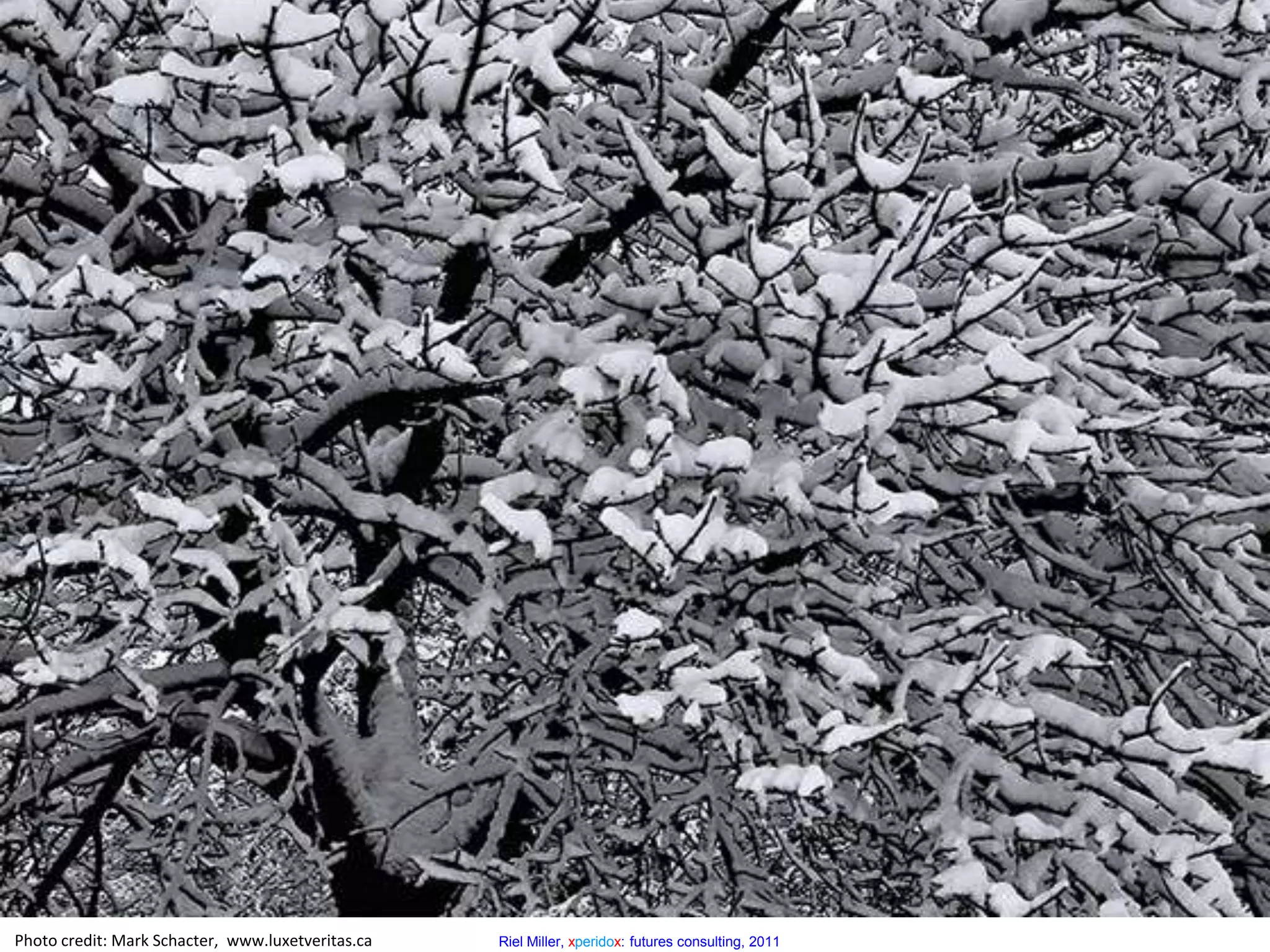
Moving to the Micro-Level: Complex societal evolutionEconomic SocialGovernancePhoto credit: Mark Schacter,  www.luxetveritas.ca
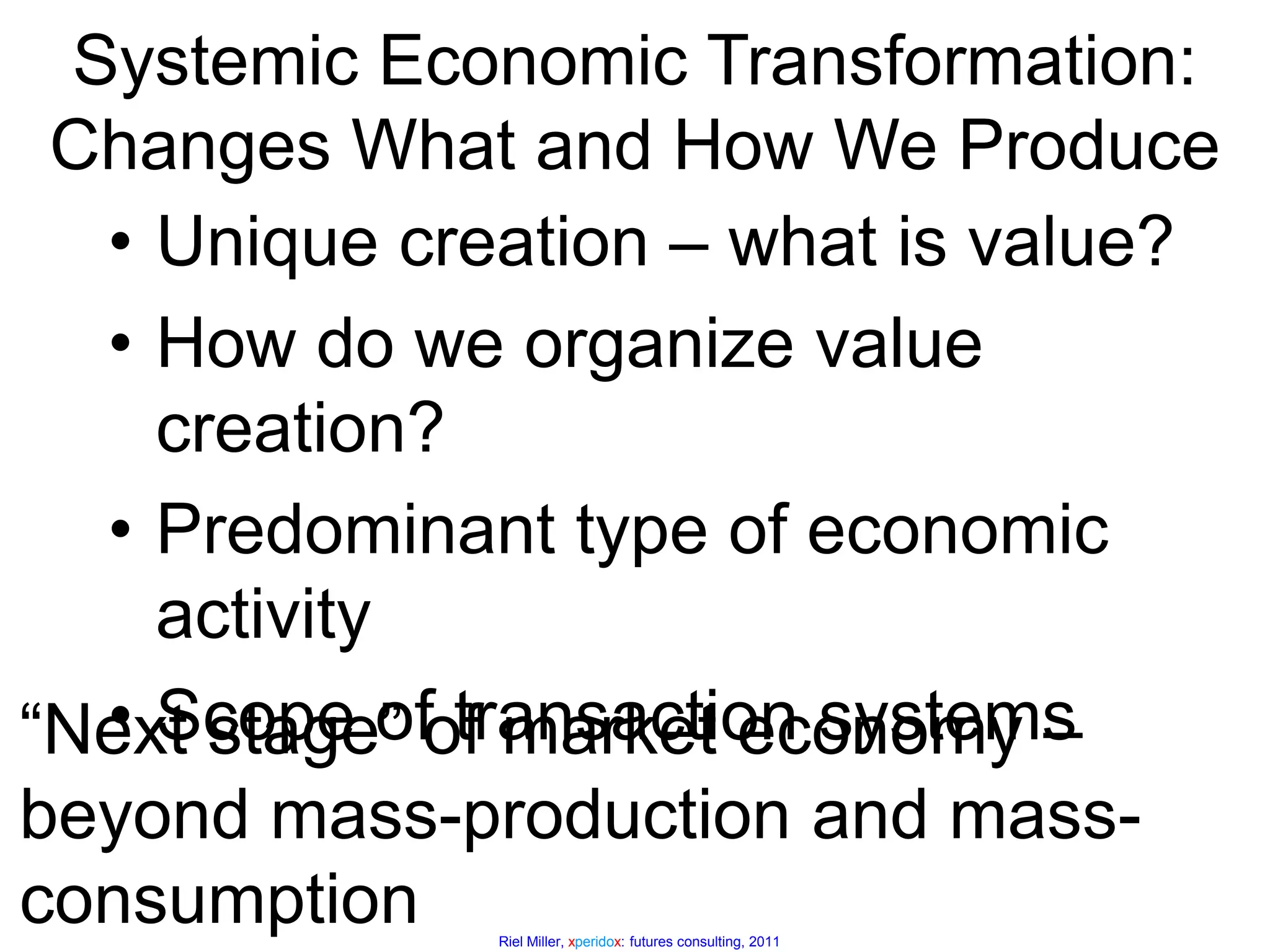
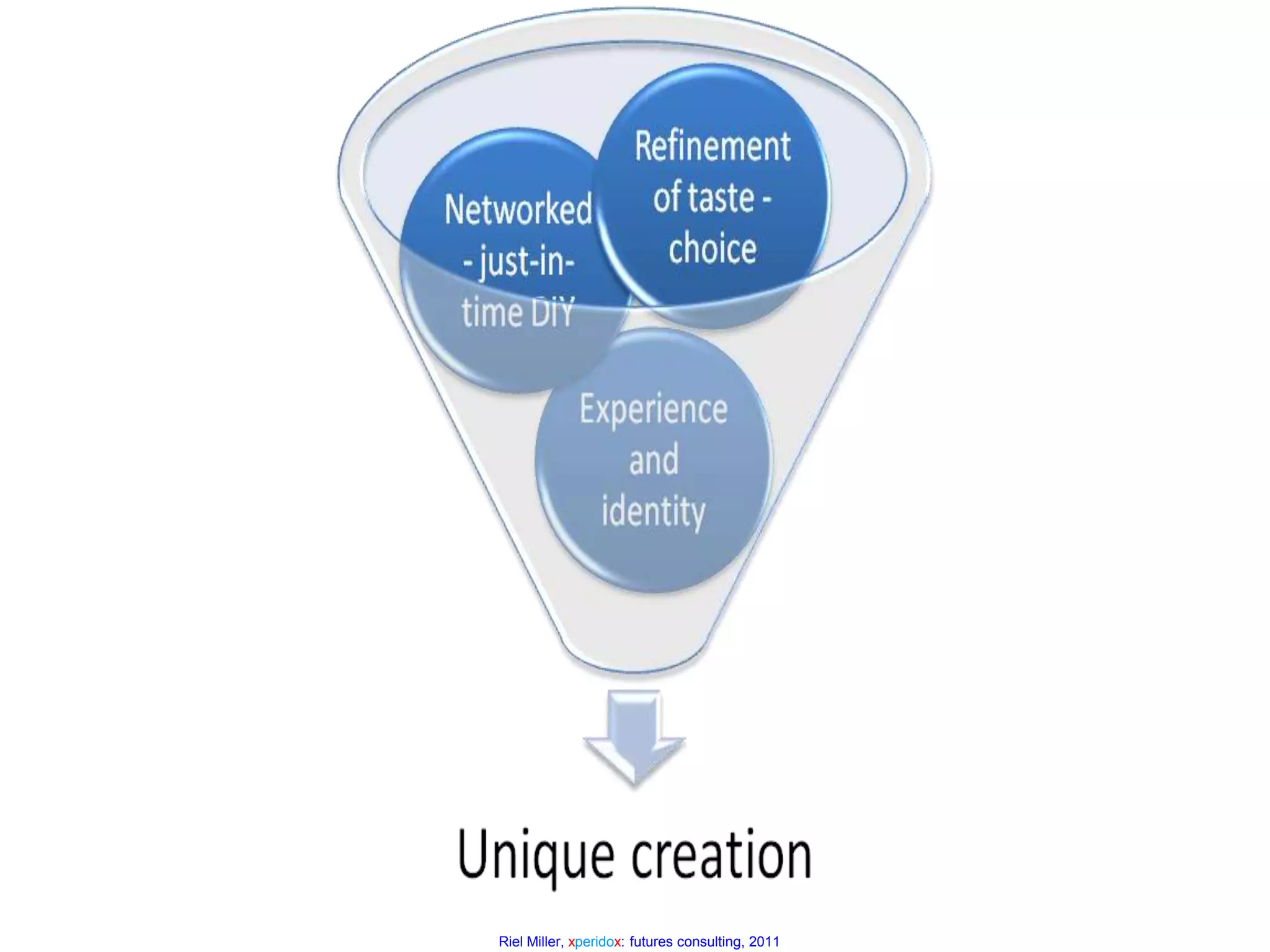
Systemic Economic Transformation: Changes What and How We ProduceUnique creation – what is value?How do we organize value creation?Predominant type of economic activityScope of transaction systems“Next stage” of market economy – beyond mass-production and mass-consumption
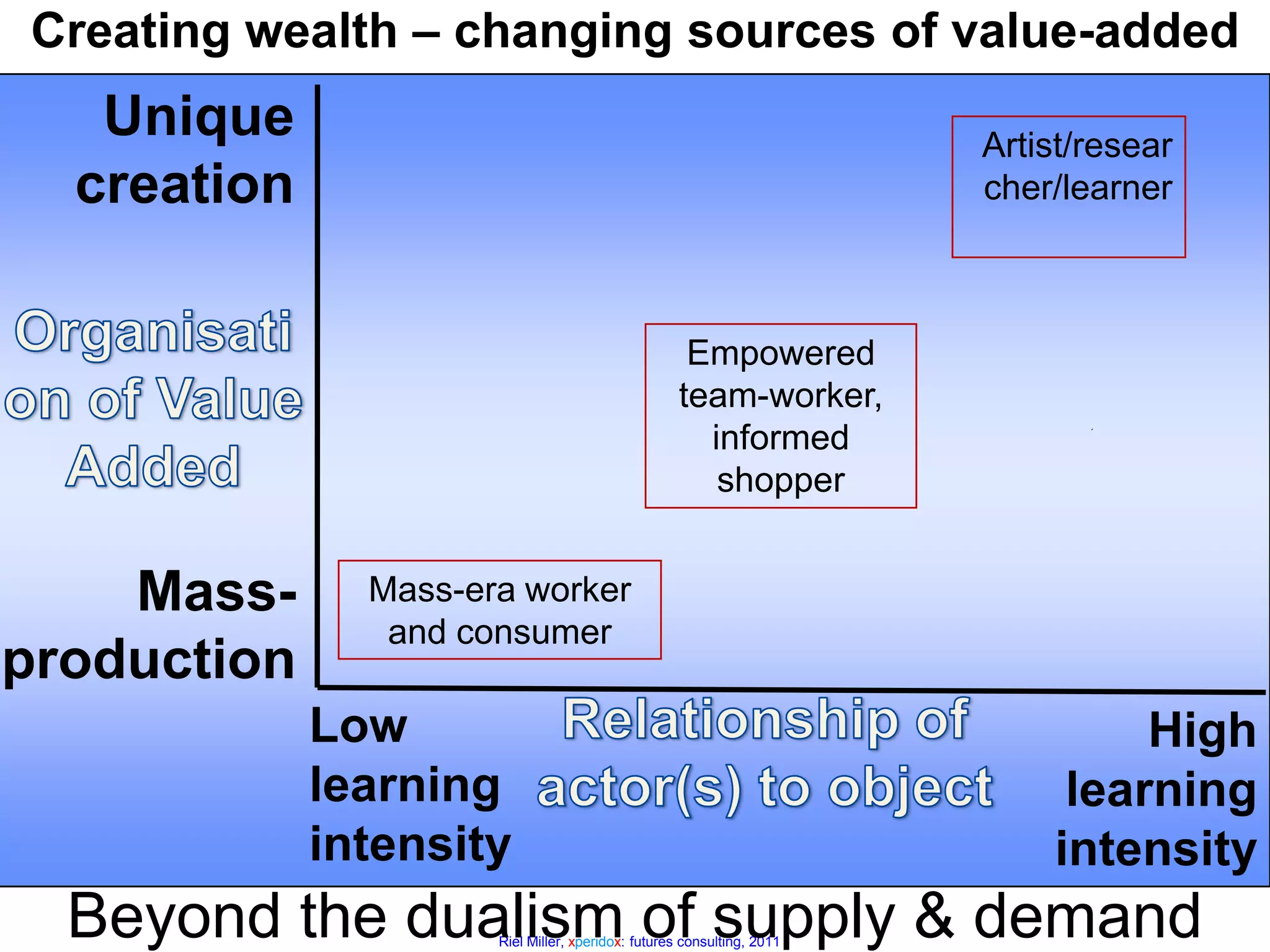
Creating wealth – changing sources of value-addedUnique creationArtist/researcher/learnerOrganisation of Value AddedEmpoweredteam-worker, informedshopperMass-productionMass-eraworkerand consumerRelationship of actor(s) to objectLow learning intensityHigh learning intensityBeyond the dualism of supply & demand
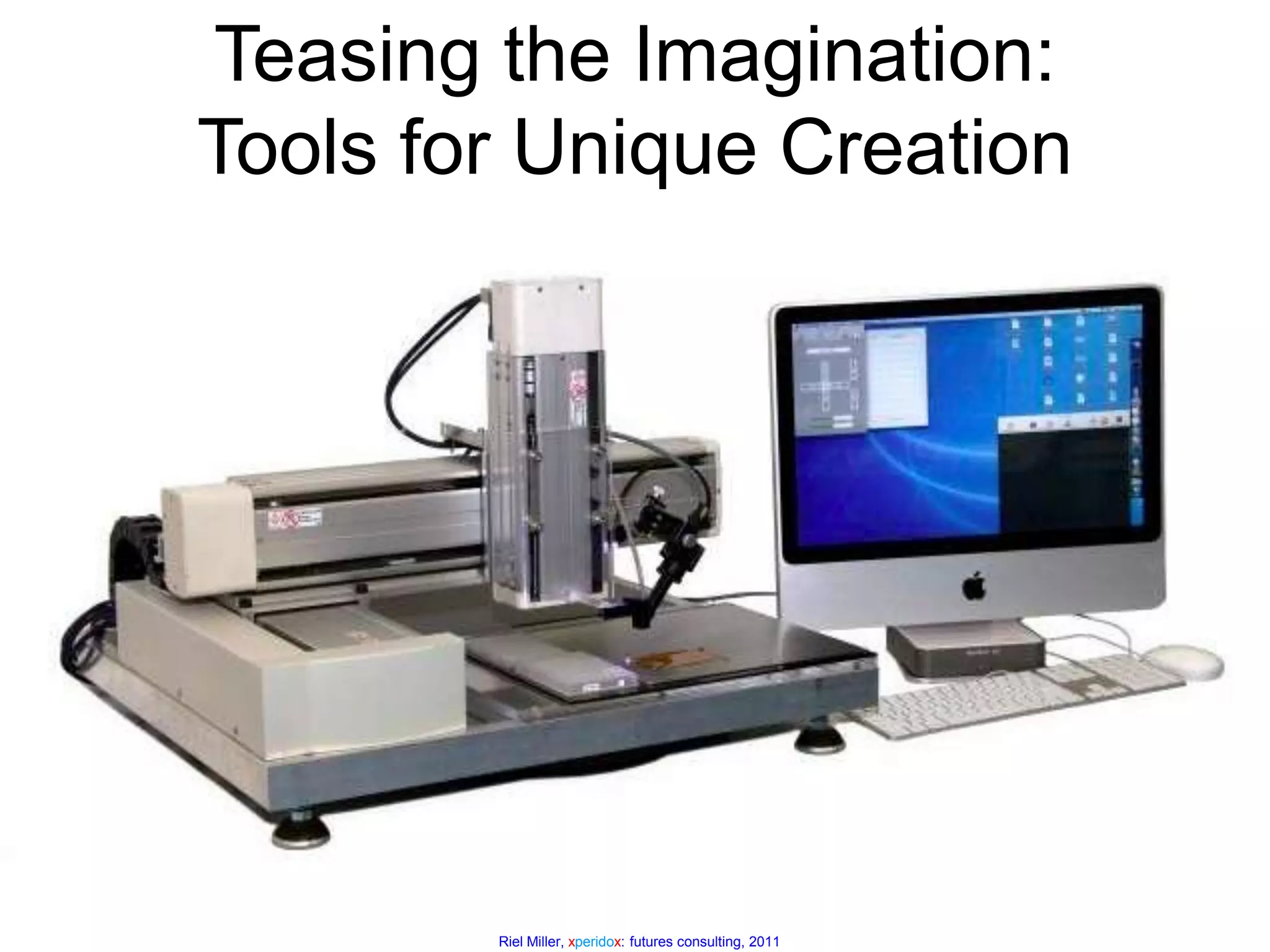
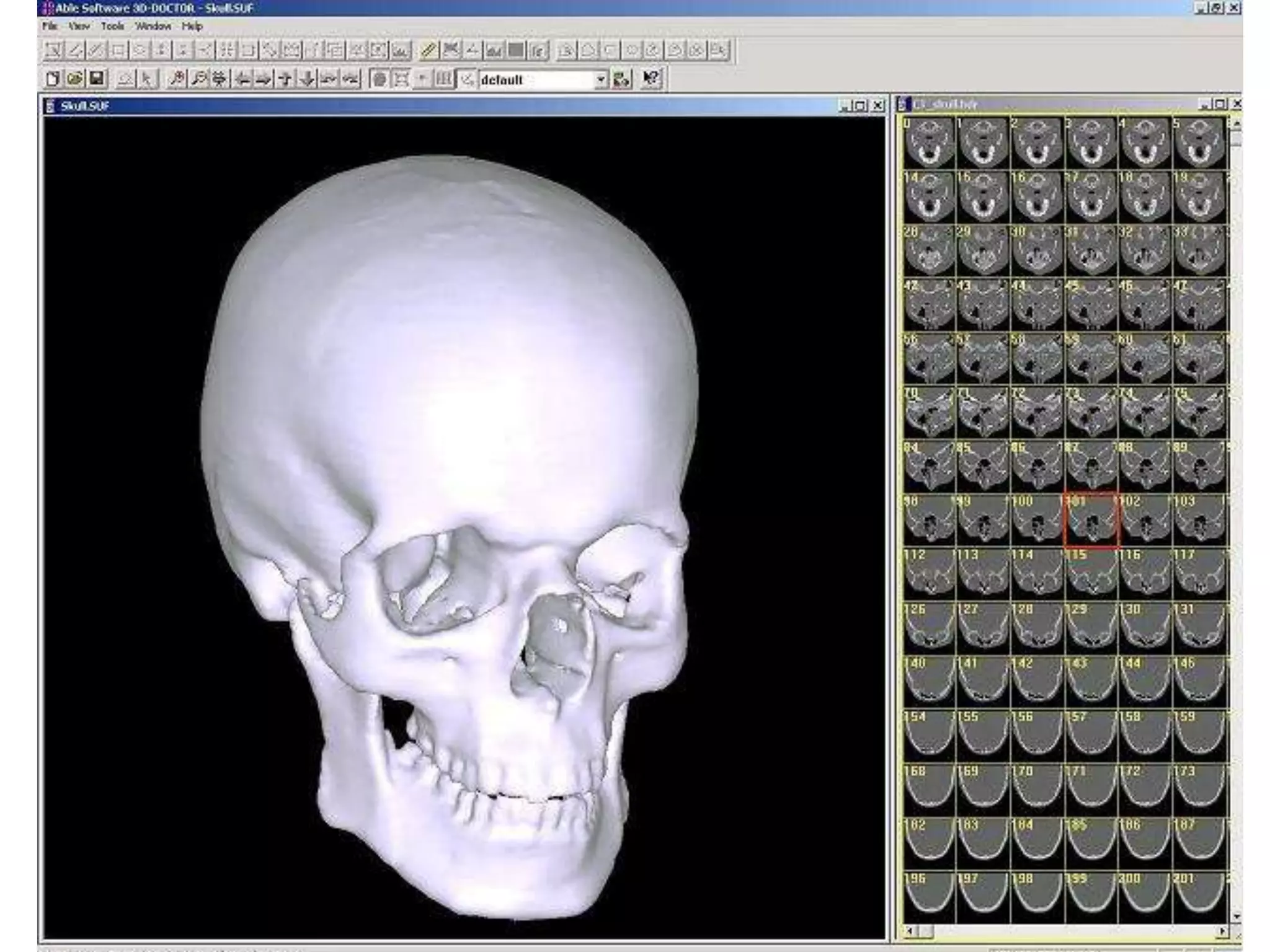
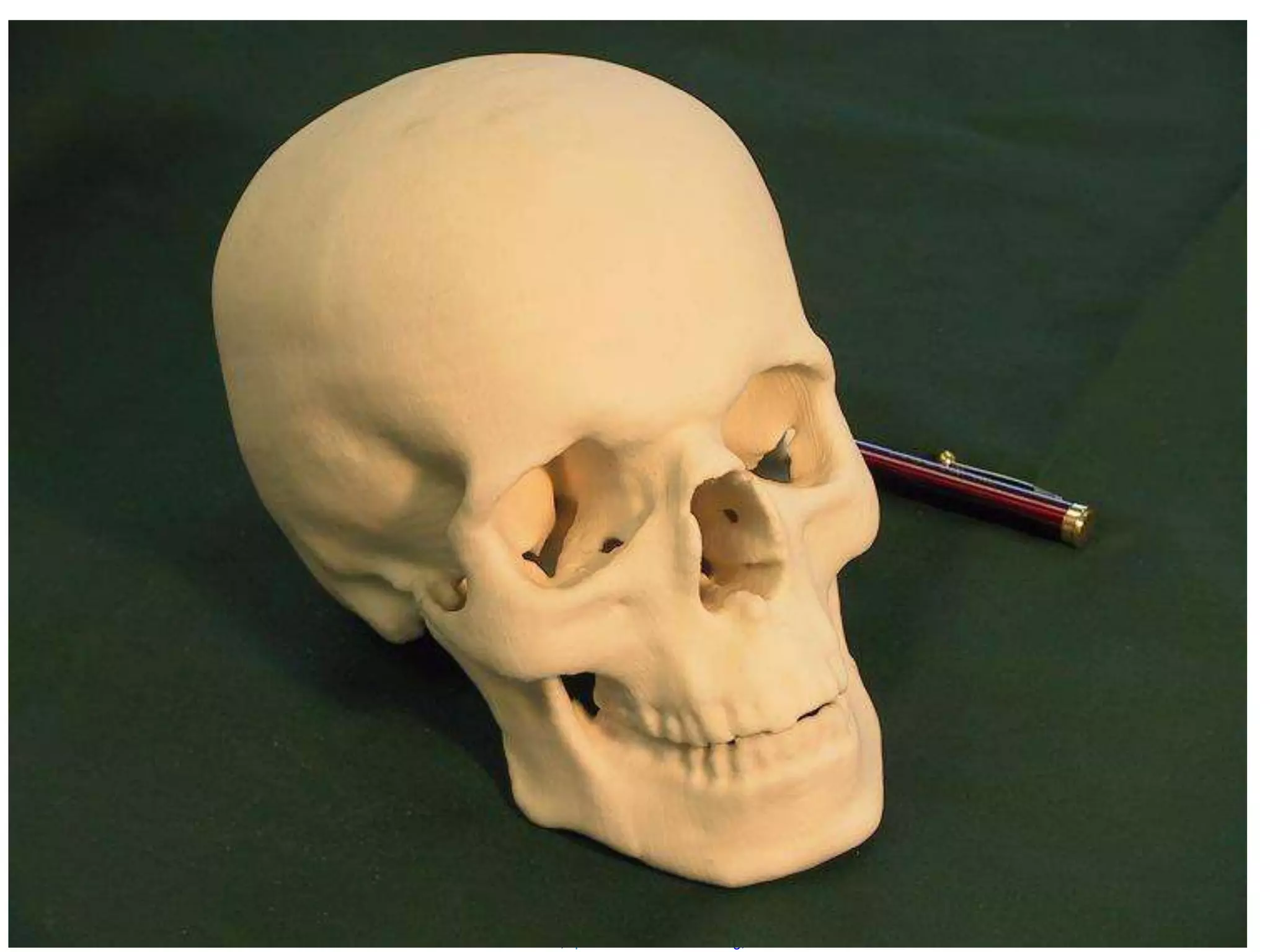
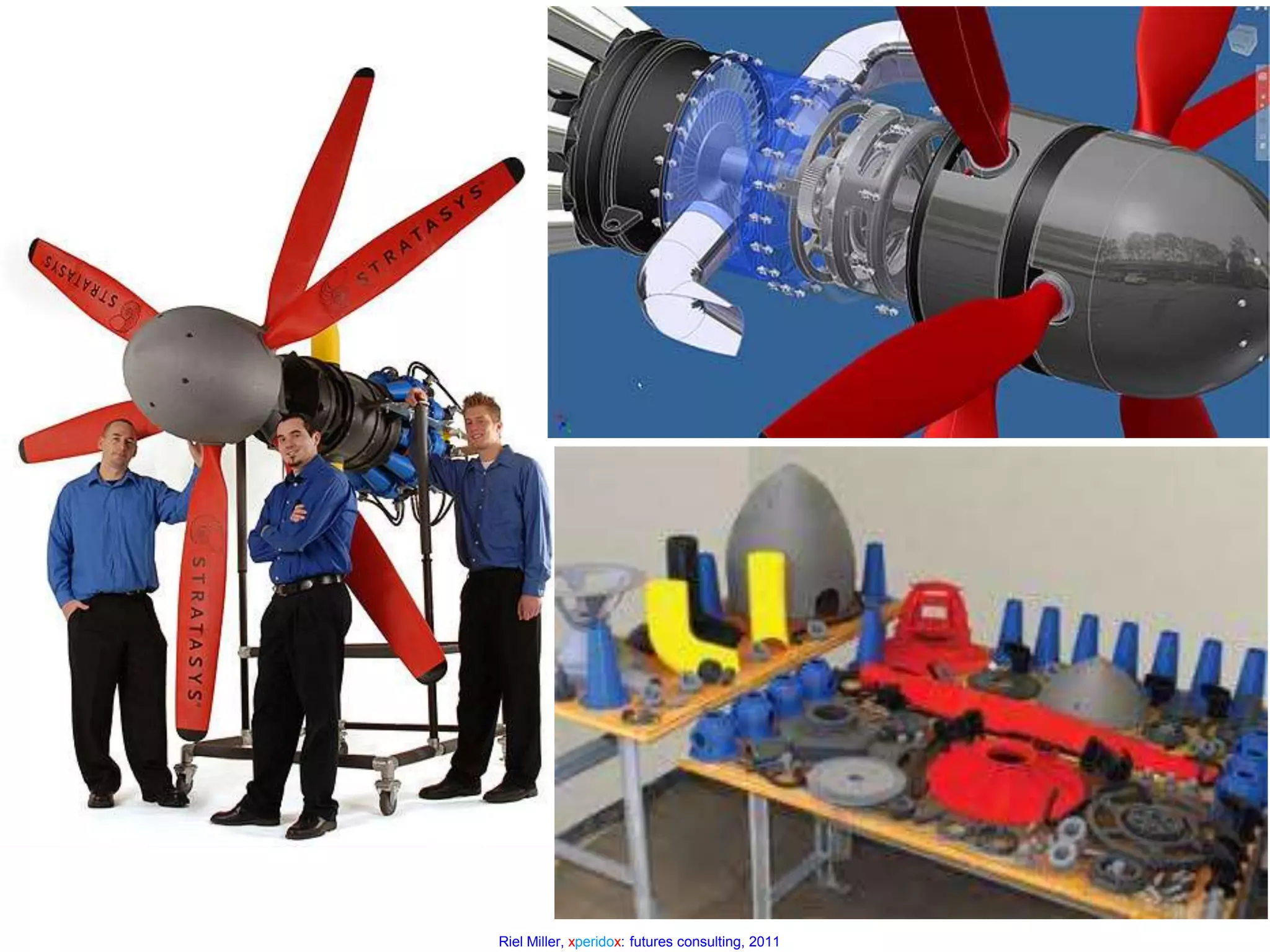
Teasing the Imagination:Tools for Unique Creation
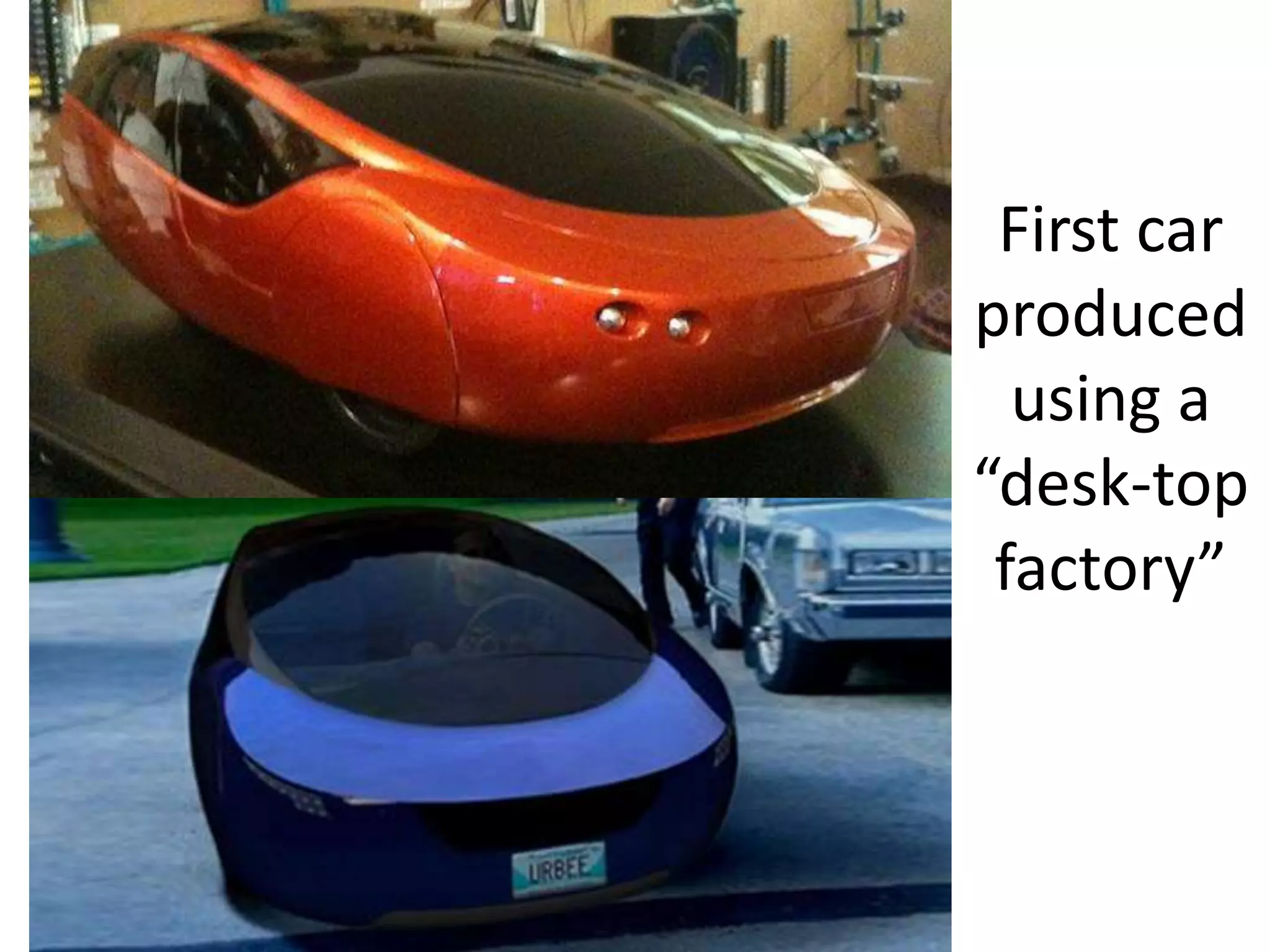
First car produced using a “desk-top factory”
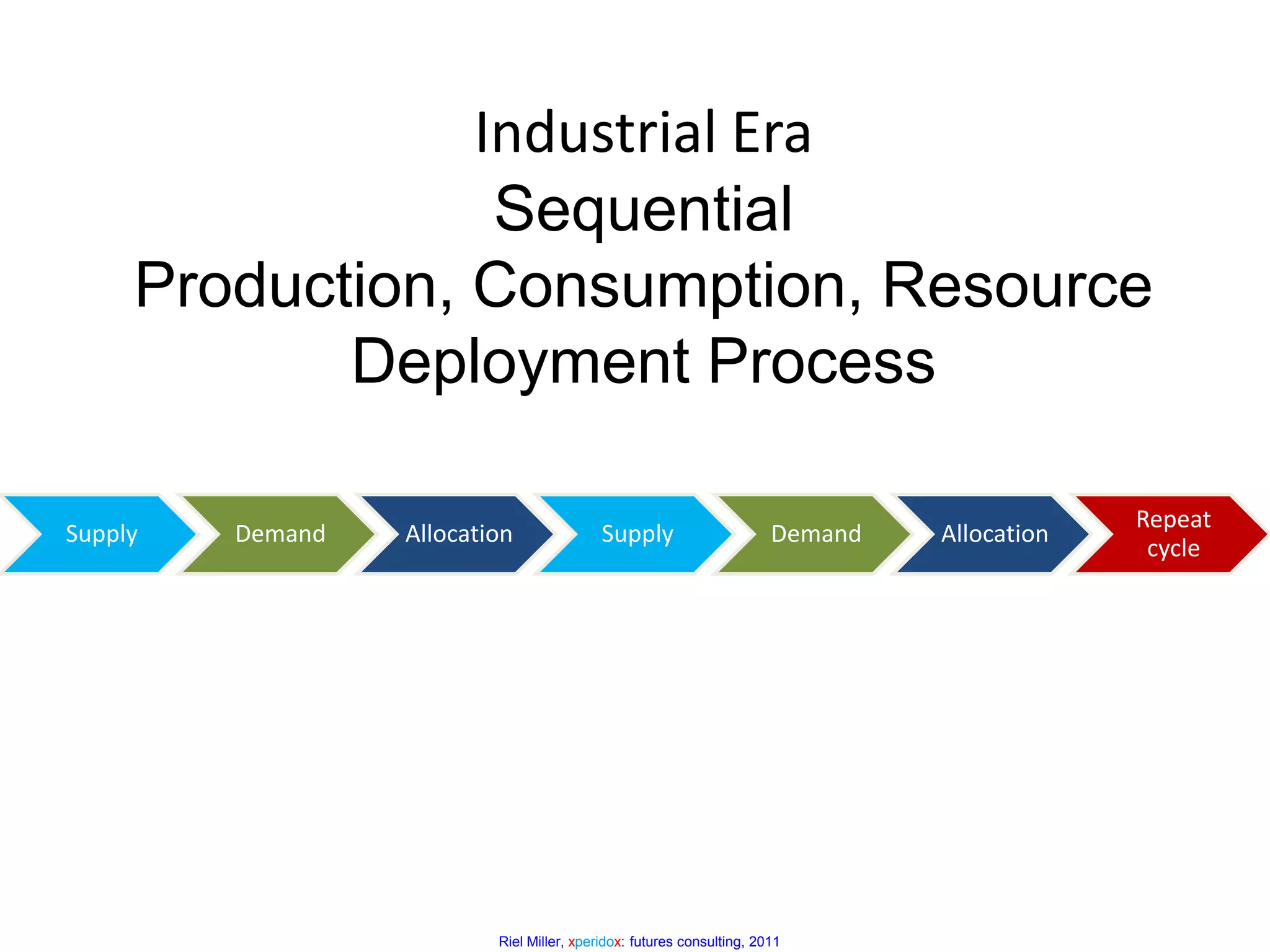
Industrial EraSequential Production, Consumption, Resource Deployment Process
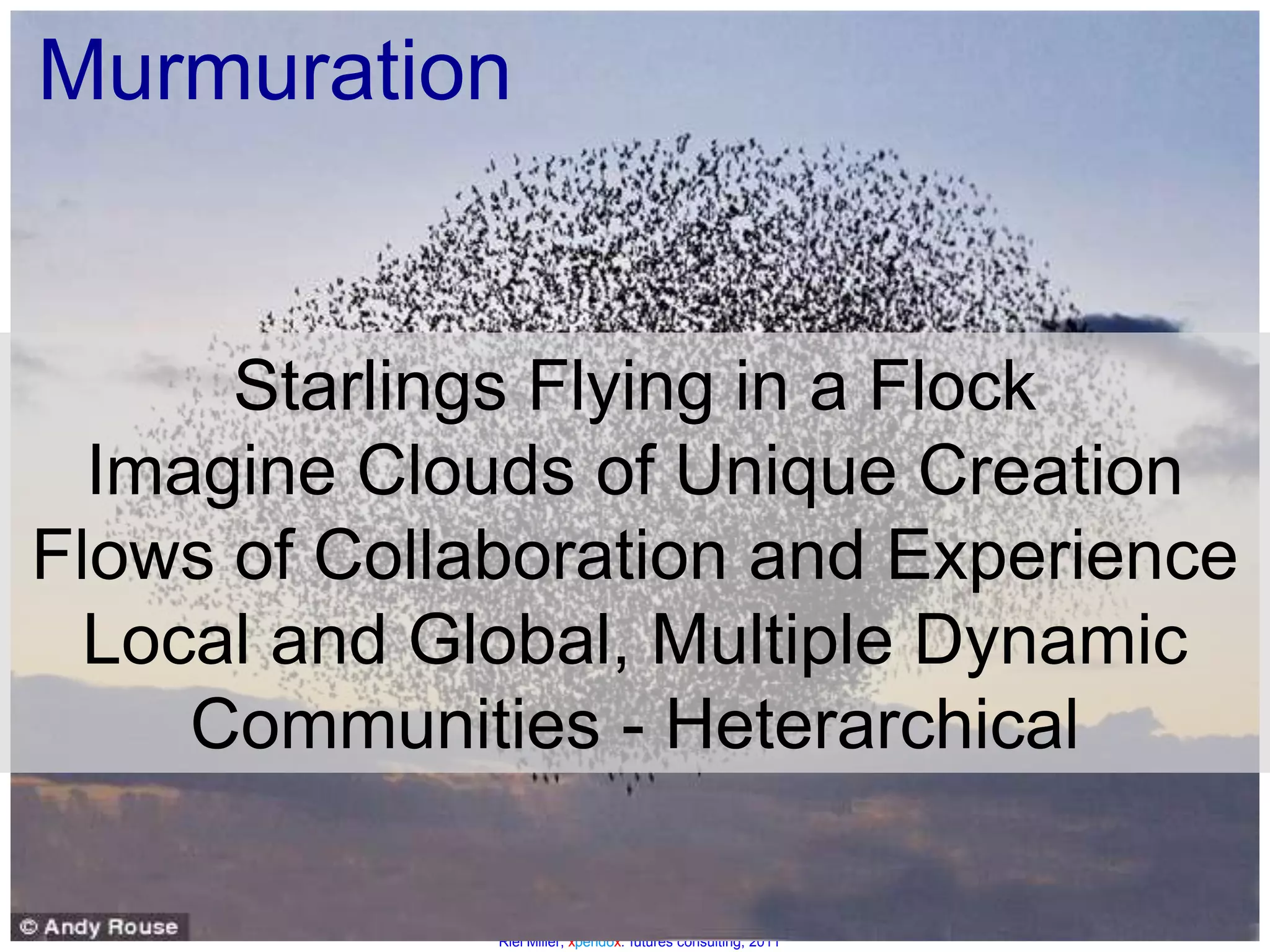
MurmurationStarlings Flying in a FlockImagine Clouds of Unique Creation Flows of Collaboration and ExperienceLocal and Global, Multiple Dynamic Communities - Heterarchical
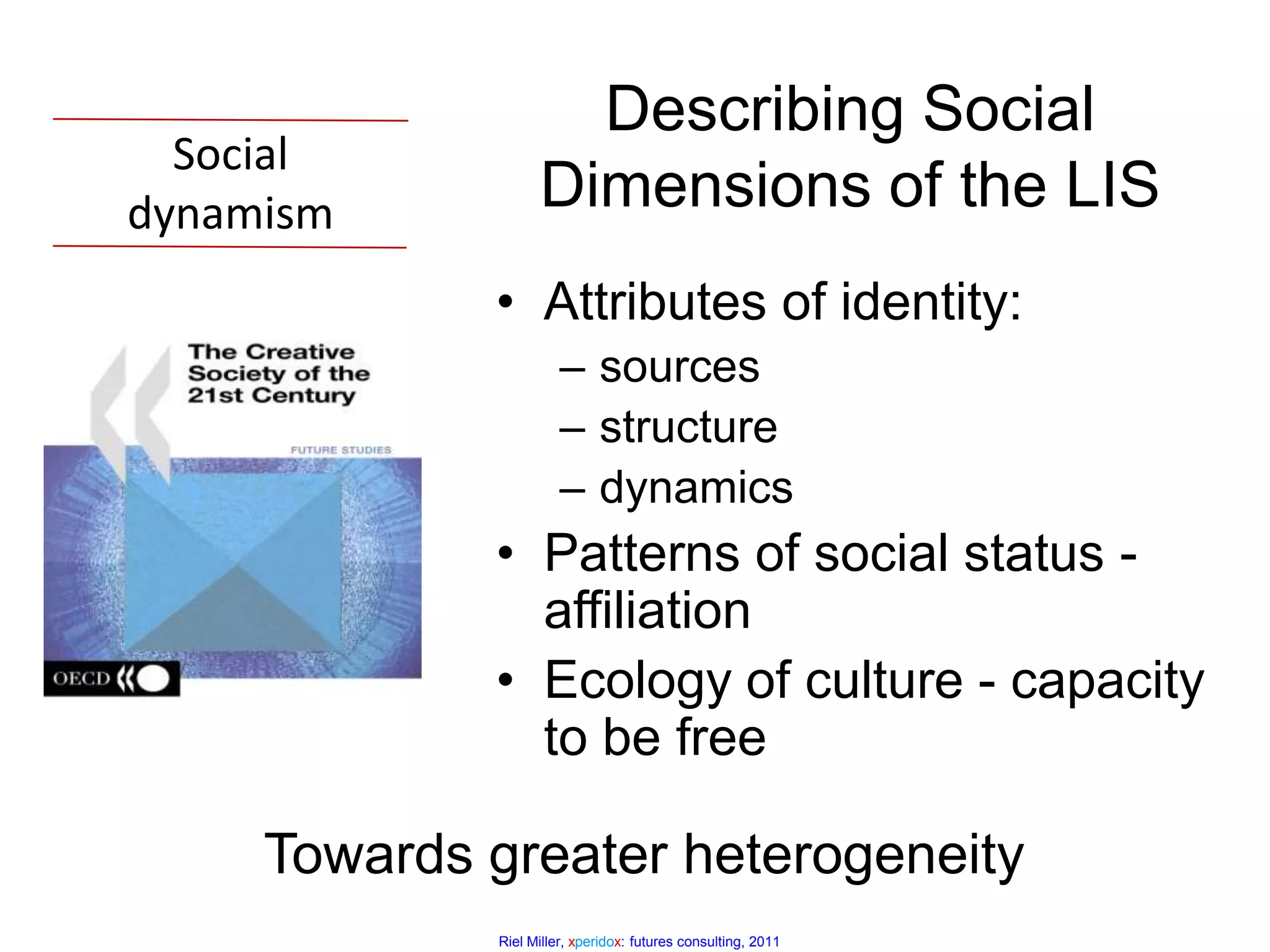
Social dynamismDescribing Social Dimensions of the LISAttributes of identity:
sources
structure
dynamics
Patterns of social status - affiliation
Ecology of culture - capacity to be freeTowards greater heterogeneity
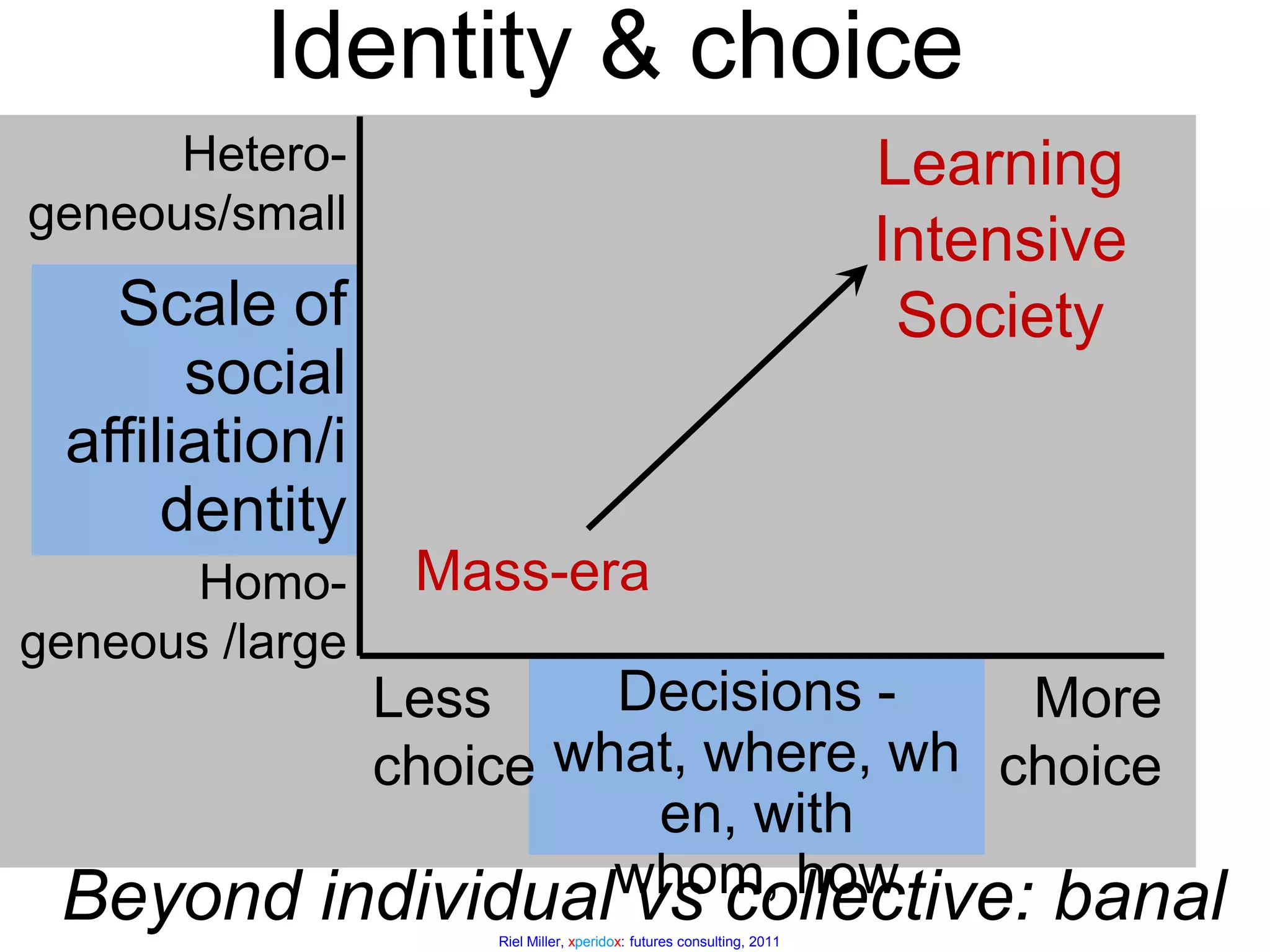
Identity & choiceHetero-geneous/smallLearning Intensive SocietyScale of social affiliation/identityMass-eraHomo-geneous /largeDecisions - what, where, when, with whom, howLess choiceMore choiceBeyond individual vscollective: banal creativity

Education Futures: Part of the Solution or Part of the Problem?

  • 1.
    Education Futures: Partof the Solution or Part of the Problem?------------------------------------------------------------------------------------Riel MillerEDUCATIONAL FUTURESLeadership and PracticeThe Open University, Milton Keynes, May 17, 2011Artist: HeykoStoeber
  • 2.
    Two Big Changes1.In the way we think about the world.2. In the way we organize the world.Fundamental indeterminacy and the creativity of the universeHeterarchy and the Learning Intensive Society murmuration
  • 3.
    1. Embracing Complexity:Changing the way we use the futurePhoto credit: Mark Schacter ©
  • 4.
    The End ofCertaintyMankind is at a turning point, the beginning of a new rationality in which science is no longer identified with certitude and probability with ignorance. … science is no longer limited to idealized and simplified situations but reflects the complexity of the real world, a science that views us and our creativity as part of a fundamental trend present at all levels of nature.Ilya Prigogine, The End of Certainty: Time, Chaos and the New Laws of Nature… we are now able to include probabilities in the formulation of the basic laws of physics. Once this is done, Newtonian determinism fails; the future is no longer determined by the present….
  • 5.
    The possible isnot in the future it is in the past.“We must resign ourselves to the inevitable: it is the real which makes itself possible, and not the possible which becomes real. But the truth is that philosophy has never frankly admitted this continuous creation of unforeseeable novelty.”Henri Bergson, The Creative Mind
  • 6.
    Caught in theProbabilistic Stance: Probable, Possible, Plausible
  • 8.
    What difference doesit make?After all everyday life goes on.So why bother?It changes what we see.
  • 9.
    It changes whatwe imagine.
  • 10.
    It changes whatwe resist.
  • 11.
    It changes whatwe preserve.
  • 12.
    It changes howwe preserve what we want to preserve.
  • 13.
    It changes theconditions of change.Then what? If we accept this ontological starting point – how to make it practical? Take an anticipatory systems perspective that encompasses both animate and inanimate anticipation.Distinguish the three ontological dimensions of the potential of the present – three ways of imagining the future and the different methods that are related to each (ontology-epistemology linked).Learning processes that use collective intelligence – action research, reframing, and narrative capacity to question anticipatory assumptions – embracing complexity, spontaneity, improvisation.
  • 14.
  • 15.
    Futures Literacy: ambientstrategic thinkingFutures Literacy is the capacity to tell anticipatory stories using rigorous imagining based on sharing depth of knowledge from across the community. FL is a way of internalizing the constant development of our understanding of the potential of the emergent present and of changing anticipatory assumptions.
  • 16.
  • 18.
    Anticipatory Systems ViewS : object systemM : model of SE : effector systemSource: Robert Rosen, Anticipatory Systems: Philosophical, Mathematical, & Methodological Foundations., Pergamon Press, Oxford, 1985. Slide by A. H. Louie, Mathematical Biologist
  • 19.
    “The main differencebetween forecasting and scenarios on the one hand, and anticipation on the other, is that the latter is a property of the system, intrinsic to its functioning, while the former are cognitive strategies that a system A develops in order to understand the future of some other system B (of which A may or may not be a component element). … The theory of anticipatory systems can therefore be seen as comprising both first- and third-person information.”Roberto Poli, 2010
  • 20.
    B. Three dimensionsof the potential of the present
  • 21.
  • 22.
  • 23.
    Optimization Futures: Chess,Farming, Assembly LineNon-complex goal, known in advance and fixedRules are given in advance and fixedResources are given in advance and fixed
  • 24.
    Exploratory futures: imaginingthe potential of the present
  • 26.
    C. HybridStrategic Scenario MethodRigorous imagining – developing analytically rich and imaginative stories of a functioning society as a way to question our assumptions.
  • 27.
    Futures Literacy: DecisionMaking CapacityUsing the Future for Knowledge Creation, Discovery and Communication
  • 28.
    Futures Literacy inPracticeLevel 1 futures literacyTemporal awareness, values, expectationsLevel 2 futures literacyRigorous imaginingLevel 3 futures literacyStrategic scenarios
  • 29.
    Anticipatory Methods: ContextMakes a DifferenceComplexExplorationOptimization(chess game)SimpleOpenClosedAligning Anticipatory Contexts and Systems: Embracing Complexity – Use Futures Literacy
  • 30.
    2. The LearningIntensive Society Scenario – A Level 2 ModelSocietyTechnologyEconomyGovernanceScale of the change:Incremental radicalism transforms everyday life
  • 31.
    Within one ortwo generations
  • 32.
  • 33.
    Alters culture &valuesAttributes of the model:Descriptive variablesNot limited by how it is doneNot causalNot pathImagining possibilities
  • 34.
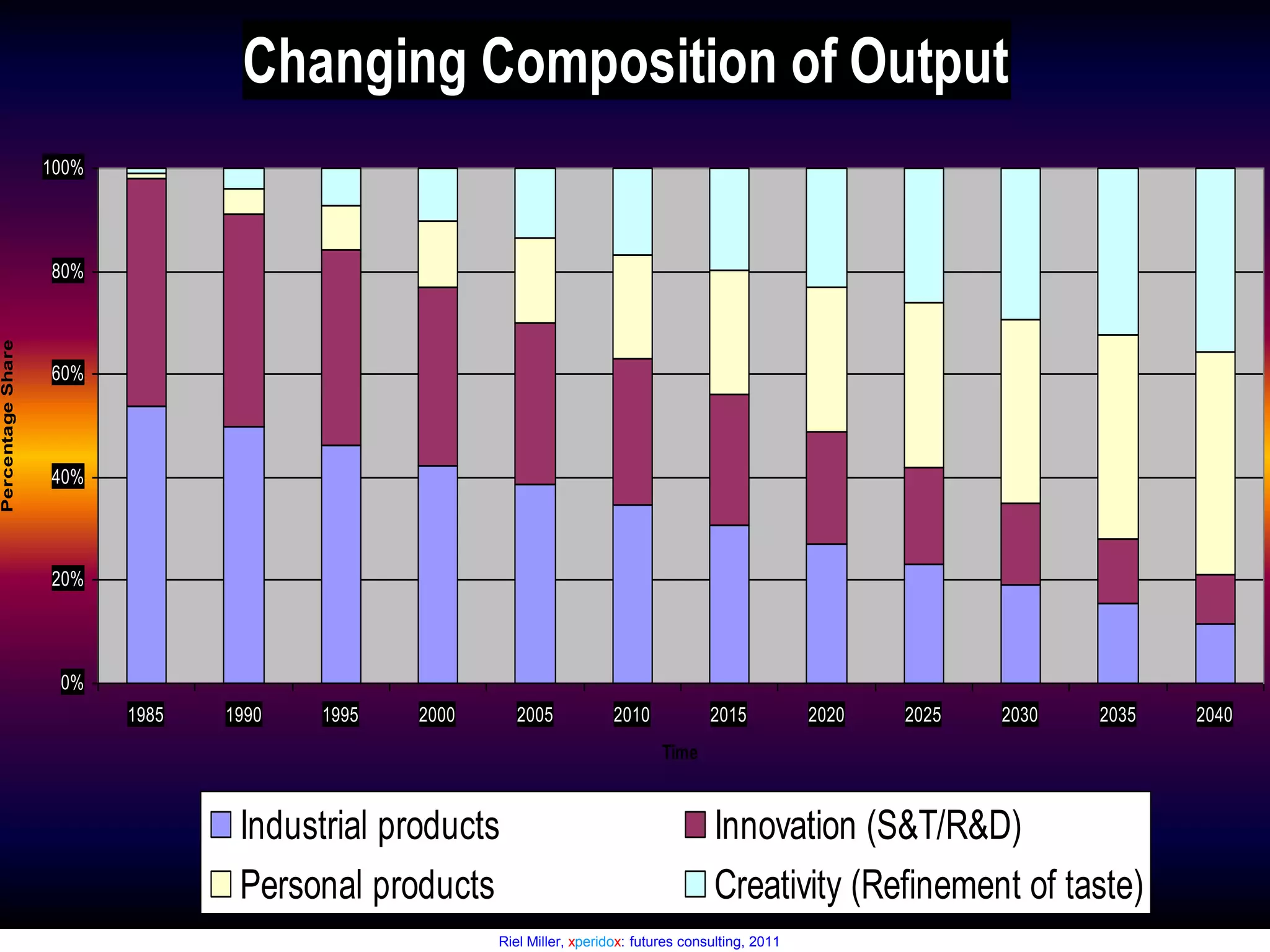
    AgricultureHouseholdCraft/CreativeIndustrial(goods & services,public& private)Compositional TransformationShare of total wealth creation by sourceAgriculturalSocietyIndustrial SocietyLearningIntensive
  • 35.
    Learning in everyday life is more intense if, in daily life, over a lifetime, people generate (flow) and accumulate (stock) more:know-howknow-whoknow-whatknow-why
  • 36.
    Greater Learning Intensityof Daily LifeAverage intensity of know-whoAverage intensity of know-whatAverage intensity of know-howAverage intensity of know-why (decision making capacity)Agricultural SocietyIndustrial SocietyLearning SocietySource: Riel Miller, XperidoX Futures Consulting; rielm@yahoo.com
  • 37.
    Moving to theMicro-Level: Complex societal evolutionEconomic SocialGovernancePhoto credit: Mark Schacter, www.luxetveritas.ca
  • 38.
    Systemic Economic Transformation:Changes What and How We ProduceUnique creation – what is value?How do we organize value creation?Predominant type of economic activityScope of transaction systems“Next stage” of market economy – beyond mass-production and mass-consumption
  • 39.
    Creating wealth –changing sources of value-addedUnique creationArtist/researcher/learnerOrganisation of Value AddedEmpoweredteam-worker, informedshopperMass-productionMass-eraworkerand consumerRelationship of actor(s) to objectLow learning intensityHigh learning intensityBeyond the dualism of supply & demand
  • 40.
  • 44.
    First car producedusing a “desk-top factory”
  • 45.
    Industrial EraSequential Production,Consumption, Resource Deployment Process
  • 48.
    MurmurationStarlings Flying ina FlockImagine Clouds of Unique Creation Flows of Collaboration and ExperienceLocal and Global, Multiple Dynamic Communities - Heterarchical
  • 49.
    Social dynamismDescribing SocialDimensions of the LISAttributes of identity:
  • 50.
  • 51.
  • 52.
  • 53.
    Patterns of socialstatus - affiliation
  • 54.
    Ecology of culture- capacity to be freeTowards greater heterogeneity
  • 55.
    Identity & choiceHetero-geneous/smallLearningIntensive SocietyScale of social affiliation/identityMass-eraHomo-geneous /largeDecisions - what, where, when, with whom, howLess choiceMore choiceBeyond individual vscollective: banal creativity
  • 56.
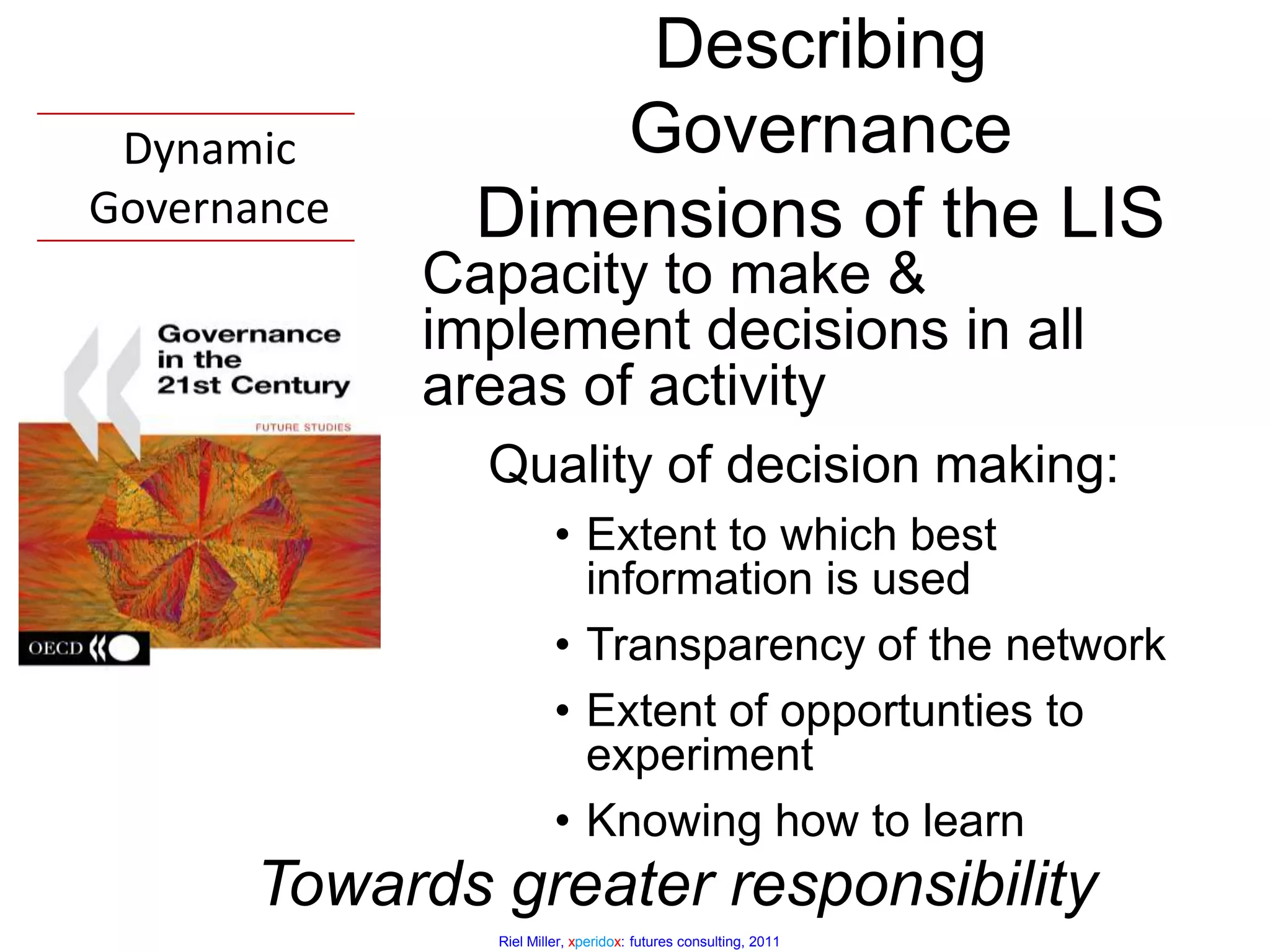
    Describing Governance Dimensionsof the LISDynamic GovernanceCapacity to make & implement decisions in all areas of activityQuality of decision making:Extent to which best information is usedTransparency of the networkExtent of opportunties to experimentKnowing how to learnTowards greater responsibility
  • 57.
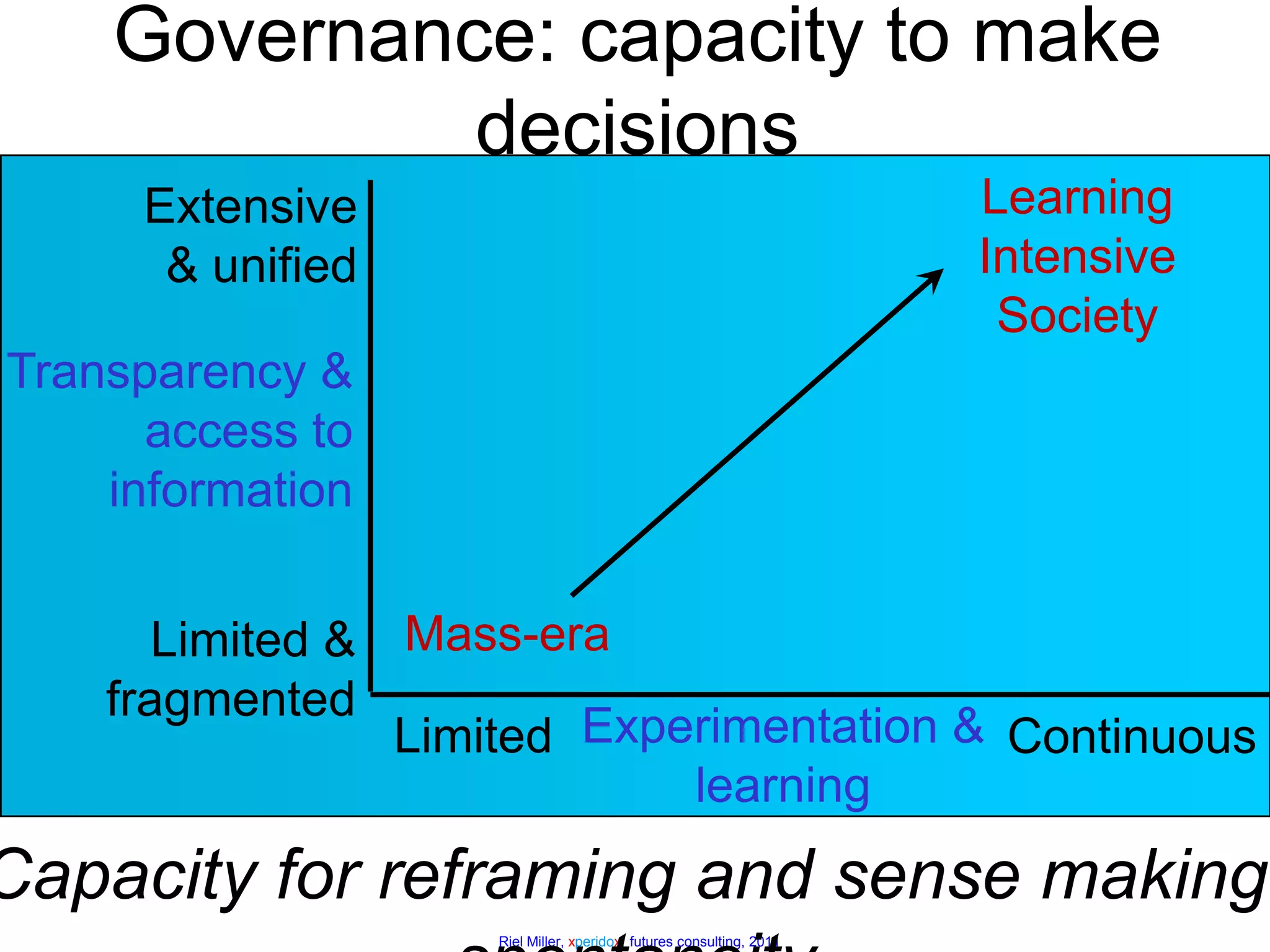
    Governance: capacity tomake decisionsLearning Intensive SocietyExtensive & unifiedTransparency & access to informationMass-eraLimited & fragmentedExperimentation & learningLimitedContinuousCapacity for reframing and sense making: spontaneity
  • 58.
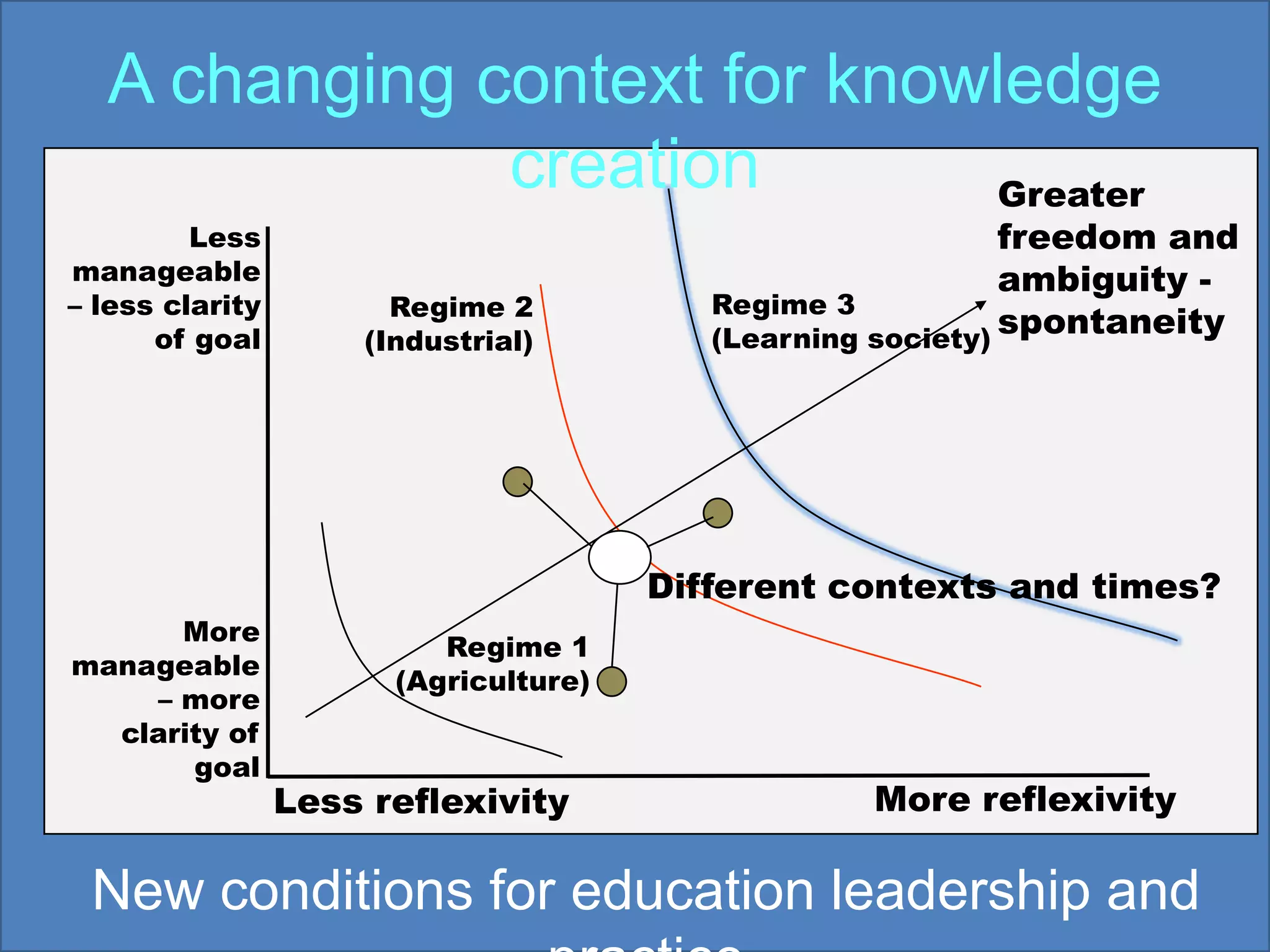
    Different contexts andtimes?Regime 1 (Agriculture)A changing context for knowledge creationGreater freedom and ambiguity - spontaneityLess manageable – less clarity of goalRegime 3 (Learning society)Regime 2 (Industrial)More manageable – more clarity of goalMore reflexivityLess reflexivityNew conditions for education leadership and practice
  • 59.
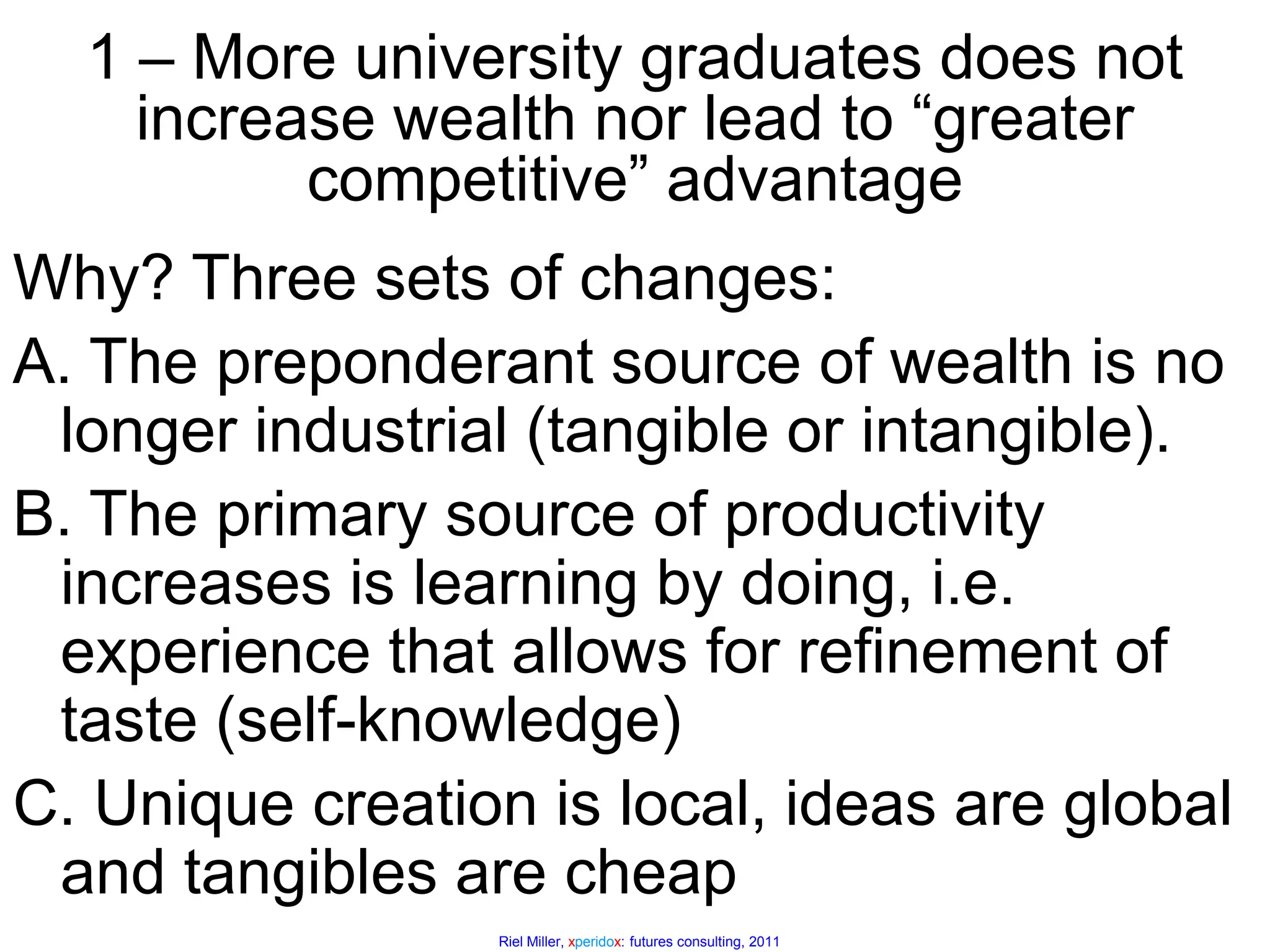
    1 – Moreuniversity graduates does not increase wealth nor lead to “greater competitive” advantageWhy? Three sets of changes:A. The preponderant source of wealth is no longer industrial (tangible or intangible).B. The primary source of productivity increases is learning by doing, i.e. experience that allows for refinement of taste (self-knowledge)C. Unique creation is local, ideas are global and tangibles are cheap
  • 61.
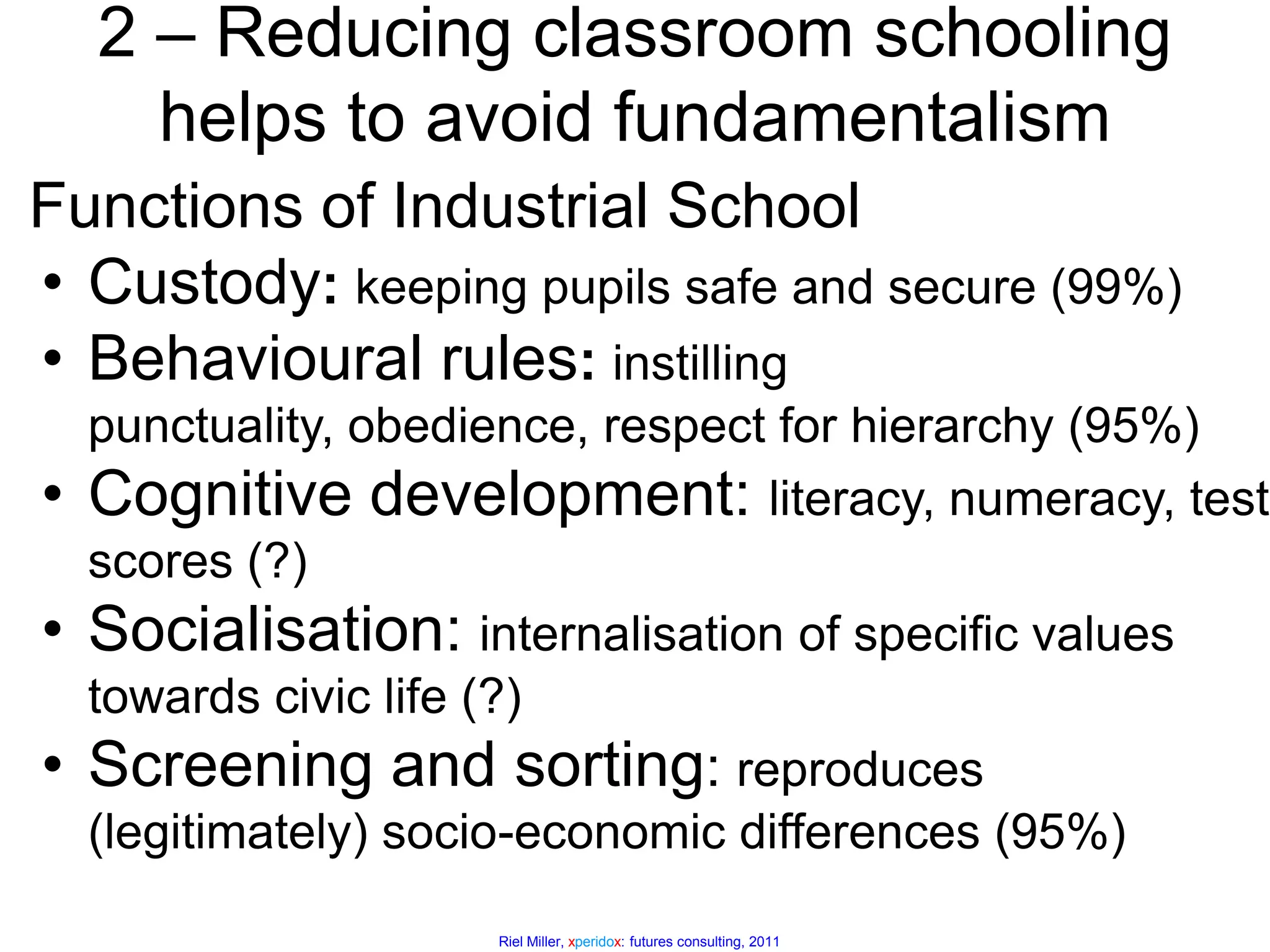
    2 – Reducingclassroom schooling helps to avoid fundamentalismFunctions of Industrial SchoolCustody: keeping pupils safe and secure (99%)Behaviouralrules: instilling punctuality, obedience, respect for hierarchy (95%)Cognitive development:literacy, numeracy, test scores (?)Socialisation: internalisation of specific values towards civic life (?)Screening and sorting: reproduces (legitimately) socio-economic differences (95%)
  • 62.
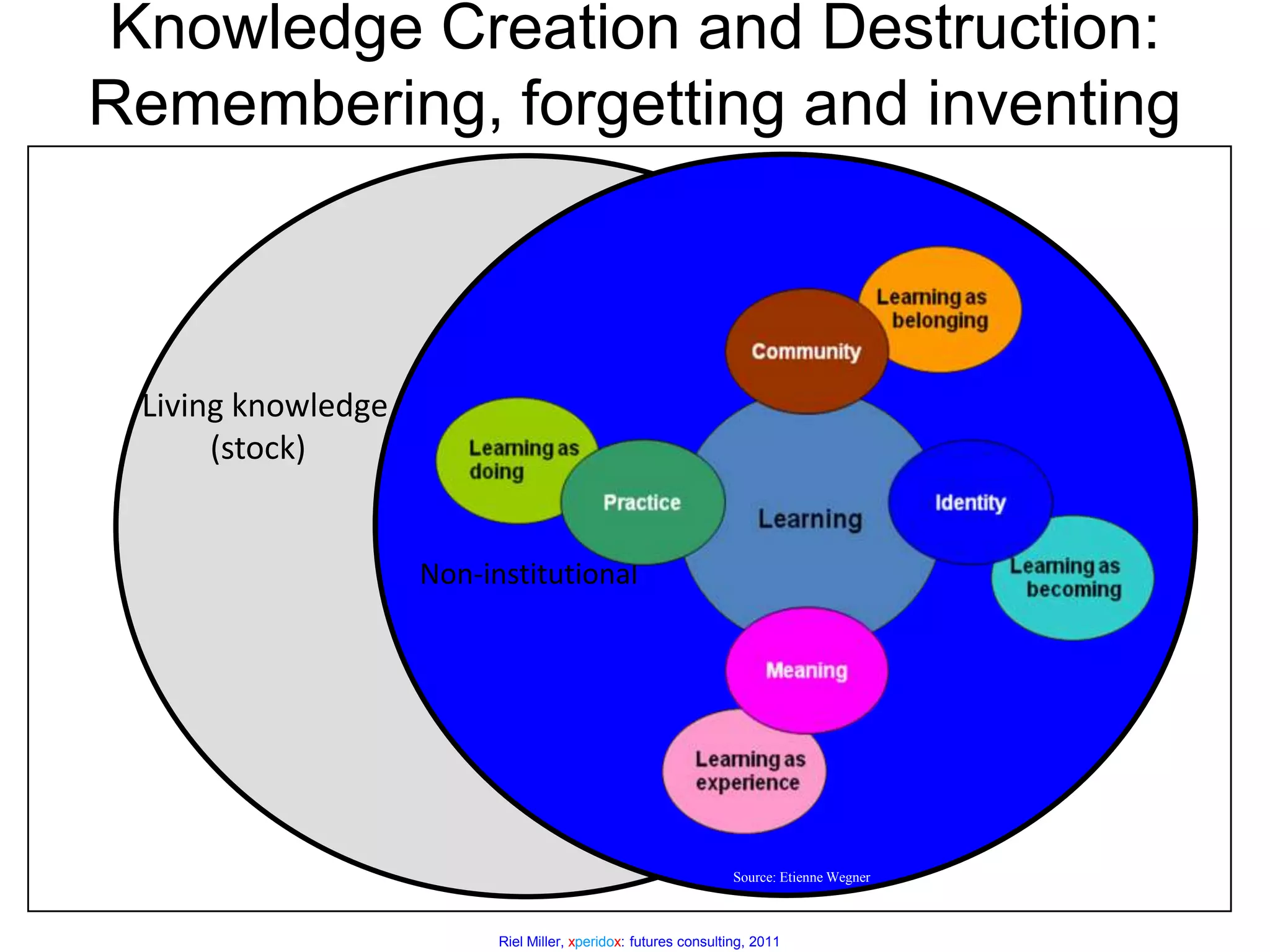
    Knowledge Creation andDestruction: Remembering, forgetting and inventingCover it allDiscovery(flow)Living knowledge(stock)Public sectorPrivate sectorNet newPreservationNon-institutionalNet newPreservationSource: Etienne Wegner
  • 63.
    3 – Thewealthiest societies have the highest average ageThe productivity of unique creation and the quality of decision making capacity both increase, all other things being equal, with experience and better information – this is the wisdom economy – the know why society.
  • 64.
    Transformation“Society is nowat a stage in history in which one pulse is ending and another beginning. The immense destruction that a new pulse signals is both frightening and creative. It raises fundamental questions about transformation. The only way to approach such a period, in which uncertainty is very large and one cannot predict what the future holds, is not to predict, but to experiment and act inventively and exuberantly via diverse adventures in living.”C.S. “Buzz” Hollings, “Coping with Transformational Change”, Options, IIASA, Summer 2010
  • 66.
    A time formethod and methods for our timeWhy futures literacy now? Because a futures literate society can use:diversification, imagination and inter-dependency to embrace spontaneity, experimentation & complexity
  • 67.
  • 68.
    fear of therisks (perception)
  • 69.
  • 70.
    in order toinspire aspirations consistent with a world where means are ends (values in practice)How we anticipate matters – it changes the presentThank yourielm@yahoo.comImage: Sempe

Editor's Notes

  • #2 Education Futures: Part of the Solution or Part of the Problem?Two premises: 1) Distinguishing endogenous systemic change from exogenous requires not only taking a specific point-of-view but that such a point-of-view be created (invented) in the first place. 2) From the vantage point of taking human systems as a subject learning may be considered a trans-historical attribute while education is a historically specific form and organization of learning. Starting from these two premises I will explore three topics. First what is the future and what is an ontologically grounded anticipatory systems approach to ‘using the future’. Second how a rigorously imagined story of the future can be used to reveal systemic boundaries and relationships using the example of the end of schooling in a Learning Intensive Society. And Third, what are the implications of the preceding discussion for Education Futures: Leadership and Practice.
  • #3 Two premises: 1) Distinguishing endogenous systemic change from exogenous requires not only taking a specific point-of-view but that such a point-of-view be created (invented) in the first place. Use the future. But to use the future you must first know what it is. 2) From the vantage point of taking human systems as a subject learning may be considered a trans-historical attribute while education is a historically specific form and organization of learning. How to locate or situate education as it is organized today in its systemic context and bring into play the extra systemic potential of the present – in other words what is emergent.http://www.fractals.macrowellness.com/Site%20fractal%20images/Gallery%202_p2/2007-01-06_var1_a5.jpg http://www.historycooperative.org/journals/sia/32.2/images/fahlman_fig05b.jpg
  • #21 Bruegel the Elder, 1559, Staatliche Museen zu Berlin - Gemaldegalerie, Berlin Link: http://www.ibiblio.org/wm/paint/auth/bruegel/proverbs.jpg
  • #23 Bruegel the Elder, 1559, Staatliche Museen zu Berlin - Gemaldegalerie, Berlin Link: http://www.ibiblio.org/wm/paint/auth/bruegel/proverbs.jpg
  • #38 http://www.wired.co.uk/news/archive/2010-11/02/printed-carIntroduced in Las Vegas at the A prototype for an electric vehicle -- code named Urbee -- is the first to have its entire body built with a 3D printer.Stratasys and Winnipeg engineering group Kor Ecologic have partnered to create the electric/liquid fuel hybrid, which can deliver more than 200 miles per gallon on the motorway and 100 miles per gallon in the city.The two-passenger hybrid aims to be fuel efficient, easy to repair, safe to drive and inexpensive to own.All exterior components -- including the glass panel prototypes -- were created using Dimension 3D Printers and Fortus 3D Production Systems at Stratasys' digital manufacturing service -- RedEye on Demand.