GROUP
COMMUNICATION
JIGAR J. RANGANI
EN.NO.130210107040
TOPICS
 Definition of Group Communication
 Group Communication
 Prerequisites of a Group Communication
 Benefits in Group Communication
 Take in mind during group communication
 Don’t do during group communication
 Important points in Group Communication
 Group problem solving
 Important point in group communication
 Stages in team/group devlopment
DEFINITION OF GROUP
COMMUNICATION
 Group Discussion is a modern method of
assessing students personality.
 It is both a technique and an art and a
comprehensive tool to judge the worthiness of the
student and his appropriateness for the job.
GROUP COMMUNICATION
 The term suggests a discussion among a group of
persons.
 The group will have 8 & 12 members who will express
their views freely, frankly in a friendly manner, on a
topic of current issue.
PREREQUISITES OF A GROUP
COMMUNICATION
 Topics given by panelists
 Planning and preparation
 Knowledge with self-confidence
 Communication skills/ power of speech
 Presentation
 Body Language and personal appearance
 Being calm and cool
PREREQUISITES OF A GROUP
COMMUNICATION
 Extensive knowledge base related to state, country
and globe.
 Areas are politics,sports,science &trade
commerce,Industry and Technology,MNC,ect.
 Analyze the social,economical issues logistically .
 Listening skills
 Co-operation.
BENEFITS IN GROUP
COMMUNICATION
 Stimulation of thinking in a new way.
 Expansion of knowledge
 Understanding of your strength and weakness.
 Your true personality is revealed and qualities of
leadership crystallize
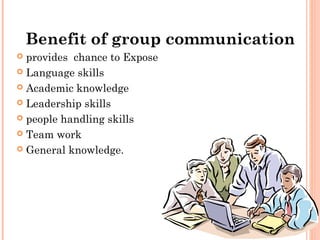
Benefit of group communication
 provides chance to Expose
 Language skills
 Academic knowledge
 Leadership skills
 people handling skills
 Team work
 General knowledge.
TAKE IN MIND DURING GROUP
COMMUNICATION
 Appropriate to the issue .
 Make original points & support them by substantial
reasoning .
 Listen to the other participants actively &carefully.
 Whatever you say must be with a logical flow,&validate
it with an example as far as possible.
 Make only accurate statements.
 Modulate the volume, pitch and tone.
 Be considerate to the feelings of the others.
 Try to get your turn.
 Be an active and dynamic participant by listening.
 Talk with confidence and self-assurance.
DON’TS DURING GROUP
COMMUNICATION
 Being shy /nervous / keeping isolated from
G.c
 Interrupting another participant before his
arguments are over
 Speak in favour ; example:Establish your
position and stand by it stubbornly
 Changed opinions
 Don’t make fun of any participant even if
his arguments are funny.
 Don’t engage yourself in sub-group
conversation.
Don’t repeat and use irrelevant materials.
Addressing yourself to the examiner.
Worrying about making some grammatical
mistakes,for your interest the matter you
put across are important.
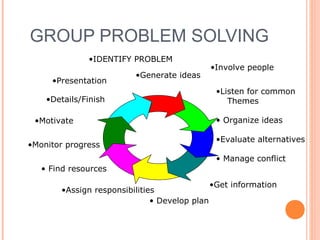
GROUP PROBLEM SOLVING
•Listen for common
Themes
• Organize ideas
•Evaluate alternatives
• Manage conflict
•Involve people
•Get information
• Develop plan
•Generate ideas
•Assign responsibilities
• Find resources
•Monitor progress
•Motivate
•Details/Finish
•Presentation
•IDENTIFY PROBLEM
IMPORTANT POINTS IN GROUP
COMMUNICATION
 Be assertive: An assertive person is direct ,
honest careful about not hurting others ‘self-
respect’.
 A patient listener: listening to another person is
one way of showing appreciation.
 Right language : Words can make friends &
right words at the right time make the best
results.
 Be analytical and fact-oriented : It is necessary
to make relevant points which can be supported
with facts and analyzed logically.
STAGES IN TEAM/GROUP
DEVELOPMENT
 Forming
 when the group begins to discuss the task(s) and
orientate towards a work plan
 Storming
 conflicts and tensions emerge when there are different
working styles, differing expectations and different work
ethics
 Norming
 beginning to develop mutual trust and effective ways of
working
 Performing
 when effective work patterns are producing the required
results
130210107040

130210107040

  • 1.
  • 2.
    TOPICS  Definition ofGroup Communication  Group Communication  Prerequisites of a Group Communication  Benefits in Group Communication  Take in mind during group communication  Don’t do during group communication  Important points in Group Communication  Group problem solving  Important point in group communication  Stages in team/group devlopment
  • 3.
    DEFINITION OF GROUP COMMUNICATION Group Discussion is a modern method of assessing students personality.  It is both a technique and an art and a comprehensive tool to judge the worthiness of the student and his appropriateness for the job.
  • 4.
    GROUP COMMUNICATION  Theterm suggests a discussion among a group of persons.  The group will have 8 & 12 members who will express their views freely, frankly in a friendly manner, on a topic of current issue.
  • 5.
    PREREQUISITES OF AGROUP COMMUNICATION  Topics given by panelists  Planning and preparation  Knowledge with self-confidence  Communication skills/ power of speech  Presentation  Body Language and personal appearance  Being calm and cool
  • 6.
    PREREQUISITES OF AGROUP COMMUNICATION  Extensive knowledge base related to state, country and globe.  Areas are politics,sports,science &trade commerce,Industry and Technology,MNC,ect.  Analyze the social,economical issues logistically .  Listening skills  Co-operation.
  • 7.
    BENEFITS IN GROUP COMMUNICATION Stimulation of thinking in a new way.  Expansion of knowledge  Understanding of your strength and weakness.  Your true personality is revealed and qualities of leadership crystallize
  • 8.
    Benefit of groupcommunication  provides chance to Expose  Language skills  Academic knowledge  Leadership skills  people handling skills  Team work  General knowledge.
  • 9.
    TAKE IN MINDDURING GROUP COMMUNICATION  Appropriate to the issue .  Make original points & support them by substantial reasoning .  Listen to the other participants actively &carefully.  Whatever you say must be with a logical flow,&validate it with an example as far as possible.  Make only accurate statements.
  • 10.
     Modulate thevolume, pitch and tone.  Be considerate to the feelings of the others.  Try to get your turn.  Be an active and dynamic participant by listening.  Talk with confidence and self-assurance.
  • 11.
    DON’TS DURING GROUP COMMUNICATION Being shy /nervous / keeping isolated from G.c  Interrupting another participant before his arguments are over  Speak in favour ; example:Establish your position and stand by it stubbornly  Changed opinions  Don’t make fun of any participant even if his arguments are funny.
  • 12.
     Don’t engageyourself in sub-group conversation. Don’t repeat and use irrelevant materials. Addressing yourself to the examiner. Worrying about making some grammatical mistakes,for your interest the matter you put across are important.
  • 13.
    GROUP PROBLEM SOLVING •Listenfor common Themes • Organize ideas •Evaluate alternatives • Manage conflict •Involve people •Get information • Develop plan •Generate ideas •Assign responsibilities • Find resources •Monitor progress •Motivate •Details/Finish •Presentation •IDENTIFY PROBLEM
  • 14.
    IMPORTANT POINTS INGROUP COMMUNICATION  Be assertive: An assertive person is direct , honest careful about not hurting others ‘self- respect’.  A patient listener: listening to another person is one way of showing appreciation.  Right language : Words can make friends & right words at the right time make the best results.  Be analytical and fact-oriented : It is necessary to make relevant points which can be supported with facts and analyzed logically.
  • 15.
    STAGES IN TEAM/GROUP DEVELOPMENT Forming  when the group begins to discuss the task(s) and orientate towards a work plan  Storming  conflicts and tensions emerge when there are different working styles, differing expectations and different work ethics  Norming  beginning to develop mutual trust and effective ways of working  Performing  when effective work patterns are producing the required results

Editor's Notes

  • #16 Conclude by stating that stages of group development help all members to increasingly focus on group tasks and relax into roles and a key aspect of effective working is the agreement on ground rules…how the group will work, what is acceptable behaviour and what is not acceptable Exercise 4 (Handout on ground rules) Ask the students to reflect on groups/teams they have worked in and decide which ground rules helped the experience to be effective and which new ones would have helped to make the experience more productive, fulfilling and would have aided a smoother transfer to a new stage of development ( 5 minutes plenary) Time taken so far: 45 minutes