Learning Spaces
An overview of 5 different learning
spaces that will push students towards
becoming 21st century learners
Introduction
“The new learning spaces incorporate technologies and engage
the learner, creating new learning possibilities, enhancing
achievements and extending interactions with local and global
communities.” (Teaching Australia, 2009)
Communicators, networkers, innovators, multi model learners and
tech savvy individuals are all words that spring to mind when
defining the characteristics of a 21st century learner. It is our job as
educators to provide a learning environment, both physical and
virtual, that allow for these characteristics to develop. A learning
environment that is active, collaborative, diverse, connected and
most of all student centered must be created to accommodate
students beginning of growth into global learners.
This presentation plans to explore learning spaces across five
environments: the classroom & school, beyond the classroom, the
electronic space, the individual space, the group space and
learning in the 21st century.
The classroom and the school
The Physical Environment
This includes the physical conditions of the school and classroom: Furnishing, lighting,
storage, noise and acoustics, climate and thermal control, privacy, play equipment and play
grounds. (McGregor, J 2004)
Strengths
The physical space of the classroom and school should allow students to feel safe, supported
and happy.
• Todays schools must create a space that students want to go to, similar to the way cafes
attract people, rather then the space just being purely functional. (Bunting, A 2004)
• Attention must be paid to the importance of 'Desirable’ designs including 'friendly and
agreeable' entrance areas, supervised private places for students, as well as public spaces
that foster a sense of engagement and community, with particular attention to the colour
and lighting used. (McGregor, J).
Weaknesses
• Lack of Funding to equip, modify or build classrooms and school learning environments
that encourage and inspire students.
• Rural geographical locations can sometimes prevent or delay the development of
classroom learning spaces.
• Education of key stakeholders to change the culture of their thinking about classrooms
and schools can also be something that is detrimental to a school environment.
The classroom and the school
Curriculum and pedagogy:
Click here
Teacher and student connections:
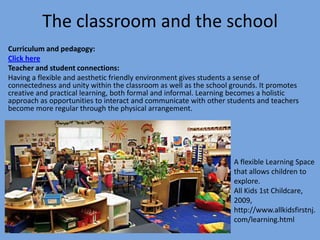
Having a flexible and aesthetic friendly environment gives students a sense of
connectedness and unity within the classroom as well as the school grounds. It promotes
creative and practical learning, both formal and informal. Learning becomes a holistic
approach as opportunities to interact and communicate with other students and teachers
become more regular through the physical arrangement.

A flexible Learning Space
that allows children to
explore.
All Kids 1st Childcare,
2009,
http://www.allkidsfirstnj.
com/learning.html
The classroom and the school
A clip promoting the growth and development of curriculum and
pedagogy for the 21st century through the classroom and school
environment. (Whitby, G. 2007. Retrieved from
http://www.youtube.com/watch?v=l72UFXqa8ZU&feature=player_embedded)
Beyond the classroom

The Physical environment:
The physical environment has many variables. It can
range from sitting on a basketball court explaining
instructions, to taking children on an excursion to the
Zoo. Therefore there are many options of what the
physical space could be:
• inside or outside
• within the school boundary or offsite
• seated, standing, lying
• accessible to resources or remote

Strengths:
• Engaging to students (changing from the norm)
• Adaptability of the space to suit the topic/teacher
• Potential to move the topic (eg visit art gallery,
work in garden)
• Specific (Aboriginal artwork, rocks from outside,
paint outside)
• Cater for different learning types.

Weakness
• Potential OH&S issues
• Weather implications
• Lack of classroom resources to hand
• Outside distraction (other students/teachers,
birds, rocks)
• Potential to incur costs (Excursions)

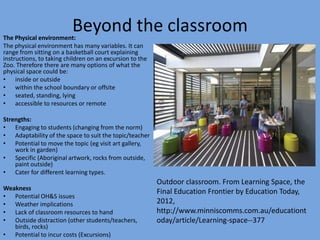
Outdoor classroom. From Learning Space, the
Final Education Frontier by Education Today,
2012,
http://www.minniscomms.com.au/educationt
oday/article/Learning-space--377
Beyond the classroom
Teacher and student connections:
Positioning students in different learning
environments such as field trips and
incursions offer rich content knowledge that
students may not have the opportunity to
discover within the realms of the classroom.
Having someone with expert knowledge of
a topic talk to learners about different
aspects of a specific focus area may help
create discussion and thinking throughout
the classroom.
Students will benefit from the change of
scenery, particularly if the new environment
aides in comprehension of the subject.
Actually visiting a particular environment
allows children to visualize, hear, smell and
touch, often making the learning
experience more memorable and therefor
more beneficial. (Johnson, 2009)

Curriculum and pedagogy:
Click here

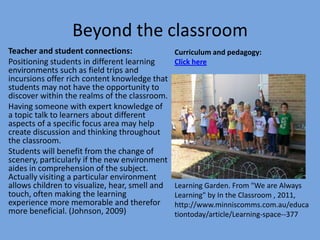
Learning Garden. From "We are Always
Learning" by In the Classroom , 2011,
http://www.minniscomms.com.au/educa
tiontoday/article/Learning-space--377
The electronic learning space
Physical environment:
This environment is not necessarily one that we can sit in but one that is built for us through the technology
of the 21st century and helps engage in a world that the students understand and enjoy. “Contemporary
learning- learning in an online world describes describes the integrated nature of highly technological world
in which young people live and learn.(Ministerial Council on Education, Employment, Training and Youth
Affairs, 2008)
Strengths
• Accessibility- Offers access beyond the face to face time that a school can provide. The use of school
intranets allows for learning and discussion to take place even after the school bell has rung.
• Communication- Students can communicate in a variety of ways without being near the person seek
assistance. Communication is enhanced between teacher-student, teacher-parent, student-student,
student-community and student-world.
• Engage students- Students are engaged in a world that is their own, a world that they have grown up in
and know how to use better then we do.
Weaknesses
• Cost- As technology is forever changing and updating, the cost of this product can mean that school are
unable to provide the products that may assist in a students optimal learning.
• Safety- Communication is worldwide with technology so safety tutorials need to be implemented,
whether this be in class or or an online tutorial students need to be educated about cyber safety.
The electronic learning space

A look at some of the technology that is being used in 21st century
learning. (Kraft, M. 2013. Retrieved from.
http://www.youtube.com/watch?v=nA1Aqp0sPQo)
The electronic learning space
Curriculum and pedagogy:
Click here.
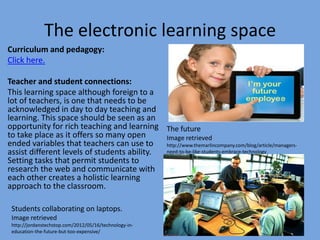
Teacher and student connections:
This learning space although foreign to a
lot of teachers, is one that needs to be
acknowledged in day to day teaching and
learning. This space should be seen as an
opportunity for rich teaching and learning The future
to take place as it offers so many open
Image retrieved
ended variables that teachers can use to
http://www.themarlincompany.com/blog/article/managersneed-to-be-like-students-embrace-technology
assist different levels of students ability.
Setting tasks that permit students to
research the web and communicate with
each other creates a holistic learning
approach to the classroom.
Students collaborating on laptops.
Image retrieved
http://jordanstechstop.com/2012/05/16/technology-ineducation-the-future-but-too-expensive/
The individual learning space
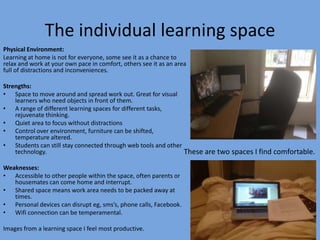
Physical Environment:
Learning at home is not for everyone, some see it as a chance to
relax and work at your own pace in comfort, others see it as an area
full of distractions and inconveniences.
Strengths:
• Space to move around and spread work out. Great for visual
learners who need objects in front of them.
• A range of different learning spaces for different tasks,
rejuvenate thinking.
• Quiet area to focus without distractions
• Control over environment, furniture can be shifted,
temperature altered.
• Students can still stay connected through web tools and other
technology.
These are two spaces I find comfortable.
Weaknesses:
• Accessible to other people within the space, often parents or
housemates can come home and interrupt.
• Shared space means work area needs to be packed away at
times.
• Personal devices can disrupt eg, sms’s, phone calls, Facebook.
• Wifi connection can be temperamental.
Images from a learning space I feel most productive.
The individual learning space
Curriculum and pedagogy:
Click here
Teacher and student connections:
As this is based on the students opinion some key areas of importance would be• Quiet-Turning of mobile phones and having people out of the house can create a
quiet environment that promotes the learner to read, reflect and work without
an interruption.
• Different room/areas• Light and window- Light is stimulating and activates the thinking process and the
window allows learners to ‘stretch’ their eyes and and a place to reflect without
moving.
• Formal work space/desk- Having a permanent workspace puts the learner in
‘work mode’ and signals to individuals around that work is being undertaken so
do not disturb.
• Different room/areas- Having different spaces like the couch lets the learner
move when needing to refocus or feel comfortable. Often the garden or roof can
provide a great space for reading of revising.
The group learning space
Physical environment:
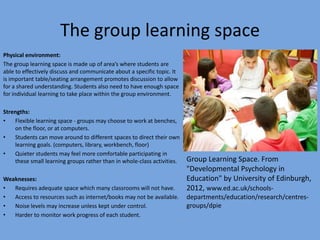
The group learning space is made up of area’s where students are
able to effectively discuss and communicate about a specific topic. It
is important table/seating arrangement promotes discussion to allow
for a shared understanding. Students also need to have enough space
for individual learning to take place within the group environment.
Strengths:
•
Flexible learning space - groups may choose to work at benches,
on the floor, or at computers.
•
Students can move around to different spaces to direct their own
learning goals. (computers, library, workbench, floor)
•
Quieter students may feel more comfortable participating in
these small learning groups rather than in whole-class activities.
Weaknesses:
•
Requires adequate space which many classrooms will not have.
•
Access to resources such as internet/books may not be available.
•
Noise levels may increase unless kept under control.
•
Harder to monitor work progress of each student.

Group Learning Space. From
"Developmental Psychology in
Education" by University of Edinburgh,
2012, www.ed.ac.uk/schoolsdepartments/education/research/centresgroups/dpie
The group learning space
Curriculum and pedagogy:
Click here.
Teacher and student connections:
Teachers will need to carefully examine
the learning space to ensure it is
adequately prepared for group work
(lighting, space, acoustics, colour,
temperature). It has also been argued by
Johnson, 2009, that for group learning to
be successful, teachers must prepare
students for the management of
discussion within their groups, including
acceptance of disagreement.
Students may need extra time adjusting
to working in a group learning space and
as such will require guidance and
preparation sessions from the teacher.

Northern Christian School. (2012) Group
Learning [digital image]. Retrieved from
http://www.northernsuburbs.tas.edu.au
/
Learning in the 21st century
"Twenty-first century learning theories emphasize the importance of
supporting authentic and ubiquitous (anywhere, anyhow) learning, and
providing students with opportunities, resources and spaces to develop
their creative and critical thinking skills" (The Australian Curriculum,
Assessment and Reporting Authority, 2013) .
'Anywhere, anyhow learning' means teachers need to be proactive and
flexible in their teaching techniques, as different learning environments,
such as the ones spoken about will be blended into everyday teaching and
learning. Teachers need to develop skill sets in students such as problem
solving, critical thinking, communication and collaboration and apply
imagination and intervention to tasks. For this to happen constant
evaluation and development of the teaching and learning process needs
to take place. Digital technology will play a key role in incorporating this as
it allows for communication to take place anytime anywhere. Students are
able to stay connected 24 hours a day 7 days a week making learning a
highly social and collaborative task. (Wilson, 2011)
Learning in the 21 century

Statistics about 21st century learning.
(Australian institute for teaching and school leadership, 2013. Retrieved
from http://www.youtube.com/watch?v=nA1Aqp0sPQo )
Learning in the 21st century- Prediction
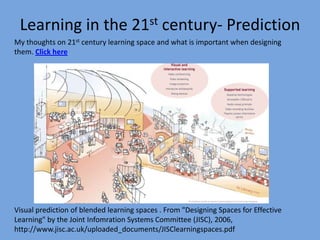
My thoughts on 21st century learning space and what is important when designing
them. Click here

Visual prediction of blended learning spaces . From "Designing Spaces for Effective
Learning" by the Joint Infomration Systems Committee (JISC), 2006,
http://www.jisc.ac.uk/uploaded_documents/JISClearningspaces.pdf
References
All Kids 1st (2009). A flexible learning space that allows kids to explore [digital image].
Retrieved from http://www.allkidsfirstnj.com/learning.html
Australian Curriculum Assessment and Reporting Authority. (2013). Domain: Personal
Learning. Retrieved from http://ausvels.vcaa.vic.edu.au/PersonalLearning/Overview/Introduction

Australian institute for teaching and school leadership. (2013) Learning for the 21st
century. [Video file] http://www.youtube.com/watch?v=nA1Aqp0sPQo
Bunting, A. (2004) 'Secondary schools designed for a purpose: but which one?’,
Teacher, no.154 pp.10–13.

Education Today. (2012). Outdoor Classroom [digital image]. Retrieved from
http://www.minniscomms.com.au/educationtoday/article/Learning-space--377
Fadel, C., & Trilling, B. (2009). 21st century skills: Learning for life in our times. San
Francisco, USA: John Wiley & Sons Inc.

Johnson, J. (2009). Beyond four walls: experiential and situated learning teacher. (198),
18-20
References
Joint Information Systems Committee. (2006). Visual prediction of blended learning spaces [digital
image]. Retrieved from http://www.jisc.ac.uk/uploaded_documents/JISClearningspaces.pdf
Kraft, M. (2013). What is 21st century education? [Video file] Retrieved from
http://www.youtube.com/watch?v=GegtmIJPdrM
McGregor, J. (2004) 'Spatiality and the Place of the Material in Schools', Pedagogy, Culture and
Society,vol. 12, no. 3 pp.347–372.
Ministerial Council on Education, Employment, Training and Youth Affairs. (2008). Learning Spaces
Framework, p.4.
Teaching Australia. (2009). 21st Century Learning Spaces. Retrieved from:www.teachingaustralia.com.au
University of Edinburgh. (2013). Developmental Psychology in Education [digital image]. Retrieved from
www.ed.ac.uk/schools-departments/education/research/centres-groups/dpie
Whitby, G. (2007). 21st Century Pedagogy [Video file]. Retrieved from
http://www.youtube.com/watch?v=l72UFXqa8ZU&feature=player_embedded
Wilson, L., & Uscinski, S. (2011, October). The learning landscape: How schools are shaping space and
place for 21st century learners. Independence, 36 (2), 6-24.

The Learning Environments by Cam Weston

  • 1.
    Learning Spaces An overviewof 5 different learning spaces that will push students towards becoming 21st century learners
  • 2.
    Introduction “The new learningspaces incorporate technologies and engage the learner, creating new learning possibilities, enhancing achievements and extending interactions with local and global communities.” (Teaching Australia, 2009) Communicators, networkers, innovators, multi model learners and tech savvy individuals are all words that spring to mind when defining the characteristics of a 21st century learner. It is our job as educators to provide a learning environment, both physical and virtual, that allow for these characteristics to develop. A learning environment that is active, collaborative, diverse, connected and most of all student centered must be created to accommodate students beginning of growth into global learners. This presentation plans to explore learning spaces across five environments: the classroom & school, beyond the classroom, the electronic space, the individual space, the group space and learning in the 21st century.
  • 3.
    The classroom andthe school The Physical Environment This includes the physical conditions of the school and classroom: Furnishing, lighting, storage, noise and acoustics, climate and thermal control, privacy, play equipment and play grounds. (McGregor, J 2004) Strengths The physical space of the classroom and school should allow students to feel safe, supported and happy. • Todays schools must create a space that students want to go to, similar to the way cafes attract people, rather then the space just being purely functional. (Bunting, A 2004) • Attention must be paid to the importance of 'Desirable’ designs including 'friendly and agreeable' entrance areas, supervised private places for students, as well as public spaces that foster a sense of engagement and community, with particular attention to the colour and lighting used. (McGregor, J). Weaknesses • Lack of Funding to equip, modify or build classrooms and school learning environments that encourage and inspire students. • Rural geographical locations can sometimes prevent or delay the development of classroom learning spaces. • Education of key stakeholders to change the culture of their thinking about classrooms and schools can also be something that is detrimental to a school environment.
  • 4.
    The classroom andthe school Curriculum and pedagogy: Click here Teacher and student connections: Having a flexible and aesthetic friendly environment gives students a sense of connectedness and unity within the classroom as well as the school grounds. It promotes creative and practical learning, both formal and informal. Learning becomes a holistic approach as opportunities to interact and communicate with other students and teachers become more regular through the physical arrangement. A flexible Learning Space that allows children to explore. All Kids 1st Childcare, 2009, http://www.allkidsfirstnj. com/learning.html
  • 5.
    The classroom andthe school A clip promoting the growth and development of curriculum and pedagogy for the 21st century through the classroom and school environment. (Whitby, G. 2007. Retrieved from http://www.youtube.com/watch?v=l72UFXqa8ZU&feature=player_embedded)
  • 6.
    Beyond the classroom ThePhysical environment: The physical environment has many variables. It can range from sitting on a basketball court explaining instructions, to taking children on an excursion to the Zoo. Therefore there are many options of what the physical space could be: • inside or outside • within the school boundary or offsite • seated, standing, lying • accessible to resources or remote Strengths: • Engaging to students (changing from the norm) • Adaptability of the space to suit the topic/teacher • Potential to move the topic (eg visit art gallery, work in garden) • Specific (Aboriginal artwork, rocks from outside, paint outside) • Cater for different learning types. Weakness • Potential OH&S issues • Weather implications • Lack of classroom resources to hand • Outside distraction (other students/teachers, birds, rocks) • Potential to incur costs (Excursions) Outdoor classroom. From Learning Space, the Final Education Frontier by Education Today, 2012, http://www.minniscomms.com.au/educationt oday/article/Learning-space--377
  • 7.
    Beyond the classroom Teacherand student connections: Positioning students in different learning environments such as field trips and incursions offer rich content knowledge that students may not have the opportunity to discover within the realms of the classroom. Having someone with expert knowledge of a topic talk to learners about different aspects of a specific focus area may help create discussion and thinking throughout the classroom. Students will benefit from the change of scenery, particularly if the new environment aides in comprehension of the subject. Actually visiting a particular environment allows children to visualize, hear, smell and touch, often making the learning experience more memorable and therefor more beneficial. (Johnson, 2009) Curriculum and pedagogy: Click here Learning Garden. From "We are Always Learning" by In the Classroom , 2011, http://www.minniscomms.com.au/educa tiontoday/article/Learning-space--377
  • 8.
    The electronic learningspace Physical environment: This environment is not necessarily one that we can sit in but one that is built for us through the technology of the 21st century and helps engage in a world that the students understand and enjoy. “Contemporary learning- learning in an online world describes describes the integrated nature of highly technological world in which young people live and learn.(Ministerial Council on Education, Employment, Training and Youth Affairs, 2008) Strengths • Accessibility- Offers access beyond the face to face time that a school can provide. The use of school intranets allows for learning and discussion to take place even after the school bell has rung. • Communication- Students can communicate in a variety of ways without being near the person seek assistance. Communication is enhanced between teacher-student, teacher-parent, student-student, student-community and student-world. • Engage students- Students are engaged in a world that is their own, a world that they have grown up in and know how to use better then we do. Weaknesses • Cost- As technology is forever changing and updating, the cost of this product can mean that school are unable to provide the products that may assist in a students optimal learning. • Safety- Communication is worldwide with technology so safety tutorials need to be implemented, whether this be in class or or an online tutorial students need to be educated about cyber safety.
  • 9.
    The electronic learningspace A look at some of the technology that is being used in 21st century learning. (Kraft, M. 2013. Retrieved from. http://www.youtube.com/watch?v=nA1Aqp0sPQo)
  • 10.
    The electronic learningspace Curriculum and pedagogy: Click here. Teacher and student connections: This learning space although foreign to a lot of teachers, is one that needs to be acknowledged in day to day teaching and learning. This space should be seen as an opportunity for rich teaching and learning The future to take place as it offers so many open Image retrieved ended variables that teachers can use to http://www.themarlincompany.com/blog/article/managersneed-to-be-like-students-embrace-technology assist different levels of students ability. Setting tasks that permit students to research the web and communicate with each other creates a holistic learning approach to the classroom. Students collaborating on laptops. Image retrieved http://jordanstechstop.com/2012/05/16/technology-ineducation-the-future-but-too-expensive/
  • 11.
    The individual learningspace Physical Environment: Learning at home is not for everyone, some see it as a chance to relax and work at your own pace in comfort, others see it as an area full of distractions and inconveniences. Strengths: • Space to move around and spread work out. Great for visual learners who need objects in front of them. • A range of different learning spaces for different tasks, rejuvenate thinking. • Quiet area to focus without distractions • Control over environment, furniture can be shifted, temperature altered. • Students can still stay connected through web tools and other technology. These are two spaces I find comfortable. Weaknesses: • Accessible to other people within the space, often parents or housemates can come home and interrupt. • Shared space means work area needs to be packed away at times. • Personal devices can disrupt eg, sms’s, phone calls, Facebook. • Wifi connection can be temperamental. Images from a learning space I feel most productive.
  • 12.
    The individual learningspace Curriculum and pedagogy: Click here Teacher and student connections: As this is based on the students opinion some key areas of importance would be• Quiet-Turning of mobile phones and having people out of the house can create a quiet environment that promotes the learner to read, reflect and work without an interruption. • Different room/areas• Light and window- Light is stimulating and activates the thinking process and the window allows learners to ‘stretch’ their eyes and and a place to reflect without moving. • Formal work space/desk- Having a permanent workspace puts the learner in ‘work mode’ and signals to individuals around that work is being undertaken so do not disturb. • Different room/areas- Having different spaces like the couch lets the learner move when needing to refocus or feel comfortable. Often the garden or roof can provide a great space for reading of revising.
  • 13.
    The group learningspace Physical environment: The group learning space is made up of area’s where students are able to effectively discuss and communicate about a specific topic. It is important table/seating arrangement promotes discussion to allow for a shared understanding. Students also need to have enough space for individual learning to take place within the group environment. Strengths: • Flexible learning space - groups may choose to work at benches, on the floor, or at computers. • Students can move around to different spaces to direct their own learning goals. (computers, library, workbench, floor) • Quieter students may feel more comfortable participating in these small learning groups rather than in whole-class activities. Weaknesses: • Requires adequate space which many classrooms will not have. • Access to resources such as internet/books may not be available. • Noise levels may increase unless kept under control. • Harder to monitor work progress of each student. Group Learning Space. From "Developmental Psychology in Education" by University of Edinburgh, 2012, www.ed.ac.uk/schoolsdepartments/education/research/centresgroups/dpie
  • 14.
    The group learningspace Curriculum and pedagogy: Click here. Teacher and student connections: Teachers will need to carefully examine the learning space to ensure it is adequately prepared for group work (lighting, space, acoustics, colour, temperature). It has also been argued by Johnson, 2009, that for group learning to be successful, teachers must prepare students for the management of discussion within their groups, including acceptance of disagreement. Students may need extra time adjusting to working in a group learning space and as such will require guidance and preparation sessions from the teacher. Northern Christian School. (2012) Group Learning [digital image]. Retrieved from http://www.northernsuburbs.tas.edu.au /
  • 15.
    Learning in the21st century "Twenty-first century learning theories emphasize the importance of supporting authentic and ubiquitous (anywhere, anyhow) learning, and providing students with opportunities, resources and spaces to develop their creative and critical thinking skills" (The Australian Curriculum, Assessment and Reporting Authority, 2013) . 'Anywhere, anyhow learning' means teachers need to be proactive and flexible in their teaching techniques, as different learning environments, such as the ones spoken about will be blended into everyday teaching and learning. Teachers need to develop skill sets in students such as problem solving, critical thinking, communication and collaboration and apply imagination and intervention to tasks. For this to happen constant evaluation and development of the teaching and learning process needs to take place. Digital technology will play a key role in incorporating this as it allows for communication to take place anytime anywhere. Students are able to stay connected 24 hours a day 7 days a week making learning a highly social and collaborative task. (Wilson, 2011)
  • 16.
    Learning in the21 century Statistics about 21st century learning. (Australian institute for teaching and school leadership, 2013. Retrieved from http://www.youtube.com/watch?v=nA1Aqp0sPQo )
  • 17.
    Learning in the21st century- Prediction My thoughts on 21st century learning space and what is important when designing them. Click here Visual prediction of blended learning spaces . From "Designing Spaces for Effective Learning" by the Joint Infomration Systems Committee (JISC), 2006, http://www.jisc.ac.uk/uploaded_documents/JISClearningspaces.pdf
  • 18.
    References All Kids 1st(2009). A flexible learning space that allows kids to explore [digital image]. Retrieved from http://www.allkidsfirstnj.com/learning.html Australian Curriculum Assessment and Reporting Authority. (2013). Domain: Personal Learning. Retrieved from http://ausvels.vcaa.vic.edu.au/PersonalLearning/Overview/Introduction Australian institute for teaching and school leadership. (2013) Learning for the 21st century. [Video file] http://www.youtube.com/watch?v=nA1Aqp0sPQo Bunting, A. (2004) 'Secondary schools designed for a purpose: but which one?’, Teacher, no.154 pp.10–13. Education Today. (2012). Outdoor Classroom [digital image]. Retrieved from http://www.minniscomms.com.au/educationtoday/article/Learning-space--377 Fadel, C., & Trilling, B. (2009). 21st century skills: Learning for life in our times. San Francisco, USA: John Wiley & Sons Inc. Johnson, J. (2009). Beyond four walls: experiential and situated learning teacher. (198), 18-20
  • 19.
    References Joint Information SystemsCommittee. (2006). Visual prediction of blended learning spaces [digital image]. Retrieved from http://www.jisc.ac.uk/uploaded_documents/JISClearningspaces.pdf Kraft, M. (2013). What is 21st century education? [Video file] Retrieved from http://www.youtube.com/watch?v=GegtmIJPdrM McGregor, J. (2004) 'Spatiality and the Place of the Material in Schools', Pedagogy, Culture and Society,vol. 12, no. 3 pp.347–372. Ministerial Council on Education, Employment, Training and Youth Affairs. (2008). Learning Spaces Framework, p.4. Teaching Australia. (2009). 21st Century Learning Spaces. Retrieved from:www.teachingaustralia.com.au University of Edinburgh. (2013). Developmental Psychology in Education [digital image]. Retrieved from www.ed.ac.uk/schools-departments/education/research/centres-groups/dpie Whitby, G. (2007). 21st Century Pedagogy [Video file]. Retrieved from http://www.youtube.com/watch?v=l72UFXqa8ZU&feature=player_embedded Wilson, L., & Uscinski, S. (2011, October). The learning landscape: How schools are shaping space and place for 21st century learners. Independence, 36 (2), 6-24.