1.1 Understanding that microorganism is a living things
Microorganism
Bacteria Fungi Protozua Virus
Cannot see with
naked eyes
GrowMoveBreathe
Characteristics
Cause the
dough rise
• Rotten oranges
• Mouldy rice
tiny
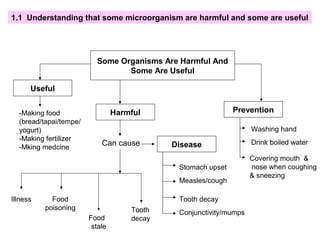
1.1 Understanding that some microorganism are harmful and some are useful
Some Organisms Are Harmful And
Some Are Useful
Useful
Harmful
Can cause
Illness Food
poisoning
Food
stale
Tooth
decay
Prevention
Disease
Stomach upset
Measles/cough
Tooth decay
Conjunctivity/mumps
Washing hand
Drink boiled water
Covering mouth &
nose when coughing
& sneezing
-Making food
(bread/tapai/tempe/
yogurt)
-Making fertilizer
-Mking medcine
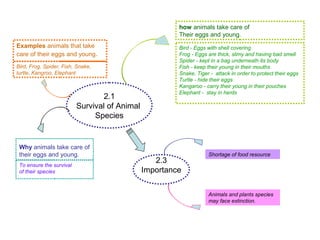
2.1
Survival of Animal
Species
Examples animals that take
care of their eggs and young.
how animals take care of
Their eggs and young.
Why animals take care of
their eggs and young.
Bird - Eggs with shell covering
Frog - Eggs are thick, slimy and having bad smell
Spider - kept in a bag underneath its body
Fish - keep their young in their mouths
Snake, Tiger - attack in order to protect their eggs
Turtle - hide their eggs
Kangaroo - carry their young in their pouches
Elephant - stay in herds
2.3
Importance
Shortage of food resource
Animals and plants species
may face extinction.
Bird, Frog, Spider, Fish, Snake,
turtle, Kangroo, Elephant
To ensure the survival
of their species
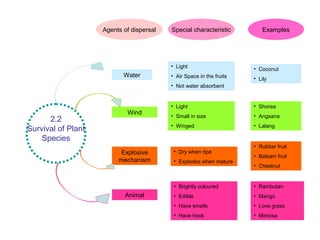
2.2
Survival of Plant
Species
Water
Explosive
mechanism
Wind
Animal
• Light
• Air Space in the fruits
• Not water absorbent
• Light
• Small in size
• Winged
• Dry when ripe
• Explodes when mature
• Brightly coloured
• Edible
• Have smells
• Have hook
• Coconut
• Lily
• Shorea
• Angsana
• Lalang
• Rubber fruit
• Balsam fruit
• Chestnut
• Rambutan
• Mango
• Love grass
• Mimosa
Agents of dispersal Special characteristic Examples
3.1 Food Chain
Animals and the
food they eat
Classify animals into
herbivore, carnivore
and omnivore.
Producer ConsumerConstruct food chain
Green plant obtain
energy from
the sun to make
food. Green
Plant as a producer
Herbivore :
Animals that eat plants only.
e.g.: cow, goat, deer
Carnivore:
Animals that eat other animals.
e.g.: tiger, lion
Omnivore:
Animals that eat plants and
other animals
Animals that eat plant
or other animals
are called consumers.
The food relationship
among living things
can be shown by
a food chain.
To construct food
chain It must start
with plant as
a producer.
In a food chain
the arrow
means ‘eaten by’
All living things need
food to survive.
Green plant can make their
own food. However
animals cannot
make their own make
their own food.
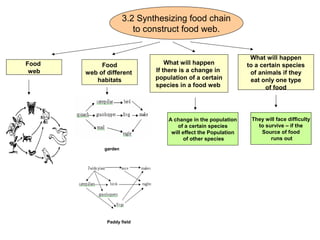
3.2 Synthesizing food chain
to construct food web.
Food
web
What will happen
If there is a change in
population of a certain
species in a food web
Food
web of different
habitats
What will happen
to a certain species
of animals if they
eat only one type
of food
Paddy field
garden
A change in the population
of a certain species
will effect the Population
of other species
They will face difficulty
to survive – if the
Source of food
runs out
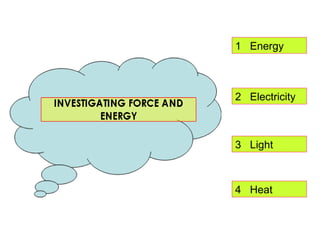
1 Energy
2 Electricity
3 Light
4 Heat
INVESTIGATING FORCE AND ENERGY
ENERGY 1.1 The Uses of Energy
Why energy
is needed?
- by living things to carry
out life processes.
Ex : moving, breathing,
growing
The Sources of Energy
Sun
- main source of energy
- produces light and heat
Food
- food contains
stored energy
Wind
- Moving air
- Used to pump
water, drive
small sawmills
- to move, boil, melt,
or bounce non-living things
Fuel
Batteries
- wood, coal,
petroleum,
natural gas
- device that
generated
electrical energy
from chemical energy
Water
- moving or
falling water
produce
energy
INVESTIGATING FORCE AND ENERGY
ENERGY 1.2 Energy can be transformed from
one form to another
Form of energySound energy
Heat energy
Light energy Electrical energy Kinetic energy
Chemical energy
Potential energy
Energy can be
transformed
a) lighting a candle
Chemical energy →
heat energy + light energy
b) Kicking a ball
Chemical energy →
kinetic energy →
heat energy
Example of appliance that make use of
energy transform
a) Electric iron
Electrical energy → heat energy
b) Radio
Electrical energy → sound energy
c) Television
Electrical energy → sound energy + light energy
INVESTIGATING FORCE AND ENERGY
ENERGY
1.3 Renewable and
Non-renewable Energy
Renewable energy
Energy that
cannot
be replaced
Resources –
solar, wind,
biomass fuel,
water
Non-renewable energy
Energy that be
replenished when
it is used up
Resources –
natural gas,
petroleum,
coal
Why use energy wisely
How to use energy
Some energy
resources cannot
be replenished
when used up
To save
cost
Avoid
wastage
Reduce
pollution
Turn off the
television when
no one
watching it
Switch off the
lights before
going to leave
the room
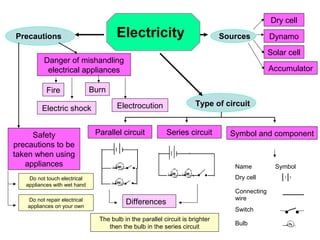
Electricity Sources
Dry cell
Accumulator
Dynamo
Solar cell
Type of circuit
Name Symbol
Dry cell
Connecting
wire
Switch
Bulb
Symbol and componentParallel circuit Series circuit
Precautions
Differences
The bulb in the parallel circuit is brighter
then the bulb in the series circuit
Danger of mishandling
electrical appliances
Fire Burn
Electric shock Electrocution
Safety
precautions to be
taken when using
appliances
Do not touch electrical
appliances with wet hand
Do not repair electrical
appliances on your own
Light
Can be reflected
How ?
Uses of reflection
Side mirror of a car
Periscope Kaleidoscope
Travel in a straight line
How shadow
is formed
When light is
completely
or partially
blocked by
an opaque
object
The light that
falls on objects
‘bounces off’
the objects and
comes to your
eyes
mirror
Shadow form
Opaque object
Light
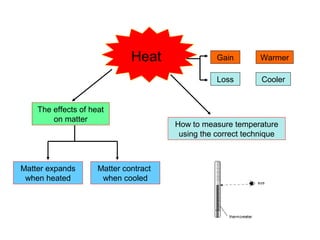
Heat Gain
Loss Cooler
Warmer
How to measure temperature
using the correct technique
The effects of heat
on matter
Matter expands
when heated
Matter contract
when cooled
Investigating
Materials
1.1 Matter exist in the form of solid, liquid or gas
solid liquid gas
has mass
Properties of solid Properties of liquid Properties of gas
fixed
volume
fixed shape
has mass
examples
water milk air
no permanent shape
fixed volume
stem
wood
stone
can't fixed
shape
has mass
Can't fixed
volume
can compressed
1.2
CHANGING
STATES OF
WATER
gas - liquid
liquid - gas
liquid - gas
solid - liquid melting
Boiling
Affected by windy and hot
weather
evaporation
condensation
Freezing
1.31.3
Understanding the water cycle.Understanding the water cycle.
Circulation of water inCirculation of water in
the environment.the environment.
Formation of cloudsFormation of clouds
and rain.and rain.Importance of water.Importance of water.
Changes in the states ofChanges in the states of
matter in the water cyclematter in the water cycle
Liquid to gas (evaporation)Liquid to gas (evaporation)
Droplets of water willDroplets of water will
become bigger andbecome bigger and
heavier →heavier → rain
evaporation
condensation
sea
Gas → liquid (Condensation)Gas → liquid (Condensation)
1.41.4
Appreciating the importanceAppreciating the importance
of water resources.of water resources.
To prevent living aquatic from beingTo prevent living aquatic from being
destroyed and undergoing extinctiondestroyed and undergoing extinction
Reasons to keep ourReasons to keep our
water resources clean.water resources clean. To ensure the cleanlinessTo ensure the cleanliness
of water supplyof water supply
To regulateTo regulate
the formation ofthe formation of
clouds and rainclouds and rain
To avoid infectedTo avoid infected
diseasesdiseases
Ways to keep our waterWays to keep our water
resources cleanresources clean
Keep the rivers cleanKeep the rivers clean Cleanliness campaignCleanliness campaign
2.1 The properties of acid,2.1 The properties of acid,
alkaline and neutral substances.alkaline and neutral substances.
Identify the taste of acidicIdentify the taste of acidic
and alkaline food.and alkaline food.
Identify acidic, alkalineIdentify acidic, alkaline
and neutral substancesand neutral substances
using litmus paper.using litmus paper.
• Conclude the properties ofConclude the properties of
acidic, alkaline and neutralacidic, alkaline and neutral
substances.substances.
Changes in colourChanges in colour
of litmus papersof litmus papers
blue to redblue to red red to bluered to blue
no changeno change
bitterbitter soursour
Properties of alkaliProperties of alkali
Properties of acidProperties of acid
Properties ofProperties of
neutral substancesneutral substancesTaste bitter & changeTaste bitter & change
red litmus paper bluered litmus paper blue
Taste sour & changeTaste sour & change
blue litmus paper redblue litmus paper red
Other tastes –Other tastes –
no changes in litmus paperno changes in litmus paper
acidacid alkalinealkaline
neutralneutral
INVESTIGATING
THE EARTH
AND
THE UNIVERSE
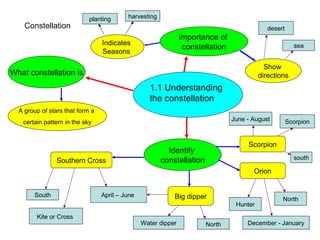
Show
directions
Indicates
Seasons
A group of stars that form a
certain pattern in the sky
Importance of
constellation
Identify
constellation
What constellation is
1.1 Understanding
the constellation
Constellation
Big dipper
Scorpion
Orion
Southern Cross
North
North
South April – June
Kite or Cross
Scorpion
Hunter
Water dipper
south
December - January
June - August
planting harvesting
desert
sea
2.1
The movements
of the Earth, the Moon
and the Sun
Earth rotates
on it axis
Earth rotates
and at the
same time
moves around
the sun
Moon rotates
on it axis
Moon rotates
and at the
same time
moves around
the Earth
The Moon and
the Earth move
round the Sun at
the same time
The earth
rotates on its axis
from west to east
The changes
in length and position
of the shadow
throughout the day
THE EARTH , THE MOON
AND THE SUN
2.2
The occurrence of day and night
It is day time for the part
of the Earth facing the Sun.
It is night time for
the part of the Earth facing
away from the Sun.
Day and night occur
due to the rotation of the Earth
on its axis.
the Sun the Earth
night-timenight-time
daytimedaytime
axisaxis
westwest easteast
2.3 Phases Of The Moon
The Moon Does Not Emit Light
The Moon appear bright
when it reflect sunlight
Describe the phases
of the moon
1-New moon, 3- New half moon, 5- Full moon
7- Old half moon
INVESTIGATING
TECHNOLOGY
1.1
The shapes of objects in a structure
The shape of objects Identify shape in structure
CuboidCube Cylinder
Sphere ConePyramid
Sphere
Cylinder
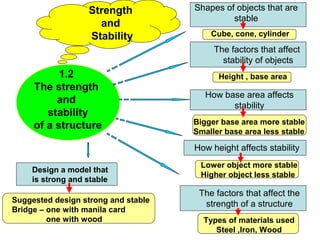
Strength
and
Stability
Shapes of objects that are
stable
The factors that affect
stability of objects
How base area affects
stability
How height affects stability
1.2
The strength
and
stability
of a structure
The factors that affect the
strength of a structure
Design a model that
is strong and stable
Cube, cone, cylinder
Height , base area
Bigger base area more stable
Smaller base area less stable
Lower object more stable
Higher object less stable
Types of materials used
Steel ,Iron, Wood
Suggested design strong and stable
Bridge – one with manila card
one with wood

Sc mind map year 5

  • 3.
    1.1 Understanding thatmicroorganism is a living things Microorganism Bacteria Fungi Protozua Virus Cannot see with naked eyes GrowMoveBreathe Characteristics Cause the dough rise • Rotten oranges • Mouldy rice tiny
  • 4.
    1.1 Understanding thatsome microorganism are harmful and some are useful Some Organisms Are Harmful And Some Are Useful Useful Harmful Can cause Illness Food poisoning Food stale Tooth decay Prevention Disease Stomach upset Measles/cough Tooth decay Conjunctivity/mumps Washing hand Drink boiled water Covering mouth & nose when coughing & sneezing -Making food (bread/tapai/tempe/ yogurt) -Making fertilizer -Mking medcine
  • 5.
    2.1 Survival of Animal Species Examplesanimals that take care of their eggs and young. how animals take care of Their eggs and young. Why animals take care of their eggs and young. Bird - Eggs with shell covering Frog - Eggs are thick, slimy and having bad smell Spider - kept in a bag underneath its body Fish - keep their young in their mouths Snake, Tiger - attack in order to protect their eggs Turtle - hide their eggs Kangaroo - carry their young in their pouches Elephant - stay in herds 2.3 Importance Shortage of food resource Animals and plants species may face extinction. Bird, Frog, Spider, Fish, Snake, turtle, Kangroo, Elephant To ensure the survival of their species
  • 6.
    2.2 Survival of Plant Species Water Explosive mechanism Wind Animal •Light • Air Space in the fruits • Not water absorbent • Light • Small in size • Winged • Dry when ripe • Explodes when mature • Brightly coloured • Edible • Have smells • Have hook • Coconut • Lily • Shorea • Angsana • Lalang • Rubber fruit • Balsam fruit • Chestnut • Rambutan • Mango • Love grass • Mimosa Agents of dispersal Special characteristic Examples
  • 7.
    3.1 Food Chain Animalsand the food they eat Classify animals into herbivore, carnivore and omnivore. Producer ConsumerConstruct food chain Green plant obtain energy from the sun to make food. Green Plant as a producer Herbivore : Animals that eat plants only. e.g.: cow, goat, deer Carnivore: Animals that eat other animals. e.g.: tiger, lion Omnivore: Animals that eat plants and other animals Animals that eat plant or other animals are called consumers. The food relationship among living things can be shown by a food chain. To construct food chain It must start with plant as a producer. In a food chain the arrow means ‘eaten by’ All living things need food to survive. Green plant can make their own food. However animals cannot make their own make their own food.
  • 8.
    3.2 Synthesizing foodchain to construct food web. Food web What will happen If there is a change in population of a certain species in a food web Food web of different habitats What will happen to a certain species of animals if they eat only one type of food Paddy field garden A change in the population of a certain species will effect the Population of other species They will face difficulty to survive – if the Source of food runs out
  • 9.
  • 10.
    INVESTIGATING FORCE ANDENERGY ENERGY 1.1 The Uses of Energy Why energy is needed? - by living things to carry out life processes. Ex : moving, breathing, growing The Sources of Energy Sun - main source of energy - produces light and heat Food - food contains stored energy Wind - Moving air - Used to pump water, drive small sawmills - to move, boil, melt, or bounce non-living things Fuel Batteries - wood, coal, petroleum, natural gas - device that generated electrical energy from chemical energy Water - moving or falling water produce energy
  • 11.
    INVESTIGATING FORCE ANDENERGY ENERGY 1.2 Energy can be transformed from one form to another Form of energySound energy Heat energy Light energy Electrical energy Kinetic energy Chemical energy Potential energy Energy can be transformed a) lighting a candle Chemical energy → heat energy + light energy b) Kicking a ball Chemical energy → kinetic energy → heat energy Example of appliance that make use of energy transform a) Electric iron Electrical energy → heat energy b) Radio Electrical energy → sound energy c) Television Electrical energy → sound energy + light energy
  • 12.
    INVESTIGATING FORCE ANDENERGY ENERGY 1.3 Renewable and Non-renewable Energy Renewable energy Energy that cannot be replaced Resources – solar, wind, biomass fuel, water Non-renewable energy Energy that be replenished when it is used up Resources – natural gas, petroleum, coal Why use energy wisely How to use energy Some energy resources cannot be replenished when used up To save cost Avoid wastage Reduce pollution Turn off the television when no one watching it Switch off the lights before going to leave the room
  • 13.
    Electricity Sources Dry cell Accumulator Dynamo Solarcell Type of circuit Name Symbol Dry cell Connecting wire Switch Bulb Symbol and componentParallel circuit Series circuit Precautions Differences The bulb in the parallel circuit is brighter then the bulb in the series circuit Danger of mishandling electrical appliances Fire Burn Electric shock Electrocution Safety precautions to be taken when using appliances Do not touch electrical appliances with wet hand Do not repair electrical appliances on your own
  • 14.
    Light Can be reflected How? Uses of reflection Side mirror of a car Periscope Kaleidoscope Travel in a straight line How shadow is formed When light is completely or partially blocked by an opaque object The light that falls on objects ‘bounces off’ the objects and comes to your eyes mirror Shadow form Opaque object Light
  • 15.
    Heat Gain Loss Cooler Warmer Howto measure temperature using the correct technique The effects of heat on matter Matter expands when heated Matter contract when cooled
  • 16.
  • 17.
    1.1 Matter existin the form of solid, liquid or gas solid liquid gas has mass Properties of solid Properties of liquid Properties of gas fixed volume fixed shape has mass examples water milk air no permanent shape fixed volume stem wood stone can't fixed shape has mass Can't fixed volume can compressed
  • 18.
    1.2 CHANGING STATES OF WATER gas -liquid liquid - gas liquid - gas solid - liquid melting Boiling Affected by windy and hot weather evaporation condensation Freezing
  • 19.
    1.31.3 Understanding the watercycle.Understanding the water cycle. Circulation of water inCirculation of water in the environment.the environment. Formation of cloudsFormation of clouds and rain.and rain.Importance of water.Importance of water. Changes in the states ofChanges in the states of matter in the water cyclematter in the water cycle Liquid to gas (evaporation)Liquid to gas (evaporation) Droplets of water willDroplets of water will become bigger andbecome bigger and heavier →heavier → rain evaporation condensation sea Gas → liquid (Condensation)Gas → liquid (Condensation)
  • 20.
    1.41.4 Appreciating the importanceAppreciatingthe importance of water resources.of water resources. To prevent living aquatic from beingTo prevent living aquatic from being destroyed and undergoing extinctiondestroyed and undergoing extinction Reasons to keep ourReasons to keep our water resources clean.water resources clean. To ensure the cleanlinessTo ensure the cleanliness of water supplyof water supply To regulateTo regulate the formation ofthe formation of clouds and rainclouds and rain To avoid infectedTo avoid infected diseasesdiseases Ways to keep our waterWays to keep our water resources cleanresources clean Keep the rivers cleanKeep the rivers clean Cleanliness campaignCleanliness campaign
  • 21.
    2.1 The propertiesof acid,2.1 The properties of acid, alkaline and neutral substances.alkaline and neutral substances. Identify the taste of acidicIdentify the taste of acidic and alkaline food.and alkaline food. Identify acidic, alkalineIdentify acidic, alkaline and neutral substancesand neutral substances using litmus paper.using litmus paper. • Conclude the properties ofConclude the properties of acidic, alkaline and neutralacidic, alkaline and neutral substances.substances. Changes in colourChanges in colour of litmus papersof litmus papers blue to redblue to red red to bluered to blue no changeno change bitterbitter soursour Properties of alkaliProperties of alkali Properties of acidProperties of acid Properties ofProperties of neutral substancesneutral substancesTaste bitter & changeTaste bitter & change red litmus paper bluered litmus paper blue Taste sour & changeTaste sour & change blue litmus paper redblue litmus paper red Other tastes –Other tastes – no changes in litmus paperno changes in litmus paper acidacid alkalinealkaline neutralneutral
  • 22.
  • 23.
    Show directions Indicates Seasons A group ofstars that form a certain pattern in the sky Importance of constellation Identify constellation What constellation is 1.1 Understanding the constellation Constellation Big dipper Scorpion Orion Southern Cross North North South April – June Kite or Cross Scorpion Hunter Water dipper south December - January June - August planting harvesting desert sea
  • 24.
    2.1 The movements of theEarth, the Moon and the Sun Earth rotates on it axis Earth rotates and at the same time moves around the sun Moon rotates on it axis Moon rotates and at the same time moves around the Earth The Moon and the Earth move round the Sun at the same time The earth rotates on its axis from west to east The changes in length and position of the shadow throughout the day THE EARTH , THE MOON AND THE SUN
  • 25.
    2.2 The occurrence ofday and night It is day time for the part of the Earth facing the Sun. It is night time for the part of the Earth facing away from the Sun. Day and night occur due to the rotation of the Earth on its axis. the Sun the Earth night-timenight-time daytimedaytime axisaxis westwest easteast
  • 26.
    2.3 Phases OfThe Moon The Moon Does Not Emit Light The Moon appear bright when it reflect sunlight Describe the phases of the moon 1-New moon, 3- New half moon, 5- Full moon 7- Old half moon
  • 27.
  • 28.
    1.1 The shapes ofobjects in a structure The shape of objects Identify shape in structure CuboidCube Cylinder Sphere ConePyramid Sphere Cylinder
  • 29.
    Strength and Stability Shapes of objectsthat are stable The factors that affect stability of objects How base area affects stability How height affects stability 1.2 The strength and stability of a structure The factors that affect the strength of a structure Design a model that is strong and stable Cube, cone, cylinder Height , base area Bigger base area more stable Smaller base area less stable Lower object more stable Higher object less stable Types of materials used Steel ,Iron, Wood Suggested design strong and stable Bridge – one with manila card one with wood