MIND MAP YEAR 4
INVESTIGATING LIVING  THINGS
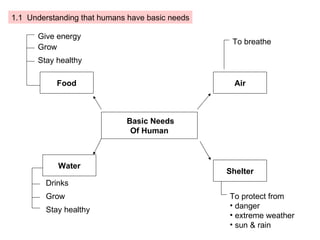
Basic Needs  Of Human Food Shelter Air Water To breathe To protect from danger extreme weather sun & rain Give energy Grow Stay healthy Drinks Grow Stay healthy 1.1  Understanding that humans have basic needs
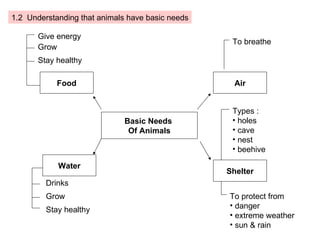
Basic Needs  Of Animals Food Shelter Air Water To breathe To protect from danger extreme weather sun & rain Give energy Grow Stay healthy Drinks Grow Stay healthy 1.2  Understanding that animals have basic needs Types : holes cave nest beehive
Plants Have Basic Needs Air Sunlight Water With : grow healthy grow well not wilted Without : wilted Turn yellow Die 1.3  Understanding that plants have basic needs
2.1  Analysing life processes that humans undergo Analysing Life Processes That Human Undergo Respond To  Stimuli Breathing Reproduce Organs Inhale –  take in air Exhale –  give out air Nose/Mouth  Wind-pipe  Lungs A process to produce their young or offspring Rate of breath Number of chest movement  In a period of time Organs Eyes -  Sight Nose -  Smell Tongue -  Taste Ears -  Sound Skin -  Touch Excrete Defecate Lungs ( Carbon dioxide + water vapour ) Kidney  ( urine + mineral salt ) Skin  ( Sweat + mineral salt ) Faeces Purpose : avoid danger avoid getting hurt avoid getting injured to survive
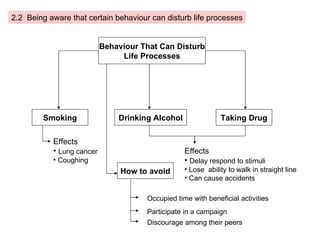
2.2  Being aware that certain behaviour can disturb life processes Behaviour That Can Disturb Life Processes Smoking Taking Drug Drinking Alcohol Effects Lung cancer Coughing Effects Delay respond to stimuli Lose  ability to walk in straight line Can cause accidents How to avoid Participate in a campaign Discourage among their peers Occupied time with beneficial activities
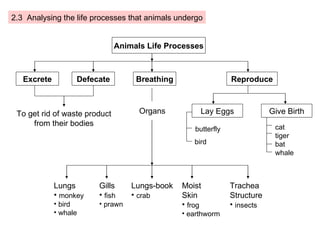
2.3  Analysing the life processes that animals undergo Animals Life Processes Breathing Excrete Reproduce Lay Eggs Give Birth Organs Lungs monkey bird whale Gills fish prawn Lungs-book crab Moist Skin frog earthworm  Trachea Structure insects Defecate To get rid of waste product from their bodies cat tiger bat whale butterfly bird
2.4  Life processes  plants undergo plants respond to stimuli. water, sunlight, touch, gravity. why plants need to reproduce to ensure the survival of the species.   various ways plants reproduce through…seeds, spores, suckers, stem cutting,  leaves, underground stem.  what will happen to the world if  plants do not reproduce. no food supply. plants reproduce. Seeds – balsam, corn, durian Spores – fern, mushroom Suckers – banana, pineapple Stem cutting – hibiscus, rose, tapioca Leaves – bryophyllum, begonia Stem – potato, onion, ginger and lily the part of plant that responds  to touch. the part of plant that responds  to sunlight. Shoot the part of plant that responds  to gravity. Roots the part of plant that responds to water Roots   Science Year 4 INVESTIGATING LIVING THINGS 2. Living Things Undergo Life Processes
Special characteristics  of animals that protect  them  from danger. special behaviour  of animals that protect them  from danger. The special characteristics and behaviour of animals help to  protect  them from danger. 3.1 animals have specific characteristics and behaviour to protect  themselves Thick and hard skin To prevent their enemies from injuring Hard shell Snails and tortoise retract their head And legs into the shell when the are Attacked  by enemies Hard scales Pangolins and crocodiles have hard scales To protect their bodies from injuries Spines Raise the sharp spines when  the enemies  Advance towards them Horns  Use their horn to attack enemies. Sharp claws To protect themselves  and their  Young from the enemies- lion ,cat, Bears, and eagle. Spray black ink Dark surrounding helps the animal not to been seen by enemies –  e.g: octopus, squid Poisonous sting or fangs Can hurt and kill enemies-e.g..: scorpion, centipede snake , bee. Camouflage Has body colour or patterns that that are  Similar  to the surrounding Pretend to dead To trick their enemies –e.g.: beetle
3.2/3.3  Animals have specific  characteristics  and behaviour to protect  themselves from  extreme weather and survive how specific characteristics and behavior  of  animals help to protect  them from very hot or cold weather. specific characteristics and  behavior of animals that protect them from very hot and cold weather. Hot weather Cold weather Wrinkled Skin Elephant ,hippopotamuses  and buffaloes  lose body  heat through wrinkled skins Wallowing Elephant, hippopotamuses and buffaloes keep their body cool by wallowing in mud holes Humps Camels store food and water in the form Of fats in the humps on their back. Thick Fur Polar bears have thick fur to prevent the body  From losing heat to cold surroundings. Fat Layers Under The Skins Penguins, seals, and whales have fat layers under their skin to keep their bodies warm Small Ears Seals and Walruses have small ears to prevent  Heat loss from their bodies. Hibernate Polar bears hibernates during extreme cold  Weather
3.4 Plants have specific characteristics to protect themselves from enemy Th e specific characteristics of  plants that protect them  from enemies  How the specific characteristics of  plants help to  protect them  from enemies. characteristics that protect plants. Have thorns poisonous Have fine hairs Produces latex  Close leaflets  when touch
3.5  Plants have specific characteristics to protect themselves from dry region and strong wind strong wind dry region Eg : cactus . Long roots to absorb water Succulent stem can store  water Thorn can can prevent the excessive loss of  water Eg:  Coconut tree, bamboo tree, mangrove tree Have stems that bend easily  Have buttress roots Have separated leaves Needle- shaped leaves
INVESTIGATING FORCE AND ENERGY
MEASUREMENT Volume  1.1 Length 1.2  Area 1.5 Mass 1.6 Time 1.7 Standard units 1.3 Solid 1.4 Liquid
1.1Length Terminology - The distance between two points/place/position Ways to measure Measuring tape  Cubit Arm span String Ruler Standard Tools Measuring tape  Ruler  Unit mm cm m km Correct technique - The eye must be directly above the end of object
1.2 Area -  Area is the amount of    Space taken up by the    surface of an object.  Terminology -  Using square card with a    sides of 1 centimetre Standard unit - Square millimetre (mm 2 ) - Square centimetre (cm 2 ) - Square metre (m 2 ) - Square kilometre (km 2 ) - Using formula Area = length X width 1cm  1cm Different ways to measure area 2cm  4cm  = 4cm X 2 cm   = 8cm 2 3cm  3cm  by placing uniform  objects such as tiles,    books and stamps    on the surface of    the objects
Volume Terminology The amount of space that something takes up 1.3 Solid 1.4 Liquid Formula Length x width x height Standard Units mm3, cm 3 , m 3 Tools Standard Units measuring cylinder ml, l Correct technique a) taking the reading at the   lowest part of the meniscus. b) eyes must be at the same level   as the lowest part of the meniscus
1.5 Mass Terminology - Amount of matter in an object Tools Electronic balance Simple balance Beam balance Kitchen  scale Bathroom scale Lever balance Standard unit mg g kg Correct technique
1.6 Time Terminology - Duration between two event Way to measure - Sundial , sand clock , candle clock Process that repeats uniformly can be used to measure time  Swinging pendulum  Pulse rate candle water dripping Changing day and night Tool Standard unit - Second , minute , hour - Digital clock , watch , wrist watch , clock Old clock Events can be used measuring time
1.7  The Importance of Standard Units - for accuracy and   consistency - easy to communicate   and understanding
Investigating Materials
1.1  The properties of materials Insulator Float on water Conduct electricity metal conduct heat Sink in water Light to pass through Can be stretch wood stone rubber ring glass carbon plastics   metal wood
1.2 Applying knowledge properties of materials in everyday life Suggest ways  to keep things hot  Covered with insulators  Suggest ways  to keep things cold  hot thing cold thing To prevent  heat loss prevent from absorbing heat
1.3 Uses of  materials based on their properties List of object and materials that they  are made of Reason why particular  materials are used to make an object cheap easy to get  strength good quality transparent glass glasses Soft wood tissue hard metal spoon properties materials object
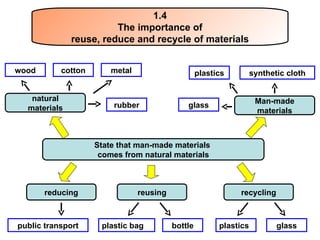
natural materials Man-made materials wood metal rubber cotton plastics synthetic cloth glass State that man-made materials  comes from natural materials reducing reusing recycling public transport plastic bag bottle plastics glass 1.4 The importance of reuse, reduce and recycle of materials
RUSTING CAN BE PREVENTED DIFFERENT WAYS TO PREVENT OBJECTS FROM RUSTING Coating with non rusting materials *paint *oil *grease THE NECESSARY TO PREVENT RUSTING *Everlasting Live *Save Natural  material *Save Cost *Looking good 1.6 *Conclusion; Rusting can be avoided by preventing iron contact  with air and water.
UNDERSTANDING THAT SOME MATERIALS CAN BE RUST RUSTY OBJECTS NON RUSTY OBJECTS OBJECT MADE OF IRON AND STEEL OBJECT MADE OF GLASS PLASTIC, WOOD, CLAY AND SILK *Nail *Spoon *Knife *Needle *Glass *Bottle *Cup *Pencil
INVESTIGATING  THE EARTH  AND  THE UNIVERSE
1.1 The solar system List of  constituents List of planets Planets  move around  the Sun Nine Planets Natural satellites Meteors Comets Asteroids M ercury  –  M y V enus  –  V ery E arth  –  E xcellent M ars  –  M other J upiter  –  J ust S aturn  –  S erved U ranus  –  U s N eptune  –  N ine P luto  –  P udding THE  SOLAR SYSTEM
1.2 The relative size and distance between  the Earth, the Moon and the Sun Size of the Sun relative to the size of the Earth. Size of the Earth relative to the size of the Moon. The relative distance from the Earth to the Sun compared to the relative distance from the Earth to the Moon. the Sun 1 the Earth 100 the Earth 1 the Moon 4 the Sun the Earth the Moon 150 000 000 km 382 500 km 1 :  400
1.3 Appreciating the perfect placement of the planet Earth in the Solar System Why certain planets are not conducive for living things . EFFECT The Earth is  the only planet in the  Solar System that  has living things. The nearer a planet to the Sun is, the hotter is the surface of the planet . The farther a planet from the Sun is, the colder is the surface of the planet. Do not have enough air and water. Earth is the third planet from the Sun, it receives enough light  and heat from the Sun. It is not too hot or too cold. The atmosphere of the Earth contains air and there is water on Earth. Much nearer :  The temperature on the Earth would rise. Water on Earth would evaporate. No water and the temperature would be  very hot. Much farther : The temperature on the Earth would drop. Water would freeze into ice. All living things would die.
INVESTIGATING TECHNOLOGY
1.1.Understanding the importance of technology in everyday life Limitation of human ability Examples of human limitations are Unable to see fine objects Unable to speak loud Unable to walk for long distance Unable to see far away objects Devices to overcome human limitation Microscope -  The usage of lens to see fine  features of objects and microbes  Microphone - To increase the voice volume Telephone -To communicate from long distance Bicycle, motorcycle, airplanes Can travel long distance in a shorter time Telescope, binocular - To see far away objects
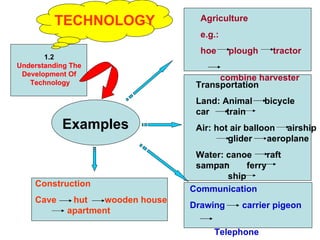
TECHNOLOGY 1.2  Understanding The  Development Of  Technology Agriculture e.g.:  hoe  plough  tractor  combine harvester Transportation Land: Animal  bicycle  car  train Air: hot air balloon  airship  glider  aeroplane Water: canoe  raft  sampan  ferry    ship Communication Drawing  carrier pigeon  Telephone Construction Cave  hut  wooden house  apartment Examples
Problems they encounter in their daily life TECHNOLOGY Ideas to solve the problems identified Device to solve the problem identified . Demonstrate that device invented can be used to solve the problem identified 1.3  Synthesising  how technology  can be used to  solve problems Cannot move and lift heavy thing Cannot move farther Sketch the model Brain storming lever wheelbarrow Pulley – can lift everything Wheel barrow – can move heavy thing easily
1.4 Analysing That Technology Can Benefit Mankind If Used Wisely Advantages of Technology Disadvantages of Technology Communication Enable human to learn more about things happening around the world Transportation Enable human to travel  far away places in shorter time Agriculture Machines make it easier to plants  and harvest their crops Construction Roads, highways, bridges and  building is easier and faster to build Environmental pollution from increase  In waste materials Environmental destruction result from excessive usage of natural resources Social problem Bad effects on health result from environmental pollution and excessive use of chemicals

Mind map year 4

  • 1.
  • 2.
  • 3.
    Basic Needs Of Human Food Shelter Air Water To breathe To protect from danger extreme weather sun & rain Give energy Grow Stay healthy Drinks Grow Stay healthy 1.1 Understanding that humans have basic needs
  • 4.
    Basic Needs Of Animals Food Shelter Air Water To breathe To protect from danger extreme weather sun & rain Give energy Grow Stay healthy Drinks Grow Stay healthy 1.2 Understanding that animals have basic needs Types : holes cave nest beehive
  • 5.
    Plants Have BasicNeeds Air Sunlight Water With : grow healthy grow well not wilted Without : wilted Turn yellow Die 1.3 Understanding that plants have basic needs
  • 6.
    2.1 Analysinglife processes that humans undergo Analysing Life Processes That Human Undergo Respond To Stimuli Breathing Reproduce Organs Inhale – take in air Exhale – give out air Nose/Mouth Wind-pipe Lungs A process to produce their young or offspring Rate of breath Number of chest movement In a period of time Organs Eyes - Sight Nose - Smell Tongue - Taste Ears - Sound Skin - Touch Excrete Defecate Lungs ( Carbon dioxide + water vapour ) Kidney ( urine + mineral salt ) Skin ( Sweat + mineral salt ) Faeces Purpose : avoid danger avoid getting hurt avoid getting injured to survive
  • 7.
    2.2 Beingaware that certain behaviour can disturb life processes Behaviour That Can Disturb Life Processes Smoking Taking Drug Drinking Alcohol Effects Lung cancer Coughing Effects Delay respond to stimuli Lose ability to walk in straight line Can cause accidents How to avoid Participate in a campaign Discourage among their peers Occupied time with beneficial activities
  • 8.
    2.3 Analysingthe life processes that animals undergo Animals Life Processes Breathing Excrete Reproduce Lay Eggs Give Birth Organs Lungs monkey bird whale Gills fish prawn Lungs-book crab Moist Skin frog earthworm Trachea Structure insects Defecate To get rid of waste product from their bodies cat tiger bat whale butterfly bird
  • 9.
    2.4 Lifeprocesses plants undergo plants respond to stimuli. water, sunlight, touch, gravity. why plants need to reproduce to ensure the survival of the species. various ways plants reproduce through…seeds, spores, suckers, stem cutting, leaves, underground stem. what will happen to the world if plants do not reproduce. no food supply. plants reproduce. Seeds – balsam, corn, durian Spores – fern, mushroom Suckers – banana, pineapple Stem cutting – hibiscus, rose, tapioca Leaves – bryophyllum, begonia Stem – potato, onion, ginger and lily the part of plant that responds to touch. the part of plant that responds to sunlight. Shoot the part of plant that responds to gravity. Roots the part of plant that responds to water Roots Science Year 4 INVESTIGATING LIVING THINGS 2. Living Things Undergo Life Processes
  • 10.
    Special characteristics of animals that protect them from danger. special behaviour of animals that protect them from danger. The special characteristics and behaviour of animals help to protect them from danger. 3.1 animals have specific characteristics and behaviour to protect themselves Thick and hard skin To prevent their enemies from injuring Hard shell Snails and tortoise retract their head And legs into the shell when the are Attacked by enemies Hard scales Pangolins and crocodiles have hard scales To protect their bodies from injuries Spines Raise the sharp spines when the enemies Advance towards them Horns Use their horn to attack enemies. Sharp claws To protect themselves and their Young from the enemies- lion ,cat, Bears, and eagle. Spray black ink Dark surrounding helps the animal not to been seen by enemies – e.g: octopus, squid Poisonous sting or fangs Can hurt and kill enemies-e.g..: scorpion, centipede snake , bee. Camouflage Has body colour or patterns that that are Similar to the surrounding Pretend to dead To trick their enemies –e.g.: beetle
  • 11.
    3.2/3.3 Animalshave specific characteristics and behaviour to protect themselves from extreme weather and survive how specific characteristics and behavior of animals help to protect them from very hot or cold weather. specific characteristics and behavior of animals that protect them from very hot and cold weather. Hot weather Cold weather Wrinkled Skin Elephant ,hippopotamuses and buffaloes lose body heat through wrinkled skins Wallowing Elephant, hippopotamuses and buffaloes keep their body cool by wallowing in mud holes Humps Camels store food and water in the form Of fats in the humps on their back. Thick Fur Polar bears have thick fur to prevent the body From losing heat to cold surroundings. Fat Layers Under The Skins Penguins, seals, and whales have fat layers under their skin to keep their bodies warm Small Ears Seals and Walruses have small ears to prevent Heat loss from their bodies. Hibernate Polar bears hibernates during extreme cold Weather
  • 12.
    3.4 Plants havespecific characteristics to protect themselves from enemy Th e specific characteristics of plants that protect them from enemies How the specific characteristics of plants help to protect them from enemies. characteristics that protect plants. Have thorns poisonous Have fine hairs Produces latex Close leaflets when touch
  • 13.
    3.5 Plantshave specific characteristics to protect themselves from dry region and strong wind strong wind dry region Eg : cactus . Long roots to absorb water Succulent stem can store water Thorn can can prevent the excessive loss of water Eg: Coconut tree, bamboo tree, mangrove tree Have stems that bend easily Have buttress roots Have separated leaves Needle- shaped leaves
  • 14.
  • 15.
    MEASUREMENT Volume 1.1 Length 1.2 Area 1.5 Mass 1.6 Time 1.7 Standard units 1.3 Solid 1.4 Liquid
  • 16.
    1.1Length Terminology -The distance between two points/place/position Ways to measure Measuring tape Cubit Arm span String Ruler Standard Tools Measuring tape Ruler Unit mm cm m km Correct technique - The eye must be directly above the end of object
  • 17.
    1.2 Area - Area is the amount of Space taken up by the surface of an object. Terminology - Using square card with a sides of 1 centimetre Standard unit - Square millimetre (mm 2 ) - Square centimetre (cm 2 ) - Square metre (m 2 ) - Square kilometre (km 2 ) - Using formula Area = length X width 1cm 1cm Different ways to measure area 2cm 4cm = 4cm X 2 cm = 8cm 2 3cm 3cm by placing uniform objects such as tiles, books and stamps on the surface of the objects
  • 18.
    Volume Terminology Theamount of space that something takes up 1.3 Solid 1.4 Liquid Formula Length x width x height Standard Units mm3, cm 3 , m 3 Tools Standard Units measuring cylinder ml, l Correct technique a) taking the reading at the lowest part of the meniscus. b) eyes must be at the same level as the lowest part of the meniscus
  • 19.
    1.5 Mass Terminology- Amount of matter in an object Tools Electronic balance Simple balance Beam balance Kitchen scale Bathroom scale Lever balance Standard unit mg g kg Correct technique
  • 20.
    1.6 Time Terminology- Duration between two event Way to measure - Sundial , sand clock , candle clock Process that repeats uniformly can be used to measure time Swinging pendulum Pulse rate candle water dripping Changing day and night Tool Standard unit - Second , minute , hour - Digital clock , watch , wrist watch , clock Old clock Events can be used measuring time
  • 21.
    1.7 TheImportance of Standard Units - for accuracy and consistency - easy to communicate and understanding
  • 22.
  • 23.
    1.1 Theproperties of materials Insulator Float on water Conduct electricity metal conduct heat Sink in water Light to pass through Can be stretch wood stone rubber ring glass carbon plastics metal wood
  • 24.
    1.2 Applying knowledgeproperties of materials in everyday life Suggest ways to keep things hot Covered with insulators Suggest ways to keep things cold hot thing cold thing To prevent heat loss prevent from absorbing heat
  • 25.
    1.3 Uses of materials based on their properties List of object and materials that they are made of Reason why particular materials are used to make an object cheap easy to get strength good quality transparent glass glasses Soft wood tissue hard metal spoon properties materials object
  • 26.
    natural materials Man-madematerials wood metal rubber cotton plastics synthetic cloth glass State that man-made materials comes from natural materials reducing reusing recycling public transport plastic bag bottle plastics glass 1.4 The importance of reuse, reduce and recycle of materials
  • 27.
    RUSTING CAN BEPREVENTED DIFFERENT WAYS TO PREVENT OBJECTS FROM RUSTING Coating with non rusting materials *paint *oil *grease THE NECESSARY TO PREVENT RUSTING *Everlasting Live *Save Natural material *Save Cost *Looking good 1.6 *Conclusion; Rusting can be avoided by preventing iron contact with air and water.
  • 28.
    UNDERSTANDING THAT SOMEMATERIALS CAN BE RUST RUSTY OBJECTS NON RUSTY OBJECTS OBJECT MADE OF IRON AND STEEL OBJECT MADE OF GLASS PLASTIC, WOOD, CLAY AND SILK *Nail *Spoon *Knife *Needle *Glass *Bottle *Cup *Pencil
  • 29.
    INVESTIGATING THEEARTH AND THE UNIVERSE
  • 30.
    1.1 The solarsystem List of constituents List of planets Planets move around the Sun Nine Planets Natural satellites Meteors Comets Asteroids M ercury – M y V enus – V ery E arth – E xcellent M ars – M other J upiter – J ust S aturn – S erved U ranus – U s N eptune – N ine P luto – P udding THE SOLAR SYSTEM
  • 31.
    1.2 The relativesize and distance between the Earth, the Moon and the Sun Size of the Sun relative to the size of the Earth. Size of the Earth relative to the size of the Moon. The relative distance from the Earth to the Sun compared to the relative distance from the Earth to the Moon. the Sun 1 the Earth 100 the Earth 1 the Moon 4 the Sun the Earth the Moon 150 000 000 km 382 500 km 1 : 400
  • 32.
    1.3 Appreciating theperfect placement of the planet Earth in the Solar System Why certain planets are not conducive for living things . EFFECT The Earth is the only planet in the Solar System that has living things. The nearer a planet to the Sun is, the hotter is the surface of the planet . The farther a planet from the Sun is, the colder is the surface of the planet. Do not have enough air and water. Earth is the third planet from the Sun, it receives enough light and heat from the Sun. It is not too hot or too cold. The atmosphere of the Earth contains air and there is water on Earth. Much nearer : The temperature on the Earth would rise. Water on Earth would evaporate. No water and the temperature would be very hot. Much farther : The temperature on the Earth would drop. Water would freeze into ice. All living things would die.
  • 33.
  • 34.
    1.1.Understanding the importanceof technology in everyday life Limitation of human ability Examples of human limitations are Unable to see fine objects Unable to speak loud Unable to walk for long distance Unable to see far away objects Devices to overcome human limitation Microscope - The usage of lens to see fine features of objects and microbes Microphone - To increase the voice volume Telephone -To communicate from long distance Bicycle, motorcycle, airplanes Can travel long distance in a shorter time Telescope, binocular - To see far away objects
  • 35.
    TECHNOLOGY 1.2 Understanding The Development Of Technology Agriculture e.g.: hoe plough tractor combine harvester Transportation Land: Animal bicycle car train Air: hot air balloon airship glider aeroplane Water: canoe raft sampan ferry ship Communication Drawing carrier pigeon Telephone Construction Cave hut wooden house apartment Examples
  • 36.
    Problems they encounterin their daily life TECHNOLOGY Ideas to solve the problems identified Device to solve the problem identified . Demonstrate that device invented can be used to solve the problem identified 1.3 Synthesising how technology can be used to solve problems Cannot move and lift heavy thing Cannot move farther Sketch the model Brain storming lever wheelbarrow Pulley – can lift everything Wheel barrow – can move heavy thing easily
  • 37.
    1.4 Analysing ThatTechnology Can Benefit Mankind If Used Wisely Advantages of Technology Disadvantages of Technology Communication Enable human to learn more about things happening around the world Transportation Enable human to travel far away places in shorter time Agriculture Machines make it easier to plants and harvest their crops Construction Roads, highways, bridges and building is easier and faster to build Environmental pollution from increase In waste materials Environmental destruction result from excessive usage of natural resources Social problem Bad effects on health result from environmental pollution and excessive use of chemicals