NR505 Advanced Research Methods: Evidence-Based Practice
Evidence-Based Practice Change Project Proposal Template
Nursing Practice Concern/Problem
PICOT Question
Key Stakeholders
Theoretical Framework
Literature Review
Data Collection Methods
Analysis
Expected Outcomes
NR 505 Week 7 Assignment _7/24/2019JPTS
1
Chamberlain College of Nursing NR 505
ADVANCED RESEARCH METHODS – EVIDENCE-BASED
PRACTICE
Research Summary Assignment
Chamberlain College of Nursing
NR 505: Advanced Research Methods: Evidence-Based Practice
Dr. Hellem
Sept. 2019
NR 505: Research Summary Template
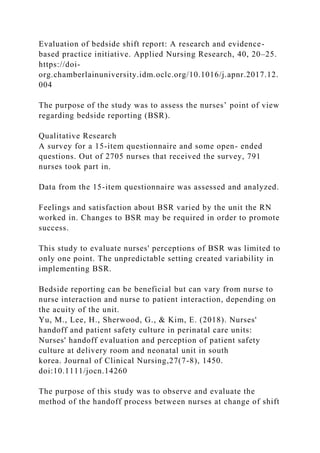
PICOT QUESTION: In patients, what is the effect of bedside
report in comparison to phone report on patient outcomes in a
period of six weeks?
Full reference for article (APA Format)
Purpose
Research Method
Participants
Data Collection
Study Findings
Limitations
Relevance to PICOT
Rush, S. (2014). Bedside reporting: Dynamic dialogue. Nursing
Management,43(1), 40-40.
doi:10.1097/01.NUMA.0000409923.61966.ac
The study focused on increasing patient satisfaction and safety
through bedside reporting at Catholic Healthare West (CHW).
Qualitative Research
Participants included hospital staff, leaders, and patients.
Nurse supervisors observed bedside reporting at change of shift.
They then filled out a questionnaire that had to be checked off
to ensure bedside reporting was done correctly.
Bedside reporting made a positive impact in the hospital. Its
success was witnessed by nurse leadership rounding on patients
in the hospital.
The sample of participants was small and only one department
of the hospital was used.
The findings conclude the positive outcomes on patient
satisfaction with bedside reporting.

Lu, S., Kerr, D., & McKinlay, L. (2014). Bedside nursing
handover: Patients' opinions. International Journal of Nursing
Practice,20(5), 451-459. doi:10.1111/ijn.12158
Evidence proves bedside reporting is beneficial. This study tries
to develop a protocol for nurses to follow when shift report is
given at bedside.
Qualitative research.
A sample of 30 admitted, consenting patients were used. The
patients were admitted to one of the three departments where
the process of bedside report had been implemented for at least
one year.
All data was collected from the answers from the patients
through audio-recorded interviews. A research assistant and a
registered nurse were present in the interview.
Four essential components came out of the study. Some
regarded patient feelings and some regarded possible changes.
Patients felt bedside reporting was ‘effective and personalized’
(1). They felt empowered in their care (2). Some felt their
privacy was at jeopardy (3), thus allowing for training (4) in
this sensitive matter.
The study was limited to three departments in the hospital and
no clear generalizability came out of it. Sample collected was
small.
Patients feel a sense of empowerment when having some control
over their plan of care. It is important for staff to have training
in proper communication and sensitive topics at bedside.
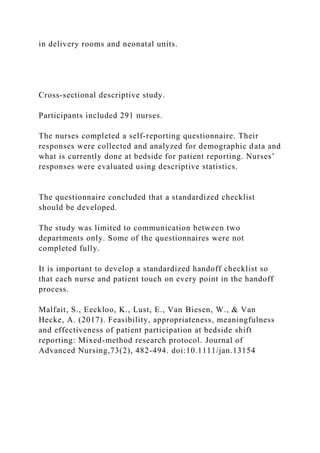
Schirm, V., Banz, G., Swartz, C., & Richmond, M. (2018).
Evaluation of bedside shift report: A research and evidence-
based practice initiative. Applied Nursing Research, 40, 20–25.
https://doi-
org.chamberlainuniversity.idm.oclc.org/10.1016/j.apnr.2017.12.
004
The purpose of the study was to assess the nurses’ point of view
regarding bedside reporting (BSR).
Qualitative Research
A survey for a 15-item questionnaire and some open- ended
questions. Out of 2705 nurses that received the survey, 791
nurses took part in.
Data from the 15-item questionnaire was assessed and analyzed.
Feelings and satisfaction about BSR varied by the unit the RN
worked in. Changes to BSR may be required in order to promote
success.
This study to evaluate nurses' perceptions of BSR was limited to
only one point. The unpredictable setting created variability in
implementing BSR.
Bedside reporting can be beneficial but can vary from nurse to
nurse interaction and nurse to patient interaction, depending on
the acuity of the unit.
Yu, M., Lee, H., Sherwood, G., & Kim, E. (2018). Nurses'
handoff and patient safety culture in perinatal care units:
Nurses' handoff evaluation and perception of patient safety
culture at delivery room and neonatal unit in south
korea. Journal of Clinical Nursing,27(7-8), 1450.
doi:10.1111/jocn.14260
The purpose of this study was to observe and evaluate the
method of the handoff process between nurses at change of shift
in delivery rooms and neonatal units.
Cross‐sectional descriptive study.
Participants included 291 nurses.
The nurses completed a self‐reporting questionnaire. Their
responses were collected and analyzed for demographic data and
what is currently done at bedside for patient reporting. Nurses’
responses were evaluated using descriptive statistics.
The questionnaire concluded that a standardized checklist
should be developed.
The study was limited to communication between two
departments only. Some of the questionnaires were not
completed fully.
It is important to develop a standardized handoff checklist so
that each nurse and patient touch on every point in the handoff
process.
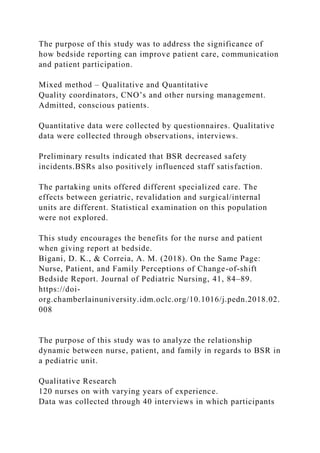
Malfait, S., Eeckloo, K., Lust, E., Van Biesen, W., & Van
Hecke, A. (2017). Feasibility, appropriateness, meaningfulness
and effectiveness of patient participation at bedside shift
reporting: Mixed-method research protocol. Journal of
Advanced Nursing,73(2), 482-494. doi:10.1111/jan.13154
The purpose of this study was to address the significance of
how bedside reporting can improve patient care, communication
and patient participation.
Mixed method – Qualitative and Quantitative
Quality coordinators, CNO’s and other nursing management.
Admitted, conscious patients.
Quantitative data were collected by questionnaires. Qualitative
data were collected through observations, interviews.
Preliminary results indicated that BSR decreased safety
incidents.BSRs also positively influenced staff satisfaction.
The partaking units offered different specialized care. The
effects between geriatric, revalidation and surgical/internal
units are different. Statistical examination on this population
were not explored.
This study encourages the benefits for the nurse and patient
when giving report at bedside.
Bigani, D. K., & Correia, A. M. (2018). On the Same Page:
Nurse, Patient, and Family Perceptions of Change-of-shift
Bedside Report. Journal of Pediatric Nursing, 41, 84–89.
https://doi-
org.chamberlainuniversity.idm.oclc.org/10.1016/j.pedn.2018.02.
008
The purpose of this study was to analyze the relationship
dynamic between nurse, patient, and family in regards to BSR in
a pediatric unit.
Qualitative Research
120 nurses on with varying years of experience.
Data was collected through 40 interviews in which participants
were given a questionnaire.
The study resulted with positive feedback, consistent with BSR
contributing to effective communication and an increase in
patient safety.
The study is limited in its small sample size and the
generalizability. Furthermore, the questionnaire did not get
tested for reliability and validity
Bedside reporting contributes to safety and good patient
outcomes.
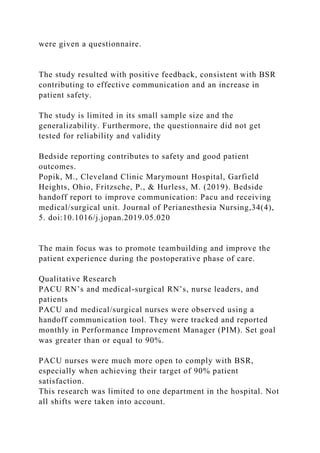
Popik, M., Cleveland Clinic Marymount Hospital, Garfield
Heights, Ohio, Fritzsche, P., & Hurless, M. (2019). Bedside
handoff report to improve communication: Pacu and receiving
medical/surgical unit. Journal of Perianesthesia Nursing,34(4),
5. doi:10.1016/j.jopan.2019.05.020
The main focus was to promote teambuilding and improve the
patient experience during the postoperative phase of care.
Qualitative Research
PACU RN’s and medical-surgical RN’s, nurse leaders, and
patients
PACU and medical/surgical nurses were observed using a
handoff communication tool. They were tracked and reported
monthly in Performance Improvement Manager (PIM). Set goal
was greater than or equal to 90%.
PACU nurses were much more open to comply with BSR,
especially when achieving their target of 90% patient
satisfaction.
This research was limited to one department in the hospital. Not
all shifts were taken into account.
This article is a reminder of the importance of BSR, but also
helps in promoting teamwork.
White-Trevino, K., & Dearmon, V. (2018). Transitioning nurse
handoff to the bedside: Engaging staff and patients. Nursing
Administration Quarterly,42(3), 261-261.
The study explains the process undertaken to implement a
structured, patient-centered report in the ED.
Qualitative research
39-bed unit. 46 ED RN’s participated.
Observation and goals were assessed over a 3 month period.
SBAR-T handoff was used, along with a competency checklist.
Patients report satisfaction with the bedside report and with
nurse communication. Although, patient engagement varied by
where the nurses stood when giving report (had their backs to
the patient, or stood across from patient, fixated on the
computer).
Sampling bias may have occurred, since observations did not
include all shift changes and consisted of a small sampling of
handoff observations.
Bedside reporting is beneficial to both parties, the RN and the
patient, but RN’s need to be cognizant of their nonverbal
communication when reporting.
Ford, Y., & Heyman, A. (2017). Patients' perceptions of bedside
handoff: Further evidence to support a culture of
always. Journal of Nursing Care Quality,32(1), 15-24.
doi:10.1097/NCQ.0000000000000201
The purpose of this study was to address the positive
correlations between bedside handoff and patients' satisfaction.
Qualitative Research
A survey was conducted on five inpatient adult medical-surgical
units, each ranging from 26-46 beds, at a hospital in the
Midwestern United States.
Through a questionnaire, patients were asked to evaluate their
hospital stay. They were asked 11 questions, mostly pertaining
to report hand-off.
Even though the goals were not met, there was a substantial
improvement in favor of bedside handoff from patients.
The sample of the patients chosen was small, exclusively from
one unit. The sample may have limited the generalizability of
the findings.
When it comes to patient satisfaction, bedside reporting is
subjective to the patient but the findings do correlate patient
satisfaction to bedside handoff.
Usher, R., Cronin, S., & York, N. (2018). Evaluating the
influence of a standardized bedside handoff process in a
medical–surgical unit. The Journal of Continuing Education in
Nursing,49(4), 157-163. doi:10.3928/00220124-20180320-05
The purpose of the study was to evaluate the influence of a
standardized bedside handoff process in a medical-surgical unit.
Qualitative Research
32 nurses, varying ages from 25 to 44, mostly women, and
bachelor’s prepared.
Nurses were observed at bedside handoff using the SBAR(T)
competency checklist. Their behavior was then evaluated for
quality, consistency, and thoroughness in their delivery.
There was no significant change in the scores when using the
SBAR(T) pre and post using the standardized checklist.
However, the mean increased toward improvement using the
standardized checklist.
The sample was small. If standardized bedside handoff will be
implemented, a larger sample is needed hospital wide.
This study was specific to a standardized bedside handoff.
Evidence proves BSR is beneficial to patient and nurse. Should
we focus on standardizing the handoff process?
Fall 2017: BUSS 330 Managing ChangeKotter’s Eight Steps to
Transforming Your Organization
STEP #
STEP
ANALYSIS
Higginson-Lewis
Orchard Gardens
1
Establishing a Sense of Urgency
2
Forming a Powerful Guiding Coalition
3
Creating a Vision
4
Communicating a Vision
5
Empowering colleagues to act on the Vision
6
Planning for and creating short-term Wins
7
Consolidating improvements & Producing still more Change
8
Institutionalizing New Approaches
A Tale of Two Schools
In a struggling neighborhood filled with kids from struggling
families, two of the city’s worst-
performing schools are on diverging paths. Orchard Gardens,
the turnaround success, gets all the
press. The Higginson/Lewis gets whatever’s left over.
By Rob Gurwitt | Boston Magazine | September 2013
“In some cities you get a whole year to plan a new school,” says
the Higginson/Lewis school’s principal,
Joy Salesman-Oliver. “Here? Six weeks over the summer.” /
Photographs by Trent Bell
There used to be $30,000 worth of musical instruments stored
next to the auditorium of the
Higginson/Lewis K–8 School in Roxbury. The stash included
saxophones, trumpets, flutes, trombones,
and clarinets—a closet-load of promise. They showed up in
2009, the same year the school was stitched
together from the old Henry L. Higginson Elementary School,
which now sits empty just up the street,
and the George A. Lewis Middle School, a worn, 102-year-old
building that the combined school came to
occupy. The instruments were bought with a grant from the VH1
Save the Music Foundation, and they
came with a pledge from the school district to hire a music
teacher. This was fitting, given that one of
the school’s namesakes, Henry Lee Higginson, was the founder
of the Boston Symphony Orchestra.
But that was four years ago. The Higginson/Lewis, a struggling
school in a struggling neighborhood filled
with kids from struggling families, never got its music teacher.
And then most of the instruments
disappeared. “At first I was worried they’d grown legs and
walked out the door, stolen,” said one
teacher. In fact, they’d been lent to another school for its band.
Just a few trombones and clarinets
remained, the brass fittings on their cases untouched and still as
shiny as on the day they arrived.
Like many inner-city schools, the Higginson/Lewis has
struggled even when good things happen to it.
And good things don’t come along so often. The faded red-brick
exterior is imposing and aloof. Inside,
there are efforts at cheeriness: doors and trim painted a jaunty
blue that has taken on a murky denim
tinge, walls highlighted with inspirational quotes (“Start where
you are, use what you have, do what you
can. –Arthur Ashe”) painted a few years ago by volunteers from
Bain Capital. But slogans can’t hide the
sunless hallways, or the clocks that all run an hour fast because
fixing them would require a visit by an
electrician from central offices who has never shown up. The
windows don’t open, and there’s no air
conditioning—on a hot day it can get to more than 100 degrees
in the classrooms along the southeast
side. Just blocks away, dealers sell drugs on Warren Street and
prostitutes ply their trade along Blue Hill
Avenue. When a shootout erupted last spring at the nearby
Walgreens, the kids playing in the
schoolyard heard the shots—before they were hustled inside and
the school went into lockdown.
Academically, the school has been a laggard. Its MCAS scores
in English are well below the district’s
average for proficient or advanced work. In 2012, only one
other Boston public school did worse in
math. Even more disheartening, the Higginson/Lewis is being
outperformed by most other BPS schools
when it comes to improving its MCAS scores. “Our fate,” said
one of the elementary school teachers in
May, “is at least a weekly conversation here.”
And for good reason. In recent years, dramatic things have
befallen the stragglers among Boston’s public
schools. They’ve been shut down, “merged” into nonexistence,
or converted into charters. A lucky few
have been transformed into “turnaround” schools—a designation
under state law in which the students
stay the same but half or more of the staff is replaced. Over the
past couple of years, a turnaround
called Orchard Gardens, located just a mile from the
Higginson/Lewis, has received more positive
publicity than any other public school in Boston: a story on the
NBC Nightly News, a loving shout-out
from Governor Deval Patrick at the Democratic National
Convention, a well-covered visit to the White
House by one of its first-grade classes. It is Exhibit A for the
group of school reformers who’ve coalesced
around a push, as CommonWealth magazine’s executive editor
put it recently in the Globe, “for the
embrace of a strategy to make school-level autonomy the
governing principle, rather than a carve-out
exception, at Boston’s 128 district schools.”
But the Higginson/Lewis fell into a different category: It wasn’t
quite bad enough to be designated a
turnaround. And so it continued to lag. That bitter irony has
been compounded by anxiety over a new
school-assignment system, which is set to take effect next year.
For the first time, school quality—as
measured by MCAS performance—will explicitly figure in the
choices presented to Boston parents.
Meanwhile, both the mayor’s race and a School Quality
Working Group recently created by Mayor
Menino are focusing citywide attention on fixing the schools.
The pressure on places like the
Higginson/Lewis has become overpowering.
This makes sense from the perspective of the Boston School
Committee, the administrators who work at
Boston Public Schools’ headquarters on Court Street, and the
politicians who see the city’s future in its
schools. They want schools that are dragging down overall
performance to get better or, if they can’t,
just to go away.
But inside the Higginson/Lewis, there’s worry about what will
happen a year from now, when parents
are given clear choices between schools that are succeeding and
schools that are not. “I’m not sure
what I’m supposed to be doing: advertising my bad-
neighborhood, not-very-high-quality school as
what?” says Joy Salesman-Oliver, the principal. There’s
palpable resentment toward BPS’s central
offices—“We absolutely feel abandoned,” says one teacher—for
not doing more to help the school lift
its performance. And there’s more than a little envy of Orchard
Gardens, the other hardscrabble
Roxbury K–8 school, which has seen levels of funding,
flexibility, and attention that the teachers and
administrators at the Higginson/Lewis can barely imagine.
Yet there is also, among some of the Higginson/Lewis school’s
staffers, a frustrated belief that they
should be doing more with what they do have. “There’s a
culture in this building of blame,” says one.
“People say, ‘Well, I couldn’t possibly teach this child because,
you see, I don’t have the pencils.’ ‘I
couldn’t possibly teach this child because, you see, he doesn’t
come to school on time.’ But at the end of
the day, our job description says, ‘You have to teach that
child.’”
In this kind of struggle—the one between being a school to
which things happen and becoming a school
that makes things happen—the Higginson/Lewis is far from the
lost cause that outsiders assume it to be.
It’s in a much more difficult position than that: perched
uncomfortably on the knife edge. It could go
either way. Whether it tips in the direction everyone wants it to
will say a lot about Boston’s ability to
rebuild its least-favored public schools.
Clockwise from top left, Higginson/Lewis assistant principal
David Brown; Lena Reddick, the director of
community and partnership; the school itself; and teacher Jason
Wise. / Photographs by Trent Bell
THE HIGGINSON/LEWIS’S STRUGGLES began with a
merger. The Lewis was once an unofficial feeder
school for the Boston Arts Academy, but wrinkles in the system
had assigned it a disproportionate share
of children with behavior problems, or kids whose parents
didn’t know how to be involved. “The Lewis
school was the dumping ground for kids in the city,” says
Reverend David Wright, who is the executive
director of the Black Ministerial Alliance of Greater Boston and
has a daughter at the Higginson/Lewis.
“If you had a parent who didn’t choose a school, you ended up
here. If you were a new immigrant to the
city and they had no place to put you, they put you here. If you
didn’t choose anywhere to go or if you
were cruising to no man’s land, this was where you ended up.”
The Higginson Elementary School, just four blocks away, had
been small, cozy, and well ordered, a place
where every teacher not only knew every student, but also knew
about them and their families. In 2009,
its kids and staff also ended up at the Lewis.
“There was no plan,” says Salesman-Oliver, who’d been the
Higginson’s principal and was asked to take
over the newly merged school. “They didn’t hand me a book
that said, ‘This is how you make a K–8
school.’ In some cities you get a whole year to plan a new
school, to talk to parents, hire staff, whatever.
Here? Six weeks over the summer.”
Salesman-Oliver, who grew up in Roxbury in a tight-knit
Jamaican family, is a BPS veteran, which may
explain her matter-of-fact cynicism about the system’s
bureaucracy. The day she and her colleagues
arrived at the Lewis was an eye-opener. “When we got here,”
Salesman-Oliver says, “nothing was fixed.
It was like time had stopped on the last day of school.” They
found the school’s furniture and supplies
jumbled up in the auditorium. Some classrooms were bare,
while others were piled to the ceiling with
books and furniture. The cafeteria had nothing—not a table or a
chair—and remained empty, despite
repeated calls to central offices, until the day school opened.
These were annoying but relatively straightforward issues,
fixable with sweat and some very long days.
Much harder was trying to impose on the joint school, with its
volatile mix of big and little kids, and of
teachers who barely knew each other, the same sense of order,
discipline, and common purpose that
had marked the Higginson. “Honestly,” says David Brown, the
assistant principal at the Higginson/Lewis,
“academics was far, far off our radar screen, because what we
had was, we had a mess.”
Salesman-Oliver and her staff felt they had to pay almost
single-minded attention to the myriad issues
raised by a high-poverty student body. Of the 386 children
enrolled last year, says Renee Craigwell, who
works with students’ families, “there may be, tops, 30 to 35
kids who have both parents who
understand and know what’s going on and who will advocate for
them.”
Among administrators and staffers at the school, many of whom
are African American and grew up in or
around Roxbury, this has led to an intense focus on trying to
provide what kids might lack at home, from
discipline to healthcare—and a stern word to parents who aren’t
paying close enough attention to their
children’s needs. “Most of our parents are minority parents,”
says Lena Reddick, who coordinates the
school’s partnerships with social-service providers and others.
“They choose schools differently than I
think I would say our white counterparts do. They’re not always
focused on the popularity of the school
or the scores. I think they’re looking for a place where our
children are going to be nurtured.” Yet as
hard as the Higginson/Lewis has tried to stem the tides of social
dysfunction by caring for kids and
supporting their families, even after four years it has floundered
at improving the one thing it is most
responsible for: academic performance.
As spring gave way to summer this year, the Higginson/Lewis
still hadn’t seen the kinds of jumps in
performance everyone was hoping for, and a quiet panic settled
in. The uncertainty about the school’s
fate was so disconcerting that some teachers, convinced it’d be
shut down, contemplated jumping ship.
“Do I look for a job this year,” one of them said, “rather than
looking with all of my colleagues next
year?” Even good news took on a glass-half-empty gloom.
When plans took shape to renovate the
school’s asphalt playground, the staff saw darker motives in the
gift. “They’re spending a whole lot of
money on us,” Salesman-Oliver mused one day while describing
the playground changes in store.
“Which makes us wonder: Are we the next in-district charter
school?”
Teachers, in particular, were unsettled by the school’s
stubbornly low MCAS scores. “I don’t get it,” said
third-grade teacher Melisa Nettleton at a particularly tense
moment in the spring, as her students were
taking the MCAS tests that she and others were convinced
would decide the school’s fate. “Please
pardon my language, but I work my ass off and my colleagues
do as well. I don’t understand what’s
going on.”
At Orchard Gardens, principal Andrew Bott (left) and teacher
Andrew Vega (right) are part of a team
leading the city’s most dramatic academic turnaround. /
Photograph by Trent Bell
A WEEK LATER, over at Orchard Gardens, Andrew Vega’s
eighth-grade English class was trying to puzzle
its way through the first chapter of Tim O’Brien’s classic
Vietnam War novel, The Things They Carried.
Sitting in a bright, airy classroom with a view of the Prudential
Center, the students talked about how
the soldiers deal with the reality that they could die at any
moment. One boy raised his hand. “Why isn’t
it, like, dialogue?” he asked, referring to the absence of
quotation marks at this point in the book.
“It is dialogue,” Vega responded, “but it’s missing quotes.”
“Why?” a girl asked.
“This is a high-school-level question,” Vega responded. “Let’s
pretend this was a reading assignment the
night before. Now your teacher walks up to the front of the
room. ‘Good morning, class. Let’s talk about
chapter one. Antonio, why are there no quotes in the
dialogue?’”
Vega’s class erupted in protest.
“Let me tell you a secret, okay?” Vega lowered his voice. “In
English, it’s all made up.”
“That’s not true!” someone called.
Vega continued calmly: “If you come to class and have an idea
and you can support it with something
you’ve read, you can turn that into something. If you continue
to look for ‘the right answer’ when you
talk about books at the high school level, you’re never going to
do well. You have to take risks.”
Orchard Gardens sits near a housing project of the same name,
and before it became a turnaround
school, it was among the worst-performing schools in the state,
beset by high staff turnover, a revolving
door of principals, an incoherent curriculum, and kids who were
out of control. “It was chaotic,” says
Sarah White Smith, the middle school guidance counselor, who
started there before the turnaround.
It is anything but chaotic now. The student body hasn’t
changed—the portion of students who come
from families in poverty is 87 percent, compared with 88
percent at the Higginson/Lewis. But today, its
MCAS scores are among the fastest-rising of any school in the
district. It has become Boston’s flashing-
neon rebuke to the idea that ineffective public schools filled
with poor kids from often-troubled families
cannot be fixed.
The best-known aspect of Orchard Gardens’ refashioning was
the controversial decision by its principal,
Andrew Bott, to replace 80 percent of its staff when he took
over the school in 2010, even though the
state’s school-reform law required him to replace only 50
percent. It wasn’t so much that Bott, who is
white, wanted to start with a clean slate. He wanted people
around him who were convinced that, with
creativity and determination, they could succeed. Early on, he
says, he was talking with the staff about
what it would take to transform the school with the same
student population it had always had when a
teacher spoke up. “You just don’t get it! You don’t understand
these kids, and you don’t get this
neighborhood,” she told him angrily. “It struck me,” Bott says,
“that if that’s the mindset, then the
students you’re teaching will never achieve. I needed to know
that as a staff we would not come in with
any judgments, any preconceived notions about our students and
the ability to transform what had
been in many ways utter dysfunction.”
Bott recruited veteran BPS teachers he knew from other schools,
but also handpicked young, energetic,
and demanding teachers like Vega, who left a public high
school in Los Angeles to teach at Orchard
Gardens. And that was just the starting point. Bott and his
teachers had much greater autonomy than
ordinary public schools to shape the school day and design the
curriculum. Each of Boston’s 12
turnaround schools was given additional federal money for three
years, and was allowed to add an hour
to the typical BPS school day. Using their extra $1.3 million a
year, Bott and his staff added a voluntary
afterschool program for the elementary schoolers and a
mandatory three hours of afterschool
programming for the middle schoolers. One of Bott’s more-
striking moves was to replace the school’s
security personnel with visual-arts, dance, music, and theater
teachers.
In many of Boston’s regular public schools, including the
Higginson/Lewis, teachers get less than an hour
per week to meet together to discuss students who are
struggling, collaborate on joint projects, or
brainstorm solutions to challenges that arise at the school. At
Orchard Gardens, elementary teachers
spend three hours a week, while middle school teachers get
four. They’re guided by colleagues who,
thanks to the federal money, have spent a lot of time over the
past three years learning to be “teacher
leaders.”
The school is full of high expectations, and Bott has made it a
habit to hang posters around the building
that underline the point. After the first graders’ trip to the
White House in 2012, he blew up a photo of
President Obama, his eyebrow cocked and a slight “That’s
impressive!” smile on his face as he stands
watching a row of Orchard Gardens kids. Underneath, Bott put,
“Look how impressed the President is
with OG. Would he have been impressed by you today?”
“Kids realize when they’ve been counted out,” says Meghan
Welch, the school’s director of operations.
“They get when they’ve been marginalized. They get when, eh,
no one really cares. But that doesn’t
mean they’re not excited to seize opportunities when they
come.”
IT’S EASY TO point to Orchard Gardens as an unassailable
model of what is possible for inner-city
educators to achieve. But there is resistance to this idea in
various corners of the public school system,
fed by an unspoken blend of resentment, envy, and political
calculation. It is one of the cruelties of life
in an urban public school system that, because the
Higginson/Lewis had the misfortune not to be one of
the worst schools in the city three years ago, it didn’t become a
turnaround school. It never got three
years of federal funding. Salesman-Oliver never got the right to
choose her own teachers. It doesn’t
have the flexibility to structure its school day as it would like,
or to shape the curriculum, or to give
teachers three to four hours of planning time a week.
The Higginson/Lewis can’t rely on the extraordinary resources
and attention provided to the
turnarounds in order to hoist itself to sustainability. Yet it’s not
hard to see what will get it there: a core
of energetic teachers and staffers, people like Jason Wise.
In 2005, well before the Higginson/Lewis merger, Wise began
his teaching career as a substitute at the
Lewis middle school. On his first day he was given an eighth-
grade social studies class whose regular
teacher hadn’t even made it through the first day of school. The
man had barely paused by the front
office to announce, “I’m overwhelmed” before heading out the
door for good.
There followed a succession of subs. Wise vowed he’d be the
last. “I was determined not to be the
teacher who walked out on kids,” he remembers. So he stood up
in front of the class. “I know things got
off to a rough start,” he told them, “but you can always start
over, and we’re starting over today.”
The kids just stared back, until one girl in the front row raised
her hand. This was the first question Wise
had ever fielded as a teacher, and he was curious. Would it be
about the American Revolution? About
the Civil Rights era?
“Who the fuck are you?” she said.
Wise found the exchange oddly appealing. “There was
something about the way she said it, this profane
innocence that just popped out,” he says. “I thought, This place
is wild. I need to stick around.”
He did, and a few years ago he prevailed on the school to let
him put on a production of The Wiz. “It
wasn’t even a shoestring budget,” he says. “It was a that-little-
plastic-thing-on-the-end-of-a-shoestring
budget.” But he got together with a few other committed
teachers. Kids started signing up, and then
more kids. It was a raging success. Every year since then Wise
has followed it up with a new production,
for which he writes the script and music himself—Dr. Seuss’s
The Lorax before it became a film, and last
year a show based on Aesop’s Fables.
“That first year of The Wiz,” says David Wright, “the
auditorium was maybe three-quarters empty. The
second year it was three-quarters full. Now it’s packed.” These
days, parents who’d never set foot in the
school before, or had visited only because their kid was in
trouble, are helping build sets or find props.
“If we can keep this up,” Wright says, “this becomes one of
those annual community institutions that
everyone wants to go to.”
Painstakingly, the Higginson/Lewis has begun to cobble
together a network that can help its students
meet the challenges they face. Lena Reddick, a former Blue
Cross Blue Shield administrator, is three
years through a five-year federal grant overseeing the school’s
efforts to build partnerships that
augment its teaching. When City Councilor Tito Jackson offered
to connect the school with a tae kwon
do instructor, Reddick found the money and made the
arrangements. She’s brought in eye care—and
free glasses, which have helped the behavior and the grades of
several students—along with dental
care; built a relationship with Boston Ballet, which teaches
dance to sixth-grade girls; coordinated with
Roxbury Presbyterian Church (Reverend Liz Walker’s home
base) to build a successful and expanding
Saturday math-tutoring program; and contracted for before- and
afterschool programming.
She’s also the school’s point person for Higher Ground, the
Roxbury nonprofit established by the social
entrepreneur Hubie Jones, who hooked the school up with the
Whittier Street Health Center to help it
deal with chronic problems like obesity and asthma, and got a
crew of students from Boston
Architectural College to draw up plans to improve the school’s
look, accessibility, and use of classroom
space. Jones intervened with former school superintendent Carol
Johnson to get a corps of City Year
volunteers into the Higginson/Lewis. In addition to tutoring and
helping in classrooms, the corps
members stood outside every morning, greeting kids as they
came in the door.
All of these are hopeful developments, but they also serve to
underline a pervasive feeling around the
school that what it does have, it’s had to fight for. Last year, the
school district created a new
designation—“high support”—for 21 schools, including the
Higginson/Lewis. As Salesman-Oliver puts it,
rhetorically addressing the school bureaucracy downtown, “One
of the reasons we’re a ‘high-support
school’ is because you haven’t given us any support.”
Compared with the turnarounds, the help they’ve gotten has
been limited. “There weren’t any
additional resources [for the high-support schools],” says
Kamalkant Chavda, the assistant
superintendent for data and accountability. “It was raising the
sense of alarm and urgency for these
schools, so that the central office would provide as many
supports to these schools as it could in a
budget-neutral way.”
But Johnson, who stepped down as superintendent at the end of
June, doesn’t think that’s enough. “All
of our turnaround schools have flexibility around who they hire
and where they place people, flexibility
around their master schedule, and the ability to redistribute
resources to address the specific challenges
identified in their data,” she says. She and Menino went to the
state legislature at the beginning of the
year with a request to give schools designated by the state as
“Level 3”—the category the high-support
schools fall into—the same abilities. “Even when you select a
great leader, it’s not enough if they don’t
have the tools to make changes,” Johnson says. “It’s about
building a culture of people who you know
understand what the work is really about.”
This is a hard issue for the Higginson/Lewis, because at heart
it’s about how the adults in the building
relate to one another. There is no culture of collaboration
among teachers, and it’s worth noticing that
the most constant encouragement the Higginson/Lewis’s kids
get when it comes to higher education is
in the gym, where phys-ed teacher Tony DaRocha has listed
Boston-area colleges on the wall. When he
talks to his classes, he makes sure to stand with the list over his
shoulder.
But many of the teachers at the Higginson/Lewis have yet to
buy into the notion that what they do will
make the difference between success and failure for their
students. In a 2011–2012 survey of teachers,
BPS found an intriguing contrast between the teachers at the
Higginson/Lewis and those at Orchard
Gardens. When asked about the most important factors
influencing how much students learn in school,
teachers at the former disproportionately said it had to do with
matters out of their control, especially
family support. The teachers at Orchard Gardens, on the other
hand, believed above all in their own
influence on their students. The factor they most often picked?
“Classroom lessons requiring students to
play an active role.”
At the Higginson/Lewis, David Brown, the assistant principal,
has begun an effort to refashion school
culture, leading a monthly professional-development session to
build a common set of expectations.
“Students rise to the expectation level we set,” he says. “So we
have to set the standard that everyone
can learn and everyone can achieve, including us as adults. We
have to put that bar high.”
As the school year drew to a close at the end of June, spirits in
the building rose. There were hints that
the school might have seen a bump in its MCAS scores. And the
district announced a plan to reopen the
Higginson as an “inclusive” school that would blend mainstream
and special-needs kids from preschool
through the second grade—with the Lewis becoming an
inclusive 3–8 school. Even when the move got
temporarily hung up at the school committee, the teachers at the
Higginson/Lewis immediately grasped
its real meaning: They weren’t on the chopping block.
A few teachers in the building decided that if they couldn’t
build a collaborative culture with colleagues
in their own school, they’d make common cause with teachers at
other schools. Math teacher Colin
Rose launched an effort to build an online eighth-grade algebra
class, so that the handful of kids at the
Higginson/Lewis who qualified could join with students at
nearby schools in Roxbury to learn something
no single school had the resources to provide on its own. Jason
Wise began collaborating with arts
teachers from other Roxbury schools, like Boston Latin
Academy and Trotter Elementary School, to
explore ways to augment one another’s efforts. “We all have
pieces of an arts program, but we want to
see what we can do collectively,” Wise says. “It’s really tough
to teach on an island. This cross-
collaboration is how it starts: You can’t teach in a bubble, and
kids can’t learn from bubble teachers.”
Something else happened as well. As the final days of school
ticked away at the end of June, Salesman-
Oliver put in a call to a counterpart across town. She’d cobbled
together the funds, she believed, to hire
a music teacher for one full day a week starting this year. The
Higginson/Lewis’s musical instruments
were returned a few days after school let out.
Source URL:
http://www.bostonmagazine.com/news/article/2013/08/27/a-
tale-of-two-schools/
NR505 Advanced Research Methods  Evidence-Based Pract.docx

NR505 Advanced Research Methods Evidence-Based Pract.docx

  • 1.
    NR505 Advanced ResearchMethods: Evidence-Based Practice Evidence-Based Practice Change Project Proposal Template Nursing Practice Concern/Problem PICOT Question Key Stakeholders Theoretical Framework Literature Review Data Collection Methods
  • 2.
    Analysis Expected Outcomes NR 505Week 7 Assignment _7/24/2019JPTS 1 Chamberlain College of Nursing NR 505 ADVANCED RESEARCH METHODS – EVIDENCE-BASED PRACTICE Research Summary Assignment Chamberlain College of Nursing NR 505: Advanced Research Methods: Evidence-Based Practice Dr. Hellem Sept. 2019
  • 3.
    NR 505: ResearchSummary Template PICOT QUESTION: In patients, what is the effect of bedside report in comparison to phone report on patient outcomes in a period of six weeks? Full reference for article (APA Format) Purpose Research Method Participants Data Collection Study Findings Limitations Relevance to PICOT Rush, S. (2014). Bedside reporting: Dynamic dialogue. Nursing Management,43(1), 40-40. doi:10.1097/01.NUMA.0000409923.61966.ac The study focused on increasing patient satisfaction and safety through bedside reporting at Catholic Healthare West (CHW). Qualitative Research Participants included hospital staff, leaders, and patients. Nurse supervisors observed bedside reporting at change of shift. They then filled out a questionnaire that had to be checked off to ensure bedside reporting was done correctly. Bedside reporting made a positive impact in the hospital. Its success was witnessed by nurse leadership rounding on patients in the hospital. The sample of participants was small and only one department of the hospital was used. The findings conclude the positive outcomes on patient
  • 4.
    satisfaction with bedsidereporting. Lu, S., Kerr, D., & McKinlay, L. (2014). Bedside nursing handover: Patients' opinions. International Journal of Nursing Practice,20(5), 451-459. doi:10.1111/ijn.12158 Evidence proves bedside reporting is beneficial. This study tries to develop a protocol for nurses to follow when shift report is given at bedside. Qualitative research. A sample of 30 admitted, consenting patients were used. The patients were admitted to one of the three departments where the process of bedside report had been implemented for at least one year. All data was collected from the answers from the patients through audio-recorded interviews. A research assistant and a registered nurse were present in the interview. Four essential components came out of the study. Some regarded patient feelings and some regarded possible changes. Patients felt bedside reporting was ‘effective and personalized’ (1). They felt empowered in their care (2). Some felt their privacy was at jeopardy (3), thus allowing for training (4) in this sensitive matter. The study was limited to three departments in the hospital and no clear generalizability came out of it. Sample collected was small. Patients feel a sense of empowerment when having some control over their plan of care. It is important for staff to have training in proper communication and sensitive topics at bedside. Schirm, V., Banz, G., Swartz, C., & Richmond, M. (2018).
  • 5.
    Evaluation of bedsideshift report: A research and evidence- based practice initiative. Applied Nursing Research, 40, 20–25. https://doi- org.chamberlainuniversity.idm.oclc.org/10.1016/j.apnr.2017.12. 004 The purpose of the study was to assess the nurses’ point of view regarding bedside reporting (BSR). Qualitative Research A survey for a 15-item questionnaire and some open- ended questions. Out of 2705 nurses that received the survey, 791 nurses took part in. Data from the 15-item questionnaire was assessed and analyzed. Feelings and satisfaction about BSR varied by the unit the RN worked in. Changes to BSR may be required in order to promote success. This study to evaluate nurses' perceptions of BSR was limited to only one point. The unpredictable setting created variability in implementing BSR. Bedside reporting can be beneficial but can vary from nurse to nurse interaction and nurse to patient interaction, depending on the acuity of the unit. Yu, M., Lee, H., Sherwood, G., & Kim, E. (2018). Nurses' handoff and patient safety culture in perinatal care units: Nurses' handoff evaluation and perception of patient safety culture at delivery room and neonatal unit in south korea. Journal of Clinical Nursing,27(7-8), 1450. doi:10.1111/jocn.14260 The purpose of this study was to observe and evaluate the method of the handoff process between nurses at change of shift
  • 6.
    in delivery roomsand neonatal units. Cross‐sectional descriptive study. Participants included 291 nurses. The nurses completed a self‐reporting questionnaire. Their responses were collected and analyzed for demographic data and what is currently done at bedside for patient reporting. Nurses’ responses were evaluated using descriptive statistics. The questionnaire concluded that a standardized checklist should be developed. The study was limited to communication between two departments only. Some of the questionnaires were not completed fully. It is important to develop a standardized handoff checklist so that each nurse and patient touch on every point in the handoff process. Malfait, S., Eeckloo, K., Lust, E., Van Biesen, W., & Van Hecke, A. (2017). Feasibility, appropriateness, meaningfulness and effectiveness of patient participation at bedside shift reporting: Mixed-method research protocol. Journal of Advanced Nursing,73(2), 482-494. doi:10.1111/jan.13154
  • 7.
    The purpose ofthis study was to address the significance of how bedside reporting can improve patient care, communication and patient participation. Mixed method – Qualitative and Quantitative Quality coordinators, CNO’s and other nursing management. Admitted, conscious patients. Quantitative data were collected by questionnaires. Qualitative data were collected through observations, interviews. Preliminary results indicated that BSR decreased safety incidents.BSRs also positively influenced staff satisfaction. The partaking units offered different specialized care. The effects between geriatric, revalidation and surgical/internal units are different. Statistical examination on this population were not explored. This study encourages the benefits for the nurse and patient when giving report at bedside. Bigani, D. K., & Correia, A. M. (2018). On the Same Page: Nurse, Patient, and Family Perceptions of Change-of-shift Bedside Report. Journal of Pediatric Nursing, 41, 84–89. https://doi- org.chamberlainuniversity.idm.oclc.org/10.1016/j.pedn.2018.02. 008 The purpose of this study was to analyze the relationship dynamic between nurse, patient, and family in regards to BSR in a pediatric unit. Qualitative Research 120 nurses on with varying years of experience. Data was collected through 40 interviews in which participants
  • 8.
    were given aquestionnaire. The study resulted with positive feedback, consistent with BSR contributing to effective communication and an increase in patient safety. The study is limited in its small sample size and the generalizability. Furthermore, the questionnaire did not get tested for reliability and validity Bedside reporting contributes to safety and good patient outcomes. Popik, M., Cleveland Clinic Marymount Hospital, Garfield Heights, Ohio, Fritzsche, P., & Hurless, M. (2019). Bedside handoff report to improve communication: Pacu and receiving medical/surgical unit. Journal of Perianesthesia Nursing,34(4), 5. doi:10.1016/j.jopan.2019.05.020 The main focus was to promote teambuilding and improve the patient experience during the postoperative phase of care. Qualitative Research PACU RN’s and medical-surgical RN’s, nurse leaders, and patients PACU and medical/surgical nurses were observed using a handoff communication tool. They were tracked and reported monthly in Performance Improvement Manager (PIM). Set goal was greater than or equal to 90%. PACU nurses were much more open to comply with BSR, especially when achieving their target of 90% patient satisfaction. This research was limited to one department in the hospital. Not all shifts were taken into account.
  • 9.
    This article isa reminder of the importance of BSR, but also helps in promoting teamwork. White-Trevino, K., & Dearmon, V. (2018). Transitioning nurse handoff to the bedside: Engaging staff and patients. Nursing Administration Quarterly,42(3), 261-261. The study explains the process undertaken to implement a structured, patient-centered report in the ED. Qualitative research 39-bed unit. 46 ED RN’s participated. Observation and goals were assessed over a 3 month period. SBAR-T handoff was used, along with a competency checklist. Patients report satisfaction with the bedside report and with nurse communication. Although, patient engagement varied by where the nurses stood when giving report (had their backs to the patient, or stood across from patient, fixated on the computer). Sampling bias may have occurred, since observations did not include all shift changes and consisted of a small sampling of handoff observations. Bedside reporting is beneficial to both parties, the RN and the patient, but RN’s need to be cognizant of their nonverbal communication when reporting. Ford, Y., & Heyman, A. (2017). Patients' perceptions of bedside handoff: Further evidence to support a culture of always. Journal of Nursing Care Quality,32(1), 15-24. doi:10.1097/NCQ.0000000000000201 The purpose of this study was to address the positive
  • 10.
    correlations between bedsidehandoff and patients' satisfaction. Qualitative Research A survey was conducted on five inpatient adult medical-surgical units, each ranging from 26-46 beds, at a hospital in the Midwestern United States. Through a questionnaire, patients were asked to evaluate their hospital stay. They were asked 11 questions, mostly pertaining to report hand-off. Even though the goals were not met, there was a substantial improvement in favor of bedside handoff from patients. The sample of the patients chosen was small, exclusively from one unit. The sample may have limited the generalizability of the findings. When it comes to patient satisfaction, bedside reporting is subjective to the patient but the findings do correlate patient satisfaction to bedside handoff. Usher, R., Cronin, S., & York, N. (2018). Evaluating the influence of a standardized bedside handoff process in a medical–surgical unit. The Journal of Continuing Education in Nursing,49(4), 157-163. doi:10.3928/00220124-20180320-05 The purpose of the study was to evaluate the influence of a standardized bedside handoff process in a medical-surgical unit. Qualitative Research 32 nurses, varying ages from 25 to 44, mostly women, and bachelor’s prepared. Nurses were observed at bedside handoff using the SBAR(T)
  • 11.
    competency checklist. Theirbehavior was then evaluated for quality, consistency, and thoroughness in their delivery. There was no significant change in the scores when using the SBAR(T) pre and post using the standardized checklist. However, the mean increased toward improvement using the standardized checklist. The sample was small. If standardized bedside handoff will be implemented, a larger sample is needed hospital wide. This study was specific to a standardized bedside handoff. Evidence proves BSR is beneficial to patient and nurse. Should we focus on standardizing the handoff process? Fall 2017: BUSS 330 Managing ChangeKotter’s Eight Steps to Transforming Your Organization STEP # STEP ANALYSIS Higginson-Lewis Orchard Gardens 1 Establishing a Sense of Urgency 2 Forming a Powerful Guiding Coalition
  • 12.
    3 Creating a Vision 4 Communicatinga Vision 5 Empowering colleagues to act on the Vision 6 Planning for and creating short-term Wins 7 Consolidating improvements & Producing still more Change 8 Institutionalizing New Approaches A Tale of Two Schools In a struggling neighborhood filled with kids from struggling families, two of the city’s worst- performing schools are on diverging paths. Orchard Gardens, the turnaround success, gets all the press. The Higginson/Lewis gets whatever’s left over.
  • 13.
    By Rob Gurwitt| Boston Magazine | September 2013 “In some cities you get a whole year to plan a new school,” says the Higginson/Lewis school’s principal, Joy Salesman-Oliver. “Here? Six weeks over the summer.” / Photographs by Trent Bell There used to be $30,000 worth of musical instruments stored next to the auditorium of the Higginson/Lewis K–8 School in Roxbury. The stash included saxophones, trumpets, flutes, trombones, and clarinets—a closet-load of promise. They showed up in 2009, the same year the school was stitched together from the old Henry L. Higginson Elementary School, which now sits empty just up the street, and the George A. Lewis Middle School, a worn, 102-year-old building that the combined school came to occupy. The instruments were bought with a grant from the VH1 Save the Music Foundation, and they came with a pledge from the school district to hire a music teacher. This was fitting, given that one of the school’s namesakes, Henry Lee Higginson, was the founder of the Boston Symphony Orchestra. But that was four years ago. The Higginson/Lewis, a struggling school in a struggling neighborhood filled with kids from struggling families, never got its music teacher. And then most of the instruments disappeared. “At first I was worried they’d grown legs and walked out the door, stolen,” said one teacher. In fact, they’d been lent to another school for its band.
  • 14.
    Just a fewtrombones and clarinets remained, the brass fittings on their cases untouched and still as shiny as on the day they arrived. Like many inner-city schools, the Higginson/Lewis has struggled even when good things happen to it. And good things don’t come along so often. The faded red-brick exterior is imposing and aloof. Inside, there are efforts at cheeriness: doors and trim painted a jaunty blue that has taken on a murky denim tinge, walls highlighted with inspirational quotes (“Start where you are, use what you have, do what you can. –Arthur Ashe”) painted a few years ago by volunteers from Bain Capital. But slogans can’t hide the sunless hallways, or the clocks that all run an hour fast because fixing them would require a visit by an electrician from central offices who has never shown up. The windows don’t open, and there’s no air conditioning—on a hot day it can get to more than 100 degrees in the classrooms along the southeast side. Just blocks away, dealers sell drugs on Warren Street and prostitutes ply their trade along Blue Hill Avenue. When a shootout erupted last spring at the nearby Walgreens, the kids playing in the schoolyard heard the shots—before they were hustled inside and the school went into lockdown. Academically, the school has been a laggard. Its MCAS scores in English are well below the district’s average for proficient or advanced work. In 2012, only one other Boston public school did worse in math. Even more disheartening, the Higginson/Lewis is being outperformed by most other BPS schools when it comes to improving its MCAS scores. “Our fate,” said one of the elementary school teachers in May, “is at least a weekly conversation here.”
  • 15.
    And for goodreason. In recent years, dramatic things have befallen the stragglers among Boston’s public schools. They’ve been shut down, “merged” into nonexistence, or converted into charters. A lucky few have been transformed into “turnaround” schools—a designation under state law in which the students stay the same but half or more of the staff is replaced. Over the past couple of years, a turnaround called Orchard Gardens, located just a mile from the Higginson/Lewis, has received more positive publicity than any other public school in Boston: a story on the NBC Nightly News, a loving shout-out from Governor Deval Patrick at the Democratic National Convention, a well-covered visit to the White House by one of its first-grade classes. It is Exhibit A for the group of school reformers who’ve coalesced around a push, as CommonWealth magazine’s executive editor put it recently in the Globe, “for the embrace of a strategy to make school-level autonomy the governing principle, rather than a carve-out exception, at Boston’s 128 district schools.” But the Higginson/Lewis fell into a different category: It wasn’t quite bad enough to be designated a turnaround. And so it continued to lag. That bitter irony has been compounded by anxiety over a new school-assignment system, which is set to take effect next year. For the first time, school quality—as measured by MCAS performance—will explicitly figure in the choices presented to Boston parents. Meanwhile, both the mayor’s race and a School Quality Working Group recently created by Mayor Menino are focusing citywide attention on fixing the schools. The pressure on places like the Higginson/Lewis has become overpowering.
  • 16.
    This makes sensefrom the perspective of the Boston School Committee, the administrators who work at Boston Public Schools’ headquarters on Court Street, and the politicians who see the city’s future in its schools. They want schools that are dragging down overall performance to get better or, if they can’t, just to go away. But inside the Higginson/Lewis, there’s worry about what will happen a year from now, when parents are given clear choices between schools that are succeeding and schools that are not. “I’m not sure what I’m supposed to be doing: advertising my bad- neighborhood, not-very-high-quality school as what?” says Joy Salesman-Oliver, the principal. There’s palpable resentment toward BPS’s central offices—“We absolutely feel abandoned,” says one teacher—for not doing more to help the school lift its performance. And there’s more than a little envy of Orchard Gardens, the other hardscrabble Roxbury K–8 school, which has seen levels of funding, flexibility, and attention that the teachers and administrators at the Higginson/Lewis can barely imagine. Yet there is also, among some of the Higginson/Lewis school’s staffers, a frustrated belief that they should be doing more with what they do have. “There’s a culture in this building of blame,” says one. “People say, ‘Well, I couldn’t possibly teach this child because, you see, I don’t have the pencils.’ ‘I couldn’t possibly teach this child because, you see, he doesn’t come to school on time.’ But at the end of the day, our job description says, ‘You have to teach that
  • 17.
    child.’” In this kindof struggle—the one between being a school to which things happen and becoming a school that makes things happen—the Higginson/Lewis is far from the lost cause that outsiders assume it to be. It’s in a much more difficult position than that: perched uncomfortably on the knife edge. It could go either way. Whether it tips in the direction everyone wants it to will say a lot about Boston’s ability to rebuild its least-favored public schools. Clockwise from top left, Higginson/Lewis assistant principal David Brown; Lena Reddick, the director of community and partnership; the school itself; and teacher Jason Wise. / Photographs by Trent Bell THE HIGGINSON/LEWIS’S STRUGGLES began with a merger. The Lewis was once an unofficial feeder school for the Boston Arts Academy, but wrinkles in the system had assigned it a disproportionate share of children with behavior problems, or kids whose parents didn’t know how to be involved. “The Lewis school was the dumping ground for kids in the city,” says Reverend David Wright, who is the executive director of the Black Ministerial Alliance of Greater Boston and has a daughter at the Higginson/Lewis. “If you had a parent who didn’t choose a school, you ended up here. If you were a new immigrant to the city and they had no place to put you, they put you here. If you didn’t choose anywhere to go or if you
  • 18.
    were cruising tono man’s land, this was where you ended up.” The Higginson Elementary School, just four blocks away, had been small, cozy, and well ordered, a place where every teacher not only knew every student, but also knew about them and their families. In 2009, its kids and staff also ended up at the Lewis. “There was no plan,” says Salesman-Oliver, who’d been the Higginson’s principal and was asked to take over the newly merged school. “They didn’t hand me a book that said, ‘This is how you make a K–8 school.’ In some cities you get a whole year to plan a new school, to talk to parents, hire staff, whatever. Here? Six weeks over the summer.” Salesman-Oliver, who grew up in Roxbury in a tight-knit Jamaican family, is a BPS veteran, which may explain her matter-of-fact cynicism about the system’s bureaucracy. The day she and her colleagues arrived at the Lewis was an eye-opener. “When we got here,” Salesman-Oliver says, “nothing was fixed. It was like time had stopped on the last day of school.” They found the school’s furniture and supplies jumbled up in the auditorium. Some classrooms were bare, while others were piled to the ceiling with books and furniture. The cafeteria had nothing—not a table or a chair—and remained empty, despite repeated calls to central offices, until the day school opened. These were annoying but relatively straightforward issues, fixable with sweat and some very long days. Much harder was trying to impose on the joint school, with its volatile mix of big and little kids, and of teachers who barely knew each other, the same sense of order, discipline, and common purpose that
  • 19.
    had marked theHigginson. “Honestly,” says David Brown, the assistant principal at the Higginson/Lewis, “academics was far, far off our radar screen, because what we had was, we had a mess.” Salesman-Oliver and her staff felt they had to pay almost single-minded attention to the myriad issues raised by a high-poverty student body. Of the 386 children enrolled last year, says Renee Craigwell, who works with students’ families, “there may be, tops, 30 to 35 kids who have both parents who understand and know what’s going on and who will advocate for them.” Among administrators and staffers at the school, many of whom are African American and grew up in or around Roxbury, this has led to an intense focus on trying to provide what kids might lack at home, from discipline to healthcare—and a stern word to parents who aren’t paying close enough attention to their children’s needs. “Most of our parents are minority parents,” says Lena Reddick, who coordinates the school’s partnerships with social-service providers and others. “They choose schools differently than I think I would say our white counterparts do. They’re not always focused on the popularity of the school or the scores. I think they’re looking for a place where our children are going to be nurtured.” Yet as hard as the Higginson/Lewis has tried to stem the tides of social dysfunction by caring for kids and supporting their families, even after four years it has floundered at improving the one thing it is most responsible for: academic performance.
  • 20.
    As spring gaveway to summer this year, the Higginson/Lewis still hadn’t seen the kinds of jumps in performance everyone was hoping for, and a quiet panic settled in. The uncertainty about the school’s fate was so disconcerting that some teachers, convinced it’d be shut down, contemplated jumping ship. “Do I look for a job this year,” one of them said, “rather than looking with all of my colleagues next year?” Even good news took on a glass-half-empty gloom. When plans took shape to renovate the school’s asphalt playground, the staff saw darker motives in the gift. “They’re spending a whole lot of money on us,” Salesman-Oliver mused one day while describing the playground changes in store. “Which makes us wonder: Are we the next in-district charter school?” Teachers, in particular, were unsettled by the school’s stubbornly low MCAS scores. “I don’t get it,” said third-grade teacher Melisa Nettleton at a particularly tense moment in the spring, as her students were taking the MCAS tests that she and others were convinced would decide the school’s fate. “Please pardon my language, but I work my ass off and my colleagues do as well. I don’t understand what’s going on.” At Orchard Gardens, principal Andrew Bott (left) and teacher Andrew Vega (right) are part of a team leading the city’s most dramatic academic turnaround. / Photograph by Trent Bell
  • 21.
    A WEEK LATER,over at Orchard Gardens, Andrew Vega’s eighth-grade English class was trying to puzzle its way through the first chapter of Tim O’Brien’s classic Vietnam War novel, The Things They Carried. Sitting in a bright, airy classroom with a view of the Prudential Center, the students talked about how the soldiers deal with the reality that they could die at any moment. One boy raised his hand. “Why isn’t it, like, dialogue?” he asked, referring to the absence of quotation marks at this point in the book. “It is dialogue,” Vega responded, “but it’s missing quotes.” “Why?” a girl asked. “This is a high-school-level question,” Vega responded. “Let’s pretend this was a reading assignment the night before. Now your teacher walks up to the front of the room. ‘Good morning, class. Let’s talk about chapter one. Antonio, why are there no quotes in the dialogue?’” Vega’s class erupted in protest. “Let me tell you a secret, okay?” Vega lowered his voice. “In English, it’s all made up.” “That’s not true!” someone called. Vega continued calmly: “If you come to class and have an idea and you can support it with something you’ve read, you can turn that into something. If you continue to look for ‘the right answer’ when you talk about books at the high school level, you’re never going to
  • 22.
    do well. Youhave to take risks.” Orchard Gardens sits near a housing project of the same name, and before it became a turnaround school, it was among the worst-performing schools in the state, beset by high staff turnover, a revolving door of principals, an incoherent curriculum, and kids who were out of control. “It was chaotic,” says Sarah White Smith, the middle school guidance counselor, who started there before the turnaround. It is anything but chaotic now. The student body hasn’t changed—the portion of students who come from families in poverty is 87 percent, compared with 88 percent at the Higginson/Lewis. But today, its MCAS scores are among the fastest-rising of any school in the district. It has become Boston’s flashing- neon rebuke to the idea that ineffective public schools filled with poor kids from often-troubled families cannot be fixed. The best-known aspect of Orchard Gardens’ refashioning was the controversial decision by its principal, Andrew Bott, to replace 80 percent of its staff when he took over the school in 2010, even though the state’s school-reform law required him to replace only 50 percent. It wasn’t so much that Bott, who is white, wanted to start with a clean slate. He wanted people around him who were convinced that, with creativity and determination, they could succeed. Early on, he says, he was talking with the staff about what it would take to transform the school with the same student population it had always had when a teacher spoke up. “You just don’t get it! You don’t understand these kids, and you don’t get this neighborhood,” she told him angrily. “It struck me,” Bott says,
  • 23.
    “that if that’sthe mindset, then the students you’re teaching will never achieve. I needed to know that as a staff we would not come in with any judgments, any preconceived notions about our students and the ability to transform what had been in many ways utter dysfunction.” Bott recruited veteran BPS teachers he knew from other schools, but also handpicked young, energetic, and demanding teachers like Vega, who left a public high school in Los Angeles to teach at Orchard Gardens. And that was just the starting point. Bott and his teachers had much greater autonomy than ordinary public schools to shape the school day and design the curriculum. Each of Boston’s 12 turnaround schools was given additional federal money for three years, and was allowed to add an hour to the typical BPS school day. Using their extra $1.3 million a year, Bott and his staff added a voluntary afterschool program for the elementary schoolers and a mandatory three hours of afterschool programming for the middle schoolers. One of Bott’s more- striking moves was to replace the school’s security personnel with visual-arts, dance, music, and theater teachers. In many of Boston’s regular public schools, including the Higginson/Lewis, teachers get less than an hour per week to meet together to discuss students who are struggling, collaborate on joint projects, or brainstorm solutions to challenges that arise at the school. At Orchard Gardens, elementary teachers spend three hours a week, while middle school teachers get
  • 24.
    four. They’re guidedby colleagues who, thanks to the federal money, have spent a lot of time over the past three years learning to be “teacher leaders.” The school is full of high expectations, and Bott has made it a habit to hang posters around the building that underline the point. After the first graders’ trip to the White House in 2012, he blew up a photo of President Obama, his eyebrow cocked and a slight “That’s impressive!” smile on his face as he stands watching a row of Orchard Gardens kids. Underneath, Bott put, “Look how impressed the President is with OG. Would he have been impressed by you today?” “Kids realize when they’ve been counted out,” says Meghan Welch, the school’s director of operations. “They get when they’ve been marginalized. They get when, eh, no one really cares. But that doesn’t mean they’re not excited to seize opportunities when they come.” IT’S EASY TO point to Orchard Gardens as an unassailable model of what is possible for inner-city educators to achieve. But there is resistance to this idea in various corners of the public school system, fed by an unspoken blend of resentment, envy, and political calculation. It is one of the cruelties of life in an urban public school system that, because the Higginson/Lewis had the misfortune not to be one of the worst schools in the city three years ago, it didn’t become a turnaround school. It never got three years of federal funding. Salesman-Oliver never got the right to choose her own teachers. It doesn’t have the flexibility to structure its school day as it would like, or to shape the curriculum, or to give
  • 25.
    teachers three tofour hours of planning time a week. The Higginson/Lewis can’t rely on the extraordinary resources and attention provided to the turnarounds in order to hoist itself to sustainability. Yet it’s not hard to see what will get it there: a core of energetic teachers and staffers, people like Jason Wise. In 2005, well before the Higginson/Lewis merger, Wise began his teaching career as a substitute at the Lewis middle school. On his first day he was given an eighth- grade social studies class whose regular teacher hadn’t even made it through the first day of school. The man had barely paused by the front office to announce, “I’m overwhelmed” before heading out the door for good. There followed a succession of subs. Wise vowed he’d be the last. “I was determined not to be the teacher who walked out on kids,” he remembers. So he stood up in front of the class. “I know things got off to a rough start,” he told them, “but you can always start over, and we’re starting over today.” The kids just stared back, until one girl in the front row raised her hand. This was the first question Wise had ever fielded as a teacher, and he was curious. Would it be about the American Revolution? About the Civil Rights era? “Who the fuck are you?” she said. Wise found the exchange oddly appealing. “There was something about the way she said it, this profane innocence that just popped out,” he says. “I thought, This place
  • 26.
    is wild. Ineed to stick around.” He did, and a few years ago he prevailed on the school to let him put on a production of The Wiz. “It wasn’t even a shoestring budget,” he says. “It was a that-little- plastic-thing-on-the-end-of-a-shoestring budget.” But he got together with a few other committed teachers. Kids started signing up, and then more kids. It was a raging success. Every year since then Wise has followed it up with a new production, for which he writes the script and music himself—Dr. Seuss’s The Lorax before it became a film, and last year a show based on Aesop’s Fables. “That first year of The Wiz,” says David Wright, “the auditorium was maybe three-quarters empty. The second year it was three-quarters full. Now it’s packed.” These days, parents who’d never set foot in the school before, or had visited only because their kid was in trouble, are helping build sets or find props. “If we can keep this up,” Wright says, “this becomes one of those annual community institutions that everyone wants to go to.” Painstakingly, the Higginson/Lewis has begun to cobble together a network that can help its students meet the challenges they face. Lena Reddick, a former Blue Cross Blue Shield administrator, is three years through a five-year federal grant overseeing the school’s efforts to build partnerships that augment its teaching. When City Councilor Tito Jackson offered to connect the school with a tae kwon do instructor, Reddick found the money and made the arrangements. She’s brought in eye care—and free glasses, which have helped the behavior and the grades of several students—along with dental
  • 27.
    care; built arelationship with Boston Ballet, which teaches dance to sixth-grade girls; coordinated with Roxbury Presbyterian Church (Reverend Liz Walker’s home base) to build a successful and expanding Saturday math-tutoring program; and contracted for before- and afterschool programming. She’s also the school’s point person for Higher Ground, the Roxbury nonprofit established by the social entrepreneur Hubie Jones, who hooked the school up with the Whittier Street Health Center to help it deal with chronic problems like obesity and asthma, and got a crew of students from Boston Architectural College to draw up plans to improve the school’s look, accessibility, and use of classroom space. Jones intervened with former school superintendent Carol Johnson to get a corps of City Year volunteers into the Higginson/Lewis. In addition to tutoring and helping in classrooms, the corps members stood outside every morning, greeting kids as they came in the door. All of these are hopeful developments, but they also serve to underline a pervasive feeling around the school that what it does have, it’s had to fight for. Last year, the school district created a new designation—“high support”—for 21 schools, including the Higginson/Lewis. As Salesman-Oliver puts it, rhetorically addressing the school bureaucracy downtown, “One of the reasons we’re a ‘high-support school’ is because you haven’t given us any support.” Compared with the turnarounds, the help they’ve gotten has
  • 28.
    been limited. “Thereweren’t any additional resources [for the high-support schools],” says Kamalkant Chavda, the assistant superintendent for data and accountability. “It was raising the sense of alarm and urgency for these schools, so that the central office would provide as many supports to these schools as it could in a budget-neutral way.” But Johnson, who stepped down as superintendent at the end of June, doesn’t think that’s enough. “All of our turnaround schools have flexibility around who they hire and where they place people, flexibility around their master schedule, and the ability to redistribute resources to address the specific challenges identified in their data,” she says. She and Menino went to the state legislature at the beginning of the year with a request to give schools designated by the state as “Level 3”—the category the high-support schools fall into—the same abilities. “Even when you select a great leader, it’s not enough if they don’t have the tools to make changes,” Johnson says. “It’s about building a culture of people who you know understand what the work is really about.” This is a hard issue for the Higginson/Lewis, because at heart it’s about how the adults in the building relate to one another. There is no culture of collaboration among teachers, and it’s worth noticing that the most constant encouragement the Higginson/Lewis’s kids get when it comes to higher education is in the gym, where phys-ed teacher Tony DaRocha has listed Boston-area colleges on the wall. When he talks to his classes, he makes sure to stand with the list over his shoulder.
  • 29.
    But many ofthe teachers at the Higginson/Lewis have yet to buy into the notion that what they do will make the difference between success and failure for their students. In a 2011–2012 survey of teachers, BPS found an intriguing contrast between the teachers at the Higginson/Lewis and those at Orchard Gardens. When asked about the most important factors influencing how much students learn in school, teachers at the former disproportionately said it had to do with matters out of their control, especially family support. The teachers at Orchard Gardens, on the other hand, believed above all in their own influence on their students. The factor they most often picked? “Classroom lessons requiring students to play an active role.” At the Higginson/Lewis, David Brown, the assistant principal, has begun an effort to refashion school culture, leading a monthly professional-development session to build a common set of expectations. “Students rise to the expectation level we set,” he says. “So we have to set the standard that everyone can learn and everyone can achieve, including us as adults. We have to put that bar high.” As the school year drew to a close at the end of June, spirits in the building rose. There were hints that the school might have seen a bump in its MCAS scores. And the district announced a plan to reopen the Higginson as an “inclusive” school that would blend mainstream and special-needs kids from preschool through the second grade—with the Lewis becoming an inclusive 3–8 school. Even when the move got
  • 30.
    temporarily hung upat the school committee, the teachers at the Higginson/Lewis immediately grasped its real meaning: They weren’t on the chopping block. A few teachers in the building decided that if they couldn’t build a collaborative culture with colleagues in their own school, they’d make common cause with teachers at other schools. Math teacher Colin Rose launched an effort to build an online eighth-grade algebra class, so that the handful of kids at the Higginson/Lewis who qualified could join with students at nearby schools in Roxbury to learn something no single school had the resources to provide on its own. Jason Wise began collaborating with arts teachers from other Roxbury schools, like Boston Latin Academy and Trotter Elementary School, to explore ways to augment one another’s efforts. “We all have pieces of an arts program, but we want to see what we can do collectively,” Wise says. “It’s really tough to teach on an island. This cross- collaboration is how it starts: You can’t teach in a bubble, and kids can’t learn from bubble teachers.” Something else happened as well. As the final days of school ticked away at the end of June, Salesman- Oliver put in a call to a counterpart across town. She’d cobbled together the funds, she believed, to hire a music teacher for one full day a week starting this year. The Higginson/Lewis’s musical instruments were returned a few days after school let out. Source URL: http://www.bostonmagazine.com/news/article/2013/08/27/a- tale-of-two-schools/