SAY NO TO PLASTIC
PRESENTED BY,
PAVITHRA . S
II- B.COM(DC3)
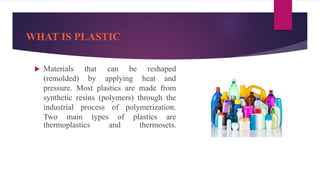
WHAT IS PLASTIC
 Materials that can be reshaped
(remolded) by applying heat and
pressure. Most plastics are made from
synthetic resins (polymers) through the
industrial process of polymerization.
Two main types of plastics are
thermoplastics and thermosets.
TYPES OF PLASTICS
 POLYCARBONATE– compact discs, eyeglasses,traffic lights and lenses
 POLYESTER – fibers and textiles
 POLYETHYLENE – a wide range of inexpensive uses including supermarket
bags and plastic bottles
 HIGH-DENSITY POLYETHYLENE– detergent bottles, milk jugs and
molded plastic cases
 LOW-DENSITY POLYETHYLENE– outdoor furniture,siding, floor tiles,
shower curtains and clamshell packaging
 POLYVINYL CHLORIDE – plumbing pipes, electrical wire/cable insulation
 POLYVINYLIDENE CHLORIDE (PVDC) – food packaging
HISTORY OF PLASTIC
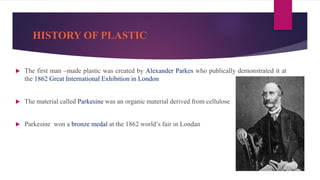
 The first man –made plastic was created by Alexander Parkes who publically demonstrated it at
the 1862 Great International Exhibition in London
 The material called Parkesine was an organic material derived from cellulose
 Parkesine won a bronze medal at the 1862 world’s fair in Londan
USAGE OF PLASTICS
 Plastics Applications can be found in almost all areas of everyday living due to their
versatility
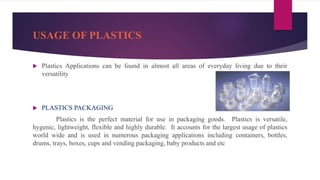
 PLASTICS PACKAGING
Plastics is the perfect material for use in packaging goods. Plastics is versatile,
hygenic, lightweight, flexible and highly durable. It accounts for the largest usage of plastics
world wide and is used in numerous packaging applications including containers, bottles,
drums, trays, boxes, cups and vending packaging, baby products and etc
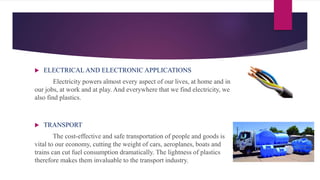
 ELECTRICAL AND ELECTRONIC APPLICATIONS
Electricity powers almost every aspect of our lives, at home and in
our jobs, at work and at play. And everywhere that we find electricity, we
also find plastics.
 TRANSPORT
The cost-effective and safe transportation of people and goods is
vital to our economy, cutting the weight of cars, aeroplanes, boats and
trains can cut fuel consumption dramatically. The lightness of plastics
therefore makes them invaluable to the transport industry.
PLASTIC POLLUTION
 Plastic pollution is the accumulation of plastic products in the environment that
adversely affects wildlife, wildlife habitat and humans.Plastics that act
as pollutants are categorized into micro, or macro debris, based on size.
 Plastics are inexpensive and durable, and as a result levels of plastic production
by humans are high. Moreover, the chemical structure of most plastics renders
them resistant to many natural processes of degradation and as a result they are
slow to degrade.
 EFFECTS ON ENVIRONMENT
 LAND
 OCEAN
 AIR
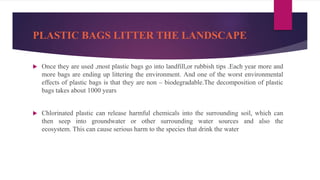
PLASTIC BAGS LITTER THE LANDSCAPE
 Once they are used ,most plastic bags go into landfill,or rubbish tips .Each year more and
more bags are ending up littering the environment. And one of the worst environmental
effects of plastic bags is that they are non – biodegradable.The decomposition of plastic
bags takes about 1000 years
 Chlorinated plastic can release harmful chemicals into the surrounding soil, which can
then seep into groundwater or other surrounding water sources and also the
ecosystem. This can cause serious harm to the species that drink the water
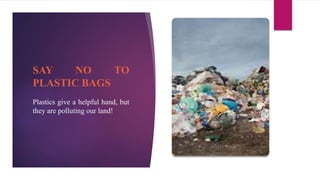
SAY NO TO
PLASTIC BAGS
Plastics give a helpful hand, but
they are polluting our land!
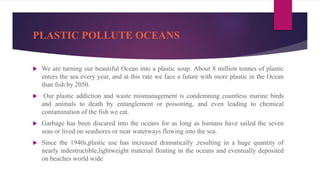
PLASTIC POLLUTE OCEANS
 We are turning our beautiful Ocean into a plastic soup. About 8 million tonnes of plastic
enters the sea every year, and at this rate we face a future with more plastic in the Ocean
than fish by 2050.
 Our plastic addiction and waste mismanagement is condemning countless marine birds
and animals to death by entanglement or poisoning, and even leading to chemical
contamination of the fish we eat.
 Garbage has been discared into the oceans for as long as humans have sailed the seven
seas or lived on seashores or near waterways flowing into the sea.
 Since the 1940s,plastic use has increased dramatically ,resulting in a huge quantity of
nearly indestructible,lightweight material floating in the oceans and eventually deposited
on beaches world wide
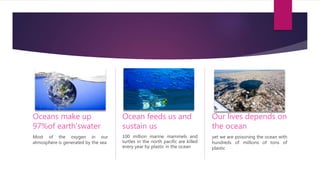
Oceans make up
97%of earth’swater
Most of the oxygen in our
atmosphere is generated by the sea
Ocean feeds us and
sustain us
100 million marine mammels and
turtles in the north pacific are killed
every year by plastic in the ocean
Our lives depends on
the ocean
yet we are poisoning the ocean with
hundreds of millions of tons of
plastic
WHAT CAUSES AIR POLLUTION FROM
PLASTIC
 Plastic materials are everywhere. We use plastic bags, straws and plastic bottles for such a
short time and then we dispose of it. Yet, they remain forever - toxic till the end.
 When plastic is produced, it’s made from toxic materials such as benzene and vinyl
hydrochloride. It is destined to be toxic from birth to forever. These chemicals are known
to cause cancer, and the manufacturing byproducts contaminate our air and soil. The type of
plastic that is the major source of dioxin is PVC.
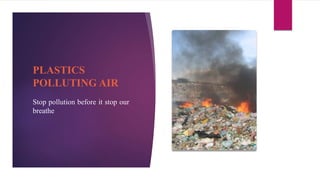
PLASTICS
POLLUTING AIR
Stop pollution before it stop our
breathe
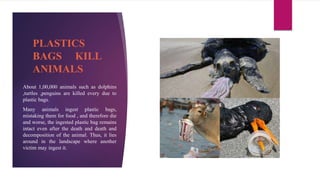
PLASTICS
BAGS KILL
ANIMALS
About 1,00,000 animals such as dolphins
,turtles ,penguins are killed every due to
plastic bags.
Many animals ingest plastic bags,
mistaking them for food , and therefore die
and worse, the ingested plastic bag remains
intact even after the death and death and
decomposition of the animal. Thus, it lies
around in the landscape where another
victim may ingest it.
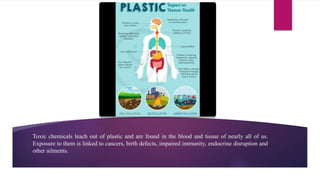
PLASTIC AFFECTS HUMAN HEALTH
 Plastic plays the villain right from the stage of its production .The major chemicals
that go into the making of plastic are highly toxic and pose serious threat to living
beings of all species on earth
 Some of the constituents of plastic such as benzene are known to cause cancer. Plastic
resins themselves are flammable and have contributed considerably to several
accidents world wide.
Toxic chemicals leach out of plastic and are found in the blood and tissue of nearly all of us.
Exposure to them is linked to cancers, birth defects, impaired immunity, endocrine disruption and
other ailments.
STEPS TAKEN BY THE GOVERNMENT TO
BAN PLASTIC
 Tamil Nadu to ban use of plastic items from 2019
The Tamil Nadu government announced it would ban the use of plastic itemdegradable carry from
January 2019 to "gift a plastic-free" state to future generationChief Minister K Palaniswami's announcement in
the state assembly coincided with International Environment Day.
 Reusables in government offices
Government offices in Kerala made the switch to ink pens and steel cutlery to ensure articles like
plastic water bottles, disposable teacups and plastic carry bags are no longer used across the office premises.
Mooted by the Suchitwa Mission and Haritha Keralam Mission, the idea envisioned by the concerned authorities
was to make government departments set an example for a clean environment. The step can be easily emulated
across not just government offices but also corporates and private organisations while paving the way for an
environment-friendly work culture.
Fishing for plastic waste from water bodies
 The creatures of the sea are sadly paying the price of our indifference and inability to manage waste,
and nothing is more disheartening than coming across multiple reports about the carcasses of marine
animals on seashores, with plastic waste inside their bellies. However, there is help.
 As per a brilliant initiative helmed by Kerala’s Suchitwa Mission, 28 fishermen from the Neendakara
harbour have been engaged in not just finding fish but also plastic that either gets stuck in the fishing
nets or floats in the sea. In last 10 months since the project was launched, they have managed to
recover 25 tonnes of plastic waste.
 Crackdown on plastic usage
 While states like Maharashtra, Goa, Jammu and Kashmir, Karnataka and Punjab have imposed
some form of a ban on plastic, there is also confusion among both the authorities and citizens as to
what is permissible and what is not.
 Standing out in this regard is the state of Sikkim. Thanks to its complete crackdown on plastic,
it went on to earn the tag of India’s cleanest state.Sikkim is the second smallest state in the country,
and therefore, it had no scope for the creation of multiple landfill sites.
 In 1998, it became the first Indian state to ban disposable plastic bags, and in 2016, it took a
significant step by banning the use of packaged drinking water in government offices and
government events and the use of Styrofoam and thermocol disposable plates and cutlery across the
entire state.
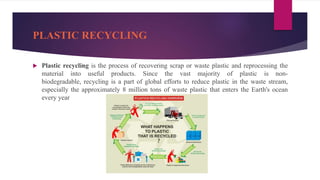
PLASTIC RECYCLING
 Plastic recycling is the process of recovering scrap or waste plastic and reprocessing the
material into useful products. Since the vast majority of plastic is non-
biodegradable, recycling is a part of global efforts to reduce plastic in the waste stream,
especially the approximately 8 million tons of waste plastic that enters the Earth's ocean
every year
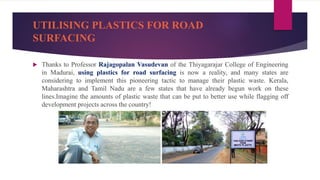
UTILISING PLASTICS FOR ROAD
SURFACING
 Thanks to Professor Rajagopalan Vasudevan of the Thiyagarajar College of Engineering
in Madurai, using plastics for road surfacing is now a reality, and many states are
considering to implement this pioneering tactic to manage their plastic waste. Kerala,
Maharashtra and Tamil Nadu are a few states that have already begun work on these
lines.Imagine the amounts of plastic waste that can be put to better use while flagging off
development projects across the country!
WHAT CAN WE DO ?
 Say NO to plastic check-out bags whilst shopping and buy reusable bags or bring your own for
your shopping instead.
 Use glass/ceramic instead of plastic .
 Replace plastic travel mugs with stainless steel for hot beverages.
 When you can’t avoid plastic ,check container bottems for recycling codes .choose those easily
recycled.
 Shop at the local farmers markets.Buy can instead of the plastic bottle
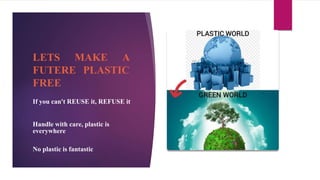
LETS MAKE A
FUTERE PLASTIC
FREE
If you can't REUSE it, REFUSE it
Handle with care, plastic is
everywhere
No plastic is fantastic
CONCLUSION
 Plastic pollution has so many negative effects .They are not not confined to one
segment of the ecosystem. Different components of the environment are affected
and this causes loss of biodiversity. The planet is much better when it’s clean and
pollution is kept at a minimum or completely eradicated.
 The government must perform its responsibility and individuals must also do
what is right to protect the environment and themselves.They must strive to have
a clean planet by recycling waste products ,using green alternatives and disposing
of wastes appropriately. When we all do what is necessary, we reduce plastic
pollution and conserve the environment.

Say no to plastic

  • 1.
    SAY NO TOPLASTIC PRESENTED BY, PAVITHRA . S II- B.COM(DC3)
  • 2.
    WHAT IS PLASTIC Materials that can be reshaped (remolded) by applying heat and pressure. Most plastics are made from synthetic resins (polymers) through the industrial process of polymerization. Two main types of plastics are thermoplastics and thermosets.
  • 3.
    TYPES OF PLASTICS POLYCARBONATE– compact discs, eyeglasses,traffic lights and lenses  POLYESTER – fibers and textiles  POLYETHYLENE – a wide range of inexpensive uses including supermarket bags and plastic bottles  HIGH-DENSITY POLYETHYLENE– detergent bottles, milk jugs and molded plastic cases  LOW-DENSITY POLYETHYLENE– outdoor furniture,siding, floor tiles, shower curtains and clamshell packaging  POLYVINYL CHLORIDE – plumbing pipes, electrical wire/cable insulation  POLYVINYLIDENE CHLORIDE (PVDC) – food packaging
  • 4.
    HISTORY OF PLASTIC The first man –made plastic was created by Alexander Parkes who publically demonstrated it at the 1862 Great International Exhibition in London  The material called Parkesine was an organic material derived from cellulose  Parkesine won a bronze medal at the 1862 world’s fair in Londan
  • 5.
    USAGE OF PLASTICS Plastics Applications can be found in almost all areas of everyday living due to their versatility  PLASTICS PACKAGING Plastics is the perfect material for use in packaging goods. Plastics is versatile, hygenic, lightweight, flexible and highly durable. It accounts for the largest usage of plastics world wide and is used in numerous packaging applications including containers, bottles, drums, trays, boxes, cups and vending packaging, baby products and etc
  • 6.
     ELECTRICAL ANDELECTRONIC APPLICATIONS Electricity powers almost every aspect of our lives, at home and in our jobs, at work and at play. And everywhere that we find electricity, we also find plastics.  TRANSPORT The cost-effective and safe transportation of people and goods is vital to our economy, cutting the weight of cars, aeroplanes, boats and trains can cut fuel consumption dramatically. The lightness of plastics therefore makes them invaluable to the transport industry.
  • 7.
    PLASTIC POLLUTION  Plasticpollution is the accumulation of plastic products in the environment that adversely affects wildlife, wildlife habitat and humans.Plastics that act as pollutants are categorized into micro, or macro debris, based on size.  Plastics are inexpensive and durable, and as a result levels of plastic production by humans are high. Moreover, the chemical structure of most plastics renders them resistant to many natural processes of degradation and as a result they are slow to degrade.  EFFECTS ON ENVIRONMENT  LAND  OCEAN  AIR
  • 8.
    PLASTIC BAGS LITTERTHE LANDSCAPE  Once they are used ,most plastic bags go into landfill,or rubbish tips .Each year more and more bags are ending up littering the environment. And one of the worst environmental effects of plastic bags is that they are non – biodegradable.The decomposition of plastic bags takes about 1000 years  Chlorinated plastic can release harmful chemicals into the surrounding soil, which can then seep into groundwater or other surrounding water sources and also the ecosystem. This can cause serious harm to the species that drink the water
  • 9.
    SAY NO TO PLASTICBAGS Plastics give a helpful hand, but they are polluting our land!
  • 10.
    PLASTIC POLLUTE OCEANS We are turning our beautiful Ocean into a plastic soup. About 8 million tonnes of plastic enters the sea every year, and at this rate we face a future with more plastic in the Ocean than fish by 2050.  Our plastic addiction and waste mismanagement is condemning countless marine birds and animals to death by entanglement or poisoning, and even leading to chemical contamination of the fish we eat.  Garbage has been discared into the oceans for as long as humans have sailed the seven seas or lived on seashores or near waterways flowing into the sea.  Since the 1940s,plastic use has increased dramatically ,resulting in a huge quantity of nearly indestructible,lightweight material floating in the oceans and eventually deposited on beaches world wide
  • 11.
    Oceans make up 97%ofearth’swater Most of the oxygen in our atmosphere is generated by the sea Ocean feeds us and sustain us 100 million marine mammels and turtles in the north pacific are killed every year by plastic in the ocean Our lives depends on the ocean yet we are poisoning the ocean with hundreds of millions of tons of plastic
  • 12.
    WHAT CAUSES AIRPOLLUTION FROM PLASTIC  Plastic materials are everywhere. We use plastic bags, straws and plastic bottles for such a short time and then we dispose of it. Yet, they remain forever - toxic till the end.  When plastic is produced, it’s made from toxic materials such as benzene and vinyl hydrochloride. It is destined to be toxic from birth to forever. These chemicals are known to cause cancer, and the manufacturing byproducts contaminate our air and soil. The type of plastic that is the major source of dioxin is PVC.
  • 13.
    PLASTICS POLLUTING AIR Stop pollutionbefore it stop our breathe
  • 14.
    PLASTICS BAGS KILL ANIMALS About 1,00,000animals such as dolphins ,turtles ,penguins are killed every due to plastic bags. Many animals ingest plastic bags, mistaking them for food , and therefore die and worse, the ingested plastic bag remains intact even after the death and death and decomposition of the animal. Thus, it lies around in the landscape where another victim may ingest it.
  • 15.
    PLASTIC AFFECTS HUMANHEALTH  Plastic plays the villain right from the stage of its production .The major chemicals that go into the making of plastic are highly toxic and pose serious threat to living beings of all species on earth  Some of the constituents of plastic such as benzene are known to cause cancer. Plastic resins themselves are flammable and have contributed considerably to several accidents world wide.
  • 16.
    Toxic chemicals leachout of plastic and are found in the blood and tissue of nearly all of us. Exposure to them is linked to cancers, birth defects, impaired immunity, endocrine disruption and other ailments.
  • 17.
    STEPS TAKEN BYTHE GOVERNMENT TO BAN PLASTIC  Tamil Nadu to ban use of plastic items from 2019 The Tamil Nadu government announced it would ban the use of plastic itemdegradable carry from January 2019 to "gift a plastic-free" state to future generationChief Minister K Palaniswami's announcement in the state assembly coincided with International Environment Day.  Reusables in government offices Government offices in Kerala made the switch to ink pens and steel cutlery to ensure articles like plastic water bottles, disposable teacups and plastic carry bags are no longer used across the office premises. Mooted by the Suchitwa Mission and Haritha Keralam Mission, the idea envisioned by the concerned authorities was to make government departments set an example for a clean environment. The step can be easily emulated across not just government offices but also corporates and private organisations while paving the way for an environment-friendly work culture.
  • 18.
    Fishing for plasticwaste from water bodies  The creatures of the sea are sadly paying the price of our indifference and inability to manage waste, and nothing is more disheartening than coming across multiple reports about the carcasses of marine animals on seashores, with plastic waste inside their bellies. However, there is help.  As per a brilliant initiative helmed by Kerala’s Suchitwa Mission, 28 fishermen from the Neendakara harbour have been engaged in not just finding fish but also plastic that either gets stuck in the fishing nets or floats in the sea. In last 10 months since the project was launched, they have managed to recover 25 tonnes of plastic waste.
  • 19.
     Crackdown onplastic usage  While states like Maharashtra, Goa, Jammu and Kashmir, Karnataka and Punjab have imposed some form of a ban on plastic, there is also confusion among both the authorities and citizens as to what is permissible and what is not.  Standing out in this regard is the state of Sikkim. Thanks to its complete crackdown on plastic, it went on to earn the tag of India’s cleanest state.Sikkim is the second smallest state in the country, and therefore, it had no scope for the creation of multiple landfill sites.  In 1998, it became the first Indian state to ban disposable plastic bags, and in 2016, it took a significant step by banning the use of packaged drinking water in government offices and government events and the use of Styrofoam and thermocol disposable plates and cutlery across the entire state.
  • 20.
    PLASTIC RECYCLING  Plasticrecycling is the process of recovering scrap or waste plastic and reprocessing the material into useful products. Since the vast majority of plastic is non- biodegradable, recycling is a part of global efforts to reduce plastic in the waste stream, especially the approximately 8 million tons of waste plastic that enters the Earth's ocean every year
  • 21.
    UTILISING PLASTICS FORROAD SURFACING  Thanks to Professor Rajagopalan Vasudevan of the Thiyagarajar College of Engineering in Madurai, using plastics for road surfacing is now a reality, and many states are considering to implement this pioneering tactic to manage their plastic waste. Kerala, Maharashtra and Tamil Nadu are a few states that have already begun work on these lines.Imagine the amounts of plastic waste that can be put to better use while flagging off development projects across the country!
  • 22.
    WHAT CAN WEDO ?  Say NO to plastic check-out bags whilst shopping and buy reusable bags or bring your own for your shopping instead.  Use glass/ceramic instead of plastic .  Replace plastic travel mugs with stainless steel for hot beverages.  When you can’t avoid plastic ,check container bottems for recycling codes .choose those easily recycled.  Shop at the local farmers markets.Buy can instead of the plastic bottle
  • 23.
    LETS MAKE A FUTEREPLASTIC FREE If you can't REUSE it, REFUSE it Handle with care, plastic is everywhere No plastic is fantastic
  • 24.
    CONCLUSION  Plastic pollutionhas so many negative effects .They are not not confined to one segment of the ecosystem. Different components of the environment are affected and this causes loss of biodiversity. The planet is much better when it’s clean and pollution is kept at a minimum or completely eradicated.  The government must perform its responsibility and individuals must also do what is right to protect the environment and themselves.They must strive to have a clean planet by recycling waste products ,using green alternatives and disposing of wastes appropriately. When we all do what is necessary, we reduce plastic pollution and conserve the environment.