Business Case
     rimer

Al emp
BUSINESS CASE PRIMER


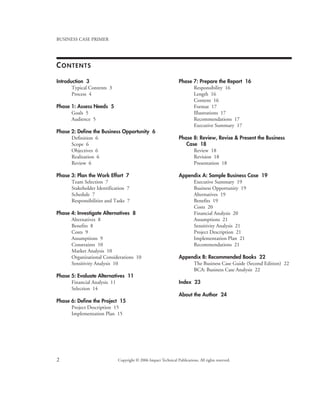
CONTENTS

Introduction 3                                                  Phase 7: Prepare the Report 16
       Typical Contents 3                                             Responsibility 16
       Process 4                                                      Length 16
                                                                      Content 16
Phase 1: Assess Needs 5                                               Format 17
      Goals 5                                                         Illustrations 17
      Audience 5                                                      Recommendations 17
                                                                      Executive Summary 17
Phase 2: Define the Business Opportunity 6
      Definition 6                                              Phase 8: Review, Revise & Present the Business
      Scope 6                                                      Case 18
      Objectives 6                                                    Review 18
      Realization 6                                                   Revision 18
      Review 6                                                        Presentation 18

Phase 3: Plan the Work Effort 7                                 Appendix A: Sample Business Case 19
      Team Selection 7                                               Executive Summary 19
      Stakeholder Identification 7                                   Business Opportunity 19
      Schedule 7                                                     Alternatives 19
      Responsibilities and Tasks 7                                   Benefits 19
                                                                     Costs 20
Phase 4: Investigate Alternatives 8                                  Financial Analysis 20
      Alternatives 8                                                 Assumptions 21
      Benefits 8                                                     Sensitivity Analysis 21
      Costs 9                                                        Project Description 21
      Assumptions 9                                                  Implementation Plan 21
      Constraints 10                                                 Recommendations 21
      Market Analysis 10
      Organizational Considerations 10                          Appendix B: Recommended Books 22
      Sensitivity Analysis 10                                        The Business Case Guide (Second Edition) 22
                                                                     BCA: Business Case Analysis 22
Phase 5: Evaluate Alternatives 11
      Financial Analysis 11                                     Index 23
      Selection 14
                                                                About the Author 24
Phase 6: Define the Project 15
      Project Description 15
      Implementation Plan 15


2                           Copyright © 2006 Impact Technical Publications. All rights reserved.
BUSINESS CASE PRIMER


INTRODUCTION

A business case is a justification for a business
project. A business case requests funding for a           Are business cases and business plans similar?
project internally from an organization’s financial        No. They are both used to generate financing. That’s
decision-makers or externally from investors.             all they have in common.

A business case compares the costs of a project with      A business plan is a method to achieve the goals of a
the benefits that it provides. The business case           business. A business plan is used to:
must show that the benefits outweigh the costs. In         ▫ Develop ideas about how to conduct a business
many instances, it must include a financial analysis       ▫ Finance the business
that calculates the project’s return on investment        ▫ Evaluate the performance of the business
(ROI).                                                    Typical sections include:
                                                          ▫ Executive Summary
Although financial information is important, a             ▫ General Business Description
business case is more than a financial justification        ▫ Products and Services
for a project. It is a business justification. The busi-   ▫ Marketing Plan
ness case should show that the project will help the      ▫ Competitive Analysis
organization meet its goals.                              ▫ Operational Plan
                                                          ▫ Management and Organization
Typical Contents                                          ▫ Capitalization and Structure
                                                          ▫ Financial Plan
Typical business-case topics include:
  Executive Summary                                       This information is from The Ernst & Young Busi-
  Business Opportunity                                    ness Plan Guide by Siegel, Ford, and Bornstein (John
  Alternatives                                            Wiley & Sons, Inc., New York, 1993). The book is
  Benefits                                                 available for purchase at:
  Costs
                                                            http://www.ImpactOnTheNet.com/bc-books.html
  Financial Analysis
  Assumptions
  Constraints
                                                          The executive summary highlights the key points in
  Market Analysis
                                                          the business case. These include important benefits
  Organizational Considerations
                                                          and the return on investment.
  Sensitivity Analysis
  Project Description
                                                          The business opportunity describes the motivation
  Implementation Plan
                                                          for the project that the business case will propose.
  Recommendations
                                                          The business opportunity includes a definition, a
                                                          statement of scope, and a discussion of objectives
Your business case need not include all of these
                                                          that the project will help the organization achieve.
topics, but they make an excellent checklist.


                                                                                                             3
BUSINESS CASE PRIMER


A business case analyzes the alternatives to a pro-     risks involved in undertaking the project. Risks
posed project. For example, an online learning          also may result from not undertaking the project.
business case might compare the benefits and costs
of classroom learning. All business cases involve at    The project description should provide enough
least two alternatives: doing or not doing a project.   information that the people who must approve the
                                                        business case can decide whether the project is
Benefits increase revenue, reduce costs, and provide     both viable and worth doing.
strategic advantage over competitors.
                                                        Don’t neglect the implementation plan! The rest of
Costs include equipment (purchase and mainte-           the business case is meaningless if the project can-
nance) and labor (training and operation).              not be implemented successfully.

Financial analysis compares benefits to costs and        The recommendations summarize the main points
analyzes the value of a project as an investment.       of a business case and offer suggestions on how to
The analysis may include a cash flow statement,          proceed with the project.
return on investment, net present value, internal
rate of return, and payback period.                     This primer discusses each of the above topics at
                                                        the point in the business case development process
Assumptions are events that a business case assumes     where the team first works with the topic.
will happen. For example, a business case might
assume approval of a product by a regulatory            Process
agency.
                                                        The business case process that this primer recom-
Constraints are schedule, resource, budget, staffing,    mends has eight phases:
technical, and other limitations that may impact        1 Assess needs
the success of a project. For example, a project        2 Define the business opportunity
might require that all employees have access to a       3 Plan the work effort
central database.                                       4 Investigate alternatives
                                                        5 Evaluate alternatives
Market analysis examines changes in the business        6 Define the project
environment that impact the success of a project        7 Prepare the report
such as technological innovations and shifts in cus-    8 Review, revise & present the business case
tomer demographics.
                                                        If you must prepare a business case quickly, you
Organizational considerations examine how a             may be tempted to take short cuts through the
project impacts an organization. A project’s success    process so that you can prepare the report as soon
might depend on management support and                  as possible. Don’t do it! If you neglect any of the
employee acceptance.                                    phases, your business case will not achieve its
                                                        potential. Without a persuasive business case, your
Sensitivity analysis evaluates the probability that a   project is less likely to be funded.
project can be implemented successfully and the


4
BUSINESS CASE PRIMER


PHASE 1: ASSESS NEEDS

In Phase 1, you define the goals that your business       funding. One of your goals might be to show that
case should achieve and the audience that must           your project is the best choice.
approve the business case for it to achieve its goals.
                                                         There is no magic formula that will tell you what
Goals                                                    your goals are. You must analyze what you are try-
                                                         ing to accomplish.
The goal of your business case may seem obvious:
to fund your project. But funding a project may be       Audience
the last step in an elaborate approval process.
                                                         Your goals depend on your audience. Who must
Your most important business case goal may be to         you convince? What information must you provide
market your proposed project throughout your             your audience to persuade them to approve the
organization. If marketing is your goal, your busi-      business case?
ness case will still need financial information, but it
might show the value of similar projects at other        A theoretically perfect business case will not be
organizations and extrapolate the data from other        approved if it does not persuade its audience that
organizations to your organization.                      its project is worth pursuing.

For example, you are proposing a complicated and         Reviewing business cases for projects that members
costly business re-engineering project, which            of your audience have approved may help you
involves major changes to your organization. The         determine what information you should include in
goal of the initial business case is to build manage-    your business case.
ment support for the proposed project. Showing
that business re-engineering is a good idea with         Learning your audience’s concerns and providing
many potential benefits is much more important            information to answer them is an important part
than describing a specific project in detail if your      of obtaining approval. For example, your project
organization is not ready to support the project.        involves complicated and expensive advanced tech-
Approval of the initial business case will result in     nologies, and a member of the approval committee
the support you need to prepare a second business        is suspicious of advanced technology projects. Find
case with a detailed description of your proposed        out all you can about that person’s concerns.
project, detailed financial information, and a            Approval of the business case may depend on how
detailed implementation plan.                            well you address those concerns.

Even if you have a straight-forward project, you         If your chief financial officer wants specific finan-
may have other goals besides funding. For exam-          cial metrics presented in a specific format, obtain
ple, you are competing with other projects for           samples of the metrics and the format. Use them in
                                                         your business case.


                                                                                                          5
BUSINESS CASE PRIMER


PHASE 2: DEFINE               THE    BUSINESS OPPORTUNITY

In Phase 2, you define the business opportunity: the     Objectives
motivation for the project that the business case
will propose. The business opportunity includes a       Describe what the business opportunity will
definition, a statement of scope, and a discussion       accomplish. The objectives of an online learning
of objectives. The business opportunity may also        opportunity might be to reduce the cost of training
include a description of what the organization will     and to reduce the time required deliver training on
be like after the opportunity has been realized.        new policies and procedures.

Note:  Many articles and books on business cases        Metrics will make your objectives much more
refer to a problem rather than to an opportunity. I     compelling. For example, your online learning
recommend viewing all problems as opportunities         objectives might be to reduce the cost of training
for improvement. A short-sighted solution to a          by 50% and to reduce the time required to deliver
problem may simply make the problem disappear.          training on new policies and procedures by 75%.
A business opportunity uses the problem as a            You may not yet have the information you need for
springboard to improve the business.                    metrics. If you don’t, keep metrics in mind during
                                                        Phase 4: Investigate Alternatives.
Definition
                                                        Realization
The definition of an online learning business
opportunity might be:                                   The realization describes what the organization
                                                        will be like after it has taken advantage of the busi-
    To deliver educational courses over the intranet    ness opportunity. This section is important if a
    that train all employees on human resources,        business case proposes changes that have a major
    accounting, and payroll policies and procedures.    impact on customers, employees, products, poli-
                                                        cies, processes, finances, markets, or competitors.
Scope
                                                        Note: If a business opportunity involves solving a
Scope includes boundaries, limits, schedules, and       problem, the realization is the solution.
budgets. The scope of an online learning business
opportunity might be:                                   Review

    The scope includes all human resources, account-    Once you have defined the business opportunity,
    ing, and payroll policies and procedures that       review it with the business case initiator. This
    apply to employees. When changes to policies        review helps ensure agreement on the extent of the
    and procedures occur, training will be updated      project that the business case will propose. You
    within two business days. Implementation will       don’t want to be halfway through the business case
    occur within six months of business case approval   when you find out that the initiator had a totally
    at a maximum cost of $200,000.                      different project in mind!


6
BUSINESS CASE PRIMER


PHASE 3: PLAN                 THE     WORK EFFORT

In Phase 3, you plan the business case work effort.           Stakeholder Identification
You select the team, identify stakeholders, establish
the schedule, and assign responsibilities and tasks.          The stakeholders include executives, managers,
                                                              and technical specialists responsible for:
Business case work efforts vary from organization               Review of business case financial information
to organization and within an organization from                 Approval of the business case
project to project. A portion of the work effort                Implementation, operation, and acceptance of
may have been completed prior to your involve-                  the project proposed in the business case
ment. If so, document the planning that has been
completed, make changes if necessary, and then                The goal is to keep stakeholders informed of busi-
finish the planning.                                           ness case progress and to solicit their input at key
                                                              points. Marty J. Schmidt recommends forming a
Team Selection                                                “core team” of stakeholders and meeting with them
                                                              several times during the development of the busi-
The size of the team is related to the size of the            ness case to make sure that they understand and
proposed project. If the business case involves               support the proposed project.2
replacing the personal computers in a department
with 18 employees,1 one person may perform all                Schedule
roles. If the business case involves a major business
re-engineering project, the team may include a                When you were assigned responsibility for the
dozen or more members.                                        business case, you may have been given a deadline.
                                                              If not, discuss a tentative deadline with the sponsor
A multiple-member team should include:                        and team members. Develop the initial schedule
  A sponsor, usually an executive, who publicizes             based on the tentative deadline. You will know
  the business case work effort and interfaces                more about the work effort after the team investi-
  with the organization’s senior management                   gates alternatives in Phase 4. At that point, you
  Technical specialists                                       may need to adjust the schedule.
  Business analysts
  A financial analyst                                          Responsibilities and Tasks
  A writer, who prepares the business case report
                                                              Meet with the team and discuss alternative ways to
Any team member may be the business case project              achieve the business opportunity. Assign general
manager.                                                      responsibilities and initial investigative tasks.


   1. Brannock, James W., “The 8-Day BCA” in BCA:                2. Schmidt, Marty J., “The Core Team: Key to Cred-
      Business Case Analysis, pages 13-77 (STS Publica-             ibility” in The Business Case Guide, Second Edition,
      tions, Plant City, Florida, 2004). For a brief review         pages 19-23 (Solution Matrix Ltd., Boston, 2002).
      of this book, see page 22.                                    For a brief review of this book, see page 22.


                                                                                                                           7
BUSINESS CASE PRIMER


P H A S E 4: I N V E S T I G A T E A L T E R N A T I V E S

In Phase 4, you investigate alternatives by gather-     might compare the benefits and costs of two alter-
ing information about their benefits, costs,             native implementations:
assumptions, constraints, risks, and so on.               All at once throughout the company
                                                          On a departmental basis starting with human
Alternatives                                              resource policies and procedures

There are three kinds of alternatives:                  Benefits
 Alteratives to the business opportunity
 Alternative projects                                   Examine the benefits of each alternative that you
 Alternative implementations of a project               have chosen to investigate.

Alteratives to the Business Opportunity                 Benefits provide three types of business value:
                                                          Increased revenue
All business cases examine at least two alternatives:     Reduced costs
pursuing or not pursuing a business opportunity           Strategic advantage
(that is, approving or rejecting a business case). A
business case for an online learning opportunity        Increased Revenue
might compare the benefits and costs of online
learning with the benefits and costs of the organi-      A business case for producing a new product
zation’s current method of training employees:          would include the anticipated increase in revenue
classroom learning.                                     from sale of the product.

Alternative Projects                                    Reduced Costs

A business case may examine alternative projects to     A business case for improving a process would
realize a business opportunity. If an organization is   include the anticipated savings in equipment,
not providing any formal training for employees,        labor, or both. Calculating the labor savings may
then a business case for an employee training           require research.
opportunity might compare the benefits and costs
of three alternatives: formal online training, formal   For example, you are investigating the benefits of
classroom training, and no formal training at all.      purchasing an expensive office-automation prod-
                                                        uct. The product distributes and updates shared
Alternative Implementations of a Project                files and prevents errors caused by overwriting the
                                                        most current copy of a file with a previous version.
A business case may examine alternative imple-          Both automatic updating and preventing errors
mentations of a project to realize a business oppor-    reduce labor costs. But you can’t include the
tunity. A business case for an opportunity to           reduced labor costs in your financial analysis unless
replace classroom training with online training         you quantify them.


8
BUSINESS CASE PRIMER


If you research the current process, you might find     Labor costs include wages, salaries, and overhead
that an administrative assistant spends three hours    costs like benefits, office space, office equipment,
a week distributing and updating shared files.          and technical support.
Twice a month a current copy of a file is overwrit-
ten by a previous copy. The administrative assistant   Another cost is lost productivity. A project may
spends an hour correcting each problem.                require staff to implement it. That reduces the pro-
                                                       ductivity of the staff. Also, employees are often less
By eliminating this manual work, the office-auto-       productive while they are learning how to use new
mation product would save five hours of adminis-        business tools and processes.
trative time each week. Take the cost per hour for
an administrative assistant and multiply it by five     Assumptions
to get the product’s weekly savings in labor costs.
Use that figure in your financial analysis.              Assumptions are events that the business case
                                                       assumes will happen. For example, the business
Strategic Advantage                                    case might assume approval from a regulatory
                                                       agency. Critical assumptions must occur for a
These benefits help an organization achieve its         project to succeed. For example, a critical assump-
goals and compete effectively.                         tion for an online learning business case might be
                                                       that all employees will have access to a personal
For example, a more accurate and current sales         computer during work hours.
forecasting system would enable decision-makers
to react faster to changes in the market. Decision-    This and the following topics (constraints, market
makers would have the information they need to         analysis, organizational considerations, and sensi-
adjust prices faster and launch promotional cam-       tivity analysis) may apply to all the alternatives. If
paigns faster. That would give their company an        so, document the topics once. For example, two
advantage over its competitors.                        alternative projects to develop a new telecommuni-
                                                       cation product might assume that regulatory
Although gathering financial data on strategic          approval will be received prior to the release of the
advantage is usually difficult, quantifying benefits     product.
that provide strategic advantage may make the dif-
ference between business case success and failure.     On the other hand, different alternatives may
                                                       involve different assumptions, constraints, and so
Costs                                                  on. If so, document the topics separately for each
                                                       alternative. For example, one alternative imple-
Examine the costs of each alternative that you have    mentation of a business re-engineering project
chosen to investigate.                                 might assume that the organization will not relo-
                                                       cate any of its facilities during the implementation
Typical costs include equipment (purchase and          period. Relocation might not impact the other
maintenance) and labor (training and operation).       alternatives.


                                                                                                           9
BUSINESS CASE PRIMER


Constraints                                            For example, a business re-engineering project may
                                                       depend on employees accepting new job assign-
Constraints are schedule, resource, budget, staffing,   ments and tasks. The business case should explain
technical, and other limitations that may impact       how employee acceptance will be attained and
the success of a project.                              include the associated costs.

For example, a project to develop a new product        Sensitivity Analysis
might be constrained by a six-month window of
opportunity during which the product must be           Sensitivity analysis evaluates the probability that a
released in the marketplace. A business re-engi-       project can be implemented successfully and the
neering project might be constrained by the            risks involved in undertaking the project. When-
requirements that all employees have access to a       ever possible, the sensitivity analysis should include
central database.                                      mechanisms to monitor and manage risks to assure
                                                       successful implementation of the project.
Market Analysis
                                                       If a project’s viability depends on the cost of raw
Market analysis examines changes in the business       materials, a sensitivity analysis would evaluate the
environment that impact the success of a project.      probability that the cost of raw materials will
These changes include technological innovations,       increase. The sensitivity analysis would propose
expanding and contracting markets, and shifts in       contingencies – such as the use of different raw
customer demographics.                                 materials – if the costs do increase.

For example, market analysis might show that the       If a project’s viability depends on realizing labor
price of new low-end computers has been falling at     savings, a sensitivity analysis might examine possi-
a yearly rate of 20%. A project to develop a new       ble scenarios if the labor savings fail to materialize.
low-end computer might depend on the price of
low-end computers falling no more than 30% in          Risks may be beyond a project’s control. For exam-
12 months.                                             ple, risks involved in a project that depends on a
                                                       third-party proprietary software product might be
Organizational Considerations                          product abandonment or obsolescence.

Organizational considerations examine how a            There may be risks involved in not undertaking a
project impacts an organization. A project’s success   project. For example, the risk of not undertaking a
might depend on management support and                 business re-engineering project might be that cur-
employee acceptance. If so, the business case          rent product design, manufacturing, and distribu-
should explain how the project will gain that sup-     tion processes will become so inefficient that the
port and acceptance.                                   company will be unable to compete effectively.


10
PHASE 5: EVALUATE ALTERNATIVES

In Phase 5, you evaluate the pros and cons of each        Delivery of benefits that do not have financial
alternative investigated in Phase 4, and you select       data; for example, benefits that provide strate-
the best alternative (or alternatives) to propose in      gic advantage
the business case.                                        Time-critical assumptions, constraints, mar-
                                                          ket analysis, organizational considerations, and
The evaluation involves a financial analysis of each       sensitivity analysis
alternative. A critical assumption, constraint, mar-
ket analysis, organizational consideration, or sensi-   Cash Flow Statement
tivity analysis may eliminate an alternative from
consideration despite a favorable financial analysis.    A cash flow statement shows how an alternative will
                                                        impact the flow of cash into and out of your orga-
Financial Analysis                                      nization. You need this information to perform the
                                                        financial analyses in this phase:
Financial analysis compares benefits to costs and          Return on investment
analyzes the value of a project as an investment. To      Net present value
start a financial analysis, choose an analysis period      Payback period
and prepare a cash flow statement.                         Internal rate of return

Note: The extent of your financial analysis depends      Let’s create a simple cash flow statement for a pro-
on your goals and audience. There is no sense in        posed project. After we have identified costs and
computing detailed financial information such as         savings (that is, after we have conducted Phase 4:
net present value and internal rate of return if your   Investigate Alternatives), we will assign the costs and
audience wants a ballpark estimate of the return on     savings to a time line.
investment and payback period.
                                                        Here is our proposed project. ABC Company
Analysis Period                                         wants to purchase a new office-automation prod-
                                                        uct with an estimated life cycle of three years.
The financial analysis of all the alternatives should    Based on the estimated lifecycle, we will use a
be for the same period.                                 three-year time line with four dates: year 0 (start of
                                                        project), year 1, year 2, and year 3.
Often a longer period is better. The alternatives
have more time in which to recover purchase and         The product costs $10,000. The installation fee is
implementation costs.                                   $2,000, and the cost of the annual maintenance
                                                        contract is $500.
Establish a time line that includes dates for:
  Cash flow into the organization through quan-          The new product will replace leased equipment
  tified benefits and out of the organization             that costs $2,000 a year, and it will save five hours
  through costs                                         a week of administrative time.


                                                                                                            11
BUSINESS CASE PRIMER


The total cost per hour (including overhead) for an      product should be replaced. For that reason, year 3
administrative assistant at ABC Company is $30.          does not include:
At $30 per hour, the new product will save $7,800          Paying the maintenance fee for year 4
per year (5 hrs./week x $30/hr. x 52 weeks/year).          The savings from not leasing equipment

ABC Company plans to purchase and install the            Return on Investment
new product when the next payment for the leased
equipment is due.                                        A project’s return on investment (ROI) is its savings
                                                         (quantified benefits) over a specified period divided
To prepare the three-year cash flow statement, we         by its costs over the same period. Multiple the
must answer three questions:                             result by 100 to obtain the ROI percentage.
  Will the $500 annual cost of the maintenance
  contract change after the first year?                       ROI = (Savings/Costs) x 100
  Will the $2,000 annual savings from replace-
  ment of the leased equipment change?                   Here is an example of a simple ROI calculation for
  Will the savings per hour from the reduction           ABC Company’s project.
  in labor change after the first year?
                                                             Immediate (year 0)
To keep our example simple, we will assume that                 savings: $2,000
costs and savings will not change from year to year.            costs:    $12,500


Table 1 shows the cash flow statement for our pro-            Year 1
posed project.                                                   savings:     $9,800
                                                                 costs:         $500
Table 1: Cash Flow Statement
Costs              Year 0     Year 1   Year 2   Year 3       Through end of first year
Equip. purchase    (10,000)     0        0        0
                                                                 savings: $11,800
                                                                 costs:   $13,000
Installation fee   (2,000)      0        0        0
Maint. fee          (500)     (500)    (500)      0
                                                         To calculate the ROI after one year, divide $11,800
Subtotal           (12,500)   (500)    (500)      0
                                                         (savings) by $13,000 (costs). The result is 0.91.1
Savings
                                                         Multiply by 100. The ROI is 91%. A project that
Leased equip.       2,000     2,000    2,000      0
                                                         breaks even has an ROI of 100%. There is no
Labor                 0       7,800    7,800    7,800
                                                         return on investment after one year.
Subtotal            2,000     9,800    9,800    7,800
Cash Flow          (10,500)   9,300    9,300    7,800        Year 2
                                                                 savings:     $9,800
When the project starts (year 0), $10,500 will flow               costs:         $500
out of ABC Company. The project will bring in
$9,300 during year 1, $9,300 during year 2, and             1. Don’t go overboard with decimals. In our example,
$7,800 during year 3. At the end of year 3, the new            labor savings is an estimate. It’s accuracy does not
                                                               justify a result with more than two decimal places.


12
BUSINESS CASE PRIMER


    Through end of second year                            NPV = NCY0 + NCY1 + NCY2 + NCY3 + ... + NCYn
        savings: $21,600                                         1    (1+r)  (1+r)2 (1+r)3 + ... + (1+r)n

        costs:   $13,500
                                                          NC = net cash flow
To calculate the ROI after two years, divide              Y0 = immediate
$21,600 by $13,500. Multiple by 100. The result           Y1 = year 1
is 160%. The project returns 160% of its invest-          Y2 = year 2
ment after two years.                                     Yn = year n (last year in computation)
                                                          r = discount rate
    Year 3
        savings:    $7,800                            Let’s examine a project with two alternatives: buy-
        costs:          $0                            ing equipment for $12,000 or leasing it for $4,100
                                                      a year over three years. The financial staff has given
    Through end of third year                         us a discount rate of 5% (r = 0.05).
        savings: $29,400
        costs:   $13,500                              At first glance, purchasing the equipment appears
                                                      to be the better choice. But let’s compute the net
The ROI after three years is 218%.                    present value for each alternative.

This simple example does not take into account        The NPV for purchasing the equipment is
the net present value of the money used to pur-       $12,000 because we pay for it immediately.
chase the office-automation product.
                                                          NPV = 12,000Y0 = $12,000
                                                                   1
Net Present Value

The net present value (NPV) adjusts the net cash      To compute the NPV for leasing the equipment,
flow by the value of money over time. Savings and      we use the NPV formula for Y0, Y1, and Y2. We
costs are greater the sooner they occur. If you can   pay $4,100 immediately, $4,100 after one year,
buy equipment for $12,000 or lease it for $4,000 a    and $4,100 after two years.
year over three years (without paying any interest
or other finance charges), leasing the equipment is        NPV = 4,100Y0 + 4,100Y1 + 4,100Y2
                                                                  1       1.05      (1.05)2
the better choice because your organization can
earn interest on $8,000 during the first year and on
$4,000 during the second year.                            NPV = 4,100 + 3,905 + 3,719 = $11,724


To determine net present value, ask your financial     The difference between purchasing and leasing is
analysts what value they are using for the annual     $276. Leasing is the better choice.
discount rate (or investment yield rate). Use that
rate to adjust the savings and costs for each year.   To compute the NPV for ABC Company’s project,
                                                      we start with the net cash flow for each year from
Here’s the formula:                                   Table 1. ABC Company’s discount rate is 5%.


                                                                                                            13
BUSINESS CASE PRIMER


     NPV = -10,500 + 9,300 + 9,300 + 7,800               Payback Period
              1      1.05 1.1025 1.1576

                                                         The payback period is the time required for the sav-
     NPV = -10,500 + 8857 + 8435 + 6738 = $13,530        ings (quantified benefits) to equal the costs.

The NPV for our three-year ABC Company                   For our ABC Company project, the NPV after one
project is $13,530.                                      year is negative $1,643. The NPV after two years is
                                                         $6,792. The payback period occurs between one
Internal Rate of Return                                  and two years after the project starts.

The internal rate of return (IRR) is the discount        The difference between the NPV after one year
rate (investment yield) at which a project’s net         and the NPV after two years is $8,435. The NPV
present value equals zero. All other factors being       increases by $843.50 each tenth of a year.
equal, the project with the higher internal rate of
return is better.                                            NPV after 1.0 year: -$1,643.00
                                                             NPV after 1.1 years:  -$799.50
If project #1 is the equivalent of investing money           NPV after 1.2 years:    $44.00
at 40% (IRR = 40%) and project #2 is the equiva-
lent of investing money at 15% (IRR = 15%),              The payback period for ABC Company’s project is
project #1 is the better choice.                         1.2 years.

Remember our NPV formula?                                Selection

     NPV = NCY0 + NCY1 + NCY2 + NCY3 + ... + NCYn        Review your analysis for each alternative.
            1    (1+r)  (1+r)2 (1+r)3 + ... + (1+r)n

                                                         Eliminate alternatives with a high probability of
To compute the NPV, we assigned a value to r.            failure as indicated by your analysis of their
                                                         assumptions, constraints, markets, organizational
To computer the IRR, we assign NPV a value of            considerations, and sensitivities.
zero. We must solve an equation – which requires
either skill with algebra or luck with the “let’s make   Eliminate alternatives with weak financial perfor-
r equal this” method. Here is the equation for our       mance as indicated by your financial analysis.
three-year ABC Company project:
                                                         Examine the remaining alternatives. Balance the
     0 = -10,500 + 9,300 + 9,300 + 7,800                 projected financial performance against the
             1      (1+r)  (1+r)2 (1+r)3
                                                         assumptions, constraints, markets, organizational
                                                         considerations, and sensitivities.
Using the “let’s make r equal this” method, we
compute r to be approximately 0.68. The IRR for          Select the best alternative or alternatives to propose
the ABC Company’s proposed project is 68%.               as the business case project.


14
BUSINESS CASE PRIMER


PHASE 6: DEFINE              THE    PROJECT

In Phase 6, you define the business case project. If      back to Phase 4: Investigate Alternatives. After you
you selected multiple alternatives in Phase 5: Eval-     resolve the problems, the probability of successful
uate Alternatives, then define each alternative as a      funding and implementation will increase.
separate project. The projects may share assump-
tions, constraints, market analysis, organizational      Tip for high-tech business cases!   If your project
considerations, and sensitivity analysis that apply      involves complicated technologies that are unclear
to all of the alternatives.                              to the people who must approve your business
                                                         case, they may refuse to fund the project. Docu-
A business case is a business justification, not sim-     menting and quantifying benefits may not be
ply a financial justification. Defining the project is      enough. The audience may need to understand
an important part of the business justification.          how the technologies used in the project enable the
                                                         benefits. If other documents explain how the
Phase 6 may be iterative with phases 4 and 5. As         project will work, refer to them. If you must write
you define the project, you may identify additional       your own material, see Impact Technical Publica-
benefits and costs as well as new assumptions, con-       tions’ White Paper Writing Guide. “Phase 6: Write”
straints, markets, organizational considerations,        tells you how to explain technical concepts clearly.
and sensitivities. If so, investigate the new informa-   You can download the guide at:
tion and re-evaluate the alternatives.
                                                             http://www.ImpactOnTheNet.com/wp-guide.pdf
Project Description
                                                         Implementation Plan
The project description should:
 Give an overview of the project                         Develop an implementation plan with major
 Define the project’s major components and                project tasks and milestones. Typical tasks include
 activities                                              acquisition, development, testing, deployment,
 Document the project’s scope and boundaries             and training.
 Explain all changes that the project will make
 to the organization and its policies, processes,        The implementation plan should account for all
 products, services, and markets                         important assumptions, constraints, markets, orga-
                                                         nizational considerations, and sensitivities. The
The project description should provide enough            rest of the business case is meaningless if the
information that the approval committee can              project cannot be implemented successfully.
decide whether the project is both viable and
worth doing.                                             The implementation plan should include feedback
                                                         mechanisms tied to milestones. After the business
As you describe the project and explain how it will      case has been approved, use the feedback to moni-
be implemented, you may discover potential prob-         tor the implementation and to evaluate the success
lems with the selected alternative. If you do, go        of the project.


                                                                                                          15
BUSINESS CASE PRIMER


P H A S E 7: P R E P A R E         THE     REPORT

In Phase 7, you prepare the business case report.          complicated. It requires an extensive report with
The report may be a document, a slide presenta-            in-depth analysis of benefits and costs as well as a
tion, or both.                                             detailed project description and implementation
                                                           plan.
Tip! Prepare a document even if it is not required.
Most business cases are distributed as handouts. A         Content
document is easier to read than a handout of pre-
sentation slides and makes its points much more            The typical contents given in the Introduction
effectively.                                               make a good checklist for the content of a business
                                                           case report:
Responsibility                                               Executive Summary
                                                             Business Opportunity
One team member should be responsible for writ-              Alternatives
ing the report. All other team members provide               Benefits
input, but the writer makes sure that the content            Costs
has a logical organization and a unified style. The           Financial Analysis
writer also makes sure that all definitions, descrip-         Assumptions
tions, and examples are clear and complementary.             Constraints
Don’t use multiple definitions for the same con-              Market Analysis
cept. This can be a major problem when several               Organizational Considerations
team members submit input.                                   Sensitivity Analysis
                                                             Project Description
Length                                                       Implementation Plan
                                                             Recommendations
The length of a business case report depends on
the complexity of the project. Replacing a depart-         Include those sections for which you have informa-
ment’s personal computers with new equipment is            tion and group them according to the alternatives
a simple project. Analyzing the financial informa-          you are presenting.
tion involved in using current equipment, upgrad-
ing current equipment, purchasing new                      For example, you want to present information
equipment, or leasing new equipment, as James W.           about two alternatives and propose one of them in
Brannock1 does, should be sufficient. Implement-            the business case. Each alternative has its own
ing a business re-engineering project is much more         assumptions and sensitivities. Neither alternative
                                                           has constraints, market analysis, or organizational
                                                           considerations.
     1. Brannock, James W., “Business Case Analysis
        Example of Final Briefing” in BCA: Business Case
        Analysis, pages 367-379 (STS Publications, Plant   Your report’s contents might look like this:
        City, Florida, 2004).


16
BUSINESS CASE PRIMER


  Executive Summary                                     in the White Paper Writing Guide. You can down-
  Business Opportunity                                  load the guide at:
  Alternative #1
  ▪ Benefits                                                 http://www.ImpactOnTheNet.com/wp-guide.pdf
  ▪ Costs
  ▪ Financial Analysis                                  Illustrations
  ▪ Assumptions
  ▪ Sensitivity Analysis                                Charts are an important way to convey financial
  Alternative #2                                        information. Diagrams may clarify the description
  ▪ Benefits                                             of a project. For more information, see “Phase 7:
  ▪ Costs                                               Illustrations” in the White Paper Writing Guide.
  ▪ Financial Analysis
  ▪ Assumptions                                         Recommendations
  ▪ Sensitivity Analysis
  Project Description                                   The recommendations summarize the main points
  Implementation Plan                                   in the business case report and offer suggestions on
  Recommendations                                       how to proceed with the proposed project. For
                                                        example, a report might recommend approving the
Note:  I have not yet discussed the Recommenda-         business case within two months to take advantage
tions and Executive Summary. Write those sections       of a market opportunity.
last, after you have written all the other sections.
                                                        Highlighting the business opportunity and the
Although a typical business case contains a large       financial information that supports the business
amount of financial data, narrative flow is impor-        opportunity is often a good idea.
tant. You are telling a story to encourage your audi-
ence to fund your project. Summarize the financial       Executive Summary
information in the text. Put large amounts of
financial data in appendixes.                            Write the executive summary last. It should com-
                                                        municate the essence of the business case in a few
Format                                                  well-chosen words. Depending on the complexity
                                                        of the business case, the executive summary may be
A business case report should have a restrained and     anywhere from a few paragraphs to several pages.
formal appearance. It should not be difficult to
read. Don’t cram text and endless tables of data        The executive summary should highlight the key
into the smallest space possible. There is no point     points in the business case. These include impor-
in writing a business case report if your audience      tant benefits and financial information like return
won’t read it!                                          on investment. Critical assumptions, constraints,
                                                        market analysis, organizational considerations, and
Page designs that work well for white papers are        sensitivity analysis may also be included. A portion
excellent for business case reports. For formatting     of your audience may read only the executive sum-
suggestions, see “Phase 5: Design the Look & Feel”      mary. Make sure it is persuasive!


                                                                                                         17
BUSINESS CASE PRIMER


P H A S E 8: R E V I E W , R E V I S E & P R E S E N T       THE    BUSINESS CASE

In Phase 8, you review the business case to maxi-        non-quantified benefits should be reasonable. The
mize its credibility, revise it, and present it to the   report should state the critical assumptions, con-
approval committee.                                      straints, market analysis, organizational consider-
                                                         ations, and sensitivity analysis for all alternatives.
Review
                                                         Stakeholder Review
The reviewers are your business case team and your
stakeholders. I recommend two separate reviews: a        If possible, review the business case with the stake-
team review followed by a stakeholder review.            holders after you review it with the team. If you
                                                         don’t have time for separate reviews, have the team
Team Review                                              and the stakeholders review the business case
                                                         together. Avoid presenting the business case to the
The review should cover the entire report to the         approval committee without first reviewing it with
approval committee. If the team will distribute a        the stakeholders.
written document and give a presentation, review
the document and run through the presentation.           Revision

Note: If you developed the business case on your         When you have consensus on the report’s organiza-
own, review it with your subject matter experts and      tion, content, and tone, prepare the final version.
others who provided input.
                                                         Don’t forget to proofread the final version. Make
The report should support your business case goals       sure that no mistakes have crept into the business
and meet the information needs of your audience.         case document or presentation at the last minute.
Check the report against your needs assessment in
Phase 1.                                                 Presentation

The business case should be complete and objec-          If the business case report involves both a docu-
tive. Review the financial information and the            ment and a presentation, distribute the document
project information to make sure that the report         to the approval committee before you give the pre-
will be credible to the approval committee.              sentation. If the committee has not specified the
                                                         time period, a week should be sufficient.
The report should contain all the information that
the approval committee will need to reach a knowl-       Remember that the approval committee may ques-
edgeable and informed decision about the project.        tion information in the business case. Be prepared
                                                         to provide answers or to research the information,
The report should give each alternative’s strengths      make adjustments, and present a follow-up report.
and weaknesses fairly. All implementation sched-
ules, financial projections, and delivery dates for       Good luck with your presentation!


18
BUSINESS CASE PRIMER


A P P E N D I X A: S A M P L E B U S I N E S S C A S E

This sample is a business case for the hypothetical   Remember: never force the contents of a business
ABC Company project discussed in “Financial           case into a template. The contents of your business
Analysis” on page 11. The sample shows the typical    case must meet your needs as explained in Phase 1:
contents of a business case.                          Assess Needs on page 5.


       Business Case for New Office Automation Equipment
                                          Date: April 15, 2006

Executive Summary                                     Alternatives

This business case recommends purchasing Elec-        The business case team examined the three leading
troWorkFlow, an office-automation product that         office-automation products. Two of them were
will save $23,400 in labor costs over three years.    eliminated from consideration because they cost
                                                      from $40,000 to $60,000 over three years. Both
Process and data improvements resulting from          products deliver the same benefits as ElectroWork-
ElectroWorkFlow should increase productivity          Flow. Because the products scale well, they are via-
throughout ABC Company. For example, the pro-         ble at companies much larger than ABC Company.
ductivity of the financial modeling staff may
increase by up to 40 hours a year.                    Benefits

ElectroWorkFlow will cost $13,500 over three          ElectroWorkFlow will provide all the capabilities
years; it will replace leased office-automation        and benefits of ABC Company’s current office-
equipment that costs $6,000 over three years.         automation product.

The return on investment (ROI) over three years is    ElectroWorkFlow will eliminate the $2000 annual
218%. The payback period is 1.2 years.                cost of the current leased equipment.1

Business Opportunity                                  ElectroWorkFlow will solve two problems that
                                                      require on average five hours of work each week by
ABC Company has an opportunity to save 260            administrative assistants:
hours of office labor annually by automating time-       Automatic distribution and updating of shared
consuming and error-prone manual tasks.                 files
                                                        Elimination of errors when overwriting files
This opportunity aligns with ABC Company’s
objective to grow efficiently and to devote its           1. The lease cost is not expected to change over the
resources to revenue generating functions.                  next three years.


                                                                                                                19
BUSINESS CASE PRIMER


Automatic Distribution and Updating of Shared                 Costs
Files
                                                              ElectroWorkFlow purchase price: $10,000.
Administrative assistants at ABC Company spend
on average three hours a week distributing and                Estimated life cycle: three years.
updating shared files. ElectroWorkFlow will auto-
mate these processes.                                         Installation fee: $2,000.

By automatically distributing and updating shared             Annual maintenance contract: $500.2
files, ElectroWorkFlow will save an estimated
$4,680 per year1 in labor costs.                              Financial Analysis

Elimination of Errors when Overwriting Files                  Cash Flow Statement (three years)

ABC Company’s current office-automation prod-                                      Year 0     Year 1   Year 2   Year 3
uct has no built-in safeguards to prevent users from           Costs              7-1-06     7-1-07   7-1-08   7-1-09
accidentally making changes to an obsolete version             Equip. purchase    (10,000)     0        0         0
of a file and then overwriting the current version              Installation fee   (2,000)      0        0         0
with the obsolete version. On average, users acci-             Maint. fee          (500)     (500)    (500)       0
dentally overwrite current files with obsolete files             Subtotal           (12,500)   (500)    (500)       0
twice a month. Administrative assistants spend an              Savings
hour correcting each problem.
                                                               Leased equip.       2,000     2,000    2,000       0
                                                               Labor                 0       7,800    7,800     7,800
By eliminating these errors, ElectroWorkFlow will
                                                               Subtotal            2,000     9,800    9,800     7,800
save an estimated $3,120 per year in labor costs.
                                                               Cash Flow          (10,500)   9,300    9,300    7,800

Improved Financial Modeling
                                                              ABC Company’s discount rate as of April 1, 2006,
Financial modelers use roughly two dozen shared               is 0.05.
files. When current data in these shared files is
overwritten with obsolete data, financial modelers             Return on investment (ROI): 218%
must recheck and redo their models. No records
are kept for this work, but anecdotal evidence sug-           Net present value (NPV): $13,530
gests that up to 40 hours per year may be wasted
redoing financial models. At $50 per hour, this lost           Internal rate of return (IRR): 68%
time costs ABC Company up to $2,000 a year.
                                                              Payback period: 1.2 years


     1. The total cost per hour (including overhead) for an       2. The maintenance contract contains a clause that
        administrative assistant at ABC Company is $30.              locks in this rate for three years.


20
BUSINESS CASE PRIMER


Assumptions                                            ABC Company realizes the anticipated labor sav-
                                                       ings. If administrative assistants encounter prob-
The volume of shared files will remain the same or      lems, they will report them to the IT support staff.
increase over the next three years.
                                                       The office manager will prepare a monthly report
Significant changes will not occur in the way most      on administrative assistant labor savings and sub-
shared files are distributed, used, and updated.        mit it to the directors of IT and finance.

Sensitivity Analysis                                   Implementation Plan

To realize $7,800 in annual labor savings, ABC         ElectroWorkFlow will be installed over the week-
Company must reduce administrative assistant           end of June 24-25, 2006.
(AA) labor by 260 hours per year.
                                                       Note:The lease for the current office-automation
Currently, ABC Company employs three full-time         equipment expires on July 1, 2006.
AAs and one part-time AA who works on average
34 hours per week. In 2005 ABC Company hired           ElectroWorkFlow will be production ready at 6:00
a leased worker to perform 120 hours of AA tasks.      am on Monday, June 26, 2006.

By eliminating the leased worker (120 hours saved)     A member of the IT staff will be trained from 9-12
and reducing the part-time AA to 31 hours per          am on June 26, 2006.
week (140 hours saved), ABC Company will save
260 hours per year in AA labor.                        Administrative assistants will be trained from 1-4
                                                       pm on June 26, 2006.
Project Description
                                                       Recommendations
When the business case is approved, the IT depart-
ment will schedule installation of ElectroWork-        This business case recommends purchase of Elec-
Flow over a weekend.                                   troWorkFlow on June 23, 2006, and installation
                                                       over the weekend of June 24-25, 2006.
ElectroWorkFlow installers will perform all office
automation conversion and testing work with the        The $2,000 annual lease for the current equipment
assistance of ABC Company’s regular weekend IT         expires on June 30, 2006. To avoid renewing the
staff.                                                 lease, ABC Company should install ElectroWork-
                                                       Flow no later than June 24-25, 2006. If necessary,
ElectroWorkFlow trainers will provide a half day of    ABC Company can install ElectroWorkFlow over
training to a member of the IT staff and a half-day    another weekend in June 2006.
of training to the administrative assistants.
                                                       This schedule will enable ABC Company to realize
The office manager will monitor the administrative      the project’s net present value of $13,530 by July
assistants’ time reports each week to make sure that   1, 2009.


                                                                                                        21
BUSINESS CASE PRIMER


APPENDIX B: RECOMMENDED BOOKS

Links for purchasing these books are available at        BCA: Business Case Analysis
the Impact Technical Publications Web site:
                                                         James W. Brannock
  http://www.ImpactOnTheNet.com/bc-books.html
                                                         Amazon.com describes this book as a “how to”
The Web site also recommends several books about         guide for business and economic decisions that
information technology business cases.                   “shows a comprehensive, yet surprisingly easy to
                                                         learn set of examples, concepts and techniques for
The Business Case Guide (Second Edition)                 conducting such studies. It offers a simple guide to
                                                         basic analysis of business situations.”
Marty J. Schmidt
                                                         The 66-page chapter on “The 8-Day BCA” justi-
This impressively comprehensive book has ten             fies the cost of the book. The chapter walks readers
times more information than the Business Case            through the process of analyzing and developing a
Primer you are reading. The book starts with an          simple business case for replacing the personal
overview of basic concepts and then examines in          computers in an office. The chapter includes expla-
detail both the contents of a business case and the      nations of all calculations in the example business
process of developing a business case.                   case including net present value, total ownership
                                                         costs, and cash flow.
As Schmidt explains in Chapter 1, “The Business
Case Guide is designed to help you understand the        Other chapters of interest:
structure and the content that make a business case       “Economic Analysis,” which discusses the con-
compelling and useful. It is also designed to lead        cept of present value, breakeven analysis, sav-
you through the steps in developing a solid busi-         ings-to-investment ratio, benefit-to-cost ratio,
ness case: defining the case, designing the case,          and payback among multiple projects
developing cost and benefit data, analyzing the            “Business Case Analysis Purpose and Events”
results, and packaging, presenting, and using the         “Business Case Analysis Example of Final Pre-
case.”                                                    sentation” (25 slides)

Although at times the book bogs down in detail           Much of the rest of the book discusses - to quote
(the discussion of the date to put on the business       the back cover - “economic and management sci-
case occupies the better part of a page!), it presents   ence techniques.” These techniques may be of lim-
most of the material clearly and thoroughly. The         ited interest to readers who want to master
two helpful appendixes contain a sample business         fundamentals quickly so that they can prepare an
case and an overview of financial metrics for those       effective business case.
of us who need a refresher course in finance and
accounting.


22
BUSINESS CASE PRIMER


INDEX

A                                          team 7                          O
Alternatives                               topics 3                        Opportunity 6
    evaluating 11                          writing 16
                                                                           Organizational considerations 10
    investigating 8                    Business opportunity 6
    selecting 14                       Business plan 3
Analysis
                                                                           P
                                                                           Payback period 14
    financial 11                       C                                   Phases in process 4
    market 10                          Cash flow statement 11
    sensitivity 10                                                         Plan the work effort 7
                                       Checklist 16
Analysis period 11                                                         Prepare the report 16
                                       Conclusions. See Recommendations.
Approval 18                                                                Present value 13
                                       Constraints 10
Assess needs 5                                                             Presentation for approval 18
                                       Contents 3, 16
Assumptions 9                                                              Process description 4
                                       Costs 9
Audience 5                                                                 Project
                                                                               description 15
                                       D                                       implementation plan 15
B                                      Define the business opportunity 6
Benefits 8
Books 22
                                       Define the project 15               R
Business case                                                              Rate of return 14
    alternatives 8, 11                 E                                   Recommendations 17
    approval 18                        Evaluate alternatives 11            Report 16
    assumptions 9                      Executive summary 17                Responsibilities 7
    audience 5                                                             Return on investment 12
    benefits 8                                                             Review, revise & present the business
    books 22                           F                                     case 18
    constraints 10                     Financial analysis 11
                                                                           Risks 10
    contents 3, 16                                                         ROI. See Return on investment.
    costs 9                            G
    defined 3
                                       Goals 5                             S
    executive summary 17
    financial analysis 11                                                  Sample business case 19
    goals 5                            I                                   Savings 8
    implementation plan 15             Implementation plan 15              Schedule 7
    market analysis 10                 Internal rate of return 14          Sensitivity analysis 10
    opportunity 6                      Investigate alternatives 8          Slide presentation 16
    organizational considerations 10
    planning 7
                                       Investment return 12                Stakeholders 7, 18
    presenting 18                      IRR. See Internal rate of return.   Strategic advantage 9
    process 4                                                              Summary. See Executive summary.
    project description 15             M
    recommendations 17                 Market analysis 10                  T
    responsibilities 7
                                                                           Team 7
    reviewing and revising 18
    sample 19                          N                                   Topics 3
    schedule 7                         Needs assessment 5
    sensitivity analysis 10            Net present value 13                W
    stakeholders 7                     NPV. See Net present value.         Work effort 7


                                                                                                               23
ABOUT      THE    AUTHOR
Al Kemp’s business cases, white papers, and product technical overviews
have helped secure 40 million dollars for high-tech start-up companies
and advanced technology projects at Fortune 500 companies. With
strong business experience and extensive technical skills, Mr. Kemp spe-
cializes in educating prospective customers and investors on highly tech-
nical topics. A technical and marketing communication consultant since
1987, Mr. Kemp is the owner of Impact Technical Publications. He
holds an M.A. in English from the University of Chicago and a B.A. in
writing from the University of Illinois.


                                                     Copyright © 2006 Impact Technical Publications.
                                                                                 All rights reserved.

                                                    This primer uses the names of a fictitious organiza-
                                                    tion (ABC Company) and product (ElectroWork-
                                                    Flow). Any resemblance between this organization
                                                    and product and any real organization or product
                                                    with the same name is purely coincidental.


                                                     7090 Routt Street, Arvada, Colorado 80004 USA
                                                     303.431.8259          www.ImpactOnTheNet.com

Bcprimer

  • 1.
    Business Case rimer Al emp
  • 2.
    BUSINESS CASE PRIMER CONTENTS Introduction3 Phase 7: Prepare the Report 16 Typical Contents 3 Responsibility 16 Process 4 Length 16 Content 16 Phase 1: Assess Needs 5 Format 17 Goals 5 Illustrations 17 Audience 5 Recommendations 17 Executive Summary 17 Phase 2: Define the Business Opportunity 6 Definition 6 Phase 8: Review, Revise & Present the Business Scope 6 Case 18 Objectives 6 Review 18 Realization 6 Revision 18 Review 6 Presentation 18 Phase 3: Plan the Work Effort 7 Appendix A: Sample Business Case 19 Team Selection 7 Executive Summary 19 Stakeholder Identification 7 Business Opportunity 19 Schedule 7 Alternatives 19 Responsibilities and Tasks 7 Benefits 19 Costs 20 Phase 4: Investigate Alternatives 8 Financial Analysis 20 Alternatives 8 Assumptions 21 Benefits 8 Sensitivity Analysis 21 Costs 9 Project Description 21 Assumptions 9 Implementation Plan 21 Constraints 10 Recommendations 21 Market Analysis 10 Organizational Considerations 10 Appendix B: Recommended Books 22 Sensitivity Analysis 10 The Business Case Guide (Second Edition) 22 BCA: Business Case Analysis 22 Phase 5: Evaluate Alternatives 11 Financial Analysis 11 Index 23 Selection 14 About the Author 24 Phase 6: Define the Project 15 Project Description 15 Implementation Plan 15 2 Copyright © 2006 Impact Technical Publications. All rights reserved.
  • 3.
    BUSINESS CASE PRIMER INTRODUCTION Abusiness case is a justification for a business project. A business case requests funding for a Are business cases and business plans similar? project internally from an organization’s financial No. They are both used to generate financing. That’s decision-makers or externally from investors. all they have in common. A business case compares the costs of a project with A business plan is a method to achieve the goals of a the benefits that it provides. The business case business. A business plan is used to: must show that the benefits outweigh the costs. In ▫ Develop ideas about how to conduct a business many instances, it must include a financial analysis ▫ Finance the business that calculates the project’s return on investment ▫ Evaluate the performance of the business (ROI). Typical sections include: ▫ Executive Summary Although financial information is important, a ▫ General Business Description business case is more than a financial justification ▫ Products and Services for a project. It is a business justification. The busi- ▫ Marketing Plan ness case should show that the project will help the ▫ Competitive Analysis organization meet its goals. ▫ Operational Plan ▫ Management and Organization Typical Contents ▫ Capitalization and Structure ▫ Financial Plan Typical business-case topics include: Executive Summary This information is from The Ernst & Young Busi- Business Opportunity ness Plan Guide by Siegel, Ford, and Bornstein (John Alternatives Wiley & Sons, Inc., New York, 1993). The book is Benefits available for purchase at: Costs http://www.ImpactOnTheNet.com/bc-books.html Financial Analysis Assumptions Constraints The executive summary highlights the key points in Market Analysis the business case. These include important benefits Organizational Considerations and the return on investment. Sensitivity Analysis Project Description The business opportunity describes the motivation Implementation Plan for the project that the business case will propose. Recommendations The business opportunity includes a definition, a statement of scope, and a discussion of objectives Your business case need not include all of these that the project will help the organization achieve. topics, but they make an excellent checklist. 3
  • 4.
    BUSINESS CASE PRIMER Abusiness case analyzes the alternatives to a pro- risks involved in undertaking the project. Risks posed project. For example, an online learning also may result from not undertaking the project. business case might compare the benefits and costs of classroom learning. All business cases involve at The project description should provide enough least two alternatives: doing or not doing a project. information that the people who must approve the business case can decide whether the project is Benefits increase revenue, reduce costs, and provide both viable and worth doing. strategic advantage over competitors. Don’t neglect the implementation plan! The rest of Costs include equipment (purchase and mainte- the business case is meaningless if the project can- nance) and labor (training and operation). not be implemented successfully. Financial analysis compares benefits to costs and The recommendations summarize the main points analyzes the value of a project as an investment. of a business case and offer suggestions on how to The analysis may include a cash flow statement, proceed with the project. return on investment, net present value, internal rate of return, and payback period. This primer discusses each of the above topics at the point in the business case development process Assumptions are events that a business case assumes where the team first works with the topic. will happen. For example, a business case might assume approval of a product by a regulatory Process agency. The business case process that this primer recom- Constraints are schedule, resource, budget, staffing, mends has eight phases: technical, and other limitations that may impact 1 Assess needs the success of a project. For example, a project 2 Define the business opportunity might require that all employees have access to a 3 Plan the work effort central database. 4 Investigate alternatives 5 Evaluate alternatives Market analysis examines changes in the business 6 Define the project environment that impact the success of a project 7 Prepare the report such as technological innovations and shifts in cus- 8 Review, revise & present the business case tomer demographics. If you must prepare a business case quickly, you Organizational considerations examine how a may be tempted to take short cuts through the project impacts an organization. A project’s success process so that you can prepare the report as soon might depend on management support and as possible. Don’t do it! If you neglect any of the employee acceptance. phases, your business case will not achieve its potential. Without a persuasive business case, your Sensitivity analysis evaluates the probability that a project is less likely to be funded. project can be implemented successfully and the 4
  • 5.
    BUSINESS CASE PRIMER PHASE1: ASSESS NEEDS In Phase 1, you define the goals that your business funding. One of your goals might be to show that case should achieve and the audience that must your project is the best choice. approve the business case for it to achieve its goals. There is no magic formula that will tell you what Goals your goals are. You must analyze what you are try- ing to accomplish. The goal of your business case may seem obvious: to fund your project. But funding a project may be Audience the last step in an elaborate approval process. Your goals depend on your audience. Who must Your most important business case goal may be to you convince? What information must you provide market your proposed project throughout your your audience to persuade them to approve the organization. If marketing is your goal, your busi- business case? ness case will still need financial information, but it might show the value of similar projects at other A theoretically perfect business case will not be organizations and extrapolate the data from other approved if it does not persuade its audience that organizations to your organization. its project is worth pursuing. For example, you are proposing a complicated and Reviewing business cases for projects that members costly business re-engineering project, which of your audience have approved may help you involves major changes to your organization. The determine what information you should include in goal of the initial business case is to build manage- your business case. ment support for the proposed project. Showing that business re-engineering is a good idea with Learning your audience’s concerns and providing many potential benefits is much more important information to answer them is an important part than describing a specific project in detail if your of obtaining approval. For example, your project organization is not ready to support the project. involves complicated and expensive advanced tech- Approval of the initial business case will result in nologies, and a member of the approval committee the support you need to prepare a second business is suspicious of advanced technology projects. Find case with a detailed description of your proposed out all you can about that person’s concerns. project, detailed financial information, and a Approval of the business case may depend on how detailed implementation plan. well you address those concerns. Even if you have a straight-forward project, you If your chief financial officer wants specific finan- may have other goals besides funding. For exam- cial metrics presented in a specific format, obtain ple, you are competing with other projects for samples of the metrics and the format. Use them in your business case. 5
  • 6.
    BUSINESS CASE PRIMER PHASE2: DEFINE THE BUSINESS OPPORTUNITY In Phase 2, you define the business opportunity: the Objectives motivation for the project that the business case will propose. The business opportunity includes a Describe what the business opportunity will definition, a statement of scope, and a discussion accomplish. The objectives of an online learning of objectives. The business opportunity may also opportunity might be to reduce the cost of training include a description of what the organization will and to reduce the time required deliver training on be like after the opportunity has been realized. new policies and procedures. Note: Many articles and books on business cases Metrics will make your objectives much more refer to a problem rather than to an opportunity. I compelling. For example, your online learning recommend viewing all problems as opportunities objectives might be to reduce the cost of training for improvement. A short-sighted solution to a by 50% and to reduce the time required to deliver problem may simply make the problem disappear. training on new policies and procedures by 75%. A business opportunity uses the problem as a You may not yet have the information you need for springboard to improve the business. metrics. If you don’t, keep metrics in mind during Phase 4: Investigate Alternatives. Definition Realization The definition of an online learning business opportunity might be: The realization describes what the organization will be like after it has taken advantage of the busi- To deliver educational courses over the intranet ness opportunity. This section is important if a that train all employees on human resources, business case proposes changes that have a major accounting, and payroll policies and procedures. impact on customers, employees, products, poli- cies, processes, finances, markets, or competitors. Scope Note: If a business opportunity involves solving a Scope includes boundaries, limits, schedules, and problem, the realization is the solution. budgets. The scope of an online learning business opportunity might be: Review The scope includes all human resources, account- Once you have defined the business opportunity, ing, and payroll policies and procedures that review it with the business case initiator. This apply to employees. When changes to policies review helps ensure agreement on the extent of the and procedures occur, training will be updated project that the business case will propose. You within two business days. Implementation will don’t want to be halfway through the business case occur within six months of business case approval when you find out that the initiator had a totally at a maximum cost of $200,000. different project in mind! 6
  • 7.
    BUSINESS CASE PRIMER PHASE3: PLAN THE WORK EFFORT In Phase 3, you plan the business case work effort. Stakeholder Identification You select the team, identify stakeholders, establish the schedule, and assign responsibilities and tasks. The stakeholders include executives, managers, and technical specialists responsible for: Business case work efforts vary from organization Review of business case financial information to organization and within an organization from Approval of the business case project to project. A portion of the work effort Implementation, operation, and acceptance of may have been completed prior to your involve- the project proposed in the business case ment. If so, document the planning that has been completed, make changes if necessary, and then The goal is to keep stakeholders informed of busi- finish the planning. ness case progress and to solicit their input at key points. Marty J. Schmidt recommends forming a Team Selection “core team” of stakeholders and meeting with them several times during the development of the busi- The size of the team is related to the size of the ness case to make sure that they understand and proposed project. If the business case involves support the proposed project.2 replacing the personal computers in a department with 18 employees,1 one person may perform all Schedule roles. If the business case involves a major business re-engineering project, the team may include a When you were assigned responsibility for the dozen or more members. business case, you may have been given a deadline. If not, discuss a tentative deadline with the sponsor A multiple-member team should include: and team members. Develop the initial schedule A sponsor, usually an executive, who publicizes based on the tentative deadline. You will know the business case work effort and interfaces more about the work effort after the team investi- with the organization’s senior management gates alternatives in Phase 4. At that point, you Technical specialists may need to adjust the schedule. Business analysts A financial analyst Responsibilities and Tasks A writer, who prepares the business case report Meet with the team and discuss alternative ways to Any team member may be the business case project achieve the business opportunity. Assign general manager. responsibilities and initial investigative tasks. 1. Brannock, James W., “The 8-Day BCA” in BCA: 2. Schmidt, Marty J., “The Core Team: Key to Cred- Business Case Analysis, pages 13-77 (STS Publica- ibility” in The Business Case Guide, Second Edition, tions, Plant City, Florida, 2004). For a brief review pages 19-23 (Solution Matrix Ltd., Boston, 2002). of this book, see page 22. For a brief review of this book, see page 22. 7
  • 8.
    BUSINESS CASE PRIMER PH A S E 4: I N V E S T I G A T E A L T E R N A T I V E S In Phase 4, you investigate alternatives by gather- might compare the benefits and costs of two alter- ing information about their benefits, costs, native implementations: assumptions, constraints, risks, and so on. All at once throughout the company On a departmental basis starting with human Alternatives resource policies and procedures There are three kinds of alternatives: Benefits Alteratives to the business opportunity Alternative projects Examine the benefits of each alternative that you Alternative implementations of a project have chosen to investigate. Alteratives to the Business Opportunity Benefits provide three types of business value: Increased revenue All business cases examine at least two alternatives: Reduced costs pursuing or not pursuing a business opportunity Strategic advantage (that is, approving or rejecting a business case). A business case for an online learning opportunity Increased Revenue might compare the benefits and costs of online learning with the benefits and costs of the organi- A business case for producing a new product zation’s current method of training employees: would include the anticipated increase in revenue classroom learning. from sale of the product. Alternative Projects Reduced Costs A business case may examine alternative projects to A business case for improving a process would realize a business opportunity. If an organization is include the anticipated savings in equipment, not providing any formal training for employees, labor, or both. Calculating the labor savings may then a business case for an employee training require research. opportunity might compare the benefits and costs of three alternatives: formal online training, formal For example, you are investigating the benefits of classroom training, and no formal training at all. purchasing an expensive office-automation prod- uct. The product distributes and updates shared Alternative Implementations of a Project files and prevents errors caused by overwriting the most current copy of a file with a previous version. A business case may examine alternative imple- Both automatic updating and preventing errors mentations of a project to realize a business oppor- reduce labor costs. But you can’t include the tunity. A business case for an opportunity to reduced labor costs in your financial analysis unless replace classroom training with online training you quantify them. 8
  • 9.
    BUSINESS CASE PRIMER Ifyou research the current process, you might find Labor costs include wages, salaries, and overhead that an administrative assistant spends three hours costs like benefits, office space, office equipment, a week distributing and updating shared files. and technical support. Twice a month a current copy of a file is overwrit- ten by a previous copy. The administrative assistant Another cost is lost productivity. A project may spends an hour correcting each problem. require staff to implement it. That reduces the pro- ductivity of the staff. Also, employees are often less By eliminating this manual work, the office-auto- productive while they are learning how to use new mation product would save five hours of adminis- business tools and processes. trative time each week. Take the cost per hour for an administrative assistant and multiply it by five Assumptions to get the product’s weekly savings in labor costs. Use that figure in your financial analysis. Assumptions are events that the business case assumes will happen. For example, the business Strategic Advantage case might assume approval from a regulatory agency. Critical assumptions must occur for a These benefits help an organization achieve its project to succeed. For example, a critical assump- goals and compete effectively. tion for an online learning business case might be that all employees will have access to a personal For example, a more accurate and current sales computer during work hours. forecasting system would enable decision-makers to react faster to changes in the market. Decision- This and the following topics (constraints, market makers would have the information they need to analysis, organizational considerations, and sensi- adjust prices faster and launch promotional cam- tivity analysis) may apply to all the alternatives. If paigns faster. That would give their company an so, document the topics once. For example, two advantage over its competitors. alternative projects to develop a new telecommuni- cation product might assume that regulatory Although gathering financial data on strategic approval will be received prior to the release of the advantage is usually difficult, quantifying benefits product. that provide strategic advantage may make the dif- ference between business case success and failure. On the other hand, different alternatives may involve different assumptions, constraints, and so Costs on. If so, document the topics separately for each alternative. For example, one alternative imple- Examine the costs of each alternative that you have mentation of a business re-engineering project chosen to investigate. might assume that the organization will not relo- cate any of its facilities during the implementation Typical costs include equipment (purchase and period. Relocation might not impact the other maintenance) and labor (training and operation). alternatives. 9
  • 10.
    BUSINESS CASE PRIMER Constraints For example, a business re-engineering project may depend on employees accepting new job assign- Constraints are schedule, resource, budget, staffing, ments and tasks. The business case should explain technical, and other limitations that may impact how employee acceptance will be attained and the success of a project. include the associated costs. For example, a project to develop a new product Sensitivity Analysis might be constrained by a six-month window of opportunity during which the product must be Sensitivity analysis evaluates the probability that a released in the marketplace. A business re-engi- project can be implemented successfully and the neering project might be constrained by the risks involved in undertaking the project. When- requirements that all employees have access to a ever possible, the sensitivity analysis should include central database. mechanisms to monitor and manage risks to assure successful implementation of the project. Market Analysis If a project’s viability depends on the cost of raw Market analysis examines changes in the business materials, a sensitivity analysis would evaluate the environment that impact the success of a project. probability that the cost of raw materials will These changes include technological innovations, increase. The sensitivity analysis would propose expanding and contracting markets, and shifts in contingencies – such as the use of different raw customer demographics. materials – if the costs do increase. For example, market analysis might show that the If a project’s viability depends on realizing labor price of new low-end computers has been falling at savings, a sensitivity analysis might examine possi- a yearly rate of 20%. A project to develop a new ble scenarios if the labor savings fail to materialize. low-end computer might depend on the price of low-end computers falling no more than 30% in Risks may be beyond a project’s control. For exam- 12 months. ple, risks involved in a project that depends on a third-party proprietary software product might be Organizational Considerations product abandonment or obsolescence. Organizational considerations examine how a There may be risks involved in not undertaking a project impacts an organization. A project’s success project. For example, the risk of not undertaking a might depend on management support and business re-engineering project might be that cur- employee acceptance. If so, the business case rent product design, manufacturing, and distribu- should explain how the project will gain that sup- tion processes will become so inefficient that the port and acceptance. company will be unable to compete effectively. 10
  • 11.
    PHASE 5: EVALUATEALTERNATIVES In Phase 5, you evaluate the pros and cons of each Delivery of benefits that do not have financial alternative investigated in Phase 4, and you select data; for example, benefits that provide strate- the best alternative (or alternatives) to propose in gic advantage the business case. Time-critical assumptions, constraints, mar- ket analysis, organizational considerations, and The evaluation involves a financial analysis of each sensitivity analysis alternative. A critical assumption, constraint, mar- ket analysis, organizational consideration, or sensi- Cash Flow Statement tivity analysis may eliminate an alternative from consideration despite a favorable financial analysis. A cash flow statement shows how an alternative will impact the flow of cash into and out of your orga- Financial Analysis nization. You need this information to perform the financial analyses in this phase: Financial analysis compares benefits to costs and Return on investment analyzes the value of a project as an investment. To Net present value start a financial analysis, choose an analysis period Payback period and prepare a cash flow statement. Internal rate of return Note: The extent of your financial analysis depends Let’s create a simple cash flow statement for a pro- on your goals and audience. There is no sense in posed project. After we have identified costs and computing detailed financial information such as savings (that is, after we have conducted Phase 4: net present value and internal rate of return if your Investigate Alternatives), we will assign the costs and audience wants a ballpark estimate of the return on savings to a time line. investment and payback period. Here is our proposed project. ABC Company Analysis Period wants to purchase a new office-automation prod- uct with an estimated life cycle of three years. The financial analysis of all the alternatives should Based on the estimated lifecycle, we will use a be for the same period. three-year time line with four dates: year 0 (start of project), year 1, year 2, and year 3. Often a longer period is better. The alternatives have more time in which to recover purchase and The product costs $10,000. The installation fee is implementation costs. $2,000, and the cost of the annual maintenance contract is $500. Establish a time line that includes dates for: Cash flow into the organization through quan- The new product will replace leased equipment tified benefits and out of the organization that costs $2,000 a year, and it will save five hours through costs a week of administrative time. 11
  • 12.
    BUSINESS CASE PRIMER Thetotal cost per hour (including overhead) for an product should be replaced. For that reason, year 3 administrative assistant at ABC Company is $30. does not include: At $30 per hour, the new product will save $7,800 Paying the maintenance fee for year 4 per year (5 hrs./week x $30/hr. x 52 weeks/year). The savings from not leasing equipment ABC Company plans to purchase and install the Return on Investment new product when the next payment for the leased equipment is due. A project’s return on investment (ROI) is its savings (quantified benefits) over a specified period divided To prepare the three-year cash flow statement, we by its costs over the same period. Multiple the must answer three questions: result by 100 to obtain the ROI percentage. Will the $500 annual cost of the maintenance contract change after the first year? ROI = (Savings/Costs) x 100 Will the $2,000 annual savings from replace- ment of the leased equipment change? Here is an example of a simple ROI calculation for Will the savings per hour from the reduction ABC Company’s project. in labor change after the first year? Immediate (year 0) To keep our example simple, we will assume that savings: $2,000 costs and savings will not change from year to year. costs: $12,500 Table 1 shows the cash flow statement for our pro- Year 1 posed project. savings: $9,800 costs: $500 Table 1: Cash Flow Statement Costs Year 0 Year 1 Year 2 Year 3 Through end of first year Equip. purchase (10,000) 0 0 0 savings: $11,800 costs: $13,000 Installation fee (2,000) 0 0 0 Maint. fee (500) (500) (500) 0 To calculate the ROI after one year, divide $11,800 Subtotal (12,500) (500) (500) 0 (savings) by $13,000 (costs). The result is 0.91.1 Savings Multiply by 100. The ROI is 91%. A project that Leased equip. 2,000 2,000 2,000 0 breaks even has an ROI of 100%. There is no Labor 0 7,800 7,800 7,800 return on investment after one year. Subtotal 2,000 9,800 9,800 7,800 Cash Flow (10,500) 9,300 9,300 7,800 Year 2 savings: $9,800 When the project starts (year 0), $10,500 will flow costs: $500 out of ABC Company. The project will bring in $9,300 during year 1, $9,300 during year 2, and 1. Don’t go overboard with decimals. In our example, $7,800 during year 3. At the end of year 3, the new labor savings is an estimate. It’s accuracy does not justify a result with more than two decimal places. 12
  • 13.
    BUSINESS CASE PRIMER Through end of second year NPV = NCY0 + NCY1 + NCY2 + NCY3 + ... + NCYn savings: $21,600 1 (1+r) (1+r)2 (1+r)3 + ... + (1+r)n costs: $13,500 NC = net cash flow To calculate the ROI after two years, divide Y0 = immediate $21,600 by $13,500. Multiple by 100. The result Y1 = year 1 is 160%. The project returns 160% of its invest- Y2 = year 2 ment after two years. Yn = year n (last year in computation) r = discount rate Year 3 savings: $7,800 Let’s examine a project with two alternatives: buy- costs: $0 ing equipment for $12,000 or leasing it for $4,100 a year over three years. The financial staff has given Through end of third year us a discount rate of 5% (r = 0.05). savings: $29,400 costs: $13,500 At first glance, purchasing the equipment appears to be the better choice. But let’s compute the net The ROI after three years is 218%. present value for each alternative. This simple example does not take into account The NPV for purchasing the equipment is the net present value of the money used to pur- $12,000 because we pay for it immediately. chase the office-automation product. NPV = 12,000Y0 = $12,000 1 Net Present Value The net present value (NPV) adjusts the net cash To compute the NPV for leasing the equipment, flow by the value of money over time. Savings and we use the NPV formula for Y0, Y1, and Y2. We costs are greater the sooner they occur. If you can pay $4,100 immediately, $4,100 after one year, buy equipment for $12,000 or lease it for $4,000 a and $4,100 after two years. year over three years (without paying any interest or other finance charges), leasing the equipment is NPV = 4,100Y0 + 4,100Y1 + 4,100Y2 1 1.05 (1.05)2 the better choice because your organization can earn interest on $8,000 during the first year and on $4,000 during the second year. NPV = 4,100 + 3,905 + 3,719 = $11,724 To determine net present value, ask your financial The difference between purchasing and leasing is analysts what value they are using for the annual $276. Leasing is the better choice. discount rate (or investment yield rate). Use that rate to adjust the savings and costs for each year. To compute the NPV for ABC Company’s project, we start with the net cash flow for each year from Here’s the formula: Table 1. ABC Company’s discount rate is 5%. 13
  • 14.
    BUSINESS CASE PRIMER NPV = -10,500 + 9,300 + 9,300 + 7,800 Payback Period 1 1.05 1.1025 1.1576 The payback period is the time required for the sav- NPV = -10,500 + 8857 + 8435 + 6738 = $13,530 ings (quantified benefits) to equal the costs. The NPV for our three-year ABC Company For our ABC Company project, the NPV after one project is $13,530. year is negative $1,643. The NPV after two years is $6,792. The payback period occurs between one Internal Rate of Return and two years after the project starts. The internal rate of return (IRR) is the discount The difference between the NPV after one year rate (investment yield) at which a project’s net and the NPV after two years is $8,435. The NPV present value equals zero. All other factors being increases by $843.50 each tenth of a year. equal, the project with the higher internal rate of return is better. NPV after 1.0 year: -$1,643.00 NPV after 1.1 years: -$799.50 If project #1 is the equivalent of investing money NPV after 1.2 years: $44.00 at 40% (IRR = 40%) and project #2 is the equiva- lent of investing money at 15% (IRR = 15%), The payback period for ABC Company’s project is project #1 is the better choice. 1.2 years. Remember our NPV formula? Selection NPV = NCY0 + NCY1 + NCY2 + NCY3 + ... + NCYn Review your analysis for each alternative. 1 (1+r) (1+r)2 (1+r)3 + ... + (1+r)n Eliminate alternatives with a high probability of To compute the NPV, we assigned a value to r. failure as indicated by your analysis of their assumptions, constraints, markets, organizational To computer the IRR, we assign NPV a value of considerations, and sensitivities. zero. We must solve an equation – which requires either skill with algebra or luck with the “let’s make Eliminate alternatives with weak financial perfor- r equal this” method. Here is the equation for our mance as indicated by your financial analysis. three-year ABC Company project: Examine the remaining alternatives. Balance the 0 = -10,500 + 9,300 + 9,300 + 7,800 projected financial performance against the 1 (1+r) (1+r)2 (1+r)3 assumptions, constraints, markets, organizational considerations, and sensitivities. Using the “let’s make r equal this” method, we compute r to be approximately 0.68. The IRR for Select the best alternative or alternatives to propose the ABC Company’s proposed project is 68%. as the business case project. 14
  • 15.
    BUSINESS CASE PRIMER PHASE6: DEFINE THE PROJECT In Phase 6, you define the business case project. If back to Phase 4: Investigate Alternatives. After you you selected multiple alternatives in Phase 5: Eval- resolve the problems, the probability of successful uate Alternatives, then define each alternative as a funding and implementation will increase. separate project. The projects may share assump- tions, constraints, market analysis, organizational Tip for high-tech business cases! If your project considerations, and sensitivity analysis that apply involves complicated technologies that are unclear to all of the alternatives. to the people who must approve your business case, they may refuse to fund the project. Docu- A business case is a business justification, not sim- menting and quantifying benefits may not be ply a financial justification. Defining the project is enough. The audience may need to understand an important part of the business justification. how the technologies used in the project enable the benefits. If other documents explain how the Phase 6 may be iterative with phases 4 and 5. As project will work, refer to them. If you must write you define the project, you may identify additional your own material, see Impact Technical Publica- benefits and costs as well as new assumptions, con- tions’ White Paper Writing Guide. “Phase 6: Write” straints, markets, organizational considerations, tells you how to explain technical concepts clearly. and sensitivities. If so, investigate the new informa- You can download the guide at: tion and re-evaluate the alternatives. http://www.ImpactOnTheNet.com/wp-guide.pdf Project Description Implementation Plan The project description should: Give an overview of the project Develop an implementation plan with major Define the project’s major components and project tasks and milestones. Typical tasks include activities acquisition, development, testing, deployment, Document the project’s scope and boundaries and training. Explain all changes that the project will make to the organization and its policies, processes, The implementation plan should account for all products, services, and markets important assumptions, constraints, markets, orga- nizational considerations, and sensitivities. The The project description should provide enough rest of the business case is meaningless if the information that the approval committee can project cannot be implemented successfully. decide whether the project is both viable and worth doing. The implementation plan should include feedback mechanisms tied to milestones. After the business As you describe the project and explain how it will case has been approved, use the feedback to moni- be implemented, you may discover potential prob- tor the implementation and to evaluate the success lems with the selected alternative. If you do, go of the project. 15
  • 16.
    BUSINESS CASE PRIMER PH A S E 7: P R E P A R E THE REPORT In Phase 7, you prepare the business case report. complicated. It requires an extensive report with The report may be a document, a slide presenta- in-depth analysis of benefits and costs as well as a tion, or both. detailed project description and implementation plan. Tip! Prepare a document even if it is not required. Most business cases are distributed as handouts. A Content document is easier to read than a handout of pre- sentation slides and makes its points much more The typical contents given in the Introduction effectively. make a good checklist for the content of a business case report: Responsibility Executive Summary Business Opportunity One team member should be responsible for writ- Alternatives ing the report. All other team members provide Benefits input, but the writer makes sure that the content Costs has a logical organization and a unified style. The Financial Analysis writer also makes sure that all definitions, descrip- Assumptions tions, and examples are clear and complementary. Constraints Don’t use multiple definitions for the same con- Market Analysis cept. This can be a major problem when several Organizational Considerations team members submit input. Sensitivity Analysis Project Description Length Implementation Plan Recommendations The length of a business case report depends on the complexity of the project. Replacing a depart- Include those sections for which you have informa- ment’s personal computers with new equipment is tion and group them according to the alternatives a simple project. Analyzing the financial informa- you are presenting. tion involved in using current equipment, upgrad- ing current equipment, purchasing new For example, you want to present information equipment, or leasing new equipment, as James W. about two alternatives and propose one of them in Brannock1 does, should be sufficient. Implement- the business case. Each alternative has its own ing a business re-engineering project is much more assumptions and sensitivities. Neither alternative has constraints, market analysis, or organizational considerations. 1. Brannock, James W., “Business Case Analysis Example of Final Briefing” in BCA: Business Case Analysis, pages 367-379 (STS Publications, Plant Your report’s contents might look like this: City, Florida, 2004). 16
  • 17.
    BUSINESS CASE PRIMER Executive Summary in the White Paper Writing Guide. You can down- Business Opportunity load the guide at: Alternative #1 ▪ Benefits http://www.ImpactOnTheNet.com/wp-guide.pdf ▪ Costs ▪ Financial Analysis Illustrations ▪ Assumptions ▪ Sensitivity Analysis Charts are an important way to convey financial Alternative #2 information. Diagrams may clarify the description ▪ Benefits of a project. For more information, see “Phase 7: ▪ Costs Illustrations” in the White Paper Writing Guide. ▪ Financial Analysis ▪ Assumptions Recommendations ▪ Sensitivity Analysis Project Description The recommendations summarize the main points Implementation Plan in the business case report and offer suggestions on Recommendations how to proceed with the proposed project. For example, a report might recommend approving the Note: I have not yet discussed the Recommenda- business case within two months to take advantage tions and Executive Summary. Write those sections of a market opportunity. last, after you have written all the other sections. Highlighting the business opportunity and the Although a typical business case contains a large financial information that supports the business amount of financial data, narrative flow is impor- opportunity is often a good idea. tant. You are telling a story to encourage your audi- ence to fund your project. Summarize the financial Executive Summary information in the text. Put large amounts of financial data in appendixes. Write the executive summary last. It should com- municate the essence of the business case in a few Format well-chosen words. Depending on the complexity of the business case, the executive summary may be A business case report should have a restrained and anywhere from a few paragraphs to several pages. formal appearance. It should not be difficult to read. Don’t cram text and endless tables of data The executive summary should highlight the key into the smallest space possible. There is no point points in the business case. These include impor- in writing a business case report if your audience tant benefits and financial information like return won’t read it! on investment. Critical assumptions, constraints, market analysis, organizational considerations, and Page designs that work well for white papers are sensitivity analysis may also be included. A portion excellent for business case reports. For formatting of your audience may read only the executive sum- suggestions, see “Phase 5: Design the Look & Feel” mary. Make sure it is persuasive! 17
  • 18.
    BUSINESS CASE PRIMER PH A S E 8: R E V I E W , R E V I S E & P R E S E N T THE BUSINESS CASE In Phase 8, you review the business case to maxi- non-quantified benefits should be reasonable. The mize its credibility, revise it, and present it to the report should state the critical assumptions, con- approval committee. straints, market analysis, organizational consider- ations, and sensitivity analysis for all alternatives. Review Stakeholder Review The reviewers are your business case team and your stakeholders. I recommend two separate reviews: a If possible, review the business case with the stake- team review followed by a stakeholder review. holders after you review it with the team. If you don’t have time for separate reviews, have the team Team Review and the stakeholders review the business case together. Avoid presenting the business case to the The review should cover the entire report to the approval committee without first reviewing it with approval committee. If the team will distribute a the stakeholders. written document and give a presentation, review the document and run through the presentation. Revision Note: If you developed the business case on your When you have consensus on the report’s organiza- own, review it with your subject matter experts and tion, content, and tone, prepare the final version. others who provided input. Don’t forget to proofread the final version. Make The report should support your business case goals sure that no mistakes have crept into the business and meet the information needs of your audience. case document or presentation at the last minute. Check the report against your needs assessment in Phase 1. Presentation The business case should be complete and objec- If the business case report involves both a docu- tive. Review the financial information and the ment and a presentation, distribute the document project information to make sure that the report to the approval committee before you give the pre- will be credible to the approval committee. sentation. If the committee has not specified the time period, a week should be sufficient. The report should contain all the information that the approval committee will need to reach a knowl- Remember that the approval committee may ques- edgeable and informed decision about the project. tion information in the business case. Be prepared to provide answers or to research the information, The report should give each alternative’s strengths make adjustments, and present a follow-up report. and weaknesses fairly. All implementation sched- ules, financial projections, and delivery dates for Good luck with your presentation! 18
  • 19.
    BUSINESS CASE PRIMER AP P E N D I X A: S A M P L E B U S I N E S S C A S E This sample is a business case for the hypothetical Remember: never force the contents of a business ABC Company project discussed in “Financial case into a template. The contents of your business Analysis” on page 11. The sample shows the typical case must meet your needs as explained in Phase 1: contents of a business case. Assess Needs on page 5. Business Case for New Office Automation Equipment Date: April 15, 2006 Executive Summary Alternatives This business case recommends purchasing Elec- The business case team examined the three leading troWorkFlow, an office-automation product that office-automation products. Two of them were will save $23,400 in labor costs over three years. eliminated from consideration because they cost from $40,000 to $60,000 over three years. Both Process and data improvements resulting from products deliver the same benefits as ElectroWork- ElectroWorkFlow should increase productivity Flow. Because the products scale well, they are via- throughout ABC Company. For example, the pro- ble at companies much larger than ABC Company. ductivity of the financial modeling staff may increase by up to 40 hours a year. Benefits ElectroWorkFlow will cost $13,500 over three ElectroWorkFlow will provide all the capabilities years; it will replace leased office-automation and benefits of ABC Company’s current office- equipment that costs $6,000 over three years. automation product. The return on investment (ROI) over three years is ElectroWorkFlow will eliminate the $2000 annual 218%. The payback period is 1.2 years. cost of the current leased equipment.1 Business Opportunity ElectroWorkFlow will solve two problems that require on average five hours of work each week by ABC Company has an opportunity to save 260 administrative assistants: hours of office labor annually by automating time- Automatic distribution and updating of shared consuming and error-prone manual tasks. files Elimination of errors when overwriting files This opportunity aligns with ABC Company’s objective to grow efficiently and to devote its 1. The lease cost is not expected to change over the resources to revenue generating functions. next three years. 19
  • 20.
    BUSINESS CASE PRIMER AutomaticDistribution and Updating of Shared Costs Files ElectroWorkFlow purchase price: $10,000. Administrative assistants at ABC Company spend on average three hours a week distributing and Estimated life cycle: three years. updating shared files. ElectroWorkFlow will auto- mate these processes. Installation fee: $2,000. By automatically distributing and updating shared Annual maintenance contract: $500.2 files, ElectroWorkFlow will save an estimated $4,680 per year1 in labor costs. Financial Analysis Elimination of Errors when Overwriting Files Cash Flow Statement (three years) ABC Company’s current office-automation prod- Year 0 Year 1 Year 2 Year 3 uct has no built-in safeguards to prevent users from Costs 7-1-06 7-1-07 7-1-08 7-1-09 accidentally making changes to an obsolete version Equip. purchase (10,000) 0 0 0 of a file and then overwriting the current version Installation fee (2,000) 0 0 0 with the obsolete version. On average, users acci- Maint. fee (500) (500) (500) 0 dentally overwrite current files with obsolete files Subtotal (12,500) (500) (500) 0 twice a month. Administrative assistants spend an Savings hour correcting each problem. Leased equip. 2,000 2,000 2,000 0 Labor 0 7,800 7,800 7,800 By eliminating these errors, ElectroWorkFlow will Subtotal 2,000 9,800 9,800 7,800 save an estimated $3,120 per year in labor costs. Cash Flow (10,500) 9,300 9,300 7,800 Improved Financial Modeling ABC Company’s discount rate as of April 1, 2006, Financial modelers use roughly two dozen shared is 0.05. files. When current data in these shared files is overwritten with obsolete data, financial modelers Return on investment (ROI): 218% must recheck and redo their models. No records are kept for this work, but anecdotal evidence sug- Net present value (NPV): $13,530 gests that up to 40 hours per year may be wasted redoing financial models. At $50 per hour, this lost Internal rate of return (IRR): 68% time costs ABC Company up to $2,000 a year. Payback period: 1.2 years 1. The total cost per hour (including overhead) for an 2. The maintenance contract contains a clause that administrative assistant at ABC Company is $30. locks in this rate for three years. 20
  • 21.
    BUSINESS CASE PRIMER Assumptions ABC Company realizes the anticipated labor sav- ings. If administrative assistants encounter prob- The volume of shared files will remain the same or lems, they will report them to the IT support staff. increase over the next three years. The office manager will prepare a monthly report Significant changes will not occur in the way most on administrative assistant labor savings and sub- shared files are distributed, used, and updated. mit it to the directors of IT and finance. Sensitivity Analysis Implementation Plan To realize $7,800 in annual labor savings, ABC ElectroWorkFlow will be installed over the week- Company must reduce administrative assistant end of June 24-25, 2006. (AA) labor by 260 hours per year. Note:The lease for the current office-automation Currently, ABC Company employs three full-time equipment expires on July 1, 2006. AAs and one part-time AA who works on average 34 hours per week. In 2005 ABC Company hired ElectroWorkFlow will be production ready at 6:00 a leased worker to perform 120 hours of AA tasks. am on Monday, June 26, 2006. By eliminating the leased worker (120 hours saved) A member of the IT staff will be trained from 9-12 and reducing the part-time AA to 31 hours per am on June 26, 2006. week (140 hours saved), ABC Company will save 260 hours per year in AA labor. Administrative assistants will be trained from 1-4 pm on June 26, 2006. Project Description Recommendations When the business case is approved, the IT depart- ment will schedule installation of ElectroWork- This business case recommends purchase of Elec- Flow over a weekend. troWorkFlow on June 23, 2006, and installation over the weekend of June 24-25, 2006. ElectroWorkFlow installers will perform all office automation conversion and testing work with the The $2,000 annual lease for the current equipment assistance of ABC Company’s regular weekend IT expires on June 30, 2006. To avoid renewing the staff. lease, ABC Company should install ElectroWork- Flow no later than June 24-25, 2006. If necessary, ElectroWorkFlow trainers will provide a half day of ABC Company can install ElectroWorkFlow over training to a member of the IT staff and a half-day another weekend in June 2006. of training to the administrative assistants. This schedule will enable ABC Company to realize The office manager will monitor the administrative the project’s net present value of $13,530 by July assistants’ time reports each week to make sure that 1, 2009. 21
  • 22.
    BUSINESS CASE PRIMER APPENDIXB: RECOMMENDED BOOKS Links for purchasing these books are available at BCA: Business Case Analysis the Impact Technical Publications Web site: James W. Brannock http://www.ImpactOnTheNet.com/bc-books.html Amazon.com describes this book as a “how to” The Web site also recommends several books about guide for business and economic decisions that information technology business cases. “shows a comprehensive, yet surprisingly easy to learn set of examples, concepts and techniques for The Business Case Guide (Second Edition) conducting such studies. It offers a simple guide to basic analysis of business situations.” Marty J. Schmidt The 66-page chapter on “The 8-Day BCA” justi- This impressively comprehensive book has ten fies the cost of the book. The chapter walks readers times more information than the Business Case through the process of analyzing and developing a Primer you are reading. The book starts with an simple business case for replacing the personal overview of basic concepts and then examines in computers in an office. The chapter includes expla- detail both the contents of a business case and the nations of all calculations in the example business process of developing a business case. case including net present value, total ownership costs, and cash flow. As Schmidt explains in Chapter 1, “The Business Case Guide is designed to help you understand the Other chapters of interest: structure and the content that make a business case “Economic Analysis,” which discusses the con- compelling and useful. It is also designed to lead cept of present value, breakeven analysis, sav- you through the steps in developing a solid busi- ings-to-investment ratio, benefit-to-cost ratio, ness case: defining the case, designing the case, and payback among multiple projects developing cost and benefit data, analyzing the “Business Case Analysis Purpose and Events” results, and packaging, presenting, and using the “Business Case Analysis Example of Final Pre- case.” sentation” (25 slides) Although at times the book bogs down in detail Much of the rest of the book discusses - to quote (the discussion of the date to put on the business the back cover - “economic and management sci- case occupies the better part of a page!), it presents ence techniques.” These techniques may be of lim- most of the material clearly and thoroughly. The ited interest to readers who want to master two helpful appendixes contain a sample business fundamentals quickly so that they can prepare an case and an overview of financial metrics for those effective business case. of us who need a refresher course in finance and accounting. 22
  • 23.
    BUSINESS CASE PRIMER INDEX A team 7 O Alternatives topics 3 Opportunity 6 evaluating 11 writing 16 Organizational considerations 10 investigating 8 Business opportunity 6 selecting 14 Business plan 3 Analysis P Payback period 14 financial 11 C Phases in process 4 market 10 Cash flow statement 11 sensitivity 10 Plan the work effort 7 Checklist 16 Analysis period 11 Prepare the report 16 Conclusions. See Recommendations. Approval 18 Present value 13 Constraints 10 Assess needs 5 Presentation for approval 18 Contents 3, 16 Assumptions 9 Process description 4 Costs 9 Audience 5 Project description 15 D implementation plan 15 B Define the business opportunity 6 Benefits 8 Books 22 Define the project 15 R Business case Rate of return 14 alternatives 8, 11 E Recommendations 17 approval 18 Evaluate alternatives 11 Report 16 assumptions 9 Executive summary 17 Responsibilities 7 audience 5 Return on investment 12 benefits 8 Review, revise & present the business books 22 F case 18 constraints 10 Financial analysis 11 Risks 10 contents 3, 16 ROI. See Return on investment. costs 9 G defined 3 Goals 5 S executive summary 17 financial analysis 11 Sample business case 19 goals 5 I Savings 8 implementation plan 15 Implementation plan 15 Schedule 7 market analysis 10 Internal rate of return 14 Sensitivity analysis 10 opportunity 6 Investigate alternatives 8 Slide presentation 16 organizational considerations 10 planning 7 Investment return 12 Stakeholders 7, 18 presenting 18 IRR. See Internal rate of return. Strategic advantage 9 process 4 Summary. See Executive summary. project description 15 M recommendations 17 Market analysis 10 T responsibilities 7 Team 7 reviewing and revising 18 sample 19 N Topics 3 schedule 7 Needs assessment 5 sensitivity analysis 10 Net present value 13 W stakeholders 7 NPV. See Net present value. Work effort 7 23
  • 24.
    ABOUT THE AUTHOR Al Kemp’s business cases, white papers, and product technical overviews have helped secure 40 million dollars for high-tech start-up companies and advanced technology projects at Fortune 500 companies. With strong business experience and extensive technical skills, Mr. Kemp spe- cializes in educating prospective customers and investors on highly tech- nical topics. A technical and marketing communication consultant since 1987, Mr. Kemp is the owner of Impact Technical Publications. He holds an M.A. in English from the University of Chicago and a B.A. in writing from the University of Illinois. Copyright © 2006 Impact Technical Publications. All rights reserved. This primer uses the names of a fictitious organiza- tion (ABC Company) and product (ElectroWork- Flow). Any resemblance between this organization and product and any real organization or product with the same name is purely coincidental. 7090 Routt Street, Arvada, Colorado 80004 USA 303.431.8259 www.ImpactOnTheNet.com