
Successful Web Projects


                              Preparing the Business Case


Preparing the Business Case   1
Agenda

 Introductions                     (10 min)

 Case Study                        (30 min)

 Why? Who? When? What? How much?   (60 min)

 Case Study, Revisited             (60 min)

 Gaining Approval                  (30 min)

 Risks and Success Factors
 Case Study, Applied               (15 min)

 Close                             (5 min)


Preparing the Business Case   2
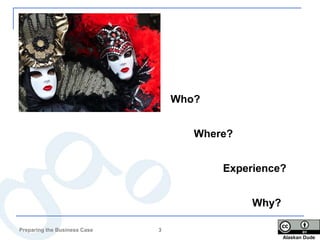
Who?


                                     Where?


                                         Experience?


                                              Why?

Preparing the Business Case   3
                                                     Alaskan Dude
What are the barriers?


Preparing the Business Case    4
                                                       roy costello
Case Study


Preparing the Business Case   5
                                  Karen Roe
WebCo Exercise (1)
   WebCo manufactures and sells WebStuff. It is divided into four divisions:
     Production manufactures WebStuff
     Marketing creates and distributes product brochures and other supporting materials
     Sales talks to potential customers and sells them WebStuff
     Operations supports customers once they have bought some WebStuff

   Being a thoroughly modern corporation, each division uses the web to support their activities:
     Production runs a supplier portal, through which its suppliers provide information about the
        status of orders, delivery tracking information, invoices, etc
     Marketing provides a range of product brochures, information sheets, etc, for resellers (via a
        private website) and customers (via the public website). It also runs a number of regional
        marketing sites in countries around the world.
     Sales runs a number of applications on on intranet, which are used by sales people to record
        new orders, expense claims, etc. These sales people are on the road a lot, so they also value
        the company news and information that is provided through the intranet.
     Operations runs a customer service portal. Customers use this to download product
        manuals, ask questions about their products and raise service requests.


Preparing the Business Case                      6
WebCo Exercise (2)
   Having been thoroughly modern for a long time now, the systems that support this are a bit of a
    mess. For example:
     Product information is inconsistent across the various marketing websites. The versions on
       the intranet (often used by sales people) and customer service portal may be different again.
     Creating a new marketing campaign can be really painful, as many sites and systems need to
       be updated independently.
     It costs a lot to operate and maintain all the different portals and websites, all of which are on
       different content management systems, servers, databases, etc.
     None of the web systems are integrated with WebCo’s ERP system, so all the supplier
       tracking information, expense information, etc, needs to be transferred manually.

   In order to sort out this mess, WebCo has decided to migrate all its web systems to a common
    Web CMS, and to integrate this CMS with the corporate ERP system.

   Discuss:
     What information you would put into a business case
     How you would gather and present this information
     (Don’t get too bogged down in whether WebCo is adopting a sensible strategy, or exactly how
        you’d execute this strategy, except to the extent that this is relevant to the business case)


Preparing the Business Case                        7
Present Back


Preparing the Business Case   8
                                  Karen Roe
Why write a business case?


                                            Because we’re told to

To prioritise allocation of resources across the portfolio

                        To create a framework for decision making

Preparing the Business Case          9
                                                            Patrick Hoesly
A framework for decision making
  Create a clear vision for the
            project

  Win meaningful support for
     delivering this vision

  Define measurable success
           criteria

Help make good decisions as
 issues arise in the project


Preparing the Business Case   12
                                   digitalrob70
Who Cares?
                                                  Execs
                               Sponsor and Project Board
                                        Project Manager
                                            Project Team
                                         Other Managers


Preparing the Business Case   14
                                                     pasukaru76
What you might care about…

 Winning people’s support for the case
 Getting their support as problems arise during the project
 Fitting your project into the wider context
     How it supports organisational goals
     How you build support from other people (or trade with them)

 Understanding what the organisation expects of you
     Structure of case, when and how to present it

 Knowing who your allies and competitors are
 Finding potential mentors
 ...

Preparing the Business Case           16
                                                                     pasukaru76
Potential Contents

   Executive Summary
   Situation
   Proposed Solution
   Benefits (financial & non-financial)
   Impacts
   Alternatives Considered
   Implementation Approach, Timelines & Resources
   Governance
   Financial Analysis
   Risks and Success Factors

Preparing the Business Case   17
Executive Summary

 What issues do you want to address?
 What do you want to do to address them?
 What benefits will the organisation get from doing this?
 How will you do this?
     Milestones
     Resources – make it clear just what you’re asking for
     Governance
     Risks
     Proof that you have a reasonable chance of success


Preparing the Business Case           18
Current State

 Outline the current state
 Describe the issues / opportunities it creates
 Describe what impact this is having on the organisation
       Increased costs & delays
       Reduced quality (describe the impact it has on customers, if possible)
       Opportunity to grow revenue, improve customer satisfaction
       …

 Illustrate in language that works for your audience
     Numbers, Pictures, Stories, Quotations, …
     Scare tactics? (Can work, but can also be resented.)
     …


Preparing the Business Case             19
Proposed Solution

 What it is
 How it addresses the issues in the current state
 Again, describe in terms your audience understands


Preparing the Business Case   20
Benefits

 What will the organisation gain by doing this?
 Financial benefits
     Highlights from the financial analysis
     Use whatever parameters (ROI, NPV, IRR, payback, …) your org prefers

 Non-financial benefits
     Align to strategic goals, as far as possible
     How will these be measured

 How will they be realised?
 Who is responsible for realising them?
 Clear understanding of benefits adds a lot of weight

Preparing the Business Case             21
Impacts

 Who will be affected by this solution?
 What processes will be affected?
 Are there any side-effects that need to be managed?
 Tell the story – how people will be affected?


Preparing the Business Case   22
Alternatives considered

 For each alternative considered:
     Describe the solution
     How do benefits and costs compare to your proposed solution?
     Why was it rejected?

 Work to your organisations expectations
     How many alternatives should you include?
     Should you recommend one, or just offer options?

 “Do Nothing” is always an option
 Socialise options with decision-makers beforehand
     Let them steer & guide you as to what options to consider
     Don’t surprise them

Preparing the Business Case           23
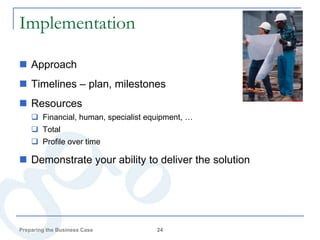
Implementation

 Approach
 Timelines – plan, milestones
 Resources
     Financial, human, specialist equipment, …
     Total
     Profile over time

 Demonstrate your ability to deliver the solution


Preparing the Business Case          24
Governance

 Who is responsible for the initiative?
     Budget
     Oversight
     Benefits realisation

 Who will be on the project board?
 Who will be the project manager?
 How will this fit to wider governance & reporting?
 Some of this may not be known at this point…


Preparing the Business Case   25
Financial Analysis

 Costs – total and spend profile over time
 Benefits – total and profile over time
 ROI, NPV, Payback calculations
     Use the approved template (if one exists)

 Be aware of issues such as:
     Capex versus Opex
     Project versus operational costs
     Planning horizon
     Sensitivities
     Role of finance (to support analysis; to review it before approval; …)


Preparing the Business Case              26
Risks and success factors

 To the project
 To benefits realisation


Preparing the Business Case   27
Tailor to your organisation

 Is there a defined template for business cases?
 Is there an approved format for ROI calculations & etc?
 Is there a required review process (e.g. by Finance)?
 What communication style works for your audience?
     Numbers? Pictures? Words? Stories? Quotes?

 What are the current strategic priorities?
     Cost cutting? Revenue growth? Focus on specific product or market?


Preparing the Business Case         28
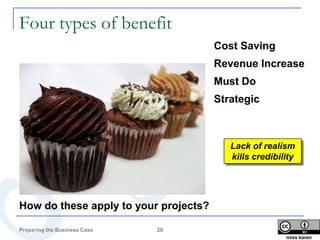
Four types of benefit
                                       Cost Saving
                                       Revenue Increase
                                       Must Do
                                       Strategic


                                          Lack of realism
                                          kills credibility


How do these apply to your projects?

Preparing the Business Case   29
                                                        miss karen
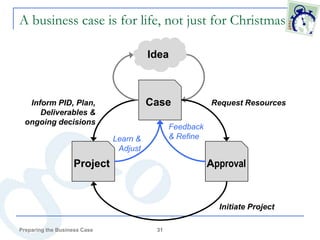
A business case is for life, not just for Christmas

                                        Idea


   Inform PID, Plan,                    Case             Request Resources
      Deliverables &
  ongoing decisions
                                              Feedback
                              Learn &         & Refine
                               Adjust
                   Project                               Approval


                                                           Initiate Project

Preparing the Business Case              31
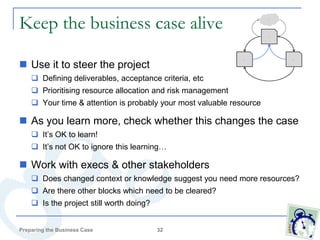
Keep the business case alive                                            Idea


                                                                        Case


 Use it to steer the project
                                                              Project          Approval


     Defining deliverables, acceptance criteria, etc
     Prioritising resource allocation and risk management
     Your time & attention is probably your most valuable resource

 As you learn more, check whether this changes the case
     It’s OK to learn!
     It’s not OK to ignore this learning…

 Work with execs & other stakeholders
     Does changed context or knowledge suggest you need more resources?
     Are there other blocks which need to be cleared?
     Is the project still worth doing?


Preparing the Business Case               32
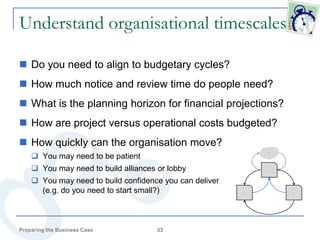
Understand organisational timescales

 Do you need to align to budgetary cycles?
 How much notice and review time do people need?
 What is the planning horizon for financial projections?
 How are project versus operational costs budgeted?
 How quickly can the organisation move?
     You may need to be patient
                                                                   Idea


     You may need to build alliances or lobby                     Case


     You may need to build confidence you can deliver
      (e.g. do you need to start small?)                 Project          Approval


Preparing the Business Case           33
Case Study, Revisited


Preparing the Business Case   34
                                   Karen Roe
Approval


Preparing the Business Case   35
                                   Karen Roe
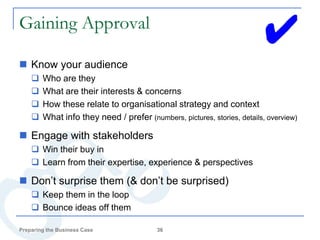
Gaining Approval
                                                                         ✔
 Know your audience
       Who are they
       What are their interests & concerns
       How these relate to organisational strategy and context
       What info they need / prefer (numbers, pictures, stories, details, overview)

 Engage with stakeholders
     Win their buy in
     Learn from their expertise, experience & perspectives

 Don’t surprise them (& don’t be surprised)
     Keep them in the loop
     Bounce ideas off them

Preparing the Business Case               36
What does approval mean?


What can / must you do next?
How long does this approval last?
Which stars need to be aligned?
Does it create additional requirements on you?

Preparing the Business Case   37
                                                 Magic Madzik
Other Success Factors
                                                     ✔
 Treat the business case as a living document
 Set clear expectations
 Get feedback
 Focus on creating a clear vision for the project
 Remember benefits realisation


Preparing the Business Case   39
Risks


                                                     ✗
 Surprising key stakeholders
 Fire and forget
 Focus on the financial case
 Unrealistic expectations on how much you can know
 Not fitting org context – not aligned to strategy & context
 Not fitting org expectations – wrong format, focus, timing


Preparing the Business Case   41
Case Study, Applied


Preparing the Business Case   43
                                   Karen Roe
Summary

 A good business case sets up the project for success
     Builds meaningful support from key stakeholders
     Creates a framework for decision making

 The business case is a living document

 Understand the organisational context
     Strategic drivers and concerns
     Key people and their drivers & concerns
     Required structure, contents, timescales, etc

 It’s a political activity – it’s OK to work with power

Preparing the Business Case        44
Thank You
graham@grahamoakes.co.uk


The Cognitive Edge method used herein in whole or in part of a derived work is ©2012 Cognitive Edge (USA) Inc., is used under
               license agreement terms which can be found at http://cognitive-edge.com/about/user-agreement
Graham Oakes Ltd
 Making sense of technology…
     Many organisations are caught up in the
      complexity of technology and systems.
     This complexity may be inherent to the
      technology itself. It may be created by the pace of technology change. Or it may arise from
      the surrounding process, people and governance structures.
     We help untangle this complexity and define business strategies that both can be
      implemented and will be adopted by people throughout the organisation and its partner
      network. We then help assure delivery of implementation projects.
 Clients…
       Cisco Worldwide Education – Architecture and research for e-learning and educational systems
       Council of Europe – Systems for monitoring compliance with international treaties; e-learning systems
       Dover Harbour Board – Systems and architecture review
       MessageLabs – Architecture and assurance for partner management portal
       National Savings & Investments – Helped NS&I and BPO partner develop joint IS strategy
       The Open University – Enterprise architecture, CRM and product development strategies
       Oxfam – Content management, CRM, e-Commerce
       Thames Valley Police – Internet Consultancy
       Sony Computer Entertainment – Global process definition
       Amnesty International, Endemol, tsoosayLabs, Vodafone, …


Preparing the Business Case                          46
WebCo – Strategic Context
 The economic downturn means that WebCo is suffering from declining sales.
  Although it continues to retain (and even grow) market share, the general decline in
  the size of the market for its products means that revenue and hence profits are
  declining rapidly.
 Accordingly, the executive team has declared that all areas of the company must
  focus on reducing costs. Only projects which can demonstrate tangible cost savings
  should be approved.


Preparing the Business Case                47
WebCo – Strategic Context
 A new competitor has entered the market with some attractive new
  products, meaning that WebCo is suffering from declining sales and market share.
 In order to respond to this threat, WebCo has started to develop a suite of new and
  improved products. It is essential that all marketing and sales activities provide
  maximum support to the launch of these products
 Accordingly, the executive team has declared that the company must focus on
  maximising the speed and effectiveness of marketing and sales. Only projects which
  can show tangible improvements in these areas should be approved.


Preparing the Business Case               48
The Cognitive Edge method used herein in whole or in part of a derived work is ©2012 Cognitive Edge
(USA) Inc., is used under license agreement terms which can be found at http://cognitive-
edge.com/about/user-agreement


Preparing the Business Case                     49

Successful web projects writing a business case - jan 2012

  • 1.
    Successful Web Projects Preparing the Business Case Preparing the Business Case 1
  • 2.
    Agenda  Introductions (10 min)  Case Study (30 min)  Why? Who? When? What? How much? (60 min)  Case Study, Revisited (60 min)  Gaining Approval (30 min)  Risks and Success Factors  Case Study, Applied (15 min)  Close (5 min) Preparing the Business Case 2
  • 3.
    Who? Where? Experience? Why? Preparing the Business Case 3 Alaskan Dude
  • 4.
    What are thebarriers? Preparing the Business Case 4 roy costello
  • 5.
    Case Study Preparing theBusiness Case 5 Karen Roe
  • 6.
    WebCo Exercise (1)  WebCo manufactures and sells WebStuff. It is divided into four divisions:  Production manufactures WebStuff  Marketing creates and distributes product brochures and other supporting materials  Sales talks to potential customers and sells them WebStuff  Operations supports customers once they have bought some WebStuff  Being a thoroughly modern corporation, each division uses the web to support their activities:  Production runs a supplier portal, through which its suppliers provide information about the status of orders, delivery tracking information, invoices, etc  Marketing provides a range of product brochures, information sheets, etc, for resellers (via a private website) and customers (via the public website). It also runs a number of regional marketing sites in countries around the world.  Sales runs a number of applications on on intranet, which are used by sales people to record new orders, expense claims, etc. These sales people are on the road a lot, so they also value the company news and information that is provided through the intranet.  Operations runs a customer service portal. Customers use this to download product manuals, ask questions about their products and raise service requests. Preparing the Business Case 6
  • 7.
    WebCo Exercise (2)  Having been thoroughly modern for a long time now, the systems that support this are a bit of a mess. For example:  Product information is inconsistent across the various marketing websites. The versions on the intranet (often used by sales people) and customer service portal may be different again.  Creating a new marketing campaign can be really painful, as many sites and systems need to be updated independently.  It costs a lot to operate and maintain all the different portals and websites, all of which are on different content management systems, servers, databases, etc.  None of the web systems are integrated with WebCo’s ERP system, so all the supplier tracking information, expense information, etc, needs to be transferred manually.  In order to sort out this mess, WebCo has decided to migrate all its web systems to a common Web CMS, and to integrate this CMS with the corporate ERP system.  Discuss:  What information you would put into a business case  How you would gather and present this information  (Don’t get too bogged down in whether WebCo is adopting a sensible strategy, or exactly how you’d execute this strategy, except to the extent that this is relevant to the business case) Preparing the Business Case 7
  • 8.
    Present Back Preparing theBusiness Case 8 Karen Roe
  • 9.
    Why write abusiness case? Because we’re told to To prioritise allocation of resources across the portfolio To create a framework for decision making Preparing the Business Case 9 Patrick Hoesly
  • 10.
    A framework fordecision making Create a clear vision for the project Win meaningful support for delivering this vision Define measurable success criteria Help make good decisions as issues arise in the project Preparing the Business Case 12 digitalrob70
  • 11.
    Who Cares? Execs Sponsor and Project Board Project Manager Project Team Other Managers Preparing the Business Case 14 pasukaru76
  • 12.
    What you mightcare about…  Winning people’s support for the case  Getting their support as problems arise during the project  Fitting your project into the wider context  How it supports organisational goals  How you build support from other people (or trade with them)  Understanding what the organisation expects of you  Structure of case, when and how to present it  Knowing who your allies and competitors are  Finding potential mentors  ... Preparing the Business Case 16 pasukaru76
  • 13.
    Potential Contents  Executive Summary  Situation  Proposed Solution  Benefits (financial & non-financial)  Impacts  Alternatives Considered  Implementation Approach, Timelines & Resources  Governance  Financial Analysis  Risks and Success Factors Preparing the Business Case 17
  • 14.
    Executive Summary  Whatissues do you want to address?  What do you want to do to address them?  What benefits will the organisation get from doing this?  How will you do this?  Milestones  Resources – make it clear just what you’re asking for  Governance  Risks  Proof that you have a reasonable chance of success Preparing the Business Case 18
  • 15.
    Current State  Outlinethe current state  Describe the issues / opportunities it creates  Describe what impact this is having on the organisation  Increased costs & delays  Reduced quality (describe the impact it has on customers, if possible)  Opportunity to grow revenue, improve customer satisfaction  …  Illustrate in language that works for your audience  Numbers, Pictures, Stories, Quotations, …  Scare tactics? (Can work, but can also be resented.)  … Preparing the Business Case 19
  • 16.
    Proposed Solution  Whatit is  How it addresses the issues in the current state  Again, describe in terms your audience understands Preparing the Business Case 20
  • 17.
    Benefits  What willthe organisation gain by doing this?  Financial benefits  Highlights from the financial analysis  Use whatever parameters (ROI, NPV, IRR, payback, …) your org prefers  Non-financial benefits  Align to strategic goals, as far as possible  How will these be measured  How will they be realised?  Who is responsible for realising them?  Clear understanding of benefits adds a lot of weight Preparing the Business Case 21
  • 18.
    Impacts  Who willbe affected by this solution?  What processes will be affected?  Are there any side-effects that need to be managed?  Tell the story – how people will be affected? Preparing the Business Case 22
  • 19.
    Alternatives considered  Foreach alternative considered:  Describe the solution  How do benefits and costs compare to your proposed solution?  Why was it rejected?  Work to your organisations expectations  How many alternatives should you include?  Should you recommend one, or just offer options?  “Do Nothing” is always an option  Socialise options with decision-makers beforehand  Let them steer & guide you as to what options to consider  Don’t surprise them Preparing the Business Case 23
  • 20.
    Implementation  Approach  Timelines– plan, milestones  Resources  Financial, human, specialist equipment, …  Total  Profile over time  Demonstrate your ability to deliver the solution Preparing the Business Case 24
  • 21.
    Governance  Who isresponsible for the initiative?  Budget  Oversight  Benefits realisation  Who will be on the project board?  Who will be the project manager?  How will this fit to wider governance & reporting?  Some of this may not be known at this point… Preparing the Business Case 25
  • 22.
    Financial Analysis  Costs– total and spend profile over time  Benefits – total and profile over time  ROI, NPV, Payback calculations  Use the approved template (if one exists)  Be aware of issues such as:  Capex versus Opex  Project versus operational costs  Planning horizon  Sensitivities  Role of finance (to support analysis; to review it before approval; …) Preparing the Business Case 26
  • 23.
    Risks and successfactors  To the project  To benefits realisation Preparing the Business Case 27
  • 24.
    Tailor to yourorganisation  Is there a defined template for business cases?  Is there an approved format for ROI calculations & etc?  Is there a required review process (e.g. by Finance)?  What communication style works for your audience?  Numbers? Pictures? Words? Stories? Quotes?  What are the current strategic priorities?  Cost cutting? Revenue growth? Focus on specific product or market? Preparing the Business Case 28
  • 25.
    Four types ofbenefit Cost Saving Revenue Increase Must Do Strategic Lack of realism kills credibility How do these apply to your projects? Preparing the Business Case 29 miss karen
  • 26.
    A business caseis for life, not just for Christmas Idea Inform PID, Plan, Case Request Resources Deliverables & ongoing decisions Feedback Learn & & Refine Adjust Project Approval Initiate Project Preparing the Business Case 31
  • 27.
    Keep the businesscase alive Idea Case  Use it to steer the project Project Approval  Defining deliverables, acceptance criteria, etc  Prioritising resource allocation and risk management  Your time & attention is probably your most valuable resource  As you learn more, check whether this changes the case  It’s OK to learn!  It’s not OK to ignore this learning…  Work with execs & other stakeholders  Does changed context or knowledge suggest you need more resources?  Are there other blocks which need to be cleared?  Is the project still worth doing? Preparing the Business Case 32
  • 28.
    Understand organisational timescales Do you need to align to budgetary cycles?  How much notice and review time do people need?  What is the planning horizon for financial projections?  How are project versus operational costs budgeted?  How quickly can the organisation move?  You may need to be patient Idea  You may need to build alliances or lobby Case  You may need to build confidence you can deliver (e.g. do you need to start small?) Project Approval Preparing the Business Case 33
  • 29.
    Case Study, Revisited Preparingthe Business Case 34 Karen Roe
  • 30.
  • 31.
    Gaining Approval ✔  Know your audience  Who are they  What are their interests & concerns  How these relate to organisational strategy and context  What info they need / prefer (numbers, pictures, stories, details, overview)  Engage with stakeholders  Win their buy in  Learn from their expertise, experience & perspectives  Don’t surprise them (& don’t be surprised)  Keep them in the loop  Bounce ideas off them Preparing the Business Case 36
  • 32.
    What does approvalmean? What can / must you do next? How long does this approval last? Which stars need to be aligned? Does it create additional requirements on you? Preparing the Business Case 37 Magic Madzik
  • 33.
    Other Success Factors ✔  Treat the business case as a living document  Set clear expectations  Get feedback  Focus on creating a clear vision for the project  Remember benefits realisation Preparing the Business Case 39
  • 34.
    Risks ✗  Surprising key stakeholders  Fire and forget  Focus on the financial case  Unrealistic expectations on how much you can know  Not fitting org context – not aligned to strategy & context  Not fitting org expectations – wrong format, focus, timing Preparing the Business Case 41
  • 35.
    Case Study, Applied Preparingthe Business Case 43 Karen Roe
  • 36.
    Summary  A goodbusiness case sets up the project for success  Builds meaningful support from key stakeholders  Creates a framework for decision making  The business case is a living document  Understand the organisational context  Strategic drivers and concerns  Key people and their drivers & concerns  Required structure, contents, timescales, etc  It’s a political activity – it’s OK to work with power Preparing the Business Case 44
  • 37.
    Thank You graham@grahamoakes.co.uk The CognitiveEdge method used herein in whole or in part of a derived work is ©2012 Cognitive Edge (USA) Inc., is used under license agreement terms which can be found at http://cognitive-edge.com/about/user-agreement
  • 38.
    Graham Oakes Ltd Making sense of technology…  Many organisations are caught up in the complexity of technology and systems.  This complexity may be inherent to the technology itself. It may be created by the pace of technology change. Or it may arise from the surrounding process, people and governance structures.  We help untangle this complexity and define business strategies that both can be implemented and will be adopted by people throughout the organisation and its partner network. We then help assure delivery of implementation projects.  Clients…  Cisco Worldwide Education – Architecture and research for e-learning and educational systems  Council of Europe – Systems for monitoring compliance with international treaties; e-learning systems  Dover Harbour Board – Systems and architecture review  MessageLabs – Architecture and assurance for partner management portal  National Savings & Investments – Helped NS&I and BPO partner develop joint IS strategy  The Open University – Enterprise architecture, CRM and product development strategies  Oxfam – Content management, CRM, e-Commerce  Thames Valley Police – Internet Consultancy  Sony Computer Entertainment – Global process definition  Amnesty International, Endemol, tsoosayLabs, Vodafone, … Preparing the Business Case 46
  • 39.
    WebCo – StrategicContext  The economic downturn means that WebCo is suffering from declining sales. Although it continues to retain (and even grow) market share, the general decline in the size of the market for its products means that revenue and hence profits are declining rapidly.  Accordingly, the executive team has declared that all areas of the company must focus on reducing costs. Only projects which can demonstrate tangible cost savings should be approved. Preparing the Business Case 47
  • 40.
    WebCo – StrategicContext  A new competitor has entered the market with some attractive new products, meaning that WebCo is suffering from declining sales and market share.  In order to respond to this threat, WebCo has started to develop a suite of new and improved products. It is essential that all marketing and sales activities provide maximum support to the launch of these products  Accordingly, the executive team has declared that the company must focus on maximising the speed and effectiveness of marketing and sales. Only projects which can show tangible improvements in these areas should be approved. Preparing the Business Case 48
  • 41.
    The Cognitive Edgemethod used herein in whole or in part of a derived work is ©2012 Cognitive Edge (USA) Inc., is used under license agreement terms which can be found at http://cognitive- edge.com/about/user-agreement Preparing the Business Case 49

Editor's Notes

  • #3 I’ve written business cases for several clients (dozens over the years, more or less formal); I learn something every time; let’s learn togetherWhy = why do we need to write a business case?Who = who are the stakeholders?When = the lifecycle of the business case. It’s an active piece of content, not a one-off / fire-and-forget document.What = possible contentsHow much = possible value drivers for a web or intranet project, and how to capture themRisks and Success Factors = what stuff might come up in writing a case? How do you deal with it?I could talk for 3 hours, but you’d go to sleep. So instead, let’s have lots of hands-on – explore issues, and learn from each other: success comes from writing the biz case that works for your context, not from following a template… .But my aim is to throw out some ideas to help you…
  • #4 Who are you?Where are you from?Have you written business cases / are you writing one now?Why did you decide to come on this workshop?
  • #6 Get us moving / talking / thinking – this isn’t just me talking at you: you’re going to create the case study
  • #9 Present back what you’d coverOpen up for group discussion
  • #30 Discuss these with people – how do they apply to a web or intranet project?What examples do they haveUse examples from WIF, SIPP in each case
  • #35 Use Ritual Dissent technique from Cognitive Edge for the teams to review and refineWork in teams to create refined business case (15 mins – with coffee / break)One person presents to next team (3 mins)Turn back and listen to discussion – what they like, what they dislike, what they don’t understand, what they disagree with (3 mins)Refine case (5 mins)Present and feedback (6 mins)Refine case (5 mins)Total = 37 mins plus handover times & etc = 40 mins. (Drop 5 & 6 if running late.)
  • #36 Another person from team presents the final, refined case (3 mins to prep)Teams now role play the approval board looking at each other’s proposals. Give them a briefing (in the 3 mins, in parallel with above):To cut costsTo protect market share from new competitorWould you approve it? What works / doesn’t work in the case?Present and discuss, as before. (6 mins)Debrief in plenary – what does this tell us about approval?
  • #40 How might you deal with these?
  • #42 How might you deal with these?
  • #44 Go into small teams to discuss what the contents might mean for their own contextPresent back what they might cover for their own context
  • #46 Who I amIndependent consultantDo 2 things – help set up project (untangle complexity); help keep in touch with what’s going onUnusual perspective on assurancePortfolio of mid-size projects rather than single large programmeDifferent twists, but aligns to where many organisations are at, so will share experienceAgenda