James Ratliff, M.D. 07.23.08
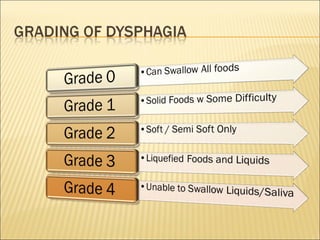
C/C: 56 y/o AAF with c/o Difficulty Swallowing  Patient reports food is getting stuck and she coughs when she drinks water. No complaint of nausea/vomiting/hemetemesis c/o weakness and severe lethargy Associated weight loss approx 9 lbs in 1 week She denies fever / chills ECOG status 1
Intraductal Papilloma of Left Breast COPD Asthma Seizure Disorder GERD Sickle Cell Trait
Left Breast Lumpectomy
Dilantin Albuterol Thiamine Nizatidine ALLERGIES: Penicillin
Lives Alone Tobacco Use ½ ppd x 30 yrs ETOH of 2 Beers Daily Denies Drug usage
Mother- Breast Cancer Father- Cancer of unknown type Brother - Polio
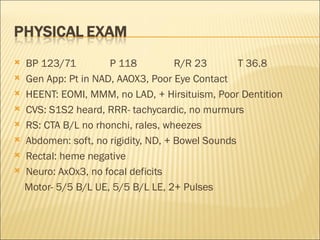
BP 123/71 P 118 R/R 23 T 36.8 Gen App: Pt in NAD, AAOX3, Poor Eye Contact HEENT: EOMI, MMM, no LAD, + Hirsituism, Poor Dentition CVS: S1S2 heard, RRR- tachycardic, no murmurs RS: CTA B/L no rhonchi, rales, wheezes Abdomen: soft, no rigidity, ND, + Bowel Sounds Rectal: heme negative Neuro: AxOx3, no focal deficits Motor- 5/5 B/L UE, 5/5 B/L LE, 2+ Pulses
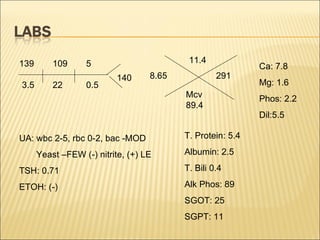
UA: wbc 2-5, rbc 0-2, bac -MOD Yeast –FEW (-) nitrite, (+) LE TSH: 0.71 ETOH: (-) Ca: 7.8 Mg: 1.6 Phos: 2.2 Dil:5.5 T. Protein: 5.4 Albumin: 2.5 T. Bili 0.4 Alk Phos: 89 SGOT: 25 SGPT: 11 8.65 11.4 Mcv 89.4 291 139 3.5 109 22 5 0.5 140
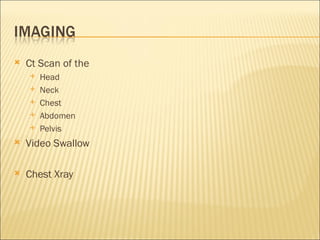
Ct Scan of the  Head  Neck  Chest Abdomen Pelvis Video Swallow Chest Xray
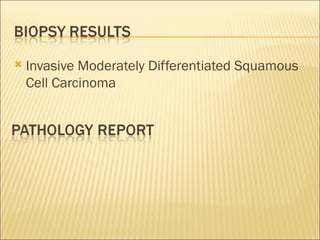
Invasive Moderately Differentiated Squamous Cell Carcinoma
Pt was kept NPO, evaluated by GI where EGD was performed demonstrating an ulcerative mass  - Bx were taken Pt was further evaluated by ENT via Triple Scope Patient Experienced Respiratory Failure s/p Triple Scope Intubated and Transferred to ICU – Successfully Extubated Day2 Heme / Onc Recommendation  Concurrent Chemotherapy / Radiation Patient Transferred to Floor -Portacath Placement and Initiation of Therapy
Esophagus is a Cursed Tube No Serosa / Thin Walled Longitudinal Lesions /  Submucosal Lymphnodes Squamous Cell / Adenocarcinoma account for over 95%  In the 1960’s Squamous Cell CA = 90% Now Squamous Cell and Adenocarcinoma are about Equal in Occurrence  50% - 60% present with Incurable Locally Advanced / Metastatic Disease 6000 New Cases per Year Male to Female Ratio 3:1 Black to White Ratio 6:1
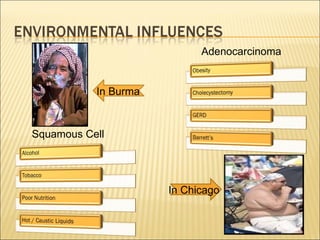
Squamous Cell Adenocarcinoma In Burma In Chicago
Palliation is the Goal of Treatment for the Majority Tumors that Invade through the Esophageal Wall or are Node + Long Term Survival is Poor  Optimal Treatment for T3 and Above, if Unresectable, is Combination Chemoradiotherapy Accurate Staging is the Key Barium studies Suggest the Diagnosis Diagnosis is Made with a Biopsy Accuracy Improves with the Frequency of Biopsies taken 1 = 93% 4 = 95% 7 = 98% Addition of a Brush Cytology increases Accuracy to 100%
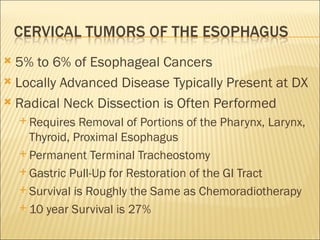
5% to 6% of Esophageal Cancers Locally Advanced Disease Typically Present at DX Radical Neck Dissection is Often Performed Requires Removal of Portions of the Pharynx, Larynx, Thyroid, Proximal Esophagus Permanent Terminal Tracheostomy Gastric Pull-Up for Restoration of the GI Tract Survival is Roughly the Same as Chemoradiotherapy 10 year Survival is 27%
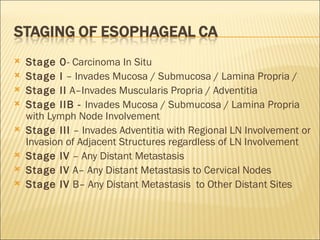
Stage 0 - Carcinoma In Situ Stage I  – Invades Mucosa / Submucosa / Lamina Propria /  Stage II  A–Invades Muscularis Propria / Adventitia Stage IIB -  Invades Mucosa / Submucosa / Lamina Propria with Lymph Node Involvement Stage III  – Invades Adventitia with Regional LN Involvement or Invasion of Adjacent Structures regardless of LN Involvement Stage IV  – Any Distant Metastasis  Stage IV  A– Any Distant Metastasis to Cervical Nodes Stage IV  B– Any Distant Metastasis  to Other Distant Sites
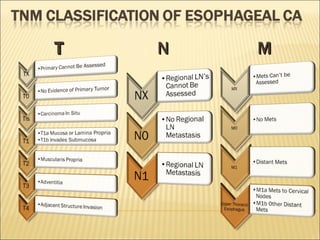
T M N
 
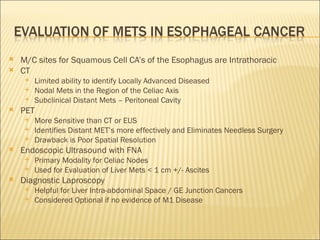
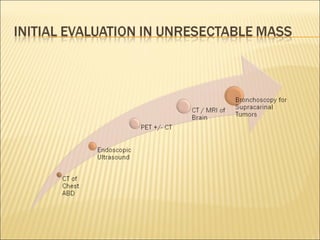
M/C sites for Squamous Cell CA’s of the Esophagus are Intrathoracic CT Limited ability to identify Locally Advanced Diseased Nodal Mets in the Region of the Celiac Axis Subclinical Distant Mets – Peritoneal Cavity PET  More Sensitive than CT or EUS Identifies Distant MET’s more effectively and Eliminates Needless Surgery Drawback is Poor Spatial Resolution Endoscopic Ultrasound with FNA Primary Modality for Celiac Nodes Used for Evaluation of Liver Mets < 1 cm +/- Ascites Diagnostic Laproscopy  Helpful for Liver Intra-abdominal Space / GE Junction Cancers  Considered Optional if no evidence of M1 Disease
 
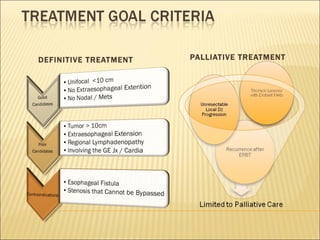
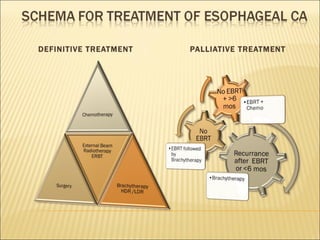
DEFINITIVE TREATMENT PALLIATIVE TREATMENT
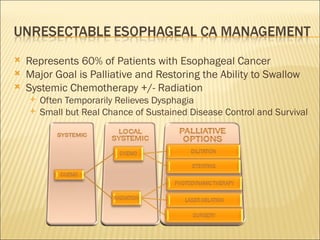
Represents 60% of Patients with Esophageal Cancer Major Goal is Palliative and Restoring the Ability to Swallow Systemic Chemotherapy +/- Radiation Often Temporarily Relieves Dysphagia Small but Real Chance of Sustained Disease Control and Survival
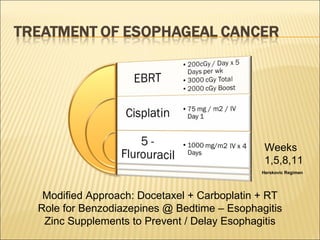
Weeks 1,5,8,11 Modified Approach: Docetaxel + Carboplatin + RT Role for Benzodiazepines @ Bedtime – Esophagitis Zinc Supplements to Prevent / Delay Esophagitis Herskovic Regimen
NCCN Practice Guidelines in Oncology – v.1.2008 Palliative Therapy -  Category 1 Consensus Concurrent Chemoradiation 5FU Based / Cisplatin 50.4 Gy RT And / or Best Supportive Care Conroy Yataghene Phase II Trial - Journal of Clinical Oncology 2007;25(18suppl)4532 5-FU / Leucovorin / Oxaliplatin (FOLFOX4) vs 5-FU / Cisplatin Median Time to Progression 15m – 9.5m Median Event Free Survival 11.6m – 7.8m Median Overall Survival 22.7 m – 14.7m Phase III is Underway
Important in the Management of Unresectable Esophageal Cancer Maintenance of Long Term Disease Control Sustained Remission / LT Survival Rare with RT alone RT alone has a 1-2 % 3 to 5 year Survival Rate In the RTOG Trial All Patients in the RT Only Arm Were  Dead  byYr 3 27% of those in the Chemoradiotherapy Arm were  Alive  at Yr 5 Significant Dysphagia Palliation is Possible with RT 70% to 90% Palliated for an Average of 3 Months Downside is the Time it Takes to Accomplish -5 to 6 weeks
Risk of Transesophageal Fistula Development 6% Risk 70 % Close Spontaneously after Treatment Post RT Strictures Malignant and Benign Recurrent Dysphagia
RTOG 85-10 Trial Demonstrated a significant Survival Benefit to Concurrent Chemo Radiotherapy Median Survival of 14 vs 9 Months 5 Year Survival of 27% vs 0% Relief of Dysphagia 88% Reported Improvement in 2 Weeks Maximum Benefit in 4 Weeks All had No Significant Dysphagia Until Death or Last Followup Visit Failure Rate of 45% Intergroup Trial 0123 Showed No Benefit to HiDose RT Chemoradiotherapy Alone = to Chemoradiotherapy followed by Surgery Chemoradiotherapy Associated with More Local Failures 40% - 50%
High Radiation Dose with Relative Sparing of Surrounding Structures Used Alone or With EBRT + - Chemo Alternative to Stent Placement – Dysphagia Administered at a Low Dose vs High Dose Rate Can Provide Long Term Palliation Longer to Act Compared to Metal Stent Increased Days with No Dysphagia - 115 vs 82 Lower Complication Rate Better Quality of Life Scores Brachytherapy Boost + RT + Chemo Mixed Results in Trials 2 Studies Showed the Combo to be Tolerated – Survival 17 / 16.5 Mon RTOG Study - 34% Incidence of Severe Toxicity or Death – 11 mon Best Used in Short Survival Patients - 3 to 6 Months If Survival is Less then 3 Months Stenting is Advised
http://www.nccn.org/professionals/physician_gls/PDF/esophageal.pdf -v.1.2008 http://www.uptodate.com/online/content/topic.do?topicKey=gicancer/11551&view=print http://ctep.cancer.gov./forms/CTCAEv3.pdf Herskovic, A, Martz,K,Al-Sarraf, M, et al. Combined chemotherapy and radiotherapy compared with radiotherapy alone in patients with esophageal cancer of the esophagus. N Engl J Med 1992; 326: 1593 Chu, Edward, Chemotherapy Protocols. Jones and Bartlett Pub 2007 ISBN – 13:978-0-7637-4454-0

Esophagus Final 2003

  • 1.
  • 2.
    C/C: 56 y/oAAF with c/o Difficulty Swallowing Patient reports food is getting stuck and she coughs when she drinks water. No complaint of nausea/vomiting/hemetemesis c/o weakness and severe lethargy Associated weight loss approx 9 lbs in 1 week She denies fever / chills ECOG status 1
  • 3.
    Intraductal Papilloma ofLeft Breast COPD Asthma Seizure Disorder GERD Sickle Cell Trait
  • 4.
  • 5.
    Dilantin Albuterol ThiamineNizatidine ALLERGIES: Penicillin
  • 6.
    Lives Alone TobaccoUse ½ ppd x 30 yrs ETOH of 2 Beers Daily Denies Drug usage
  • 7.
    Mother- Breast CancerFather- Cancer of unknown type Brother - Polio
  • 8.
    BP 123/71 P118 R/R 23 T 36.8 Gen App: Pt in NAD, AAOX3, Poor Eye Contact HEENT: EOMI, MMM, no LAD, + Hirsituism, Poor Dentition CVS: S1S2 heard, RRR- tachycardic, no murmurs RS: CTA B/L no rhonchi, rales, wheezes Abdomen: soft, no rigidity, ND, + Bowel Sounds Rectal: heme negative Neuro: AxOx3, no focal deficits Motor- 5/5 B/L UE, 5/5 B/L LE, 2+ Pulses
  • 9.
    UA: wbc 2-5,rbc 0-2, bac -MOD Yeast –FEW (-) nitrite, (+) LE TSH: 0.71 ETOH: (-) Ca: 7.8 Mg: 1.6 Phos: 2.2 Dil:5.5 T. Protein: 5.4 Albumin: 2.5 T. Bili 0.4 Alk Phos: 89 SGOT: 25 SGPT: 11 8.65 11.4 Mcv 89.4 291 139 3.5 109 22 5 0.5 140
  • 10.
    Ct Scan ofthe Head Neck Chest Abdomen Pelvis Video Swallow Chest Xray
  • 11.
    Invasive Moderately DifferentiatedSquamous Cell Carcinoma
  • 12.
    Pt was keptNPO, evaluated by GI where EGD was performed demonstrating an ulcerative mass - Bx were taken Pt was further evaluated by ENT via Triple Scope Patient Experienced Respiratory Failure s/p Triple Scope Intubated and Transferred to ICU – Successfully Extubated Day2 Heme / Onc Recommendation Concurrent Chemotherapy / Radiation Patient Transferred to Floor -Portacath Placement and Initiation of Therapy
  • 13.
    Esophagus is aCursed Tube No Serosa / Thin Walled Longitudinal Lesions / Submucosal Lymphnodes Squamous Cell / Adenocarcinoma account for over 95% In the 1960’s Squamous Cell CA = 90% Now Squamous Cell and Adenocarcinoma are about Equal in Occurrence 50% - 60% present with Incurable Locally Advanced / Metastatic Disease 6000 New Cases per Year Male to Female Ratio 3:1 Black to White Ratio 6:1
  • 14.
    Squamous Cell AdenocarcinomaIn Burma In Chicago
  • 15.
    Palliation is theGoal of Treatment for the Majority Tumors that Invade through the Esophageal Wall or are Node + Long Term Survival is Poor Optimal Treatment for T3 and Above, if Unresectable, is Combination Chemoradiotherapy Accurate Staging is the Key Barium studies Suggest the Diagnosis Diagnosis is Made with a Biopsy Accuracy Improves with the Frequency of Biopsies taken 1 = 93% 4 = 95% 7 = 98% Addition of a Brush Cytology increases Accuracy to 100%
  • 16.
    5% to 6%of Esophageal Cancers Locally Advanced Disease Typically Present at DX Radical Neck Dissection is Often Performed Requires Removal of Portions of the Pharynx, Larynx, Thyroid, Proximal Esophagus Permanent Terminal Tracheostomy Gastric Pull-Up for Restoration of the GI Tract Survival is Roughly the Same as Chemoradiotherapy 10 year Survival is 27%
  • 17.
    Stage 0 -Carcinoma In Situ Stage I – Invades Mucosa / Submucosa / Lamina Propria / Stage II A–Invades Muscularis Propria / Adventitia Stage IIB - Invades Mucosa / Submucosa / Lamina Propria with Lymph Node Involvement Stage III – Invades Adventitia with Regional LN Involvement or Invasion of Adjacent Structures regardless of LN Involvement Stage IV – Any Distant Metastasis Stage IV A– Any Distant Metastasis to Cervical Nodes Stage IV B– Any Distant Metastasis to Other Distant Sites
  • 18.
  • 19.
  • 20.
    M/C sites forSquamous Cell CA’s of the Esophagus are Intrathoracic CT Limited ability to identify Locally Advanced Diseased Nodal Mets in the Region of the Celiac Axis Subclinical Distant Mets – Peritoneal Cavity PET More Sensitive than CT or EUS Identifies Distant MET’s more effectively and Eliminates Needless Surgery Drawback is Poor Spatial Resolution Endoscopic Ultrasound with FNA Primary Modality for Celiac Nodes Used for Evaluation of Liver Mets < 1 cm +/- Ascites Diagnostic Laproscopy Helpful for Liver Intra-abdominal Space / GE Junction Cancers Considered Optional if no evidence of M1 Disease
  • 21.
  • 22.
  • 23.
  • 24.
    Represents 60% ofPatients with Esophageal Cancer Major Goal is Palliative and Restoring the Ability to Swallow Systemic Chemotherapy +/- Radiation Often Temporarily Relieves Dysphagia Small but Real Chance of Sustained Disease Control and Survival
  • 25.
    Weeks 1,5,8,11 ModifiedApproach: Docetaxel + Carboplatin + RT Role for Benzodiazepines @ Bedtime – Esophagitis Zinc Supplements to Prevent / Delay Esophagitis Herskovic Regimen
  • 26.
    NCCN Practice Guidelinesin Oncology – v.1.2008 Palliative Therapy - Category 1 Consensus Concurrent Chemoradiation 5FU Based / Cisplatin 50.4 Gy RT And / or Best Supportive Care Conroy Yataghene Phase II Trial - Journal of Clinical Oncology 2007;25(18suppl)4532 5-FU / Leucovorin / Oxaliplatin (FOLFOX4) vs 5-FU / Cisplatin Median Time to Progression 15m – 9.5m Median Event Free Survival 11.6m – 7.8m Median Overall Survival 22.7 m – 14.7m Phase III is Underway
  • 27.
    Important in theManagement of Unresectable Esophageal Cancer Maintenance of Long Term Disease Control Sustained Remission / LT Survival Rare with RT alone RT alone has a 1-2 % 3 to 5 year Survival Rate In the RTOG Trial All Patients in the RT Only Arm Were Dead byYr 3 27% of those in the Chemoradiotherapy Arm were Alive at Yr 5 Significant Dysphagia Palliation is Possible with RT 70% to 90% Palliated for an Average of 3 Months Downside is the Time it Takes to Accomplish -5 to 6 weeks
  • 28.
    Risk of TransesophagealFistula Development 6% Risk 70 % Close Spontaneously after Treatment Post RT Strictures Malignant and Benign Recurrent Dysphagia
  • 29.
    RTOG 85-10 TrialDemonstrated a significant Survival Benefit to Concurrent Chemo Radiotherapy Median Survival of 14 vs 9 Months 5 Year Survival of 27% vs 0% Relief of Dysphagia 88% Reported Improvement in 2 Weeks Maximum Benefit in 4 Weeks All had No Significant Dysphagia Until Death or Last Followup Visit Failure Rate of 45% Intergroup Trial 0123 Showed No Benefit to HiDose RT Chemoradiotherapy Alone = to Chemoradiotherapy followed by Surgery Chemoradiotherapy Associated with More Local Failures 40% - 50%
  • 30.
    High Radiation Dosewith Relative Sparing of Surrounding Structures Used Alone or With EBRT + - Chemo Alternative to Stent Placement – Dysphagia Administered at a Low Dose vs High Dose Rate Can Provide Long Term Palliation Longer to Act Compared to Metal Stent Increased Days with No Dysphagia - 115 vs 82 Lower Complication Rate Better Quality of Life Scores Brachytherapy Boost + RT + Chemo Mixed Results in Trials 2 Studies Showed the Combo to be Tolerated – Survival 17 / 16.5 Mon RTOG Study - 34% Incidence of Severe Toxicity or Death – 11 mon Best Used in Short Survival Patients - 3 to 6 Months If Survival is Less then 3 Months Stenting is Advised
  • 31.
    http://www.nccn.org/professionals/physician_gls/PDF/esophageal.pdf -v.1.2008 http://www.uptodate.com/online/content/topic.do?topicKey=gicancer/11551&view=printhttp://ctep.cancer.gov./forms/CTCAEv3.pdf Herskovic, A, Martz,K,Al-Sarraf, M, et al. Combined chemotherapy and radiotherapy compared with radiotherapy alone in patients with esophageal cancer of the esophagus. N Engl J Med 1992; 326: 1593 Chu, Edward, Chemotherapy Protocols. Jones and Bartlett Pub 2007 ISBN – 13:978-0-7637-4454-0