






Topic: satellite T.V
                Rida munir butt
                    Saba ijaz
                Misbah bahadur
                  Kashifa zafar
                  Aroosa tariq
Students of mass communication and media
  studies university of Gujrat
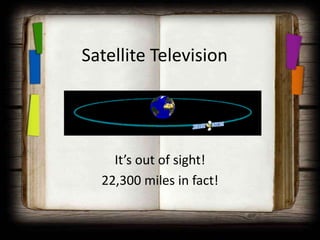
Satellite Television


    It’s out of sight!
  22,300 miles in fact!
What is satellite?


An artificial body placed in orbit
around the earth or another planet in
order to collect information or for
communication.
Satellite TV:

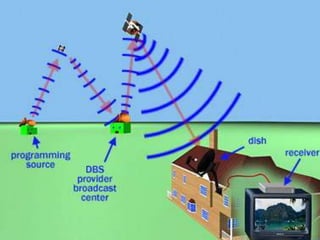
Satellite television is an electronic
device that is used to receive or
transmit television broadcasts from a
communication satellite that is
orbiting in space.
•Satellite TV at first place called direct
broadcast satellite (DBS) because it
bypasses closed-circuit television. it is
immoveable.
•On the second place TVRO satellite
systems have a large dish which is
movable.

•Closed-circuit television is transmitted
by wire to a limited number of people.
•Require subscription fees and
licenses.

•DBS is therefore known as narrow
casting, which involves sending
television broadcasts only to
subscribers and not to the general
public. Receivers systems to pick up
signals.
NASA and the USAF Space Command are
  tracking some 600 active satellites plus
11,000 dead satellites and pieces of orbiting
     debris bigger than 10 cm/6 inches
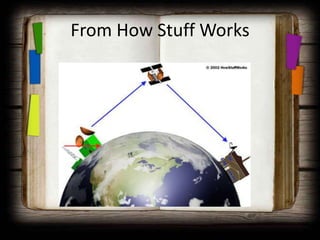
From How Stuff Works
• In order for a satellite to be used
  for television transmission, it must
  "hang" over one spot above the
  Earth.
• a receiving dish that is constantly
  moving, in order to keep up with
  the transmitting satellite with the
  speed of earth.
• Satellite TV is transmitted by
  microwaves.
• Avoid abstractions
• Survey the place
• Position the dish
• Satellite Feed Horn Assembly
• Satellite recever
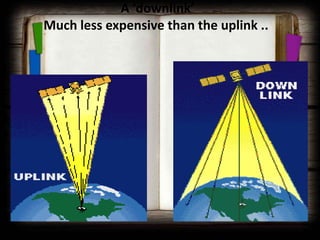
A ‘downlink’
Much less expensive than the uplink ..
The Clarke Belt
• These satellites appear to be in the
  same position in the sky at all
  times.
• They are directly over the equator
  but not directly over us.
• They are in a line that starts 14
  degrees above our Western
  Horizon.
• And rises to 42 degrees elevation in
  the South
24 Channels on a Satellite
• Numbered 1 to 24
• Odd Number Channels are often
  Vertically Polarized...
• Even Number Channels are often
  Horizontally Polarized.
• The antenna must line up with the
  polarization..
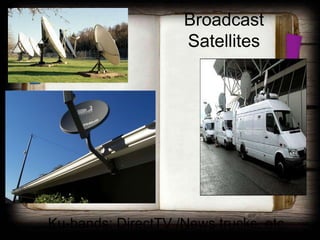
Broadcast
                    Satellites


Ku-bands: DirectTV /News trucks, etc.
History
Cable and Satellite:
         Early Years
• Late 1940s: CATV
  (Community Antenna
  Television)
• Used to bring broadcast signal
  to people in…..
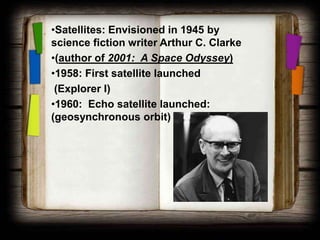
•Satellites: Envisioned in 1945 by
science fiction writer Arthur C. Clarke
•(author of 2001: A Space Odyssey)
•1958: First satellite launched
 (Explorer I)
•1960: Echo satellite launched:
(geosynchronous orbit)
• mid-1970s. Big Dish (6.5-10 feet)
  satellites appear in rural areas.

• 1994. DBS (Direct Broadcast Satellite)
  television begins. (3 feet or less)


• DirecTV (owned by News Corp.) and
  EchoStar are the main corporations.


• DirecTV merges with EchoStar, 2007--
  FCC JUST APPROVED IT BUT NOT
  QUITE DONE YET
First Communication
  Satellite Launched :

• The first communications
  satellite, on July 10, 1962,

• Telstar 1, was sent into
  orbit. Funded by American
  Telephone and Telegraph,
  ECHO 1, was launched in
  1960.
• . The first national network of
  satellite television, called Orbita
  , was created in Soviet Union in
  1967
• The first domestic North American
  satellite to carry television was
  Canada ’s geostationary Anik 1
  , which was launched in 1972
• ATS-6 , the world's first
  experimental educational and
  Direct Broadcast Satellite , was
  launched in 1974
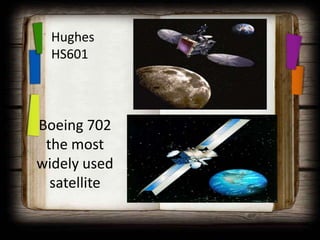
Hughes
  HS601


Boeing 702
 the most
widely used
  satellite
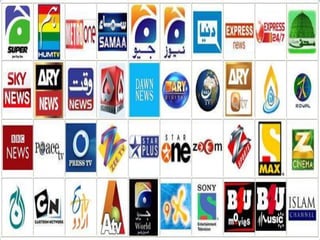
Satellite TV in Pakistan
• Ptv network
• Virtual University Educational TV
  Network
• Aaj tv network
• Ary tv network
• Eye tv
• Atv
• Geo
• Indus
• And many other regional networks
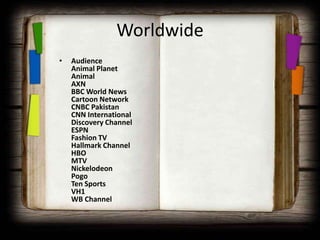
Worldwide
•   Audience
    Animal Planet
    Animal
    AXN
    BBC World News
    Cartoon Network
    CNBC Pakistan
    CNN International
    Discovery Channel
    ESPN
    Fashion TV
    Hallmark Channel
    HBO
    MTV
    Nickelodeon
    Pogo
    Ten Sports
    VH1
    WB Channel
• We are not the broadcast engineers …
• We are the broadcasters of journalism
  so we will proceed with
• Content
• Ownership
• Marketing
• News production
• Entertainment production
Content
• What to show and what could not
• As any one around the globe can
  buy and got its services any where
  so its content necessarily present a
  clear picture of its society.
• Satellite TV become a vital source
  of English language as its content
  supports this language.
Ownership
• Content is directly effected by ownership of
  the channel
• Policies about each and every which is going
  to be aired on t.v will be made
• So they determine the wide spread effects of
  satellite tv
• Investments are about Rs 2,600 million in
  satellite TV by the year 2008.
Marketing
• Who is sponsoring your program?
• What they want you to show?
• What's your preferences?
News and programming
• Mallala issue Pakistan media
• Delhi case and Indian TV
• American head of CIA scandal and
  western media
• Innocence of Muslims and world media
• Ptv home v/s ptv world
Pakistani
scenario
Pakistani ;perspective
• Satellite channels first landed in
  Pakistan in 1992
• over 50 international channels are
  available in Pakistan.
• PTV, which was expected to chart
  its own course of excellence but
  fails to do so.
• Privately owned satellite
  televisions like star and zee had
  put ptv in dock.
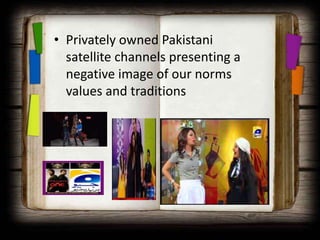
• Privately owned Pakistani
  satellite channels presenting a
  negative image of our norms
  values and traditions
• . Until that time, the only legal
  satellite TV distribution system in
  Pakistan was a pay-TV system run by
  Shaheen Pay TV Company.
• Now the system has been upgraded
  and a good number of international
  channels are available through its'
  modified MMDS Version – Sun TV .
• Geo TV in particular, has been the
  exponent of a new vision for middle
  class Pakistan in which money and
  glamour are the top agenda items
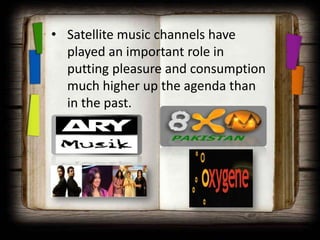
• Satellite music channels, ARY
  Music, MTV and Channel V spoiling
  the youth.
• Many middle class viewers have
  switched to GEO, ARY, Indus , BBC and
  CNN for news and current affairs, to
  Zee or Sony for entertainment, to
  Star, 10 Sports and ESPN for
  sports, and to Discovery for
  science, environment and wildlife
Yesterday
, today, tomorr
      ow
Past

• Less audience
• Less impact
• New technology
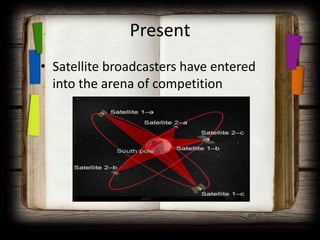
Present
• Satellite broadcasters have entered
  into the arena of competition
• International broadcasters are
  there to challenge the news aired
  by the state TV
• spontaneously providing people
  excess to live coverage of
  happenings inside and around the
  globe.
Survey
• According to the survey which rates
  countries on a sliding scale of 0 to
  100, with 0 representing the most
  free and 100 the least free, India
  scored 48, Pakistan 60, Bangladesh
  49, Sri Lanka 46, Nepal 52, Bhutan
  62 and the Maldives 68
• These channels have
  affected old social and
  cultural values, introduced
  new fusions of the world.
• Satellite music channels have
  played an important role in
  putting pleasure and consumption
  much higher up the agenda than
  in the past.
•     satellite TV through its talk shows
    has been to promote far greater
    openness about issues like human
    rights, women's rights, questions of
    choice and career, and relations with
    others.
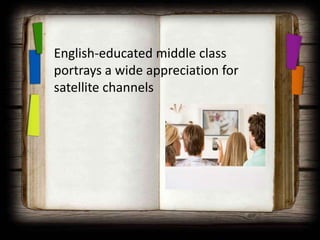
English-educated middle class
portrays a wide appreciation for
satellite channels
• Today satellite TV has been a means
  of reinforcing peoples existing
  preferences
• Afshaan , kiran
  kahani, tanhaiyan, khul ja sim sim,
• Ishq e mamnu , muhabat jay bar
  main, bulbuly,
• Ptv cnn bbc
Mtv, channel V, zee TV star plus geo
  ……so many
Final words……………………

Satellite television

  • 1.
    Topic: satellite T.V Rida munir butt Saba ijaz Misbah bahadur Kashifa zafar Aroosa tariq Students of mass communication and media studies university of Gujrat
  • 2.
    Satellite Television It’s out of sight! 22,300 miles in fact!
  • 4.
    What is satellite? Anartificial body placed in orbit around the earth or another planet in order to collect information or for communication.
  • 5.
    Satellite TV: Satellite televisionis an electronic device that is used to receive or transmit television broadcasts from a communication satellite that is orbiting in space.
  • 6.
    •Satellite TV atfirst place called direct broadcast satellite (DBS) because it bypasses closed-circuit television. it is immoveable. •On the second place TVRO satellite systems have a large dish which is movable. •Closed-circuit television is transmitted by wire to a limited number of people.
  • 7.
    •Require subscription feesand licenses. •DBS is therefore known as narrow casting, which involves sending television broadcasts only to subscribers and not to the general public. Receivers systems to pick up signals.
  • 8.
    NASA and theUSAF Space Command are tracking some 600 active satellites plus 11,000 dead satellites and pieces of orbiting debris bigger than 10 cm/6 inches
  • 9.
  • 10.
    • In orderfor a satellite to be used for television transmission, it must "hang" over one spot above the Earth. • a receiving dish that is constantly moving, in order to keep up with the transmitting satellite with the speed of earth.
  • 11.
    • Satellite TVis transmitted by microwaves. • Avoid abstractions • Survey the place • Position the dish • Satellite Feed Horn Assembly • Satellite recever
  • 12.
    A ‘downlink’ Much lessexpensive than the uplink ..
  • 14.
    The Clarke Belt •These satellites appear to be in the same position in the sky at all times. • They are directly over the equator but not directly over us. • They are in a line that starts 14 degrees above our Western Horizon. • And rises to 42 degrees elevation in the South
  • 15.
    24 Channels ona Satellite • Numbered 1 to 24 • Odd Number Channels are often Vertically Polarized... • Even Number Channels are often Horizontally Polarized. • The antenna must line up with the polarization..
  • 16.
    Broadcast Satellites Ku-bands: DirectTV /News trucks, etc.
  • 17.
  • 18.
    Cable and Satellite: Early Years • Late 1940s: CATV (Community Antenna Television) • Used to bring broadcast signal to people in…..
  • 19.
    •Satellites: Envisioned in1945 by science fiction writer Arthur C. Clarke •(author of 2001: A Space Odyssey) •1958: First satellite launched (Explorer I) •1960: Echo satellite launched: (geosynchronous orbit)
  • 20.
    • mid-1970s. BigDish (6.5-10 feet) satellites appear in rural areas. • 1994. DBS (Direct Broadcast Satellite) television begins. (3 feet or less) • DirecTV (owned by News Corp.) and EchoStar are the main corporations. • DirecTV merges with EchoStar, 2007-- FCC JUST APPROVED IT BUT NOT QUITE DONE YET
  • 21.
    First Communication Satellite Launched : • The first communications satellite, on July 10, 1962, • Telstar 1, was sent into orbit. Funded by American Telephone and Telegraph, ECHO 1, was launched in 1960.
  • 22.
    • . Thefirst national network of satellite television, called Orbita , was created in Soviet Union in 1967 • The first domestic North American satellite to carry television was Canada ’s geostationary Anik 1 , which was launched in 1972 • ATS-6 , the world's first experimental educational and Direct Broadcast Satellite , was launched in 1974
  • 23.
    Hughes HS601 Boeing702 the most widely used satellite
  • 24.
    Satellite TV inPakistan • Ptv network • Virtual University Educational TV Network • Aaj tv network • Ary tv network • Eye tv • Atv • Geo • Indus • And many other regional networks
  • 26.
    Worldwide • Audience Animal Planet Animal AXN BBC World News Cartoon Network CNBC Pakistan CNN International Discovery Channel ESPN Fashion TV Hallmark Channel HBO MTV Nickelodeon Pogo Ten Sports VH1 WB Channel
  • 28.
    • We arenot the broadcast engineers … • We are the broadcasters of journalism so we will proceed with • Content • Ownership • Marketing • News production • Entertainment production
  • 29.
    Content • What toshow and what could not • As any one around the globe can buy and got its services any where so its content necessarily present a clear picture of its society. • Satellite TV become a vital source of English language as its content supports this language.
  • 30.
    Ownership • Content isdirectly effected by ownership of the channel • Policies about each and every which is going to be aired on t.v will be made • So they determine the wide spread effects of satellite tv • Investments are about Rs 2,600 million in satellite TV by the year 2008.
  • 31.
    Marketing • Who issponsoring your program? • What they want you to show? • What's your preferences?
  • 32.
    News and programming •Mallala issue Pakistan media • Delhi case and Indian TV • American head of CIA scandal and western media • Innocence of Muslims and world media • Ptv home v/s ptv world
  • 33.
  • 34.
    Pakistani ;perspective • Satellitechannels first landed in Pakistan in 1992 • over 50 international channels are available in Pakistan. • PTV, which was expected to chart its own course of excellence but fails to do so. • Privately owned satellite televisions like star and zee had put ptv in dock.
  • 35.
    • Privately ownedPakistani satellite channels presenting a negative image of our norms values and traditions
  • 36.
    • . Untilthat time, the only legal satellite TV distribution system in Pakistan was a pay-TV system run by Shaheen Pay TV Company. • Now the system has been upgraded and a good number of international channels are available through its' modified MMDS Version – Sun TV .
  • 37.
    • Geo TVin particular, has been the exponent of a new vision for middle class Pakistan in which money and glamour are the top agenda items • Satellite music channels, ARY Music, MTV and Channel V spoiling the youth.
  • 38.
    • Many middleclass viewers have switched to GEO, ARY, Indus , BBC and CNN for news and current affairs, to Zee or Sony for entertainment, to Star, 10 Sports and ESPN for sports, and to Discovery for science, environment and wildlife
  • 39.
  • 40.
    Past • Less audience •Less impact • New technology
  • 41.
    Present • Satellite broadcastershave entered into the arena of competition
  • 42.
    • International broadcastersare there to challenge the news aired by the state TV • spontaneously providing people excess to live coverage of happenings inside and around the globe.
  • 43.
    Survey • According tothe survey which rates countries on a sliding scale of 0 to 100, with 0 representing the most free and 100 the least free, India scored 48, Pakistan 60, Bangladesh 49, Sri Lanka 46, Nepal 52, Bhutan 62 and the Maldives 68
  • 44.
    • These channelshave affected old social and cultural values, introduced new fusions of the world.
  • 45.
    • Satellite musicchannels have played an important role in putting pleasure and consumption much higher up the agenda than in the past.
  • 46.
    satellite TV through its talk shows has been to promote far greater openness about issues like human rights, women's rights, questions of choice and career, and relations with others.
  • 48.
    English-educated middle class portraysa wide appreciation for satellite channels
  • 49.
    • Today satelliteTV has been a means of reinforcing peoples existing preferences • Afshaan , kiran kahani, tanhaiyan, khul ja sim sim, • Ishq e mamnu , muhabat jay bar main, bulbuly, • Ptv cnn bbc Mtv, channel V, zee TV star plus geo ……so many
  • 51.