DSS:  Digital Satellite System TED-111-01 Steve Eckenrode
Background DSS has a lot of background information and much happened in transition to digital.  Direct TV launched its surface in 1994, through the DVB-S digital satellite system, which had not yet been standardised; the Thomson DSS was used in place of the DVB-S.
Background The Thomson DSS is functionally similar compared to DVB-S in respect to MPEG 2 video, MPEG-1 Layer II or AC3 audio, QPSK modulation, and identical error correction (Reed-Solomon coding and Viterbi forward error correction), however, the information tables and transport stream are completely different.  Plus with all DSS receivers are proprietary DirecTV reception units.
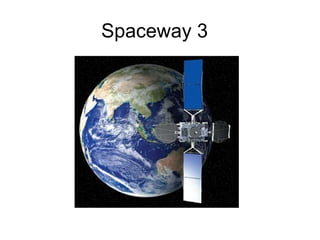
Background The HDTV services are off the SPACEWAY-1, SPACEWAY-2, DirecTV-10 and DirecTV-11 satellites, however, the transition from DSS encoded channels to HDTV isn’t entirely complete, as DSS encoded channels still remain.
Spaceway 3
Functionality The first satellite television signal to be relayed was in 1962 and it was from Europe to the Telstar satellite over North America.  In 1963, the first geosynchronous communication satellite, Syncom 2, was launched.  Nicknamed Early Bird, Intelsat I, was the world’s first commercial communication satellite and it was launched into synchronous orbit on April 6, 1965.
Functionality Generally, there are two types of positioning for satellites that are used for television:  geostationary orbit (37,000 km or 22,300 miles) above the earth’s equator or they are naturally highly elliptical (around 63.4 degrees of inclination and about 12 hour orbital period, known as Molniya orbit).
Model of Function
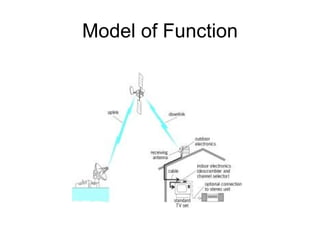
Functionality Two common frequency bands are:  C-band (4-8 GHz) or K u -band (12-18 GHz).  The downlink is the leg the signal path on the satellite being sent to the Earth station.  For Ku-band a satellite typically has up to 32 transponders and for C-band it has up to 24 transponders, however, more are found in hybrid satellites.
Functionality After traveling such a great distance the downlinked satellite signal is weak, due to inverse-square law, and is collected by a parabolic receiving dish, then is the device that reflects the signal to the feedhorn or focal point.  Essentially, the feedhorn represents a flared front-end of waveguide, which gathers the sent signals around the focal point.
Usage in Society The shift from 50 Ohm impedance cable and N-connectors from C-Band systems to 75 Ohm technology and F-connectors was focused on being more economical.  This allowed TV satellite receivers to be UHF TV tuner compatable, which was also a transition in channel selection, from down conversion to a much lower intermediate frequency set at 70 Mhz to be then demodulated.  It is this change which sparked the commercial boom of satellite television, fronted by DTH industry.
Usage in Society
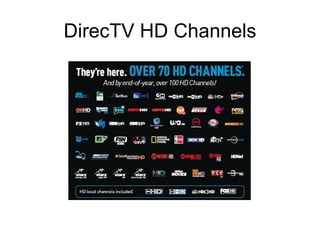
Future Outlooks Now with HDTV, DirecTV rebroadcasts local HDTV stations using the H.264/MPEG-4 AVC codec.  At the same time it has a newer transmission protocol (DVB-S2) over the newer satellites. The older MPEG-2 compression and DSS protocol that has been used made HD not vary compatable.
DirecTV HD Channels
Future Outlooks XM Satellite Radio owns three satellites in orbit:  two launched in 2001 and another later in 2005.  They’re Boeing (also once known as Hughes) 702 comsats, and were put into orbit by Sea Launch boosters.  For cities where satellite signals could be blocked by big buildings, back-up ground transmitters are to be built.
XM Radio Availability
Bibliography Digital Satellite Service . (n.d). Retrieved from http://www.bing.com/reference/semhtml/Digital_Satellite_Service?sids=2&qpvt=digital+satellite+systems&q=digital+satellite+systems Satellite Television . (n.d). Retrieved from http://www.bing.com/reference/semhtml/Satellite_television DirecTV . (n.d).  Retrieved from http://www.bing.com/reference/semhtml/DirecTV?sids=3&qpvt=digital+satellite+systems&q=digital+satellite+systems Digital Radio . (n.d). Retrieved from http://www.bing.com/reference/semhtml/Digital_radio?sids=89&qpvt=digital+satellite+systems&q=digital+satellite+systems

Dss

  • 1.
    DSS: DigitalSatellite System TED-111-01 Steve Eckenrode
  • 2.
    Background DSS hasa lot of background information and much happened in transition to digital. Direct TV launched its surface in 1994, through the DVB-S digital satellite system, which had not yet been standardised; the Thomson DSS was used in place of the DVB-S.
  • 3.
    Background The ThomsonDSS is functionally similar compared to DVB-S in respect to MPEG 2 video, MPEG-1 Layer II or AC3 audio, QPSK modulation, and identical error correction (Reed-Solomon coding and Viterbi forward error correction), however, the information tables and transport stream are completely different. Plus with all DSS receivers are proprietary DirecTV reception units.
  • 4.
    Background The HDTVservices are off the SPACEWAY-1, SPACEWAY-2, DirecTV-10 and DirecTV-11 satellites, however, the transition from DSS encoded channels to HDTV isn’t entirely complete, as DSS encoded channels still remain.
  • 5.
  • 6.
    Functionality The firstsatellite television signal to be relayed was in 1962 and it was from Europe to the Telstar satellite over North America. In 1963, the first geosynchronous communication satellite, Syncom 2, was launched. Nicknamed Early Bird, Intelsat I, was the world’s first commercial communication satellite and it was launched into synchronous orbit on April 6, 1965.
  • 7.
    Functionality Generally, thereare two types of positioning for satellites that are used for television: geostationary orbit (37,000 km or 22,300 miles) above the earth’s equator or they are naturally highly elliptical (around 63.4 degrees of inclination and about 12 hour orbital period, known as Molniya orbit).
  • 8.
  • 9.
    Functionality Two commonfrequency bands are: C-band (4-8 GHz) or K u -band (12-18 GHz). The downlink is the leg the signal path on the satellite being sent to the Earth station. For Ku-band a satellite typically has up to 32 transponders and for C-band it has up to 24 transponders, however, more are found in hybrid satellites.
  • 10.
    Functionality After travelingsuch a great distance the downlinked satellite signal is weak, due to inverse-square law, and is collected by a parabolic receiving dish, then is the device that reflects the signal to the feedhorn or focal point. Essentially, the feedhorn represents a flared front-end of waveguide, which gathers the sent signals around the focal point.
  • 11.
    Usage in SocietyThe shift from 50 Ohm impedance cable and N-connectors from C-Band systems to 75 Ohm technology and F-connectors was focused on being more economical. This allowed TV satellite receivers to be UHF TV tuner compatable, which was also a transition in channel selection, from down conversion to a much lower intermediate frequency set at 70 Mhz to be then demodulated. It is this change which sparked the commercial boom of satellite television, fronted by DTH industry.
  • 12.
  • 13.
    Future Outlooks Nowwith HDTV, DirecTV rebroadcasts local HDTV stations using the H.264/MPEG-4 AVC codec. At the same time it has a newer transmission protocol (DVB-S2) over the newer satellites. The older MPEG-2 compression and DSS protocol that has been used made HD not vary compatable.
  • 14.
  • 15.
    Future Outlooks XMSatellite Radio owns three satellites in orbit: two launched in 2001 and another later in 2005. They’re Boeing (also once known as Hughes) 702 comsats, and were put into orbit by Sea Launch boosters. For cities where satellite signals could be blocked by big buildings, back-up ground transmitters are to be built.
  • 16.
  • 17.
    Bibliography Digital SatelliteService . (n.d). Retrieved from http://www.bing.com/reference/semhtml/Digital_Satellite_Service?sids=2&qpvt=digital+satellite+systems&q=digital+satellite+systems Satellite Television . (n.d). Retrieved from http://www.bing.com/reference/semhtml/Satellite_television DirecTV . (n.d). Retrieved from http://www.bing.com/reference/semhtml/DirecTV?sids=3&qpvt=digital+satellite+systems&q=digital+satellite+systems Digital Radio . (n.d). Retrieved from http://www.bing.com/reference/semhtml/Digital_radio?sids=89&qpvt=digital+satellite+systems&q=digital+satellite+systems