GEOPHYSICAL RESEARCH LETTERS, VOL. 26, NO. 16, PAGES 2409-2412, AUGUST 15, 1999
Copyright 1999 by American Geophysical Union. Paper number 1999GL900189. 0094-8276/99/1999GL900189$05.00
Delineating Land/Forest Fire Burnt Scars with ERS
Interferometric Synthetic Aperture Radar
S. C. Liew, L. K. Kwoh, K. Padmanabhan, O. K. Lim and H. Lim
Centre for Remote Imaging, Sensing and Processing, National University of Singapore, Republic of Singapore
Abstract. Cloud-penetrating C-band synthetic aperture radar
imagery acquired during two ERS-1/2 tandem missions (April
1996 and October 1997) was used in mapping burnt areas in
South Kalimantan, Indonesia, during the 1997 Southeast Asia
forest fire episode. Vegetated areas were classified by their
low interferometric coherence in both the 1996 and 1997
imagery while the burnt areas were delineated by their
increased coherence in 1997. A total of 552 kha of land was
found to be burnt scars out of the 3.6 Mha area surveyed. The
results were validated using a multispectral SPOT image of
the area acquired in September 1997.
Introduction
In 1997, during the dry season from July to November,
fires raged out of control in the tropical forest of Sumatra and
Kalimantan, Indonesia. In addition to transboundary pollution
in the form of smoke haze, the effects of forest fires on the
environment include the loss of biodiversity, loss of forests as
carbon sinks and emission of greenhouse gases with potential
contribution to global warming [Levine, 1991, 1996; Zepp,
1994].
In order to assess the impacts of the fires to the
environment, it is important to acquire information such as the
location of fires, spatial extent of burnt areas, types of land
cover on fire and geographical distribution of fires. Satellite
remote sensing is able to provide some of the essential
information [Malingreau, 1990]. Remote sensing studies of
fires are usually carried out using optical/Infrared sensors
[Kaufman et al., 1990] such as the NOAA-AVHRR
[Robinson, 1991; Matson, 1987], LANDSAT-TM [Pereira
and Setzer, 1993] and SPOT-HRV [Liew et al., 1998]. The
AVHRR sensors on board the NOAA Polar Orbiting Satellites
are able to detect the presence of fire hot spots using channel
3 (3.8 µm) and provide images showing the spatial
distribution and temporal evolution of fire hot spots
[Robinson, 1991; Matson, 1987]. The channels 1 and 2 of the
same sensors also provide information about the aerosols
characteristics and distribution of the smoke haze [Ferrare et
al., 1990]. However, due to the coarse resolution (1.1 km) of
the AVHRR sensors, the exact locations of fires and the types
of land cover on fire cannot be determined. Measurement
from hot spot images generally overestimates the area burnt
but underestimates the total fire count [Malingreau, 1990;
Kaufman et al., 1990]. Burnt areas can be mapped with high-
resolution optical sensors such as the LANDSAT-TM (30 m)
and SPOT-HRV (20 m), using the spectral characteristics of
the fire scars. Individual smoke plumes can be observed in the
images and hence the precise locations of the active fire areas
can be determined using the high-resolution images. The
types of land cover on fire can also be determined from the
spectral and contextual features of the fire areas. One major
limitation of optical/infrared remote sensing imagery lies in
the inability of optical/infrared radiation in penetrating clouds
and thick haze.
In this paper, we report on the use of the cloud-penetrating
C-band SAR on-board the ERS-1 and ERS-2 satellites in
mapping burnt areas during the 1997 Southeast Asia forest
fire episode. SAR backscatter intensity and interferometric
coherence have been used in forest mapping and monitoring
[LeToan et al., 1996; Wegmuller and Werner, 1995; Stussi et
al., 1997]. In particular, tropical forests are known to have a
constant backscattering coefficient (σo
) between -7 and -6 dB
in C-band. The interferometric coherence of the vegetated
area is typically low compared with the clearcuts or sparsely
vegetated area. If multitemporal SAR data of an area of
interest are acquired, clearings of forests/vegetation can be
detected by an observed change in σo
and/or an increase in
coherence of the area. Unlike optical/infrared sensors, SAR is
unable to detect hot spots or smoke plumes directly associated
with fires. It is thus not able to tell whether the clearings are
due to fires or other means. However, if fires have been
known to occur in an area of interest, the extent of fire
affected areas can be mapped using SAR backscattered
intensity and interferometric coherence signatures.
Methods
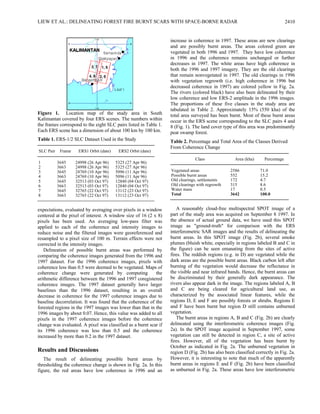
The location map of the study area covering four ERS
frames is shown in Fig. 1 and the dataset used in the study is
shown in Table 1. The study area is located in South
Kalimantan, near the town of Banjarmasin. This area is
known to be severely affected by fires from observations
using NOAA-AVHRR and SPOT imagery. The ERS data
were acquired during two tandem missions in April 1996 and
October 1997 and processed to the level of Single-Look
Complex (SLC). Altogether 8 pairs of tandem-SLC data were
used. Each pair of the SLC images were first co-registered
and the coherence (γ1,2) and intensity (I1, I2) images were
generated by,
γ1 2
1 2
1 1 2 2
, =
∗
∗ ∗
s s
s s s s
(1)
I s s kk k k= =
∗
( , )1 2 (2)
where s1, s2 are the complex pixel values of the two
coregistered SLC images and the brackets denote statistical
LIEW ET AL.: DELINEATING FOREST FIRE BURNT SCARS WITH SPACE-BORNE RADAR 2410
Figure 1. Location map of the study area in South
Kalimantan covered by four ERS scenes. The numbers within
the frames correspond to the eight SLC pairs listed in Table 1.
Each ERS scene has a dimension of about 100 km by 100 km.
Table 1. ERS-1/2 SLC Dataset Used in the Study
SLC Pair Frame ERS1 Orbit (date) ERS2 Orbit (date)
1 3645 24998 (26 Apr 96) 5325 (27 Apr 96)
2 3663 24998 (26 Apr 96) 5325 (27 Apr 96)
3 3645 24769 (10 Apr 96) 5096 (11 Apr 96)
4 3663 24769 (10 Apr 96) 5096 (11 Apr 96)
5 3645 32513 (03 Oct 97) 12840 (04 Oct 97)
6 3663 32513 (03 Oct 97) 12840 (04 Oct 97)
7 3645 32765 (22 Oct 97) 13112 (23 Oct 97)
8 3663 32765 (22 Oct 97) 13112 (23 Oct 97)
expectations, evaluated by averaging over pixels in a window
centered at the pixel of interest. A window size of 16 (2 x 8)
pixels has been used. An averaging low-pass filter was
applied to each of the coherence and intensity images to
reduce noise and the filtered images were georeferenced and
resampled to a pixel size of 100 m. Terrain effects were not
corrected in the intensity images.
Delineation of possible burnt areas was performed by
comparing the coherence images generated from the 1996 and
1997 dataset. For the 1996 coherence images, pixels with
coherence less than 0.5 were deemed to be vegetated. Maps of
coherence change were generated by computing the
arithmetic difference between the 1996 and 1997 coregistered
coherence images. The 1997 dataset generally have larger
baselines than the 1996 dataset, resulting in an overall
decrease in coherence for the 1997 coherence images due to
baseline decorrelation. It was found that the coherence of the
forested regions in the 1997 images was lower than that in the
1996 images by about 0.07. Hence, this value was added to all
pixels in the 1997 coherence images before the coherence
change was evaluated. A pixel was classified as a burnt scar if
its 1996 coherence was less than 0.5 and the coherence
increased by more than 0.2 in the 1997 dataset.
Results and Discussions
The result of delineating possible burnt areas by
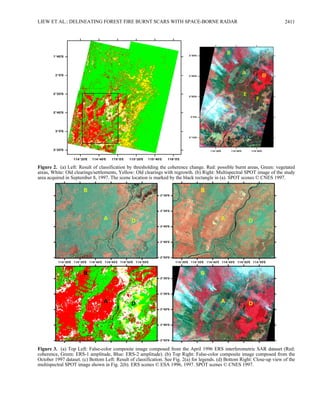
thresholding the coherence change is shown in Fig. 2a. In this
figure, the red areas have low coherence in 1996 and an
increase in coherence in 1997. These areas are new clearings
and are possibly burnt areas. The areas colored green are
vegetated in both 1996 and 1997. They have low coherence
in 1996 and the coherence remains unchanged or further
decreases in 1997. The white areas have high coherence in
both the 1996 and 1997 imagery. They are the old clearings
that remain nonvegetated in 1997. The old clearings in 1996
with vegetation regrowth (i.e. high coherence in 1996 but
decreased coherence in 1997) are colored yellow in Fig. 2a.
The rivers (colored black) have also been delineated by their
low coherence and low ERS-2 amplitude in the 1996 images.
The proportions of these five classes in the study area are
tabulated in Table 2. Approximately 15% (550 kha) of the
total area surveyed has been burnt. Most of these burnt areas
occur in the ERS scene corresponding to the SLC pairs 4 and
8 (Fig. 1). The land cover type of this area was predominantly
peat swamp forest.
Table 2. Percentage and Total Area of the Classes Derived
From Coherence Change
Class Area (kha) Percentage
Vegetated areas 2586 71.0
Possible burnt areas 552 15.2
Old clearings, settlements 172 4.7
Old clearings with regrowth 315 8.6
Water mass 17 0.5
Total 3642 100.0
A reasonably cloud-free multispectral SPOT image of a
part of the study area was acquired on September 8 1997. In
the absence of actual ground data, we have used this SPOT
image as "ground-truth" for comparison with the ERS
interferometric SAR images and the results of delineating the
burnt areas. In this SPOT image (Fig. 2b), several smoke
plumes (bluish white, especially in regions labeled B and C in
the figure) can be seen emanating from the sites of active
fires. The reddish regions (e.g. in D) are vegetated while the
dark areas are the possible burnt areas. Black carbon left after
burning of the vegetation would decrease the reflectance in
the visible and near infrared bands. Hence, the burnt areas can
be discriminated by their generally dark appearance. The
rivers also appear dark in the image. The regions labeled A, B
and C are being cleared for agricultural land use, as
characterized by the associated linear features, while the
regions D, E and F are possibly forests or shrubs. Regions E
and F have been burnt but region D still contains unburned
vegetation.
The burnt areas in regions A, B and C (Fig. 2b) are clearly
delineated using the interferometric coherence images (Fig.
2a). In the SPOT image acquired in September 1997, some
vegetation can still be detected in region C, a site of active
fires. However, all of the vegetation has been burnt by
October as indicated in Fig. 2a. The unburned vegetation in
region D (Fig. 2b) has also been classified correctly in Fig. 2a.
However, it is interesting to note that much of the apparently
burnt areas in regions E and F (Fig. 2b) have been classified
as unburned in Fig. 2a. These areas have low interferometric
LIEW ET AL.: DELINEATING FOREST FIRE BURNT SCARS WITH SPACE-BORNE RADAR 2411
Figure 2. (a) Left: Result of classification by thresholding the coherence change. Red: possible burnt areas, Green: vegetated
areas, White: Old clearings/settlements, Yellow: Old clearings with regrowth. (b) Right: Multispectral SPOT image of the study
area acquired in September 8, 1997. The scene location is marked by the black rectangle in (a). SPOT scenes © CNES 1997.
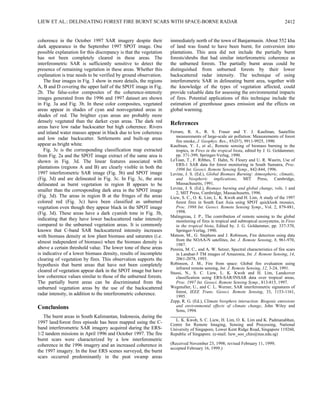
Figure 3. (a) Top Left: False-color composite image composed from the April 1996 ERS interferometric SAR dataset (Red:
coherence, Green: ERS-1 amplitude, Blue: ERS-2 amplitude). (b) Top Right: False-color composite image composed from the
October 1997 dataset. (c) Bottom Left: Result of classification. See Fig. 2(a) for legends. (d) Bottom Right: Close-up view of the
multispectral SPOT image shown in Fig. 2(b). ERS scenes © ESA 1996, 1997. SPOT scenes © CNES 1997.
LIEW ET AL.: DELINEATING FOREST FIRE BURNT SCARS WITH SPACE-BORNE RADAR 2412
coherence in the October 1997 SAR imagery despite their
dark appearance in the September 1997 SPOT image. One
possible explanation for this discrepancy is that the vegetation
has not been completely cleared in these areas. The
interferometric SAR is sufficiently sensitive to detect the
presence of remaining vegetation in these areas. Whether this
explanation is true needs to be verified by ground observation.
The four images in Fig. 3 show in more details, the regions
A, B and D covering the upper half of the SPOT image in Fig.
2b. The false-color composites of the coherence-intensity
images generated from the 1996 and 1997 dataset are shown
in Fig. 3a and Fig. 3b. In these color composites, vegetated
areas appear in shades of cyan and nonvegetated areas in
shades of red. The brighter cyan areas are probably more
densely vegetated than the darker cyan areas. The dark red
areas have low radar backscatter but high coherence. Rivers
and inland water masses appear in black due to low coherence
and low radar backscatter. Settlements and built-up areas
appear as bright white.
Fig. 3c is the corresponding classification map extracted
from Fig. 2a and the SPOT image extract of the same area is
shown in Fig. 3d. The linear features associated with
plantations (regions A and B) are clearly visible in both the
1997 interferometric SAR image (Fig. 3b) and SPOT image
(Fig. 3d) and are delineated in Fig. 3c. In Fig. 3c, the area
delineated as burnt vegetation in region B appears to be
smaller than the corresponding dark area in the SPOT image
(Fig. 3d). The areas in region B at the fringes of the areas
colored red (Fig. 3c) have been classified as unburned
vegetation even though they appear black in the SPOT image
(Fig. 3d). These areas have a dark cyanish tone in Fig. 3b,
indicating that they have lower backscattered radar intensity
compared to the unburned vegetation areas. It is commonly
known that C-band SAR backscattered intensity increases
with biomass density at low plant biomass and saturates (i.e.
almost independent of biomass) when the biomass density is
above a certain threshold value. The lower tone of these areas
is indicative of a lower biomass density, results of incomplete
clearing of vegetation by fires. This observation supports the
hypothesis that burnt areas that have not been completely
cleared of vegetation appear dark in the SPOT image but have
low coherence values similar to those of the unburned forests.
The partially burnt areas can be discriminated from the
unburned vegetation areas by the use of the backscattered
radar intensity, in addition to the interferometric coherence.
Conclusions
The burnt areas in South Kalimantan, Indonesia, during the
1997 land/forest fires episode has been mapped using the C-
band interferometric SAR imagery acquired during the ERS-
1/2 tandem missions in April 1996 and October 1997. The fire
burnt scars were characterized by a low interferometric
coherence in the 1996 imagery and an increased coherence in
the 1997 imagery. In the four ERS scenes surveyed, the burnt
scars occurred predominantly in the peat swamp areas
immediately north of the town of Banjarmasin. About 552 kha
of land was found to have been burnt, for conversion into
plantations. This area did not include the partially burnt
forests/shrubs that had similar interferometric coherence as
the unburned forests. The partially burnt areas could be
distinguished from unburned forests by their lower
backscattered radar intensity. The technique of using
interferometric SAR in delineating burnt area, together with
the knowledge of the types of vegetation affected, could
provide valuable data for assessing the environmental impacts
of fires. Potential applications of this technique include the
estimation of greenhouse gases emission and the effects on
global warming.
References
Ferrare, R. A., R. S. Fraser and Y. J. Kaufman, Saatellite
measurements of large-scale air pollution: Measurements of forest
fire smoke, J. Geophys. Res., 95(D7), 9911-9925, 1990.
Kaufman, Y. J., et al., Remote sensing of biomass burning in the
tropics, in Fires in the tropical biota, edited by J. G. Goldammer,
pp. 371-399, Springer-Verlag, 1990.
LeToan, T., F. Ribbes, T. Hahn, N. Floury and U. R. Wasrin, Use of
ERS-1 SAR data for forest monitoring in South Sumatra, Proc.
1996 Int. Geosci. Remote Sensing Symp., 842-844, 1996.
Levine, J. S. (Ed.), Global Biomass Burning: Atmospheric, climatic,
and biospheric implications, MIT Press, Cambridge,
Massachusetts, 1991.
Levine, J. S. (Ed.), Biomass burning and global change, vols. 1 and
2, MIT Press, Cambridge, Massachusetts, 1996.
Liew, S. C., O. K. Lim, L. K. Kwoh and H. Lim, A study of the 1997
forest fires in South East Asia using SPOT quicklook mosaics,
Proc. 1998 Int. Geosci. Remote Sensing Symp., Vol. 2, 879-881,
1998.
Malingreau, J. P., The contribution of remote sensing to the global
monitoring of fires in tropical and subtropical ecosystems, in Fires
in the tropical biota, Edited by. J. G. Goldammer, pp. 337-370,
Springer-Verlag, 1990.
Matson, M., G. Stephens and J. Robinson, Fire detection using data
from the NOAA-N satellites, Int. J. Remote Sensing, 8, 961-970,
1987.
Pereira, M. C., and A. W. Setzer, Spectral characteristics of fire scars
in Landsat-5 TM images of Amazonia, Int. J. Remote Sensing, 14,
2061-2078, 1993.
Robinson, J. M., Fire from space: Global fire evaluation using
infrared remote sensing, Int. J. Remote Sensing, 12, 3-24, 1991.
Stussi, N., S. C. Liew, L. K. Kwoh and H. Lim, Landcover
classification using ERS-SAR/INSAR data over tropical areas,
Proc. 1997 Int. Geosci. Remote Sensing Symp., 813-815, 1997.
Wegmuller, U., and C. L. Werner, SAR interferometric signatures of
forest, IEEE Trans. Geosci. Remote Sensing, 33, 1153-1161,
1995.
Zepp, R. G. (Ed.), Climate biosphere interaction: Biogenic emissions
and environmental effects of climate change, John Wiley and
Sons, 1994.
L. K. Kwoh, S. C. Liew, H. Lim, O. K. Lim and K. Padmanabhan,
Centre for Remote Imaging, Sensing and Processing, National
University of Singapore, Lower Kent Ridge Road, Singapore 119260,
Republic of Singapore. (e-mail: liew_soo_chin@nus.edu.sg)
(Received November 23, 1998; revised February 11, 1999;
accepted February 16, 1999.)

GRL99

  • 1.
    GEOPHYSICAL RESEARCH LETTERS,VOL. 26, NO. 16, PAGES 2409-2412, AUGUST 15, 1999 Copyright 1999 by American Geophysical Union. Paper number 1999GL900189. 0094-8276/99/1999GL900189$05.00 Delineating Land/Forest Fire Burnt Scars with ERS Interferometric Synthetic Aperture Radar S. C. Liew, L. K. Kwoh, K. Padmanabhan, O. K. Lim and H. Lim Centre for Remote Imaging, Sensing and Processing, National University of Singapore, Republic of Singapore Abstract. Cloud-penetrating C-band synthetic aperture radar imagery acquired during two ERS-1/2 tandem missions (April 1996 and October 1997) was used in mapping burnt areas in South Kalimantan, Indonesia, during the 1997 Southeast Asia forest fire episode. Vegetated areas were classified by their low interferometric coherence in both the 1996 and 1997 imagery while the burnt areas were delineated by their increased coherence in 1997. A total of 552 kha of land was found to be burnt scars out of the 3.6 Mha area surveyed. The results were validated using a multispectral SPOT image of the area acquired in September 1997. Introduction In 1997, during the dry season from July to November, fires raged out of control in the tropical forest of Sumatra and Kalimantan, Indonesia. In addition to transboundary pollution in the form of smoke haze, the effects of forest fires on the environment include the loss of biodiversity, loss of forests as carbon sinks and emission of greenhouse gases with potential contribution to global warming [Levine, 1991, 1996; Zepp, 1994]. In order to assess the impacts of the fires to the environment, it is important to acquire information such as the location of fires, spatial extent of burnt areas, types of land cover on fire and geographical distribution of fires. Satellite remote sensing is able to provide some of the essential information [Malingreau, 1990]. Remote sensing studies of fires are usually carried out using optical/Infrared sensors [Kaufman et al., 1990] such as the NOAA-AVHRR [Robinson, 1991; Matson, 1987], LANDSAT-TM [Pereira and Setzer, 1993] and SPOT-HRV [Liew et al., 1998]. The AVHRR sensors on board the NOAA Polar Orbiting Satellites are able to detect the presence of fire hot spots using channel 3 (3.8 µm) and provide images showing the spatial distribution and temporal evolution of fire hot spots [Robinson, 1991; Matson, 1987]. The channels 1 and 2 of the same sensors also provide information about the aerosols characteristics and distribution of the smoke haze [Ferrare et al., 1990]. However, due to the coarse resolution (1.1 km) of the AVHRR sensors, the exact locations of fires and the types of land cover on fire cannot be determined. Measurement from hot spot images generally overestimates the area burnt but underestimates the total fire count [Malingreau, 1990; Kaufman et al., 1990]. Burnt areas can be mapped with high- resolution optical sensors such as the LANDSAT-TM (30 m) and SPOT-HRV (20 m), using the spectral characteristics of the fire scars. Individual smoke plumes can be observed in the images and hence the precise locations of the active fire areas can be determined using the high-resolution images. The types of land cover on fire can also be determined from the spectral and contextual features of the fire areas. One major limitation of optical/infrared remote sensing imagery lies in the inability of optical/infrared radiation in penetrating clouds and thick haze. In this paper, we report on the use of the cloud-penetrating C-band SAR on-board the ERS-1 and ERS-2 satellites in mapping burnt areas during the 1997 Southeast Asia forest fire episode. SAR backscatter intensity and interferometric coherence have been used in forest mapping and monitoring [LeToan et al., 1996; Wegmuller and Werner, 1995; Stussi et al., 1997]. In particular, tropical forests are known to have a constant backscattering coefficient (σo ) between -7 and -6 dB in C-band. The interferometric coherence of the vegetated area is typically low compared with the clearcuts or sparsely vegetated area. If multitemporal SAR data of an area of interest are acquired, clearings of forests/vegetation can be detected by an observed change in σo and/or an increase in coherence of the area. Unlike optical/infrared sensors, SAR is unable to detect hot spots or smoke plumes directly associated with fires. It is thus not able to tell whether the clearings are due to fires or other means. However, if fires have been known to occur in an area of interest, the extent of fire affected areas can be mapped using SAR backscattered intensity and interferometric coherence signatures. Methods The location map of the study area covering four ERS frames is shown in Fig. 1 and the dataset used in the study is shown in Table 1. The study area is located in South Kalimantan, near the town of Banjarmasin. This area is known to be severely affected by fires from observations using NOAA-AVHRR and SPOT imagery. The ERS data were acquired during two tandem missions in April 1996 and October 1997 and processed to the level of Single-Look Complex (SLC). Altogether 8 pairs of tandem-SLC data were used. Each pair of the SLC images were first co-registered and the coherence (γ1,2) and intensity (I1, I2) images were generated by, γ1 2 1 2 1 1 2 2 , = ∗ ∗ ∗ s s s s s s (1) I s s kk k k= = ∗ ( , )1 2 (2) where s1, s2 are the complex pixel values of the two coregistered SLC images and the brackets denote statistical
  • 2.
    LIEW ET AL.:DELINEATING FOREST FIRE BURNT SCARS WITH SPACE-BORNE RADAR 2410 Figure 1. Location map of the study area in South Kalimantan covered by four ERS scenes. The numbers within the frames correspond to the eight SLC pairs listed in Table 1. Each ERS scene has a dimension of about 100 km by 100 km. Table 1. ERS-1/2 SLC Dataset Used in the Study SLC Pair Frame ERS1 Orbit (date) ERS2 Orbit (date) 1 3645 24998 (26 Apr 96) 5325 (27 Apr 96) 2 3663 24998 (26 Apr 96) 5325 (27 Apr 96) 3 3645 24769 (10 Apr 96) 5096 (11 Apr 96) 4 3663 24769 (10 Apr 96) 5096 (11 Apr 96) 5 3645 32513 (03 Oct 97) 12840 (04 Oct 97) 6 3663 32513 (03 Oct 97) 12840 (04 Oct 97) 7 3645 32765 (22 Oct 97) 13112 (23 Oct 97) 8 3663 32765 (22 Oct 97) 13112 (23 Oct 97) expectations, evaluated by averaging over pixels in a window centered at the pixel of interest. A window size of 16 (2 x 8) pixels has been used. An averaging low-pass filter was applied to each of the coherence and intensity images to reduce noise and the filtered images were georeferenced and resampled to a pixel size of 100 m. Terrain effects were not corrected in the intensity images. Delineation of possible burnt areas was performed by comparing the coherence images generated from the 1996 and 1997 dataset. For the 1996 coherence images, pixels with coherence less than 0.5 were deemed to be vegetated. Maps of coherence change were generated by computing the arithmetic difference between the 1996 and 1997 coregistered coherence images. The 1997 dataset generally have larger baselines than the 1996 dataset, resulting in an overall decrease in coherence for the 1997 coherence images due to baseline decorrelation. It was found that the coherence of the forested regions in the 1997 images was lower than that in the 1996 images by about 0.07. Hence, this value was added to all pixels in the 1997 coherence images before the coherence change was evaluated. A pixel was classified as a burnt scar if its 1996 coherence was less than 0.5 and the coherence increased by more than 0.2 in the 1997 dataset. Results and Discussions The result of delineating possible burnt areas by thresholding the coherence change is shown in Fig. 2a. In this figure, the red areas have low coherence in 1996 and an increase in coherence in 1997. These areas are new clearings and are possibly burnt areas. The areas colored green are vegetated in both 1996 and 1997. They have low coherence in 1996 and the coherence remains unchanged or further decreases in 1997. The white areas have high coherence in both the 1996 and 1997 imagery. They are the old clearings that remain nonvegetated in 1997. The old clearings in 1996 with vegetation regrowth (i.e. high coherence in 1996 but decreased coherence in 1997) are colored yellow in Fig. 2a. The rivers (colored black) have also been delineated by their low coherence and low ERS-2 amplitude in the 1996 images. The proportions of these five classes in the study area are tabulated in Table 2. Approximately 15% (550 kha) of the total area surveyed has been burnt. Most of these burnt areas occur in the ERS scene corresponding to the SLC pairs 4 and 8 (Fig. 1). The land cover type of this area was predominantly peat swamp forest. Table 2. Percentage and Total Area of the Classes Derived From Coherence Change Class Area (kha) Percentage Vegetated areas 2586 71.0 Possible burnt areas 552 15.2 Old clearings, settlements 172 4.7 Old clearings with regrowth 315 8.6 Water mass 17 0.5 Total 3642 100.0 A reasonably cloud-free multispectral SPOT image of a part of the study area was acquired on September 8 1997. In the absence of actual ground data, we have used this SPOT image as "ground-truth" for comparison with the ERS interferometric SAR images and the results of delineating the burnt areas. In this SPOT image (Fig. 2b), several smoke plumes (bluish white, especially in regions labeled B and C in the figure) can be seen emanating from the sites of active fires. The reddish regions (e.g. in D) are vegetated while the dark areas are the possible burnt areas. Black carbon left after burning of the vegetation would decrease the reflectance in the visible and near infrared bands. Hence, the burnt areas can be discriminated by their generally dark appearance. The rivers also appear dark in the image. The regions labeled A, B and C are being cleared for agricultural land use, as characterized by the associated linear features, while the regions D, E and F are possibly forests or shrubs. Regions E and F have been burnt but region D still contains unburned vegetation. The burnt areas in regions A, B and C (Fig. 2b) are clearly delineated using the interferometric coherence images (Fig. 2a). In the SPOT image acquired in September 1997, some vegetation can still be detected in region C, a site of active fires. However, all of the vegetation has been burnt by October as indicated in Fig. 2a. The unburned vegetation in region D (Fig. 2b) has also been classified correctly in Fig. 2a. However, it is interesting to note that much of the apparently burnt areas in regions E and F (Fig. 2b) have been classified as unburned in Fig. 2a. These areas have low interferometric
  • 3.
    LIEW ET AL.:DELINEATING FOREST FIRE BURNT SCARS WITH SPACE-BORNE RADAR 2411 Figure 2. (a) Left: Result of classification by thresholding the coherence change. Red: possible burnt areas, Green: vegetated areas, White: Old clearings/settlements, Yellow: Old clearings with regrowth. (b) Right: Multispectral SPOT image of the study area acquired in September 8, 1997. The scene location is marked by the black rectangle in (a). SPOT scenes © CNES 1997. Figure 3. (a) Top Left: False-color composite image composed from the April 1996 ERS interferometric SAR dataset (Red: coherence, Green: ERS-1 amplitude, Blue: ERS-2 amplitude). (b) Top Right: False-color composite image composed from the October 1997 dataset. (c) Bottom Left: Result of classification. See Fig. 2(a) for legends. (d) Bottom Right: Close-up view of the multispectral SPOT image shown in Fig. 2(b). ERS scenes © ESA 1996, 1997. SPOT scenes © CNES 1997.
  • 4.
    LIEW ET AL.:DELINEATING FOREST FIRE BURNT SCARS WITH SPACE-BORNE RADAR 2412 coherence in the October 1997 SAR imagery despite their dark appearance in the September 1997 SPOT image. One possible explanation for this discrepancy is that the vegetation has not been completely cleared in these areas. The interferometric SAR is sufficiently sensitive to detect the presence of remaining vegetation in these areas. Whether this explanation is true needs to be verified by ground observation. The four images in Fig. 3 show in more details, the regions A, B and D covering the upper half of the SPOT image in Fig. 2b. The false-color composites of the coherence-intensity images generated from the 1996 and 1997 dataset are shown in Fig. 3a and Fig. 3b. In these color composites, vegetated areas appear in shades of cyan and nonvegetated areas in shades of red. The brighter cyan areas are probably more densely vegetated than the darker cyan areas. The dark red areas have low radar backscatter but high coherence. Rivers and inland water masses appear in black due to low coherence and low radar backscatter. Settlements and built-up areas appear as bright white. Fig. 3c is the corresponding classification map extracted from Fig. 2a and the SPOT image extract of the same area is shown in Fig. 3d. The linear features associated with plantations (regions A and B) are clearly visible in both the 1997 interferometric SAR image (Fig. 3b) and SPOT image (Fig. 3d) and are delineated in Fig. 3c. In Fig. 3c, the area delineated as burnt vegetation in region B appears to be smaller than the corresponding dark area in the SPOT image (Fig. 3d). The areas in region B at the fringes of the areas colored red (Fig. 3c) have been classified as unburned vegetation even though they appear black in the SPOT image (Fig. 3d). These areas have a dark cyanish tone in Fig. 3b, indicating that they have lower backscattered radar intensity compared to the unburned vegetation areas. It is commonly known that C-band SAR backscattered intensity increases with biomass density at low plant biomass and saturates (i.e. almost independent of biomass) when the biomass density is above a certain threshold value. The lower tone of these areas is indicative of a lower biomass density, results of incomplete clearing of vegetation by fires. This observation supports the hypothesis that burnt areas that have not been completely cleared of vegetation appear dark in the SPOT image but have low coherence values similar to those of the unburned forests. The partially burnt areas can be discriminated from the unburned vegetation areas by the use of the backscattered radar intensity, in addition to the interferometric coherence. Conclusions The burnt areas in South Kalimantan, Indonesia, during the 1997 land/forest fires episode has been mapped using the C- band interferometric SAR imagery acquired during the ERS- 1/2 tandem missions in April 1996 and October 1997. The fire burnt scars were characterized by a low interferometric coherence in the 1996 imagery and an increased coherence in the 1997 imagery. In the four ERS scenes surveyed, the burnt scars occurred predominantly in the peat swamp areas immediately north of the town of Banjarmasin. About 552 kha of land was found to have been burnt, for conversion into plantations. This area did not include the partially burnt forests/shrubs that had similar interferometric coherence as the unburned forests. The partially burnt areas could be distinguished from unburned forests by their lower backscattered radar intensity. The technique of using interferometric SAR in delineating burnt area, together with the knowledge of the types of vegetation affected, could provide valuable data for assessing the environmental impacts of fires. Potential applications of this technique include the estimation of greenhouse gases emission and the effects on global warming. References Ferrare, R. A., R. S. Fraser and Y. J. Kaufman, Saatellite measurements of large-scale air pollution: Measurements of forest fire smoke, J. Geophys. Res., 95(D7), 9911-9925, 1990. Kaufman, Y. J., et al., Remote sensing of biomass burning in the tropics, in Fires in the tropical biota, edited by J. G. Goldammer, pp. 371-399, Springer-Verlag, 1990. LeToan, T., F. Ribbes, T. Hahn, N. Floury and U. R. Wasrin, Use of ERS-1 SAR data for forest monitoring in South Sumatra, Proc. 1996 Int. Geosci. Remote Sensing Symp., 842-844, 1996. Levine, J. S. (Ed.), Global Biomass Burning: Atmospheric, climatic, and biospheric implications, MIT Press, Cambridge, Massachusetts, 1991. Levine, J. S. (Ed.), Biomass burning and global change, vols. 1 and 2, MIT Press, Cambridge, Massachusetts, 1996. Liew, S. C., O. K. Lim, L. K. Kwoh and H. Lim, A study of the 1997 forest fires in South East Asia using SPOT quicklook mosaics, Proc. 1998 Int. Geosci. Remote Sensing Symp., Vol. 2, 879-881, 1998. Malingreau, J. P., The contribution of remote sensing to the global monitoring of fires in tropical and subtropical ecosystems, in Fires in the tropical biota, Edited by. J. G. Goldammer, pp. 337-370, Springer-Verlag, 1990. Matson, M., G. Stephens and J. Robinson, Fire detection using data from the NOAA-N satellites, Int. J. Remote Sensing, 8, 961-970, 1987. Pereira, M. C., and A. W. Setzer, Spectral characteristics of fire scars in Landsat-5 TM images of Amazonia, Int. J. Remote Sensing, 14, 2061-2078, 1993. Robinson, J. M., Fire from space: Global fire evaluation using infrared remote sensing, Int. J. Remote Sensing, 12, 3-24, 1991. Stussi, N., S. C. Liew, L. K. Kwoh and H. Lim, Landcover classification using ERS-SAR/INSAR data over tropical areas, Proc. 1997 Int. Geosci. Remote Sensing Symp., 813-815, 1997. Wegmuller, U., and C. L. Werner, SAR interferometric signatures of forest, IEEE Trans. Geosci. Remote Sensing, 33, 1153-1161, 1995. Zepp, R. G. (Ed.), Climate biosphere interaction: Biogenic emissions and environmental effects of climate change, John Wiley and Sons, 1994. L. K. Kwoh, S. C. Liew, H. Lim, O. K. Lim and K. Padmanabhan, Centre for Remote Imaging, Sensing and Processing, National University of Singapore, Lower Kent Ridge Road, Singapore 119260, Republic of Singapore. (e-mail: liew_soo_chin@nus.edu.sg) (Received November 23, 1998; revised February 11, 1999; accepted February 16, 1999.)