Training
Rajesh Sharma
Extending
Warehouse
Management
Training
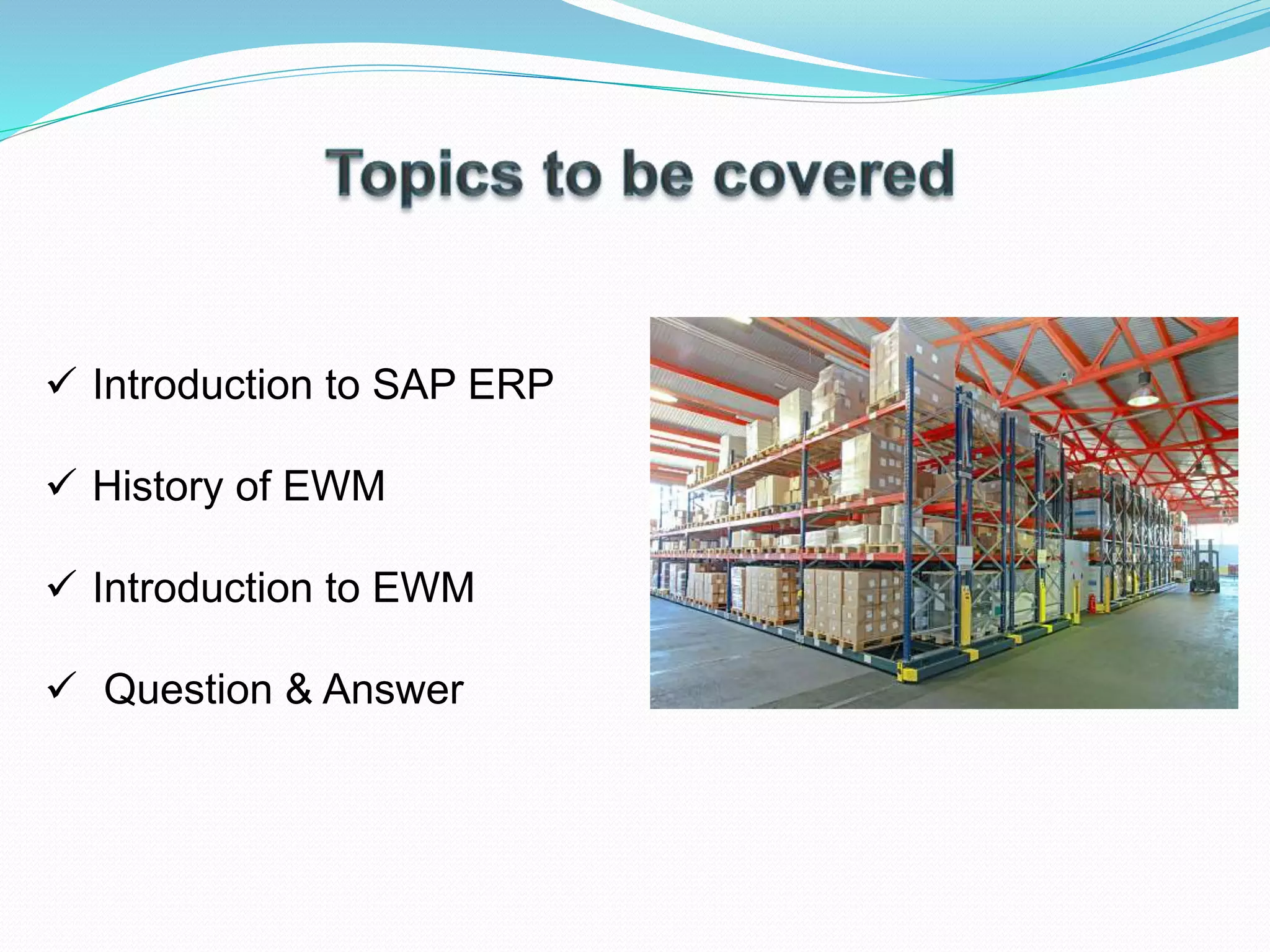
яГ╝ Introduction to SAP ERP
яГ╝ History of EWM
яГ╝ Introduction to EWM
яГ╝ Question & Answer
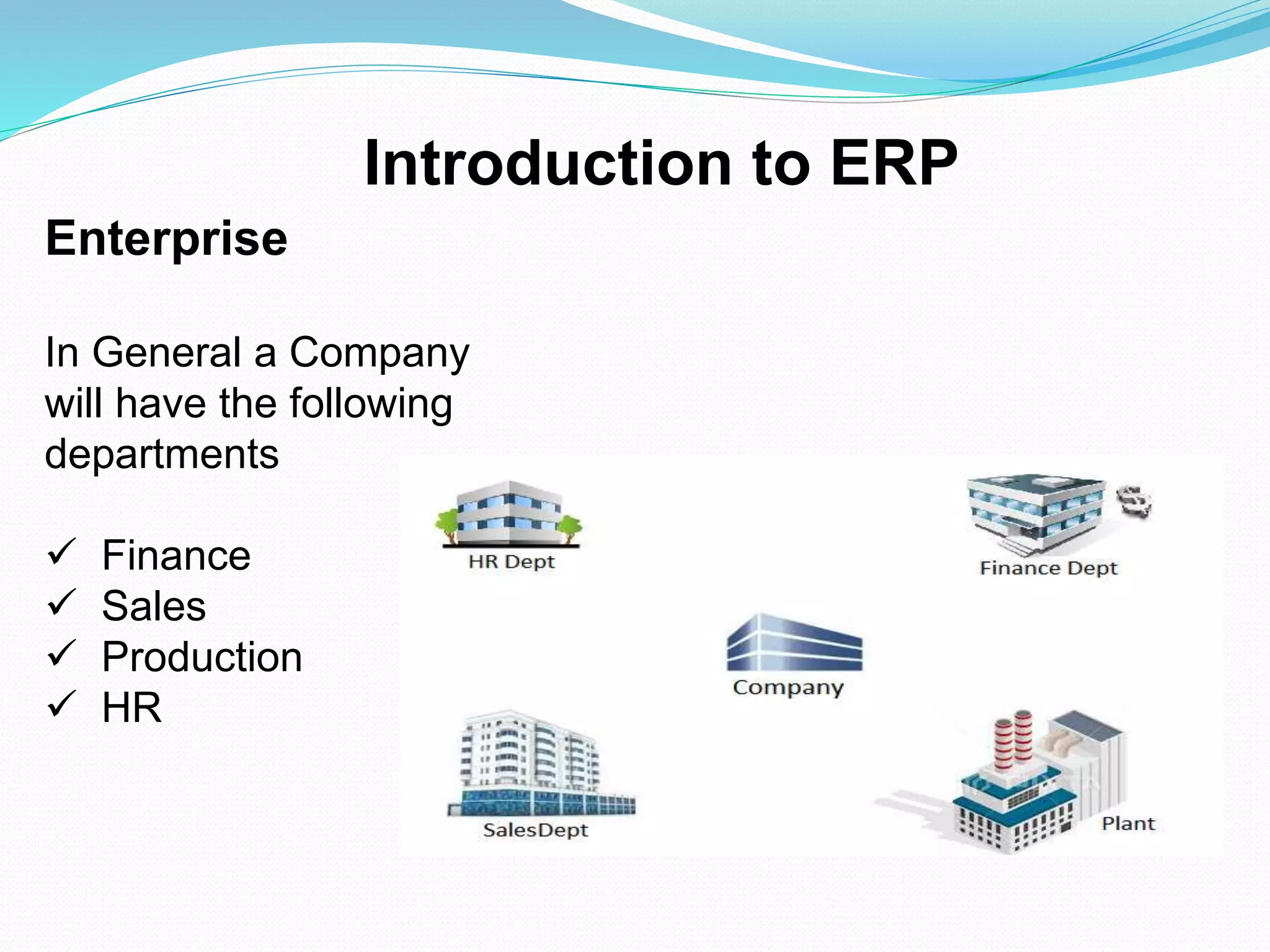
Enterprise
In General a Company
will have the following
departments
яГ╝ Finance
яГ╝ Sales
яГ╝ Production
яГ╝ HR
Introduction to ERP
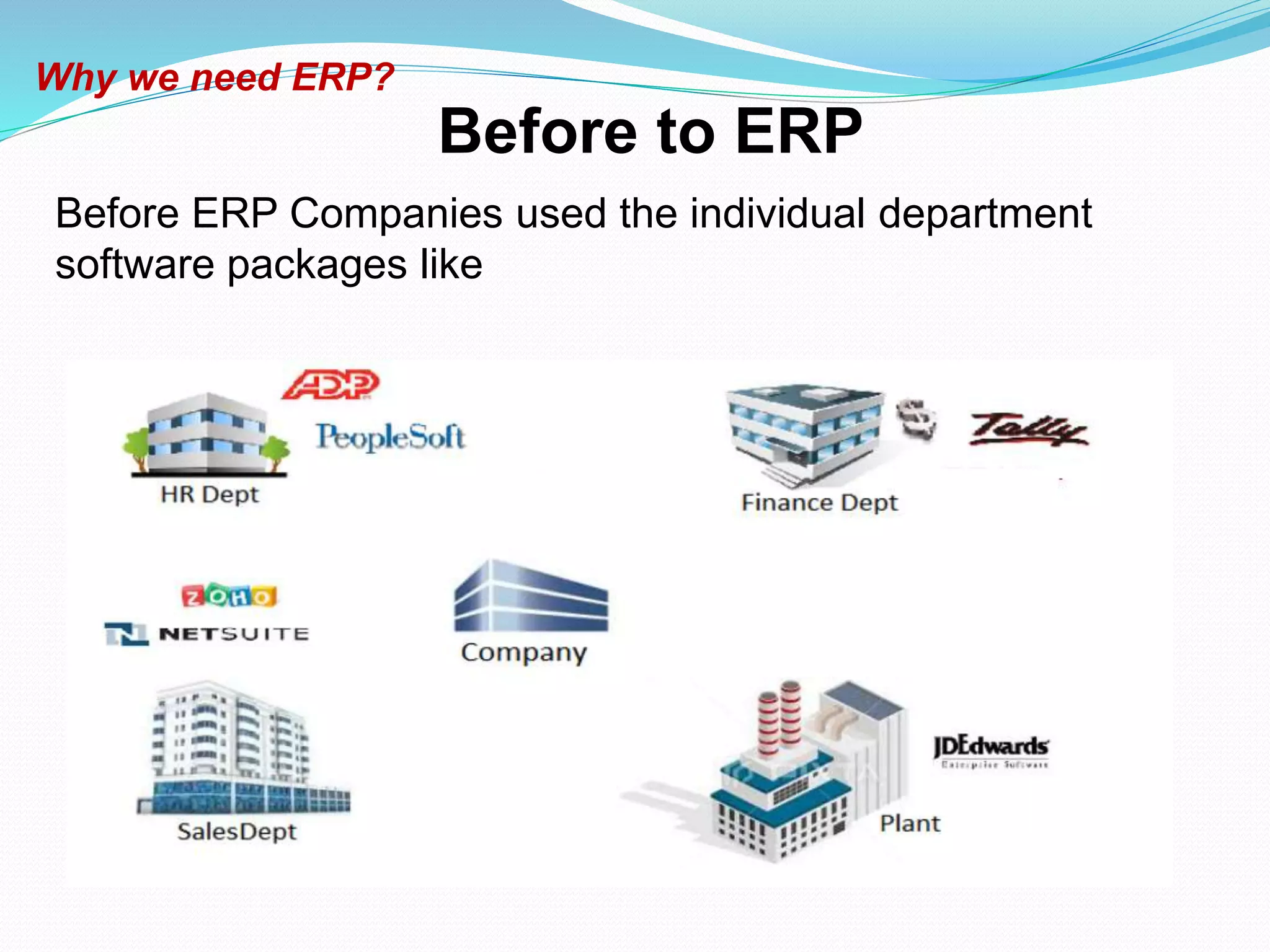
Before ERP Companies used the individual department
software packages like
Before to ERP
Why we need ERP?
Before ERP Companies used the individual department software
packages like;
яВз Finance
тАв Accounting Package (Talley, quick book)
яВз Production
тАв JD Edwards, Ariba
яВз Sales
тАв Netsuite, Zoho CRM
яВз HR
тАв CSB, Staff files, ADO HCM
тАв Pay roll package
тАв Time management package
тАв Travel package
Before to ERP
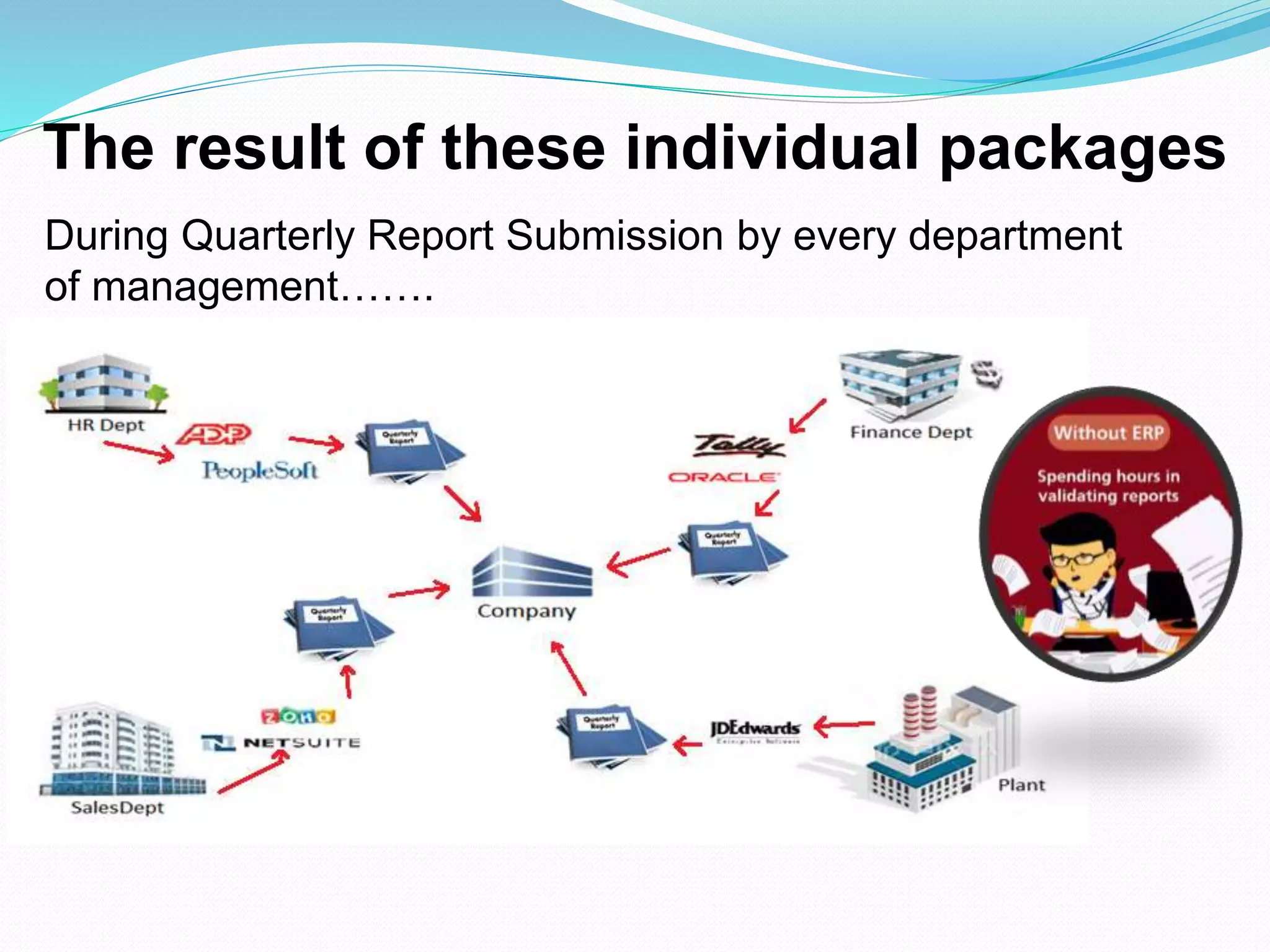
The result of these individual packages
During Quarterly Report Submission by every department
of managementтАжтАж.
The result of these individual packages
яВз It leads to many problems like
яВз Non tallying of facts and figures
яВз No integration and updating between departments
яВз There by decision making is not accurate
What Industry needs?
яВз Data Accuracy
яВз Instant availability
Data accuracy
яВз Decision will be based on accuracy of data
яВз If data is not accurate decision will be wrongтАж
яВз So all the CEO and other decision makers of
the company needs
тАв Accurate data
тАв Instant availability
яВз It is possible only based on ERP
packages
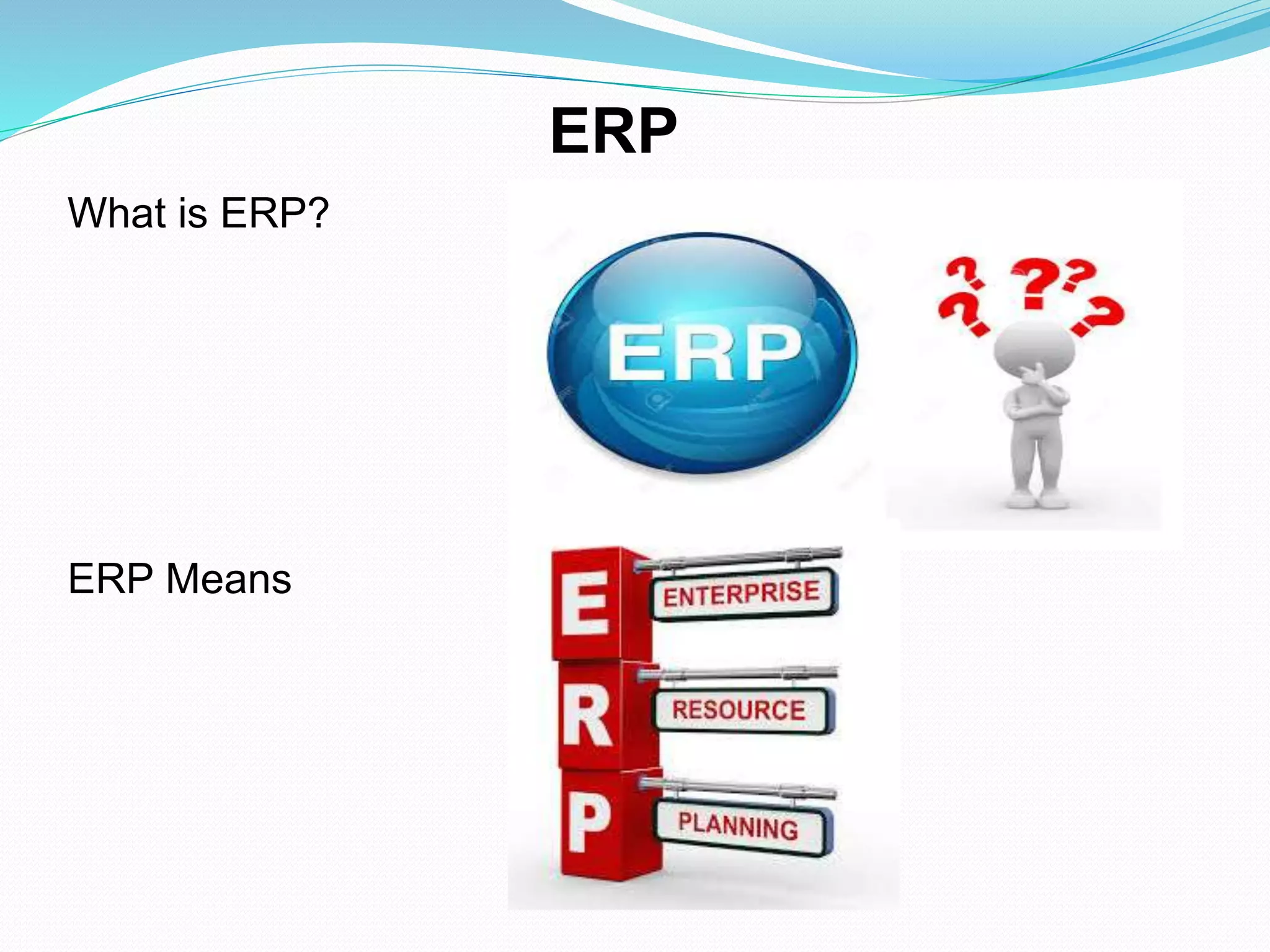
ERP
What is ERP?
ERP Means
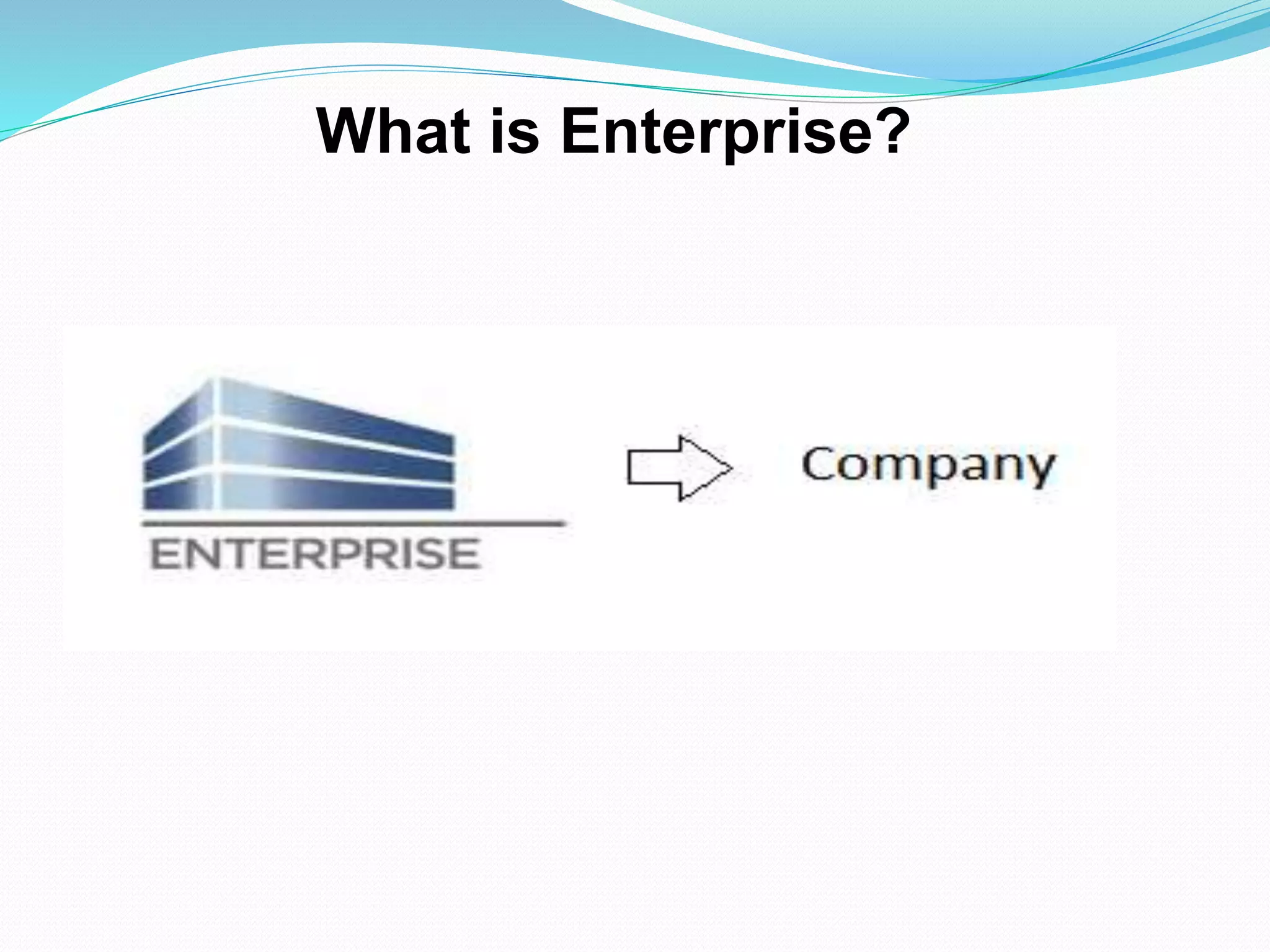
What is Enterprise?
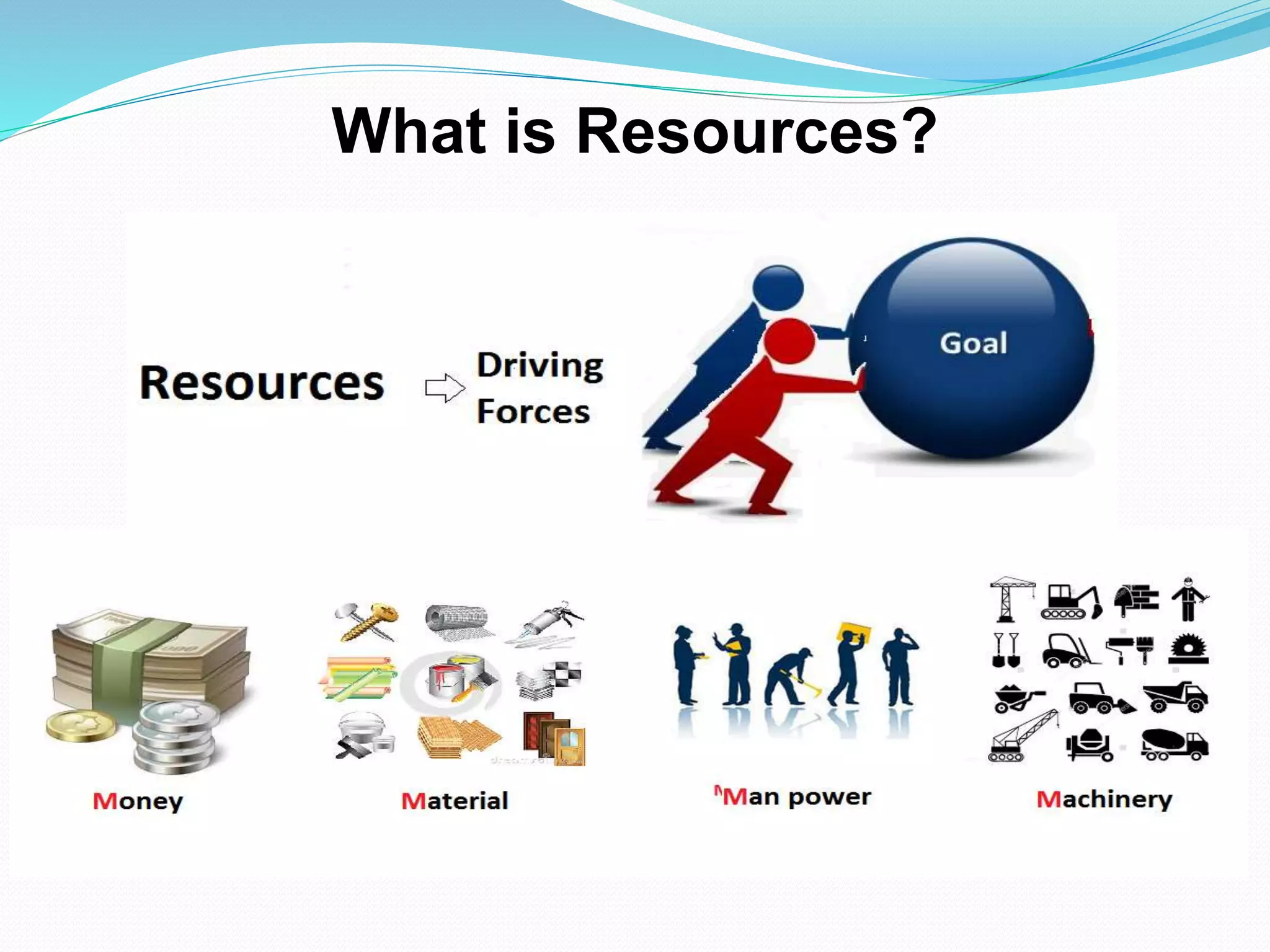
What is Resources?
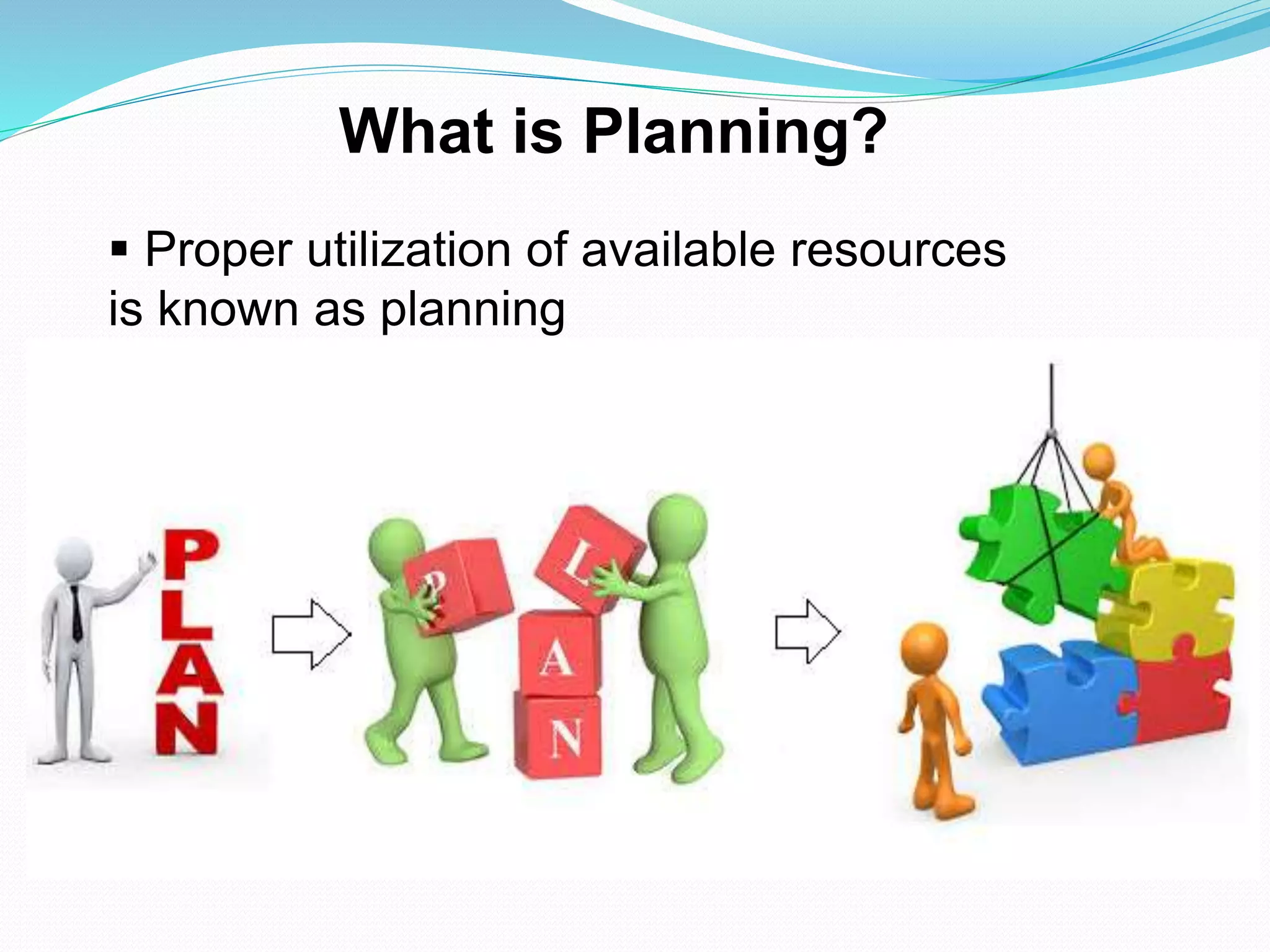
What is Planning?
яВз Proper utilization of available resources
is known as planning
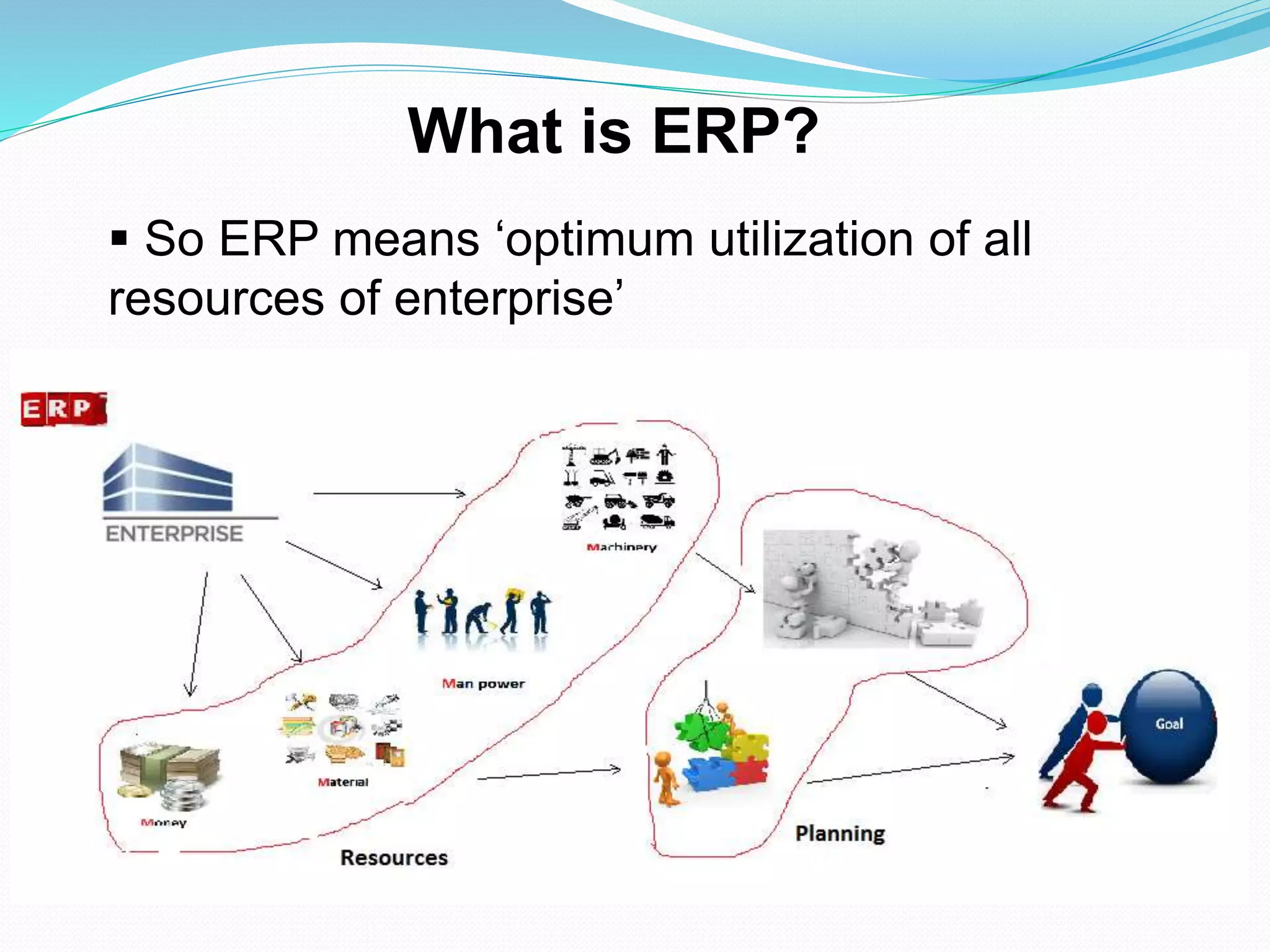
What is ERP?
яВз So ERP means тАШoptimum utilization of all
resources of enterpriseтАЩ
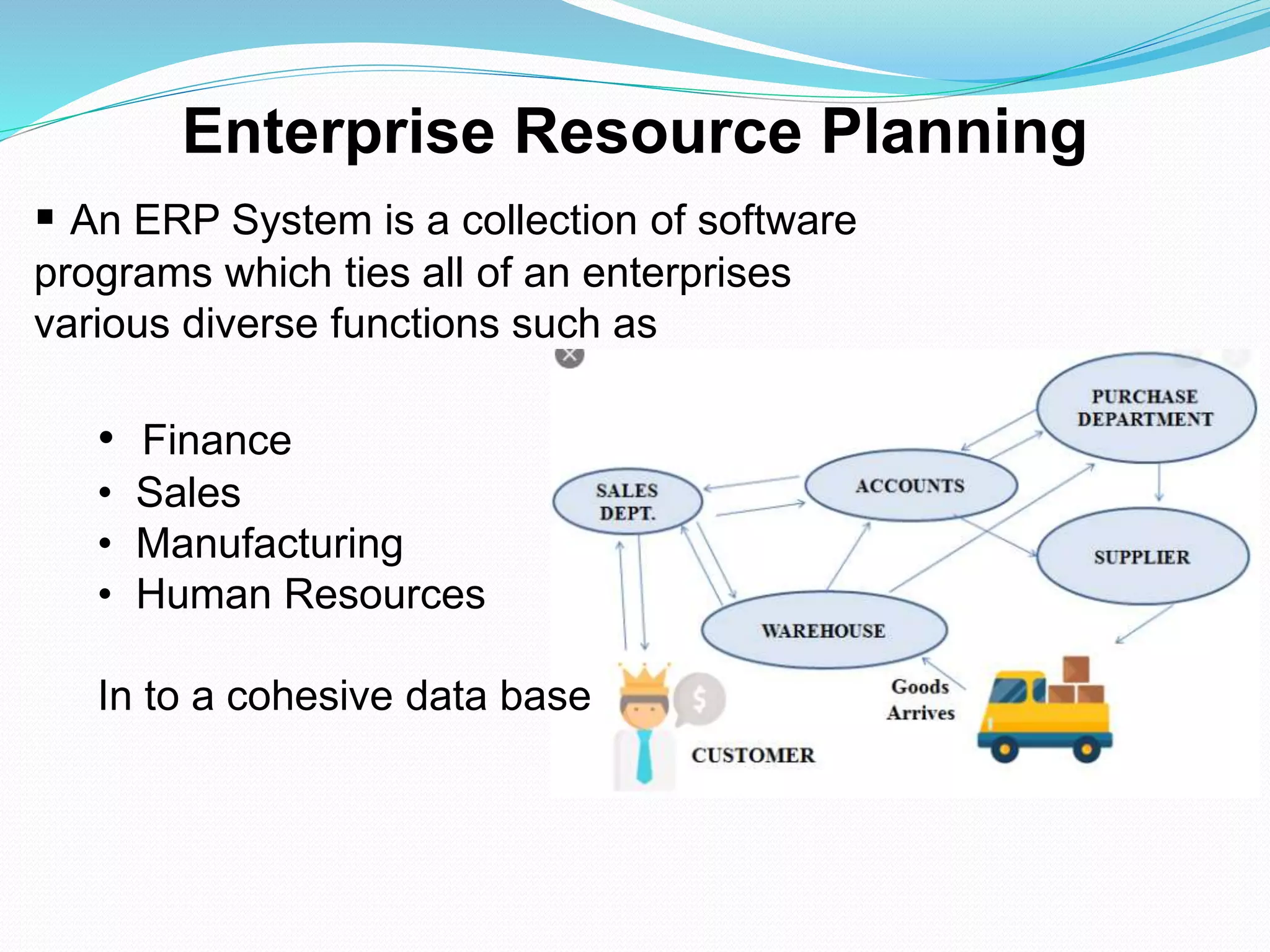
яВз An ERP System is a collection of software
programs which ties all of an enterprises
various diverse functions such as
тАв Finance
тАв Sales
тАв Manufacturing
тАв Human Resources
In to a cohesive data base
Enterprise Resource Planning
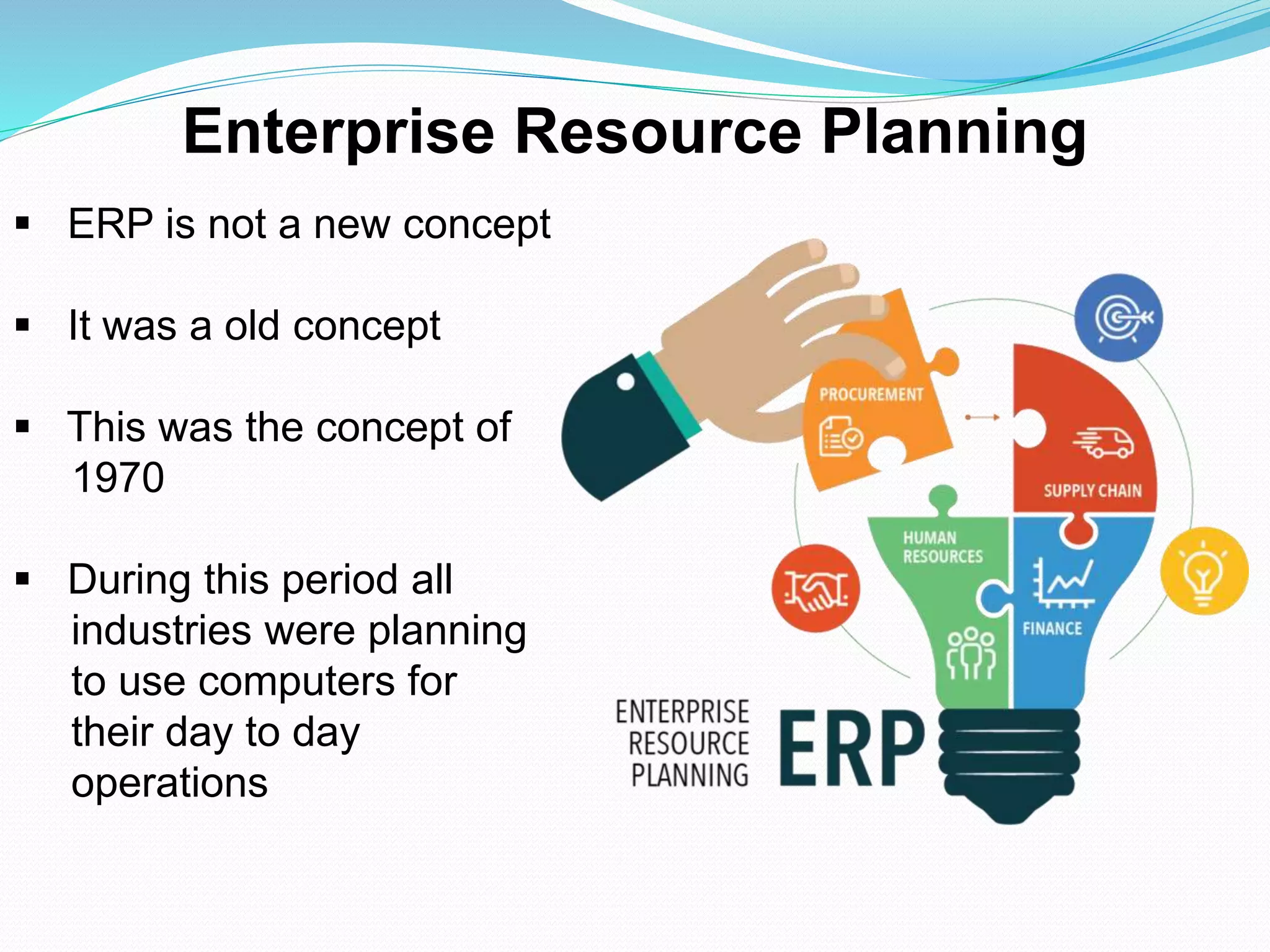
яВз ERP is not a new concept
яВз It was a old concept
яВз This was the concept of
1970
яВз During this period all
industries were planning
to use computers for
their day to day
operations
Enterprise Resource Planning
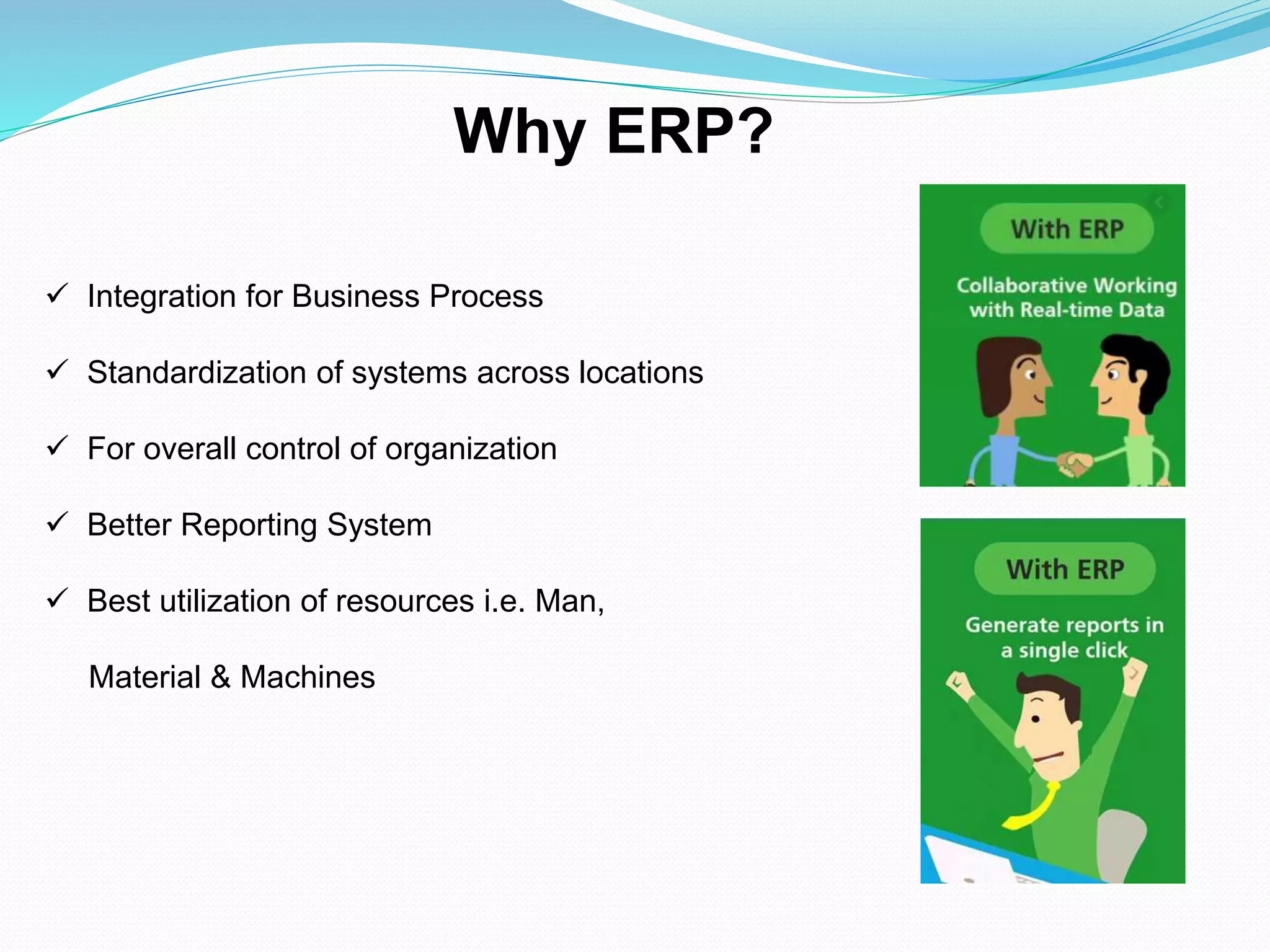
яГ╝ Integration for Business Process
яГ╝ Standardization of systems across locations
яГ╝ For overall control of organization
яГ╝ Better Reporting System
яГ╝ Best utilization of resources i.e. Man,
Material & Machines
Why ERP?
яВз Oracle тАУ Financial
яВз People soft тАУ HR
яВз Siebel тАУ CRM
яВз JD edwards тАУ Production
яВз Baan тАУ Production
яВз SAP
Famous ERP providers
яВз SAP is an ERP package
яВз SAP stands for
тАв S тАУ System
тАв A тАУ Applications
тАв P тАУ Product in Data Processing
What is SAP?
яВз Founded in Germany by five former IBM
Engineer in 1972
1. Dietmar Hopp
2. Hans-Werner Hector
3. Hasso Plattner
4. Klaus Tschira
5. Claus Wellenereuther
яВз In 1988, SAP went public and became a
joint stock company SAP AG
History of SAP?
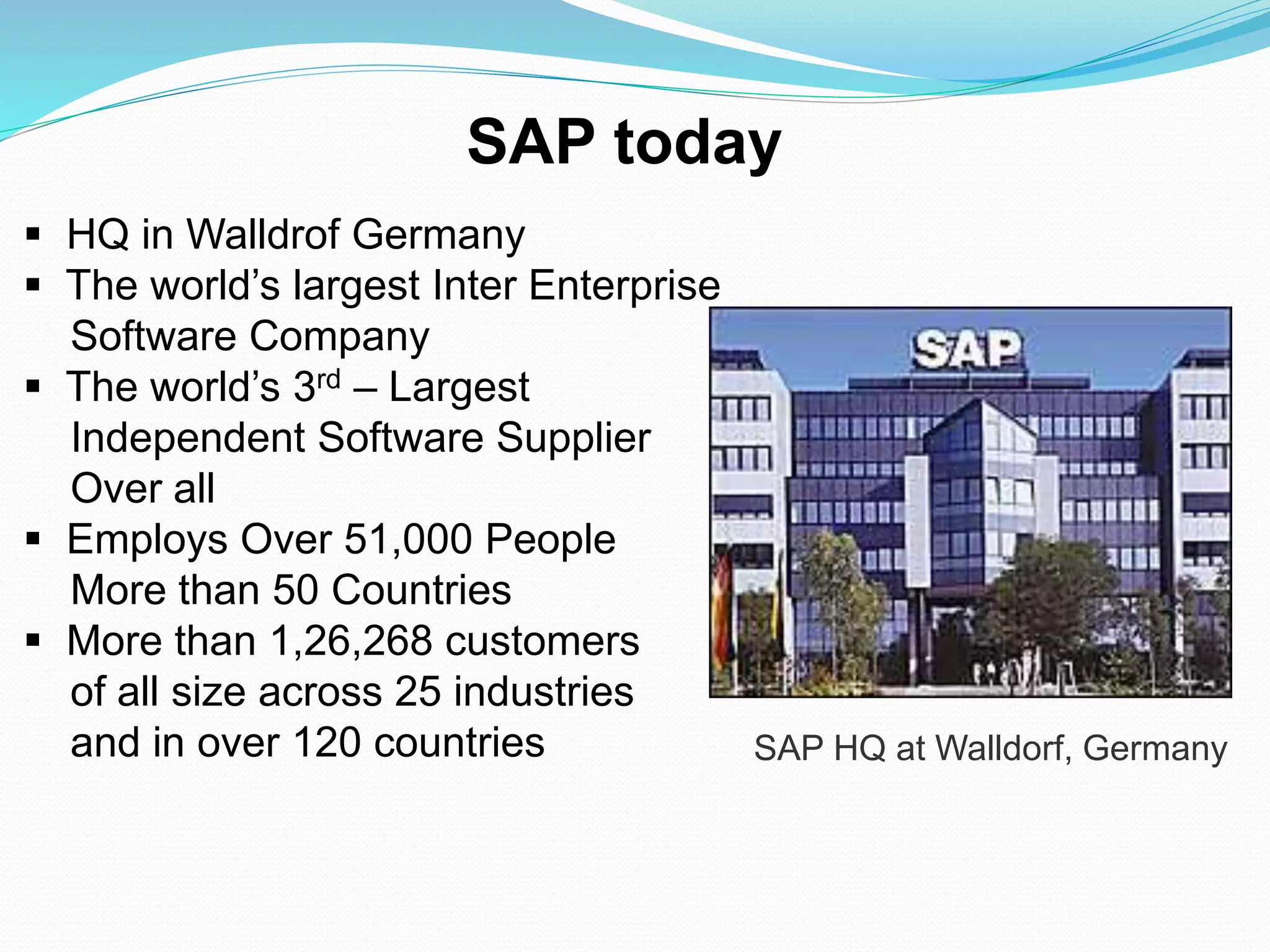
яВз HQ in Walldrof Germany
яВз The worldтАЩs largest Inter Enterprise
Software Company
яВз The worldтАЩs 3rd тАУ Largest
Independent Software Supplier
Over all
яВз Employs Over 51,000 People
More than 50 Countries
яВз More than 1,26,268 customers
of all size across 25 industries
and in over 120 countries
SAP today
SAP HQ at Walldorf, Germany
яВз 1972 : SAP AG founded in Germany
яВз 1979 : SAP R/2 introduced for mainframe computers
яВз 1992 : SAP R/3 released as client server application
яВз 1996 : SAP R/3 became partially internet enabled
яВз 1997 : Developed and launched the new dimension
product line including CRM. SCM. And Data
warehousing solution
яВз 1999 : SAP announced my SAP.com, the next generation of its
enterprise application system on internet architecture
яВз 2000- 2005 : Introduced my business suite, Net Weaver, and
XI Applications
History of SAP time line
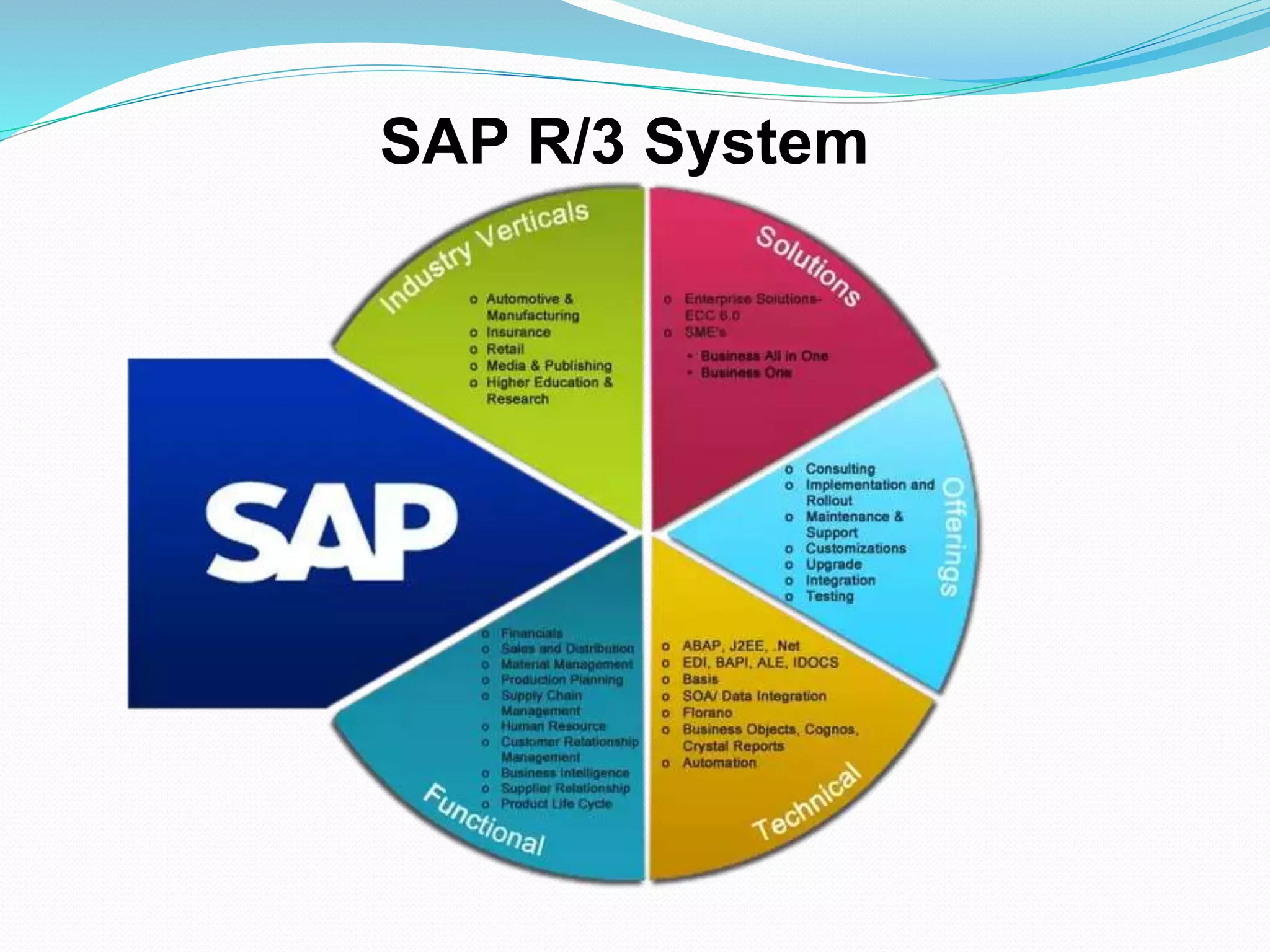
яГ╝ R тАУ Real time data processing
яГ╝ 3 тАУ Tires
1) Data base layer
2) Application layer
3) Presentation layer
SAP R/3 System
SAP R/3 System
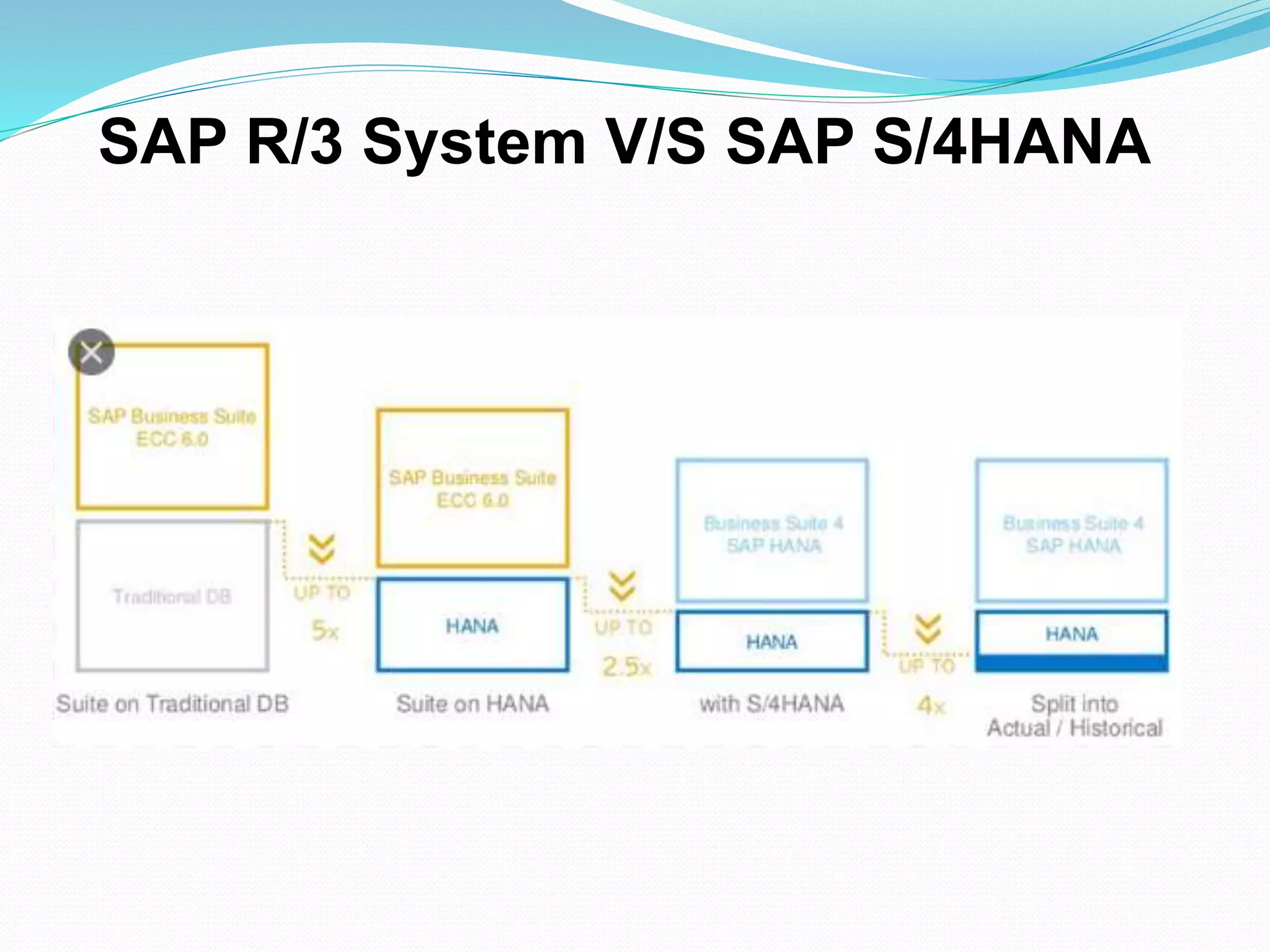
яГ╝ In feb2015 launched SAP S/4HANA SAPтАЩs next-generation ERP solution
яГ╝ SAP S/4HANA is a new Enterprise Resource Planning Solution with simplified
data, a simple tool design, agile, easier to use, perform complex calculations, and
greater amounts of data.
яГ╝ It can deployed on-premise, on-cloud, or as a hybrid system.
яГ╝ SAP HANA is an in-memory database technology which acts as the core
technology for lot of other SAP and Non-SAP applications.
яГ╝ SAP S/4HANA is a new generation ERP solution which run on SAP HANA
database architecture.
SAP R/3 System V/S SAP S/4HANA
яГ╝ SAP EWM is a part of SAP AGтАЩs Supply Chain Management Suite of Solution
яГ╝ The Extended Warehouse Management is an integrated software platform for
flexible, automated support for processing goods movements and for managing
inventory in the warehouse.
яГ╝ SAP EWM is similar to Warehouse Management
яГ╝ EWM is more flexible in building objects, like warehouse structure, picking,
put-away, handling unit management, Radio Frequency and more,
яГ╝ Activity area, work centers, resources, are the elements incorporated in EWM
SAP Extended Warehouse Management
History of EWM
EWM Overview
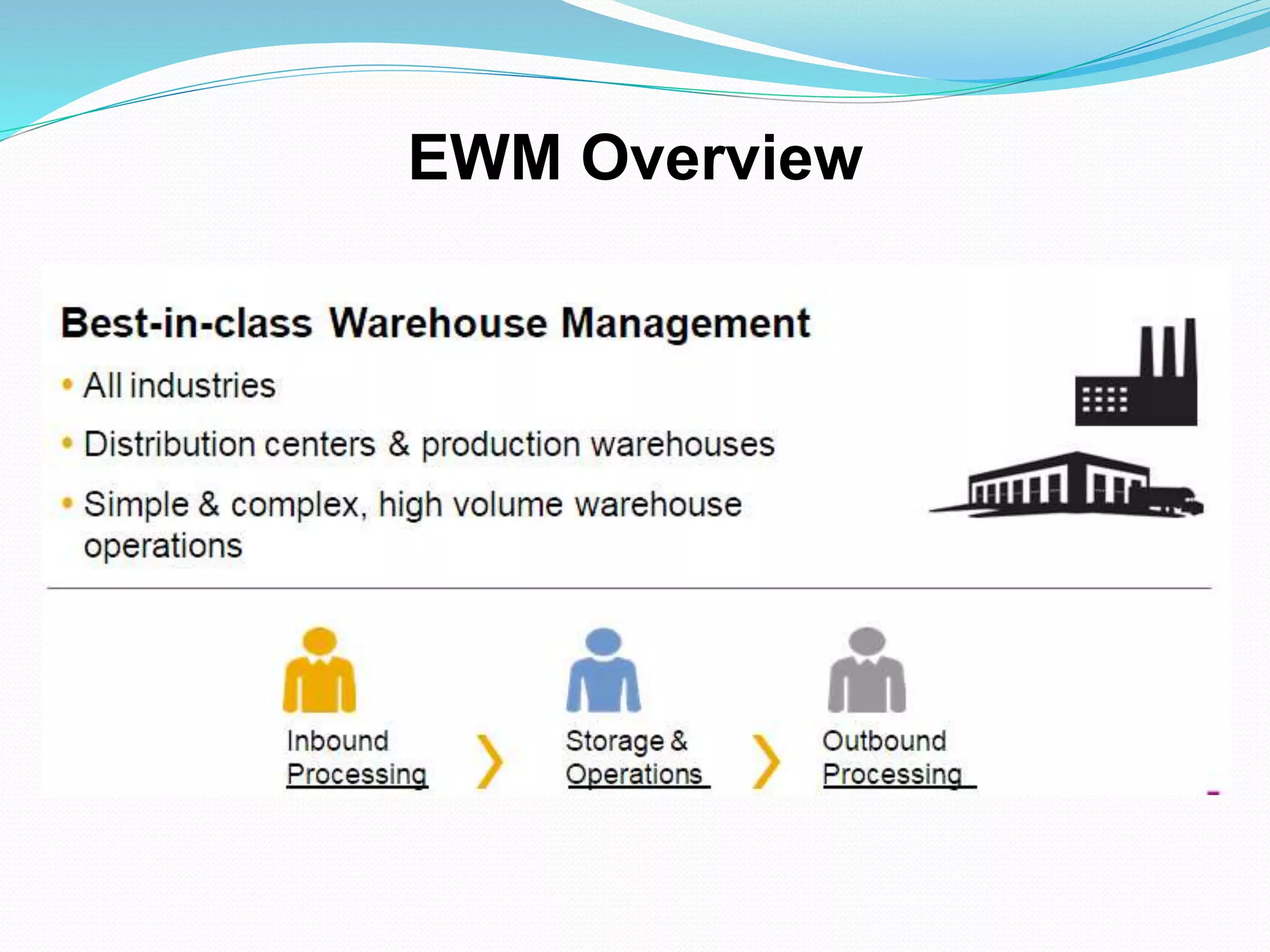
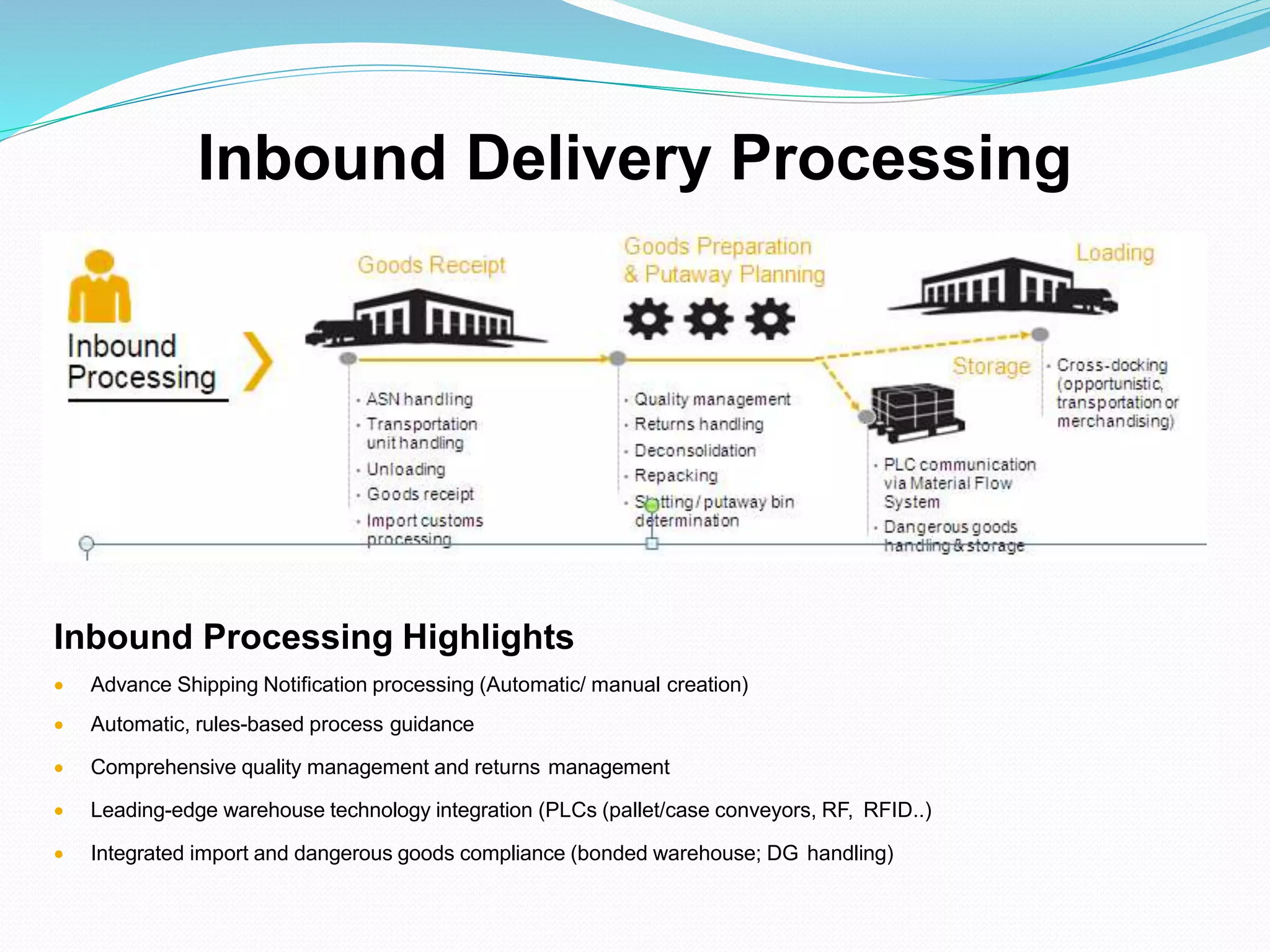
Inbound Processing Highlights
яВ╖ Advance Shipping Notification processing (Automatic/ manual creation)
яВ╖ Automatic, rules-based process guidance
яВ╖ Comprehensive quality management and returns management
яВ╖ Leading-edge warehouse technology integration (PLCs (pallet/case conveyors, RF, RFID..)
яВ╖ Integrated import and dangerous goods compliance (bonded warehouse; DG handling)
Inbound Delivery Processing
Storage
Outbound Processing Highlights
яВ╖ Wave, labor & cartonization optimization
яВ╖ Full native technology support (mobile radio frequency, pick-by-voice, RFID)
яВ╖ Material Flow System for direct PLC and conveyor system communication
яВ╖ Transportation process integration
яВ╖ Comprehensive warehouse performance analytics & operations monitoring
Outbound Processing
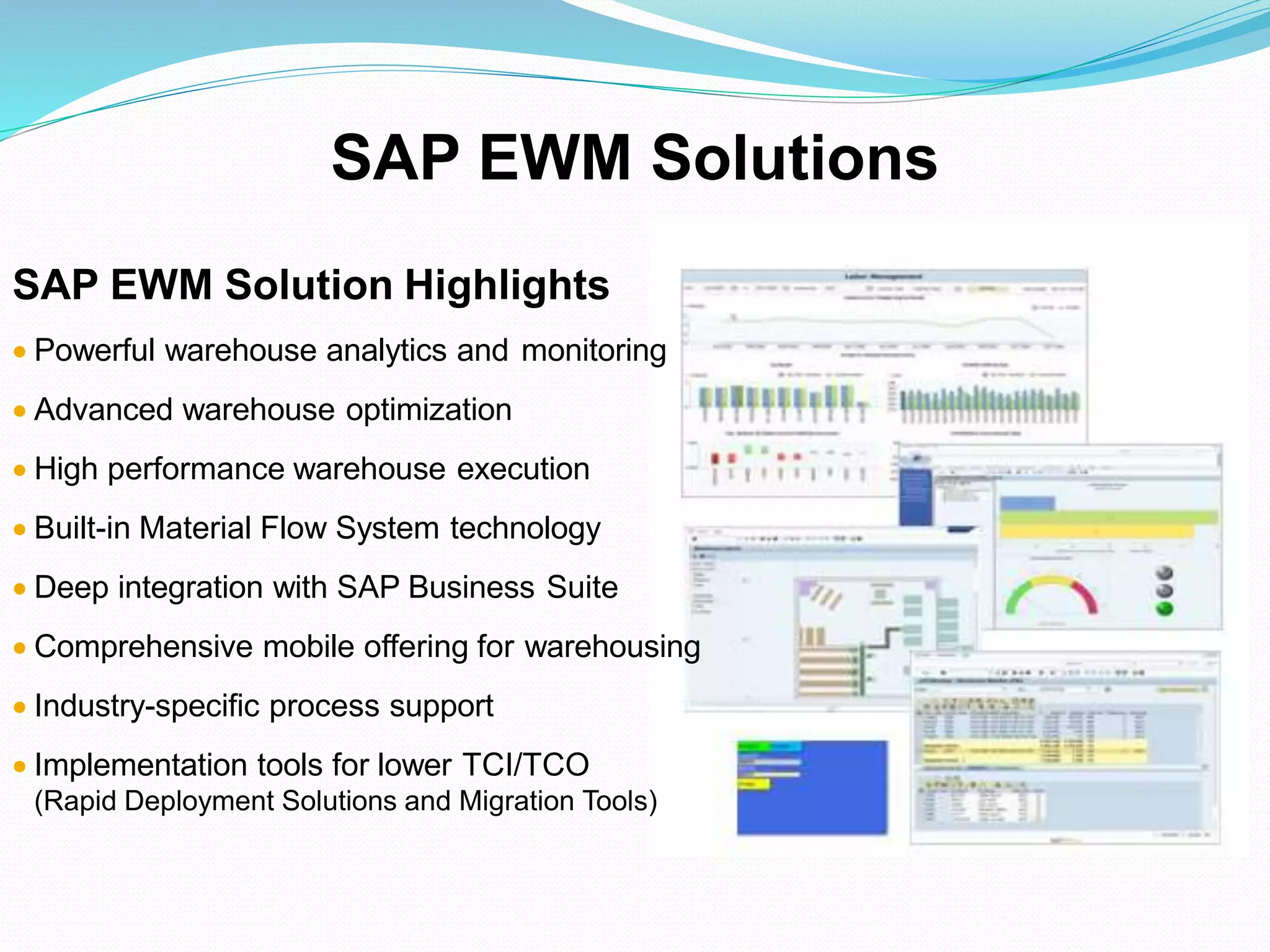
SAP EWM Solution Highlights
яВ╖ Powerful warehouse analytics and monitoring
яВ╖ Advanced warehouse optimization
яВ╖ High performance warehouse execution
яВ╖ Built-in Material Flow System technology
яВ╖ Deep integration with SAP Business Suite
яВ╖ Comprehensive mobile offering for warehousing
яВ╖ Industry-specific process support
яВ╖ Implementation tools for lower TCI/TCO
(Rapid Deployment Solutions and Migration Tools)
SAP EWM Solutions
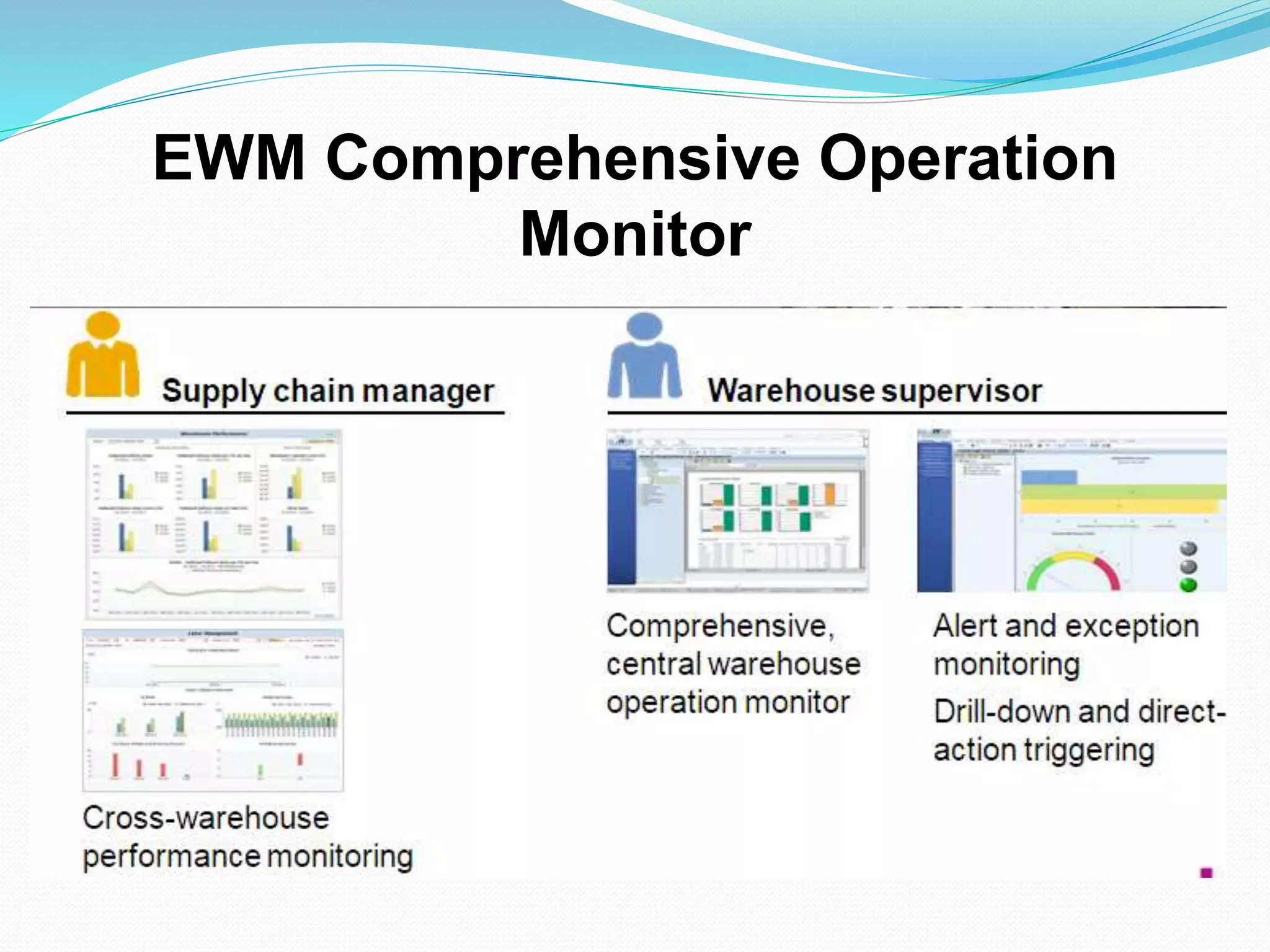
EWM Comprehensive Operation
Monitor
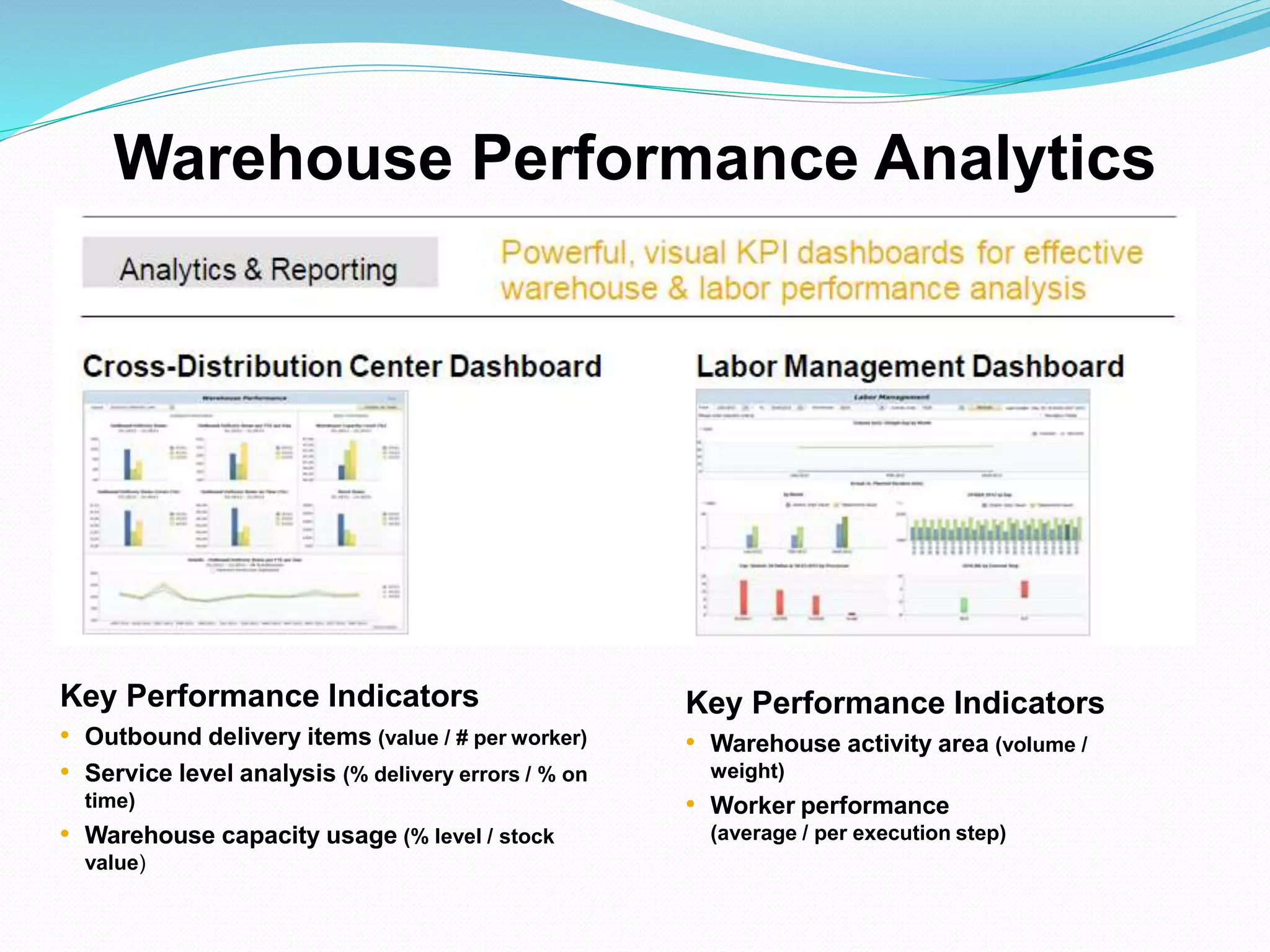
Key Performance Indicators
тАв Outbound delivery items (value / # per worker)
тАв Service level analysis (% delivery errors / % on
time)
тАв Warehouse capacity usage (% level / stock
value)
Key Performance Indicators
тАв Warehouse activity area (volume /
weight)
тАв Worker performance
(average / per execution step)
Warehouse Performance Analytics
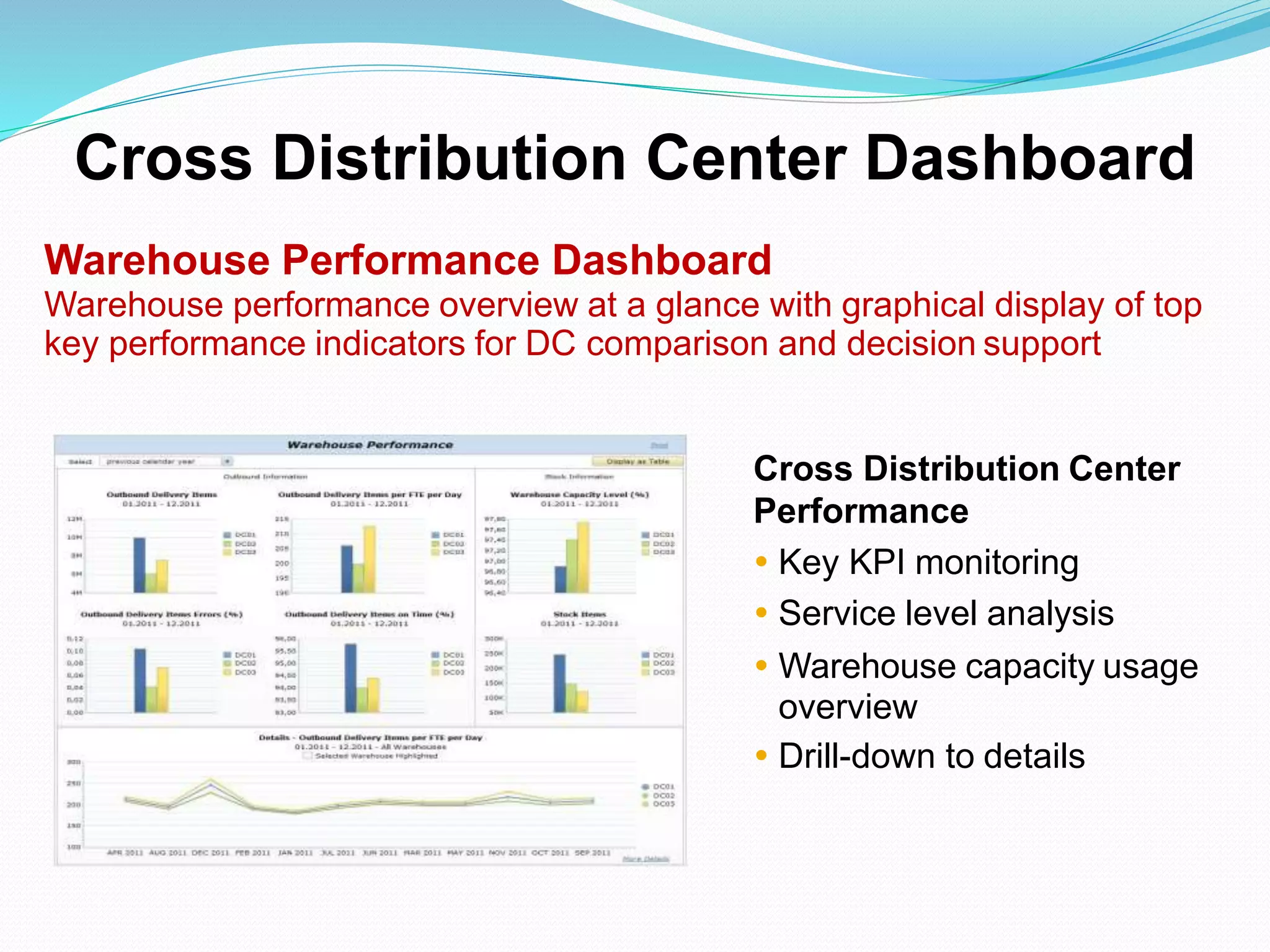
Warehouse Performance Dashboard
Warehouse performance overview at a glance with graphical display of top
key performance indicators for DC comparison and decision support
Cross Distribution Center
Performance
яВЯ Key KPI monitoring
яВЯ Service level analysis
яВЯ Warehouse capacity usage
overview
яВЯ Drill-down to details
Cross Distribution Center Dashboard
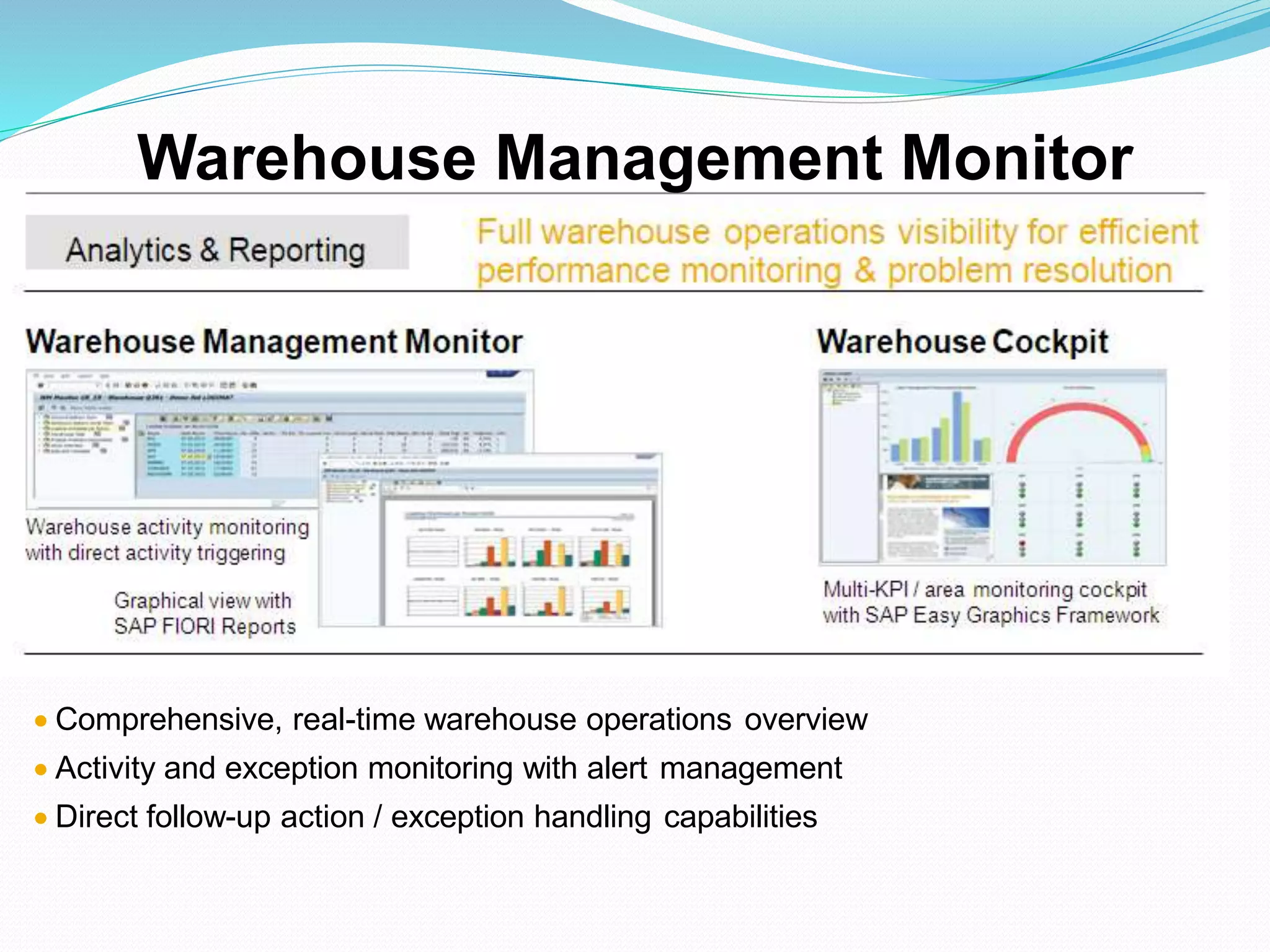
яВ╖ Comprehensive, real-time warehouse operations overview
яВ╖ Activity and exception monitoring with alert management
яВ╖ Direct follow-up action / exception handling capabilities
Warehouse Management Monitor
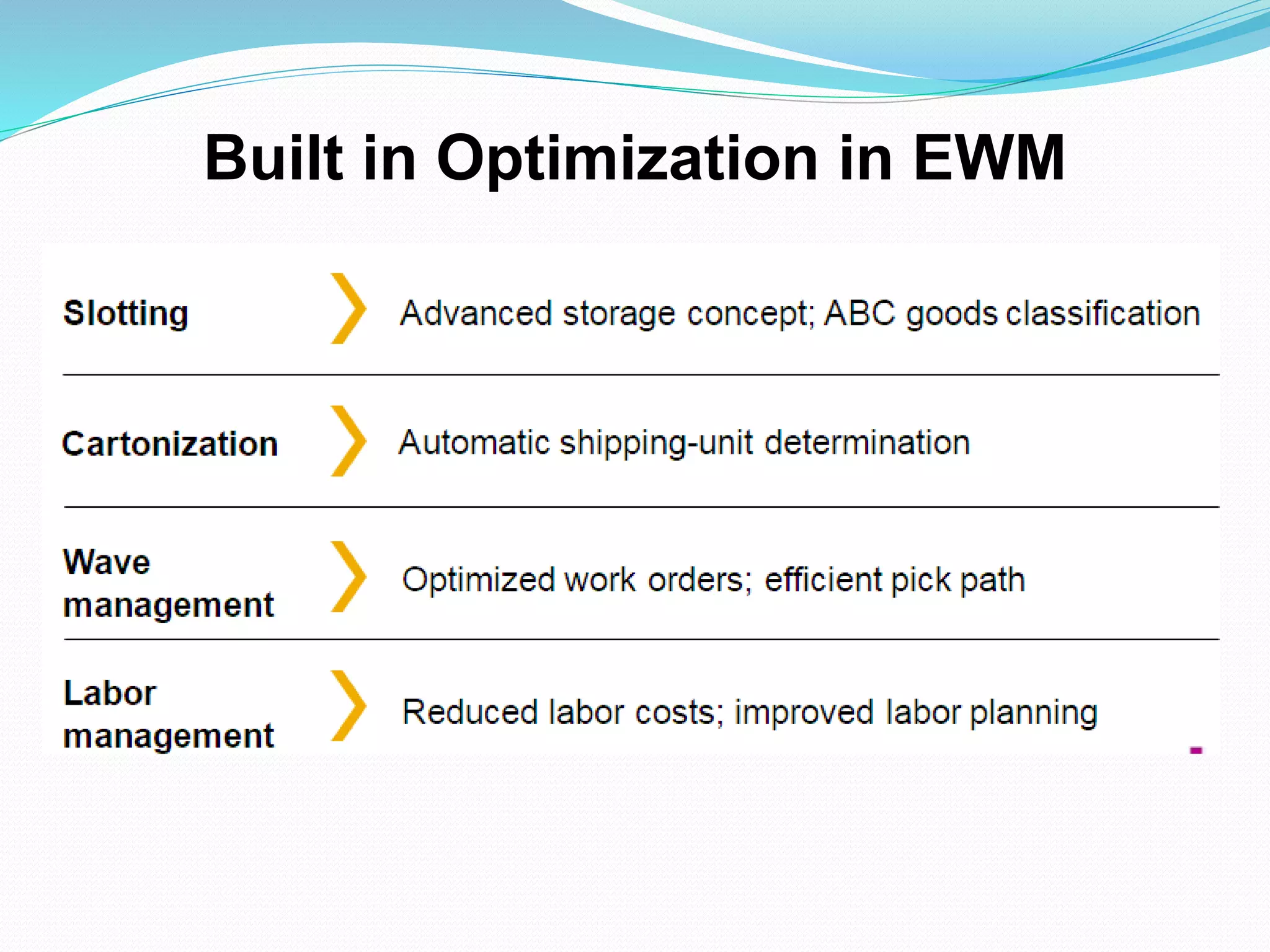
Built in Optimization in EWM
яВ╖ Manual / automatic cartonization planning with delivery order transfer
яВ╖ Early load / handling unit visibility for better labor & load planning
яВ╖ Advanced algorithm for packaging type and handling unit optimization
Cartonization Planning
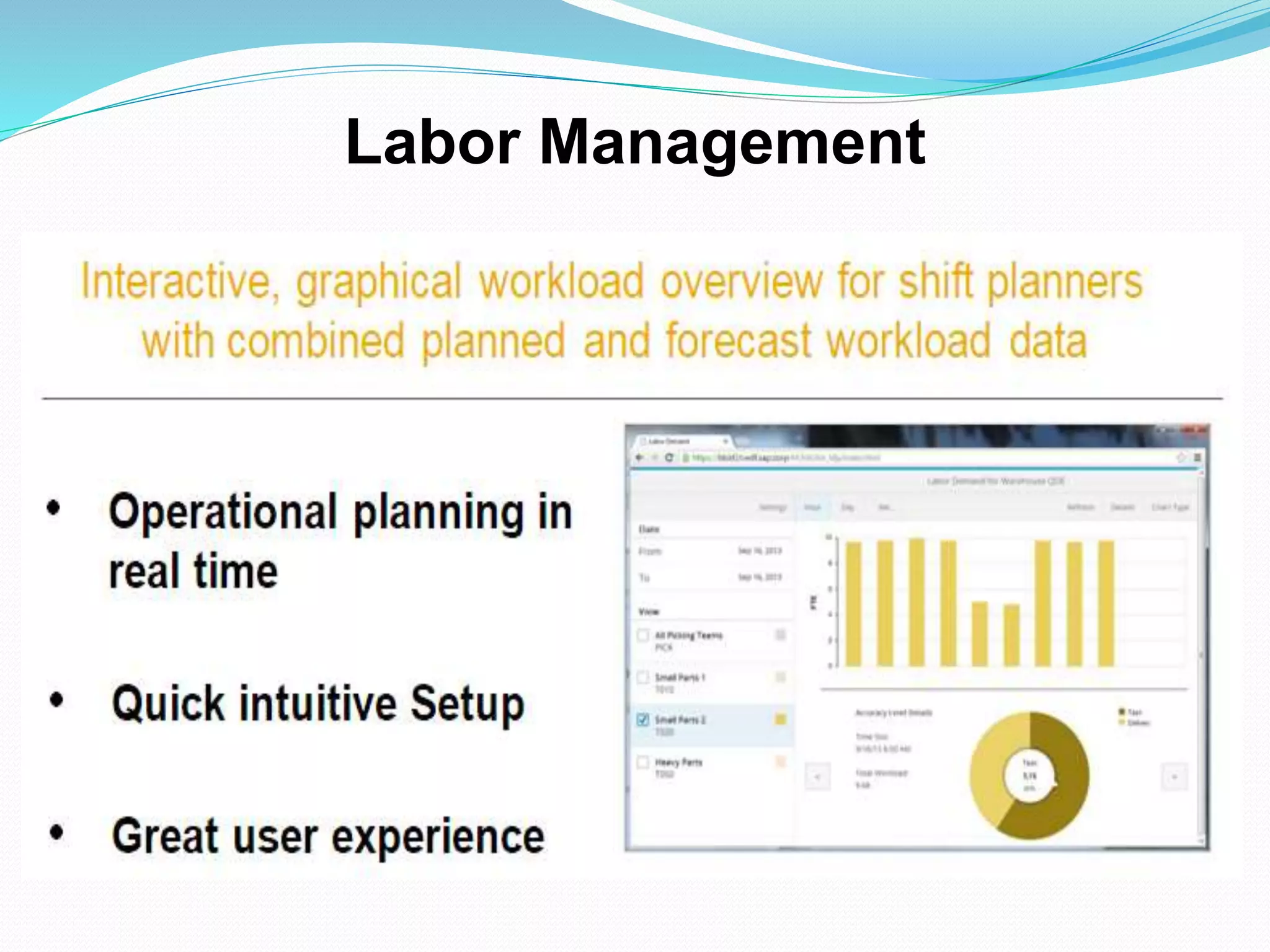
яВ╖ Accurate workload forecast for efficient capacity balancing
яВ╖ Real-time labor activity visibility for improved efficiency & timely problem
Wave Management
Labor Management
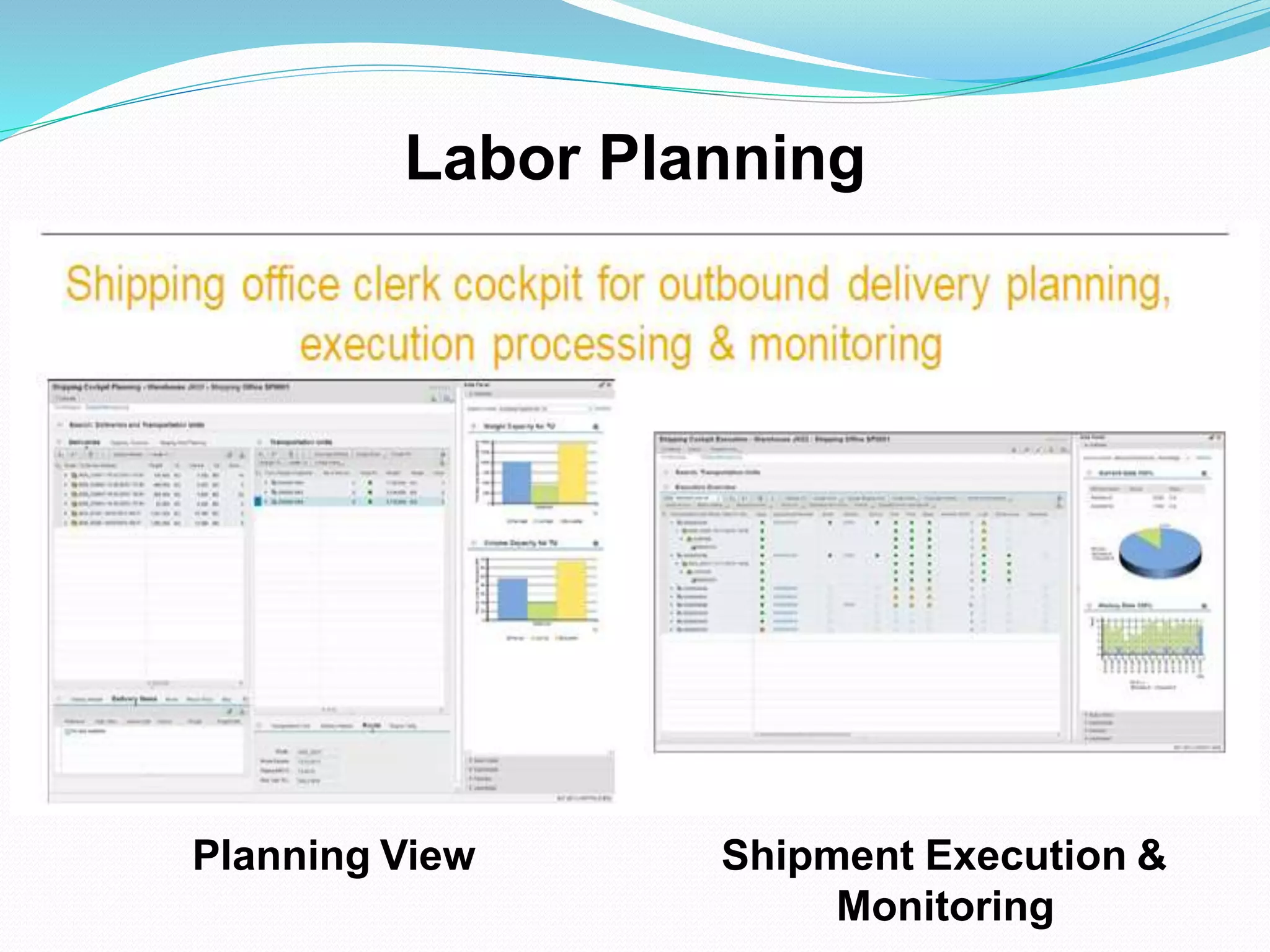
Planning View Shipment Execution &
Monitoring
Labor Planning
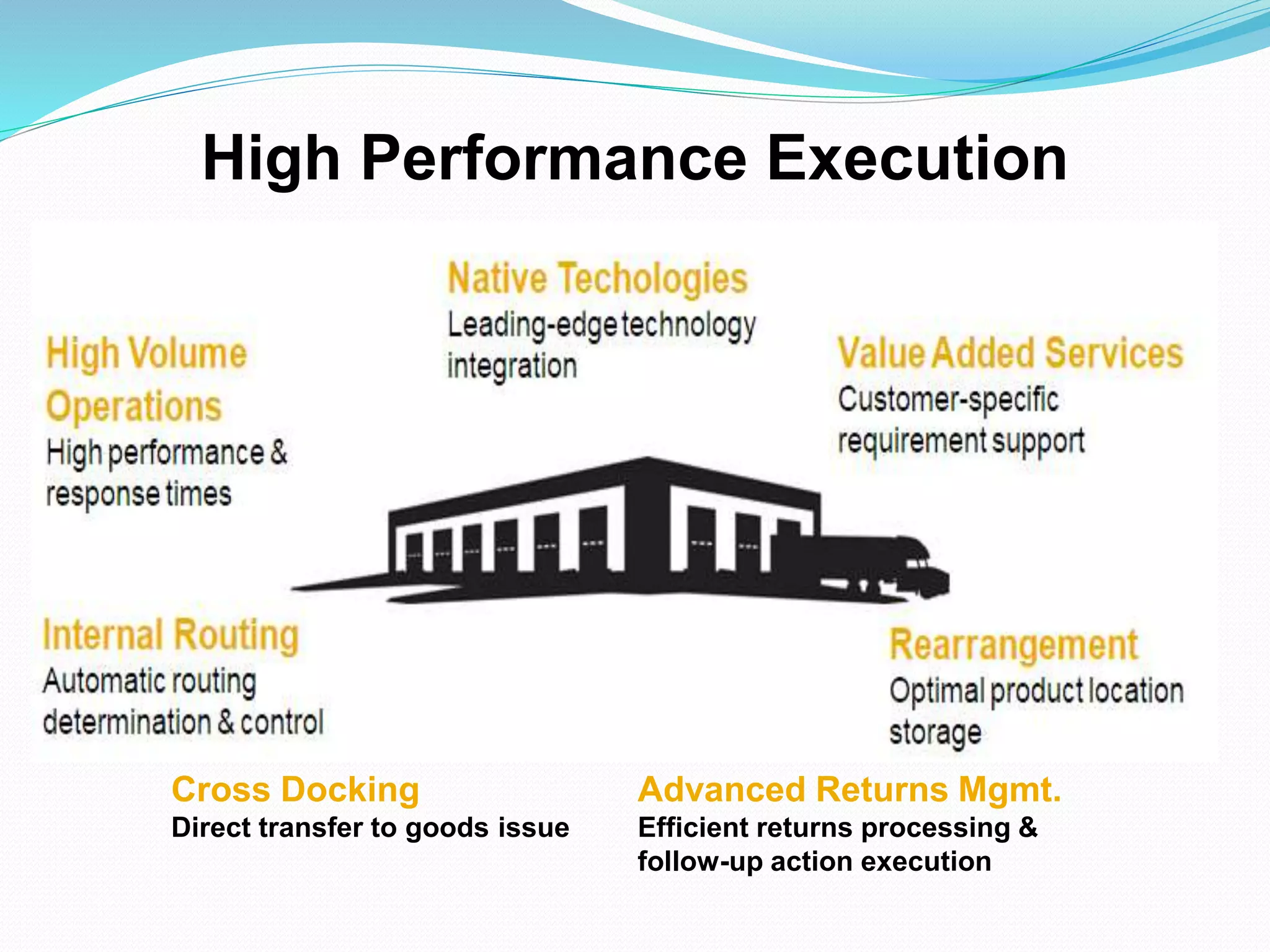
Cross Docking
Direct transfer to goods issue
Advanced Returns Mgmt.
Efficient returns processing &
follow-up action execution
High Performance Execution
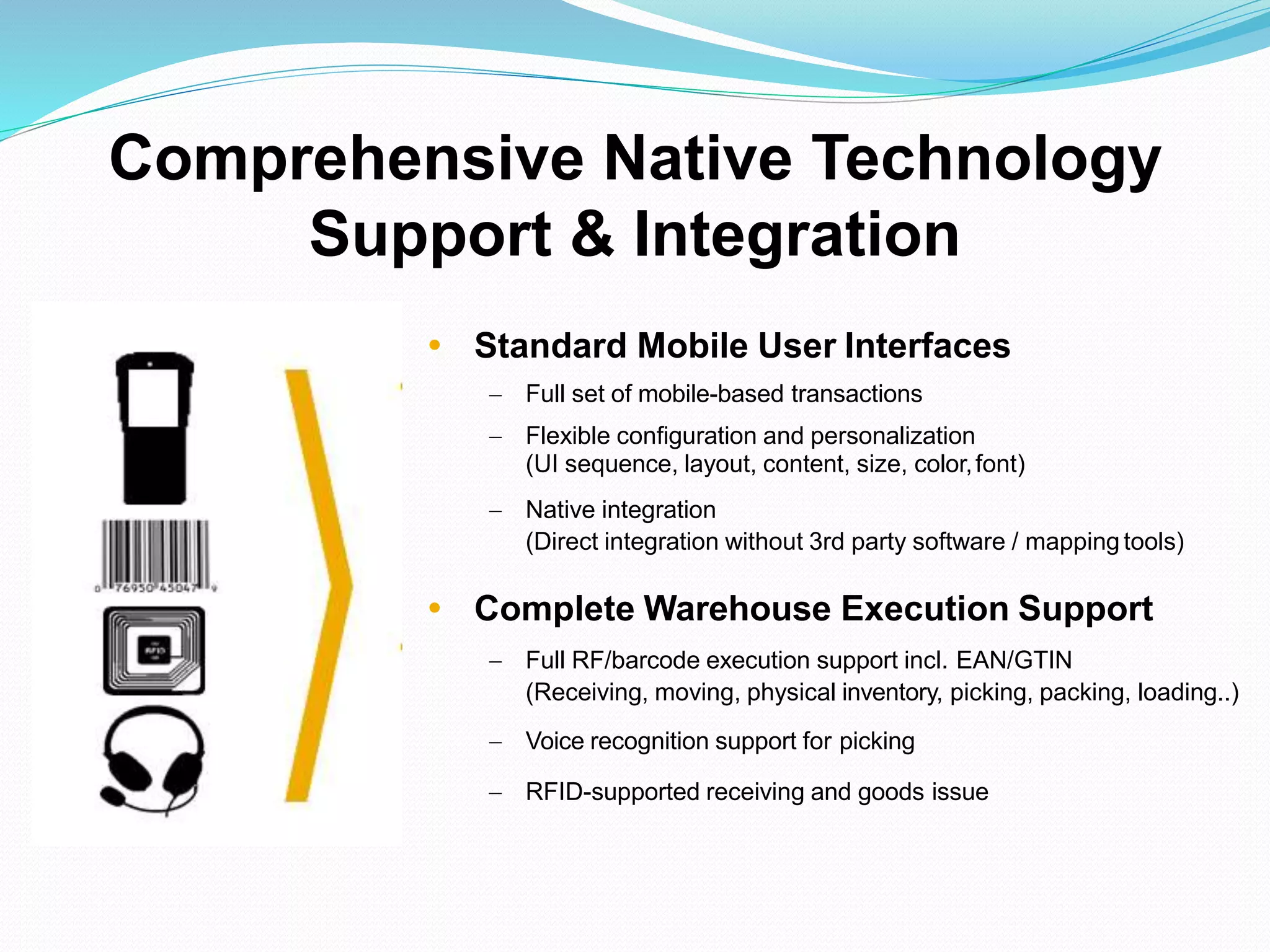
яВЯ Standard Mobile User Interfaces
яАн Full set of mobile-based transactions
яАн Flexible configuration and personalization
(UI sequence, layout, content, size, color,font)
яАн Native integration
(Direct integration without 3rd party software / mapping tools)
яВЯ Complete Warehouse Execution Support
яАн Full RF/barcode execution support incl. EAN/GTIN
(Receiving, moving, physical inventory, picking, packing, loading..)
яАн Voice recognition support for picking
яАн RFID-supported receiving and goods issue
Comprehensive Native Technology
Support & Integration
яБо Embedded in well established RF framework
and Internet Transaction Server (ITS)
яБо Widespread standards applied
(XHTML+Voice)
яБо Fast Pick-by-Voice Response Times
яБо Non-disruptive error handling
яБо Partnering with voice recognition providers
(TopSystems, VoCollect)
Pick-by-Voice
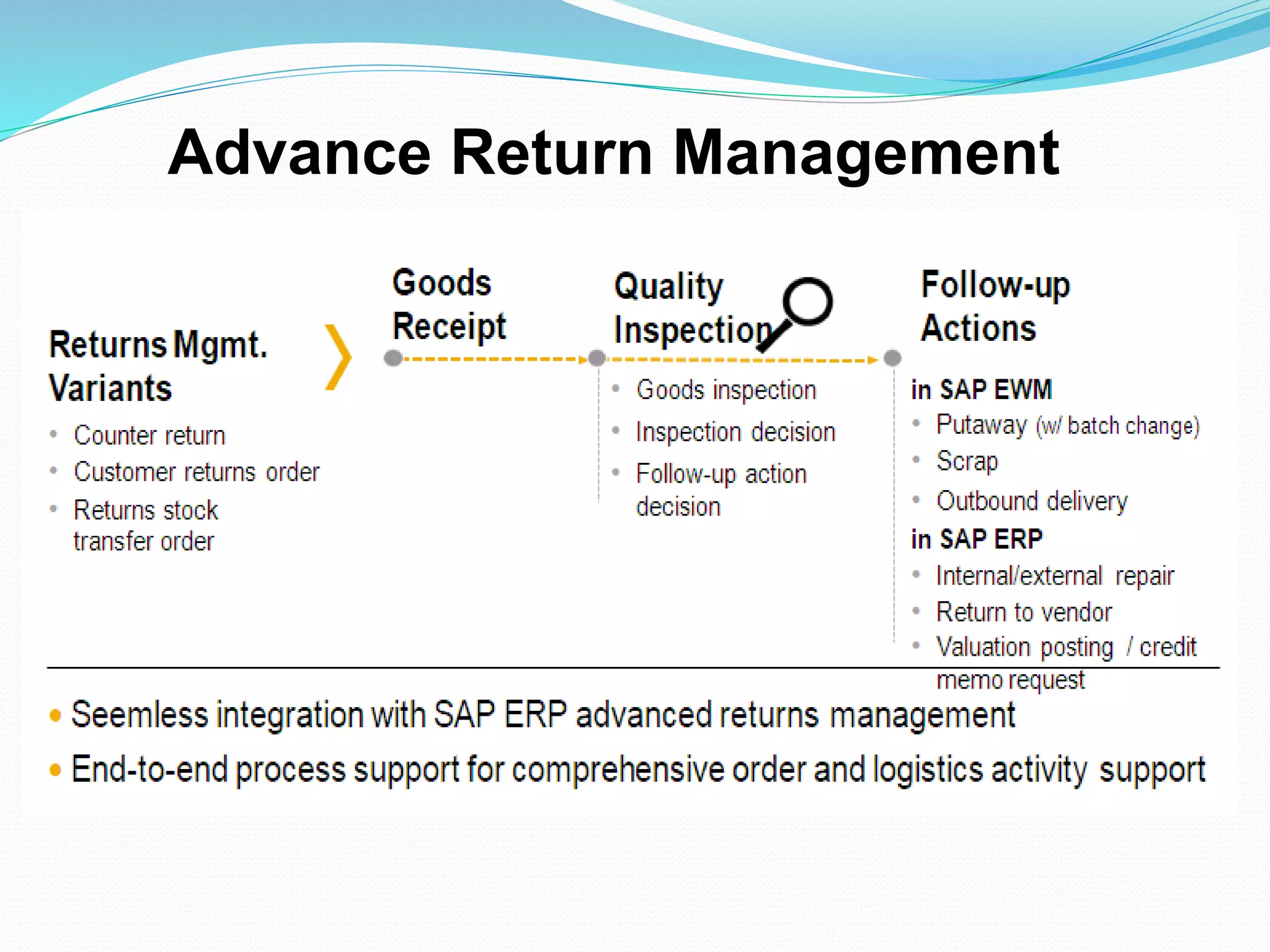
Advance Return Management
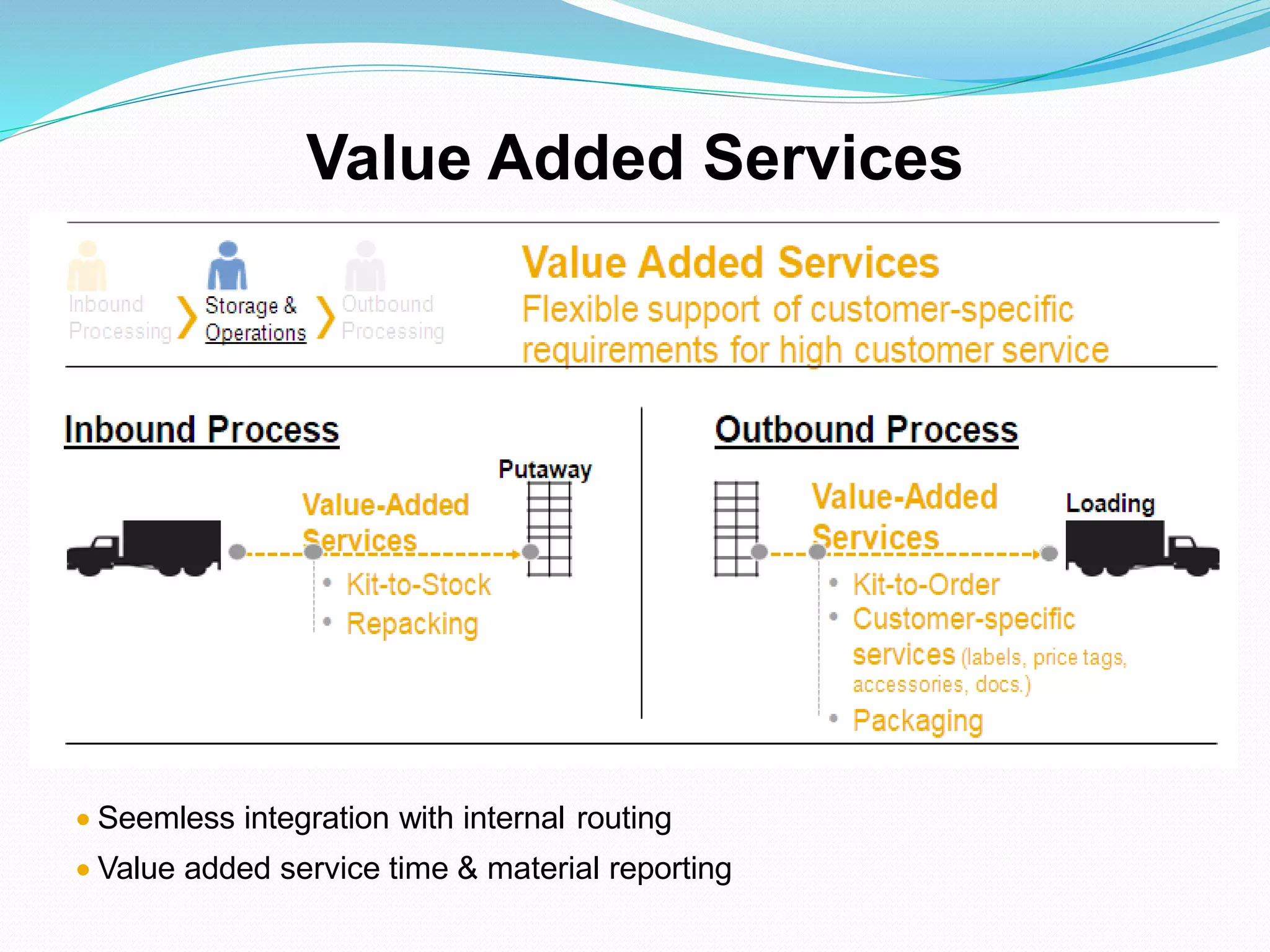
яВ╖ Seemless integration with internal routing
яВ╖ Value added service time & material reporting
Value Added Services
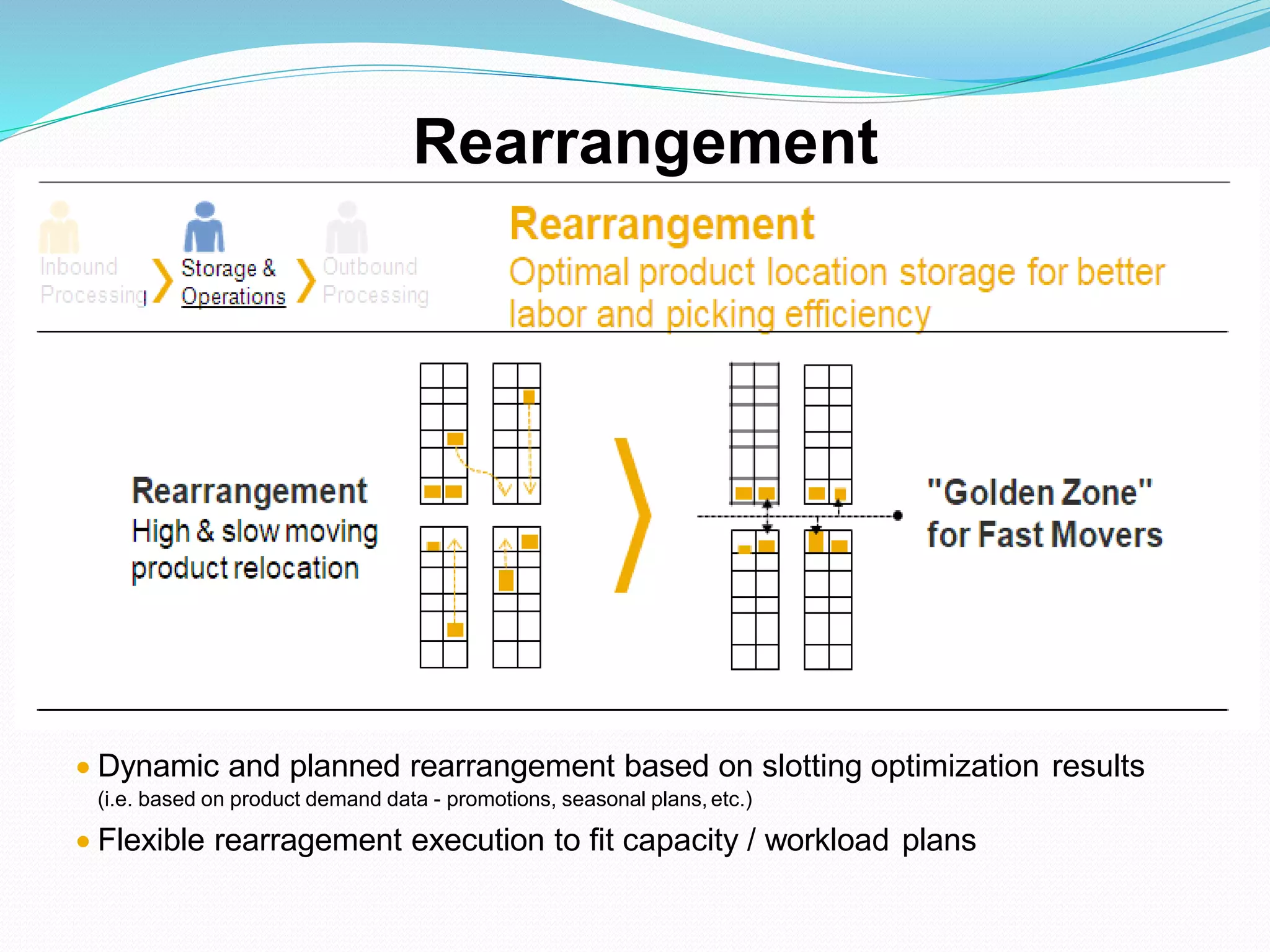
яВ╖ Dynamic and planned rearrangement based on slotting optimization results
(i.e. based on product demand data - promotions, seasonal plans, etc.)
яВ╖ Flexible rearragement execution to fit capacity / workload plans
Rearrangement
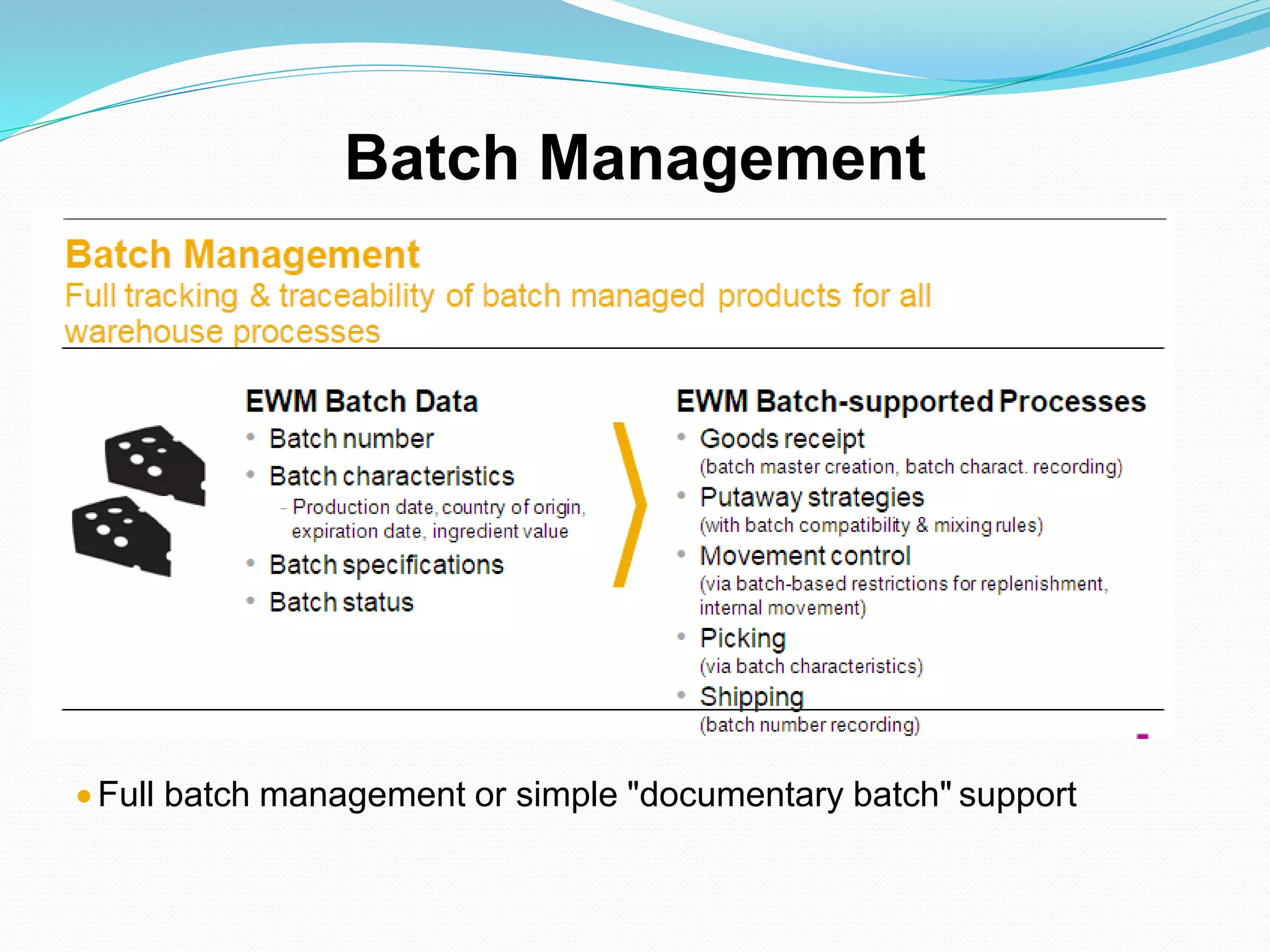
яВ╖ Full batch management or simple "documentary batch" support
Batch Management
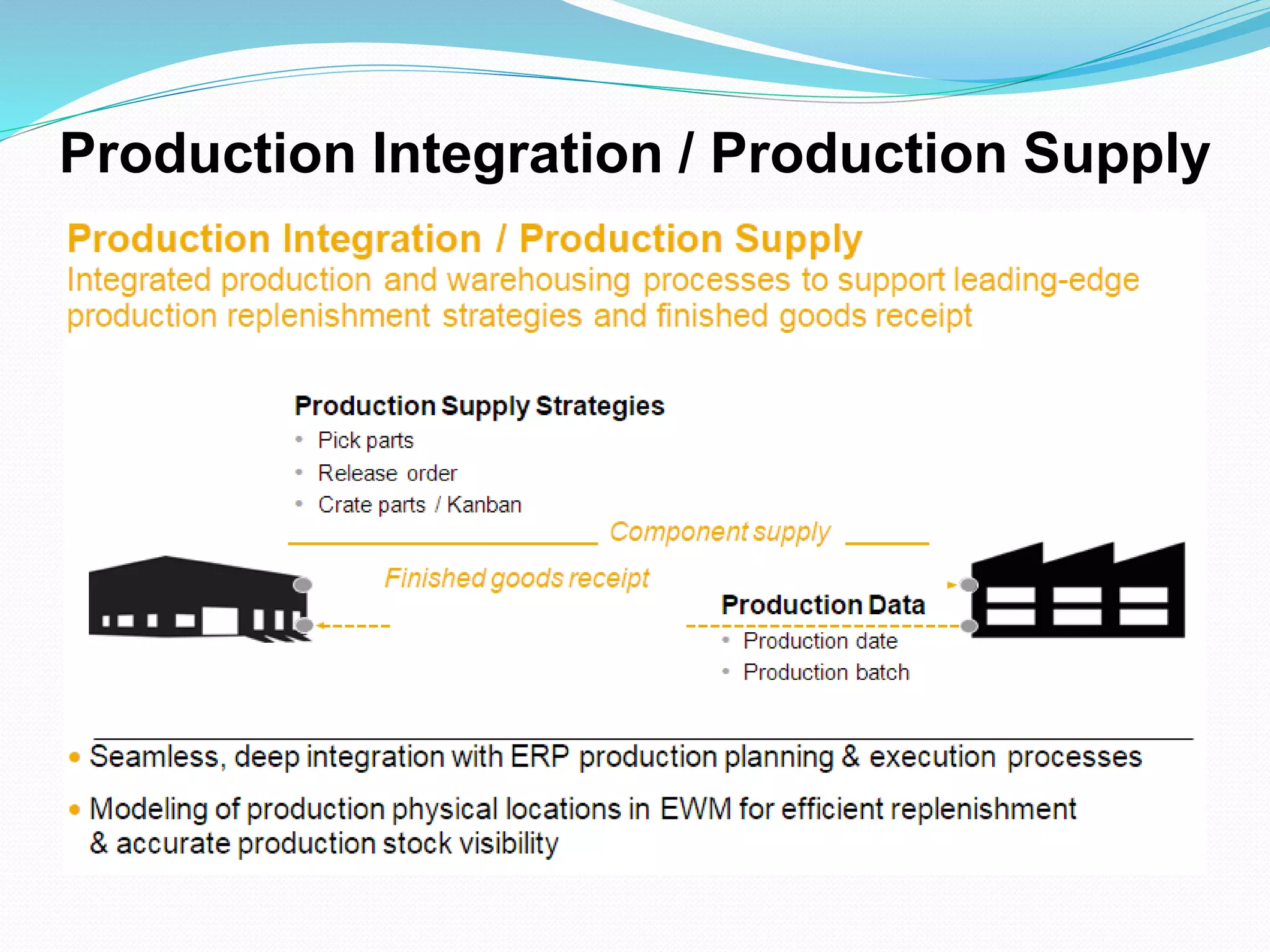
Production Integration / Production Supply
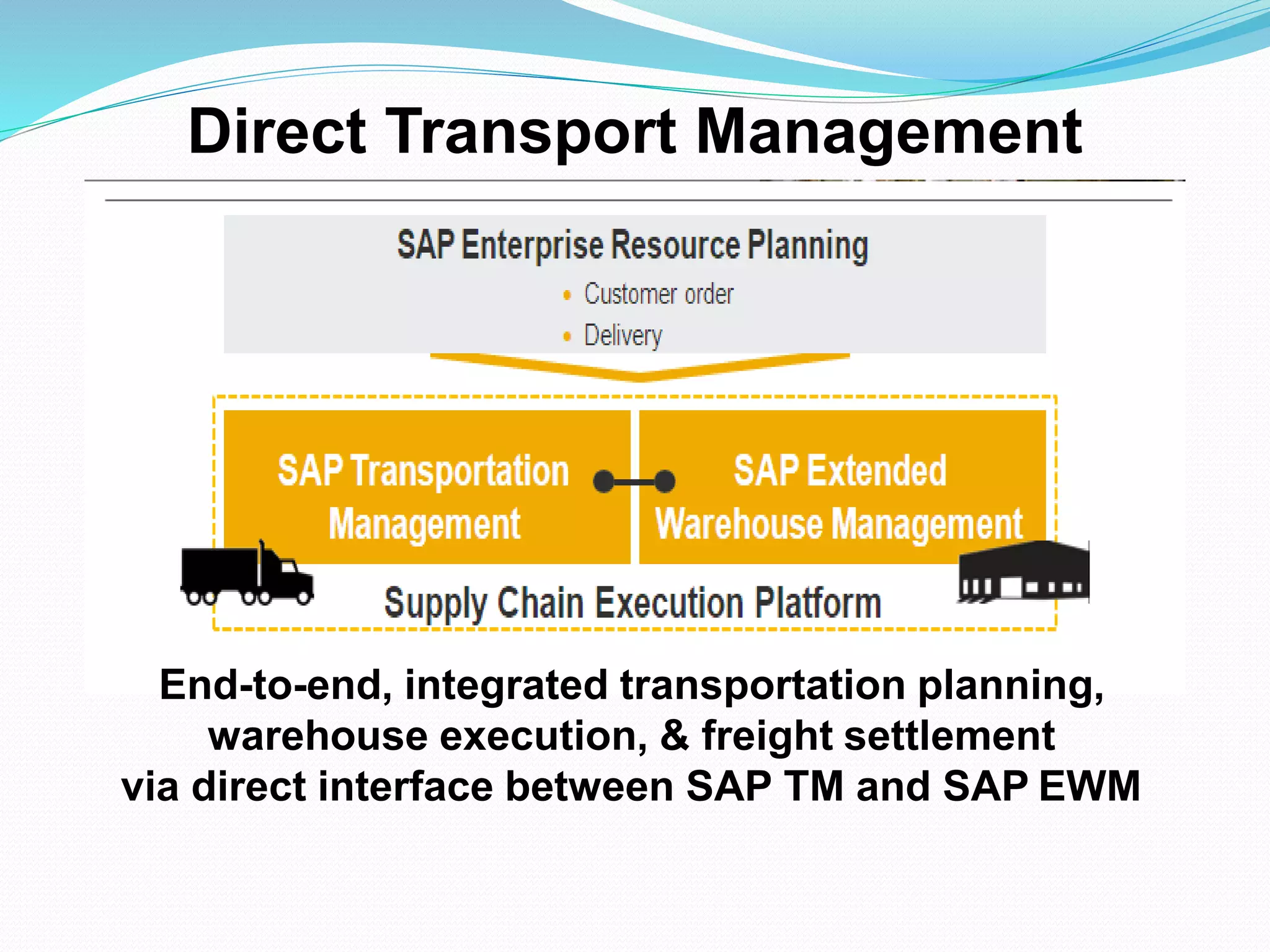
End-to-end, integrated transportation planning,
warehouse execution, & freight settlement
via direct interface between SAP TM and SAP EWM
Direct Transport Management
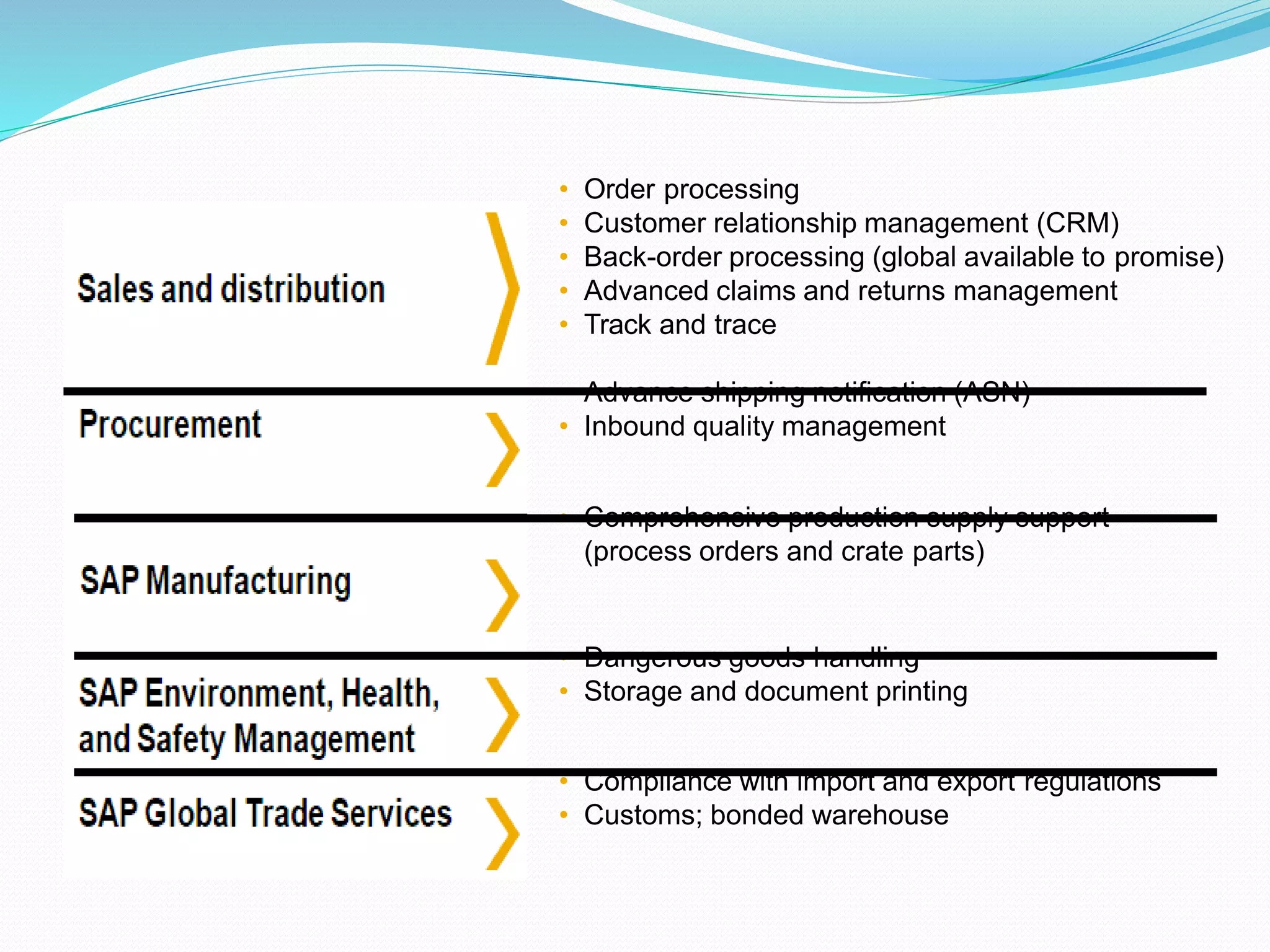
тАв Order processing
тАв Customer relationship management (CRM)
тАв Back-order processing (global available to promise)
тАв Advanced claims and returns management
тАв Track and trace
тАв Advance shipping notification (ASN)
тАв Inbound quality management
тАв Comprehensive production supply support
(process orders and crate parts)
тАв Dangerous goods handling
тАв Storage and document printing
тАв Compliance with import and export regulations
тАв Customs; bonded warehouse
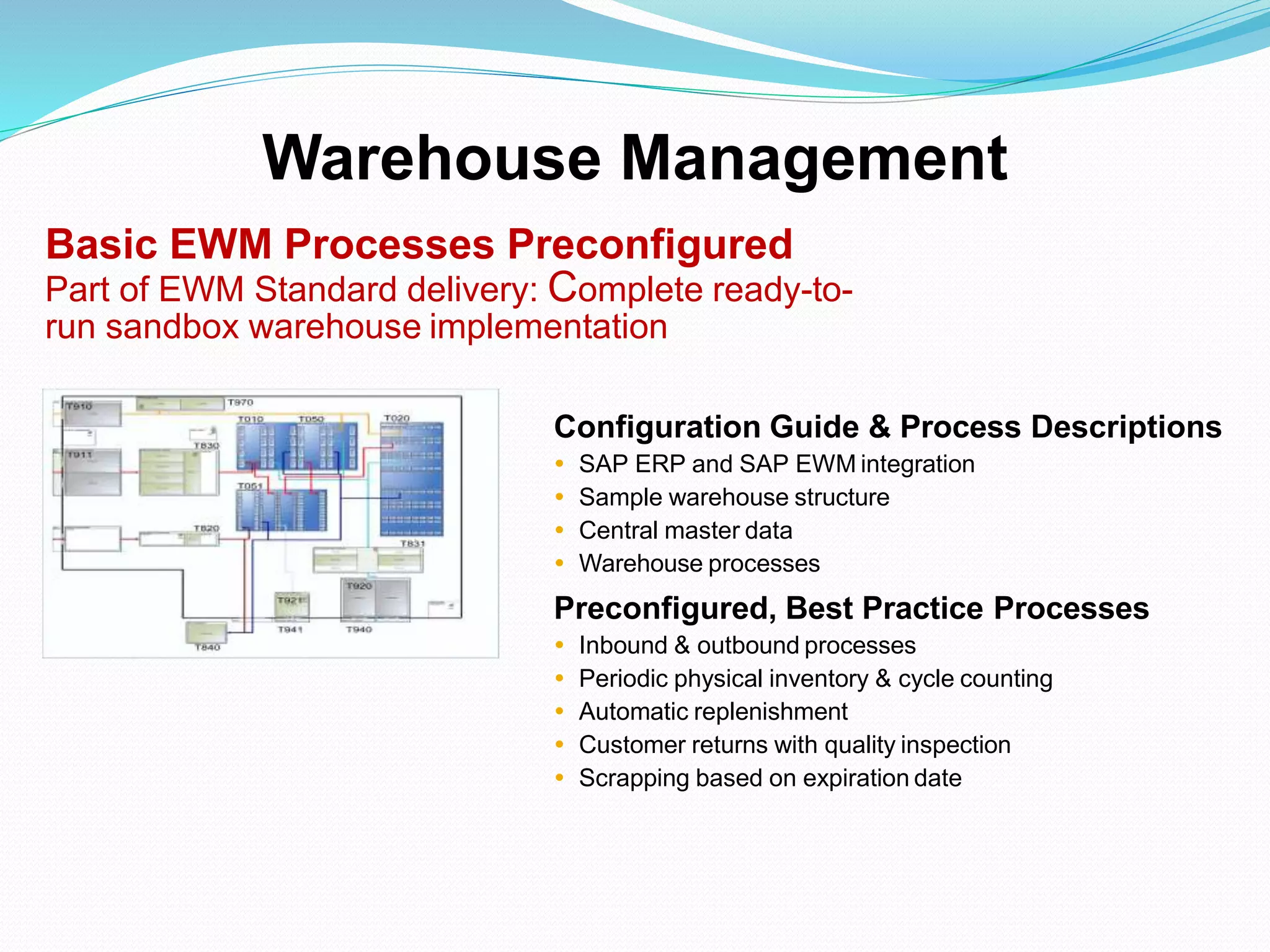
Basic EWM Processes Preconfigured
Part of EWM Standard delivery: Complete ready-to-
run sandbox warehouse implementation
Configuration Guide & Process Descriptions
яВЯ SAP ERP and SAP EWM integration
яВЯ Sample warehouse structure
яВЯ Central master data
яВЯ Warehouse processes
Preconfigured, Best Practice Processes
яВЯ Inbound & outbound processes
яВЯ Periodic physical inventory & cycle counting
яВЯ Automatic replenishment
яВЯ Customer returns with quality inspection
яВЯ Scrapping based on expiration date
Warehouse Management
Warehouse Layout Overview
яВЯ Visual display of master data set-up
яВЯ Warehouse & yard overview
яВЯ Color-coded storage types
(High rack, bins, handling unit, conveyor...)
яВЯ Travel paths & distances
яВЯ Aerial warehouse & rack frontal views
(with zoom-in/out)
Drill-down Details
яВЯ Resource status / location
яВЯ Storage bin status (empty, blocked)
Graphical Warehouse Layout
EWM Deployment Option
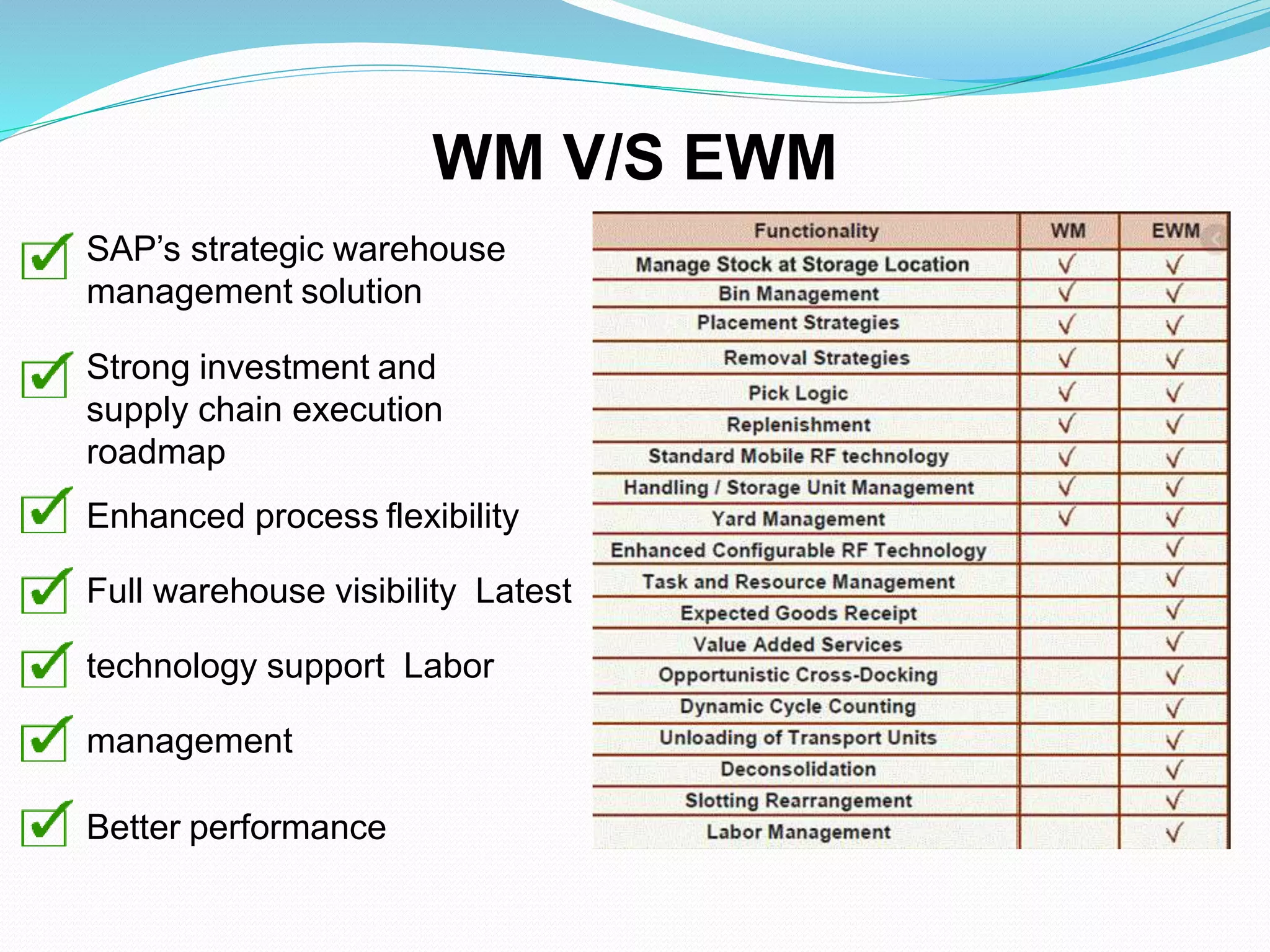
SAPтАЩs strategic warehouse
management solution
Strong investment and
supply chain execution
roadmap
Enhanced process flexibility
Full warehouse visibility Latest
technology support Labor
management
Better performance
WM V/S EWM
WM V/S EWM
What is new in EWM S/4HANA 1909?
яГ╝ Embedded Extended Warehouse Management on SAP S/4HANA,
clients could take advantage of the SAP HANA in-memory database
execute high-speed transactions for their warehousing operations.
яГ╝ In version of SAP S/4HANA more functionality was added to EWM,
including ever-growing list of innovative SAP Fiori apps and a stripped
down version called stock room management.
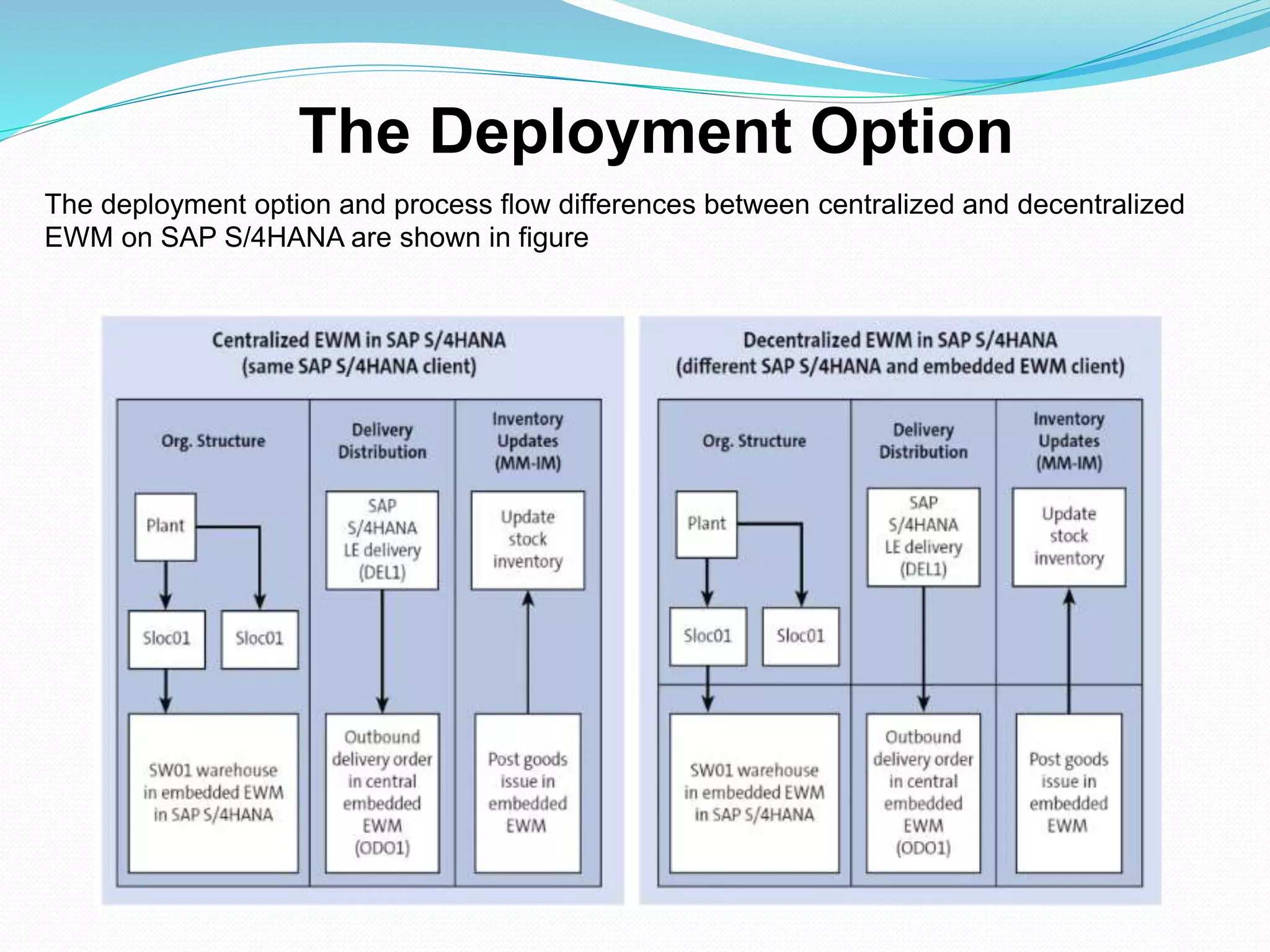
яГ╝ With the new decentralized deployment client can take advantage of
current and new innovations in embedded EWM but keep on using
separate SAP ERP or SAP S/4HANA core system.
яГ╝ With this new updates business can now connect multiple SAP ERP or
SAP S/4HANA core system to the same embedded in SAP S/4HANA
system.
яГ╝ This would reduce the cost of re-implementing the core ERP for each
embedded EWM in SAP S/4HANA for their existing landscape.
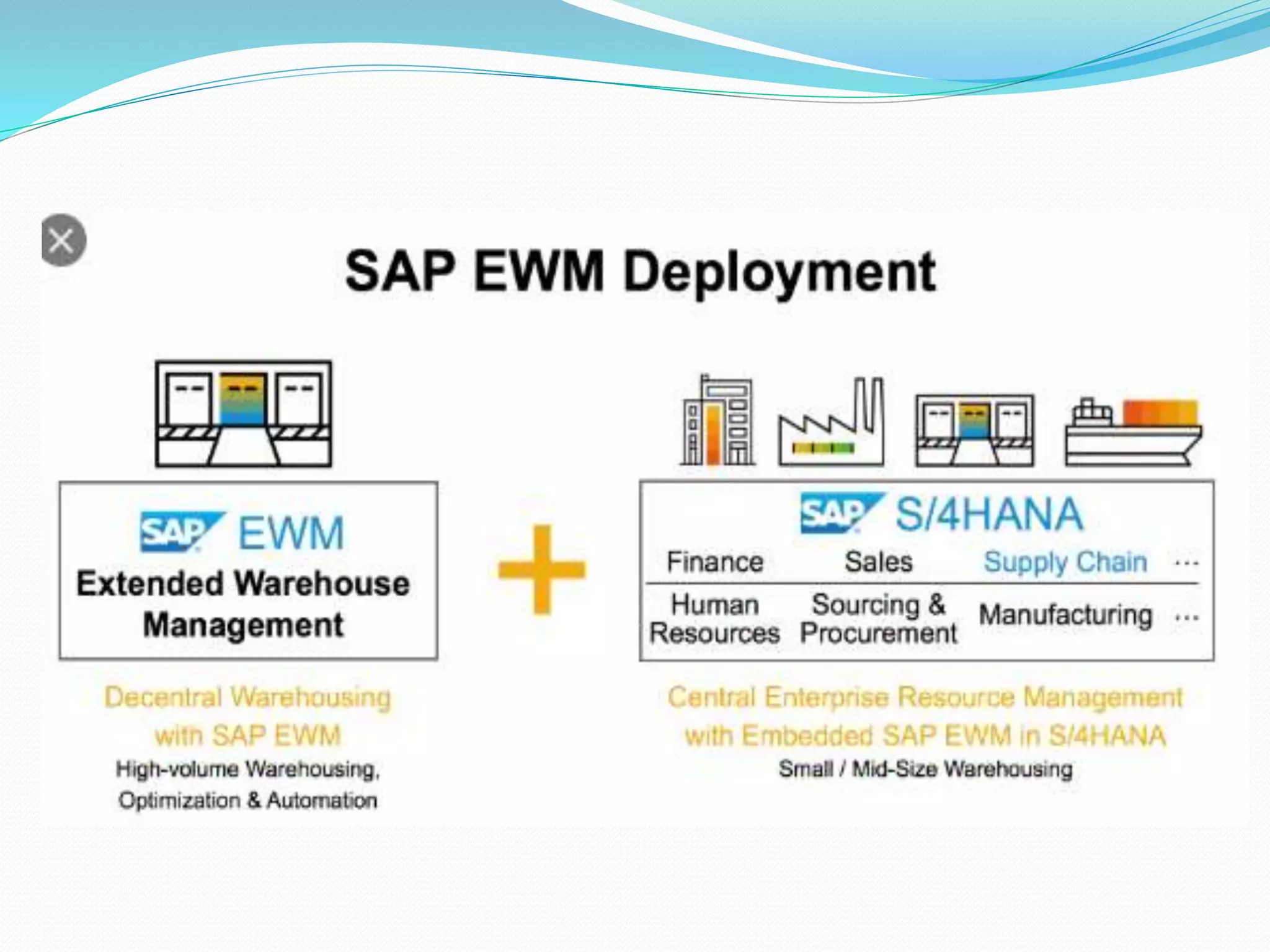
The Deployment Option
The deployment option and process flow differences between centralized and decentralized
EWM on SAP S/4HANA are shown in figure
Stock Room Management
In SAP S/4HANA 1909, SAP released a third deployment option for WM
customers who do no use warehouse processes extensively, do not need
advanced functionality found in SAP EWM, and would like to continue
using the basic warehouse process found in their existing SAP Logistic
Execution Warehouse Management (LE-WM) applications. Called stock
room management, this deployment allows customers to upgrade to SAP
S/4HANA without performing a full-fledged WM transformation.
The various features of WM in SAP S/4HANA which can be utilized under
stock room management exist in a number of groups; inventory
management processes; outbound, inbound, and internal stock
movement; physical inventory; and reports for stock data.
Rajesh Sharma

Ewm training ppt

  • 1.
  • 2.
  • 3.
  • 4.
    яГ╝ Introduction toSAP ERP яГ╝ History of EWM яГ╝ Introduction to EWM яГ╝ Question & Answer
  • 5.
    Enterprise In General aCompany will have the following departments яГ╝ Finance яГ╝ Sales яГ╝ Production яГ╝ HR Introduction to ERP
  • 6.
    Before ERP Companiesused the individual department software packages like Before to ERP Why we need ERP?
  • 7.
    Before ERP Companiesused the individual department software packages like; яВз Finance тАв Accounting Package (Talley, quick book) яВз Production тАв JD Edwards, Ariba яВз Sales тАв Netsuite, Zoho CRM яВз HR тАв CSB, Staff files, ADO HCM тАв Pay roll package тАв Time management package тАв Travel package Before to ERP
  • 8.
    The result ofthese individual packages During Quarterly Report Submission by every department of managementтАжтАж.
  • 9.
    The result ofthese individual packages яВз It leads to many problems like яВз Non tallying of facts and figures яВз No integration and updating between departments яВз There by decision making is not accurate
  • 10.
    What Industry needs? яВзData Accuracy яВз Instant availability
  • 11.
    Data accuracy яВз Decisionwill be based on accuracy of data яВз If data is not accurate decision will be wrongтАж яВз So all the CEO and other decision makers of the company needs тАв Accurate data тАв Instant availability яВз It is possible only based on ERP packages
  • 12.
  • 13.
  • 14.
  • 15.
    What is Planning? яВзProper utilization of available resources is known as planning
  • 16.
    What is ERP? яВзSo ERP means тАШoptimum utilization of all resources of enterpriseтАЩ
  • 17.
    яВз An ERPSystem is a collection of software programs which ties all of an enterprises various diverse functions such as тАв Finance тАв Sales тАв Manufacturing тАв Human Resources In to a cohesive data base Enterprise Resource Planning
  • 18.
    яВз ERP isnot a new concept яВз It was a old concept яВз This was the concept of 1970 яВз During this period all industries were planning to use computers for their day to day operations Enterprise Resource Planning
  • 19.
    яГ╝ Integration forBusiness Process яГ╝ Standardization of systems across locations яГ╝ For overall control of organization яГ╝ Better Reporting System яГ╝ Best utilization of resources i.e. Man, Material & Machines Why ERP?
  • 20.
    яВз Oracle тАУFinancial яВз People soft тАУ HR яВз Siebel тАУ CRM яВз JD edwards тАУ Production яВз Baan тАУ Production яВз SAP Famous ERP providers
  • 21.
    яВз SAP isan ERP package яВз SAP stands for тАв S тАУ System тАв A тАУ Applications тАв P тАУ Product in Data Processing What is SAP?
  • 22.
    яВз Founded inGermany by five former IBM Engineer in 1972 1. Dietmar Hopp 2. Hans-Werner Hector 3. Hasso Plattner 4. Klaus Tschira 5. Claus Wellenereuther яВз In 1988, SAP went public and became a joint stock company SAP AG History of SAP?
  • 23.
    яВз HQ inWalldrof Germany яВз The worldтАЩs largest Inter Enterprise Software Company яВз The worldтАЩs 3rd тАУ Largest Independent Software Supplier Over all яВз Employs Over 51,000 People More than 50 Countries яВз More than 1,26,268 customers of all size across 25 industries and in over 120 countries SAP today SAP HQ at Walldorf, Germany
  • 24.
    яВз 1972 :SAP AG founded in Germany яВз 1979 : SAP R/2 introduced for mainframe computers яВз 1992 : SAP R/3 released as client server application яВз 1996 : SAP R/3 became partially internet enabled яВз 1997 : Developed and launched the new dimension product line including CRM. SCM. And Data warehousing solution яВз 1999 : SAP announced my SAP.com, the next generation of its enterprise application system on internet architecture яВз 2000- 2005 : Introduced my business suite, Net Weaver, and XI Applications History of SAP time line
  • 25.
    яГ╝ R тАУReal time data processing яГ╝ 3 тАУ Tires 1) Data base layer 2) Application layer 3) Presentation layer SAP R/3 System
  • 26.
  • 27.
    яГ╝ In feb2015launched SAP S/4HANA SAPтАЩs next-generation ERP solution яГ╝ SAP S/4HANA is a new Enterprise Resource Planning Solution with simplified data, a simple tool design, agile, easier to use, perform complex calculations, and greater amounts of data. яГ╝ It can deployed on-premise, on-cloud, or as a hybrid system. яГ╝ SAP HANA is an in-memory database technology which acts as the core technology for lot of other SAP and Non-SAP applications. яГ╝ SAP S/4HANA is a new generation ERP solution which run on SAP HANA database architecture. SAP R/3 System V/S SAP S/4HANA
  • 28.
    SAP R/3 SystemV/S SAP S/4HANA
  • 30.
    яГ╝ SAP EWMis a part of SAP AGтАЩs Supply Chain Management Suite of Solution яГ╝ The Extended Warehouse Management is an integrated software platform for flexible, automated support for processing goods movements and for managing inventory in the warehouse. яГ╝ SAP EWM is similar to Warehouse Management яГ╝ EWM is more flexible in building objects, like warehouse structure, picking, put-away, handling unit management, Radio Frequency and more, яГ╝ Activity area, work centers, resources, are the elements incorporated in EWM SAP Extended Warehouse Management
  • 31.
  • 32.
  • 34.
    Inbound Processing Highlights яВ╖Advance Shipping Notification processing (Automatic/ manual creation) яВ╖ Automatic, rules-based process guidance яВ╖ Comprehensive quality management and returns management яВ╖ Leading-edge warehouse technology integration (PLCs (pallet/case conveyors, RF, RFID..) яВ╖ Integrated import and dangerous goods compliance (bonded warehouse; DG handling) Inbound Delivery Processing
  • 35.
  • 36.
    Outbound Processing Highlights яВ╖Wave, labor & cartonization optimization яВ╖ Full native technology support (mobile radio frequency, pick-by-voice, RFID) яВ╖ Material Flow System for direct PLC and conveyor system communication яВ╖ Transportation process integration яВ╖ Comprehensive warehouse performance analytics & operations monitoring Outbound Processing
  • 37.
    SAP EWM SolutionHighlights яВ╖ Powerful warehouse analytics and monitoring яВ╖ Advanced warehouse optimization яВ╖ High performance warehouse execution яВ╖ Built-in Material Flow System technology яВ╖ Deep integration with SAP Business Suite яВ╖ Comprehensive mobile offering for warehousing яВ╖ Industry-specific process support яВ╖ Implementation tools for lower TCI/TCO (Rapid Deployment Solutions and Migration Tools) SAP EWM Solutions
  • 38.
  • 39.
    Key Performance Indicators тАвOutbound delivery items (value / # per worker) тАв Service level analysis (% delivery errors / % on time) тАв Warehouse capacity usage (% level / stock value) Key Performance Indicators тАв Warehouse activity area (volume / weight) тАв Worker performance (average / per execution step) Warehouse Performance Analytics
  • 40.
    Warehouse Performance Dashboard Warehouseperformance overview at a glance with graphical display of top key performance indicators for DC comparison and decision support Cross Distribution Center Performance яВЯ Key KPI monitoring яВЯ Service level analysis яВЯ Warehouse capacity usage overview яВЯ Drill-down to details Cross Distribution Center Dashboard
  • 41.
    яВ╖ Comprehensive, real-timewarehouse operations overview яВ╖ Activity and exception monitoring with alert management яВ╖ Direct follow-up action / exception handling capabilities Warehouse Management Monitor
  • 42.
  • 43.
    яВ╖ Manual /automatic cartonization planning with delivery order transfer яВ╖ Early load / handling unit visibility for better labor & load planning яВ╖ Advanced algorithm for packaging type and handling unit optimization Cartonization Planning
  • 44.
    яВ╖ Accurate workloadforecast for efficient capacity balancing яВ╖ Real-time labor activity visibility for improved efficiency & timely problem Wave Management
  • 45.
  • 46.
    Planning View ShipmentExecution & Monitoring Labor Planning
  • 47.
    Cross Docking Direct transferto goods issue Advanced Returns Mgmt. Efficient returns processing & follow-up action execution High Performance Execution
  • 48.
    яВЯ Standard MobileUser Interfaces яАн Full set of mobile-based transactions яАн Flexible configuration and personalization (UI sequence, layout, content, size, color,font) яАн Native integration (Direct integration without 3rd party software / mapping tools) яВЯ Complete Warehouse Execution Support яАн Full RF/barcode execution support incl. EAN/GTIN (Receiving, moving, physical inventory, picking, packing, loading..) яАн Voice recognition support for picking яАн RFID-supported receiving and goods issue Comprehensive Native Technology Support & Integration
  • 49.
    яБо Embedded inwell established RF framework and Internet Transaction Server (ITS) яБо Widespread standards applied (XHTML+Voice) яБо Fast Pick-by-Voice Response Times яБо Non-disruptive error handling яБо Partnering with voice recognition providers (TopSystems, VoCollect) Pick-by-Voice
  • 50.
  • 51.
    яВ╖ Seemless integrationwith internal routing яВ╖ Value added service time & material reporting Value Added Services
  • 52.
    яВ╖ Dynamic andplanned rearrangement based on slotting optimization results (i.e. based on product demand data - promotions, seasonal plans, etc.) яВ╖ Flexible rearragement execution to fit capacity / workload plans Rearrangement
  • 53.
    яВ╖ Full batchmanagement or simple "documentary batch" support Batch Management
  • 54.
    Production Integration /Production Supply
  • 55.
    End-to-end, integrated transportationplanning, warehouse execution, & freight settlement via direct interface between SAP TM and SAP EWM Direct Transport Management
  • 56.
    тАв Order processing тАвCustomer relationship management (CRM) тАв Back-order processing (global available to promise) тАв Advanced claims and returns management тАв Track and trace тАв Advance shipping notification (ASN) тАв Inbound quality management тАв Comprehensive production supply support (process orders and crate parts) тАв Dangerous goods handling тАв Storage and document printing тАв Compliance with import and export regulations тАв Customs; bonded warehouse
  • 57.
    Basic EWM ProcessesPreconfigured Part of EWM Standard delivery: Complete ready-to- run sandbox warehouse implementation Configuration Guide & Process Descriptions яВЯ SAP ERP and SAP EWM integration яВЯ Sample warehouse structure яВЯ Central master data яВЯ Warehouse processes Preconfigured, Best Practice Processes яВЯ Inbound & outbound processes яВЯ Periodic physical inventory & cycle counting яВЯ Automatic replenishment яВЯ Customer returns with quality inspection яВЯ Scrapping based on expiration date Warehouse Management
  • 58.
    Warehouse Layout Overview яВЯVisual display of master data set-up яВЯ Warehouse & yard overview яВЯ Color-coded storage types (High rack, bins, handling unit, conveyor...) яВЯ Travel paths & distances яВЯ Aerial warehouse & rack frontal views (with zoom-in/out) Drill-down Details яВЯ Resource status / location яВЯ Storage bin status (empty, blocked) Graphical Warehouse Layout
  • 59.
  • 61.
    SAPтАЩs strategic warehouse managementsolution Strong investment and supply chain execution roadmap Enhanced process flexibility Full warehouse visibility Latest technology support Labor management Better performance WM V/S EWM
  • 62.
  • 63.
    What is newin EWM S/4HANA 1909? яГ╝ Embedded Extended Warehouse Management on SAP S/4HANA, clients could take advantage of the SAP HANA in-memory database execute high-speed transactions for their warehousing operations. яГ╝ In version of SAP S/4HANA more functionality was added to EWM, including ever-growing list of innovative SAP Fiori apps and a stripped down version called stock room management. яГ╝ With the new decentralized deployment client can take advantage of current and new innovations in embedded EWM but keep on using separate SAP ERP or SAP S/4HANA core system. яГ╝ With this new updates business can now connect multiple SAP ERP or SAP S/4HANA core system to the same embedded in SAP S/4HANA system. яГ╝ This would reduce the cost of re-implementing the core ERP for each embedded EWM in SAP S/4HANA for their existing landscape.
  • 64.
    The Deployment Option Thedeployment option and process flow differences between centralized and decentralized EWM on SAP S/4HANA are shown in figure
  • 65.
    Stock Room Management InSAP S/4HANA 1909, SAP released a third deployment option for WM customers who do no use warehouse processes extensively, do not need advanced functionality found in SAP EWM, and would like to continue using the basic warehouse process found in their existing SAP Logistic Execution Warehouse Management (LE-WM) applications. Called stock room management, this deployment allows customers to upgrade to SAP S/4HANA without performing a full-fledged WM transformation. The various features of WM in SAP S/4HANA which can be utilized under stock room management exist in a number of groups; inventory management processes; outbound, inbound, and internal stock movement; physical inventory; and reports for stock data.
  • 67.
Editor's Notes

  • #18┬аDefine ERP, Problem without ERP.
  • #19┬аDefine ERP, Problem without ERP.