IDoc (Intermediate Documents)
IDoc (Intermediate Document)
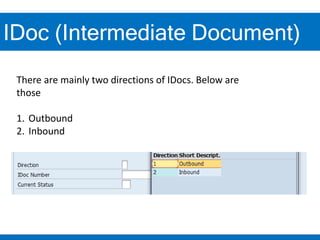
There are mainly two directions of IDocs. Below are
those
1. Outbound
2. Inbound
IDoc (Intermediate Documents)
IDoc (Intermediate Document)
IDoc (Intermediate Documents)
2- Inbound IDoc
Inbound IDoc
3rd Party
System
Middleware
System (SAP
PI or SOA)
SAP
IDoc
XML/JSON
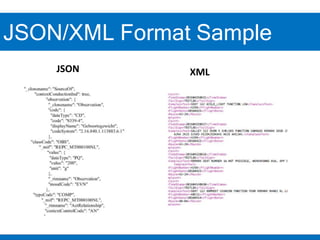
JSON/XML Format Sample
JSON XML
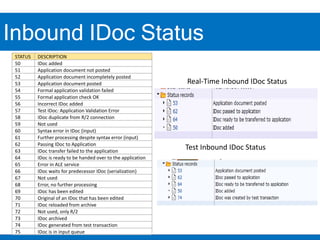
Inbound IDoc Status
STATUS DESCRIPTION
50 IDoc added
51 Application document not posted
52 Application document incompletely posted
53 Application document posted
54 Formal application validation failed
55 Formal application check OK
56 Incorrect IDoc added
57 Test IDoc: Application Validation Error
58 IDoc duplicate from R/2 connection
59 Not used
60 Syntax error in IDoc (input)
61 Further processing despite syntax error (input)
62 Passing IDoc to Application
63 IDoc transfer failed to the application
64 IDoc is ready to be handed over to the application
65 Error in ALE service
66 IDoc waits for predecessor IDoc (serialization)
67 Not used
68 Error, no further processing
69 IDoc has been edited
70 Original of an IDoc that has been edited
71 IDoc reloaded from archive
72 Not used, only R/2
73 IDoc archived
74 IDoc generated from test transaction
75 IDoc is in input queue
Real-Time Inbound IDoc Status
Test Inbound IDoc Status
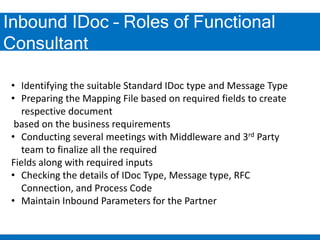
Inbound IDoc – Roles of Functional
Consultant
• Identifying the suitable Standard IDoc type and Message Type
• Preparing the Mapping File based on required fields to create
respective document
based on the business requirements
• Conducting several meetings with Middleware and 3rd Party
team to finalize all the required
Fields along with required inputs
• Checking the details of IDoc Type, Message type, RFC
Connection, and Process Code
• Maintain Inbound Parameters for the Partner
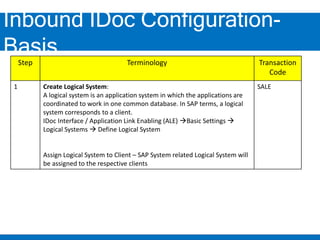
Inbound IDoc Configuration-
Basis
Step Terminology Transaction
Code
1 Create Logical System:
A logical system is an application system in which the applications are
coordinated to work in one common database. In SAP terms, a logical
system corresponds to a client.
IDoc Interface / Application Link Enabling (ALE) Basic Settings 
Logical Systems  Define Logical System
Assign Logical System to Client – SAP System related Logical System will
be assigned to the respective clients
SALE
Inbound IDoc Configuration-
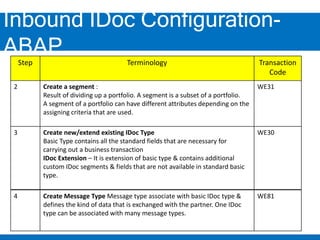
ABAP
Step Terminology Transaction
Code
2 Create a segment :
Result of dividing up a portfolio. A segment is a subset of a portfolio.
A segment of a portfolio can have different attributes depending on the
assigning criteria that are used.
WE31
3 Create new/extend existing IDoc Type
Basic Type contains all the standard fields that are necessary for
carrying out a business transaction
IDoc Extension – It is extension of basic type & contains additional
custom IDoc segments & fields that are not available in standard basic
type.
WE30
4 Create Message Type Message type associate with basic IDoc type &
defines the kind of data that is exchanged with the partner. One IDoc
type can be associated with many message types.
WE81
Inbound IDoc Configuration-
ABAP/Basis
Step Terminology Transaction
Code
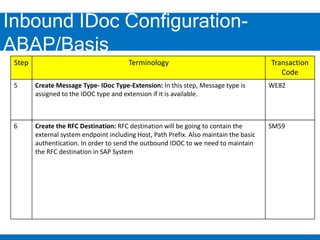
5 Create Message Type- IDoc Type-Extension: In this step, Message type is
assigned to the IDOC type and extension if it is available.
WE82
6 Create the RFC Destination: RFC destination will be going to contain the
external system endpoint including Host, Path Prefix. Also maintain the basic
authentication. In order to send the outbound IDOC to we need to maintain
the RFC destination in SAP System
SM59
Inbound IDoc Configuration-
Basis
Step Terminology Transaction
Code
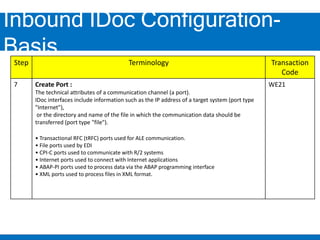
7 Create Port :
The technical attributes of a communication channel (a port).
IDoc interfaces include information such as the IP address of a target system (port type
"Internet"),
or the directory and name of the file in which the communication data should be
transferred (port type "file").
• Transactional RFC (tRFC) ports used for ALE communication.
• File ports used by EDI
• CPI-C ports used to communicate with R/2 systems
• Internet ports used to connect with Internet applications
• ABAP-PI ports used to process data via the ABAP programming interface
• XML ports used to process files in XML format.
WE21
Inbound IDoc Configuration-
ABAP/Functional
Step Terminology Transaction
Code
8 Create Process Code :
Process code refers to a workflow or a function module which helps in reading
or writing data from/to IDoc. Process Codes are used in both ALE and EDI
framework to identify the function module or API (Application Programming
Interface) to be invoked for subsequent processing. Inbound as well as
outbound interfaces use process code but for different purposes. inbound
process codes are stored in TEDE2.
The process code specifies the process (function module or workflow) which is
to be triggered when the IDoc is received (tab page Inbound Options).
WE42
9 Change Distribution Model- This step may be maintained for Material Master
etc. cases. In our projects, Distribution Model is not maintained for any of the
Inbound IDocs
BD64
Inbound IDoc Configuration-
ABAP/Functional
Step Terminology Transaction
Code
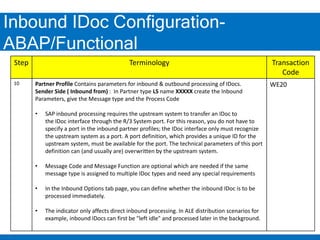
10 Partner Profile Contains parameters for inbound & outbound processing of IDocs.
Sender Side ( Inbound from) : In Partner type LS name XXXXX create the Inbound
Parameters, give the Message type and the Process Code
• SAP inbound processing requires the upstream system to transfer an IDoc to
the IDoc interface through the R/3 System port. For this reason, you do not have to
specify a port in the inbound partner profiles; the IDoc interface only must recognize
the upstream system as a port. A port definition, which provides a unique ID for the
upstream system, must be available for the port. The technical parameters of this port
definition can (and usually are) overwritten by the upstream system.
• Message Code and Message Function are optional which are needed if the same
message type is assigned to multiple IDoc types and need any special requirements
• In the Inbound Options tab page, you can define whether the inbound IDoc is to be
processed immediately.
• The indicator only affects direct inbound processing. In ALE distribution scenarios for
example, inbound IDocs can first be "left idle" and processed later in the background.
WE20
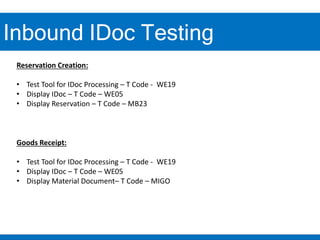
Inbound IDoc Testing
Reservation Creation:
• Test Tool for IDoc Processing – T Code - WE19
• Display IDoc – T Code – WE05
• Display Reservation – T Code – MB23
Goods Receipt:
• Test Tool for IDoc Processing – T Code - WE19
• Display IDoc – T Code – WE05
• Display Material Document– T Code – MIGO
Important Links of IDoc
https://wiki.scn.sap.com/wiki/display/ABAP/ALE+and+IDocs?original_fqdn=wiki.s
dn.sap.com#ALEandIDocs-ALE
https://wiki.scn.sap.com/wiki/display/ABAPConn/IDoc+Overview
https://wiki.scn.sap.com/wiki/display/ABAP/ALE%2CIDOC
IDoc (Intermediate Documents)
THANK YOU
LIKE – SHARE – SUBSCRIBE

SAP Inbound IDoc.pptx

  • 1.
    IDoc (Intermediate Documents) IDoc(Intermediate Document)
  • 2.
    There are mainlytwo directions of IDocs. Below are those 1. Outbound 2. Inbound IDoc (Intermediate Documents) IDoc (Intermediate Document)
  • 3.
  • 4.
    Inbound IDoc 3rd Party System Middleware System(SAP PI or SOA) SAP IDoc XML/JSON
  • 5.
  • 6.
    Inbound IDoc Status STATUSDESCRIPTION 50 IDoc added 51 Application document not posted 52 Application document incompletely posted 53 Application document posted 54 Formal application validation failed 55 Formal application check OK 56 Incorrect IDoc added 57 Test IDoc: Application Validation Error 58 IDoc duplicate from R/2 connection 59 Not used 60 Syntax error in IDoc (input) 61 Further processing despite syntax error (input) 62 Passing IDoc to Application 63 IDoc transfer failed to the application 64 IDoc is ready to be handed over to the application 65 Error in ALE service 66 IDoc waits for predecessor IDoc (serialization) 67 Not used 68 Error, no further processing 69 IDoc has been edited 70 Original of an IDoc that has been edited 71 IDoc reloaded from archive 72 Not used, only R/2 73 IDoc archived 74 IDoc generated from test transaction 75 IDoc is in input queue Real-Time Inbound IDoc Status Test Inbound IDoc Status
  • 7.
    Inbound IDoc –Roles of Functional Consultant • Identifying the suitable Standard IDoc type and Message Type • Preparing the Mapping File based on required fields to create respective document based on the business requirements • Conducting several meetings with Middleware and 3rd Party team to finalize all the required Fields along with required inputs • Checking the details of IDoc Type, Message type, RFC Connection, and Process Code • Maintain Inbound Parameters for the Partner
  • 8.
    Inbound IDoc Configuration- Basis StepTerminology Transaction Code 1 Create Logical System: A logical system is an application system in which the applications are coordinated to work in one common database. In SAP terms, a logical system corresponds to a client. IDoc Interface / Application Link Enabling (ALE) Basic Settings  Logical Systems  Define Logical System Assign Logical System to Client – SAP System related Logical System will be assigned to the respective clients SALE
  • 9.
    Inbound IDoc Configuration- ABAP StepTerminology Transaction Code 2 Create a segment : Result of dividing up a portfolio. A segment is a subset of a portfolio. A segment of a portfolio can have different attributes depending on the assigning criteria that are used. WE31 3 Create new/extend existing IDoc Type Basic Type contains all the standard fields that are necessary for carrying out a business transaction IDoc Extension – It is extension of basic type & contains additional custom IDoc segments & fields that are not available in standard basic type. WE30 4 Create Message Type Message type associate with basic IDoc type & defines the kind of data that is exchanged with the partner. One IDoc type can be associated with many message types. WE81
  • 10.
    Inbound IDoc Configuration- ABAP/Basis StepTerminology Transaction Code 5 Create Message Type- IDoc Type-Extension: In this step, Message type is assigned to the IDOC type and extension if it is available. WE82 6 Create the RFC Destination: RFC destination will be going to contain the external system endpoint including Host, Path Prefix. Also maintain the basic authentication. In order to send the outbound IDOC to we need to maintain the RFC destination in SAP System SM59
  • 11.
    Inbound IDoc Configuration- Basis StepTerminology Transaction Code 7 Create Port : The technical attributes of a communication channel (a port). IDoc interfaces include information such as the IP address of a target system (port type "Internet"), or the directory and name of the file in which the communication data should be transferred (port type "file"). • Transactional RFC (tRFC) ports used for ALE communication. • File ports used by EDI • CPI-C ports used to communicate with R/2 systems • Internet ports used to connect with Internet applications • ABAP-PI ports used to process data via the ABAP programming interface • XML ports used to process files in XML format. WE21
  • 12.
    Inbound IDoc Configuration- ABAP/Functional StepTerminology Transaction Code 8 Create Process Code : Process code refers to a workflow or a function module which helps in reading or writing data from/to IDoc. Process Codes are used in both ALE and EDI framework to identify the function module or API (Application Programming Interface) to be invoked for subsequent processing. Inbound as well as outbound interfaces use process code but for different purposes. inbound process codes are stored in TEDE2. The process code specifies the process (function module or workflow) which is to be triggered when the IDoc is received (tab page Inbound Options). WE42 9 Change Distribution Model- This step may be maintained for Material Master etc. cases. In our projects, Distribution Model is not maintained for any of the Inbound IDocs BD64
  • 13.
    Inbound IDoc Configuration- ABAP/Functional StepTerminology Transaction Code 10 Partner Profile Contains parameters for inbound & outbound processing of IDocs. Sender Side ( Inbound from) : In Partner type LS name XXXXX create the Inbound Parameters, give the Message type and the Process Code • SAP inbound processing requires the upstream system to transfer an IDoc to the IDoc interface through the R/3 System port. For this reason, you do not have to specify a port in the inbound partner profiles; the IDoc interface only must recognize the upstream system as a port. A port definition, which provides a unique ID for the upstream system, must be available for the port. The technical parameters of this port definition can (and usually are) overwritten by the upstream system. • Message Code and Message Function are optional which are needed if the same message type is assigned to multiple IDoc types and need any special requirements • In the Inbound Options tab page, you can define whether the inbound IDoc is to be processed immediately. • The indicator only affects direct inbound processing. In ALE distribution scenarios for example, inbound IDocs can first be "left idle" and processed later in the background. WE20
  • 14.
    Inbound IDoc Testing ReservationCreation: • Test Tool for IDoc Processing – T Code - WE19 • Display IDoc – T Code – WE05 • Display Reservation – T Code – MB23 Goods Receipt: • Test Tool for IDoc Processing – T Code - WE19 • Display IDoc – T Code – WE05 • Display Material Document– T Code – MIGO
  • 15.
    Important Links ofIDoc https://wiki.scn.sap.com/wiki/display/ABAP/ALE+and+IDocs?original_fqdn=wiki.s dn.sap.com#ALEandIDocs-ALE https://wiki.scn.sap.com/wiki/display/ABAPConn/IDoc+Overview https://wiki.scn.sap.com/wiki/display/ABAP/ALE%2CIDOC
  • 16.
    IDoc (Intermediate Documents) THANKYOU LIKE – SHARE – SUBSCRIBE