Welcome 1
Anupama krishnan V.P.S.V
Ayurveda College Kottakkal
Dr Anupama Krishnan
Dept of Swasthavritha
V.P.S.V Ayurveda College Kottakkal
Sanitation,Hygiene
Waste Disposal
2
anupama krishnan vpsv ayurveda collegee
kottakkal
3
anupama krishnan vpsv ayurveda collegee
kottakkal
4
anupama krishnan vpsv ayurveda collegee
kottakkal
Sanitation is more important than
independence
5
anupama krishnan vpsv ayurveda collegee
kottakkal
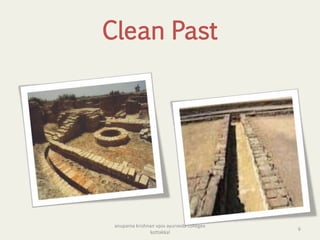
Clean Past
6
anupama krishnan vpsv ayurveda collegee
kottakkal
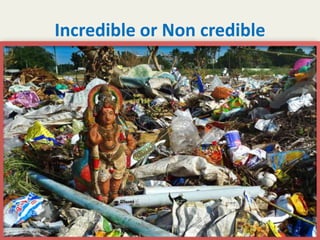
Incredible or Non credible
7
anupama krishnan vpsv ayurveda collegee
kottakkal
8
anupama krishnan vpsv ayurveda collegee
kottakkal
s
9
anupama krishnan vpsv ayurveda collegee
kottakkal
Gods own…
10
anupama krishnan vpsv ayurveda collegee
kottakkal
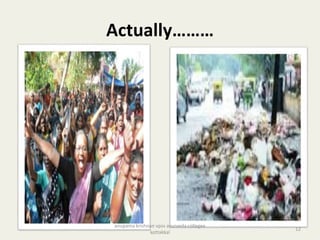
Actually………
12
anupama krishnan vpsv ayurveda collegee
kottakkal
INDUSRIALISATION
14
anupama krishnan vpsv ayurveda collegee
kottakkal
Great Sanitary Awakening
(1800s-1900s)
• Growth in scientific knowledge
• Humanitarian ideals
• Connection between poverty
and disease
• Water supply , sewage removal
• Monitor community health status
15
anupama krishnan vpsv ayurveda collegee
kottakkal
Sanitary revolution
• Clean water; water treatment
• Food inspection
• Soaps, disinfectants, pharmaceuticals
• Personal hygiene (bathing)

• Public works departments; garbage
collection, landfills, street cleaning
• Public health departments and regulation
16
anupama krishnan vpsv ayurveda collegee
kottakkal
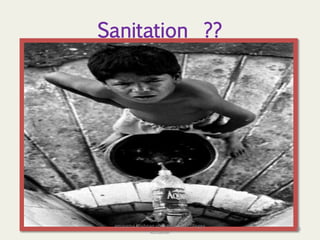
Sanitation ??
18
anupama krishnan vpsv ayurveda collegee
kottakkal
What does it mean
Sanitation[san′itā′shən]
• Etymology: L, sanitas, health
science of maintaining a healthful, disease
free, hazard free environment
(Mosby's Medical Dictionary, 9th edition. ©
2009, Elsevier)
19
anupama krishnan vpsv ayurveda collegee
kottakkal
Safe management of human excreta, including
its safe confinement ,treatment, disposal and
associated hygiene-related practices.
National Urban Sanitation Policy (2008)
20
anupama krishnan vpsv ayurveda collegee
kottakkal
• ‘Sanitation’ is a subject matter included in
Entry 6 of the State List
• Article 246 of Constitution of India
21
anupama krishnan vpsv ayurveda collegee
kottakkal
Coverage
• 2.6 billion people lack access to improved
sanitation
• Two thirds of whom live in Asia and Saharan
Africa
• More than half live in India, lack even an
unimproved sanitation facility and must
defecate in the open
22
anupama krishnan vpsv ayurveda collegee
kottakkal
Consequence
• Every year, 1.5 million children die due to
diarrhea caused by combined effects of
inadequate sanitation, unsafe water supply,
and poor personal hygiene
• Lack of sanitation contributes to about 10%
of the global disease burden
23
anupama krishnan vpsv ayurveda collegee
kottakkal
• 1 billion people regularly defecate in the
open (United Nations)
• Dramatic consequences on the human
health, dignity and security
• One out of three women around the world
lack access to safe toilets
24
anupama krishnan vpsv ayurveda collegee
kottakkal
Disparity
Improved sanitation
• Industrialised countries 99%
• Developing countries 53%
• Developing countries - urban sanitation
coverage is 71% while rural coverage is 39%.
25
anupama krishnan vpsv ayurveda collegee
kottakkal
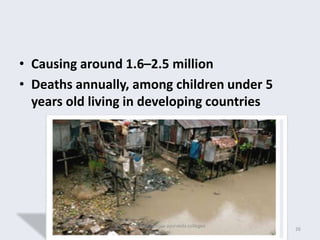
• Causing around 1.6–2.5 million
• Deaths annually, among children under 5
years old living in developing countries
26
anupama krishnan vpsv ayurveda collegee
kottakkal
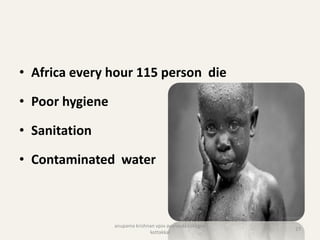
• Africa every hour 115 person die
• Poor hygiene
• Sanitation
• Contaminated water
27
anupama krishnan vpsv ayurveda collegee
kottakkal
28
anupama krishnan vpsv ayurveda collegee
kottakkal
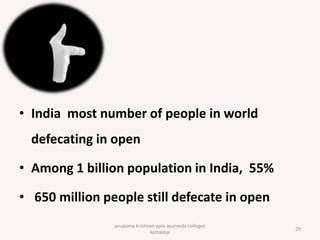
• India most number of people in world
defecating in open
• Among 1 billion population in India, 55%
• 650 million people still defecate in open
29
anupama krishnan vpsv ayurveda collegee
kottakkal
30
anupama krishnan vpsv ayurveda collegee
kottakkal
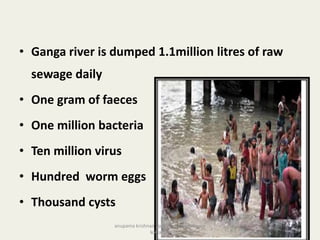
• Ganga river is dumped 1.1million litres of raw
sewage daily
• One gram of faeces
• One million bacteria
• Ten million virus
• Hundred worm eggs
• Thousand cysts
31
anupama krishnan vpsv ayurveda collegee
kottakkal
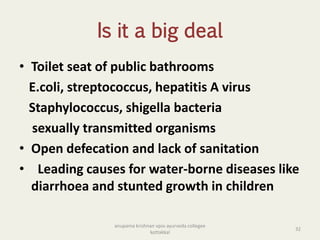
Is it a big deal
• Toilet seat of public bathrooms
E.coli, streptococcus, hepatitis A virus
Staphylococcus, shigella bacteria
sexually transmitted organisms
• Open defecation and lack of sanitation
• Leading causes for water-borne diseases like
diarrhoea and stunted growth in children
32
anupama krishnan vpsv ayurveda collegee
kottakkal
Impact
• Diseases faecooral transmission pathway
• Soil transmitted helminths - human
roundworm, human whipworm, hookworms
• Infections every year in kids
• Anaemia in pregnant women
33
anupama krishnan vpsv ayurveda collegee
kottakkal
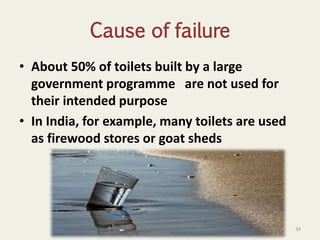
Cause of failure
• About 50% of toilets built by a large
government programme are not used for
their intended purpose
• In India, for example, many toilets are used
as firewood stores or goat sheds
34
anupama krishnan vpsv ayurveda collegee
kottakkal
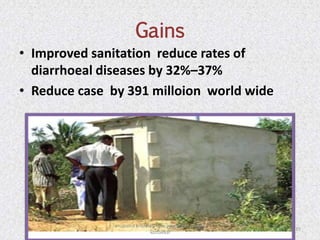
Gains
• Improved sanitation reduce rates of
diarrhoeal diseases by 32%–37%
• Reduce case by 391 milloion world wide
35
anupama krishnan vpsv ayurveda collegee
kottakkal
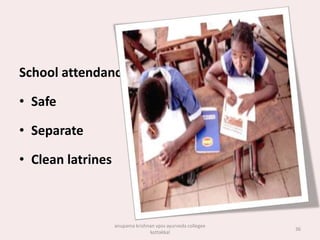
School attendance
• Safe
• Separate
• Clean latrines
36
anupama krishnan vpsv ayurveda collegee
kottakkal
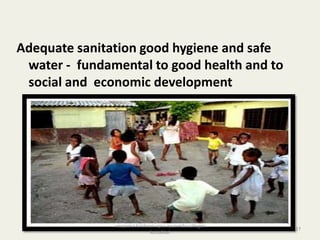
Adequate sanitation good hygiene and safe
water - fundamental to good health and to
social and economic development
37
anupama krishnan vpsv ayurveda collegee
kottakkal
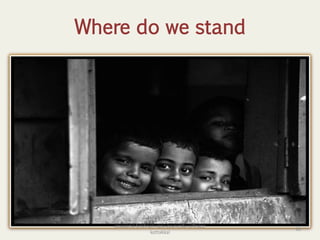
Where do we stand
•
38
anupama krishnan vpsv ayurveda collegee
kottakkal
Kerala Calls
• About 93,046 households do not
have access to sanitary toilets
• About 32,425 of these households use
shared toilet facilities
• Open defecation - 60,621
• Adding to the fecal load in the environment
39
anupama krishnan vpsv ayurveda collegee
kottakkal
Ray of hope ……..
• Kerala Total Health and Sanitation Mission
• Clean Kerala program under Rural Development
Department
• Within three years - 413,000 latrines
• Kerala currently highest coverage
of individual household latrines in India
41
anupama krishnan vpsv ayurveda collegee
kottakkal
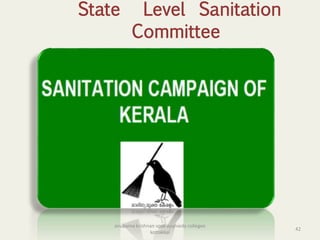
State Level Sanitation
Committee
42
anupama krishnan vpsv ayurveda collegee
kottakkal
Suchitwa Mission
• Kudumbashree
• General Education Department
• Health & Family Welfare Department
• Kerala State Pollution Control Board
• Kerala Water Authority
• Town Planning Department
43
anupama krishnan vpsv ayurveda collegee
kottakkal
Suchitwa mission
• Package of Practices
• Personal hygiene
• Safe disposal of human excreta
• Home sanitation food hygiene
• Safe handling drinking water
• Liquid waste management
• Solid waste management
• Community environmental sanitation
44
anupama krishnan vpsv ayurveda collegee
kottakkal
Goal of Kerala
State Sanitation Strategy
• Ensuring 100 percent hygienically safe
sanitation
• Awareness sustained behavioral change
• Achieving Open Defecation Free Cities
• Improved Institutional governance
• Human resource capacities for city-wide
Sanitation
45
anupama krishnan vpsv ayurveda collegee
kottakkal
Role
• Social scientists
• Behaviour change Experts
• Health professionals
• Individual people
46
anupama krishnan vpsv ayurveda collegee
kottakkal
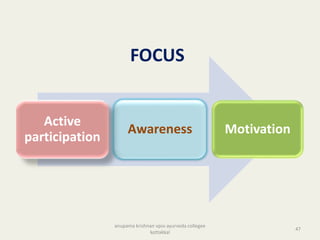
FOCUS
Active
participation
Awareness Motivation
47
anupama krishnan vpsv ayurveda collegee
kottakkal
Community Led Total Sanitation
• Ignite community awareness
Encourages a cooperative
participatory approach ending open
defecation
• Creating a clean, healthy, and hygienic
environment from which everyone benefits
48
anupama krishnan vpsv ayurveda collegee
kottakkal
Activities undertaken to assure the
conditions in which people can be healthy
Organized community efforts to prevent,
identify and counter threats to the health of
the public.
49
anupama krishnan vpsv ayurveda collegee
kottakkal
Why Ayurveda
Public Health
“the science and art of pre-venting diseases,
prolonging life, promoting health ,efficiency
through organized community efforts…”.
(CEA Winslow ,1920)
50
anupama krishnan vpsv ayurveda collegee
kottakkal
Ayurveda Role
• Environmental sanitation
• Control of community infections
• Healthy lifestyle , personal hygiene
• Early diagnosis, preventive treatment
51
anupama krishnan vpsv ayurveda collegee
kottakkal
Activity
Explore
• Survey hand washing practices
• Observe behavior of people using public toilets
(flush before using urinal, wash hands after
using urinal)
Discover
• Way people wash their hands
( wash rigourously, use of soap )
• People’s view on open defecation and urination
52
anupama krishnan vpsv ayurveda collegee
kottakkal
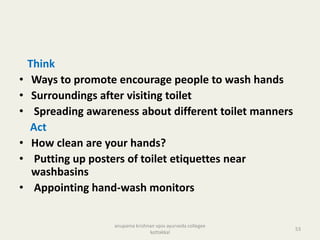
Think
• Ways to promote encourage people to wash hands
• Surroundings after visiting toilet
• Spreading awareness about different toilet manners
Act
• How clean are your hands?
• Putting up posters of toilet etiquettes near
washbasins
• Appointing hand-wash monitors
53
anupama krishnan vpsv ayurveda collegee
kottakkal
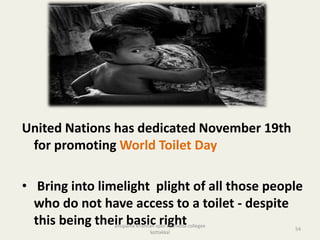
United Nations has dedicated November 19th
for promoting World Toilet Day
• Bring into limelight plight of all those people
who do not have access to a toilet - despite
this being their basic right 54
anupama krishnan vpsv ayurveda collegee
kottakkal
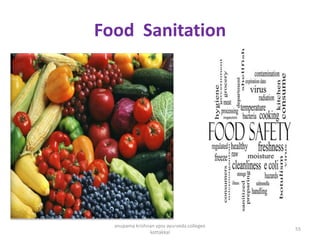
Food Sanitation
55
anupama krishnan vpsv ayurveda collegee
kottakkal
Process of handling food in ways
that are clean and healthy
56
anupama krishnan vpsv ayurveda collegee
kottakkal
57
anupama krishnan vpsv ayurveda collegee
kottakkal
58
anupama krishnan vpsv ayurveda collegee
kottakkal
59
anupama krishnan vpsv ayurveda collegee
kottakkal
60
anupama krishnan vpsv ayurveda collegee
kottakkal
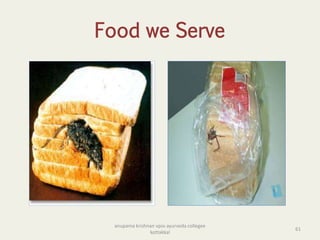
Food we Serve
anupama krishnan vpsv ayurveda collegee
kottakkal
61
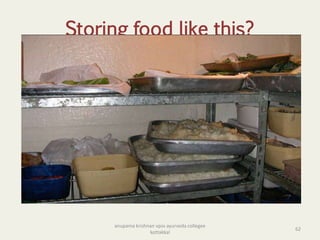
Storing food like this?
62
anupama krishnan vpsv ayurveda collegee
kottakkal
64
anupama krishnan vpsv ayurveda collegee
kottakkal
65
anupama krishnan vpsv ayurveda collegee
kottakkal
66
anupama krishnan vpsv ayurveda collegee
kottakkal
• Food Infection - microbial infection
resulting from ingestion of
contaminated foods
• Food Intoxication - type of illness
caused by toxins
67
anupama krishnan vpsv ayurveda collegee
kottakkal
• Food Spoilage - means original
nutritional value, texture, flavor of food
are damaged, food become harmful to
people and unsuitable to eat.
• Food borne Illness – A disease carried
or transmitted to people by food.
68
anupama krishnan vpsv ayurveda collegee
kottakkal
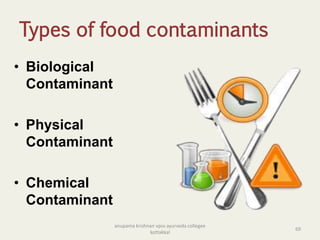
Types of food contaminants
• Biological
Contaminant
• Physical
Contaminant
• Chemical
Contaminant
69
anupama krishnan vpsv ayurveda collegee
kottakkal
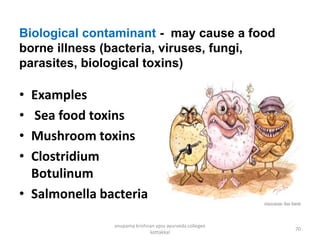
Biological contaminant - may cause a food
borne illness (bacteria, viruses, fungi,
parasites, biological toxins)
• Examples
• Sea food toxins
• Mushroom toxins
• Clostridium
Botulinum
• Salmonella bacteria
70
anupama krishnan vpsv ayurveda collegee
kottakkal
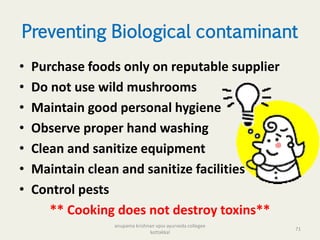
Preventing Biological contaminant
• Purchase foods only on reputable supplier
• Do not use wild mushrooms
• Maintain good personal hygiene
• Observe proper hand washing
• Clean and sanitize equipment
• Maintain clean and sanitize facilities
• Control pests
** Cooking does not destroy toxins**
71
anupama krishnan vpsv ayurveda collegee
kottakkal
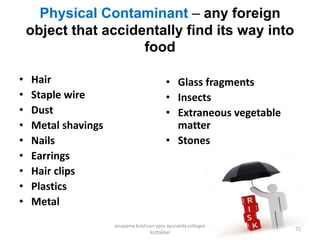
Physical Contaminant – any foreign
object that accidentally find its way into
food
• Hair
• Staple wire
• Dust
• Metal shavings
• Nails
• Earrings
• Hair clips
• Plastics
• Metal
• Glass fragments
• Insects
• Extraneous vegetable
matter
• Stones
72
anupama krishnan vpsv ayurveda collegee
kottakkal
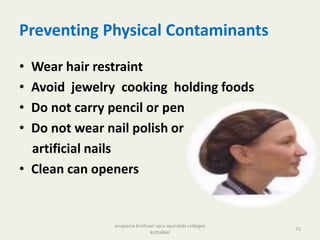
Preventing Physical Contaminants
• Wear hair restraint
• Avoid jewelry cooking holding foods
• Do not carry pencil or pen
• Do not wear nail polish or
artificial nails
• Clean can openers
73
anupama krishnan vpsv ayurveda collegee
kottakkal
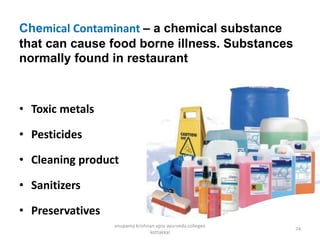
Chemical Contaminant – a chemical substance
that can cause food borne illness. Substances
normally found in restaurant
• Toxic metals
• Pesticides
• Cleaning product
• Sanitizers
• Preservatives
74
anupama krishnan vpsv ayurveda collegee
kottakkal
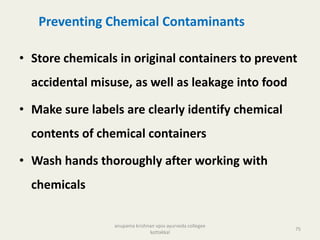
Preventing Chemical Contaminants
• Store chemicals in original containers to prevent
accidental misuse, as well as leakage into food
• Make sure labels are clearly identify chemical
contents of chemical containers
• Wash hands thoroughly after working with
chemicals
75
anupama krishnan vpsv ayurveda collegee
kottakkal
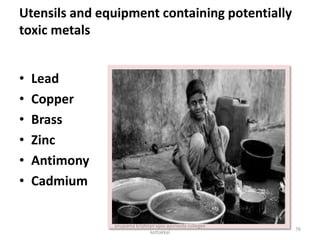
Utensils and equipment containing potentially
toxic metals
• Lead
• Copper
• Brass
• Zinc
• Antimony
• Cadmium
76
anupama krishnan vpsv ayurveda collegee
kottakkal
Main Causes of Food Borne
Illness
• Cross- Contamination
• Time-Temperature Abuse
• Poor Personal Hygiene
77
anupama krishnan vpsv ayurveda collegee
kottakkal
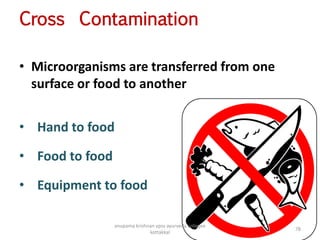
Cross Contamination
• Microorganisms are transferred from one
surface or food to another
• Hand to food
• Food to food
• Equipment to food
78
anupama krishnan vpsv ayurveda collegee
kottakkal
Preventing
Hand to food
 Wash hands properly
Cover cuts, sores and wounds
Keep fingernails short, unpolished & clean
Avoid wearing jewelry, except for plain ring
79
anupama krishnan vpsv ayurveda collegee
kottakkal
Food to Food Contamination
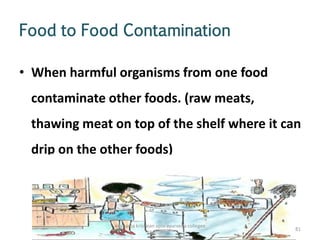
• When harmful organisms from one food
contaminate other foods. (raw meats,
thawing meat on top of the shelf where it can
drip on the other foods)
81
anupama krishnan vpsv ayurveda collegee
kottakkal
Preventing food to food
contamination
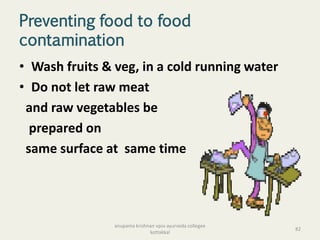
• Wash fruits & veg, in a cold running water
• Do not let raw meat
and raw vegetables be
prepared on
same surface at same time
82
anupama krishnan vpsv ayurveda collegee
kottakkal
Equipment to Food Contamination
• Use separate cutting boards for different foods
(meat- veg)
• Prepare raw foods in separate area from fresh
and ready to eat foods
• Clean & sanitize equipment, work surfaces &
utensils after preparing each foods
• Use specific containers for various food
products.
• Make sure cloth paper towel use for wiping
spills not used for any other purposes
83
anupama krishnan vpsv ayurveda collegee
kottakkal
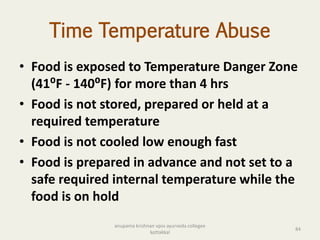
Time Temperature Abuse
• Food is exposed to Temperature Danger Zone
(41⁰F - 140⁰F) for more than 4 hrs
• Food is not stored, prepared or held at a
required temperature
• Food is not cooled low enough fast
• Food is prepared in advance and not set to a
safe required internal temperature while the
food is on hold
84
anupama krishnan vpsv ayurveda collegee
kottakkal
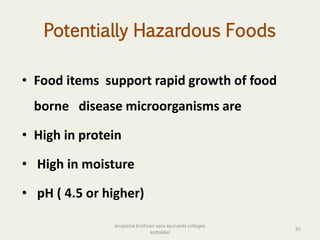
Potentially Hazardous Foods
• Food items support rapid growth of food
borne disease microorganisms are
• High in protein
• High in moisture
• pH ( 4.5 or higher)
85
anupama krishnan vpsv ayurveda collegee
kottakkal
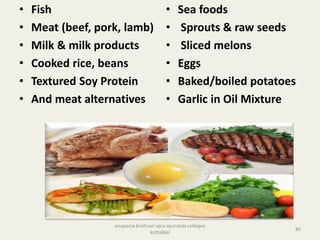
• Fish
• Meat (beef, pork, lamb)
• Milk & milk products
• Cooked rice, beans
• Textured Soy Protein
• And meat alternatives
• Sea foods
• Sprouts & raw seeds
• Sliced melons
• Eggs
• Baked/boiled potatoes
• Garlic in Oil Mixture
86
anupama krishnan vpsv ayurveda collegee
kottakkal
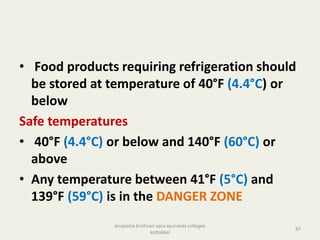
• Food products requiring refrigeration should
be stored at temperature of 40°F (4.4°C) or
below
Safe temperatures
• 40°F (4.4°C) or below and 140°F (60°C) or
above
• Any temperature between 41°F (5°C) and
139°F (59°C) is in the DANGER ZONE
87
anupama krishnan vpsv ayurveda collegee
kottakkal
• Food products may have danger zone during
some periods of preparation
• Food is being mixed with other ingredients,
chopped, or formed - danger zone
• At each stage of preparing and serving
• Product may be exposed to unsafe
temperatures and chance of becoming
contaminated
88
anupama krishnan vpsv ayurveda collegee
kottakkal
• Goal in temperature control - minimize time
PHF are in danger zone
• Three hours cumulative time is maximum
such food can be in the danger zone and not
be a health hazard
• After 4 hours in danger zone, enough bacteria
may have grown in food to cause foodborne
disease outbreaks
89
anupama krishnan vpsv ayurveda collegee
kottakkal
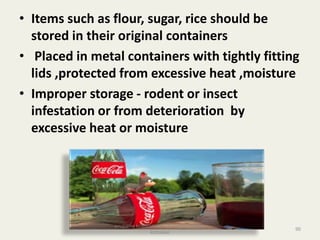
• Items such as flour, sugar, rice should be
stored in their original containers
• Placed in metal containers with tightly fitting
lids ,protected from excessive heat ,moisture
• Improper storage - rodent or insect
infestation or from deterioration by
excessive heat or moisture
90
anupama krishnan vpsv ayurveda collegee
kottakkal
• Acid food or beverages, potato salad, tomato
juice, lemonade, citrus fruit drink, or other
acidified drinks, must never be stored or
served in galvanized container
• Capable of dissolving the zinc which can
cause heavy metal poisoning
91
anupama krishnan vpsv ayurveda collegee
kottakkal
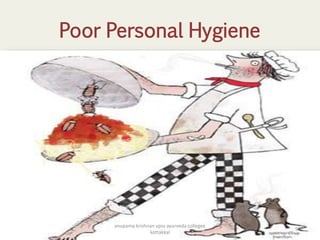
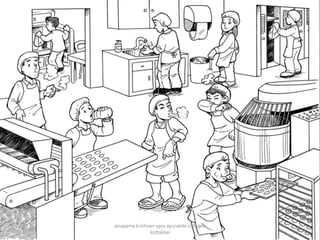
Poor Personal Hygiene
92
anupama krishnan vpsv ayurveda collegee
kottakkal
93
anupama krishnan vpsv ayurveda collegee
kottakkal
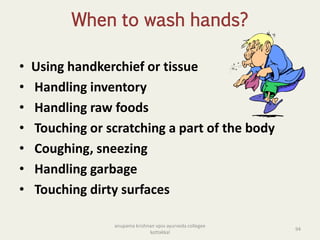
When to wash hands?
• Using handkerchief or tissue
• Handling inventory
• Handling raw foods
• Touching or scratching a part of the body
• Coughing, sneezing
• Handling garbage
• Touching dirty surfaces
94
anupama krishnan vpsv ayurveda collegee
kottakkal
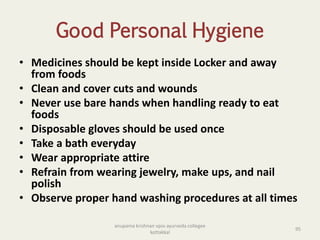
Good Personal Hygiene
• Medicines should be kept inside Locker and away
from foods
• Clean and cover cuts and wounds
• Never use bare hands when handling ready to eat
foods
• Disposable gloves should be used once
• Take a bath everyday
• Wear appropriate attire
• Refrain from wearing jewelry, make ups, and nail
polish
• Observe proper hand washing procedures at all times
95
anupama krishnan vpsv ayurveda collegee
kottakkal
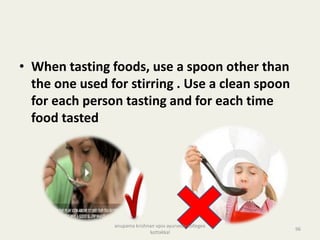
• When tasting foods, use a spoon other than
the one used for stirring . Use a clean spoon
for each person tasting and for each time
food tasted
96
anupama krishnan vpsv ayurveda collegee
kottakkal
anupama krishnan vpsv ayurveda collegee
kottakkal
97
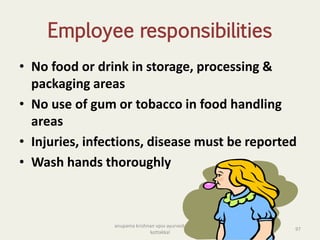
Employee responsibilities
• No food or drink in storage, processing &
packaging areas
• No use of gum or tobacco in food handling
areas
• Injuries, infections, disease must be reported
• Wash hands thoroughly
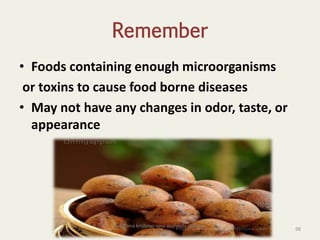
Remember
• Foods containing enough microorganisms
or toxins to cause food borne diseases
• May not have any changes in odor, taste, or
appearance
98
anupama krishnan vpsv ayurveda collegee
kottakkal
100
anupama krishnan vpsv ayurveda collegee
kottakkal
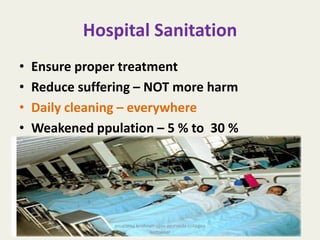
Hospital Sanitation
• Ensure proper treatment
• Reduce suffering – NOT more harm
• Daily cleaning – everywhere
• Weakened ppulation – 5 % to 30 %
101
anupama krishnan vpsv ayurveda collegee
kottakkal
• Nosocomial Infections or hospital acquired
infections
• Acquired during or as a result of hospitalization
• Any patient who develops an infection after 48
hours of hospitalization considered to have
nosocomial infection
102
anupama krishnan vpsv ayurveda collegee
kottakkal
• Healthcare-associated infections (HAIs) occur
worldwide
• 1.4 million people worldwide suffer from
infections acquired in hospital
103
anupama krishnan vpsv ayurveda collegee
kottakkal
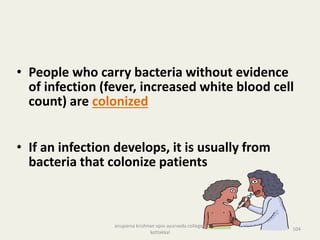
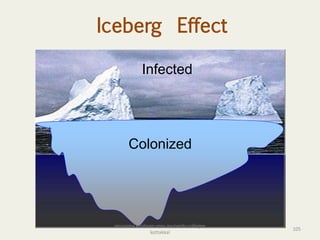
• People who carry bacteria without evidence
of infection (fever, increased white blood cell
count) are colonized
• If an infection develops, it is usually from
bacteria that colonize patients
104
anupama krishnan vpsv ayurveda collegee
kottakkal
Iceberg Effect
Infected
Colonized
105
anupama krishnan vpsv ayurveda collegee
kottakkal
• Bacteria that colonize patients can be
transmitted from one patient to another by
the hands of healthcare workers
• Bacteria can be transmitted even if the
patient is not infected
106
anupama krishnan vpsv ayurveda collegee
kottakkal
• Hands of healthcare providers most common
vehicle for the transmission of
• Microorganisms from patient to patient
• Patient to equipment and environment
• Equipment and environment to the patient
own body
107
anupama krishnan vpsv ayurveda collegee
kottakkal
• Provider‟s hands continuously touch surfaces
and substances including inanimate objects
• Patient‟s intact or non-intact skin, mucous
membranes, food, waste, body fluids and
healthcare provider‟s own body
108
anupama krishnan vpsv ayurveda collegee
kottakkal
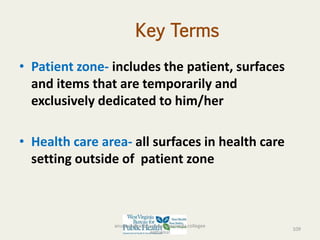
Key Terms
• Patient zone- includes the patient, surfaces
and items that are temporarily and
exclusively dedicated to him/her
• Health care area- all surfaces in health care
setting outside of patient zone
109
anupama krishnan vpsv ayurveda collegee
kottakkal
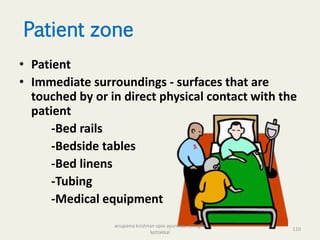
Patient zone
• Patient
• Immediate surroundings - surfaces that are
touched by or in direct physical contact with the
patient
-Bed rails
-Bedside tables
-Bed linens
-Tubing
-Medical equipment
110
anupama krishnan vpsv ayurveda collegee
kottakkal
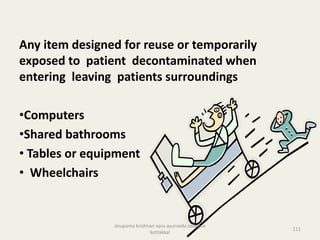
Any item designed for reuse or temporarily
exposed to patient decontaminated when
entering leaving patients surroundings
•Computers
•Shared bathrooms
• Tables or equipment
• Wheelchairs
111
anupama krishnan vpsv ayurveda collegee
kottakkal
Health-care Area
•Is everything outside of patient zone
• Hand hygiene while caring for patients helps
to protect wider health care environment
from contamination by patients germs
112
anupama krishnan vpsv ayurveda collegee
kottakkal
• “Adherence to hand hygiene
recommendations is the single most
important practice for preventing the
transmission of microorganisms in
healthcare and directly contributes to
patient safety.”
113
anupama krishnan vpsv ayurveda collegee
kottakkal
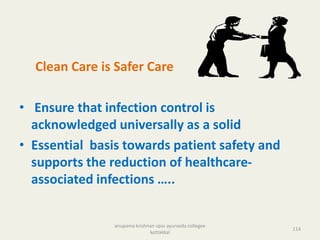
Clean Care is Safer Care
• Ensure that infection control is
acknowledged universally as a solid
• Essential basis towards patient safety and
supports the reduction of healthcare-
associated infections …..
114
anupama krishnan vpsv ayurveda collegee
kottakkal
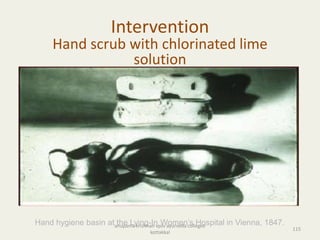
Intervention
Hand scrub with chlorinated lime
solution
Hand hygiene basin at the Lying-In Women’s Hospital in Vienna, 1847.
115
anupama krishnan vpsv ayurveda collegee
kottakkal
• Hand hygiene removal of visible soil and
removal or killing of transient
microorganisms from hands
• All humans carry microorganisms on their
skin
• Two groups – Transient and Resident flora
116
anupama krishnan vpsv ayurveda collegee
kottakkal
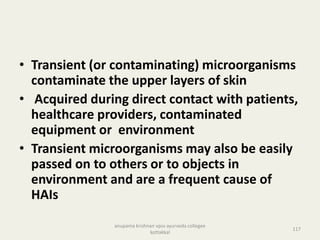
• Transient (or contaminating) microorganisms
contaminate the upper layers of skin
• Acquired during direct contact with patients,
healthcare providers, contaminated
equipment or environment
• Transient microorganisms may also be easily
passed on to others or to objects in
environment and are a frequent cause of
HAIs
117
anupama krishnan vpsv ayurveda collegee
kottakkal
• Resident flora are found in deeper layers of
skin and are more resistant to removal
• Do not generally cause HAIs
• Beneficial to good health of skin
118
anupama krishnan vpsv ayurveda collegee
kottakkal
Why learn Hand Hygiene?
• Hand hygiene is the most important way to prevent the
spread of germs
• Reduce number of germs on hands and helps reduce
spread of germs to family, friends, coworkers, patients,
residents or clients
• Using appropriate hand hygiene prevents
contamination of the patient’s, client’s, or resident’s
environment
119
anupama krishnan vpsv ayurveda collegee
kottakkal
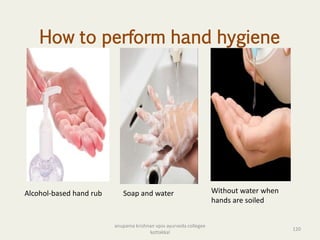
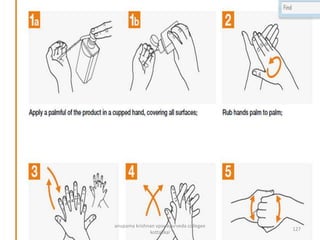
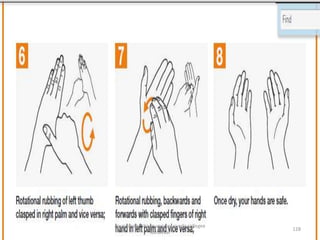
How to perform hand hygiene
Alcohol-based hand rub Soap and water Without water when
hands are soiled
120
anupama krishnan vpsv ayurveda collegee
kottakkal
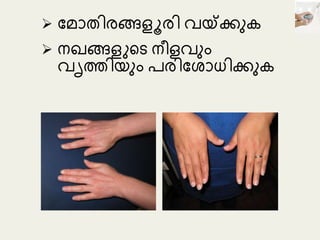
 മ ോതിരങ്ങളൂരി വയ്ക്കുക
 നഖങ്ങളുടെ നീളവുും
വൃത്തിയുും പരിമ ോധികുക
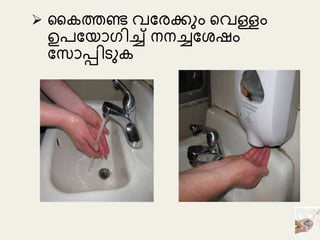
 കകത്തണ്ട വമരകുും ടവള്ളും
ഉപമയോഗിച്ച് നനച്ചമ ഷും
മ ോപ്പിെുക
 ഇരുപത് ട കണ്ട് മനരും
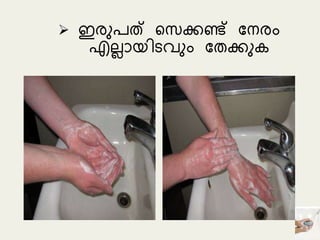
എല്ലോയിെവുും മതകുക
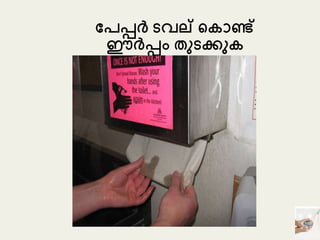
പേപ്പർ ടവല് ക ൊണ്ട്
ഈർപ്പം തുടക്കു
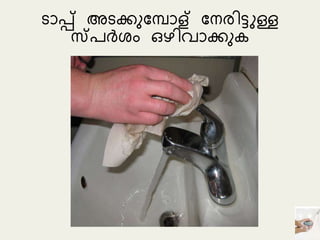
െോപ്പ് അെകുമപോള് മനരിട്ടുള്ള
സ്പർ ും ഒഴിവോകുക
127
anupama krishnan vpsv ayurveda collegee
kottakkal
128
anupama krishnan vpsv ayurveda collegee
kottakkal
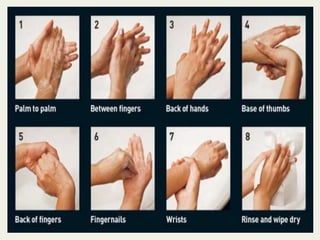
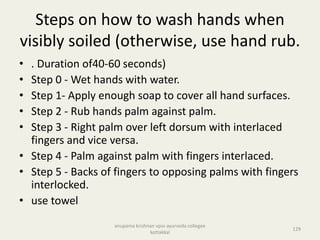
Steps on how to wash hands when
visibly soiled (otherwise, use hand rub.
• . Duration of40-60 seconds)
• Step 0 - Wet hands with water.
• Step 1- Apply enough soap to cover all hand surfaces.
• Step 2 - Rub hands palm against palm.
• Step 3 - Right palm over left dorsum with interlaced
fingers and vice versa.
• Step 4 - Palm against palm with fingers interlaced.
• Step 5 - Backs of fingers to opposing palms with fingers
interlocked.
• use towel
129
anupama krishnan vpsv ayurveda collegee
kottakkal
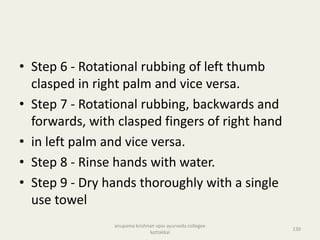
• Step 6 - Rotational rubbing of left thumb
clasped in right palm and vice versa.
• Step 7 - Rotational rubbing, backwards and
forwards, with clasped fingers of right hand
• in left palm and vice versa.
• Step 8 - Rinse hands with water.
• Step 9 - Dry hands thoroughly with a single
use towel
130
anupama krishnan vpsv ayurveda collegee
kottakkal
Effective Hand Hygiene
• Alcohol-based hand rub (ABHR)
• Should contain 70 – 90% alcohol
• Takes less time than hand washing
• More effective than hand washing with soap
and water when hands are not visibly soiled
132
anupama krishnan vpsv ayurveda collegee
kottakkal
• Common types of alcohols used include
ethanol,isopropanol or combinations
• Antimicrobial action of ethanol and
isopropanol similar
• Ethanol has greater activity against viruses
than isopropanol
• WHO recommended formulations contain
either 75% v/v isopropanol, or 80% v/v
ethanol
133
anupama krishnan vpsv ayurveda collegee
kottakkal
• Mechanical rubbing action is important to kill
transient microorganisms
• Less drying to hands than soap and water
134
anupama krishnan vpsv ayurveda collegee
kottakkal
Efficacy of ABHR
• Depends on the quality of product, the amount
of product used, time
• Spent rubbing ,hand surface rubbed
• NOT be used with water, water will
• Dilute alcohol and reduce its effectiveness
• ABHR should NOT used immediately after hand
washing with soap and water
135
anupama krishnan vpsv ayurveda collegee
kottakkal
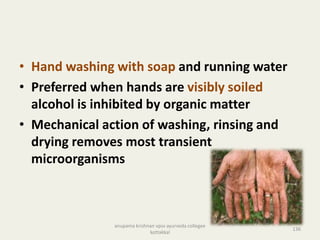
• Hand washing with soap and running water
• Preferred when hands are visibly soiled
alcohol is inhibited by organic matter
• Mechanical action of washing, rinsing and
drying removes most transient
microorganisms
136
anupama krishnan vpsv ayurveda collegee
kottakkal
Efficacy of Soaps
• Plain soaps act on hands by emulsifying dirt
and organic substances (e.g., blood, mucous),
which are then flushed away with rinsing
• Atleast 15 seconds of lathering with soap is
required to remove transient flora
137
anupama krishnan vpsv ayurveda collegee
kottakkal
• Antimicrobial soaps have residual
antimicrobial activity
• Not deactivated by presence of organic
material
• Antimicrobial soap may be considered for use
in critical care areas
138
anupama krishnan vpsv ayurveda collegee
kottakkal
• If hands are visibly soiled and running water
is not available
• Use a moistened to wetted to remove visible
soil, followed by ABHR
139
anupama krishnan vpsv ayurveda collegee
kottakkal
Soap Formulations and Product
Selection
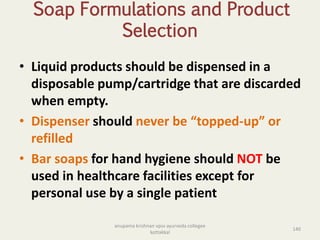
• Liquid products should be dispensed in a
disposable pump/cartridge that are discarded
when empty.
• Dispenser should never be “topped-up” or
refilled
• Bar soaps for hand hygiene should NOT be
used in healthcare facilities except for
personal use by a single patient
140
anupama krishnan vpsv ayurveda collegee
kottakkal
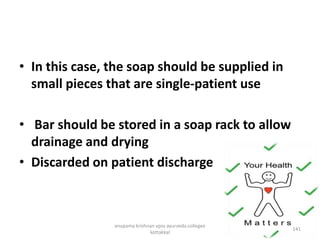
• In this case, the soap should be supplied in
small pieces that are single-patient use
• Bar should be stored in a soap rack to allow
drainage and drying
• Discarded on patient discharge
141
anupama krishnan vpsv ayurveda collegee
kottakkal
Hand Hygiene Indications
• Before initial contact with a patient or items in their
environment; this should be done on entry
• Room or bed space, even if patient has not been
touched
• Before putting on gloves;
• Before preparing, handling or serving food or
medications to a patient
• After care involving contact with blood, body fluids,
secretions and excretions of a patient,
• Immediately after removing gloves and before
moving to another activity
142
anupama krishnan vpsv ayurveda collegee
kottakkal
• Immediately after removing gloves and before
moving to another activity
• When moving from a contaminated body site to
a clean body site during healthcare
• After contact with a patient or items in their
immediate surroundings when leaving,even if
• Patient has not been touched
• Whenever in
143
anupama krishnan vpsv ayurveda collegee
kottakkal
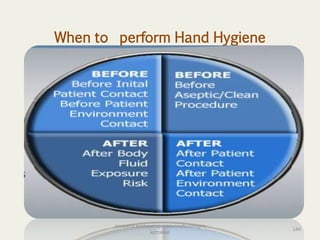
When to perform Hand Hygiene
144
anupama krishnan vpsv ayurveda collegee
kottakkal
“ My Five Moments for Hand Hygiene ”
145
anupama krishnan vpsv ayurveda collegee
kottakkal
Before touching a patient
• WHEN? Clean your hands before touching a
patient
• WHY? To protect the patient against harmful
germs carried on your hands
146
anupama krishnan vpsv ayurveda collegee
kottakkal
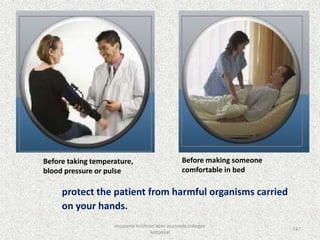
protect the patient from harmful organisms carried
on your hands.
Before taking temperature,
blood pressure or pulse
Before making someone
comfortable in bed
147
anupama krishnan vpsv ayurveda collegee
kottakkal
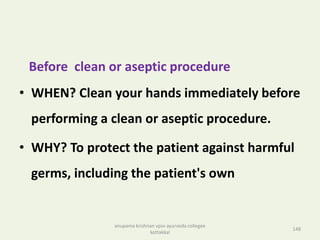
Before clean or aseptic procedure
• WHEN? Clean your hands immediately before
performing a clean or aseptic procedure.
• WHY? To protect the patient against harmful
germs, including the patient's own
148
anupama krishnan vpsv ayurveda collegee
kottakkal
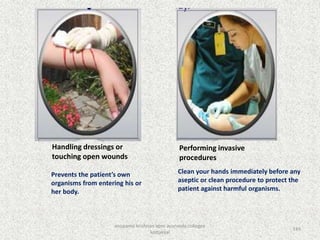
Clean your hands immediately before any
aseptic or clean procedure to protect the
patient against harmful organisms.
Handling dressings or
touching open wounds
Performing invasive
procedures
Prevents the patient’s own
organisms from entering his or
her body.
149
anupama krishnan vpsv ayurveda collegee
kottakkal
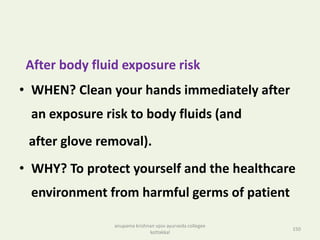
After body fluid exposure risk
• WHEN? Clean your hands immediately after
an exposure risk to body fluids (and
after glove removal).
• WHY? To protect yourself and the healthcare
environment from harmful germs of patient
150
anupama krishnan vpsv ayurveda collegee
kottakkal
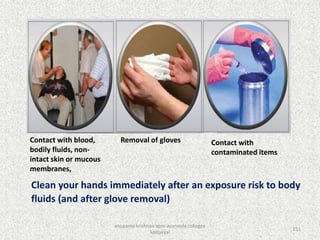
Clean your hands immediately after an exposure risk to body
fluids (and after glove removal)
Contact with blood,
bodily fluids, non-
intact skin or mucous
membranes,
Removal of gloves Contact with
contaminated items
151
anupama krishnan vpsv ayurveda collegee
kottakkal
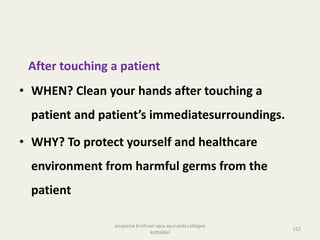
After touching a patient
• WHEN? Clean your hands after touching a
patient and patient’s immediatesurroundings.
• WHY? To protect yourself and healthcare
environment from harmful germs from the
patient
152
anupama krishnan vpsv ayurveda collegee
kottakkal
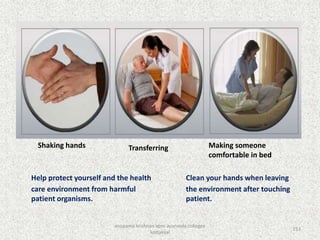
Clean your hands when leaving
the environment after touching
patient.
Shaking hands Transferring Making someone
comfortable in bed
Help protect yourself and the health
care environment from harmful
patient organisms.
153
anupama krishnan vpsv ayurveda collegee
kottakkal
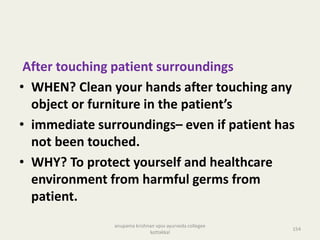
After touching patient surroundings
• WHEN? Clean your hands after touching any
object or furniture in the patient’s
• immediate surroundings– even if patient has
not been touched.
• WHY? To protect yourself and healthcare
environment from harmful germs from
patient.
154
anupama krishnan vpsv ayurveda collegee
kottakkal
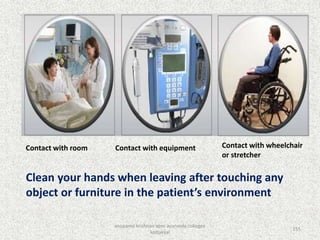
Clean your hands when leaving after touching any
object or furniture in the patient’s environment
Contact with room Contact with equipment Contact with wheelchair
or stretcher
155
anupama krishnan vpsv ayurveda collegee
kottakkal
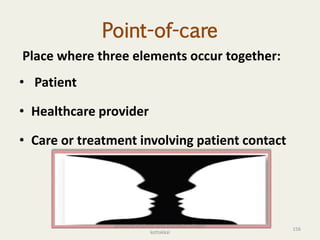
Point-of-care
Place where three elements occur together:
• Patient
• Healthcare provider
• Care or treatment involving patient contact
156
anupama krishnan vpsv ayurveda collegee
kottakkal
• Intact skin is the body‟s first line of defence
against infection
• Careful attention to hand care essential part
of the hand hygiene program
• Dermatitis, cracks, cuts or abrasions can trap
bacteria and compromise hand hygiene
• Dermatitis also increases shedding of skin
squames and, therefore, shedding of bacteria
157
anupama krishnan vpsv ayurveda collegee
kottakkal
• 30% of healthcare providers report
symptoms or signs of dermatitis
• 85% give a history of having skin problems
• promoting skin integrity through providing
good hand hygiene products
• correct techniques for hand hygiene vital for
safety of both healthcare provider and
patients
158
anupama krishnan vpsv ayurveda collegee
kottakkal
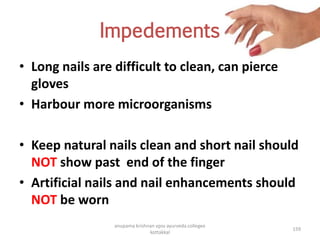
Impedements
• Long nails are difficult to clean, can pierce
gloves
• Harbour more microorganisms
• Keep natural nails clean and short nail should
NOT show past end of the finger
• Artificial nails and nail enhancements should
NOT be worn
159
anupama krishnan vpsv ayurveda collegee
kottakkal
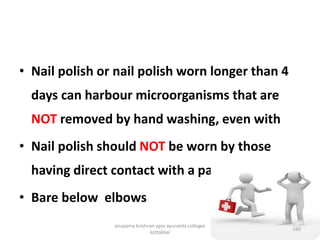
• Nail polish or nail polish worn longer than 4
days can harbour microorganisms that are
NOT removed by hand washing, even with
• Nail polish should NOT be worn by those
having direct contact with a patient
• Bare below elbows
160
anupama krishnan vpsv ayurveda collegee
kottakkal
Impedements
• Rings, hand jewellery, bracelets and wrist watches
should not be worn when performing hand hygiene.
• Jewellery, which hides bacteria and viruses
• Rings, which increase the number of microorganisms
present on hands
• Increase risk of tears in gloves
• Eczema, which often starts under a ring as irritants
may be trapped under ring causing irritation
161
anupama krishnan vpsv ayurveda collegee
kottakkal
Hand Hygiene Policies and
Procedures
• indications for hand hygiene
• how to perform hand hygiene
• selection of products used for hand hygiene
• appropriate placement of hand hygiene
products
• management of product dispensing container
• hand care program
• use of ABHR as the preferred method of hand
hygiene
• hand hygiene compliance and feedback
162
anupama krishnan vpsv ayurveda collegee
kottakkal
Sink use
• Hand hygiene sinks shall not be dedicated to
any other purpose
• Sinks used for cleaning equipment or
disposing of any waste fluids of any sort shall
not be used for hand hygiene
165
anupama krishnan vpsv ayurveda collegee
kottakkal
• Hand hygiene sinks shall be constructed of a
non-porous material such as porcelain,
enamel, vitreous china, or 18+ gauge
stainless steel
• Granite and marble are not acceptable
materials for hand hygiene sinks
166
anupama krishnan vpsv ayurveda collegee
kottakkal
• Traps shall be metal, and gaskets shall be
plastic or neoprene only
• Traps shall be 40 mm diameter.
• Overflows shall not be used, as difficulty of
sanitizing them presents an unacceptable
contamination risk.
167
anupama krishnan vpsv ayurveda collegee
kottakkal
Standard
• Wash hands before and after all patient or
specimen contact
• Handle the blood of all patients as potentially
infectious
• Wear gloves for potential contact with blood
and body fluids
168
anupama krishnan vpsv ayurveda collegee
kottakkal
• Prevent needle stick/sharp injuries
• Wear personal protective equipment (PPE)
while handling blood or body fluids
• Handle all linen soiled with blood and/or
body secretion as potentially infectious
169
anupama krishnan vpsv ayurveda collegee
kottakkal
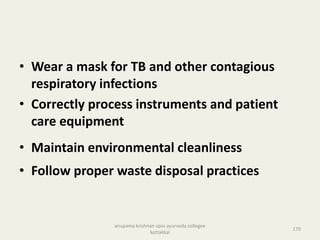
• Wear a mask for TB and other contagious
respiratory infections
• Correctly process instruments and patient
care equipment
• Maintain environmental cleanliness
• Follow proper waste disposal practices
170
anupama krishnan vpsv ayurveda collegee
kottakkal
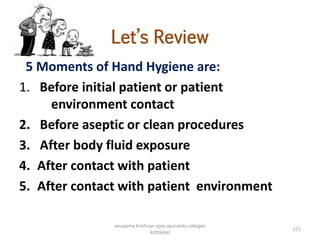
Let’s Review
5 Moments of Hand Hygiene are:
1. Before initial patient or patient
environment contact
2. Before aseptic or clean procedures
3. After body fluid exposure
4. After contact with patient
5. After contact with patient environment
171
anupama krishnan vpsv ayurveda collegee
kottakkal
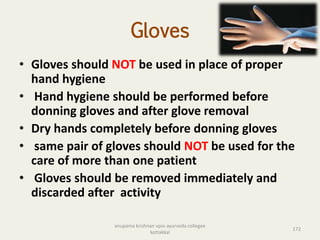
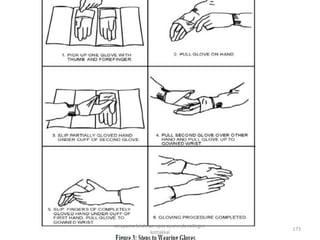
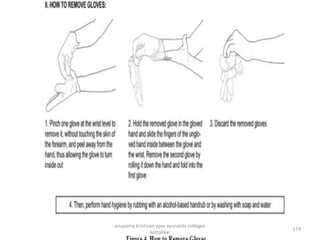
Gloves
• Gloves should NOT be used in place of proper
hand hygiene
• Hand hygiene should be performed before
donning gloves and after glove removal
• Dry hands completely before donning gloves
• same pair of gloves should NOT be used for the
care of more than one patient
• Gloves should be removed immediately and
discarded after activity
172
anupama krishnan vpsv ayurveda collegee
kottakkal
173
anupama krishnan vpsv ayurveda collegee
kottakkal
174
anupama krishnan vpsv ayurveda collegee
kottakkal
• Gloves should be changed or removed when
moving from a contaminated body site to a
clean body site within the same patient
• Gloves should be changed or removed after
touching a contaminated environmental
surface
• Disposable gloves should NOT be washed or
re-used
175
anupama krishnan vpsv ayurveda collegee
kottakkal
• Wear gloves ,contact with blood or
infectious materials, mucous membranes,
non intact skin, potentially contaminated
intact skin
• Disposable medical examination gloves for
providing direct patient care
176
anupama krishnan vpsv ayurveda collegee
kottakkal
General
• Hand Basins -detergent and water
• Lockers - detergent and water as necessary
and after patient discharge.
• Mattresses and Pillows -covered with an
impervious plastic cover
• Wiped over with detergent and water if
visibly contaminated
179
anupama krishnan vpsv ayurveda collegee
kottakkal
• Daily cleaning of mops thoroughly washed in
a bucket
• Containing HOT water and detergent
• Squeeze as much water out of mop as
possible and shake strands loose
• Leave hanging to dry in the sun
• Bucket should be turned upside down to
allow overnight drainage
180
anupama krishnan vpsv ayurveda collegee
kottakkal
• Toilet Brushes Should be rinsed in flushing
water, and stored to dry
• Walls Remove visible soiling with detergent
as necessary
• Clinic Trolleys Clean with a cloth dampened
with detergent and water
181
anupama krishnan vpsv ayurveda collegee
kottakkal
• Bed used by the patient, and other equipment
used for the patient should disinfected before
use for another patient.
• Disinfection procedures should be carried out
daily
• Sheets, pillow cases, and blankets should be
changed on a daily basis and more often if
soiling occurs
• Linen should not be shaken in order to prevent
182
anupama krishnan vpsv ayurveda collegee
kottakkal
What is the single most important reason
for healthcare workers to practice good
hand hygiene?
1. To remove visible soiling from hands
2. To prevent transfer of bacteria from the
home to the hospital
3. To prevent transfer of bacteria from the
hospital to the home
4. To prevent infections that patients
acquire in the hospital
184
anupama krishnan vpsv ayurveda collegee
kottakkal
Healthcare-associated organisms
are commonly resistant to
alcohol.
1. Strongly agree
2. Agree
3. Don’t know
4. Disagree
5. Strongly disagree
185
anupama krishnan vpsv ayurveda collegee
kottakkal
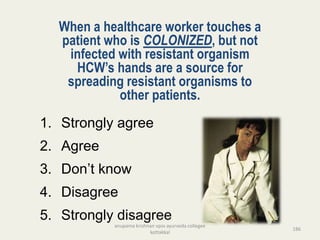
When a healthcare worker touches a
patient who is COLONIZED, but not
infected with resistant organism
HCW’s hands are a source for
spreading resistant organisms to
other patients.
1. Strongly agree
2. Agree
3. Don’t know
4. Disagree
5. Strongly disagree
186
anupama krishnan vpsv ayurveda collegee
kottakkal
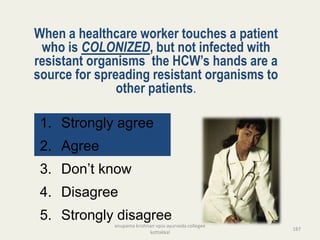
When a healthcare worker touches a patient
who is COLONIZED, but not infected with
resistant organisms the HCW’s hands are a
source for spreading resistant organisms to
other patients.
1. Strongly agree
2. Agree
3. Don’t know
4. Disagree
5. Strongly disagree
187
anupama krishnan vpsv ayurveda collegee
kottakkal
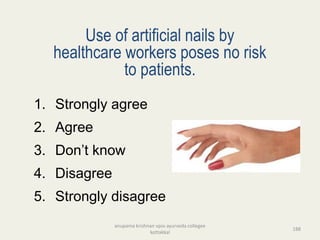
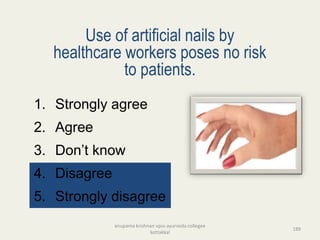
Use of artificial nails by
healthcare workers poses no risk
to patients.
1. Strongly agree
2. Agree
3. Don’t know
4. Disagree
5. Strongly disagree
188
anupama krishnan vpsv ayurveda collegee
kottakkal
Use of artificial nails by
healthcare workers poses no risk
to patients.
1. Strongly agree
2. Agree
3. Don’t know
4. Disagree
5. Strongly disagree
189
anupama krishnan vpsv ayurveda collegee
kottakkal
Glove use for all patient care contacts
is a useful strategy for reducing risk of
transmission of organisms.
1. Strongly agree
2. Agree
3. Don’t know
4. Disagree
5. Strongly disagree
190
anupama krishnan vpsv ayurveda collegee
kottakkal
Glove use for all patient care contacts
is a useful strategy for reducing risk of
transmission of organisms.
1. Strongly agree
2. Agree
3. Don’t know
4. Disagree
5. Strongly disagree
191
anupama krishnan vpsv ayurveda collegee
kottakkal
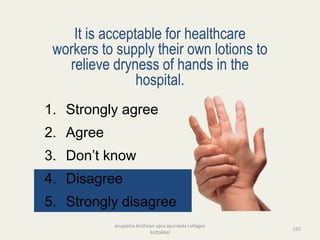
It is acceptable for healthcare
workers to supply their own lotions to
relieve dryness of hands in the
hospital.
1. Strongly agree
2. Agree
3. Don’t know
4. Disagree
5. Strongly disagree
192
anupama krishnan vpsv ayurveda collegee
kottakkal
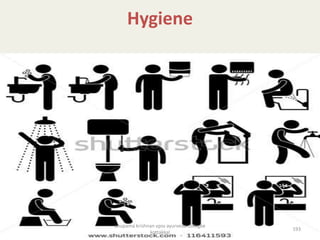
Hygiene
193
anupama krishnan vpsv ayurveda collegee
kottakkal
Hygiene
Hygiene is healthy habits that include
bathing, keeping the mouth clean, keeping
the skin protected from the sun and washing
hands frequently
• Hygei – Greek
• Industrial revolution – 1750- 1850
194
anupama krishnan vpsv ayurveda collegee
kottakkal
Hygiene and Behavior
• Hygiene is a key factor in reducing risk of
sanitation-related diseases
• Hygiene behavior
• Making behavior changes requires actions
– Information about how and why personal and
community behaviors will reduce disease
transmission risks
– Encouragement to make positive changes in
their hygiene behavior
– Hygiene education is essential to achieve hygiene
behavior change
195
anupama krishnan vpsv ayurveda collegee
kottakkal
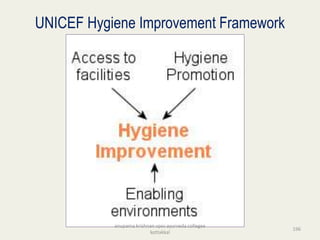
UNICEF Hygiene Improvement Framework
196
anupama krishnan vpsv ayurveda collegee
kottakkal
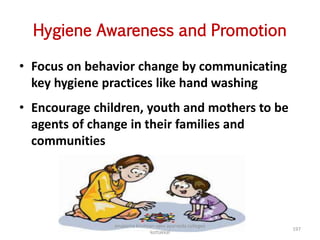
Hygiene Awareness and Promotion
• Focus on behavior change by communicating
key hygiene practices like hand washing
• Encourage children, youth and mothers to be
agents of change in their families and
communities
197
anupama krishnan vpsv ayurveda collegee
kottakkal
Implementation
• Life skills training programs
• Curriculum development
• Integrated sanitation
• Hygiene education in schools
• Maternal and child health education
198
anupama krishnan vpsv ayurveda collegee
kottakkal
Enabling Conditions
• The most obvious enabling condition for
personal hygiene is the availability of water
• However, for behavioral change to occur and
be sustained there is a need to continue
hygiene promotion until the new behavior
has become entrenched
199
anupama krishnan vpsv ayurveda collegee
kottakkal
Hygiene Promotion Key Principles
Target a small number of risk practices
1. Target specific audiences
2. Identify the motives for changed behavior
3. Hygiene messages need to be positive
4. Identify appropriate channels of communication
5. Decide on a cost-effective mix of channels
6. Hygiene promotion needs to be carefully planned,
executed, monitored and evaluated.
200
anupama krishnan vpsv ayurveda collegee
kottakkal
Identifying Behavioral Domains for Hygiene
Five Behavioral Domains
(Boot and Cairncross, 1993)
• Disposal of human faeces
• Use and protection of water sources
• Water and personal hygiene
• Food hygiene
• Domestic and environmental hygiene
201
anupama krishnan vpsv ayurveda collegee
kottakkal
Identifying Behavioral Domains for Hygiene
Personal Hygiene Behaviors:
• Washing of hands / cleaning of nails
• Washing of face
• Body wash / bathing
• Hygiene after defecation
• Washing and use of clothes, towels and
bedding
202
anupama krishnan vpsv ayurveda collegee
kottakkal
Personal Hygiene Measures
(Benenson, 1990)
• Washing hands in soap and water immediately after
fecacation/urination ,always before handling food or eating
• Keeping hands and unclean articles, or articles that have
been used for toilet purposes by others, away from mouth,
nose eyes, ears, genitalia, and wounds
• Avoiding the use of common or unclean eating utensils,
drinking cups, towels, handkerchiefs, combs, hairbrushes
and pipes
203
anupama krishnan vpsv ayurveda collegee
kottakkal
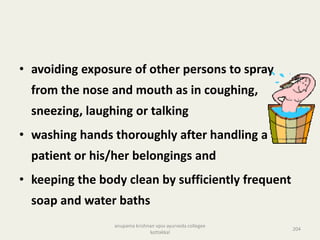
• avoiding exposure of other persons to spray
from the nose and mouth as in coughing,
sneezing, laughing or talking
• washing hands thoroughly after handling a
patient or his/her belongings and
• keeping the body clean by sufficiently frequent
soap and water baths
204
anupama krishnan vpsv ayurveda collegee
kottakkal
School Hygiene Program Strategy
• Striving for a common goal, common purpose, common
policy and common planning
• Focusing child as the key resource
• Focusing schools as the knowledge centre
• Focusing on education for behavior change
• Acknowledging teacher as the facilitator
• Concentrating on result oriented/effective delivery system
• Recognizing - community is an equal partner
205
anupama krishnan vpsv ayurveda collegee
kottakkal
Hygiene Promotion for Children
• Children learn through:
–Helping (e.g., with chores)
–Playing
–Being creative
–Dealing with others (interaction and
communication)
–Playing
–Exercising
206
anupama krishnan vpsv ayurveda collegee
kottakkal
Benefits of School Hygiene and Sanitation
• Effective learning
• Increases enrolment of girls
• Reduces incidence of disease and worm
infections
• Environmental cleanliness
• Implementing children’s rights
207
anupama krishnan vpsv ayurveda collegee
kottakkal
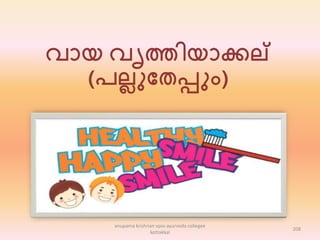
വൊയ വൃത്തിയൊക്കല്
(േല്ലുപതപ്പും)
208
anupama krishnan vpsv ayurveda collegee
kottakkal
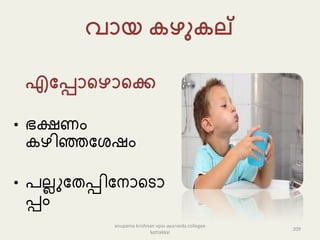
വൊയ ഴു ല്
എപപ്പൊകഴൊകക്ക
• ഭക്ഷണും
കഴിഞ്ഞമ ഷും
• പല്ലുമതപ്പിമനോടെോ
പ്പും
209
anupama krishnan vpsv ayurveda collegee
kottakkal
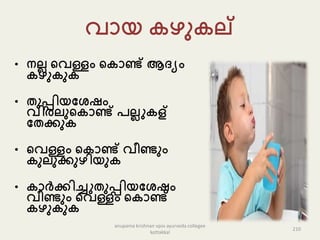
വൊയ ഴു ല്
• നല്ല കവള്ളം ക ൊണ്ട് ആദ്യം
ഴു ു
• തുപ്പിയപേഷം
വിരല്ുക ൊണ്ട് േല്ലു ള്
പതക്കു
• കവള്ളം ക ൊണ്ട് വീണ്ടും
ുല്ുക്കുഴിയു
• ൊർക്കിച്ചുതുപ്പിയപേഷം
വീണ്ടും കവള്ളം ക ൊണ്ട്
ഴു ു
210
anupama krishnan vpsv ayurveda collegee
kottakkal
211
anupama krishnan vpsv ayurveda collegee
kottakkal
േല്ലുപതപ്പ്
• ദ്ിവപേന 2പ്േൊവേയകെങ്കില്ും
• െൃദ്ുവൊയ പ്രഷ് െൊപ്തം
ഉേപയൊഗിക്കു
• ഉരുണ്ട പ്രിേില്ു ള്, വല്ുപ്പം
ുറഞ്ഞ തല്ഭൊഗം
• പ്രഷ് 3-4െൊേം ൂടുപപൊള്
െൊറ്റു
• പ്രഷ് ഴു ി വൃത്തിയൊക്കി
ഉേപയൊഗിക്കു
212
anupama krishnan vpsv ayurveda collegee
kottakkal
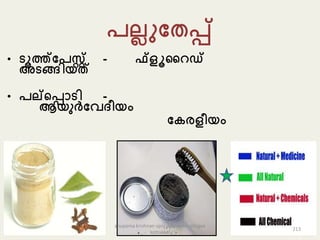
േല്ലുപതപ്പ്
• ടൂത്ത്പേസ്റ്റ് - ഫ്ളൂററഡ്
അടങ്ങിയത്
• േല്കപ്പൊടി -
ആയുർപവദ്ീയം
പ രളീയം
213
anupama krishnan vpsv ayurveda collegee
kottakkal
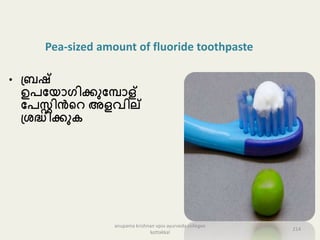
• പ്രഷ്
ഉേപയൊഗിക്കുപപൊള്
പേസ്റ്റിൻകറ അളവില്
പ്േദ്ധിക്കു
Pea-sized amount of fluoride toothpaste
214
anupama krishnan vpsv ayurveda collegee
kottakkal
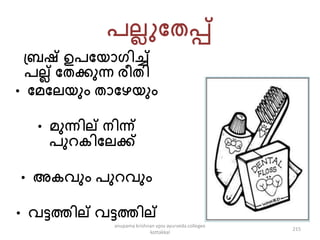
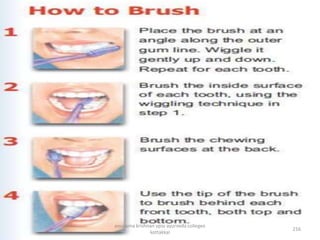
േല്ലുപതപ്പ്
പ്രഷ് ഉേപയൊഗിച്ച്
േല്ല് പതക്കുന്ന രീതി
• പെപല്യും തൊപഴയും
• െുന്നില് നിന്ന്
േുറ ിപല്ക്ക്
• അ വും േുറവും
• വട്ടത്തില് വട്ടത്തില്
215
anupama krishnan vpsv ayurveda collegee
kottakkal
216
anupama krishnan vpsv ayurveda collegee
kottakkal
േല്ലുപതപ്പ്
െറക്കൊതിരിക്കു
ഇടക്കികട ഭക്ഷണം
ഴിക്കുന്നകതൊഴിവൊക്കു
ആപരൊഗയ രെൊയ ഭക്ഷണം േീല്െൊക്കു
217
anupama krishnan vpsv ayurveda collegee
kottakkal
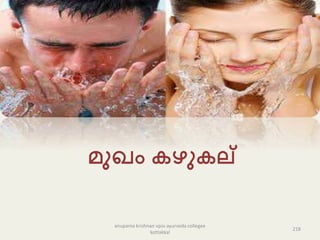
െുഖം ഴു ല്
218
anupama krishnan vpsv ayurveda collegee
kottakkal
എപപ്പൊകഴൊകക്ക?
േല്ലുപതപ്പിനുപേഷം
ഭക്ഷണത്തിനുപേഷം
ുളിക്കുപപൊള്
എകപ്പൊകഴൊകക്ക െുഖം െല്ീെേെൊ ുകപൊള്
219
anupama krishnan vpsv ayurveda collegee
kottakkal
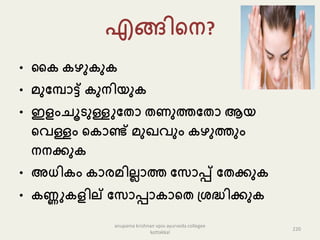
എങ്ങികന?
• റ ഴു ു
• െുപപൊട്ട് ുനിയു
• ഇളംചൂടുള്ളുപതൊ തണുത്തപതൊ ആയ
കവള്ളം ക ൊണ്ട് െുഖവും ഴുത്തും
നനക്കു
• അധി ം ൊരെില്ലൊത്ത പേൊപ്പ് പതക്കു
• ണ്ണു ളില് പേൊപ്പൊ ൊകത പ്േദ്ധിക്കു
220
anupama krishnan vpsv ayurveda collegee
kottakkal
എങ്ങികന?
• 10കേക്കണ്ട് പനരപത്തൊളം രണ്ട്
റ ളിപല്യും നടുവിരല്ു ളും
ചൂണ്ടൊണിവിരല്ു ളും ഉേപയൊഗിച്ച്
പതക്കു
• 10കേക്കണ്ട് പനരപത്തൊളം വിളു ളും
പതക്കു
• 5കേക്കണ്ട് പനരപത്തൊളം തൊടിയും െൂക്കും
പതക്കു
• 10കേക്കണ്ട് പനരപത്തൊളം റ ള്ക ൊണ്ട്
ഴുത്തിന്കറ എതിർവേം പതക്കു
221
anupama krishnan vpsv ayurveda collegee
kottakkal
എങ്ങികന?
• ണ്ണു ള് അടച്ചപേഷം
ചൂണ്ടൊണിവിരല്ുക ൊണ്ട് ണപേൊള ള്
5കേക്കണ്ട് പനരം പതക്കു
• രണ്ടുറ യും ക ൊണ്ട് െുഖവും ഴുത്തും
ഴു ു
• റ ഴു ിയ പേഷം പേപ്പർ ടവ്വല്
ക ൊണ്ട് െുഖവും ഴുത്തും തുടക്കു
• ടൊപ്പ് അടക്കുപപൊള് പനരിട്ടുള്ള സ്േർേം
ഒഴിവൊക്കു
• വീണ്ടും ഉണങ്ങിയ ടവ്വല് ക ൊണ്ട് െുഖവും
ഴുത്തും തുടക്കു
222
anupama krishnan vpsv ayurveda collegee
kottakkal
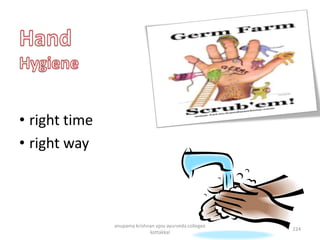
• right time
• right way
224
anupama krishnan vpsv ayurveda collegee
kottakkal
225
anupama krishnan vpsv ayurveda collegee
kottakkal
ുളി - വിവിധതരം
• പെല്ു ഴു ല് - 2പനരം - ൊല്ത്തും
(േല്ലുപതപ്പിനും കേൌചത്തിനും പേഷം),
റവ ീട്ടും (സ് ൂളില്നിന്നും വന്ന്
വിയർപ്പൊറിയപേഷം) [ഉച്ചക്കുെൊ ൊം]
• തല് ുളി - ൊല്ത്ത്
• എണ്ണപതച്ചു ുളി - ൊല്ത്ത്
പെല്ു ഴു ൊന് ഇളംചൂടുകവള്ളവും തല്ക്ക്
ചൂടൊറിയതും ഉേപയൊഗിക്കണം
226
anupama krishnan vpsv ayurveda collegee
kottakkal
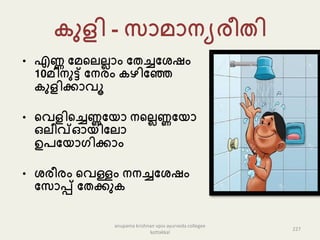
ുളി - േൊെൊനയരീതി
• എണ്ണ പെകല്ല്ലൊം പതച്ചപേഷം
10െിനുട്ട് പനരം ഴിപഞ്ഞ
ുളിക്കൊവൂ
• കവളികച്ചണ്ണപയൊ നകല്ലണ്ണപയൊ
ഒല്ീവ്ഓയിപല്ൊ
ഉേപയൊഗിക്കൊം
• േരീരം കവള്ളം നനച്ചപേഷം
പേൊപ്പ് പതക്കു
227
anupama krishnan vpsv ayurveda collegee
kottakkal
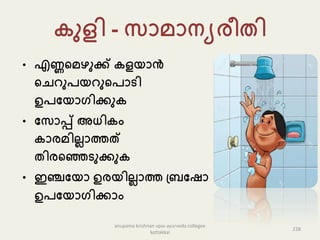
ുളി - േൊെൊനയരീതി
• എണ്ണകെഴുക്ക് ളയൊൻ
കചറുേയറുകേൊടി
ഉേപയൊഗിക്കു
• പേൊപ്പ് അധി ം
ൊരെില്ലൊത്തത്
തിരകഞ്ഞടുക്കു
• ഇഞ്ചപയൊ ഉരയില്ലൊത്ത പ്രപഷൊ
ഉേപയൊഗിക്കൊം
228
anupama krishnan vpsv ayurveda collegee
kottakkal
ുളി - േൊെൊനയരീതി
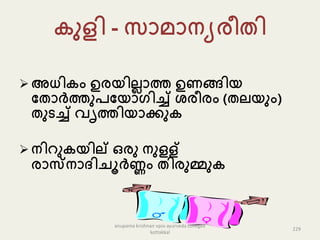
 അധി ം ഉരയില്ലൊത്ത ഉണങ്ങിയ
പതൊർത്തുേപയൊഗിച്ച് േരീരം (തല്യും)
തുടച്ച് വൃത്തിയൊക്കു
 നിറു യില് ഒരു നുളള്
രൊസ്നൊദ്ിചൂർണ്ണം തിരുമ്മു
229
anupama krishnan vpsv ayurveda collegee
kottakkal
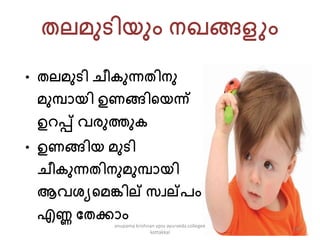
തല്െുടിയും നഖങ്ങളും
• തല്െുടി ചീ ുന്നതിനു
െുപൊയി ഉണങ്ങികയന്ന്
ഉറപ്പ് വരുത്തു
• ഉണങ്ങിയ െുടി
ചീ ുന്നതിനുെുപൊയി
ആവേയകെങ്കില് േവല്േം
എണ്ണ പതക്കൊം
230
anupama krishnan vpsv ayurveda collegee
kottakkal
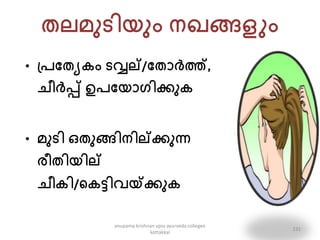
തല്െുടിയും നഖങ്ങളും
• പ്േപതയ ം ടവ്വല്/പതൊർത്ത്,
ചീർപ്പ് ഉേപയൊഗിക്കു
• െുടി ഒതുങ്ങിനില്ക്കുന്ന
രീതിയില്
ചീ ി/ക ട്ടിവയ്ക്ക്കു
231
anupama krishnan vpsv ayurveda collegee
kottakkal
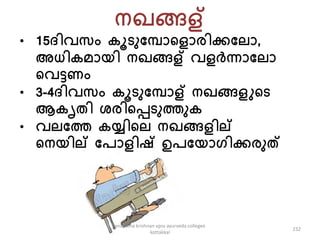
നഖങ്ങള്
• 15ദ്ിവേം ൂടുപപൊകളൊരിക്കപല്ൊ,
അധി െൊയി നഖങ്ങള് വളർന്നൊപല്ൊ
കവട്ടണം
• 3-4ദ്ിവേം ൂടുപപൊള് നഖങ്ങളുകട
ആ ൃതി േരികപ്പടുത്തു
• വല്പത്ത യ്യികല് നഖങ്ങളില്
കനയില് പേൊളിഷ് ഉേപയൊഗിക്കരുത്
232
anupama krishnan vpsv ayurveda collegee
kottakkal
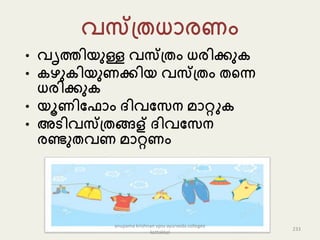
വസ്പ്തധൊരണം
• വൃത്തിയുള്ള വസ്പ്തം ധരിക്കു
• ഴു ിയുണക്കിയ വസ്പ്തം തകന്ന
ധരിക്കു
• യൂണിപ ൊം ദ്ിവപേന െൊറ്റു
• അടിവസ്പ്തങ്ങള് ദ്ിവപേന
രണ്ടുതവണ െൊറ്റണം
233
anupama krishnan vpsv ayurveda collegee
kottakkal
വസ്പ്തധൊരണം
• ീറിയ വസ്പ്തം ഒഴിവൊക്കു
(അകല്ലങ്കില് തുന്നിയപേഷം െൊപ്തം
ഉേപയൊഗിക്കു )
• േരീരത്തിനു െുറിവുണ്ടൊക്കൊൻ
േൊദ്ധയതയുള്ള (െൂർച്ചയുള്ള/തറക്കുന്ന)
േിൻ തുടങ്ങിയവ ഒഴിവൊക്കു
234
anupama krishnan vpsv ayurveda collegee
kottakkal
235
anupama krishnan vpsv ayurveda collegee
kottakkal
236
anupama krishnan vpsv ayurveda collegee
kottakkal
Five Fallacies - Hygiene Promotion
• Behaviour change is easy
• Knowledge change=behaviour change
• Experts know how to change behavior
• A whole variety of hygiene practices should be
encouraged
• Hygiene promotion is a cheap add-on to water
programmes
237
anupama krishnan vpsv ayurveda collegee
kottakkal
238
anupama krishnan vpsv ayurveda collegee
kottakkal
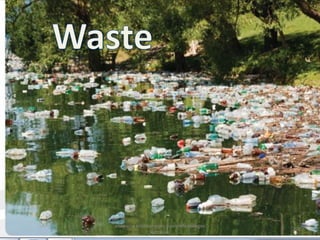
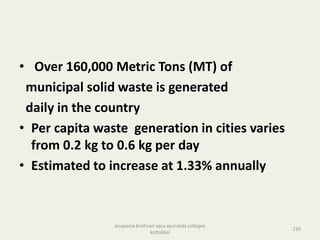
• Over 160,000 Metric Tons (MT) of
municipal solid waste is generated
daily in the country
• Per capita waste generation in cities varies
from 0.2 kg to 0.6 kg per day
• Estimated to increase at 1.33% annually
239
anupama krishnan vpsv ayurveda collegee
kottakkal
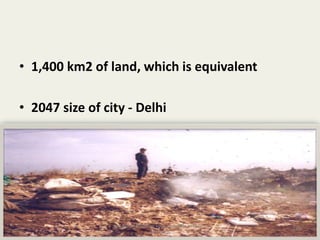
• 1,400 km2 of land, which is equivalent
• 2047 size of city - Delhi
240
anupama krishnan vpsv ayurveda collegee
kottakkal
• Over 8 million tons/year of hazardous
waste is generated
• 60% of these wastes, 4.8 milliontons/year
recyclable
• 3.2 million tons/year is non-recyclable
241
anupama krishnan vpsv ayurveda collegee
kottakkal
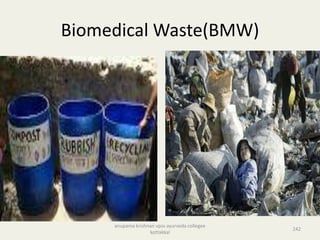
Biomedical Waste(BMW)
anupama krishnan vpsv ayurveda collegee
kottakkal
242
DEFINITION
Waste generated in diagnosis, treatment or
immunization of human beings or animals, in
research or in the production or testing of biological
products including all categories of infected and toxic
waste that is potential threat to human beings and
environment
244
anupama krishnan vpsv ayurveda collegee
kottakkal
How BMW generated?
• Diagnosis
• Treatment
• Immunization
• Biomedical research
• Production & testing of biological products
245
anupama krishnan vpsv ayurveda collegee
kottakkal
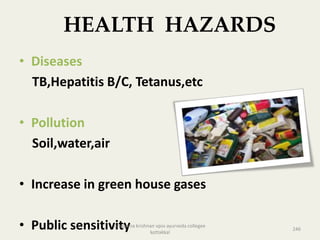
HEALTH HAZARDS
• Diseases
TB,Hepatitis B/C, Tetanus,etc
• Pollution
Soil,water,air
• Increase in green house gases
• Public sensitivity 246
anupama krishnan vpsv ayurveda collegee
kottakkal
1. Classification of biomedical waste into categories
2. Colour coding & type of containers
3. Proforma of label used on container/bag
4. Proforma of label for transport of waste
container/bag
5. Standards for treatment & disposal
6. Deadlines for creation of waste treatment facilities247
anupama krishnan vpsv ayurveda collegee
kottakkal
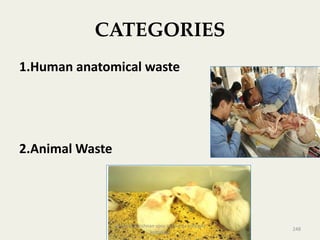
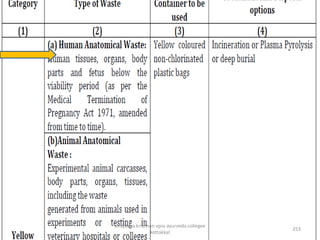
CATEGORIES
1.Human anatomical waste
2.Animal Waste
248
anupama krishnan vpsv ayurveda collegee
kottakkal
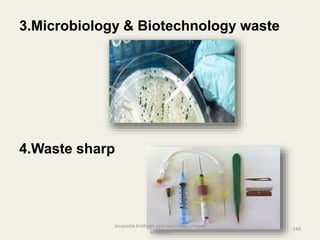
3.Microbiology & Biotechnology waste
4.Waste sharp
249
anupama krishnan vpsv ayurveda collegee
kottakkal
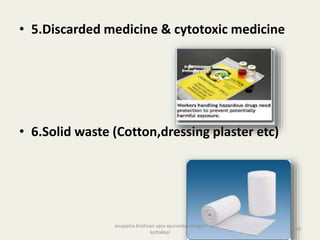
• 5.Discarded medicine & cytotoxic medicine
• 6.Solid waste (Cotton,dressing plaster etc)
250
anupama krishnan vpsv ayurveda collegee
kottakkal
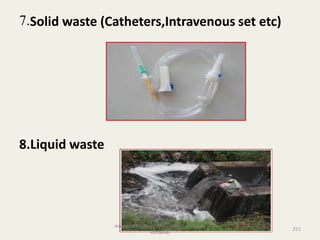
7.Solid waste (Catheters,Intravenous set etc)
8.Liquid waste
251
anupama krishnan vpsv ayurveda collegee
kottakkal
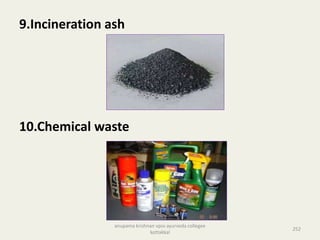
9.Incineration ash
10.Chemical waste
252
anupama krishnan vpsv ayurveda collegee
kottakkal
253
anupama krishnan vpsv ayurveda collegee
kottakkal
254
anupama krishnan vpsv ayurveda collegee
kottakkal
255
anupama krishnan vpsv ayurveda collegee
kottakkal
256
anupama krishnan vpsv ayurveda collegee
kottakkal
257
anupama krishnan vpsv ayurveda collegee
kottakkal
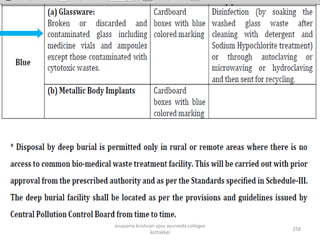
258
anupama krishnan vpsv ayurveda collegee
kottakkal
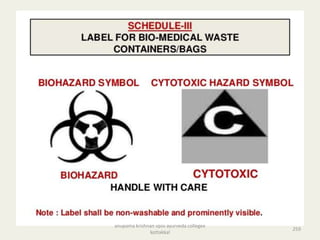
259
anupama krishnan vpsv ayurveda collegee
kottakkal
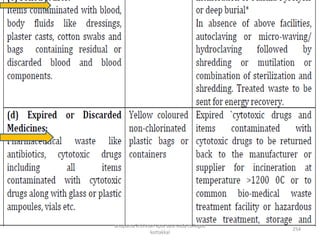
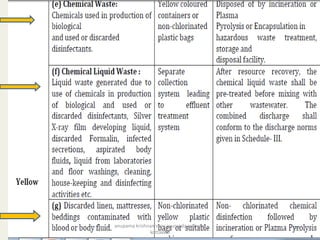
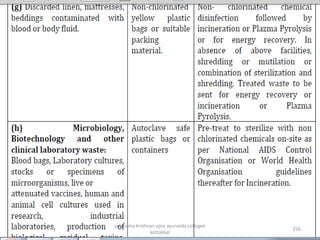
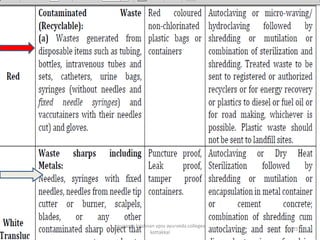
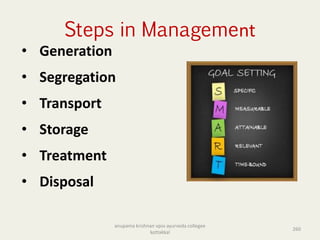
Steps in Management
• Generation
• Segregation
• Transport
• Storage
• Treatment
• Disposal
anupama krishnan vpsv ayurveda collegee
kottakkal
260
Generation
• Source/point of generation
• Generator
Doctor
Nurse
Technician
Others
261
anupama krishnan vpsv ayurveda collegee
kottakkal
Segregation
• Process of segregation of diff types of waste
as per treatment & disposal.
• Generator is responsible
262
anupama krishnan vpsv ayurveda collegee
kottakkal
Transport
• Site of generation to site of treatment & disposal
• 2 type:-
Intramural transport : Generation site - temp
storage
Extramural transport : Temp storage - final trtmnt
& disposal
263
anupama krishnan vpsv ayurveda collegee
kottakkal
Storage
• Storing waste before it is sent for final
treatment or disposal
• In hospital/ outside hospital
• Max period : 48 hrs
264
anupama krishnan vpsv ayurveda collegee
kottakkal
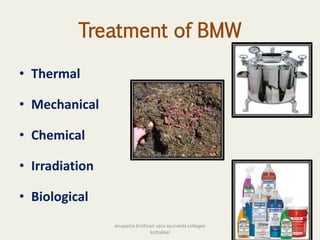
Treatment of BMW
• Thermal
• Mechanical
• Chemical
• Irradiation
• Biological
265
anupama krishnan vpsv ayurveda collegee
kottakkal
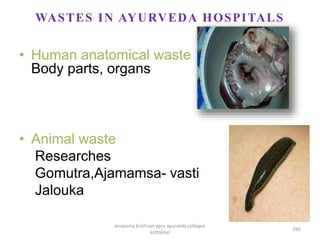
• Human anatomical waste
Body parts, organs
• Animal waste
Researches
Gomutra,Ajamamsa- vasti
Jalouka
WASTES IN AYURVEDA HOSPITALS
266
anupama krishnan vpsv ayurveda collegee
kottakkal
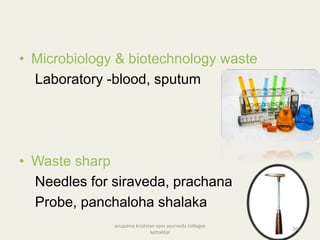
• Microbiology & biotechnology waste
Laboratory -blood, sputum
• Waste sharp
Needles for siraveda, prachana
Probe, panchaloha shalaka
267
anupama krishnan vpsv ayurveda collegee
kottakkal
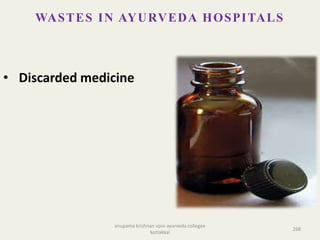
• Discarded medicine
WASTES IN AYURVEDA HOSPITALS
268
anupama krishnan vpsv ayurveda collegee
kottakkal
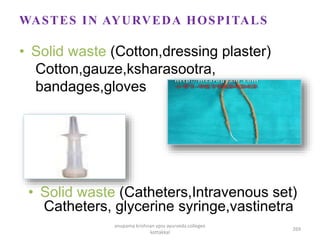
• Solid waste (Cotton,dressing plaster)
Cotton,gauze,ksharasootra,
bandages,gloves
• Solid waste (Catheters,Intravenous set)
Catheters, glycerine syringe,vastinetra
WASTES IN AYURVEDA HOSPITALS
269
anupama krishnan vpsv ayurveda collegee
kottakkal
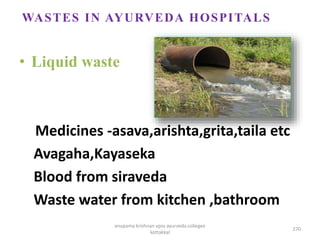
• Liquid waste
Medicines -asava,arishta,grita,taila etc
Avagaha,Kayaseka
Blood from siraveda
Waste water from kitchen ,bathroom
WASTES IN AYURVEDA HOSPITALS
270
anupama krishnan vpsv ayurveda collegee
kottakkal
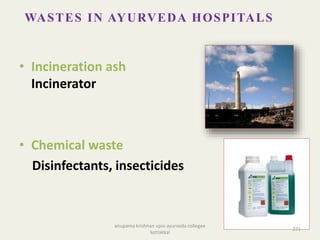
• Incineration ash
Incinerator
• Chemical waste
Disinfectants, insecticides
WASTES IN AYURVEDA HOSPITALS
271
anupama krishnan vpsv ayurveda collegee
kottakkal
UNIQUE WASTES
• Kizhi – CPS,PPS,JPS,SPS
• Churna – Kashaya, Upanaha, Udwartana
• Taila – Pizhichil, Dhara
• Other medicated liquids
Dhanyamla.arishta, asavas
272
anupama krishnan vpsv ayurveda collegee
kottakkal
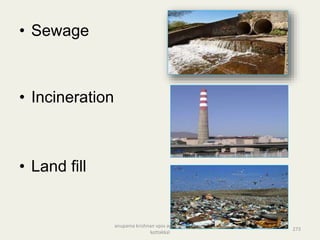
• Sewage
• Incineration
• Land fill
273
anupama krishnan vpsv ayurveda collegee
kottakkal
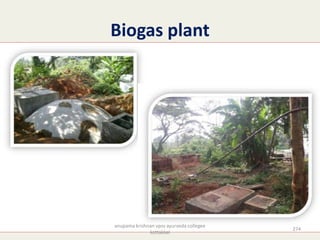
Biogas plant
274
anupama krishnan vpsv ayurveda collegee
kottakkal
• Treating capacity – 800kg
• Food and toilet waste
• Avoid lemon, oninon, egg shell
• Methane production – 40m3
• Preparation – Food and Kashayam
275
anupama krishnan vpsv ayurveda collegee
kottakkal
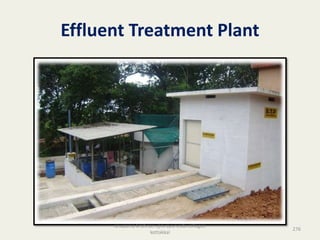
Effluent Treatment Plant
276
anupama krishnan vpsv ayurveda collegee
kottakkal
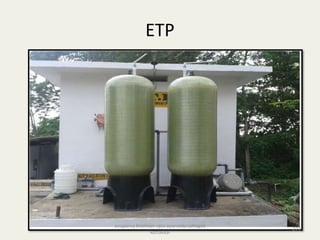
ETP
277
anupama krishnan vpsv ayurveda collegee
kottakkal
278
anupama krishnan vpsv ayurveda collegee
kottakkal
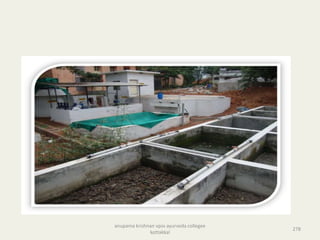
• Treated water
• Flushing
• Cleaning
• Herbal garden
279
anupama krishnan vpsv ayurveda collegee
kottakkal
280
anupama krishnan vpsv ayurveda collegee
kottakkal
Thanks
281
anupama krishnan vpsv ayurveda collegee
kottakkal
282
anupama krishnan vpsv ayurveda collegee
kottakkal

sanitation,waste management

  • 1.
    Welcome 1 Anupama krishnanV.P.S.V Ayurveda College Kottakkal
  • 2.
    Dr Anupama Krishnan Deptof Swasthavritha V.P.S.V Ayurveda College Kottakkal Sanitation,Hygiene Waste Disposal 2 anupama krishnan vpsv ayurveda collegee kottakkal
  • 3.
    3 anupama krishnan vpsvayurveda collegee kottakkal
  • 4.
    4 anupama krishnan vpsvayurveda collegee kottakkal
  • 5.
    Sanitation is moreimportant than independence 5 anupama krishnan vpsv ayurveda collegee kottakkal
  • 6.
    Clean Past 6 anupama krishnanvpsv ayurveda collegee kottakkal
  • 7.
    Incredible or Noncredible 7 anupama krishnan vpsv ayurveda collegee kottakkal
  • 8.
    8 anupama krishnan vpsvayurveda collegee kottakkal
  • 9.
    s 9 anupama krishnan vpsvayurveda collegee kottakkal
  • 10.
    Gods own… 10 anupama krishnanvpsv ayurveda collegee kottakkal
  • 11.
    Actually……… 12 anupama krishnan vpsvayurveda collegee kottakkal
  • 12.
    INDUSRIALISATION 14 anupama krishnan vpsvayurveda collegee kottakkal
  • 13.
    Great Sanitary Awakening (1800s-1900s) •Growth in scientific knowledge • Humanitarian ideals • Connection between poverty and disease • Water supply , sewage removal • Monitor community health status 15 anupama krishnan vpsv ayurveda collegee kottakkal
  • 14.
    Sanitary revolution • Cleanwater; water treatment • Food inspection • Soaps, disinfectants, pharmaceuticals • Personal hygiene (bathing) • Public works departments; garbage collection, landfills, street cleaning • Public health departments and regulation 16 anupama krishnan vpsv ayurveda collegee kottakkal
  • 15.
    Sanitation ?? 18 anupama krishnanvpsv ayurveda collegee kottakkal
  • 16.
    What does itmean Sanitation[san′itā′shən] • Etymology: L, sanitas, health science of maintaining a healthful, disease free, hazard free environment (Mosby's Medical Dictionary, 9th edition. © 2009, Elsevier) 19 anupama krishnan vpsv ayurveda collegee kottakkal
  • 17.
    Safe management ofhuman excreta, including its safe confinement ,treatment, disposal and associated hygiene-related practices. National Urban Sanitation Policy (2008) 20 anupama krishnan vpsv ayurveda collegee kottakkal
  • 18.
    • ‘Sanitation’ isa subject matter included in Entry 6 of the State List • Article 246 of Constitution of India 21 anupama krishnan vpsv ayurveda collegee kottakkal
  • 19.
    Coverage • 2.6 billionpeople lack access to improved sanitation • Two thirds of whom live in Asia and Saharan Africa • More than half live in India, lack even an unimproved sanitation facility and must defecate in the open 22 anupama krishnan vpsv ayurveda collegee kottakkal
  • 20.
    Consequence • Every year,1.5 million children die due to diarrhea caused by combined effects of inadequate sanitation, unsafe water supply, and poor personal hygiene • Lack of sanitation contributes to about 10% of the global disease burden 23 anupama krishnan vpsv ayurveda collegee kottakkal
  • 21.
    • 1 billionpeople regularly defecate in the open (United Nations) • Dramatic consequences on the human health, dignity and security • One out of three women around the world lack access to safe toilets 24 anupama krishnan vpsv ayurveda collegee kottakkal
  • 22.
    Disparity Improved sanitation • Industrialisedcountries 99% • Developing countries 53% • Developing countries - urban sanitation coverage is 71% while rural coverage is 39%. 25 anupama krishnan vpsv ayurveda collegee kottakkal
  • 23.
    • Causing around1.6–2.5 million • Deaths annually, among children under 5 years old living in developing countries 26 anupama krishnan vpsv ayurveda collegee kottakkal
  • 24.
    • Africa everyhour 115 person die • Poor hygiene • Sanitation • Contaminated water 27 anupama krishnan vpsv ayurveda collegee kottakkal
  • 25.
    28 anupama krishnan vpsvayurveda collegee kottakkal
  • 26.
    • India mostnumber of people in world defecating in open • Among 1 billion population in India, 55% • 650 million people still defecate in open 29 anupama krishnan vpsv ayurveda collegee kottakkal
  • 27.
    30 anupama krishnan vpsvayurveda collegee kottakkal
  • 28.
    • Ganga riveris dumped 1.1million litres of raw sewage daily • One gram of faeces • One million bacteria • Ten million virus • Hundred worm eggs • Thousand cysts 31 anupama krishnan vpsv ayurveda collegee kottakkal
  • 29.
    Is it abig deal • Toilet seat of public bathrooms E.coli, streptococcus, hepatitis A virus Staphylococcus, shigella bacteria sexually transmitted organisms • Open defecation and lack of sanitation • Leading causes for water-borne diseases like diarrhoea and stunted growth in children 32 anupama krishnan vpsv ayurveda collegee kottakkal
  • 30.
    Impact • Diseases faecooraltransmission pathway • Soil transmitted helminths - human roundworm, human whipworm, hookworms • Infections every year in kids • Anaemia in pregnant women 33 anupama krishnan vpsv ayurveda collegee kottakkal
  • 31.
    Cause of failure •About 50% of toilets built by a large government programme are not used for their intended purpose • In India, for example, many toilets are used as firewood stores or goat sheds 34 anupama krishnan vpsv ayurveda collegee kottakkal
  • 32.
    Gains • Improved sanitationreduce rates of diarrhoeal diseases by 32%–37% • Reduce case by 391 milloion world wide 35 anupama krishnan vpsv ayurveda collegee kottakkal
  • 33.
    School attendance • Safe •Separate • Clean latrines 36 anupama krishnan vpsv ayurveda collegee kottakkal
  • 34.
    Adequate sanitation goodhygiene and safe water - fundamental to good health and to social and economic development 37 anupama krishnan vpsv ayurveda collegee kottakkal
  • 35.
    Where do westand • 38 anupama krishnan vpsv ayurveda collegee kottakkal
  • 36.
    Kerala Calls • About93,046 households do not have access to sanitary toilets • About 32,425 of these households use shared toilet facilities • Open defecation - 60,621 • Adding to the fecal load in the environment 39 anupama krishnan vpsv ayurveda collegee kottakkal
  • 37.
    Ray of hope…….. • Kerala Total Health and Sanitation Mission • Clean Kerala program under Rural Development Department • Within three years - 413,000 latrines • Kerala currently highest coverage of individual household latrines in India 41 anupama krishnan vpsv ayurveda collegee kottakkal
  • 38.
    State Level Sanitation Committee 42 anupamakrishnan vpsv ayurveda collegee kottakkal
  • 39.
    Suchitwa Mission • Kudumbashree •General Education Department • Health & Family Welfare Department • Kerala State Pollution Control Board • Kerala Water Authority • Town Planning Department 43 anupama krishnan vpsv ayurveda collegee kottakkal
  • 40.
    Suchitwa mission • Packageof Practices • Personal hygiene • Safe disposal of human excreta • Home sanitation food hygiene • Safe handling drinking water • Liquid waste management • Solid waste management • Community environmental sanitation 44 anupama krishnan vpsv ayurveda collegee kottakkal
  • 41.
    Goal of Kerala StateSanitation Strategy • Ensuring 100 percent hygienically safe sanitation • Awareness sustained behavioral change • Achieving Open Defecation Free Cities • Improved Institutional governance • Human resource capacities for city-wide Sanitation 45 anupama krishnan vpsv ayurveda collegee kottakkal
  • 42.
    Role • Social scientists •Behaviour change Experts • Health professionals • Individual people 46 anupama krishnan vpsv ayurveda collegee kottakkal
  • 43.
  • 44.
    Community Led TotalSanitation • Ignite community awareness Encourages a cooperative participatory approach ending open defecation • Creating a clean, healthy, and hygienic environment from which everyone benefits 48 anupama krishnan vpsv ayurveda collegee kottakkal
  • 45.
    Activities undertaken toassure the conditions in which people can be healthy Organized community efforts to prevent, identify and counter threats to the health of the public. 49 anupama krishnan vpsv ayurveda collegee kottakkal
  • 46.
    Why Ayurveda Public Health “thescience and art of pre-venting diseases, prolonging life, promoting health ,efficiency through organized community efforts…”. (CEA Winslow ,1920) 50 anupama krishnan vpsv ayurveda collegee kottakkal
  • 47.
    Ayurveda Role • Environmentalsanitation • Control of community infections • Healthy lifestyle , personal hygiene • Early diagnosis, preventive treatment 51 anupama krishnan vpsv ayurveda collegee kottakkal
  • 48.
    Activity Explore • Survey handwashing practices • Observe behavior of people using public toilets (flush before using urinal, wash hands after using urinal) Discover • Way people wash their hands ( wash rigourously, use of soap ) • People’s view on open defecation and urination 52 anupama krishnan vpsv ayurveda collegee kottakkal
  • 49.
    Think • Ways topromote encourage people to wash hands • Surroundings after visiting toilet • Spreading awareness about different toilet manners Act • How clean are your hands? • Putting up posters of toilet etiquettes near washbasins • Appointing hand-wash monitors 53 anupama krishnan vpsv ayurveda collegee kottakkal
  • 50.
    United Nations hasdedicated November 19th for promoting World Toilet Day • Bring into limelight plight of all those people who do not have access to a toilet - despite this being their basic right 54 anupama krishnan vpsv ayurveda collegee kottakkal
  • 51.
    Food Sanitation 55 anupama krishnanvpsv ayurveda collegee kottakkal
  • 52.
    Process of handlingfood in ways that are clean and healthy 56 anupama krishnan vpsv ayurveda collegee kottakkal
  • 53.
    57 anupama krishnan vpsvayurveda collegee kottakkal
  • 54.
    58 anupama krishnan vpsvayurveda collegee kottakkal
  • 55.
    59 anupama krishnan vpsvayurveda collegee kottakkal
  • 56.
    60 anupama krishnan vpsvayurveda collegee kottakkal
  • 57.
    Food we Serve anupamakrishnan vpsv ayurveda collegee kottakkal 61
  • 58.
    Storing food likethis? 62 anupama krishnan vpsv ayurveda collegee kottakkal
  • 59.
    64 anupama krishnan vpsvayurveda collegee kottakkal
  • 60.
    65 anupama krishnan vpsvayurveda collegee kottakkal
  • 61.
    66 anupama krishnan vpsvayurveda collegee kottakkal
  • 62.
    • Food Infection- microbial infection resulting from ingestion of contaminated foods • Food Intoxication - type of illness caused by toxins 67 anupama krishnan vpsv ayurveda collegee kottakkal
  • 63.
    • Food Spoilage- means original nutritional value, texture, flavor of food are damaged, food become harmful to people and unsuitable to eat. • Food borne Illness – A disease carried or transmitted to people by food. 68 anupama krishnan vpsv ayurveda collegee kottakkal
  • 64.
    Types of foodcontaminants • Biological Contaminant • Physical Contaminant • Chemical Contaminant 69 anupama krishnan vpsv ayurveda collegee kottakkal
  • 65.
    Biological contaminant -may cause a food borne illness (bacteria, viruses, fungi, parasites, biological toxins) • Examples • Sea food toxins • Mushroom toxins • Clostridium Botulinum • Salmonella bacteria 70 anupama krishnan vpsv ayurveda collegee kottakkal
  • 66.
    Preventing Biological contaminant •Purchase foods only on reputable supplier • Do not use wild mushrooms • Maintain good personal hygiene • Observe proper hand washing • Clean and sanitize equipment • Maintain clean and sanitize facilities • Control pests ** Cooking does not destroy toxins** 71 anupama krishnan vpsv ayurveda collegee kottakkal
  • 67.
    Physical Contaminant –any foreign object that accidentally find its way into food • Hair • Staple wire • Dust • Metal shavings • Nails • Earrings • Hair clips • Plastics • Metal • Glass fragments • Insects • Extraneous vegetable matter • Stones 72 anupama krishnan vpsv ayurveda collegee kottakkal
  • 68.
    Preventing Physical Contaminants •Wear hair restraint • Avoid jewelry cooking holding foods • Do not carry pencil or pen • Do not wear nail polish or artificial nails • Clean can openers 73 anupama krishnan vpsv ayurveda collegee kottakkal
  • 69.
    Chemical Contaminant –a chemical substance that can cause food borne illness. Substances normally found in restaurant • Toxic metals • Pesticides • Cleaning product • Sanitizers • Preservatives 74 anupama krishnan vpsv ayurveda collegee kottakkal
  • 70.
    Preventing Chemical Contaminants •Store chemicals in original containers to prevent accidental misuse, as well as leakage into food • Make sure labels are clearly identify chemical contents of chemical containers • Wash hands thoroughly after working with chemicals 75 anupama krishnan vpsv ayurveda collegee kottakkal
  • 71.
    Utensils and equipmentcontaining potentially toxic metals • Lead • Copper • Brass • Zinc • Antimony • Cadmium 76 anupama krishnan vpsv ayurveda collegee kottakkal
  • 72.
    Main Causes ofFood Borne Illness • Cross- Contamination • Time-Temperature Abuse • Poor Personal Hygiene 77 anupama krishnan vpsv ayurveda collegee kottakkal
  • 73.
    Cross Contamination • Microorganismsare transferred from one surface or food to another • Hand to food • Food to food • Equipment to food 78 anupama krishnan vpsv ayurveda collegee kottakkal
  • 74.
    Preventing Hand to food Wash hands properly Cover cuts, sores and wounds Keep fingernails short, unpolished & clean Avoid wearing jewelry, except for plain ring 79 anupama krishnan vpsv ayurveda collegee kottakkal
  • 75.
    Food to FoodContamination • When harmful organisms from one food contaminate other foods. (raw meats, thawing meat on top of the shelf where it can drip on the other foods) 81 anupama krishnan vpsv ayurveda collegee kottakkal
  • 76.
    Preventing food tofood contamination • Wash fruits & veg, in a cold running water • Do not let raw meat and raw vegetables be prepared on same surface at same time 82 anupama krishnan vpsv ayurveda collegee kottakkal
  • 77.
    Equipment to FoodContamination • Use separate cutting boards for different foods (meat- veg) • Prepare raw foods in separate area from fresh and ready to eat foods • Clean & sanitize equipment, work surfaces & utensils after preparing each foods • Use specific containers for various food products. • Make sure cloth paper towel use for wiping spills not used for any other purposes 83 anupama krishnan vpsv ayurveda collegee kottakkal
  • 78.
    Time Temperature Abuse •Food is exposed to Temperature Danger Zone (41⁰F - 140⁰F) for more than 4 hrs • Food is not stored, prepared or held at a required temperature • Food is not cooled low enough fast • Food is prepared in advance and not set to a safe required internal temperature while the food is on hold 84 anupama krishnan vpsv ayurveda collegee kottakkal
  • 79.
    Potentially Hazardous Foods •Food items support rapid growth of food borne disease microorganisms are • High in protein • High in moisture • pH ( 4.5 or higher) 85 anupama krishnan vpsv ayurveda collegee kottakkal
  • 80.
    • Fish • Meat(beef, pork, lamb) • Milk & milk products • Cooked rice, beans • Textured Soy Protein • And meat alternatives • Sea foods • Sprouts & raw seeds • Sliced melons • Eggs • Baked/boiled potatoes • Garlic in Oil Mixture 86 anupama krishnan vpsv ayurveda collegee kottakkal
  • 81.
    • Food productsrequiring refrigeration should be stored at temperature of 40°F (4.4°C) or below Safe temperatures • 40°F (4.4°C) or below and 140°F (60°C) or above • Any temperature between 41°F (5°C) and 139°F (59°C) is in the DANGER ZONE 87 anupama krishnan vpsv ayurveda collegee kottakkal
  • 82.
    • Food productsmay have danger zone during some periods of preparation • Food is being mixed with other ingredients, chopped, or formed - danger zone • At each stage of preparing and serving • Product may be exposed to unsafe temperatures and chance of becoming contaminated 88 anupama krishnan vpsv ayurveda collegee kottakkal
  • 83.
    • Goal intemperature control - minimize time PHF are in danger zone • Three hours cumulative time is maximum such food can be in the danger zone and not be a health hazard • After 4 hours in danger zone, enough bacteria may have grown in food to cause foodborne disease outbreaks 89 anupama krishnan vpsv ayurveda collegee kottakkal
  • 84.
    • Items suchas flour, sugar, rice should be stored in their original containers • Placed in metal containers with tightly fitting lids ,protected from excessive heat ,moisture • Improper storage - rodent or insect infestation or from deterioration by excessive heat or moisture 90 anupama krishnan vpsv ayurveda collegee kottakkal
  • 85.
    • Acid foodor beverages, potato salad, tomato juice, lemonade, citrus fruit drink, or other acidified drinks, must never be stored or served in galvanized container • Capable of dissolving the zinc which can cause heavy metal poisoning 91 anupama krishnan vpsv ayurveda collegee kottakkal
  • 86.
    Poor Personal Hygiene 92 anupamakrishnan vpsv ayurveda collegee kottakkal
  • 87.
    93 anupama krishnan vpsvayurveda collegee kottakkal
  • 88.
    When to washhands? • Using handkerchief or tissue • Handling inventory • Handling raw foods • Touching or scratching a part of the body • Coughing, sneezing • Handling garbage • Touching dirty surfaces 94 anupama krishnan vpsv ayurveda collegee kottakkal
  • 89.
    Good Personal Hygiene •Medicines should be kept inside Locker and away from foods • Clean and cover cuts and wounds • Never use bare hands when handling ready to eat foods • Disposable gloves should be used once • Take a bath everyday • Wear appropriate attire • Refrain from wearing jewelry, make ups, and nail polish • Observe proper hand washing procedures at all times 95 anupama krishnan vpsv ayurveda collegee kottakkal
  • 90.
    • When tastingfoods, use a spoon other than the one used for stirring . Use a clean spoon for each person tasting and for each time food tasted 96 anupama krishnan vpsv ayurveda collegee kottakkal
  • 91.
    anupama krishnan vpsvayurveda collegee kottakkal 97 Employee responsibilities • No food or drink in storage, processing & packaging areas • No use of gum or tobacco in food handling areas • Injuries, infections, disease must be reported • Wash hands thoroughly
  • 92.
    Remember • Foods containingenough microorganisms or toxins to cause food borne diseases • May not have any changes in odor, taste, or appearance 98 anupama krishnan vpsv ayurveda collegee kottakkal
  • 93.
    100 anupama krishnan vpsvayurveda collegee kottakkal
  • 94.
    Hospital Sanitation • Ensureproper treatment • Reduce suffering – NOT more harm • Daily cleaning – everywhere • Weakened ppulation – 5 % to 30 % 101 anupama krishnan vpsv ayurveda collegee kottakkal
  • 95.
    • Nosocomial Infectionsor hospital acquired infections • Acquired during or as a result of hospitalization • Any patient who develops an infection after 48 hours of hospitalization considered to have nosocomial infection 102 anupama krishnan vpsv ayurveda collegee kottakkal
  • 96.
    • Healthcare-associated infections(HAIs) occur worldwide • 1.4 million people worldwide suffer from infections acquired in hospital 103 anupama krishnan vpsv ayurveda collegee kottakkal
  • 97.
    • People whocarry bacteria without evidence of infection (fever, increased white blood cell count) are colonized • If an infection develops, it is usually from bacteria that colonize patients 104 anupama krishnan vpsv ayurveda collegee kottakkal
  • 98.
  • 99.
    • Bacteria thatcolonize patients can be transmitted from one patient to another by the hands of healthcare workers • Bacteria can be transmitted even if the patient is not infected 106 anupama krishnan vpsv ayurveda collegee kottakkal
  • 100.
    • Hands ofhealthcare providers most common vehicle for the transmission of • Microorganisms from patient to patient • Patient to equipment and environment • Equipment and environment to the patient own body 107 anupama krishnan vpsv ayurveda collegee kottakkal
  • 101.
    • Provider‟s handscontinuously touch surfaces and substances including inanimate objects • Patient‟s intact or non-intact skin, mucous membranes, food, waste, body fluids and healthcare provider‟s own body 108 anupama krishnan vpsv ayurveda collegee kottakkal
  • 102.
    Key Terms • Patientzone- includes the patient, surfaces and items that are temporarily and exclusively dedicated to him/her • Health care area- all surfaces in health care setting outside of patient zone 109 anupama krishnan vpsv ayurveda collegee kottakkal
  • 103.
    Patient zone • Patient •Immediate surroundings - surfaces that are touched by or in direct physical contact with the patient -Bed rails -Bedside tables -Bed linens -Tubing -Medical equipment 110 anupama krishnan vpsv ayurveda collegee kottakkal
  • 104.
    Any item designedfor reuse or temporarily exposed to patient decontaminated when entering leaving patients surroundings •Computers •Shared bathrooms • Tables or equipment • Wheelchairs 111 anupama krishnan vpsv ayurveda collegee kottakkal
  • 105.
    Health-care Area •Is everythingoutside of patient zone • Hand hygiene while caring for patients helps to protect wider health care environment from contamination by patients germs 112 anupama krishnan vpsv ayurveda collegee kottakkal
  • 106.
    • “Adherence tohand hygiene recommendations is the single most important practice for preventing the transmission of microorganisms in healthcare and directly contributes to patient safety.” 113 anupama krishnan vpsv ayurveda collegee kottakkal
  • 107.
    Clean Care isSafer Care • Ensure that infection control is acknowledged universally as a solid • Essential basis towards patient safety and supports the reduction of healthcare- associated infections ….. 114 anupama krishnan vpsv ayurveda collegee kottakkal
  • 108.
    Intervention Hand scrub withchlorinated lime solution Hand hygiene basin at the Lying-In Women’s Hospital in Vienna, 1847. 115 anupama krishnan vpsv ayurveda collegee kottakkal
  • 109.
    • Hand hygieneremoval of visible soil and removal or killing of transient microorganisms from hands • All humans carry microorganisms on their skin • Two groups – Transient and Resident flora 116 anupama krishnan vpsv ayurveda collegee kottakkal
  • 110.
    • Transient (orcontaminating) microorganisms contaminate the upper layers of skin • Acquired during direct contact with patients, healthcare providers, contaminated equipment or environment • Transient microorganisms may also be easily passed on to others or to objects in environment and are a frequent cause of HAIs 117 anupama krishnan vpsv ayurveda collegee kottakkal
  • 111.
    • Resident floraare found in deeper layers of skin and are more resistant to removal • Do not generally cause HAIs • Beneficial to good health of skin 118 anupama krishnan vpsv ayurveda collegee kottakkal
  • 112.
    Why learn HandHygiene? • Hand hygiene is the most important way to prevent the spread of germs • Reduce number of germs on hands and helps reduce spread of germs to family, friends, coworkers, patients, residents or clients • Using appropriate hand hygiene prevents contamination of the patient’s, client’s, or resident’s environment 119 anupama krishnan vpsv ayurveda collegee kottakkal
  • 113.
    How to performhand hygiene Alcohol-based hand rub Soap and water Without water when hands are soiled 120 anupama krishnan vpsv ayurveda collegee kottakkal
  • 114.
     മ ോതിരങ്ങളൂരിവയ്ക്കുക  നഖങ്ങളുടെ നീളവുും വൃത്തിയുും പരിമ ോധികുക
  • 115.
     കകത്തണ്ട വമരകുുംടവള്ളും ഉപമയോഗിച്ച് നനച്ചമ ഷും മ ോപ്പിെുക
  • 116.
     ഇരുപത് ടകണ്ട് മനരും എല്ലോയിെവുും മതകുക
  • 117.
    പേപ്പർ ടവല് കൊണ്ട് ഈർപ്പം തുടക്കു
  • 119.
  • 120.
    127 anupama krishnan vpsvayurveda collegee kottakkal
  • 121.
    128 anupama krishnan vpsvayurveda collegee kottakkal
  • 122.
    Steps on howto wash hands when visibly soiled (otherwise, use hand rub. • . Duration of40-60 seconds) • Step 0 - Wet hands with water. • Step 1- Apply enough soap to cover all hand surfaces. • Step 2 - Rub hands palm against palm. • Step 3 - Right palm over left dorsum with interlaced fingers and vice versa. • Step 4 - Palm against palm with fingers interlaced. • Step 5 - Backs of fingers to opposing palms with fingers interlocked. • use towel 129 anupama krishnan vpsv ayurveda collegee kottakkal
  • 123.
    • Step 6- Rotational rubbing of left thumb clasped in right palm and vice versa. • Step 7 - Rotational rubbing, backwards and forwards, with clasped fingers of right hand • in left palm and vice versa. • Step 8 - Rinse hands with water. • Step 9 - Dry hands thoroughly with a single use towel 130 anupama krishnan vpsv ayurveda collegee kottakkal
  • 124.
    Effective Hand Hygiene •Alcohol-based hand rub (ABHR) • Should contain 70 – 90% alcohol • Takes less time than hand washing • More effective than hand washing with soap and water when hands are not visibly soiled 132 anupama krishnan vpsv ayurveda collegee kottakkal
  • 125.
    • Common typesof alcohols used include ethanol,isopropanol or combinations • Antimicrobial action of ethanol and isopropanol similar • Ethanol has greater activity against viruses than isopropanol • WHO recommended formulations contain either 75% v/v isopropanol, or 80% v/v ethanol 133 anupama krishnan vpsv ayurveda collegee kottakkal
  • 126.
    • Mechanical rubbingaction is important to kill transient microorganisms • Less drying to hands than soap and water 134 anupama krishnan vpsv ayurveda collegee kottakkal
  • 127.
    Efficacy of ABHR •Depends on the quality of product, the amount of product used, time • Spent rubbing ,hand surface rubbed • NOT be used with water, water will • Dilute alcohol and reduce its effectiveness • ABHR should NOT used immediately after hand washing with soap and water 135 anupama krishnan vpsv ayurveda collegee kottakkal
  • 128.
    • Hand washingwith soap and running water • Preferred when hands are visibly soiled alcohol is inhibited by organic matter • Mechanical action of washing, rinsing and drying removes most transient microorganisms 136 anupama krishnan vpsv ayurveda collegee kottakkal
  • 129.
    Efficacy of Soaps •Plain soaps act on hands by emulsifying dirt and organic substances (e.g., blood, mucous), which are then flushed away with rinsing • Atleast 15 seconds of lathering with soap is required to remove transient flora 137 anupama krishnan vpsv ayurveda collegee kottakkal
  • 130.
    • Antimicrobial soapshave residual antimicrobial activity • Not deactivated by presence of organic material • Antimicrobial soap may be considered for use in critical care areas 138 anupama krishnan vpsv ayurveda collegee kottakkal
  • 131.
    • If handsare visibly soiled and running water is not available • Use a moistened to wetted to remove visible soil, followed by ABHR 139 anupama krishnan vpsv ayurveda collegee kottakkal
  • 132.
    Soap Formulations andProduct Selection • Liquid products should be dispensed in a disposable pump/cartridge that are discarded when empty. • Dispenser should never be “topped-up” or refilled • Bar soaps for hand hygiene should NOT be used in healthcare facilities except for personal use by a single patient 140 anupama krishnan vpsv ayurveda collegee kottakkal
  • 133.
    • In thiscase, the soap should be supplied in small pieces that are single-patient use • Bar should be stored in a soap rack to allow drainage and drying • Discarded on patient discharge 141 anupama krishnan vpsv ayurveda collegee kottakkal
  • 134.
    Hand Hygiene Indications •Before initial contact with a patient or items in their environment; this should be done on entry • Room or bed space, even if patient has not been touched • Before putting on gloves; • Before preparing, handling or serving food or medications to a patient • After care involving contact with blood, body fluids, secretions and excretions of a patient, • Immediately after removing gloves and before moving to another activity 142 anupama krishnan vpsv ayurveda collegee kottakkal
  • 135.
    • Immediately afterremoving gloves and before moving to another activity • When moving from a contaminated body site to a clean body site during healthcare • After contact with a patient or items in their immediate surroundings when leaving,even if • Patient has not been touched • Whenever in 143 anupama krishnan vpsv ayurveda collegee kottakkal
  • 136.
    When to performHand Hygiene 144 anupama krishnan vpsv ayurveda collegee kottakkal
  • 137.
    “ My FiveMoments for Hand Hygiene ” 145 anupama krishnan vpsv ayurveda collegee kottakkal
  • 138.
    Before touching apatient • WHEN? Clean your hands before touching a patient • WHY? To protect the patient against harmful germs carried on your hands 146 anupama krishnan vpsv ayurveda collegee kottakkal
  • 139.
    protect the patientfrom harmful organisms carried on your hands. Before taking temperature, blood pressure or pulse Before making someone comfortable in bed 147 anupama krishnan vpsv ayurveda collegee kottakkal
  • 140.
    Before clean oraseptic procedure • WHEN? Clean your hands immediately before performing a clean or aseptic procedure. • WHY? To protect the patient against harmful germs, including the patient's own 148 anupama krishnan vpsv ayurveda collegee kottakkal
  • 141.
    Clean your handsimmediately before any aseptic or clean procedure to protect the patient against harmful organisms. Handling dressings or touching open wounds Performing invasive procedures Prevents the patient’s own organisms from entering his or her body. 149 anupama krishnan vpsv ayurveda collegee kottakkal
  • 142.
    After body fluidexposure risk • WHEN? Clean your hands immediately after an exposure risk to body fluids (and after glove removal). • WHY? To protect yourself and the healthcare environment from harmful germs of patient 150 anupama krishnan vpsv ayurveda collegee kottakkal
  • 143.
    Clean your handsimmediately after an exposure risk to body fluids (and after glove removal) Contact with blood, bodily fluids, non- intact skin or mucous membranes, Removal of gloves Contact with contaminated items 151 anupama krishnan vpsv ayurveda collegee kottakkal
  • 144.
    After touching apatient • WHEN? Clean your hands after touching a patient and patient’s immediatesurroundings. • WHY? To protect yourself and healthcare environment from harmful germs from the patient 152 anupama krishnan vpsv ayurveda collegee kottakkal
  • 145.
    Clean your handswhen leaving the environment after touching patient. Shaking hands Transferring Making someone comfortable in bed Help protect yourself and the health care environment from harmful patient organisms. 153 anupama krishnan vpsv ayurveda collegee kottakkal
  • 146.
    After touching patientsurroundings • WHEN? Clean your hands after touching any object or furniture in the patient’s • immediate surroundings– even if patient has not been touched. • WHY? To protect yourself and healthcare environment from harmful germs from patient. 154 anupama krishnan vpsv ayurveda collegee kottakkal
  • 147.
    Clean your handswhen leaving after touching any object or furniture in the patient’s environment Contact with room Contact with equipment Contact with wheelchair or stretcher 155 anupama krishnan vpsv ayurveda collegee kottakkal
  • 148.
    Point-of-care Place where threeelements occur together: • Patient • Healthcare provider • Care or treatment involving patient contact 156 anupama krishnan vpsv ayurveda collegee kottakkal
  • 149.
    • Intact skinis the body‟s first line of defence against infection • Careful attention to hand care essential part of the hand hygiene program • Dermatitis, cracks, cuts or abrasions can trap bacteria and compromise hand hygiene • Dermatitis also increases shedding of skin squames and, therefore, shedding of bacteria 157 anupama krishnan vpsv ayurveda collegee kottakkal
  • 150.
    • 30% ofhealthcare providers report symptoms or signs of dermatitis • 85% give a history of having skin problems • promoting skin integrity through providing good hand hygiene products • correct techniques for hand hygiene vital for safety of both healthcare provider and patients 158 anupama krishnan vpsv ayurveda collegee kottakkal
  • 151.
    Impedements • Long nailsare difficult to clean, can pierce gloves • Harbour more microorganisms • Keep natural nails clean and short nail should NOT show past end of the finger • Artificial nails and nail enhancements should NOT be worn 159 anupama krishnan vpsv ayurveda collegee kottakkal
  • 152.
    • Nail polishor nail polish worn longer than 4 days can harbour microorganisms that are NOT removed by hand washing, even with • Nail polish should NOT be worn by those having direct contact with a patient • Bare below elbows 160 anupama krishnan vpsv ayurveda collegee kottakkal
  • 153.
    Impedements • Rings, handjewellery, bracelets and wrist watches should not be worn when performing hand hygiene. • Jewellery, which hides bacteria and viruses • Rings, which increase the number of microorganisms present on hands • Increase risk of tears in gloves • Eczema, which often starts under a ring as irritants may be trapped under ring causing irritation 161 anupama krishnan vpsv ayurveda collegee kottakkal
  • 154.
    Hand Hygiene Policiesand Procedures • indications for hand hygiene • how to perform hand hygiene • selection of products used for hand hygiene • appropriate placement of hand hygiene products • management of product dispensing container • hand care program • use of ABHR as the preferred method of hand hygiene • hand hygiene compliance and feedback 162 anupama krishnan vpsv ayurveda collegee kottakkal
  • 155.
    Sink use • Handhygiene sinks shall not be dedicated to any other purpose • Sinks used for cleaning equipment or disposing of any waste fluids of any sort shall not be used for hand hygiene 165 anupama krishnan vpsv ayurveda collegee kottakkal
  • 156.
    • Hand hygienesinks shall be constructed of a non-porous material such as porcelain, enamel, vitreous china, or 18+ gauge stainless steel • Granite and marble are not acceptable materials for hand hygiene sinks 166 anupama krishnan vpsv ayurveda collegee kottakkal
  • 157.
    • Traps shallbe metal, and gaskets shall be plastic or neoprene only • Traps shall be 40 mm diameter. • Overflows shall not be used, as difficulty of sanitizing them presents an unacceptable contamination risk. 167 anupama krishnan vpsv ayurveda collegee kottakkal
  • 158.
    Standard • Wash handsbefore and after all patient or specimen contact • Handle the blood of all patients as potentially infectious • Wear gloves for potential contact with blood and body fluids 168 anupama krishnan vpsv ayurveda collegee kottakkal
  • 159.
    • Prevent needlestick/sharp injuries • Wear personal protective equipment (PPE) while handling blood or body fluids • Handle all linen soiled with blood and/or body secretion as potentially infectious 169 anupama krishnan vpsv ayurveda collegee kottakkal
  • 160.
    • Wear amask for TB and other contagious respiratory infections • Correctly process instruments and patient care equipment • Maintain environmental cleanliness • Follow proper waste disposal practices 170 anupama krishnan vpsv ayurveda collegee kottakkal
  • 161.
    Let’s Review 5 Momentsof Hand Hygiene are: 1. Before initial patient or patient environment contact 2. Before aseptic or clean procedures 3. After body fluid exposure 4. After contact with patient 5. After contact with patient environment 171 anupama krishnan vpsv ayurveda collegee kottakkal
  • 162.
    Gloves • Gloves shouldNOT be used in place of proper hand hygiene • Hand hygiene should be performed before donning gloves and after glove removal • Dry hands completely before donning gloves • same pair of gloves should NOT be used for the care of more than one patient • Gloves should be removed immediately and discarded after activity 172 anupama krishnan vpsv ayurveda collegee kottakkal
  • 163.
    173 anupama krishnan vpsvayurveda collegee kottakkal
  • 164.
    174 anupama krishnan vpsvayurveda collegee kottakkal
  • 165.
    • Gloves shouldbe changed or removed when moving from a contaminated body site to a clean body site within the same patient • Gloves should be changed or removed after touching a contaminated environmental surface • Disposable gloves should NOT be washed or re-used 175 anupama krishnan vpsv ayurveda collegee kottakkal
  • 166.
    • Wear gloves,contact with blood or infectious materials, mucous membranes, non intact skin, potentially contaminated intact skin • Disposable medical examination gloves for providing direct patient care 176 anupama krishnan vpsv ayurveda collegee kottakkal
  • 167.
    General • Hand Basins-detergent and water • Lockers - detergent and water as necessary and after patient discharge. • Mattresses and Pillows -covered with an impervious plastic cover • Wiped over with detergent and water if visibly contaminated 179 anupama krishnan vpsv ayurveda collegee kottakkal
  • 168.
    • Daily cleaningof mops thoroughly washed in a bucket • Containing HOT water and detergent • Squeeze as much water out of mop as possible and shake strands loose • Leave hanging to dry in the sun • Bucket should be turned upside down to allow overnight drainage 180 anupama krishnan vpsv ayurveda collegee kottakkal
  • 169.
    • Toilet BrushesShould be rinsed in flushing water, and stored to dry • Walls Remove visible soiling with detergent as necessary • Clinic Trolleys Clean with a cloth dampened with detergent and water 181 anupama krishnan vpsv ayurveda collegee kottakkal
  • 170.
    • Bed usedby the patient, and other equipment used for the patient should disinfected before use for another patient. • Disinfection procedures should be carried out daily • Sheets, pillow cases, and blankets should be changed on a daily basis and more often if soiling occurs • Linen should not be shaken in order to prevent 182 anupama krishnan vpsv ayurveda collegee kottakkal
  • 171.
    What is thesingle most important reason for healthcare workers to practice good hand hygiene? 1. To remove visible soiling from hands 2. To prevent transfer of bacteria from the home to the hospital 3. To prevent transfer of bacteria from the hospital to the home 4. To prevent infections that patients acquire in the hospital 184 anupama krishnan vpsv ayurveda collegee kottakkal
  • 172.
    Healthcare-associated organisms are commonlyresistant to alcohol. 1. Strongly agree 2. Agree 3. Don’t know 4. Disagree 5. Strongly disagree 185 anupama krishnan vpsv ayurveda collegee kottakkal
  • 173.
    When a healthcareworker touches a patient who is COLONIZED, but not infected with resistant organism HCW’s hands are a source for spreading resistant organisms to other patients. 1. Strongly agree 2. Agree 3. Don’t know 4. Disagree 5. Strongly disagree 186 anupama krishnan vpsv ayurveda collegee kottakkal
  • 174.
    When a healthcareworker touches a patient who is COLONIZED, but not infected with resistant organisms the HCW’s hands are a source for spreading resistant organisms to other patients. 1. Strongly agree 2. Agree 3. Don’t know 4. Disagree 5. Strongly disagree 187 anupama krishnan vpsv ayurveda collegee kottakkal
  • 175.
    Use of artificialnails by healthcare workers poses no risk to patients. 1. Strongly agree 2. Agree 3. Don’t know 4. Disagree 5. Strongly disagree 188 anupama krishnan vpsv ayurveda collegee kottakkal
  • 176.
    Use of artificialnails by healthcare workers poses no risk to patients. 1. Strongly agree 2. Agree 3. Don’t know 4. Disagree 5. Strongly disagree 189 anupama krishnan vpsv ayurveda collegee kottakkal
  • 177.
    Glove use forall patient care contacts is a useful strategy for reducing risk of transmission of organisms. 1. Strongly agree 2. Agree 3. Don’t know 4. Disagree 5. Strongly disagree 190 anupama krishnan vpsv ayurveda collegee kottakkal
  • 178.
    Glove use forall patient care contacts is a useful strategy for reducing risk of transmission of organisms. 1. Strongly agree 2. Agree 3. Don’t know 4. Disagree 5. Strongly disagree 191 anupama krishnan vpsv ayurveda collegee kottakkal
  • 179.
    It is acceptablefor healthcare workers to supply their own lotions to relieve dryness of hands in the hospital. 1. Strongly agree 2. Agree 3. Don’t know 4. Disagree 5. Strongly disagree 192 anupama krishnan vpsv ayurveda collegee kottakkal
  • 180.
    Hygiene 193 anupama krishnan vpsvayurveda collegee kottakkal
  • 181.
    Hygiene Hygiene is healthyhabits that include bathing, keeping the mouth clean, keeping the skin protected from the sun and washing hands frequently • Hygei – Greek • Industrial revolution – 1750- 1850 194 anupama krishnan vpsv ayurveda collegee kottakkal
  • 182.
    Hygiene and Behavior •Hygiene is a key factor in reducing risk of sanitation-related diseases • Hygiene behavior • Making behavior changes requires actions – Information about how and why personal and community behaviors will reduce disease transmission risks – Encouragement to make positive changes in their hygiene behavior – Hygiene education is essential to achieve hygiene behavior change 195 anupama krishnan vpsv ayurveda collegee kottakkal
  • 183.
    UNICEF Hygiene ImprovementFramework 196 anupama krishnan vpsv ayurveda collegee kottakkal
  • 184.
    Hygiene Awareness andPromotion • Focus on behavior change by communicating key hygiene practices like hand washing • Encourage children, youth and mothers to be agents of change in their families and communities 197 anupama krishnan vpsv ayurveda collegee kottakkal
  • 185.
    Implementation • Life skillstraining programs • Curriculum development • Integrated sanitation • Hygiene education in schools • Maternal and child health education 198 anupama krishnan vpsv ayurveda collegee kottakkal
  • 186.
    Enabling Conditions • Themost obvious enabling condition for personal hygiene is the availability of water • However, for behavioral change to occur and be sustained there is a need to continue hygiene promotion until the new behavior has become entrenched 199 anupama krishnan vpsv ayurveda collegee kottakkal
  • 187.
    Hygiene Promotion KeyPrinciples Target a small number of risk practices 1. Target specific audiences 2. Identify the motives for changed behavior 3. Hygiene messages need to be positive 4. Identify appropriate channels of communication 5. Decide on a cost-effective mix of channels 6. Hygiene promotion needs to be carefully planned, executed, monitored and evaluated. 200 anupama krishnan vpsv ayurveda collegee kottakkal
  • 188.
    Identifying Behavioral Domainsfor Hygiene Five Behavioral Domains (Boot and Cairncross, 1993) • Disposal of human faeces • Use and protection of water sources • Water and personal hygiene • Food hygiene • Domestic and environmental hygiene 201 anupama krishnan vpsv ayurveda collegee kottakkal
  • 189.
    Identifying Behavioral Domainsfor Hygiene Personal Hygiene Behaviors: • Washing of hands / cleaning of nails • Washing of face • Body wash / bathing • Hygiene after defecation • Washing and use of clothes, towels and bedding 202 anupama krishnan vpsv ayurveda collegee kottakkal
  • 190.
    Personal Hygiene Measures (Benenson,1990) • Washing hands in soap and water immediately after fecacation/urination ,always before handling food or eating • Keeping hands and unclean articles, or articles that have been used for toilet purposes by others, away from mouth, nose eyes, ears, genitalia, and wounds • Avoiding the use of common or unclean eating utensils, drinking cups, towels, handkerchiefs, combs, hairbrushes and pipes 203 anupama krishnan vpsv ayurveda collegee kottakkal
  • 191.
    • avoiding exposureof other persons to spray from the nose and mouth as in coughing, sneezing, laughing or talking • washing hands thoroughly after handling a patient or his/her belongings and • keeping the body clean by sufficiently frequent soap and water baths 204 anupama krishnan vpsv ayurveda collegee kottakkal
  • 192.
    School Hygiene ProgramStrategy • Striving for a common goal, common purpose, common policy and common planning • Focusing child as the key resource • Focusing schools as the knowledge centre • Focusing on education for behavior change • Acknowledging teacher as the facilitator • Concentrating on result oriented/effective delivery system • Recognizing - community is an equal partner 205 anupama krishnan vpsv ayurveda collegee kottakkal
  • 193.
    Hygiene Promotion forChildren • Children learn through: –Helping (e.g., with chores) –Playing –Being creative –Dealing with others (interaction and communication) –Playing –Exercising 206 anupama krishnan vpsv ayurveda collegee kottakkal
  • 194.
    Benefits of SchoolHygiene and Sanitation • Effective learning • Increases enrolment of girls • Reduces incidence of disease and worm infections • Environmental cleanliness • Implementing children’s rights 207 anupama krishnan vpsv ayurveda collegee kottakkal
  • 195.
  • 196.
    വൊയ ഴു ല് എപപ്പൊകഴൊകക്ക •ഭക്ഷണും കഴിഞ്ഞമ ഷും • പല്ലുമതപ്പിമനോടെോ പ്പും 209 anupama krishnan vpsv ayurveda collegee kottakkal
  • 197.
    വൊയ ഴു ല് •നല്ല കവള്ളം ക ൊണ്ട് ആദ്യം ഴു ു • തുപ്പിയപേഷം വിരല്ുക ൊണ്ട് േല്ലു ള് പതക്കു • കവള്ളം ക ൊണ്ട് വീണ്ടും ുല്ുക്കുഴിയു • ൊർക്കിച്ചുതുപ്പിയപേഷം വീണ്ടും കവള്ളം ക ൊണ്ട് ഴു ു 210 anupama krishnan vpsv ayurveda collegee kottakkal
  • 198.
    211 anupama krishnan vpsvayurveda collegee kottakkal
  • 199.
    േല്ലുപതപ്പ് • ദ്ിവപേന 2പ്േൊവേയകെങ്കില്ും •െൃദ്ുവൊയ പ്രഷ് െൊപ്തം ഉേപയൊഗിക്കു • ഉരുണ്ട പ്രിേില്ു ള്, വല്ുപ്പം ുറഞ്ഞ തല്ഭൊഗം • പ്രഷ് 3-4െൊേം ൂടുപപൊള് െൊറ്റു • പ്രഷ് ഴു ി വൃത്തിയൊക്കി ഉേപയൊഗിക്കു 212 anupama krishnan vpsv ayurveda collegee kottakkal
  • 200.
    േല്ലുപതപ്പ് • ടൂത്ത്പേസ്റ്റ് -ഫ്ളൂററഡ് അടങ്ങിയത് • േല്കപ്പൊടി - ആയുർപവദ്ീയം പ രളീയം 213 anupama krishnan vpsv ayurveda collegee kottakkal
  • 201.
  • 202.
    േല്ലുപതപ്പ് പ്രഷ് ഉേപയൊഗിച്ച് േല്ല് പതക്കുന്നരീതി • പെപല്യും തൊപഴയും • െുന്നില് നിന്ന് േുറ ിപല്ക്ക് • അ വും േുറവും • വട്ടത്തില് വട്ടത്തില് 215 anupama krishnan vpsv ayurveda collegee kottakkal
  • 203.
    216 anupama krishnan vpsvayurveda collegee kottakkal
  • 204.
  • 205.
    െുഖം ഴു ല് 218 anupamakrishnan vpsv ayurveda collegee kottakkal
  • 206.
  • 207.
    എങ്ങികന? • റ ഴുു • െുപപൊട്ട് ുനിയു • ഇളംചൂടുള്ളുപതൊ തണുത്തപതൊ ആയ കവള്ളം ക ൊണ്ട് െുഖവും ഴുത്തും നനക്കു • അധി ം ൊരെില്ലൊത്ത പേൊപ്പ് പതക്കു • ണ്ണു ളില് പേൊപ്പൊ ൊകത പ്േദ്ധിക്കു 220 anupama krishnan vpsv ayurveda collegee kottakkal
  • 208.
    എങ്ങികന? • 10കേക്കണ്ട് പനരപത്തൊളംരണ്ട് റ ളിപല്യും നടുവിരല്ു ളും ചൂണ്ടൊണിവിരല്ു ളും ഉേപയൊഗിച്ച് പതക്കു • 10കേക്കണ്ട് പനരപത്തൊളം വിളു ളും പതക്കു • 5കേക്കണ്ട് പനരപത്തൊളം തൊടിയും െൂക്കും പതക്കു • 10കേക്കണ്ട് പനരപത്തൊളം റ ള്ക ൊണ്ട് ഴുത്തിന്കറ എതിർവേം പതക്കു 221 anupama krishnan vpsv ayurveda collegee kottakkal
  • 209.
    എങ്ങികന? • ണ്ണു ള്അടച്ചപേഷം ചൂണ്ടൊണിവിരല്ുക ൊണ്ട് ണപേൊള ള് 5കേക്കണ്ട് പനരം പതക്കു • രണ്ടുറ യും ക ൊണ്ട് െുഖവും ഴുത്തും ഴു ു • റ ഴു ിയ പേഷം പേപ്പർ ടവ്വല് ക ൊണ്ട് െുഖവും ഴുത്തും തുടക്കു • ടൊപ്പ് അടക്കുപപൊള് പനരിട്ടുള്ള സ്േർേം ഒഴിവൊക്കു • വീണ്ടും ഉണങ്ങിയ ടവ്വല് ക ൊണ്ട് െുഖവും ഴുത്തും തുടക്കു 222 anupama krishnan vpsv ayurveda collegee kottakkal
  • 210.
    • right time •right way 224 anupama krishnan vpsv ayurveda collegee kottakkal
  • 211.
    225 anupama krishnan vpsvayurveda collegee kottakkal
  • 212.
    ുളി - വിവിധതരം •പെല്ു ഴു ല് - 2പനരം - ൊല്ത്തും (േല്ലുപതപ്പിനും കേൌചത്തിനും പേഷം), റവ ീട്ടും (സ് ൂളില്നിന്നും വന്ന് വിയർപ്പൊറിയപേഷം) [ഉച്ചക്കുെൊ ൊം] • തല് ുളി - ൊല്ത്ത് • എണ്ണപതച്ചു ുളി - ൊല്ത്ത് പെല്ു ഴു ൊന് ഇളംചൂടുകവള്ളവും തല്ക്ക് ചൂടൊറിയതും ഉേപയൊഗിക്കണം 226 anupama krishnan vpsv ayurveda collegee kottakkal
  • 213.
    ുളി - േൊെൊനയരീതി •എണ്ണ പെകല്ല്ലൊം പതച്ചപേഷം 10െിനുട്ട് പനരം ഴിപഞ്ഞ ുളിക്കൊവൂ • കവളികച്ചണ്ണപയൊ നകല്ലണ്ണപയൊ ഒല്ീവ്ഓയിപല്ൊ ഉേപയൊഗിക്കൊം • േരീരം കവള്ളം നനച്ചപേഷം പേൊപ്പ് പതക്കു 227 anupama krishnan vpsv ayurveda collegee kottakkal
  • 214.
    ുളി - േൊെൊനയരീതി •എണ്ണകെഴുക്ക് ളയൊൻ കചറുേയറുകേൊടി ഉേപയൊഗിക്കു • പേൊപ്പ് അധി ം ൊരെില്ലൊത്തത് തിരകഞ്ഞടുക്കു • ഇഞ്ചപയൊ ഉരയില്ലൊത്ത പ്രപഷൊ ഉേപയൊഗിക്കൊം 228 anupama krishnan vpsv ayurveda collegee kottakkal
  • 215.
    ുളി - േൊെൊനയരീതി അധി ം ഉരയില്ലൊത്ത ഉണങ്ങിയ പതൊർത്തുേപയൊഗിച്ച് േരീരം (തല്യും) തുടച്ച് വൃത്തിയൊക്കു  നിറു യില് ഒരു നുളള് രൊസ്നൊദ്ിചൂർണ്ണം തിരുമ്മു 229 anupama krishnan vpsv ayurveda collegee kottakkal
  • 216.
    തല്െുടിയും നഖങ്ങളും • തല്െുടിചീ ുന്നതിനു െുപൊയി ഉണങ്ങികയന്ന് ഉറപ്പ് വരുത്തു • ഉണങ്ങിയ െുടി ചീ ുന്നതിനുെുപൊയി ആവേയകെങ്കില് േവല്േം എണ്ണ പതക്കൊം 230 anupama krishnan vpsv ayurveda collegee kottakkal
  • 217.
    തല്െുടിയും നഖങ്ങളും • പ്േപതയം ടവ്വല്/പതൊർത്ത്, ചീർപ്പ് ഉേപയൊഗിക്കു • െുടി ഒതുങ്ങിനില്ക്കുന്ന രീതിയില് ചീ ി/ക ട്ടിവയ്ക്ക്കു 231 anupama krishnan vpsv ayurveda collegee kottakkal
  • 218.
    നഖങ്ങള് • 15ദ്ിവേം ൂടുപപൊകളൊരിക്കപല്ൊ, അധിെൊയി നഖങ്ങള് വളർന്നൊപല്ൊ കവട്ടണം • 3-4ദ്ിവേം ൂടുപപൊള് നഖങ്ങളുകട ആ ൃതി േരികപ്പടുത്തു • വല്പത്ത യ്യികല് നഖങ്ങളില് കനയില് പേൊളിഷ് ഉേപയൊഗിക്കരുത് 232 anupama krishnan vpsv ayurveda collegee kottakkal
  • 219.
    വസ്പ്തധൊരണം • വൃത്തിയുള്ള വസ്പ്തംധരിക്കു • ഴു ിയുണക്കിയ വസ്പ്തം തകന്ന ധരിക്കു • യൂണിപ ൊം ദ്ിവപേന െൊറ്റു • അടിവസ്പ്തങ്ങള് ദ്ിവപേന രണ്ടുതവണ െൊറ്റണം 233 anupama krishnan vpsv ayurveda collegee kottakkal
  • 220.
    വസ്പ്തധൊരണം • ീറിയ വസ്പ്തംഒഴിവൊക്കു (അകല്ലങ്കില് തുന്നിയപേഷം െൊപ്തം ഉേപയൊഗിക്കു ) • േരീരത്തിനു െുറിവുണ്ടൊക്കൊൻ േൊദ്ധയതയുള്ള (െൂർച്ചയുള്ള/തറക്കുന്ന) േിൻ തുടങ്ങിയവ ഒഴിവൊക്കു 234 anupama krishnan vpsv ayurveda collegee kottakkal
  • 221.
    235 anupama krishnan vpsvayurveda collegee kottakkal
  • 222.
    236 anupama krishnan vpsvayurveda collegee kottakkal
  • 223.
    Five Fallacies -Hygiene Promotion • Behaviour change is easy • Knowledge change=behaviour change • Experts know how to change behavior • A whole variety of hygiene practices should be encouraged • Hygiene promotion is a cheap add-on to water programmes 237 anupama krishnan vpsv ayurveda collegee kottakkal
  • 224.
    238 anupama krishnan vpsvayurveda collegee kottakkal
  • 225.
    • Over 160,000Metric Tons (MT) of municipal solid waste is generated daily in the country • Per capita waste generation in cities varies from 0.2 kg to 0.6 kg per day • Estimated to increase at 1.33% annually 239 anupama krishnan vpsv ayurveda collegee kottakkal
  • 226.
    • 1,400 km2of land, which is equivalent • 2047 size of city - Delhi 240 anupama krishnan vpsv ayurveda collegee kottakkal
  • 227.
    • Over 8million tons/year of hazardous waste is generated • 60% of these wastes, 4.8 milliontons/year recyclable • 3.2 million tons/year is non-recyclable 241 anupama krishnan vpsv ayurveda collegee kottakkal
  • 228.
    Biomedical Waste(BMW) anupama krishnanvpsv ayurveda collegee kottakkal 242
  • 229.
    DEFINITION Waste generated indiagnosis, treatment or immunization of human beings or animals, in research or in the production or testing of biological products including all categories of infected and toxic waste that is potential threat to human beings and environment 244 anupama krishnan vpsv ayurveda collegee kottakkal
  • 230.
    How BMW generated? •Diagnosis • Treatment • Immunization • Biomedical research • Production & testing of biological products 245 anupama krishnan vpsv ayurveda collegee kottakkal
  • 231.
    HEALTH HAZARDS • Diseases TB,HepatitisB/C, Tetanus,etc • Pollution Soil,water,air • Increase in green house gases • Public sensitivity 246 anupama krishnan vpsv ayurveda collegee kottakkal
  • 232.
    1. Classification ofbiomedical waste into categories 2. Colour coding & type of containers 3. Proforma of label used on container/bag 4. Proforma of label for transport of waste container/bag 5. Standards for treatment & disposal 6. Deadlines for creation of waste treatment facilities247 anupama krishnan vpsv ayurveda collegee kottakkal
  • 233.
    CATEGORIES 1.Human anatomical waste 2.AnimalWaste 248 anupama krishnan vpsv ayurveda collegee kottakkal
  • 234.
    3.Microbiology & Biotechnologywaste 4.Waste sharp 249 anupama krishnan vpsv ayurveda collegee kottakkal
  • 235.
    • 5.Discarded medicine& cytotoxic medicine • 6.Solid waste (Cotton,dressing plaster etc) 250 anupama krishnan vpsv ayurveda collegee kottakkal
  • 236.
    7.Solid waste (Catheters,Intravenousset etc) 8.Liquid waste 251 anupama krishnan vpsv ayurveda collegee kottakkal
  • 237.
    9.Incineration ash 10.Chemical waste 252 anupamakrishnan vpsv ayurveda collegee kottakkal
  • 238.
    253 anupama krishnan vpsvayurveda collegee kottakkal
  • 239.
    254 anupama krishnan vpsvayurveda collegee kottakkal
  • 240.
    255 anupama krishnan vpsvayurveda collegee kottakkal
  • 241.
    256 anupama krishnan vpsvayurveda collegee kottakkal
  • 242.
    257 anupama krishnan vpsvayurveda collegee kottakkal
  • 243.
    258 anupama krishnan vpsvayurveda collegee kottakkal
  • 244.
    259 anupama krishnan vpsvayurveda collegee kottakkal
  • 245.
    Steps in Management •Generation • Segregation • Transport • Storage • Treatment • Disposal anupama krishnan vpsv ayurveda collegee kottakkal 260
  • 246.
    Generation • Source/point ofgeneration • Generator Doctor Nurse Technician Others 261 anupama krishnan vpsv ayurveda collegee kottakkal
  • 247.
    Segregation • Process ofsegregation of diff types of waste as per treatment & disposal. • Generator is responsible 262 anupama krishnan vpsv ayurveda collegee kottakkal
  • 248.
    Transport • Site ofgeneration to site of treatment & disposal • 2 type:- Intramural transport : Generation site - temp storage Extramural transport : Temp storage - final trtmnt & disposal 263 anupama krishnan vpsv ayurveda collegee kottakkal
  • 249.
    Storage • Storing wastebefore it is sent for final treatment or disposal • In hospital/ outside hospital • Max period : 48 hrs 264 anupama krishnan vpsv ayurveda collegee kottakkal
  • 250.
    Treatment of BMW •Thermal • Mechanical • Chemical • Irradiation • Biological 265 anupama krishnan vpsv ayurveda collegee kottakkal
  • 251.
    • Human anatomicalwaste Body parts, organs • Animal waste Researches Gomutra,Ajamamsa- vasti Jalouka WASTES IN AYURVEDA HOSPITALS 266 anupama krishnan vpsv ayurveda collegee kottakkal
  • 252.
    • Microbiology &biotechnology waste Laboratory -blood, sputum • Waste sharp Needles for siraveda, prachana Probe, panchaloha shalaka 267 anupama krishnan vpsv ayurveda collegee kottakkal
  • 253.
    • Discarded medicine WASTESIN AYURVEDA HOSPITALS 268 anupama krishnan vpsv ayurveda collegee kottakkal
  • 254.
    • Solid waste(Cotton,dressing plaster) Cotton,gauze,ksharasootra, bandages,gloves • Solid waste (Catheters,Intravenous set) Catheters, glycerine syringe,vastinetra WASTES IN AYURVEDA HOSPITALS 269 anupama krishnan vpsv ayurveda collegee kottakkal
  • 255.
    • Liquid waste Medicines-asava,arishta,grita,taila etc Avagaha,Kayaseka Blood from siraveda Waste water from kitchen ,bathroom WASTES IN AYURVEDA HOSPITALS 270 anupama krishnan vpsv ayurveda collegee kottakkal
  • 256.
    • Incineration ash Incinerator •Chemical waste Disinfectants, insecticides WASTES IN AYURVEDA HOSPITALS 271 anupama krishnan vpsv ayurveda collegee kottakkal
  • 257.
    UNIQUE WASTES • Kizhi– CPS,PPS,JPS,SPS • Churna – Kashaya, Upanaha, Udwartana • Taila – Pizhichil, Dhara • Other medicated liquids Dhanyamla.arishta, asavas 272 anupama krishnan vpsv ayurveda collegee kottakkal
  • 258.
    • Sewage • Incineration •Land fill 273 anupama krishnan vpsv ayurveda collegee kottakkal
  • 259.
    Biogas plant 274 anupama krishnanvpsv ayurveda collegee kottakkal
  • 260.
    • Treating capacity– 800kg • Food and toilet waste • Avoid lemon, oninon, egg shell • Methane production – 40m3 • Preparation – Food and Kashayam 275 anupama krishnan vpsv ayurveda collegee kottakkal
  • 261.
    Effluent Treatment Plant 276 anupamakrishnan vpsv ayurveda collegee kottakkal
  • 262.
    ETP 277 anupama krishnan vpsvayurveda collegee kottakkal
  • 263.
    278 anupama krishnan vpsvayurveda collegee kottakkal
  • 264.
    • Treated water •Flushing • Cleaning • Herbal garden 279 anupama krishnan vpsv ayurveda collegee kottakkal
  • 265.
    280 anupama krishnan vpsvayurveda collegee kottakkal
  • 266.
    Thanks 281 anupama krishnan vpsvayurveda collegee kottakkal
  • 267.
    282 anupama krishnan vpsvayurveda collegee kottakkal