Metabolic Syndrome:  An Asian Perspective Juliana C N Chan   MBChB, MD, FRCP Professor of Medicine & Therapeutics  Director, Hong Kong Institute of Diabetes and Obesity The Chinese University of Hong Kong Hong Kong, China
General Outline Obesity and metabolic syndrome – a public health perspective Ethnicity, obesity and cardio-renal complications  Hormonal dysregulation in metabolic syndrome  Genetics of a multifaceted syndrome Emerging role of mesenteric fat as the linking factor Power of weight reduction on risk profiles The way forward – from risk stratification to structured care
Economic and humanistic burden of chronic diseases http://www.who.int/chp/chronic_disease_report/en/index.html
Common risk factors for chronic diseases Oxford Health Alliance 2003 Deaths from 4 chronic diseases Deaths from all other causes 50% of all deaths 3 risk factors Tobacco Poor diet Lack of exercice 4 chronic diseases Cancer Type 2 diabetes Chronic respiratory disease Cardiovascular
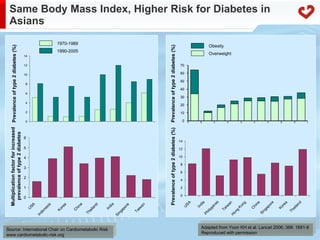
Same Body Mass Index, Higher Risk for Diabetes in Asians  Adapted from Yoon KH et al. Lancet 2006; 368: 1681-8 Reproduced with permission Prevalence of type 2 diabetes (%) Multiplication factor for increased  prevalence of type 2 diabetes 1970-1989 1990-2005 Obesity Overweight Prevalence of type 2 diabetes (%) Prevalence of type 2 diabetes (%)
% of Asian Population Having at Least One Risk Factor Stratified by Body Mass Index Hong Kong Korea Philippines Taiwan Adapted from Lancet WHO expert consultation 2004; 363: 157-63 Reproduced with permission Body mass index (kg/m 2 ) Population with >1 risk factor (%)  Men Women
Obesity, Type 2 Diabetes, Hypertension or Dyslipidemia  Relative risk Waist circumference (cm) Adapted from Lee ZSK et al. Obes Rev 2002; 3: 173-82 and Ko GT et al. Int J Obes Relat Metab Disord 1997; 21: 995-1001 0
Prediction of Intra-abdominal (Visceral) Obesity from Body Mass Index, Waist Circumference and Waist-to-Hip Ratio in Chinese Adults From Jia WP et al. Biomed Environ Sci 2003; 16: 206-11 Reproduced with permission Receiver Operating Characteristics (ROC) curves analysis ROC curves of BMI, WC and WHR for the determination of abdominal visceral obesity ( ≥  100 cm 2 ) BMI:  body mass index WC:  waist circumference WHR:   waist-to-hip ratio
Comparisons of Body Mass Index Between Patients with Increasing Number of Morbidity Condition(s)  Body mass index (kg/m 2 ) Adapted from Lee ZSK et al. Obes Rev 2002; 3: 173-82 Number of morbidity condition(s) Type 2 diabetes Hypertension Dyslipidemia 0 1  2 0 1  2 0 1  2 Morbidity conditions included type 2 diabetes, hypertension, dyslipidemia and albuminuria
Comparisons of Waist Circumference Between Patients with Increasing Number of Morbidity Condition(s)  Waist circumference (cm) Number of morbidity conditions Type 2 diabetes Hypertension Dyslipidemia Adapted from Lee ZSK et al. Obes Rev 2002; 3: 173-82 Morbidity conditions included type 2 diabetes, hypertension, dyslipidemia and albuminuria  Number of morbidity condition(s) 0 1  2 0 1  2 0 1  2
Additive Odds Ratios of Waist Circumference (WC) and Body Mass Index (BMI) on Cardiometabolic Risk Factors in 2,895 Hong Kong Chinese Adapted from Thomas GN et al. Obes Res 2004; 12: 1805-13 Reprinted by permission from Macmillan Publishers Ltd, © 2004 †  Adjusted for  WC ‡  Adjusted for BMI *  Adjusted for gender Quartile ranges for BMI are: (1) 14.78-20.56, (2) 20.57-22.10, (3) 22.11-23.52, and (4) 23.53-25.00 kg/m 2  Quartile ranges for WC are: (1) 49.8-68.0, (2) 68.3-73.1, (3) 73.3-78.3, and (4) 78.5-89.8 cm BMI† Quartile 1 Quartile 2 Quartile 3 Quartile 4 Hypertension 1.0 1.2 (0.8 to 1.8) 1.5 (0.9 to 2.3) 2.7 (1.6 to 4.6) Dyslipidemia 1.0 1.5 (1.1 to 2.0) 1.8 (1.3 to 2.5) 2.2 (1.4 to 3.2) Diabetes 1.0 1.3 (0.9 to 1.8) 1.8 (1.2 to 2.5) 2.0 (1.3 to 3.0) WC‡ Quartile 1 Quartile 2 Quartile 3 Quartile 4 Hypertension 1.0 1.1 (0.7 to 1.9) 1.8 (1.1 to 2.9) 1.8 (1.1 to 3.1) Dyslipidemia 1.0 1.8 (1.3 to 2.5) 3.0 (2.1 to 4.4) 3.6 (2.3 to 5.7) Diabetes 1.0 1.1 (0.8 to 1.6) 2.2 (1.5 to 3.3) 3.6 (2.2 to 5.7) Obesity types* Nonobese BMI obese alone Waist obese alone BMI and waist obese Hypertension 1.0 1.7 (1.2 to 2.5) 1.3 (0.7 to 2.3) 4.8 (3.7 to 6.2) Dyslipidemia 1.0 2.4 (1.8 to 3.0) 3.2 (2.1 to 5.1) 3.1 (2.5 to 3.8) Diabetes 1.0 2.2 (1.7 to 2.9) 3.2 (2.0 to 5.2) 3.9 (3.1 to 4.8)
Metabolic Syndrome – A Multifaceted Syndrome  High  blood glucose High blood  pressure Abnormal  lipid levels Obesity Heart disease Stroke Kidney failure  Depression? Cancer? Urine  protein Inflammatory markers
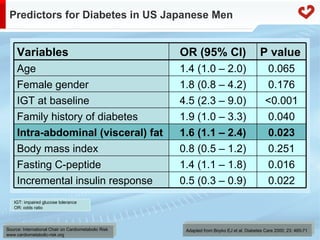
Predictors for Diabetes in US Japanese Men Adapted from Boyko EJ et al. Diabetes Care 2000; 23: 465-71 IGT: impaired glucose tolerance OR: odds ratio Variables OR (95% CI) P value Age 1.4 (1.0 – 2.0) 0.065 Female gender 1.8 (0.8 – 4.2) 0.176 IGT at baseline 4.5 (2.3 – 9.0) <0.001 Family history of diabetes 1.9 (1.0 – 3.3) 0.040 Intra-abdominal (visceral) fat 1.6 (1.1 – 2.4) 0.023 Body mass index 0.8 (0.5 – 1.2) 0.251 Fasting C-peptide 1.4 (1.1 – 1.8) 0.016 Incremental insulin response 0.5 (0.3 – 0.9) 0.022
Intra-abdominal (Visceral) Fat and Coronary Heart Disease (CHD) in Japanese Adapted from Fujimoto WY et al. Diabetes Care 1999; 22: 1808-12 *Adjusted for baseline diabetes Incident CHD status Baseline variables CHD absent CHD present P value P value* n 125 50 _ _ Weight (kg) 69.8    0.9 71.6    1.2 0.25 0.24 Body mass index (kg/m 2 ) 25.4    0.3 25.8    0.4 0.37 0.34 Computed tomography fat area (cm 2 ) Total 417.1    14.0 465.9    20.8 0.063 0.052 Chest subcutaneous 92.7    4.1 104.0    5.6 0.13 0.14 Abdomen subcutaneous 129.3    5.7 146    7.9 0.11 0.068 Intra-abdominal (visceral) 108.9    4.7 133.0    7.6 0.0075 0.016 Left thigh subcutaneous 43.1    1.5 40.8    2.1 0.39 0.72
Predictors for Coronary Heart Disease in US Japanese Men After adjustment for age, sex and body mass index Adapted from Fujimoto WY et al. Diabetes Care 1999; 22: 1808-12 Variables (1 SD) OR (95% CI) P value Intra-abdominal (visceral) fat area 1.7 (1.11-2.23) 0.009 Fasting glucose 1.91 (1.36-2.68) 0.0002 2-hour glucose 1.73 (1.25-2.4) 0.008 HDL cholesterol 0.60 (0.44-0.88) 0.0086 HDL 2  cholesterol 0.65 (0.44-0.87) 0.03 HDL 3  cholesterol 0.65 (0.46-0.94) 0.018 Fasting triglycerides 1.56 (1.09-2.13) 0.013 Systolic blood pressure 1.83 (1.28-2.6) 0.0007 Diastolic blood pressure 2.05 (1.4-3.1) 0.002
Metabolic Syndrome and Chronic Kidney Disease Adapted from Chen J et al. Ann Intern Med 2004; 140: 167-74
Glomerular Filtration Rate (GFR) Predicts All-cause Mortality, Cardiovascular and Renal Endpoints in 4,421 Chinese Type 2 Diabetic Patients (3.5-year Follow-up) Adapted from So WY et al. Diabetes Care 2006; 29: 2046-52
Metabolic Syndrome - A Unifying Hypothesis   TG and   HDL cholesterol  ß cell function  BG Adipocytokines & FFA Insulin resistance CVS and renal complications  Aging Family history (Genetics or shared environment) Psychosocial stress Visceral fat  GH and IGF-1  Testosterone (M)  Testosterone (F)  Cortisol  SNS   RAAS  BP Activated immunity Adapted from  Björntorp P. Obes Res 1993; 1: 206-22 and Chan JCN et al. Diabetes Care 1995; 18: 1013-6. Luk A and Chan JCN Diabetes Res Clin Pract 2008:  82 Suppl 1:S15-20
Age, Family History of Diabetes and Obesity are Major Explanatory Variables of Metabolic Syndrome in Hong Kong Chinese Male model  Female model  *p<0.05 Copyright © 1999 American Diabetes Association Adapted from Diabetes Care  ® , Vol. 19, 1996; 953-9 Reprinted with permission from  The American Diabetes Association
Growth Hormone (GH) and Cortisol in Young Patients with Type 2 Diabetes Plasma GH (ng/ml) Plasma cortisol (nmol/l) Plasma insulin (pmol/l) Controls (n=104) Type 2 diabetics (n=90) Copyright © 1999 American Diabetes Association Adapted from Diabetes Care  ® , Vol. 22, 1999; 1450-7 Reprinted with permission from  The American Diabetes Association
Intra-abdominal (Visceral) Fat Area Tertiles and 24-hour Ambulatory Blood Pressure and Pulse Rate in Chinese Type 2 Diabetic Patients Mean DBP (mmHg) Clock time (hours) Clock time (hours) Mean HR (bpm) Clock time (hours) Mean SBP  (mmHg) DBP: diastolic blood pressure HR: heart rate SBP: systolic blood pressure Copyright © 1997 American Diabetes Association Adapted from Diabetes Care  ® , Vol. 20, 1997; 1854-8 Reprinted with permission from  The American Diabetes Association
Central Obesity, Insulin Cortisol, Growth Hormone and 24-hour Urinary  Catecholamines in 100 Young Type 2 Diabetic Patients and 90 Control Subjects Waist circumference (cm) Dates are expressed as * geometric means and ** means Adapted from Lee ZSK et al. Diabetes Care 1999; 22: 1450-7  and Lee ZSK et al. Metabolism 2001; 50: 135-43 Insulin* p for the trend <0.001 Growth hormone p for the trend <0.05 Cortisol* p for the trend <0.01 pmol/l ng/ml nmol/l nmol/day Noradrenaline* p for the trend <0.01 Adrenaline* p for the trend <0.001 Waist circumference (cm) Quartile 1 58-67 Quartile 2 68-74 Quartile 3 75-84 Quartile 4 85-123 Quartile 1 58-67 Quartile 2 68-74 Quartile 4 85-123 Quartile 3 75-84
Insulin-like Growth Factor-1 (IGF-1), High Sensitivity C-Reactive Protein (hs-CRP), Testosterone and Metabolic Syndrome in Chinese Men  A Total testosterone IGF-1 Subjects with metabolic syndrome (%) B hs-CRP Adapted from Tong PCY et al. J Clin Endocrinol Metab 2005; 90: 6418-23 Reproduced with permission Copyright 2005, The Endocrine Society Subjects with metabolic syndrome (%) Total testosterone
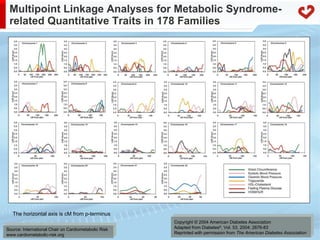
Multipoint Linkage Analyses for Metabolic Syndrome-related Quantitative Traits in 178 Families Copyright © 2004 American Diabetes Association Adapted from Diabetes ® , Vol. 53, 2004; 2676-83 Reprinted with permission from  The American Diabetes Association The horizontal axis is cM from p-terminus
Multipoint Linkage Analyses on Chromosomes 1, 2 and 16 for Metabolic Syndrome and its Component in 53 Families Major gene(s) for metabolic syndrome in chromosome 1q Copyright © 2004 American Diabetes Association Adapted from Diabetes ® , Vol. 53, 2004; 2676-83 Reprinted with permission from  The American Diabetes Association The number of affected relative pairs included in each analysis is indicated in parentheses The horizontal axis is cM from p-terminus
Are All Fat Depots the Same? Correlation between intra-abdominal (visceral) fat volume and mesenteric fat = 0.8 From Liu KH et al. Int J Obes Relat Metab Disord 2003; 27: 1267-73 Reproduced with permission Figure - Ultrasonogram of mesenteric leaves. Each mesenteric leaf is indicated by highly reflecting peritoneal surfaces (arrows). The maximum mesenteric thickness on the image was measured with the calipers (+).
Predictors of Fatty Liver in Chinese Men Adapted from Liu KH et al. Int J Obes Relat Metab Disord 2006; 30: 787-93 Variables Odds ratio (95% CI) P value Model 1  Mesenteric fat thickness  1.50 (1.27-1.77) <0.001 Triglycerides  2.64 (1.40-4.99) 0.003 HOMA 1.06 (1.00-1.12) 0.036 Model 2 Mesenteric fat thickness  1.34 (1.12-1.60) 0.002 Triglycerides  2.35 (1.19-4.63) 0.013 Body mass index  1.51 (1.26-1.82) <0.001
Multivariate Logistic Regression Analysis to Identify Independent Determinant(s) of the Metabolic Syndrome in 290 Chinese Apparently Healthy Subjects Using receiver-operating characteristic curve analysis, the cutoff value of 10 mm of mesenteric fat thickness had 70% sensitivity and 75% specificity to predict metabolic syndrome Adapted from Liu KH et al. Diabetes Care 2006; 29: 379-84  : regression coefficient SE: standard error  ±SE P value Odds ratio (95% Cl) Mesenteric fat thickness 0.30 ± 0.11 0.004 1.35 (1.10-1.66) Preperitoneal fat thickness -0.058 ± 0.07 0.41 0.94 (0.82-1.08) Subcutaneous fat thickness 0.01 ± 0.034 0.77 1.01 (0.95-1.08) HOMA-IR 0.33 ± 0.17 0.059 1.05 (1.00-1.10) Sex 0.088 ± 0.61 0.885 1.09 (0.28-3.02) Age 0.01 ± 0.034 0.775 1.01 (0.94-1.08)
Mesenteric Fat Thickness and Carotid Intima-Media Thickness (IMT) Adapted from Liu KH et al. Diabetes Care 2006; 29: 379-84 From Liu KH et al. Atherosclerosis 2005; 179:299-304 Reproduced with permission Mesenteric fat≥10 mm Mesenteric fat<10 mm
Structured Weight Management Program and Waist Circumference % Change in waist circumference Months of anti-obesity drug Adapted from Tong PCY et al. Arch Intern Med 2002; 162: 2428-35 Reproduced with permission Copyright © 2002, American Medical Association. All rights reserved. Obese patients with type 2 diabetes Obese patients without diabetes
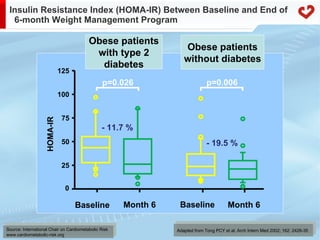
Insulin Resistance Index (HOMA-IR) Between Baseline and End of  6-month Weight Management Program - 11.7 % - 19.5 % 0 25 50 75 100 125 Baseline Month 6 p=0.006 Obese patients with type 2 diabetes Baseline Month 6 p=0.026 HOMA-IR Obese patients without diabetes Adapted from Tong PCY et al. Arch Intern Med 2002; 162: 2428-35
Change in Risk Factors after 6 Months of Weight Management Program in Hong Kong Chinese % change BMI:   body mass index    FPG:   fasting plasma glucose  FPI:   fasting plasma insulin  HbA1c:  glycosylated hemoglobin  Adapted from Tong PCY et al. Arch Intern Med 2002; 162: 2428-35 BMI WC Body fat FPG TG HbA1c SBP FPI SBP:  systolic blood pressure TG:  triglycerides WC:  waist circumference
A Holistic View of Obesity and Diabetes Genes  Environment Psycho-socio-cognitive-behavioral changes e.g. overeating, physical withdrawal, slow learning, depression, socioeconomical deprivation… Adaptation through education  Improved clinical outcomes  Disease state
Treat to Target and Stay on Target Obese subjects  (30% of population) Diabetic patients  (10% of population) Risk stratification program Weight management  program (lifestyle  ± medication) Diabetes comprehensive care program  (self care ± medication)
Conclusion Obesity, diabetes and metabolic syndrome are running rampant in Asia Asians develop cardiometabolic risk factors at a considerably lower body mass index and waist circumference values Obesity is a major predictor for cardio-renal complications in Asian population Genetics, age and stress-related hormonal changes causing obesity may be particularly relevant to Asian populations  Risk stratification and structured program reduce obesity and associated risk factors in Chinese population
www.cardiometabolic-risk.org

Metabolic syndrome: an Asian perspective

  • 1.
    Metabolic Syndrome: An Asian Perspective Juliana C N Chan MBChB, MD, FRCP Professor of Medicine & Therapeutics Director, Hong Kong Institute of Diabetes and Obesity The Chinese University of Hong Kong Hong Kong, China
  • 2.
    General Outline Obesityand metabolic syndrome – a public health perspective Ethnicity, obesity and cardio-renal complications Hormonal dysregulation in metabolic syndrome Genetics of a multifaceted syndrome Emerging role of mesenteric fat as the linking factor Power of weight reduction on risk profiles The way forward – from risk stratification to structured care
  • 3.
    Economic and humanisticburden of chronic diseases http://www.who.int/chp/chronic_disease_report/en/index.html
  • 4.
    Common risk factorsfor chronic diseases Oxford Health Alliance 2003 Deaths from 4 chronic diseases Deaths from all other causes 50% of all deaths 3 risk factors Tobacco Poor diet Lack of exercice 4 chronic diseases Cancer Type 2 diabetes Chronic respiratory disease Cardiovascular
  • 5.
    Same Body MassIndex, Higher Risk for Diabetes in Asians Adapted from Yoon KH et al. Lancet 2006; 368: 1681-8 Reproduced with permission Prevalence of type 2 diabetes (%) Multiplication factor for increased prevalence of type 2 diabetes 1970-1989 1990-2005 Obesity Overweight Prevalence of type 2 diabetes (%) Prevalence of type 2 diabetes (%)
  • 6.
    % of AsianPopulation Having at Least One Risk Factor Stratified by Body Mass Index Hong Kong Korea Philippines Taiwan Adapted from Lancet WHO expert consultation 2004; 363: 157-63 Reproduced with permission Body mass index (kg/m 2 ) Population with >1 risk factor (%) Men Women
  • 7.
    Obesity, Type 2Diabetes, Hypertension or Dyslipidemia Relative risk Waist circumference (cm) Adapted from Lee ZSK et al. Obes Rev 2002; 3: 173-82 and Ko GT et al. Int J Obes Relat Metab Disord 1997; 21: 995-1001 0
  • 8.
    Prediction of Intra-abdominal(Visceral) Obesity from Body Mass Index, Waist Circumference and Waist-to-Hip Ratio in Chinese Adults From Jia WP et al. Biomed Environ Sci 2003; 16: 206-11 Reproduced with permission Receiver Operating Characteristics (ROC) curves analysis ROC curves of BMI, WC and WHR for the determination of abdominal visceral obesity ( ≥ 100 cm 2 ) BMI: body mass index WC: waist circumference WHR: waist-to-hip ratio
  • 9.
    Comparisons of BodyMass Index Between Patients with Increasing Number of Morbidity Condition(s) Body mass index (kg/m 2 ) Adapted from Lee ZSK et al. Obes Rev 2002; 3: 173-82 Number of morbidity condition(s) Type 2 diabetes Hypertension Dyslipidemia 0 1  2 0 1  2 0 1  2 Morbidity conditions included type 2 diabetes, hypertension, dyslipidemia and albuminuria
  • 10.
    Comparisons of WaistCircumference Between Patients with Increasing Number of Morbidity Condition(s) Waist circumference (cm) Number of morbidity conditions Type 2 diabetes Hypertension Dyslipidemia Adapted from Lee ZSK et al. Obes Rev 2002; 3: 173-82 Morbidity conditions included type 2 diabetes, hypertension, dyslipidemia and albuminuria Number of morbidity condition(s) 0 1  2 0 1  2 0 1  2
  • 11.
    Additive Odds Ratiosof Waist Circumference (WC) and Body Mass Index (BMI) on Cardiometabolic Risk Factors in 2,895 Hong Kong Chinese Adapted from Thomas GN et al. Obes Res 2004; 12: 1805-13 Reprinted by permission from Macmillan Publishers Ltd, © 2004 † Adjusted for WC ‡ Adjusted for BMI * Adjusted for gender Quartile ranges for BMI are: (1) 14.78-20.56, (2) 20.57-22.10, (3) 22.11-23.52, and (4) 23.53-25.00 kg/m 2 Quartile ranges for WC are: (1) 49.8-68.0, (2) 68.3-73.1, (3) 73.3-78.3, and (4) 78.5-89.8 cm BMI† Quartile 1 Quartile 2 Quartile 3 Quartile 4 Hypertension 1.0 1.2 (0.8 to 1.8) 1.5 (0.9 to 2.3) 2.7 (1.6 to 4.6) Dyslipidemia 1.0 1.5 (1.1 to 2.0) 1.8 (1.3 to 2.5) 2.2 (1.4 to 3.2) Diabetes 1.0 1.3 (0.9 to 1.8) 1.8 (1.2 to 2.5) 2.0 (1.3 to 3.0) WC‡ Quartile 1 Quartile 2 Quartile 3 Quartile 4 Hypertension 1.0 1.1 (0.7 to 1.9) 1.8 (1.1 to 2.9) 1.8 (1.1 to 3.1) Dyslipidemia 1.0 1.8 (1.3 to 2.5) 3.0 (2.1 to 4.4) 3.6 (2.3 to 5.7) Diabetes 1.0 1.1 (0.8 to 1.6) 2.2 (1.5 to 3.3) 3.6 (2.2 to 5.7) Obesity types* Nonobese BMI obese alone Waist obese alone BMI and waist obese Hypertension 1.0 1.7 (1.2 to 2.5) 1.3 (0.7 to 2.3) 4.8 (3.7 to 6.2) Dyslipidemia 1.0 2.4 (1.8 to 3.0) 3.2 (2.1 to 5.1) 3.1 (2.5 to 3.8) Diabetes 1.0 2.2 (1.7 to 2.9) 3.2 (2.0 to 5.2) 3.9 (3.1 to 4.8)
  • 12.
    Metabolic Syndrome –A Multifaceted Syndrome High blood glucose High blood pressure Abnormal lipid levels Obesity Heart disease Stroke Kidney failure Depression? Cancer? Urine protein Inflammatory markers
  • 13.
    Predictors for Diabetesin US Japanese Men Adapted from Boyko EJ et al. Diabetes Care 2000; 23: 465-71 IGT: impaired glucose tolerance OR: odds ratio Variables OR (95% CI) P value Age 1.4 (1.0 – 2.0) 0.065 Female gender 1.8 (0.8 – 4.2) 0.176 IGT at baseline 4.5 (2.3 – 9.0) <0.001 Family history of diabetes 1.9 (1.0 – 3.3) 0.040 Intra-abdominal (visceral) fat 1.6 (1.1 – 2.4) 0.023 Body mass index 0.8 (0.5 – 1.2) 0.251 Fasting C-peptide 1.4 (1.1 – 1.8) 0.016 Incremental insulin response 0.5 (0.3 – 0.9) 0.022
  • 14.
    Intra-abdominal (Visceral) Fatand Coronary Heart Disease (CHD) in Japanese Adapted from Fujimoto WY et al. Diabetes Care 1999; 22: 1808-12 *Adjusted for baseline diabetes Incident CHD status Baseline variables CHD absent CHD present P value P value* n 125 50 _ _ Weight (kg) 69.8  0.9 71.6  1.2 0.25 0.24 Body mass index (kg/m 2 ) 25.4  0.3 25.8  0.4 0.37 0.34 Computed tomography fat area (cm 2 ) Total 417.1  14.0 465.9  20.8 0.063 0.052 Chest subcutaneous 92.7  4.1 104.0  5.6 0.13 0.14 Abdomen subcutaneous 129.3  5.7 146  7.9 0.11 0.068 Intra-abdominal (visceral) 108.9  4.7 133.0  7.6 0.0075 0.016 Left thigh subcutaneous 43.1  1.5 40.8  2.1 0.39 0.72
  • 15.
    Predictors for CoronaryHeart Disease in US Japanese Men After adjustment for age, sex and body mass index Adapted from Fujimoto WY et al. Diabetes Care 1999; 22: 1808-12 Variables (1 SD) OR (95% CI) P value Intra-abdominal (visceral) fat area 1.7 (1.11-2.23) 0.009 Fasting glucose 1.91 (1.36-2.68) 0.0002 2-hour glucose 1.73 (1.25-2.4) 0.008 HDL cholesterol 0.60 (0.44-0.88) 0.0086 HDL 2 cholesterol 0.65 (0.44-0.87) 0.03 HDL 3 cholesterol 0.65 (0.46-0.94) 0.018 Fasting triglycerides 1.56 (1.09-2.13) 0.013 Systolic blood pressure 1.83 (1.28-2.6) 0.0007 Diastolic blood pressure 2.05 (1.4-3.1) 0.002
  • 16.
    Metabolic Syndrome andChronic Kidney Disease Adapted from Chen J et al. Ann Intern Med 2004; 140: 167-74
  • 17.
    Glomerular Filtration Rate(GFR) Predicts All-cause Mortality, Cardiovascular and Renal Endpoints in 4,421 Chinese Type 2 Diabetic Patients (3.5-year Follow-up) Adapted from So WY et al. Diabetes Care 2006; 29: 2046-52
  • 18.
    Metabolic Syndrome -A Unifying Hypothesis  TG and  HDL cholesterol  ß cell function  BG Adipocytokines & FFA Insulin resistance CVS and renal complications Aging Family history (Genetics or shared environment) Psychosocial stress Visceral fat  GH and IGF-1  Testosterone (M)  Testosterone (F)  Cortisol  SNS  RAAS  BP Activated immunity Adapted from Björntorp P. Obes Res 1993; 1: 206-22 and Chan JCN et al. Diabetes Care 1995; 18: 1013-6. Luk A and Chan JCN Diabetes Res Clin Pract 2008: 82 Suppl 1:S15-20
  • 19.
    Age, Family Historyof Diabetes and Obesity are Major Explanatory Variables of Metabolic Syndrome in Hong Kong Chinese Male model Female model *p<0.05 Copyright © 1999 American Diabetes Association Adapted from Diabetes Care ® , Vol. 19, 1996; 953-9 Reprinted with permission from The American Diabetes Association
  • 20.
    Growth Hormone (GH)and Cortisol in Young Patients with Type 2 Diabetes Plasma GH (ng/ml) Plasma cortisol (nmol/l) Plasma insulin (pmol/l) Controls (n=104) Type 2 diabetics (n=90) Copyright © 1999 American Diabetes Association Adapted from Diabetes Care ® , Vol. 22, 1999; 1450-7 Reprinted with permission from The American Diabetes Association
  • 21.
    Intra-abdominal (Visceral) FatArea Tertiles and 24-hour Ambulatory Blood Pressure and Pulse Rate in Chinese Type 2 Diabetic Patients Mean DBP (mmHg) Clock time (hours) Clock time (hours) Mean HR (bpm) Clock time (hours) Mean SBP (mmHg) DBP: diastolic blood pressure HR: heart rate SBP: systolic blood pressure Copyright © 1997 American Diabetes Association Adapted from Diabetes Care ® , Vol. 20, 1997; 1854-8 Reprinted with permission from The American Diabetes Association
  • 22.
    Central Obesity, InsulinCortisol, Growth Hormone and 24-hour Urinary Catecholamines in 100 Young Type 2 Diabetic Patients and 90 Control Subjects Waist circumference (cm) Dates are expressed as * geometric means and ** means Adapted from Lee ZSK et al. Diabetes Care 1999; 22: 1450-7 and Lee ZSK et al. Metabolism 2001; 50: 135-43 Insulin* p for the trend <0.001 Growth hormone p for the trend <0.05 Cortisol* p for the trend <0.01 pmol/l ng/ml nmol/l nmol/day Noradrenaline* p for the trend <0.01 Adrenaline* p for the trend <0.001 Waist circumference (cm) Quartile 1 58-67 Quartile 2 68-74 Quartile 3 75-84 Quartile 4 85-123 Quartile 1 58-67 Quartile 2 68-74 Quartile 4 85-123 Quartile 3 75-84
  • 23.
    Insulin-like Growth Factor-1(IGF-1), High Sensitivity C-Reactive Protein (hs-CRP), Testosterone and Metabolic Syndrome in Chinese Men A Total testosterone IGF-1 Subjects with metabolic syndrome (%) B hs-CRP Adapted from Tong PCY et al. J Clin Endocrinol Metab 2005; 90: 6418-23 Reproduced with permission Copyright 2005, The Endocrine Society Subjects with metabolic syndrome (%) Total testosterone
  • 24.
    Multipoint Linkage Analysesfor Metabolic Syndrome-related Quantitative Traits in 178 Families Copyright © 2004 American Diabetes Association Adapted from Diabetes ® , Vol. 53, 2004; 2676-83 Reprinted with permission from The American Diabetes Association The horizontal axis is cM from p-terminus
  • 25.
    Multipoint Linkage Analyseson Chromosomes 1, 2 and 16 for Metabolic Syndrome and its Component in 53 Families Major gene(s) for metabolic syndrome in chromosome 1q Copyright © 2004 American Diabetes Association Adapted from Diabetes ® , Vol. 53, 2004; 2676-83 Reprinted with permission from The American Diabetes Association The number of affected relative pairs included in each analysis is indicated in parentheses The horizontal axis is cM from p-terminus
  • 26.
    Are All FatDepots the Same? Correlation between intra-abdominal (visceral) fat volume and mesenteric fat = 0.8 From Liu KH et al. Int J Obes Relat Metab Disord 2003; 27: 1267-73 Reproduced with permission Figure - Ultrasonogram of mesenteric leaves. Each mesenteric leaf is indicated by highly reflecting peritoneal surfaces (arrows). The maximum mesenteric thickness on the image was measured with the calipers (+).
  • 27.
    Predictors of FattyLiver in Chinese Men Adapted from Liu KH et al. Int J Obes Relat Metab Disord 2006; 30: 787-93 Variables Odds ratio (95% CI) P value Model 1 Mesenteric fat thickness 1.50 (1.27-1.77) <0.001 Triglycerides 2.64 (1.40-4.99) 0.003 HOMA 1.06 (1.00-1.12) 0.036 Model 2 Mesenteric fat thickness 1.34 (1.12-1.60) 0.002 Triglycerides 2.35 (1.19-4.63) 0.013 Body mass index 1.51 (1.26-1.82) <0.001
  • 28.
    Multivariate Logistic RegressionAnalysis to Identify Independent Determinant(s) of the Metabolic Syndrome in 290 Chinese Apparently Healthy Subjects Using receiver-operating characteristic curve analysis, the cutoff value of 10 mm of mesenteric fat thickness had 70% sensitivity and 75% specificity to predict metabolic syndrome Adapted from Liu KH et al. Diabetes Care 2006; 29: 379-84  : regression coefficient SE: standard error  ±SE P value Odds ratio (95% Cl) Mesenteric fat thickness 0.30 ± 0.11 0.004 1.35 (1.10-1.66) Preperitoneal fat thickness -0.058 ± 0.07 0.41 0.94 (0.82-1.08) Subcutaneous fat thickness 0.01 ± 0.034 0.77 1.01 (0.95-1.08) HOMA-IR 0.33 ± 0.17 0.059 1.05 (1.00-1.10) Sex 0.088 ± 0.61 0.885 1.09 (0.28-3.02) Age 0.01 ± 0.034 0.775 1.01 (0.94-1.08)
  • 29.
    Mesenteric Fat Thicknessand Carotid Intima-Media Thickness (IMT) Adapted from Liu KH et al. Diabetes Care 2006; 29: 379-84 From Liu KH et al. Atherosclerosis 2005; 179:299-304 Reproduced with permission Mesenteric fat≥10 mm Mesenteric fat<10 mm
  • 30.
    Structured Weight ManagementProgram and Waist Circumference % Change in waist circumference Months of anti-obesity drug Adapted from Tong PCY et al. Arch Intern Med 2002; 162: 2428-35 Reproduced with permission Copyright © 2002, American Medical Association. All rights reserved. Obese patients with type 2 diabetes Obese patients without diabetes
  • 31.
    Insulin Resistance Index(HOMA-IR) Between Baseline and End of 6-month Weight Management Program - 11.7 % - 19.5 % 0 25 50 75 100 125 Baseline Month 6 p=0.006 Obese patients with type 2 diabetes Baseline Month 6 p=0.026 HOMA-IR Obese patients without diabetes Adapted from Tong PCY et al. Arch Intern Med 2002; 162: 2428-35
  • 32.
    Change in RiskFactors after 6 Months of Weight Management Program in Hong Kong Chinese % change BMI: body mass index FPG: fasting plasma glucose FPI: fasting plasma insulin HbA1c: glycosylated hemoglobin Adapted from Tong PCY et al. Arch Intern Med 2002; 162: 2428-35 BMI WC Body fat FPG TG HbA1c SBP FPI SBP: systolic blood pressure TG: triglycerides WC: waist circumference
  • 33.
    A Holistic Viewof Obesity and Diabetes Genes Environment Psycho-socio-cognitive-behavioral changes e.g. overeating, physical withdrawal, slow learning, depression, socioeconomical deprivation… Adaptation through education Improved clinical outcomes Disease state
  • 34.
    Treat to Targetand Stay on Target Obese subjects (30% of population) Diabetic patients (10% of population) Risk stratification program Weight management program (lifestyle ± medication) Diabetes comprehensive care program (self care ± medication)
  • 35.
    Conclusion Obesity, diabetesand metabolic syndrome are running rampant in Asia Asians develop cardiometabolic risk factors at a considerably lower body mass index and waist circumference values Obesity is a major predictor for cardio-renal complications in Asian population Genetics, age and stress-related hormonal changes causing obesity may be particularly relevant to Asian populations Risk stratification and structured program reduce obesity and associated risk factors in Chinese population
  • 36.

Editor's Notes

  • #19 BP: blood pressure BG: blood glucose CVS: cardiovascular system FFA: free fatty acids GH: growth hormone IGF-1: insulin-like growth factor-1 RAAS: renin-angiotensin-aldosterone system SNS: sympathetic nervous system TG: triglycerides