Single Dose Azithromycin versus
Ciprofloxacin for Cholera in
Children: A Randomized
Controlled Trial
Dr Pooja Dewan
Postgraduate student
Department of Pediatrics
University College of Medical Sciences & GTB Hospital
Supervisor : Dr. Piyush Gupta
Professor
Dept. of Pediatrics
UCMS & GTB Hospital
Delhi
Co-Supervisors : Dr. Shukla Das
Professor
Dept. of Microbiology
UCMS & GTB Hospital
Delhi
Dr MMA Faridi
Professor & Head
Dept. of Pediatrics
UCMS & GTB Hospital
Delhi
Background
• Cholera is a significant health problem in
children
• Ciprofloxacin proven an effective drug
• Emergence of flouroquinolone resistance in
Vibrio cholerae
• Alternate drug required
• Single-dose oral azithromycin shown good
results for cholera in adults
• No similar studies in Children
Aim: to evaluate the role of Azithromycin in
children with cholera
Primary Objective:
To compare Azithromycin with Ciprofloxacin, both as
single dose treatment, in children with cholera, in terms
of clinical success (resolution of diarrhea) and
bacteriological success (cessation of excretion of Vibrio
cholerae)
Secondary Objectives:
To compare recovery time, requirement of ORS or IV fluids, and
relapse rate
• Setting: Departments of Pediatrics and
Microbiology, University College of Medical
Sciences and GTB Hospital, Delhi.
• Study Design: Randomized, open labeled,
clinical controlled trial.
• Study Period: April 1, 2011-March 31, 2012
• Consent and Ethics: Written informed consent
and Institutional Ethical Clearance
Participants
Inclusion criteria
Children between 2-12 years with
•Acute watery diarrhea for ≤24 h
•Severe dehydration, and
•Positive for V. cholerae by HD examination or stool culture
Exclusion criteria
•Severe undernutrition
•Co-existing systemic illness
•Blood in stool
•Receiving an antibiotic/antidiarrheal within preceding 24 h
Sample size
• Equivalence study
• At least 87 patients in each treatment group to
show that the difference in rates of clinical
success between the two groups does not exceed
10%; Power= 80%, α error= 5%, β error= 20%
Khan WA, et al. Randomised controlled comparison of single-
dose ciprofloxacin and doxycycline for cholera caused by
Vibrio cholerae 01 or 0139. Lancet. 1996;348(9023):296-300.
Methods
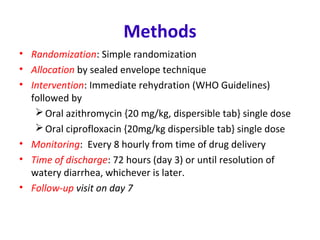
• Randomization: Simple randomization
• Allocation by sealed envelope technique
• Intervention: Immediate rehydration (WHO Guidelines)
followed by
Oral azithromycin {20 mg/kg, dispersible tab} single dose
Oral ciprofloxacin {20mg/kg dispersible tab} single dose
• Monitoring: Every 8 hourly from time of drug delivery
• Time of discharge: 72 hours (day 3) or until resolution of
watery diarrhea, whichever is later.
• Follow-up visit on day 7
Bacteriological procedures
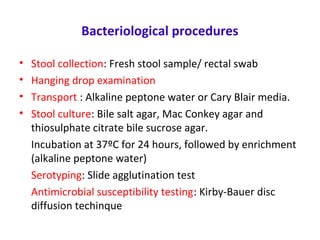
• Stool collection: Fresh stool sample/ rectal swab
• Hanging drop examination
• Transport : Alkaline peptone water or Cary Blair media.
• Stool culture: Bile salt agar, Mac Conkey agar and
thiosulphate citrate bile sucrose agar.
Incubation at 37ºC for 24 hours, followed by enrichment
(alkaline peptone water)
Serotyping: Slide agglutination test
Antimicrobial susceptibility testing: Kirby-Bauer disc
diffusion techinque
Outcome measures
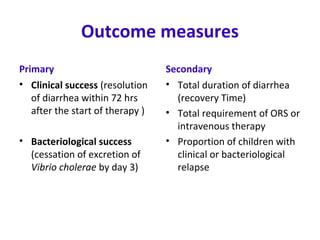
Primary
• Clinical success (resolution
of diarrhea within 72 hrs
after the start of therapy )
• Bacteriological success
(cessation of excretion of
Vibrio cholerae by day 3)
Secondary
• Total duration of diarrhea
(recovery Time)
• Total requirement of ORS or
intravenous therapy
• Proportion of children with
clinical or bacteriological
relapse
Statistical analysis
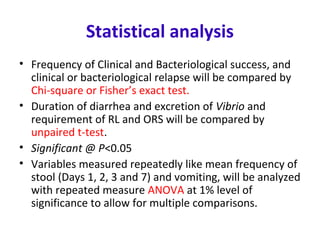
• Frequency of Clinical and Bacteriological success, and
clinical or bacteriological relapse will be compared by
Chi-square or Fisher’s exact test.
• Duration of diarrhea and excretion of Vibrio and
requirement of RL and ORS will be compared by
unpaired t-test.
• Significant @ P<0.05
• Variables measured repeatedly like mean frequency of
stool (Days 1, 2, 3 and 7) and vomiting, will be analyzed
with repeated measure ANOVA at 1% level of
significance to allow for multiple comparisons.

Sample protocol presentation 2013

  • 1.
    Single Dose Azithromycinversus Ciprofloxacin for Cholera in Children: A Randomized Controlled Trial Dr Pooja Dewan Postgraduate student Department of Pediatrics University College of Medical Sciences & GTB Hospital
  • 2.
    Supervisor : Dr.Piyush Gupta Professor Dept. of Pediatrics UCMS & GTB Hospital Delhi Co-Supervisors : Dr. Shukla Das Professor Dept. of Microbiology UCMS & GTB Hospital Delhi Dr MMA Faridi Professor & Head Dept. of Pediatrics UCMS & GTB Hospital Delhi
  • 3.
    Background • Cholera isa significant health problem in children • Ciprofloxacin proven an effective drug • Emergence of flouroquinolone resistance in Vibrio cholerae • Alternate drug required • Single-dose oral azithromycin shown good results for cholera in adults • No similar studies in Children
  • 4.
    Aim: to evaluatethe role of Azithromycin in children with cholera Primary Objective: To compare Azithromycin with Ciprofloxacin, both as single dose treatment, in children with cholera, in terms of clinical success (resolution of diarrhea) and bacteriological success (cessation of excretion of Vibrio cholerae) Secondary Objectives: To compare recovery time, requirement of ORS or IV fluids, and relapse rate
  • 5.
    • Setting: Departmentsof Pediatrics and Microbiology, University College of Medical Sciences and GTB Hospital, Delhi. • Study Design: Randomized, open labeled, clinical controlled trial. • Study Period: April 1, 2011-March 31, 2012 • Consent and Ethics: Written informed consent and Institutional Ethical Clearance
  • 6.
    Participants Inclusion criteria Children between2-12 years with •Acute watery diarrhea for ≤24 h •Severe dehydration, and •Positive for V. cholerae by HD examination or stool culture Exclusion criteria •Severe undernutrition •Co-existing systemic illness •Blood in stool •Receiving an antibiotic/antidiarrheal within preceding 24 h
  • 7.
    Sample size • Equivalencestudy • At least 87 patients in each treatment group to show that the difference in rates of clinical success between the two groups does not exceed 10%; Power= 80%, α error= 5%, β error= 20% Khan WA, et al. Randomised controlled comparison of single- dose ciprofloxacin and doxycycline for cholera caused by Vibrio cholerae 01 or 0139. Lancet. 1996;348(9023):296-300.
  • 8.
    Methods • Randomization: Simplerandomization • Allocation by sealed envelope technique • Intervention: Immediate rehydration (WHO Guidelines) followed by Oral azithromycin {20 mg/kg, dispersible tab} single dose Oral ciprofloxacin {20mg/kg dispersible tab} single dose • Monitoring: Every 8 hourly from time of drug delivery • Time of discharge: 72 hours (day 3) or until resolution of watery diarrhea, whichever is later. • Follow-up visit on day 7
  • 9.
    Bacteriological procedures • Stoolcollection: Fresh stool sample/ rectal swab • Hanging drop examination • Transport : Alkaline peptone water or Cary Blair media. • Stool culture: Bile salt agar, Mac Conkey agar and thiosulphate citrate bile sucrose agar. Incubation at 37ºC for 24 hours, followed by enrichment (alkaline peptone water) Serotyping: Slide agglutination test Antimicrobial susceptibility testing: Kirby-Bauer disc diffusion techinque
  • 10.
    Outcome measures Primary • Clinicalsuccess (resolution of diarrhea within 72 hrs after the start of therapy ) • Bacteriological success (cessation of excretion of Vibrio cholerae by day 3) Secondary • Total duration of diarrhea (recovery Time) • Total requirement of ORS or intravenous therapy • Proportion of children with clinical or bacteriological relapse
  • 11.
    Statistical analysis • Frequencyof Clinical and Bacteriological success, and clinical or bacteriological relapse will be compared by Chi-square or Fisher’s exact test. • Duration of diarrhea and excretion of Vibrio and requirement of RL and ORS will be compared by unpaired t-test. • Significant @ P<0.05 • Variables measured repeatedly like mean frequency of stool (Days 1, 2, 3 and 7) and vomiting, will be analyzed with repeated measure ANOVA at 1% level of significance to allow for multiple comparisons.

Editor's Notes

  • #7 Severe under-nutrition (weight for age less than 60% of 50th percentile of CDC 2000 standards).
  • #9 (30 mL/kg in first ½ hour; by 70 mL/kg over next 2½ hours)