SAML vs OAuth
Anil Saldhana
anil@apache.org
http://anil-identity.blogspot.com

Reference: http://architects.dzone.com/articles/saml-versus-oauthwhich-one
Informal Definitions
• SAML (Security Assertion Markup Language) is
an umbrella standard that encompasses
profiles, bindings and constructs to achieve
– Single Sign On (SSO),
– Federation and
– Identity Management.
Informal Definitions
• OAuth (Open Authorization) is a standard for
authorization of resources.
• It does not deal with authentication.
– Look for OpenID Connect for Authentication.
Formal Definitions
Formal Definitions
• Security Assertion Markup Language is an
XML-based open standard data format for
exchanging authentication and authorization
data between parties, in particular, between
an identity provider and a service provider.
• From Wikipedia Page on SAML
Formal Definitions
• OAuth : An open protocol to allow secure
authorization in a simple and standard
method from web, mobile and desktop
applications.
• From OAuth.net
Differences
Token or Message Format
Token Or Message Format
• SAML deals with XML as the data construct or
token format.
• OAuth tokens can be binary, JSON or SAML as
explained in OAuth Bearer Tokens
(https://docs.jboss.org/author/display/PLINK/
OAuth+Bearer+Tokens).
Transport
Transport
• SAML has Bindings that use HTTP such as
HTTP POST Binding, HTTP REDIRECT Binding
etc.
– But there is no restriction on the transport format.
You can use SOAP or JMS or any transport you
want to use to send SAML tokens or messages.
Transport
• OAuth uses HTTP exclusively.
Scope
Scope
• Even though SAML was designed to be
applicable openly, it is typically used in
Enterprise SSO scenarios
– within an enterprise or
– enterprise to partner or
– enterprise to cloud scenarios.
Scope
• OAuth has been designed for use with
applications on the internet,
– primarily for delegated authorization of internet
resources.

• OAuth is designed for Internet Scale.
Which Versions Should Be Used?
Versions
• SAML v2.0
• OAuth v2.0
Use Cases
Use Cases
• If your use case involves SSO (when at least
one actor or partner is an enterprise)
– then use SAML.
Use Cases
• If your use case involves providing access
(temporarily or permanent) to resources (such
as accounts, pictures, files etc.)
– then use OAuth.
Use Cases
• If your use case involves providing access to a
partner or customer application to your portal
– then use SAML.
Use Cases
• If your use case requires a centralized identity
source
– then use SAML.

You can also use an Open ID Provider as
a central Identity Provider under the
OpenID Connect Specification (under
development).
Use Cases
• If your use case involves mobile devices
– then use OAuth (with some form of bearer
tokens).
Using SAML with OAuth
SAML With OAuth
• Use SAML for authentication.
• Use SAML token/assertion as the OAuth
bearer token in the HTTP bearer header to
access protected resources.
Replace SAML with OAuth
Replace SAML With OAuth
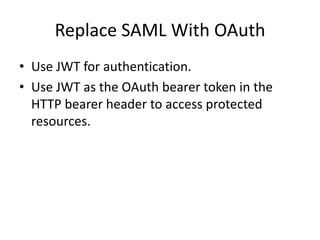
• Use JWT for authentication.
• Use JWT as the OAuth bearer token in the
HTTP bearer header to access protected
resources.
References
References
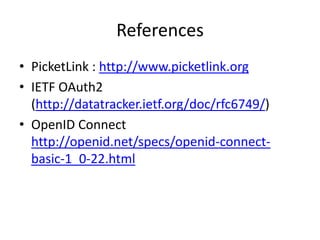
• PicketLink : http://www.picketlink.org
• IETF OAuth2
(http://datatracker.ietf.org/doc/rfc6749/)
• OpenID Connect
http://openid.net/specs/openid-connectbasic-1_0-22.html
Full Article
http://architects.dzone.com/articles/
saml-versus-oauth-which-one
Contact Me
anil@apache.org

Saml vs Oauth : Which one should I use?

  • 1.
    SAML vs OAuth AnilSaldhana anil@apache.org http://anil-identity.blogspot.com Reference: http://architects.dzone.com/articles/saml-versus-oauthwhich-one
  • 2.
  • 3.
    Informal Definitions • SAML(Security Assertion Markup Language) is an umbrella standard that encompasses profiles, bindings and constructs to achieve – Single Sign On (SSO), – Federation and – Identity Management.
  • 4.
    Informal Definitions • OAuth(Open Authorization) is a standard for authorization of resources. • It does not deal with authentication. – Look for OpenID Connect for Authentication.
  • 5.
  • 6.
    Formal Definitions • SecurityAssertion Markup Language is an XML-based open standard data format for exchanging authentication and authorization data between parties, in particular, between an identity provider and a service provider. • From Wikipedia Page on SAML
  • 7.
    Formal Definitions • OAuth: An open protocol to allow secure authorization in a simple and standard method from web, mobile and desktop applications. • From OAuth.net
  • 8.
  • 9.
  • 10.
    Token Or MessageFormat • SAML deals with XML as the data construct or token format. • OAuth tokens can be binary, JSON or SAML as explained in OAuth Bearer Tokens (https://docs.jboss.org/author/display/PLINK/ OAuth+Bearer+Tokens).
  • 11.
  • 12.
    Transport • SAML hasBindings that use HTTP such as HTTP POST Binding, HTTP REDIRECT Binding etc. – But there is no restriction on the transport format. You can use SOAP or JMS or any transport you want to use to send SAML tokens or messages.
  • 13.
    Transport • OAuth usesHTTP exclusively.
  • 14.
  • 15.
    Scope • Even thoughSAML was designed to be applicable openly, it is typically used in Enterprise SSO scenarios – within an enterprise or – enterprise to partner or – enterprise to cloud scenarios.
  • 16.
    Scope • OAuth hasbeen designed for use with applications on the internet, – primarily for delegated authorization of internet resources. • OAuth is designed for Internet Scale.
  • 17.
  • 18.
  • 19.
  • 20.
    Use Cases • Ifyour use case involves SSO (when at least one actor or partner is an enterprise) – then use SAML.
  • 21.
    Use Cases • Ifyour use case involves providing access (temporarily or permanent) to resources (such as accounts, pictures, files etc.) – then use OAuth.
  • 22.
    Use Cases • Ifyour use case involves providing access to a partner or customer application to your portal – then use SAML.
  • 23.
    Use Cases • Ifyour use case requires a centralized identity source – then use SAML. You can also use an Open ID Provider as a central Identity Provider under the OpenID Connect Specification (under development).
  • 24.
    Use Cases • Ifyour use case involves mobile devices – then use OAuth (with some form of bearer tokens).
  • 25.
  • 26.
    SAML With OAuth •Use SAML for authentication. • Use SAML token/assertion as the OAuth bearer token in the HTTP bearer header to access protected resources.
  • 27.
  • 28.
    Replace SAML WithOAuth • Use JWT for authentication. • Use JWT as the OAuth bearer token in the HTTP bearer header to access protected resources.
  • 29.
  • 30.
    References • PicketLink :http://www.picketlink.org • IETF OAuth2 (http://datatracker.ietf.org/doc/rfc6749/) • OpenID Connect http://openid.net/specs/openid-connectbasic-1_0-22.html
  • 31.
  • 32.