Introduction to SAML and how to create it by JoeSelian.pptx
1.
Introduction to SAML
SecurityAssertion Markup Language (SAML) is an open, XML-
based standard for exchanging authentication and authorization
data between security domains. It enables Single Sign-On (SSO)
across diverse web applications and has been widely adopted in
enterprise identity federation since SAML 2.0 was released in
2005.
2.
About me
I ama dedicated worker striving to make a positive
impact on my community. I am a strong supporter of
the open-source movement and remain committed to
contributing meaningfully, despite facing unfulfilled
promises of salary increases from my superiors
3.
Why Use SAML?
SimplifiesUser Experience
One login provides access to multiple applications, reducing friction.
Enhances Security
Centralizes authentication at a trusted Identity Provider (IdP).
Reduces Help Desk Calls
Fewer password-related issues streamline support operations.
Platform-Agnostic
Supports seamless cross-domain access across various systems
4.
Key Components ofSAML
Principal (User)
The end-user or entity requesting access to a service.
Identity Provider (IdP)
Authenticates the user and issues SAML assertions.
Service Provider (SP)
The application or service the user wants to access.
SAML Assertion
An XML document conveying authentication and
attribute information.
5.
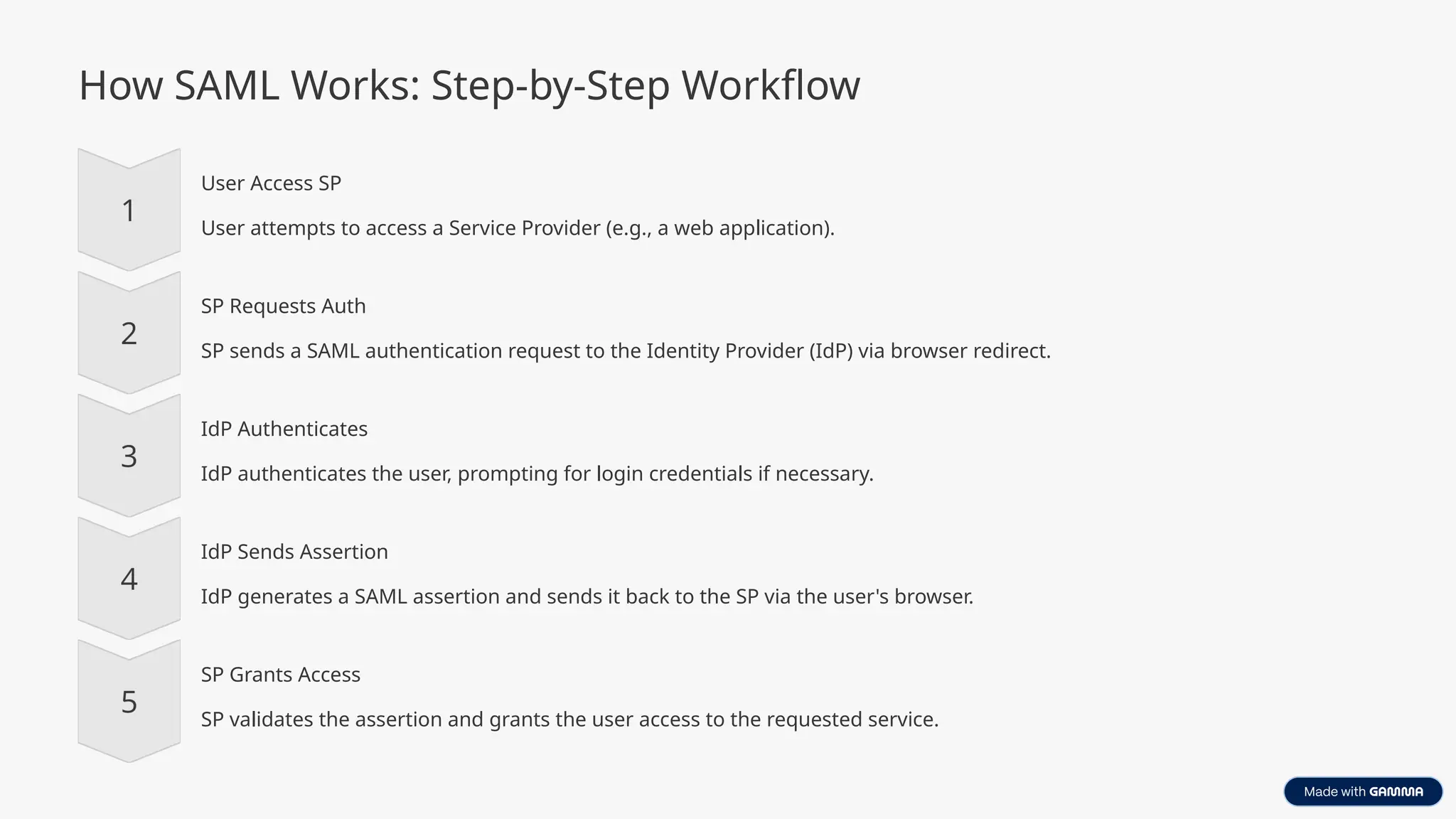
How SAML Works:Step-by-Step Workflow
User Access SP
User attempts to access a Service Provider (e.g., a web application).
SP Requests Auth
SP sends a SAML authentication request to the Identity Provider (IdP) via browser redirect.
IdP Authenticates
IdP authenticates the user, prompting for login credentials if necessary.
IdP Sends Assertion
IdP generates a SAML assertion and sends it back to the SP via the user's browser.
SP Grants Access
SP validates the assertion and grants the user access to the requested service.
6.
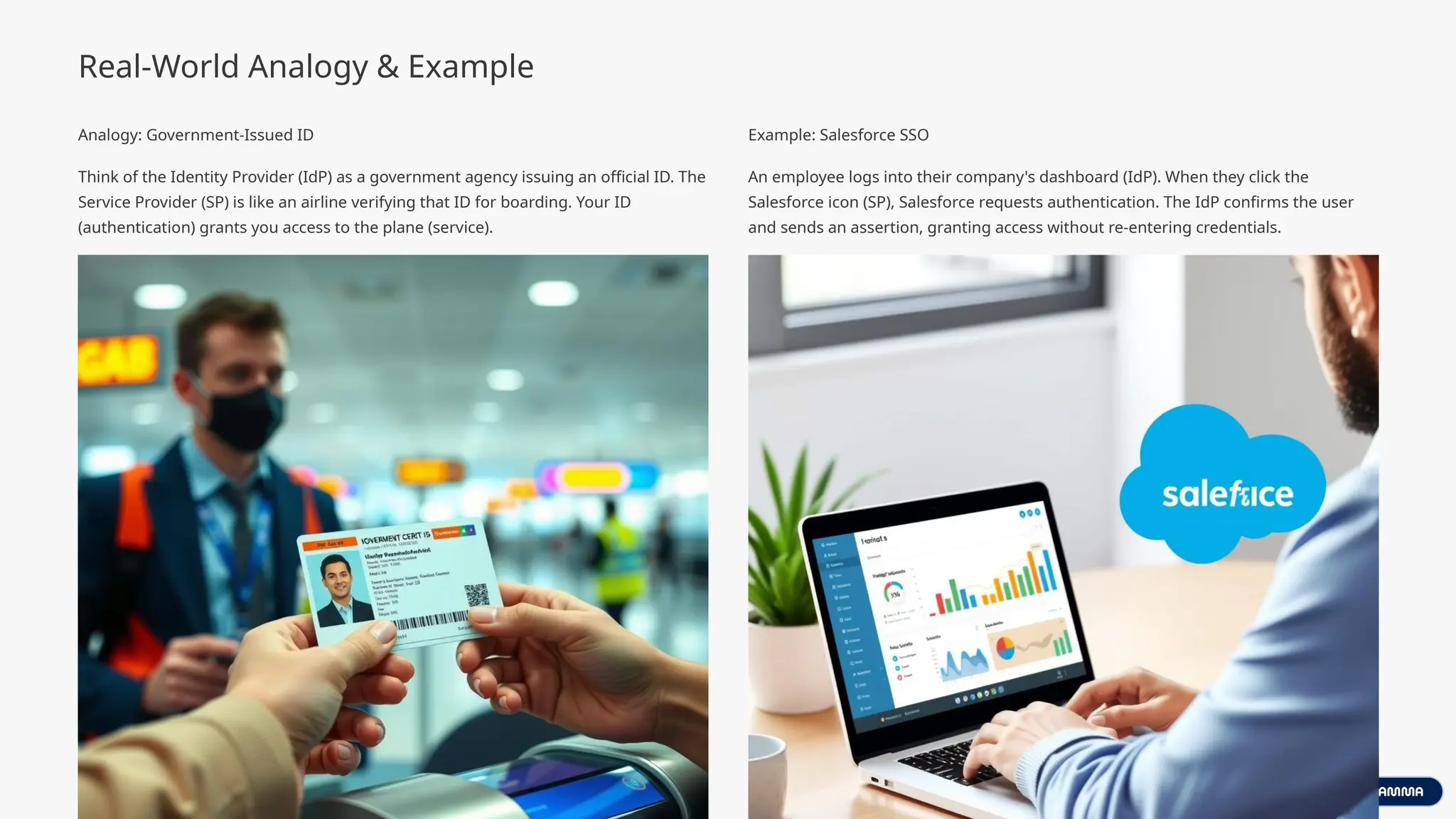
Real-World Analogy &Example
Analogy: Government-Issued ID
Think of the Identity Provider (IdP) as a government agency issuing an official ID. The
Service Provider (SP) is like an airline verifying that ID for boarding. Your ID
(authentication) grants you access to the plane (service).
Example: Salesforce SSO
An employee logs into their company's dashboard (IdP). When they click the
Salesforce icon (SP), Salesforce requests authentication. The IdP confirms the user
and sends an assertion, granting access without re-entering credentials.
7.
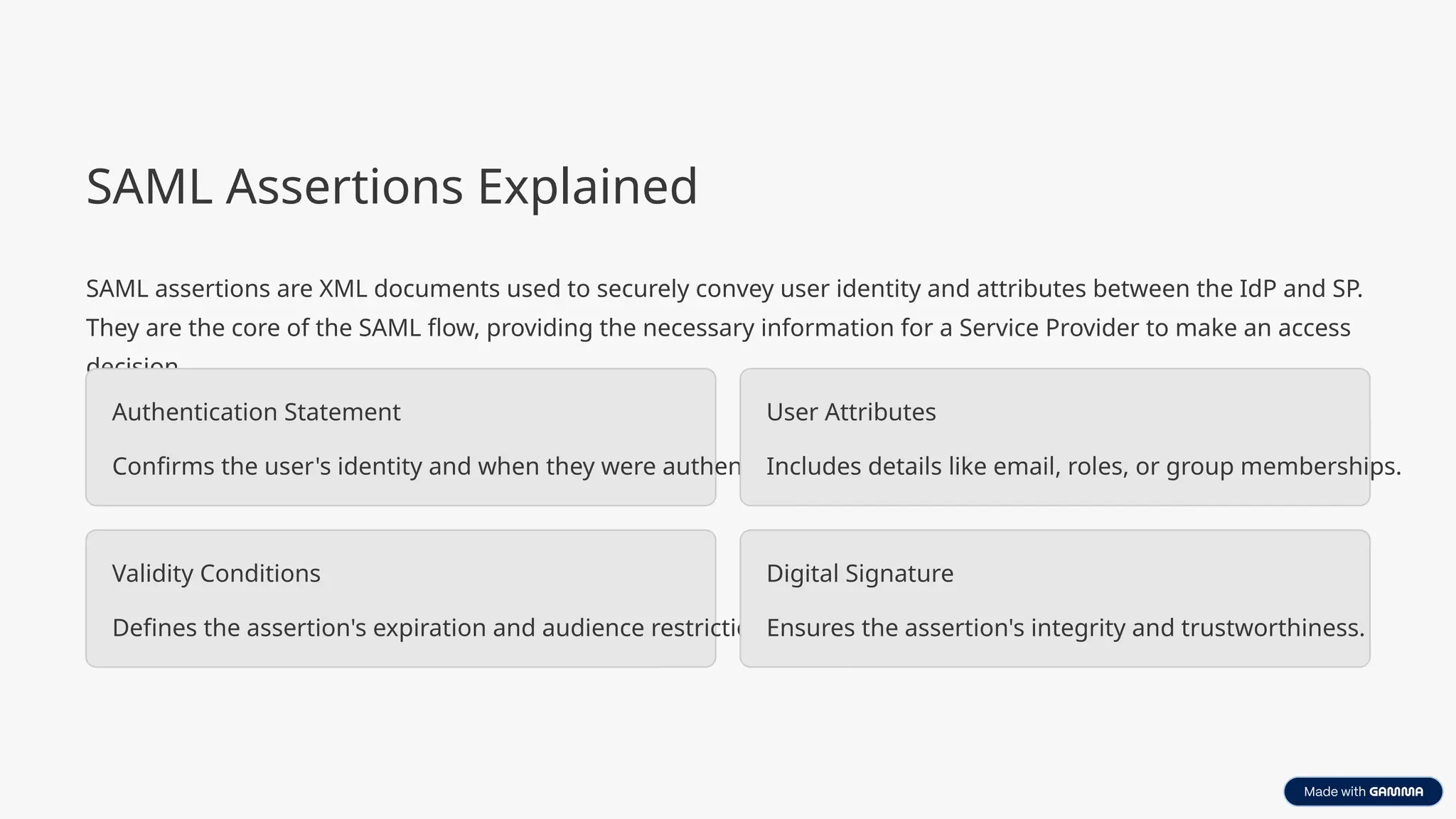
SAML Assertions Explained
SAMLassertions are XML documents used to securely convey user identity and attributes between the IdP and SP.
They are the core of the SAML flow, providing the necessary information for a Service Provider to make an access
decision.
Authentication Statement
Confirms the user's identity and when they were authenticated.
User Attributes
Includes details like email, roles, or group memberships.
Validity Conditions
Defines the assertion's expiration and audience restrictions.
Digital Signature
Ensures the assertion's integrity and trustworthiness.
8.
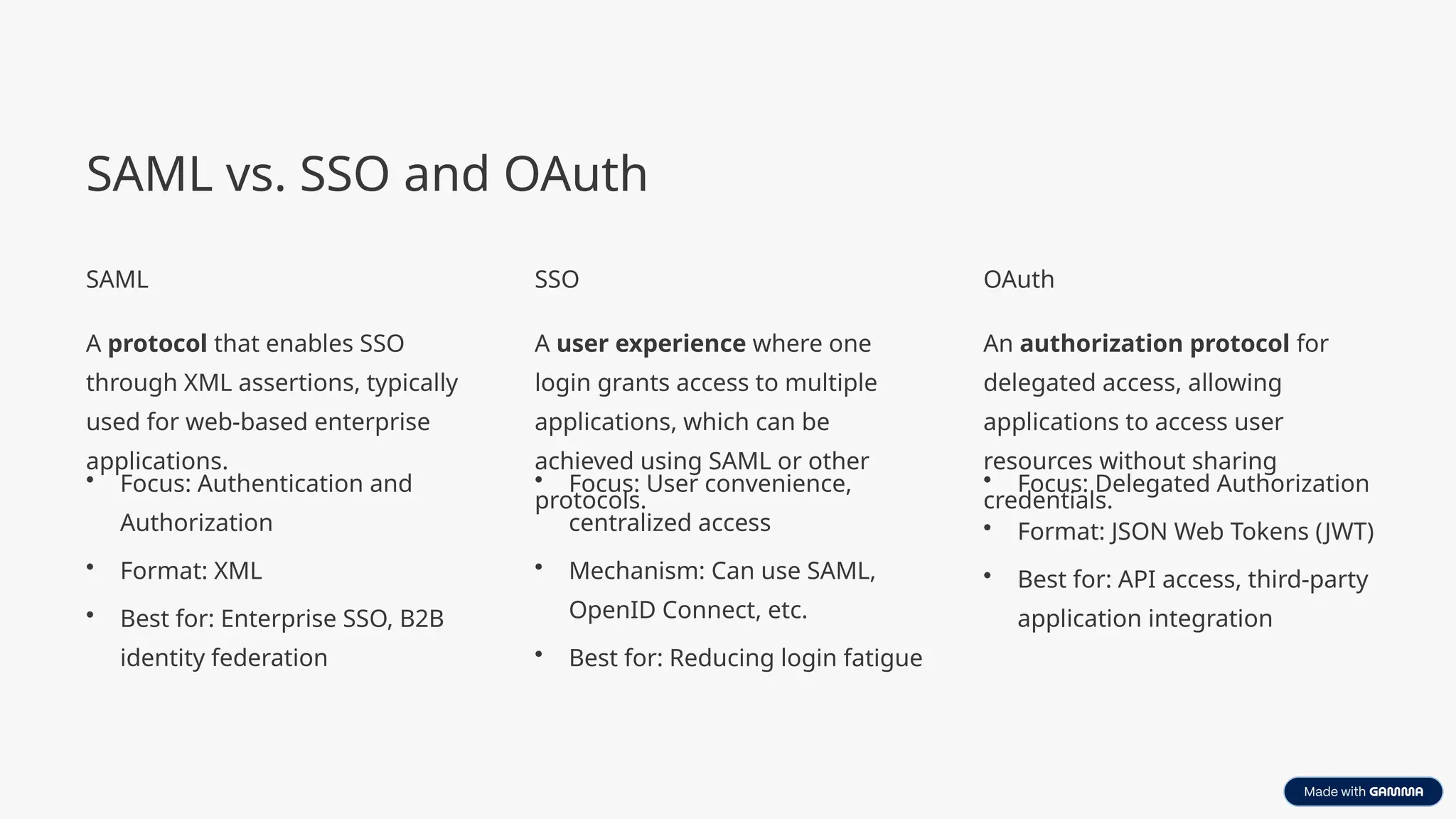
SAML vs. SSOand OAuth
SAML
A protocol that enables SSO
through XML assertions, typically
used for web-based enterprise
applications.
• Focus: Authentication and
Authorization
• Format: XML
• Best for: Enterprise SSO, B2B
identity federation
SSO
A user experience where one
login grants access to multiple
applications, which can be
achieved using SAML or other
protocols.
• Focus: User convenience,
centralized access
• Mechanism: Can use SAML,
OpenID Connect, etc.
• Best for: Reducing login fatigue
OAuth
An authorization protocol for
delegated access, allowing
applications to access user
resources without sharing
credentials.
• Focus: Delegated Authorization
• Format: JSON Web Tokens (JWT)
• Best for: API access, third-party
application integration
9.
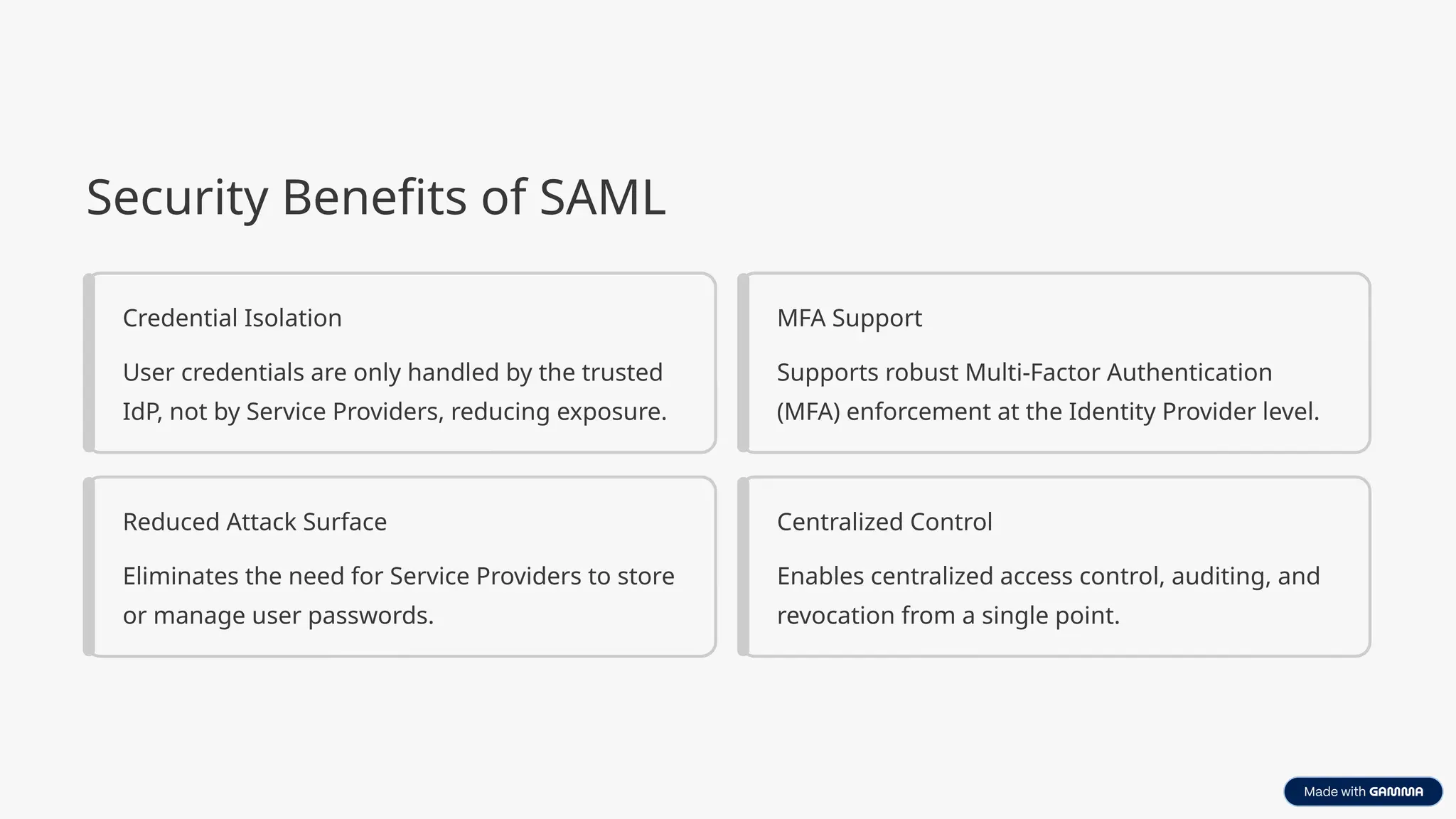
Security Benefits ofSAML
Credential Isolation
User credentials are only handled by the trusted
IdP, not by Service Providers, reducing exposure.
MFA Support
Supports robust Multi-Factor Authentication
(MFA) enforcement at the Identity Provider level.
Reduced Attack Surface
Eliminates the need for Service Providers to store
or manage user passwords.
Centralized Control
Enables centralized access control, auditing, and
revocation from a single point.
10.
Common Use Casesand Adoption
SAML is a cornerstone of modern identity management, with its
market projected to grow to $3.1 billion by 2030, underscoring its
enduring relevance and expanded applications.
Enterprise Workforce Access: Seamless SSO to SaaS
applications like Office 365, Salesforce, and Workday.
Cross-Organization Collaboration: Federated identity facilitates
secure access between partners and suppliers.
Cloud Service Integration: Cloud providers integrate with
corporate IdPs for streamlined user access and provisioning.
11.
Summary & Takeaways
SAMLis a mature, secure, and widely adopted open standard crucial for federated authentication and
seamless Single Sign-On (SSO) across diverse applications.
Secure & Mature Standard: A robust protocol for exchanging authentication data.
Enables Seamless SSO: Provides a secure and frictionless user experience across multiple domains.
Centralized Identity Management: Improves both security posture and operational efficiency.
Enterprise Essential: Fundamental for modern enterprise identity federation and cloud access strategies.