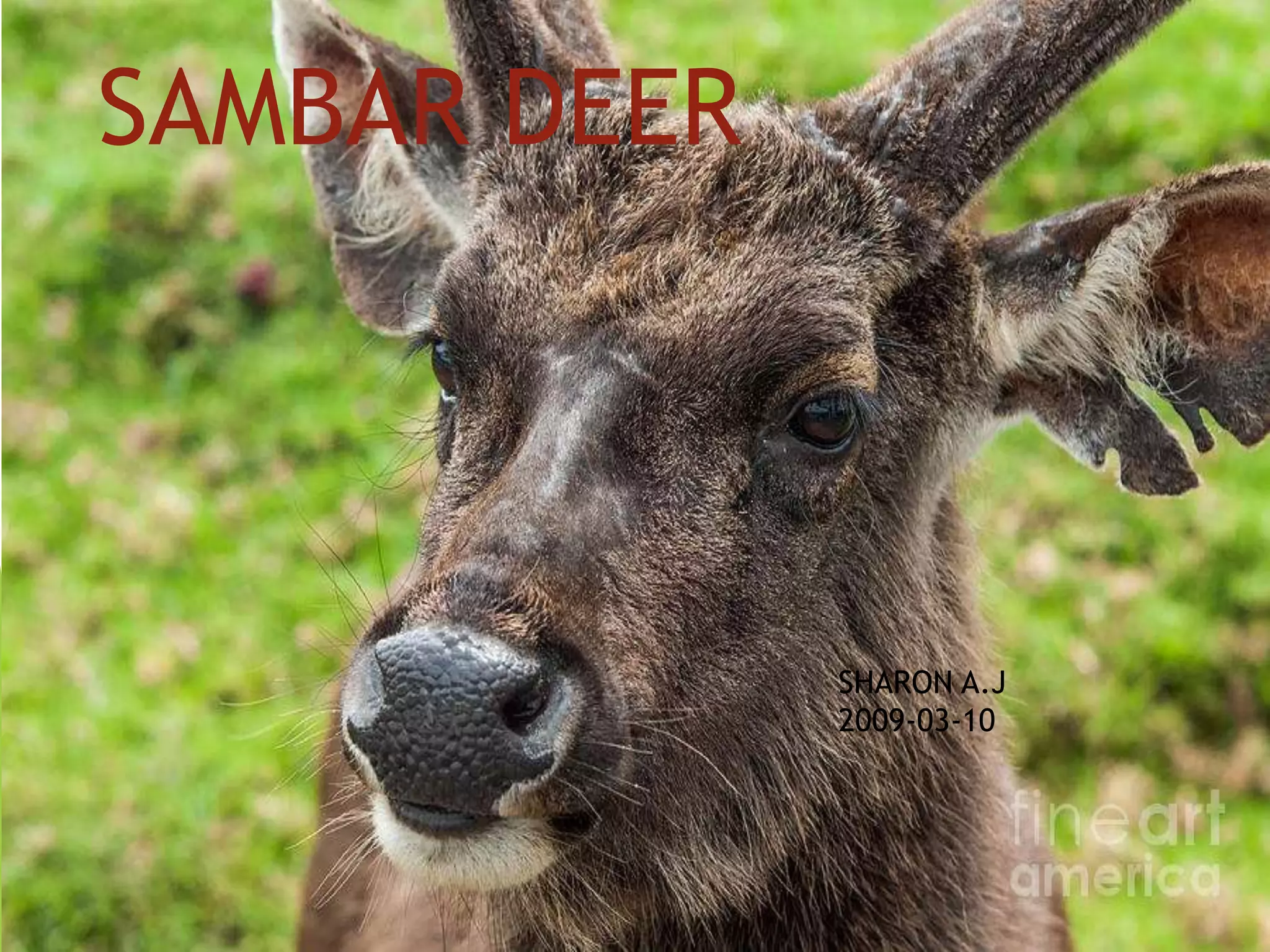
SAMBAR DEER
SHARON A.J
2009-03-10
 The sambar (Rusa unicolor) is a large deer native to
the Indian Subcontinent,
 Sambar have a small but dense mane, which tends to
be more prominent in males
 The tail is relatively long for deer, and is generally black
above with a whitish underside
 Sambar have lived for up to 28 years in captivity,
although it is unlikely that they often survive more than
twelve years in the wild
 Young male grows antlers at age 2
TAXONOMY
Kingdom : Animalia
Phylum : Chordata
Class : Mammalia
Order : Artiodactyla
Family : Cervidae
Subfamily: Cervinae
Genus : Cervus
Species : Unicolor
Scientific name : Rusa unicolor (Kerr, 1792)
New : Cervus unicolor
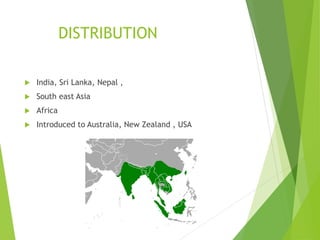
DISTRIBUTION
 India, Sri Lanka, Nepal ,
 South east Asia
 Africa
 Introduced to Australia, New Zealand , USA
HABITAT
 Open jungles and Grasslands
 Prefer forested hill-sides near
cultivation
 Adapt itself to wide variety of
environmental condition
 In India mainly temperate forests
 Prefer water source nearby
FOREST TYPES
 Sambar are found in habitats ranging from tropical
seasonal forests (tropical dry forests and seasonal moist
evergreen forests),
 subtropical mixed forests (conifers, broadleaf
deciduous, and broadleaf evergreen tree species)
to tropical rainforests
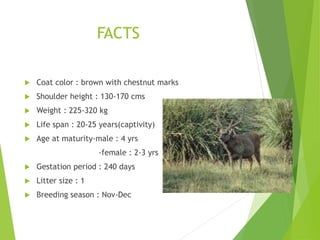
FACTS
 Coat color : brown with chestnut marks
 Shoulder height : 130-170 cms
 Weight : 225-320 kg
 Life span : 20-25 years(captivity)
 Age at maturity-male : 4 yrs
-female : 2-3 yrs
 Gestation period : 240 days
 Litter size : 1
 Breeding season : Nov-Dec
 Delicious food to Tiger , Asiatic lion
 IUCN red data list : Vulnerable
 The major threats are Habitat
encroachment and Hunting
 Body temp : 102 F
 Pulse : 60-80/minute
 Respiratory rate : 12-20/minute
BEHAVIOR
 Nocturnal or crepuscular
 Form small herd of up to 6 individuals
 Amazing sense of hearing and smell
 When alarmed all adults screams a high
pitched sound- “pooking” or “belling”
 Common communication- Scent making,
Foot stamping
 Marking by antlers and spraying urine
directly in his own face with a highly
mobile penis
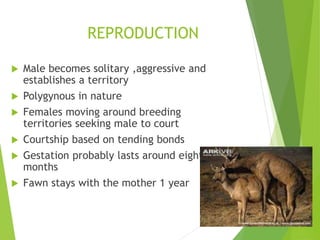
REPRODUCTION
 Male becomes solitary ,aggressive and
establishes a territory
 Polygynous in nature
 Females moving around breeding
territories seeking male to court
 Courtship based on tending bonds
 Gestation probably lasts around eight
months
 Fawn stays with the mother 1 year
SEXUAL BEHAVIOUR
 Sambar mate and reproduce year-round,
 sambar calving peaks seasonally.
 Estrus lasts around eighteen days.
 The male establishes a territory from
which he attracts nearby females, but he
does not establish a harem.
 The male stomps the ground, creating a
bare patch, and often wallows in the
mud, perhaps to accentuate the colour of
his hair
 Large dominant stags will defend non-
exclusive territories surrounded by
several smaller males
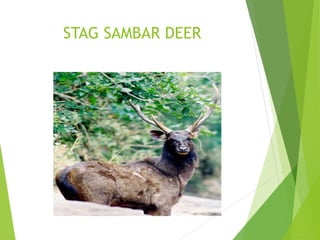
STAG SAMBAR DEER
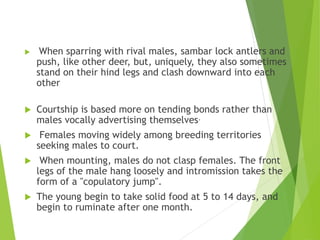
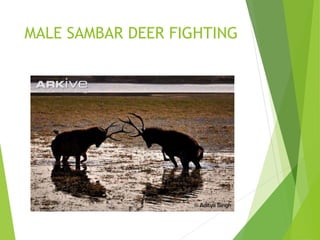
 When sparring with rival males, sambar lock antlers and
push, like other deer, but, uniquely, they also sometimes
stand on their hind legs and clash downward into each
other
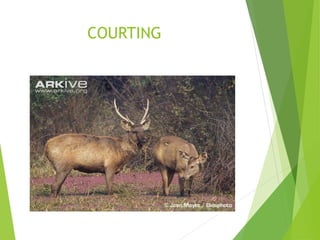
 Courtship is based more on tending bonds rather than
males vocally advertising themselves.
 Females moving widely among breeding territories
seeking males to court.
 When mounting, males do not clasp females. The front
legs of the male hang loosely and intromission takes the
form of a "copulatory jump".
 The young begin to take solid food at 5 to 14 days, and
begin to ruminate after one month.
MALE SAMBAR DEER FIGHTING
COURTING
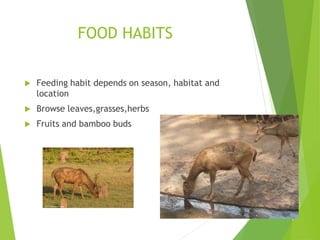
FOOD HABITS
 Feeding habit depends on season, habitat and
location
 Browse leaves,grasses,herbs
 Fruits and bamboo buds
DISEASES
 Rabies,FMD,HS
 Tuberculosis,Anthrax,Tetanus,CBPP
 Salmonellosis,colibacillosis,leptospirosis
 Dermatophytosis,candidiasis
 Trypanosomiasis,Sarcocystitis,filariasis
 Major causes of death-Traumatic injury,
respiratory infection, GIT infection,
dystocia
MANAGEMENT IN ZOO
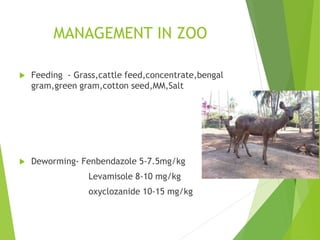
 Feeding - Grass,cattle feed,concentrate,bengal
gram,green gram,cotton seed,MM,Salt
 Deworming- Fenbendazole 5-7.5mg/kg
Levamisole 8-10 mg/kg
oxyclozanide 10-15 mg/kg
VACCINATION
 Vaccination -FMD
-HS+BQ 4ml SC
 To minimize birth in capacity chemical contraceptive
Melongestrol acetate (feed additive) and porcine zona
pellucida vaccine are succesfully applied
RESTRAINING
 PHYSICAL – squeeze guage ,trap ,crate
 CHEMICAL – succinylcholine chloride 0.07-0.14 mg/kg
- Xylazine &ketamine combination @ 0.75,1
mg/kg respectively
-Xylazine 0.7 ml & Etorphine 0.8 ml (250kg)
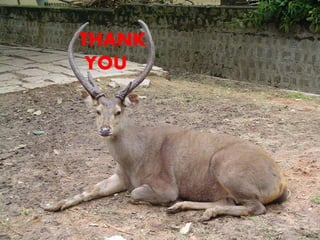
THANK
YOU

Sambar Deer

  • 1.
  • 2.
     The sambar(Rusa unicolor) is a large deer native to the Indian Subcontinent,  Sambar have a small but dense mane, which tends to be more prominent in males  The tail is relatively long for deer, and is generally black above with a whitish underside  Sambar have lived for up to 28 years in captivity, although it is unlikely that they often survive more than twelve years in the wild  Young male grows antlers at age 2
  • 3.
    TAXONOMY Kingdom : Animalia Phylum: Chordata Class : Mammalia Order : Artiodactyla Family : Cervidae Subfamily: Cervinae Genus : Cervus Species : Unicolor Scientific name : Rusa unicolor (Kerr, 1792) New : Cervus unicolor
  • 4.
    DISTRIBUTION  India, SriLanka, Nepal ,  South east Asia  Africa  Introduced to Australia, New Zealand , USA
  • 5.
    HABITAT  Open junglesand Grasslands  Prefer forested hill-sides near cultivation  Adapt itself to wide variety of environmental condition  In India mainly temperate forests  Prefer water source nearby
  • 6.
    FOREST TYPES  Sambarare found in habitats ranging from tropical seasonal forests (tropical dry forests and seasonal moist evergreen forests),  subtropical mixed forests (conifers, broadleaf deciduous, and broadleaf evergreen tree species) to tropical rainforests
  • 7.
    FACTS  Coat color: brown with chestnut marks  Shoulder height : 130-170 cms  Weight : 225-320 kg  Life span : 20-25 years(captivity)  Age at maturity-male : 4 yrs -female : 2-3 yrs  Gestation period : 240 days  Litter size : 1  Breeding season : Nov-Dec
  • 8.
     Delicious foodto Tiger , Asiatic lion  IUCN red data list : Vulnerable  The major threats are Habitat encroachment and Hunting  Body temp : 102 F  Pulse : 60-80/minute  Respiratory rate : 12-20/minute
  • 9.
    BEHAVIOR  Nocturnal orcrepuscular  Form small herd of up to 6 individuals  Amazing sense of hearing and smell  When alarmed all adults screams a high pitched sound- “pooking” or “belling”  Common communication- Scent making, Foot stamping  Marking by antlers and spraying urine directly in his own face with a highly mobile penis
  • 10.
    REPRODUCTION  Male becomessolitary ,aggressive and establishes a territory  Polygynous in nature  Females moving around breeding territories seeking male to court  Courtship based on tending bonds  Gestation probably lasts around eight months  Fawn stays with the mother 1 year
  • 11.
    SEXUAL BEHAVIOUR  Sambarmate and reproduce year-round,  sambar calving peaks seasonally.  Estrus lasts around eighteen days.  The male establishes a territory from which he attracts nearby females, but he does not establish a harem.  The male stomps the ground, creating a bare patch, and often wallows in the mud, perhaps to accentuate the colour of his hair  Large dominant stags will defend non- exclusive territories surrounded by several smaller males
  • 12.
  • 13.
     When sparringwith rival males, sambar lock antlers and push, like other deer, but, uniquely, they also sometimes stand on their hind legs and clash downward into each other  Courtship is based more on tending bonds rather than males vocally advertising themselves.  Females moving widely among breeding territories seeking males to court.  When mounting, males do not clasp females. The front legs of the male hang loosely and intromission takes the form of a "copulatory jump".  The young begin to take solid food at 5 to 14 days, and begin to ruminate after one month.
  • 14.
  • 15.
  • 16.
    FOOD HABITS  Feedinghabit depends on season, habitat and location  Browse leaves,grasses,herbs  Fruits and bamboo buds
  • 17.
    DISEASES  Rabies,FMD,HS  Tuberculosis,Anthrax,Tetanus,CBPP Salmonellosis,colibacillosis,leptospirosis  Dermatophytosis,candidiasis  Trypanosomiasis,Sarcocystitis,filariasis  Major causes of death-Traumatic injury, respiratory infection, GIT infection, dystocia
  • 18.
    MANAGEMENT IN ZOO Feeding - Grass,cattle feed,concentrate,bengal gram,green gram,cotton seed,MM,Salt  Deworming- Fenbendazole 5-7.5mg/kg Levamisole 8-10 mg/kg oxyclozanide 10-15 mg/kg
  • 19.
    VACCINATION  Vaccination -FMD -HS+BQ4ml SC  To minimize birth in capacity chemical contraceptive Melongestrol acetate (feed additive) and porcine zona pellucida vaccine are succesfully applied
  • 20.
    RESTRAINING  PHYSICAL –squeeze guage ,trap ,crate  CHEMICAL – succinylcholine chloride 0.07-0.14 mg/kg - Xylazine &ketamine combination @ 0.75,1 mg/kg respectively -Xylazine 0.7 ml & Etorphine 0.8 ml (250kg)
  • 21.