Note: This is the last author’s copy prior to publishing. The final, definitive version of this
manuscript has been published in the Journal of Interactive Online Learning, a peer-
reviewed journal at: http://www.ncolr.org/issues/jiol/v14/n2/3 . Winter 2016
Giving Back: Exploring Service-Learning in an Online Learning Environment
Rochell R. McWhorter*
rmcwhorter@uttyler.edu
903.566.7330
Julie A. Delello
jdelello@uttyler.edu
903.566.7489
Paul B. Roberts
proberts@uttyler.edu
903.566.7334
The University of Texas at Tyler
*Corresponding Author
Giving Back: Exploring Service-Learning in an Online Learning Environment
GIVING BACK: EXPLORING SERVICE-LEARNING ONLINE 2
Abstract
Service-Learning (SL) as an instructional method is growing in popularity for giving back to the
community while connecting the experience to course content. However, little has been
published on using SL for online business students. This study highlights an exploratory mixed-
methods, multiple case study of an online business leadership and ethics course utilizing SL as a
pedagogical teaching tool with 81 students. Results from the study noted that hours completed
exceeded those assigned and students identified outcomes for themselves, their university, and
nonprofit organizations where they served. The outcomes of this study mirrored those identified
by students in traditional face-to-face courses underscoring the value of SL projects in online
courses in higher education.
Key Words: business ethics, community, experiential learning, online learning,
service-learning, eService learning, engagement, stakeholders
Giving Back: Exploring Service-Learning in an Online Learning Environment
GIVING BACK: EXPLORING SERVICE-LEARNING ONLINE 3
Since online education became popular in the late 1980s for its ease of “anytime,
anywhere” learning (Parker & Martin, 2010), an overwhelming concern has been whether online
courses are as effective as traditional face-to-face (F2F) courses in terms of engagement,
motivation, and achievement (Collins, Weber, & Zambrano, 2014; Jaggars, 2011). Despite recent
improvements to technology supporting online platforms and teaching methods, a recent 2015
survey noted that academic leaders only rated online education as good as or better than F2F
instruction about 70% of the time (Allen & Seaman, 2016).
Enrollments have continued to increase in online programs and access to higher
education has become a top priority for many postsecondary institutions for improving their
reach. In fact, in the fall of 2014, one in four (5.8 million) students were enrolled in at least one
online course (Allen & Seaman, 2016). The Babson Survey Group reported that online
enrollments over the past several years have increased more rapidly than overall higher
education enrollments (Allen & Seaman, 2016). Part of the reason for this progression is the
growing diversity of the U.S. population and increased demand for courses that provide greater
flexibility, affordability, and the added convenience to students. Also, with fluctuations in the
economy and an uncertain job market, a considerable number of students are pursuing online
degrees for reasons of employment (Clinefelter & Aslanian, 2014). According to The National
Task Force on Civic Learning and Democratic Engagement (2012), today’s students are the most
diverse group in history—across class, color, religion, gender, nationality, and age. Although
diverse groups bring diversity to campuses, they also create significant new demands on faculty
to find new and innovative approaches to keep students connected to learning (McWhorter,
2010). “Focusing on critical, reflective thinking, and civic responsibility, Service-Learning (SL)
involves students in organized community service that addresses local needs, while developing
GIVING BACK: EXPLORING SERVICE-LEARNING ONLINE 4
their academic skills, respect for others, and commitment to the common good” (DiPadova-
Stocks, 2005, p. 345). This article describes how through reflective thinking, an online graduate
course in business leadership and ethics used a SL project to enhance civic responsibility and
experiential learning.
Literature Review
According to Allen and Seaman (2016), “An online course is defined as one in which at
least 80% of the course content is delivered online” (p. 7). Researchers have noted when
compared to F2F courses, online courses provide less connectedness with the material, the
instructor, the community as a whole, and less time spent studying the online materials (Figlio,
Rush, & Yin, 2010; Nguyen, 2015). Although current research has emerged that supports a view
that students can learn equally well in both online and F2F formats (Burns, 2013), less-
disciplined, dependent learners, continue to struggle with an online modality (See Weaknesses of
Online Learning, University of Illinois, 2010). In addition, both undergraduate and graduate
students have reported lower perceptions of online learning (Johnson & Mejia, 2014).
To combat the problems with asynchronous online education, innovative higher
educators turned to discussion boards that would connect students to one another and the
material (Alrushiedat & Olfman, 2013), instructor videos to supplement written lecture materials
(Hegeman, 2015), and social media platforms such as Facebook, Twitter, and Pinterest (Delello
& McWhorter, 2014) to promote more connected and personalized learning. However well-
intentioned efforts are to develop an effective online learning environment, higher education
must also continue to find ways to enable new generations of students to succeed in life and
work after college. Keh-Wen and Kuan-Chou (2013) noted that educators should link classroom
learning with real world settings so that students can learn critical thinking and problem solving
GIVING BACK: EXPLORING SERVICE-LEARNING ONLINE 5
skills. In the 21st
century, an online learning environment should consist of a high-quality
education including workforce preparation, which is connected to reflective thinking, civic
engagement, and experiential learning. Experiential learning has been defined as “a philosophy
and methodology in which educators purposefully engage with students in direct experience and
focused reflection in order to increase knowledge, develop skills, and clarify values”
(Association for Experiential Education, 2014, para. 1).
Service-Learning.
One highly engaging practice rooted in experiential learning that has become widely
accepted across college campuses, is SL. Bringle and Hatcher (1996) defined SL as “a credit-
bearing educational experience in which students participate in an organized service activity that
meets identified community needs and reflect on service activity in such a way as to gain further
understanding of course content, a broader appreciation of the discipline, and an enhanced sense
of civic responsibility” (p. 222). Thus, as defined, SL is the amalgamation of civic responsibility
and students’ learning. In The National Task Force on Civic Learning and Democratic
Engagement (2012) report titled A Crucible Moment: College Learning and Democracy’s
Future, it was suggested that “civic learning needs to be an integral component of every level of
education, from grade school through graduate school, across all fields of study” (p. 14). Doug
Guthrie (2012), Dean of the George Washington University School of Business (See Dean’s
Corner), contended that to fully engage students in the real world, they must be embedded within
their local communities.
Benefits of Service-Learning.
The documented benefits of SL are numerous. For instance, SL programs affect how
students think about ethical problems and how aware and concerned they are about those less
GIVING BACK: EXPLORING SERVICE-LEARNING ONLINE 6
fortunate than themselves (Bok, 2006; Weiler, Haddock, Zimmerman, Krafchick, Henry, &
Rudisill, 2013). Godfrey, Illes, and Berry (2005) reported that “service learning pedagogy, and
the associated educational experiences, provide a partial solution to the problem of narrowness in
business education precisely because the pedagogy blends academic rigor with practical
relevance, set in a context of civic engagement” (p. 310). Also, according to You and Rud
(2010), SL is a powerful approach to learning because it links theory to action while integrating
cognitive learning with affective learning. Cognitive learning involves the development of
intellectual skills while affective learning is about how we deal with things such as feelings,
values, and attitudes (Bloom, Englehart, Furst, Hill, & Krathwohl, 1956; Krathwohl, Bloom, &
Masia, 1973). Moreover, businesses have called for the integration of SL into business education
as part of instruction on ethics and social responsibility (Poon, Chan, & Zhou, 2011). Students
also learn how transformational leaders in organizations strive to increase employees’ levels of
commitment, recognize complex issues, gain awareness of the viewpoints of all stakeholders,
understand ethical culture, and promote worthwhile activities for a common learning experience
(i.e. Ferrell, Fraedrich, & Ferrell, 2013).
In addition, research indicates, when linked to course objectives, students may be better
equipped to transfer knowledge from one setting to another (National Center for Learning and
Citizenship [NCLC], 2011). In 2010, The NCLC analyzed 19 schools that had implemented SL.
They found that when implemented correctly, SL promoted academic engagement, increased
educational aspirations, and community engagement (See NCLC Schools of Success Network
Shows that SL Quality Matters, Baumann, 2012). Also, Levine (2011) remarked that
“longitudinal studies show that young people who serve their community and join civic
associations succeed in school and in life better than their peers who do not engage” (p. 15). For
GIVING BACK: EXPLORING SERVICE-LEARNING ONLINE 7
business schools, SL provides opportunities for students to integrate theory and practice in real-
world situations with a focus on community service (Poon, et. al, 2011) as they also build their
resumes and networking opportunities (Gallagher & McGorry, 2015).
Besides documenting student benefits, the literature also reflects the benefits of SL for
both the nonprofit organization and the institution (Bringle & Hatcher, 1996; Martin, 2015;
Young & Karme, 2015). SL provides opportunities for schools to teach civic responsibility,
educating students on the importance of community issues, while enhancing their social
responsibility (Tomkovick, Lester, Flunker, & Wells, 2008; Warren, 2012).
Service-Learning as a Component of Online Courses.
Electronic Service-Learning (eService-Learning), or online SL, can involve a
combination of instruction and service partly or wholly online (Strait & Nordyke, 2015).
However, according to Waldner, McGorry, and Widener (2012), although more students are
taking online courses, they are not exposed to online SL. In 2004, Strait and Sauer (2004)
remarked that in online courses, students are “looking for ways to gain work experience and
build on long-lasting partnerships with their communities that will benefit their future careers…
student learning is enhanced by providing multiple opportunities for practice and reflection” (p.
63).
Dailey-Hebert, Donelli-Sallee, and DiPadova (2008) discussed service e-Learning,
comprised of e-Learning and SL initiatives. The editors noted that although educational
technology is a very powerful medium for learning, misconceptions that SL was considered
incompatible with teaching in online environments has contributed to it being under-used.
Researchers have suggested that online courses can facilitate SL that transform learning while
promoting civic engagement (Rutti, La Bonte, Helms, Hervani, & Sarkarat, 2016). When
GIVING BACK: EXPLORING SERVICE-LEARNING ONLINE 8
implementing SL in online courses, Strait and Sauer (2004) encouraged faculty to begin with a
small project, provide training for students, make plans to contact community partners, be
prepared for unexpected outcomes, and include reflection as a vital part of activities.
Theoretical Framework
The theoretical framework of experiential learning draws upon the work of John Dewey
and David Kolb. Dewey (1938) described experiential learning as a process by which the learner
creates meaning from direct experience. SL allows students the opportunity to reflect upon and
make meaning from their experiences. Furco (1996) noted that:
Service learning programs are distinguished from other approaches to experiential
education by their intention to equally benefit the provider and the recipient of the service
as well as to ensure equal focus on both the service being provided and the learning that
is occurring (p. 5).
Kolb (1984) asserted that “knowledge is continuously derived from and tested out in the
experiences of the learner” (p. 27). Kolb developed a four step framework of experiential
learning: The learner must be willing to be actively involved in the experience, the learner must
be able to reflect on the experience, the learner must possess and use analytical skills to
conceptualize the experience, and the learner must possess decision making and problem solving
skills in order to use the new ideas gained from the experience. This model of experiencing,
reflecting, thinking, and performing can be integrated into course service projects, connecting the
student to the community in a real-world learning component. Consequently, students are able to
engage in multiple reflection activities, prompting “deep thinking and analysis of oneself and
one’s relationship to society” (See Meaningful Service, National Youth Leadership Council,
2008, para. 1).
GIVING BACK: EXPLORING SERVICE-LEARNING ONLINE 9
However, according to McGorry (2012), many organizations have not yet investigated
the possibilities of online SL opportunities. In fact, Strait and Nordyke (2015) noted that while
SL is embedded in F2F courses, eService Learning is a new trend in online education. Also,
most of the research in SL has been with undergraduate courses (Clinton & Thomas, 2011). To
date, very little research exists regarding attempts to deliver SL experiences with graduate
business leadership and ethics students who are receiving academic instruction through online
delivery. There is also a paucity of research regarding the teaching of business ethics online
(Collins, Weber, & Zambrano, 2014).
The purpose of this research is to gain insight into how SL can be used within online
courses, specifically graduate business leadership and ethics courses. Two research questions
guided the current study: what are the benefits of academic SL in online courses; and, how did
students apply their online course learning to their SL experience? In the following sections, we
provide the collection of data including a multi-case study across two sections of a business
leadership and ethics course, findings, cross-case discussion, limitations, implications, and future
research.
Research Design
This exploratory study utilized a mixed-methods, multiple-case research embedded
design (Creswell & Plano Clark, 2011) at one institution of higher education in the southwestern
United States. According to Bryman and Bell (2015), business research is increasingly utilizing
multiple-case study designs to allow researchers to compare and contrast the findings,
identifying what is unique and what is common across cases. Further, Merriam (1998) described
that exploratory case study research may be chosen for examining innovative practices or
programs. Also, Noyes, Darby, and Leupold (2015) promoted mixed-methods research as an
GIVING BACK: EXPLORING SERVICE-LEARNING ONLINE 10
effective way to study SL as an instructional methodology in higher education. This study
explored both the strengths and challenges of employing SL as an instructional method within
online courses. Purposive sampling was chosen for the study, which Merriam and Tisdale (2016)
noted is appropriate when researchers seek to “discover, understand, and gain insight and
therefore must select a sample from which the most can be learned” (p. 96). Thus, sampling was
within the context of those students enrolled in two sections of an online graduate business
course employing SL as an instructional method and included all students in the course who
completed the assigned SL assignments.
Case One: The Development of the Service-Learning Project
Initially, the impetus for the preliminary project was based on information that the
university would begin approving courses that offered a SL component. Through the initiative,
the university would “continue to stress the importance of service learning through an expanded
use of SL projects … students [would be] actively engaged in the discovery, expansion, and
application of knowledge within their disciplines, across disciplines, and through global
connections” (Buchanan, 2013, para. 4). As a result, the instructor wanted to pilot the project to
determine the pedagogical benefits of such an initiative. This graduate business leadership and
ethics course was taught online during a fourteen-week semester and the course was formally
housed in a learning management system (LMS) on the university website. This course was
chosen because it teaches social responsibility as a business concept, whereby organizations
serve in their communities (see Ferrell, et al., 2013) and the instructor chose this course for
piloting the initiative because it was closely aligned with SL concepts. All instructions, syllabus,
assignments, private ethics journal, and gradebook were housed within the course on the LMS as
GIVING BACK: EXPLORING SERVICE-LEARNING ONLINE 11
part of the institution’s course offerings and accessible by the faculty member and students
enrolled in the course.
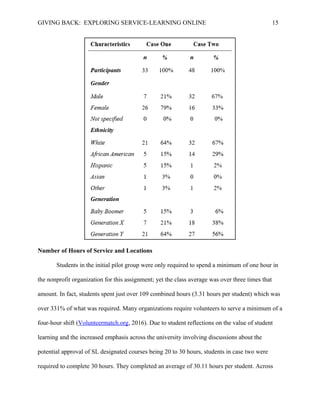
Participants. Thirty-three students participated in the pilot SL study. As a group, in
terms of gender, the participants were comprised of 79% female and 21% male, with an ethnic
diversity comprised of 64% White, 15% Hispanic, 15% African-American, 3% Asian, and 3%
representing Pacific Islander. Of these students, five (15%) were Baby-Boomers, seven (21%)
were from Generation X, and 21 (64%) were from Generation Y (see Table 1). All but one of the
students had graduate status; however, they were preliminary enrolled in the graduate program.
Data Collection. Data from the pilot study were gathered by the primary researcher
through three data sources: 1) a pre-experience survey which captured demographic information,
2) an online student journal in the LMS that was only accessible by the student and instructor,
and 3) an open-ended question on a post-survey at the end of the course. Data from the first
source was collected immediately following the SL experience, the second and third data sets
were summative data sources collected at the end of the semester and later shared with the
research team.
Case Two: Full Implementation of Service-Learning
In the semester following Case One, the instructor fully implemented the service-learning
project and provided an online project folder in the LMS which included the recent press release
from the university on SL, etiquette material, the SL proposal information, volunteer approval
documentation, release and indemnification agreement, reflection log, and final report guideline.
Each student was asked to explore these resources for a week prior to their completing a written
proposal providing their rational for selecting a specific nonprofit organization as designated by
the Internal Revenue Services (IRS) for their SL experience.
GIVING BACK: EXPLORING SERVICE-LEARNING ONLINE 12
The online students were asked in the project instructions to search for volunteer
opportunities in their respective communities through online sources and choose one for their SL
project. This served as a pathway for graduate students to develop community leadership skills
by discovering what the needs and available resources were in their surrounding community
(Pigg, Gasteyer, Marin, Apaliyah, & Keating, 2015). Students were instructed to document in the
proposal their conversation with the volunteer coordinator or manager at their chosen nonprofit
and descriptions of work they would be performing. The graduate students also outlined in the
proposal how they expected to carry out their SL hours in the allotted time in the course and
provide proof of IRS-approved nonprofit status.
Participants. Forty-eight students participated in the second iteration of the study. As a
group, in terms of gender, participants were comprised of 33% female and 67% male, with an
ethnic diversity of 48% White, 2% Hispanic, 15% African-American, 2% Asian, and 2%
representing Pacific Islander. Of these students, three (6%) were Baby-Boomers, 18 (38%) were
from Generation X, and 27 (56%) were from Generation Y (See Table 1).
Data Collection. Data in the second iteration was gathered by the primary researcher
through three data sources: 1) a pre-experience survey which captured demographic information,
2) an online SL final report, and 3) an open-ended question on a post-survey given at end of the
course. Data from the first source was collected immediately following the SL experience, the
second and third data sources were summative data sources collected at the end of the semester
and shared with the research team.
Data Analysis. Over two consecutive semesters, a total of 81 students (80 graduate and
one undergraduate) taking an online business leadership and ethics course participated in the
GIVING BACK: EXPLORING SERVICE-LEARNING ONLINE 13
research. The course was part of a college of business accredited by the Association to Advance
Collegiate Schools of Business International (AACSB). Students were asked to locate a 501(c)
(3) nonprofit organization in their community to complete their SL assignment. The case data
collected included existing documents such as pre-and post-survey data administered using the
online survey software Qualtrics (Qualtrics.com), student reflection papers, and student journals.
Permission for this study was granted through the University’s Institutional Review Board (IRB).
To begin the analysis, the recorded demographic responses (gender, ethnicity, and the
generation) for each case were examined within the online survey platform Qualtrics (See Table
1). Additionally, qualitative data (reflections, journals, open-ended questions) from the two cases
was analyzed through an inductive and comparative approach described by Merriam and Tisdell
(2016). When data is analyzed inductively, “researchers gather data to build concepts,
hypotheses, or theories rather than deductively testing hypotheses as in positivist research” (p.
17) with the goal of data analysis being “to find answers to [aforementioned] research questions”
(p. 203).
Excerpts from the student reflective reports, journals, and the open-ended question on
post-survey were pasted into a word processing document creating a transcript (Merriam &
Tisdell, 2016). A team of three researchers independently analyzed each transcript by examining
and comparing each unit of data (a meaningful segment of information, see Merriam & Tisdell,
2016, p. 203) looking for “recurring regularities in the data” (p. 206). Categories were formed as
each researcher iteratively developed an initial list of codes to the units of data and combined
similar codes. Then, the researchers created a coding document (comparable to a hierarchical
codebook described by McQueen, McLellan, Kay, & Milstein, 1998) that offered rules for
inclusion and selected representative participant extracts for each category (Lincoln & Guba,
GIVING BACK: EXPLORING SERVICE-LEARNING ONLINE 14
1985). Further, intercoder agreement (see McQueen et al., 1998) was reached as the team of
researchers reviewed the independent sets of analysis documents and all inconsistencies were
examined and resolved. Merriam and Tisdale (2016) noted that the use of a research team to
collaboratively review the data increases confidence in the findings of the study.
Once the data in transcripts were assigned to categories, the researchers met F2F to
compare their categories to reach consensus on each of the chosen categories and in turn, form
broader themes. According to Merriam and Tisdell (2016), the use of a team of researchers is
referred to as “peer examination” (p. 249) and enhances the trustworthiness of the findings.
Triangulation was utilized using multiple sources of data and multiple researchers and “is a
powerful strategy for increasing the credibility or internal validity of your research” (p. 245).
Combined analysis results are discussed below resultant to the two research questions in the
study.
Cross-Case Findings
Demographic Comparisons
The demographic characteristics of the two cases are comprised of the number of
participants, gender makeup, ethnicity, and generation of the participants as self-disclosed on the
surveys for each case. In case one, the majority of the respondents were females (79%); yet in
case two, the majority of students were male (67%). Both groups were predominately white and
from Generation Y. A side-by-side listing of the demographics of the two cases is provided in
Table 1.
Table 1. Demographics of Participants in Case One and Two
GIVING BACK: EXPLORING SERVICE-LEARNING ONLINE 15
Number of Hours of Service and Locations
Students in the initial pilot group were only required to spend a minimum of one hour in
the nonprofit organization for this assignment; yet the class average was over three times that
amount. In fact, students spent just over 109 combined hours (3.31 hours per student) which was
over 331% of what was required. Many organizations require volunteers to serve a minimum of a
four-hour shift (Volunteermatch.org, 2016). Due to student reflections on the value of student
learning and the increased emphasis across the university involving discussions about the
potential approval of SL designated courses being 20 to 30 hours, students in case two were
required to complete 30 hours. They completed an average of 30.11 hours per student. Across
GIVING BACK: EXPLORING SERVICE-LEARNING ONLINE 16
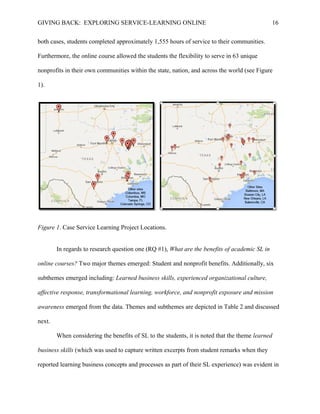
both cases, students completed approximately 1,555 hours of service to their communities.
Furthermore, the online course allowed the students the flexibility to serve in 63 unique
nonprofits in their own communities within the state, nation, and across the world (see Figure
1).
Figure 1. Case Service Learning Project Locations.
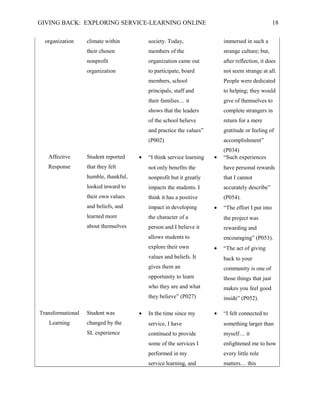
In regards to research question one (RQ #1), What are the benefits of academic SL in
online courses? Two major themes emerged: Student and nonprofit benefits. Additionally, six
subthemes emerged including: Learned business skills, experienced organizational culture,
affective response, transformational learning, workforce, and nonprofit exposure and mission
awareness emerged from the data. Themes and subthemes are depicted in Table 2 and discussed
next.
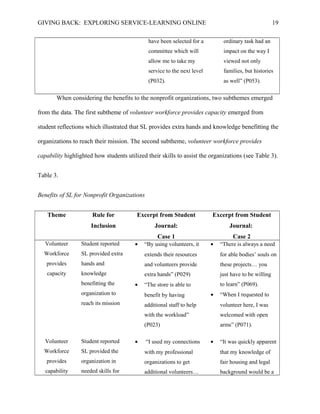
When considering the benefits of SL to the students, it is noted that the theme learned
business skills (which was used to capture written excerpts from student remarks when they
reported learning business concepts and processes as part of their SL experience) was evident in
GIVING BACK: EXPLORING SERVICE-LEARNING ONLINE 17
both Case 1 and 2. The second theme that emerged from the student reflection data was named
awareness of the workings of the nonprofit organization for comments that illustrated that
students reported recognizing the culture and climate of the nonprofit organization. Further, the
third theme was labeled affective response for those students’ written reflections that described
emotional response to their SL experience such as being thankful, humbled, looking inward to
their own values and beliefs, and learning more about themselves as a person. The fourth theme
is transformational learning that encompassed student reflections that described how they have
“changed” because of their SL experience.
Table 2
Benefits to the Students: Selected Excerpts from Student Reflections
Theme Rule for
Inclusion
Excerpt from Student
Journal:
Case 1
Excerpt from Student
Report:
Case 2
Learned Business
Skills
Student learned
business skills as
part of SL
experience
• “They were kind
enough to walk me
through the process of
how they handled
donations and the
process that is used
before items hit the
sales floor…they had
staff on the floor
maintaining order and
conducting sales at the
register” (P023)
• “[He] asked me to start
researching grants that
the organization could
potentially apply for
(both at the state and
federal level)” (P036).
• “I learned specifically
how to set up audio
equipment for the next
day’s event” (P064).
Awareness of the
workings of the
nonprofit
Student
learned about the
culture and
• “One of the values of
the organization is
giving back to the
• “Throughout my
experience…I was
astounded to be
GIVING BACK: EXPLORING SERVICE-LEARNING ONLINE 18
organization climate within
their chosen
nonprofit
organization
society. Today,
members of the
organization came out
to participate, board
members, school
principals, staff and
their families… it
shows that the leaders
of the school believe
and practice the values”
(P002)
immersed in such a
strange culture; but,
after reflection, it does
not seem strange at all.
People were dedicated
to helping; they would
give of themselves to
complete strangers in
return for a mere
gratitude or feeling of
accomplishment”
(P034)
Affective
Response
Student reported
that they felt
humble, thankful,
looked inward to
their own values
and beliefs, and
learned more
about themselves
• “I think service learning
not only benefits the
nonprofit but it greatly
impacts the students. I
think it has a positive
impact in developing
the character of a
person and I believe it
allows students to
explore their own
values and beliefs. It
gives them an
opportunity to learn
who they are and what
they believe” (P027)
• “Such experiences
have personal rewards
that I cannot
accurately describe”
(P054).
• “The effort I put into
the project was
rewarding and
encouraging” (P053).
• “The act of giving
back to your
community is one of
those things that just
makes you feel good
inside” (P052).
Transformational
Learning
Student was
changed by the
SL experience
• In the time since my
service, I have
continued to provide
some of the services I
performed in my
service learning, and
• “I felt connected to
something larger than
myself… it
enlightened me to how
every little role
matters… this
GIVING BACK: EXPLORING SERVICE-LEARNING ONLINE 19
have been selected for a
committee which will
allow me to take my
service to the next level
(P032).
ordinary task had an
impact on the way I
viewed not only
families, but histories
as well” (P053).
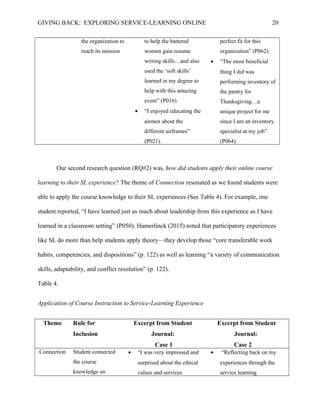
When considering the benefits to the nonprofit organizations, two subthemes emerged
from the data. The first subtheme of volunteer workforce provides capacity emerged from
student reflections which illustrated that SL provides extra hands and knowledge benefitting the
organizations to reach their mission. The second subtheme, volunteer workforce provides
capability highlighted how students utilized their skills to assist the organizations (see Table 3).
Table 3.
Benefits of SL for Nonprofit Organizations
Theme Rule for
Inclusion
Excerpt from Student
Journal:
Case 1
Excerpt from Student
Journal:
Case 2
Volunteer
Workforce
provides
capacity
Student reported
SL provided extra
hands and
knowledge
benefitting the
organization to
reach its mission
• “By using volunteers, it
extends their resources
and volunteers provide
extra hands” (P029)
• “The store is able to
benefit by having
additional staff to help
with the workload”
(P023)
• “There is always a need
for able bodies’ souls on
these projects… you
just have to be willing
to learn” (P069).
• “When I requested to
volunteer here, I was
welcomed with open
arms” (P071).
Volunteer
Workforce
provides
capability
Student reported
SL provided the
organization in
needed skills for
• “I used my connections
with my professional
organizations to get
additional volunteers…
• “It was quickly apparent
that my knowledge of
fair housing and legal
background would be a
GIVING BACK: EXPLORING SERVICE-LEARNING ONLINE 20
the organization to
reach its mission
to help the battered
women gain resume
writing skills…and also
used the ‘soft skills’
learned in my degree to
help with this amazing
event” (P016).
• “I enjoyed educating the
airmen about the
different airframes”
(P021).
perfect fit for this
organization” (P062).
• “The most beneficial
thing I did was
performing inventory of
the pantry for
Thanksgiving…a
unique project for me
since I am an inventory
specialist at my job”
(P064).
Our second research question (RQ#2) was, how did students apply their online course
learning to their SL experience? The theme of Connection resonated as we found students were
able to apply the course knowledge to their SL experiences (See Table 4). For example, one
student reported, “I have learned just as much about leadership from this experience as I have
learned in a classroom setting” (P050). Hamerlinck (2015) noted that participatory experiences
like SL do more than help students apply theory—they develop those “core transferable work
habits, competencies, and dispositions” (p. 122) as well as learning “a variety of communication
skills, adaptability, and conflict resolution” (p. 122).
Table 4.
Application of Course Instruction to Service-Learning Experience
Theme Rule for
Inclusion
Excerpt from Student
Journal:
Case 1
Excerpt from Student
Journal:
Case 2
Connection Student connected
the course
knowledge on
• “I was very impressed and
surprised about the ethical
values and services
• “Reflecting back on my
experiences through the
service learning
GIVING BACK: EXPLORING SERVICE-LEARNING ONLINE 21
leadership/ethics to
their SL experience
[nonprofit] put into their
work to feed the hungry. I
was very motivated in
ethical behavior as stated
in Chapter 7 when
performing my service
learning work” (P018)
assignments, I found several
things which related to the
course… [such as]
leadership style…
diversity… organizational
culture…stakeholders”
(P041).
Discussion
The purpose of the current study was to examine how an online graduate course can
embed SL opportunities which enhance civic responsibility and experiential learning for
students. Students, in both cases, perceived the service they provided to their local communities,
where they reside, to be a positive endeavor. In fact, the majority of the students completed more
volunteer hours than was required for the course. However, findings did suggest that increasing
the number of hours to 30 was too much for some students as noted in the following excerpt “I
think that the 30 hours required was very difficult with my schedule but luckily I was able to
make it happen”. According to a study by Darby, Longmore-Avital, Chenault, and Haglund
(2013), the typical length of SL experiences at their institution was between 20 and 41 or more
hours depending on the level of the class and the discipline. Also, SL has been found to be most
effective as a civic and academic pedagogy when students reported minimum of 15 to 20 hours
of service and had sufficient interaction and reflection with supervisors (Mabry, 1998).
There were numerous benefits to the students across both cases. For example, students
noted that they developed important business skills (e.g. grant writing, donations) which
prepared them for the world of work. According to Lester (2015), a variety of skills can be
outcomes of SL projects such as: communication, planning, organizing, self-confidence, making
a difference, teamwork, collaboration, meeting challenges, accountability, information gathering,
GIVING BACK: EXPLORING SERVICE-LEARNING ONLINE 22
decision-making, and understanding of resource allocation. When analyzing the cases in the
current study, our findings supported Lester’s research in that there is great potential for
developing leadership through SL.
Perhaps more focal was the emotional presence noted throughout the online journals. For
example, one student stated “volunteering gives a sense of pride to those who put in the effort
and time—a feeling that you contributed to the community”. Another student reported:
I completed my service learning project at the Salvation Army Family Store. I must admit
that I was not too thrilled about having to take time out of my weekend to do volunteer
work; however, once I got there I had a change of attitude. People often donate items to
the Salvation Army that they feel are useless, but to someone else those items hold so
much value.
Cleveland-Innes and Campbell (2012) defined emotional presence as “the outward
expression of emotion, affect, and feeling by individuals and among individuals in a community
of inquiry, as they relate to and interact with the learning technology, course content, students,
and the instructor” (p. 283).
Across both cases, there were students who noted how critically reflecting upon their
experiences while working as a volunteer within their own communities led them to a
transformative self-awareness—one where they experienced a significant change in the ways
they understood their identity, culture, and behavior (Kiely, 2005; Mezirow, 2000; Strait, Turk,
& Nordyke, 2015). For example, one student wrote:
When I intervened with these parents and kids and showed them that there is a different
behavior that should be taken when it comes to baseball…I believe by meeting these
kids, not only did my views change, so did theirs!
GIVING BACK: EXPLORING SERVICE-LEARNING ONLINE 23
Clark (1993) defined this type of transformational learning as one that “induces more far-
reaching change in the learner…. shaping the learner and producing a significant impact, or
paradigm shift, which affects the learner's subsequent experiences” (p. 47).
In terms of benefits to the organization, students across both cases noted that SL
experiences benefitted the nonprofit by increasing both the capacity and capability of the
organization as well as creating awareness for the organization’s mission. For example, the
capability and capacity of the nonprofit organization is increased as they gain the “help and
expertise of students [who] can work on and complete initiatives that might otherwise be
overlooked or remain unaddressed” (Schoenherr, 2015, p. 47). Further, Olberding, and Hacker
(2016) noted that SL students increase awareness of the organization’s mission and as they
enlarge the nonprofit’s support networks.
The data reflected numerous benefits to not only students and nonprofits organizations,
but also the university... In this study, 81 students, 60 nonprofit organizations in 63 unique
locations were connected. Further, the mission of the regional university had campus goals such
as graduating students with skills in communication, leadership, appreciation of human diversity,
and engaging in public service. The learning around SL projects appear to align the institution
closer to its mission in these areas.
Across both cases, the project connected what the students were learning in the classroom
to relevant, real-life experiences. For example, one student noted:
Being able to volunteer with a nonprofit really drives home ideas that we are learning in
class. I was able to see how compliance plays a very important role in the funds that
nonprofits receive to do their work in the communities that they serve.
GIVING BACK: EXPLORING SERVICE-LEARNING ONLINE 24
Moreover, Dunn and Rakes (2015) found that online graduate students who meaningfully
self-reflect and interpret their individual experiences are gaining valuable learning outcomes. In
both cases, students were involved in experiential learning (Kolb, 1984). The students started
with a concrete experience where they were actively involved with the organizations and were
able to reflect upon and conceptualize their experiences, drawing upon the knowledge they
learned within the course and the community.
As online learning continues to grow, the debate continues as to whether students in
online courses learn as much as those courses taken F2F (Gruber, 2015) and persist without
interaction in the traditional classroom (Hart, 2012). Advocating for SL to be a component in
online courses, Hill (2012) remarked, “it is worth the effort to add a real-world learning
experience to the course, and this extends to online courses, where the challenges are even more
complex than in a face-to-face course” (p. 1). According to Nordyke (2015), experiences can
take place in the community:
where the student lives, or for a national or global not-for-profit organization…
possibilities are endless…with geographical boundaries removed, eService-Learning
provides students, wherever they reside, the opportunity to engage in service learning
projects on a regional, national, or even global level (para. 7).
Nordyke (2015) advocated that designing SL for the online environment in advance
requires: (1) making decisions about course content include how eSL will be integrated into the
course, (2) utilizing a virtual classroom for the management of the SL opportunities available for
students, (3) identifying suitable course management tools, (4) making decisions on managing
academic honesty and privacy issues, (5) accounting for students with disabilities and ADA
requirements, (6) incorporating of professional standards within discipline, (7) identifying on-
GIVING BACK: EXPLORING SERVICE-LEARNING ONLINE 25
campus and outside resources to help with design and development of the course, and (8)
ensuring adequate opportunities are available in the community. Also, course formats for SL in
an online course include decisions between direct (i.e. tutoring children) and indirect (i.e. writing
a grant) assistance as well as choosing between various forms of SL (i.e. service at one
organization versus several organizations).
Limitations
It is important to recognize the limitations of this study. First, this study may not be
representative of other courses in business leadership and ethics taught online or taught in a F2F
environment. Second, in the current study, student perceptions of their experience with SL were
gathered. Each course iteration included differing amounts of service hours and types of
reflections (post-question, journal) because the initial iteration was still in the development
phase. Also, because the SL project was part of a course grade, the students may have persisted
in their volunteer hours more than if it had been voluntary.
Implications and Conclusions
This article has clearly demonstrated the benefits of SL to students in terms of extending
and applying course knowledge and improved self-worth as a result from assisting the nonprofit
organization. The university benefits from SL are also well understood, but as they move
forward with future SL endeavors, institutional support is crucial at all levels (e.g. syllabus
development, approval for courses, funding). Additionally, guidelines for facilitating learning by
faculty as to what SL is, tapping into expertise at other campuses, and the development of a clear
vision of SL for the university must be established. While benefits to the nonprofit organization
in the community where the online students resided were previously noted, it is important to
realize that these benefits are not always optimal. For instance, the relationship between the
GIVING BACK: EXPLORING SERVICE-LEARNING ONLINE 26
university and the nonprofit organizations in this study are transactional (short-term placements
with no formal agreement for continued support) rather than transformational (joint creation of
work and knowledge; see Bushouse, 2005). Thus, developing community partnerships with
nonprofits allows institutions to work together to create new learning and opportunities; and, the
online component allows impact of the institution to extend their reach beyond their region
(Tinkler, Tinkler, Hausman, & Tufo-Strouse, 2014). Additionally, by informing future SL
students about past nonprofit assignments in university courses, the university could move
toward a more transformational relationship with nonprofits as repeated efforts by university
students in SL assignments could provide on-going support for nonprofits in various localities
(Bushouse, 2005). The university could also benefit from this outreach as the name and
reputation of the university is spread to numerous communities around the globe that could result
in increased brand awareness garnering future enrollment and recognition for the regional
university.
Future research on the feedback from the volunteer coordinator at nonprofits may provide
further insight into the usefulness of higher education students as community volunteers in the
organization. Also, as the SL grows on campus, future research should be conducted across
disciplines, number of hours served, and the instructional arrangement to determine if there are
any differences. Also, compare learning outcomes between regional versus larger research-
focused institutions and whether SL is a requirement for a campus or if it is an optional
instructional tool. We recommend continued use of mixed-methods research design to capture
various aspects outcomes of SL outcomes and evaluate the effectiveness of numerous variations
of utilizing SL (Shumer, 2015) in online courses is warranted and should include data from other
stakeholders including community partners and institution administrators.
GIVING BACK: EXPLORING SERVICE-LEARNING ONLINE 27
Future longitudinal research should involve students who continue to serve in nonprofits
to see if transformation occurs within a course (a moment in time) or if SL facilitates
transformation for life (i.e. life-long learning). Also, if students shared with other people, did
sharing prompt others to become involved? Additionally, longitudinal research should be utilized
to see if the students continued to work with the nonprofits and in what capacity. Andrew Furco
(2015) expounded on the synergy created by combining online learning with SL, “something
powerful is likely to happen when these two educational practices converge… [providing]
students with high impact, transformative experiences” (para. 5), thus punctuating the value in
the creation of a new form of service-learning for online students.
GIVING BACK: EXPLORING SERVICE-LEARNING ONLINE 28
References
Allen, I. E., & Seaman, J. (2016). Online report card tracking: Tracking online education in the
United States. Babson Park, MA: Babson Survey Research Group and Quahog Research
Group. Retrieved from http://onlinelearningsurvey.com/reports/onlinereportcard.pdf
Alrushiedat, N., & Olfman, L. (2013). Assisting collaboration and peer learning: Case of
anchored asynchronous online discussions. European Journal of Management, 13(4), 93-
100.
Association for Experiential Education. (2014). West Region. Retrieved from
http://www.aee.org/index.php?option=com_content&view=article&id=31:west-
region&catid=22:connect
Baumann, P. (2012). NCLC schools of success network shows that service-learning quality
matters. Education Commission of the States. Retrieved from
http://www.ecs.org/clearinghouse/01/05/09/10509.pdf
Bloom, B. S. (Ed.), Engelhart, M. D., Furst, E. J., Hill, W. H., & Krathwohl, D. R. (1956).
Taxonomy of Educational Objectives, Handbook I, Cognitive Domain. New York: David
McKay Co., Inc.
Bok, D. (2006). Our underachieving colleges: A candid look at how much students learn and
why they should be learning more. New Jersey: Princeton University Press.
Bringle, R. G., & Hatcher, J. A. (1996). Implementing service learning in Higher Education. The
Journal of Higher Education, 67(2), 221-239.
Bryman, A., & Bell, E. (2015). Business research methods. Oxford, UK: Oxford University
Press.
GIVING BACK: EXPLORING SERVICE-LEARNING ONLINE 29
Buchanan, H. (2013). UT Tyler announces community service, service learning initiative.
Retrieved from http://www.uttyler.edu/news/pressrelease/2013/05082013.php
Burns, B. A. (2013). Students' perceptions of online courses in a graduate adolescence education
program. Journal of Online Learning & Teaching, 9(1), 13-25.
Bushouse, B. K. (2005). Community nonprofit organizations and service-learning: Resource
constraints to building partnerships with universities. Michigan Journal of Community
Service Learning, 12(1), 32-40.
Clark, M. C. (1993). Transformational learning. New Directions for Adult & Continuing
Education, (57), 47-56. doi:10.1002/ace.36719935707
Cleveland-Innes, M., & Prisca Campbell, P. (2012). Emotional presence, learning, and the online
learning environment. International Review of Research in Open and Distance Learning,
13(4), 269-292.
Clinefelter, D. L., & Aslanian, C. B. (2014). Online college students 2014: Comprehensive data
on demands and preferences. Louisville, KY: The Learning House, Inc.
Clinton, I., & Thomas, T. (2011). Business students’ experience of community service-learning.
Asia-Pacific Journal of Cooperative Education, 12(1), 51-66.
Collins, D., Weber, J., & Zambrano, R. (2014). Teaching business ethics online: Perspectives on
course design, delivery, student engagement, and assessment. Journal of Business Ethics,
25, 513–529. DOI 10.1007/s10551-013-1932-7
Creswell, J. W., & Plano Clark, V. L. (2011). Designing and conducting mixed methods
research, (2nd
ed). Thousand Oaks, CA: Sage.
Dailey-Hebert, A., Donelli-Salee, E., & DiPadova, L. N. (2008). Service E-Learning: Educating
for citizenship. Charlotte, NC: Information Age Publishing.
GIVING BACK: EXPLORING SERVICE-LEARNING ONLINE 30
Darby, A., Longmore-Avital, B., Chenault, J., & Haglund, M. (2013). Students’ motivation in
academic service-learning over the course of the semester. College Student Journal,
47(1), 185-191.
Delello, J. A., & McWhorter, R. R. (2014). New visual social media for the higher education
classroom. In G. Mallia (Ed.), The social classroom: Integrating social network use in
education. Hershey, PA: IGI Global.
Dewey, J. (1938). Experience & Education. New York, NY: Kappa Delta Pi.
DiPadova-Stocks, L. (2005). Two major concerns about service-learning: What if we don’t do it?
And what if we do? Academy of Management Learning & Education, 4(3): 345-353.
Dunn, K. E., & Rakes, G. C. (2015). Exploring online graduate students’ responses to online
self-regulation training. Journal of Interactive Online Learning, 13(4), 1-21.
Ferrell, O. C., Fraedrich, J., & Ferrell, L. (2013). Business ethics: Ethical decision making and
cases. Mason, OH: South-Western, Cengage Learning.
Figlio, D. N., Rush, M., & Yin, L. (2010). Is it live or is it internet? Experimental estimates of
the effects of online instruction on student learning. National Bureau of Economic
Research. Retrieved from http://www.nber.org/papers/w16089.pdf
Furco, A. (1996). Service-Learning: A balanced approach to experiential education. Expanding
boundaries: Serving and learning. Washington, DC: Corporation for National Service,
1996, pp. 2-6.
Furco, A. (2015). Foreword. In J. Strait & K. Nordyke (Eds.), eService-Learning: Creating
experiential learning and civic engagement through online and hybrid courses. [Kindle
eBook]. Sterling, VA: Stylus Publishing, LLC.
GIVING BACK: EXPLORING SERVICE-LEARNING ONLINE 31
Gallagher, M., & McGorry, S. (2015). Service-learning and the capstone experience.
International Advances in Economic Research, 21(4), 467-476. doi:10.1007/s11294-015-
9550-z
Godfrey, P. C., Illes, L. M., & Berry, G. R. (2005). Creating breadth in business education
through service-learning. Academy of Management Learning and Education, 4(3), 309-
323.
Gruber, S. (2015). Ideologies in online learning environments: The need for multiple stories.
Journal of Interactive Online Learning, 13(4), 39-53,
Guthrie, D. (2012, April). Dean's corner: Beyond the ivory tower: The embedded business
school. eNEWSLINE: AACSB International. Retrieved from
http://enewsline.aacsb.edu/deanscorner/
Hamerlinck, J. (2015) Community engagement and technology for a more relevant higher
education. In J. Strait & K. Nordyke (Eds.), eService-Learning: Creating experiential
learning and civic engagement through online and hybrid courses. [Kindle eBook].
Sterling, VA: Stylus Publishing, LLC.
Hart, C. (2012). Factors associated with student persistence in an online program of study: A
review of the literature. Journal of Interactive Online Learning, 11(1), 19-42.
Hegeman, J. S. (2015). Using instructor-generated video lectures in online mathematics courses
improves student learning. Online Learning, 19(3), 70-87.
Hill, C. (2012). Four keys to successful service learning in online courses. Faculty Focus:
Distance Education Report, 14(24), 1– 5.
GIVING BACK: EXPLORING SERVICE-LEARNING ONLINE 32
Jaggars, S. S. (2011). Online learning: Does it help low-income and underprepared students?
CCRC Working Paper No. 26, Assessment of Evidence Series. New York, NY: Columbia
University, Teachers College, Community College Research Center.
Johnson, H., & Mejia, M. C. (2014). Online learning and student outcomes in California’s
community colleges. Public Policy Institute of California. Retrieved from
http://www.ppic.org/content/pubs/report/R_514HJR.pdf
Keh-Wen “Carin", C., & Kuan-Chou, C. (2013). Designing service-learning: Project in systems
analysis and design course. Academy of Educational Leadership Journal, 17(2), 47-60.
Kiely, R. (2005). A transformative learning model for service-learning; A longitudinal case
study. Michigan Journal of Community Service Learning, 12(1), 5-22.
Kolb, D. A. (1984). Experiential learning. Englewood Cliffs, NJ: Prentice Hall.
Krathwohl, D. R., Bloom, B. S., & Masia, B. B. (1973). Taxonomy of Educational Objectives,
Handbook II, Cognitive Domain. New York: David McKay Co., Inc.
Lester, S. W. (2015). Melding service learning and leadership skills development. Journal of
Experiential Education, 38(3), 280-295.
Levine, P. (2011). What do we know about civic engagement? Liberal Education, 97(2), 12-19.
Mabry, J. B. (1998). Pedagogical variations in service-learning and student outcomes: How time,
contact and reflection matter. Michigan Journal of Community Service Learning, 5(1),
32–47.
Martin, M. C. (2015). Service learning as marketing pedagogy: Practical, theoretical, and
institutional perspectives. Academy of Educational Leadership Journal, 19(2), 109-127.
McGorry, S. Y. (2012). No significant difference in service-learning online. Journal of
Asynchronous Learning Networks, 16(4), 45-54.
GIVING BACK: EXPLORING SERVICE-LEARNING ONLINE 33
McQueen, K., McLellan, E., Kay, K., & Milstein, B. (1998). Codebook development for team-
based qualitative analysis. Cultural Anthropology Methods, 10(2), 31-36.
McWhorter, R. R. (2010). The emergence of virtual human resource development. Advances in
Developing Human Resources, 12(6), 623-631. doi: 10.1177/1523422310395367
Merriam, S. B. (1998). Qualitative research and case study applications in education. San
Francisco: Jossey -Bass Publishers.
Merriam, S. B., & Tisdell, E. J. (2016). Qualitative research: A guide to design and
implementation (4th ed.). San Francisco, CA: John Wiley & Sons.
Mezirow, J. (2000). Learning to think like an adult: Core concepts of transformation theory. In J.
Mezirow & Associates, (Eds.), Learning as transformation: Critical perspectives on a
theory in progress. (pp. 3-34). San Francisco: Jossey-Bass.
National Center for Learning and Citizenship (NCLC) (2011). The Schools of Success Network
News. Education Commission of the States, 1(6), 1-3. Retrieved from
http://www.ecs.org/clearinghouse/99/46/9946.pdf
The National Task Force on Civic Learning and Democratic Engagement (2012). A crucible
moment: College learning and democracy’s future. Washington, DC: Association of
American Colleges and Universities.
National Youth Leadership Council (2008). Lift: Raising the bar for service-learning practice.
Retrieved from http://lift.nylc.org/.
Nguyen, T. (2015). The effectiveness of online learning: Beyond no significant difference and
future horizons. MERLOT Journal of Online Learning and Teaching, 11(2), 309-319.
GIVING BACK: EXPLORING SERVICE-LEARNING ONLINE 34
Nordyke, K. J. (2015). Developing an eService-Learning experience for online courses. In J.
Strait & K. Nordyke (Eds.), eService-Learning: Creating experiential learning and civic
engagement through online and hybrid courses. [Kindle eBook]. Sterling, VA: Stylus
Publishing, LLC.
Noyes, E., Darby, A., & Leupold, C. (2015). Students' emotions in academic service-learning.
Journal of Higher Education Outreach and Engagement, 19(4), 63-84.
Olberding, J. C., & Hacker, W. (2016). Does the “Service” in service learning go beyond the
academic session? Assessing longer term impacts of nonprofit classes on community
partners. Journal of Nonprofit Education and Leadership, 6(1), 25-46.
Parker, M. A., & Martin, F. (2010). Using virtual classrooms: Student perceptions of features
and characteristics in an online and a blended course. MERLOT Journal of Online
Learning and Teaching, 6(1). Retrieved from
http://jolt.merlot.org/vol6no1/parker_0310.htm
Pigg, K., Gasteyer, S., Martin, K., Apaliyah, G., & Keating, K. (2015). Community leadership
development’s effects on community. In Community effects of leadership development
education: Citizen empowerment for civic engagement (pp. 73-94). Morgantown: West
Virginia University Press.
Poon, P., Chan, T. S., & Zhou, L. (2011) Implementation of service-learning in business
education: Issues and challenges. Journal of Teaching in International Business, 22(3),
185-192. DOI: 10.1080/08975930.2011.653746
Rutti, R. M., LaBonte, J., Helms, M. M., Hervani, A. A., & Sarkarat, S. (2016). The service
learning projects: Stakeholder benefits and potential class topics. Education + Training,
58(4), 422-438.
GIVING BACK: EXPLORING SERVICE-LEARNING ONLINE 35
Schoenherr, T. (2015). Service-learning in supply chain management: Benefits, challenges and
best practices. Decision Sciences Journal of Innovative Education, 13(1), 45-70.
doi:10.1111/dsji.12052
Shumer, R. (2015). Invited retrospective: The future of service-learning and community
engagement research is mixed [methods]. In V. Jagla, A. Furco, J. Strait (Eds.), Service-
learning pedagogy: How does it measure up? (pp. 365-382). Charlotte, NC: Information
Age Publishing, Inc.
Strait, J., & Nordyke, K. J. (2015). Introduction. In J. Strait & K. Nordyke (Eds.), eService-
Learning: Creating experiential learning and civic engagement through online and
hybrid courses. [Kindle eBook]. Sterling, VA: Stylus Publishing, LLC.
Strait, J., & Sauer, T. (2004). Constructing experiential learning for online courses: The birth of
e-service. Educause Quarterly, 1, 62-65.
Strait, J., Turk, J., & Nordyke, K. J. (2015). Pedagogy of civic engagement, high-impact
practices, and eService-Learning. In J. Strait & K. Nordyke (Eds.), eService-Learning:
Creating experiential learning and civic engagement through online and hybrid courses.
[Kindle eBook]. Sterling, VA: Stylus Publishing, LLC.
Tinkler, A., Tinkler, B., Hausman, E., & Tufo-Strouse, G. (2014). Key elements of effective
service-learning partnerships from the perspective of community partners. Partnerships:
A Journal of Service-Learning and Civic Engagement, 5(2), 137-152.
Tomkovick, C., Lester, S. W., Flunker, L., & Wells, T. A. (2008). Linking collegiate service-
learning to future volunteerism: Implications for nonprofit organizations. Nonprofit
Management & Leadership, 19(1), 3-26. doi:10.1002/nml.202
GIVING BACK: EXPLORING SERVICE-LEARNING ONLINE 36
University of Illinois (2010). Weaknesses of online learning. Illinois Online Network. Retrieved
from http://www.ion.uillinois.edu/resources/tutorials/overview/weaknesses.asp
Waldner, L. S., McCrory, S. Y., & Widener, M. C. (2012). E-Service-Learning: The evolution of
service-learning to engage a growing online student population. Journal of Higher
Education Outreach and Engagement, 16(2), 123-150.
Warren, J. L. (2012). Does service-learning increase student learning? A meta-analysis.
Michigan Journal of Community Service Learning, 18(2), 56-61.
Weiler, L., Haddock, S., Zimmerman, T., Krafchick, J., Henry, K., & Rudisill, S. (2013).
Benefits derived by college students from mentoring at-risk youth in a service-learning
course. American Journal of Community Psychology, 52(3/4), 236-248 13p.
doi:10.1007/s10464-013-9589-z
You, Z., & Rud, A. G. (2010). A model of Dewey's moral imagination for service-learning:
Theoretical explorations and implications for practice in higher education. Education &
Culture, 26(2), 36-51.
Young, S., & Karme, T. (2015). Service learning in an indigenous not-for-profit organization.
Education + Training, 57(7), 774-790. doi:10.1108/ET-04-2014-0041
GIVING BACK: EXPLORING SERVICE-LEARNING ONLINE 37
Author Biographies
Rochell R. McWhorter is an Assistant Professor at The University of Texas at Tyler. She
received her Ph.D. in Human Resource Development from Texas A&M University. Her research
and teaching interests are related to Virtual HRD, qualitative methods, leadership development,
visual social media, and technology-enabled learning. Email: rmcwhorter@uttyler.edu
Julie A. Delello is an Assistant Professor at The University of Texas at Tyler. She received her
Ph.D. in Curriculum and Instruction with a STEM specialization from Texas A&M University.
Her scholarly publications include topics such as new visual media technologies, STEM
education, and social media platforms. Email: jdelello@uttyler.edu
Paul B. Roberts is currently the Associate Dean in the College of Business and Technology and
an Associate Professor of HRD in the Department of Human Resource Development at The
University of Texas at Tyler. He has received more than $1,000,000 in grants and funded
projects. Email: proberts@uttyler.edu

Giving Back: Exploring Service-Learning in an Online Environment

  • 1.
    Note: This isthe last author’s copy prior to publishing. The final, definitive version of this manuscript has been published in the Journal of Interactive Online Learning, a peer- reviewed journal at: http://www.ncolr.org/issues/jiol/v14/n2/3 . Winter 2016 Giving Back: Exploring Service-Learning in an Online Learning Environment Rochell R. McWhorter* rmcwhorter@uttyler.edu 903.566.7330 Julie A. Delello jdelello@uttyler.edu 903.566.7489 Paul B. Roberts proberts@uttyler.edu 903.566.7334 The University of Texas at Tyler *Corresponding Author Giving Back: Exploring Service-Learning in an Online Learning Environment
  • 2.
    GIVING BACK: EXPLORINGSERVICE-LEARNING ONLINE 2 Abstract Service-Learning (SL) as an instructional method is growing in popularity for giving back to the community while connecting the experience to course content. However, little has been published on using SL for online business students. This study highlights an exploratory mixed- methods, multiple case study of an online business leadership and ethics course utilizing SL as a pedagogical teaching tool with 81 students. Results from the study noted that hours completed exceeded those assigned and students identified outcomes for themselves, their university, and nonprofit organizations where they served. The outcomes of this study mirrored those identified by students in traditional face-to-face courses underscoring the value of SL projects in online courses in higher education. Key Words: business ethics, community, experiential learning, online learning, service-learning, eService learning, engagement, stakeholders Giving Back: Exploring Service-Learning in an Online Learning Environment
  • 3.
    GIVING BACK: EXPLORINGSERVICE-LEARNING ONLINE 3 Since online education became popular in the late 1980s for its ease of “anytime, anywhere” learning (Parker & Martin, 2010), an overwhelming concern has been whether online courses are as effective as traditional face-to-face (F2F) courses in terms of engagement, motivation, and achievement (Collins, Weber, & Zambrano, 2014; Jaggars, 2011). Despite recent improvements to technology supporting online platforms and teaching methods, a recent 2015 survey noted that academic leaders only rated online education as good as or better than F2F instruction about 70% of the time (Allen & Seaman, 2016). Enrollments have continued to increase in online programs and access to higher education has become a top priority for many postsecondary institutions for improving their reach. In fact, in the fall of 2014, one in four (5.8 million) students were enrolled in at least one online course (Allen & Seaman, 2016). The Babson Survey Group reported that online enrollments over the past several years have increased more rapidly than overall higher education enrollments (Allen & Seaman, 2016). Part of the reason for this progression is the growing diversity of the U.S. population and increased demand for courses that provide greater flexibility, affordability, and the added convenience to students. Also, with fluctuations in the economy and an uncertain job market, a considerable number of students are pursuing online degrees for reasons of employment (Clinefelter & Aslanian, 2014). According to The National Task Force on Civic Learning and Democratic Engagement (2012), today’s students are the most diverse group in history—across class, color, religion, gender, nationality, and age. Although diverse groups bring diversity to campuses, they also create significant new demands on faculty to find new and innovative approaches to keep students connected to learning (McWhorter, 2010). “Focusing on critical, reflective thinking, and civic responsibility, Service-Learning (SL) involves students in organized community service that addresses local needs, while developing
  • 4.
    GIVING BACK: EXPLORINGSERVICE-LEARNING ONLINE 4 their academic skills, respect for others, and commitment to the common good” (DiPadova- Stocks, 2005, p. 345). This article describes how through reflective thinking, an online graduate course in business leadership and ethics used a SL project to enhance civic responsibility and experiential learning. Literature Review According to Allen and Seaman (2016), “An online course is defined as one in which at least 80% of the course content is delivered online” (p. 7). Researchers have noted when compared to F2F courses, online courses provide less connectedness with the material, the instructor, the community as a whole, and less time spent studying the online materials (Figlio, Rush, & Yin, 2010; Nguyen, 2015). Although current research has emerged that supports a view that students can learn equally well in both online and F2F formats (Burns, 2013), less- disciplined, dependent learners, continue to struggle with an online modality (See Weaknesses of Online Learning, University of Illinois, 2010). In addition, both undergraduate and graduate students have reported lower perceptions of online learning (Johnson & Mejia, 2014). To combat the problems with asynchronous online education, innovative higher educators turned to discussion boards that would connect students to one another and the material (Alrushiedat & Olfman, 2013), instructor videos to supplement written lecture materials (Hegeman, 2015), and social media platforms such as Facebook, Twitter, and Pinterest (Delello & McWhorter, 2014) to promote more connected and personalized learning. However well- intentioned efforts are to develop an effective online learning environment, higher education must also continue to find ways to enable new generations of students to succeed in life and work after college. Keh-Wen and Kuan-Chou (2013) noted that educators should link classroom learning with real world settings so that students can learn critical thinking and problem solving
  • 5.
    GIVING BACK: EXPLORINGSERVICE-LEARNING ONLINE 5 skills. In the 21st century, an online learning environment should consist of a high-quality education including workforce preparation, which is connected to reflective thinking, civic engagement, and experiential learning. Experiential learning has been defined as “a philosophy and methodology in which educators purposefully engage with students in direct experience and focused reflection in order to increase knowledge, develop skills, and clarify values” (Association for Experiential Education, 2014, para. 1). Service-Learning. One highly engaging practice rooted in experiential learning that has become widely accepted across college campuses, is SL. Bringle and Hatcher (1996) defined SL as “a credit- bearing educational experience in which students participate in an organized service activity that meets identified community needs and reflect on service activity in such a way as to gain further understanding of course content, a broader appreciation of the discipline, and an enhanced sense of civic responsibility” (p. 222). Thus, as defined, SL is the amalgamation of civic responsibility and students’ learning. In The National Task Force on Civic Learning and Democratic Engagement (2012) report titled A Crucible Moment: College Learning and Democracy’s Future, it was suggested that “civic learning needs to be an integral component of every level of education, from grade school through graduate school, across all fields of study” (p. 14). Doug Guthrie (2012), Dean of the George Washington University School of Business (See Dean’s Corner), contended that to fully engage students in the real world, they must be embedded within their local communities. Benefits of Service-Learning. The documented benefits of SL are numerous. For instance, SL programs affect how students think about ethical problems and how aware and concerned they are about those less
  • 6.
    GIVING BACK: EXPLORINGSERVICE-LEARNING ONLINE 6 fortunate than themselves (Bok, 2006; Weiler, Haddock, Zimmerman, Krafchick, Henry, & Rudisill, 2013). Godfrey, Illes, and Berry (2005) reported that “service learning pedagogy, and the associated educational experiences, provide a partial solution to the problem of narrowness in business education precisely because the pedagogy blends academic rigor with practical relevance, set in a context of civic engagement” (p. 310). Also, according to You and Rud (2010), SL is a powerful approach to learning because it links theory to action while integrating cognitive learning with affective learning. Cognitive learning involves the development of intellectual skills while affective learning is about how we deal with things such as feelings, values, and attitudes (Bloom, Englehart, Furst, Hill, & Krathwohl, 1956; Krathwohl, Bloom, & Masia, 1973). Moreover, businesses have called for the integration of SL into business education as part of instruction on ethics and social responsibility (Poon, Chan, & Zhou, 2011). Students also learn how transformational leaders in organizations strive to increase employees’ levels of commitment, recognize complex issues, gain awareness of the viewpoints of all stakeholders, understand ethical culture, and promote worthwhile activities for a common learning experience (i.e. Ferrell, Fraedrich, & Ferrell, 2013). In addition, research indicates, when linked to course objectives, students may be better equipped to transfer knowledge from one setting to another (National Center for Learning and Citizenship [NCLC], 2011). In 2010, The NCLC analyzed 19 schools that had implemented SL. They found that when implemented correctly, SL promoted academic engagement, increased educational aspirations, and community engagement (See NCLC Schools of Success Network Shows that SL Quality Matters, Baumann, 2012). Also, Levine (2011) remarked that “longitudinal studies show that young people who serve their community and join civic associations succeed in school and in life better than their peers who do not engage” (p. 15). For
  • 7.
    GIVING BACK: EXPLORINGSERVICE-LEARNING ONLINE 7 business schools, SL provides opportunities for students to integrate theory and practice in real- world situations with a focus on community service (Poon, et. al, 2011) as they also build their resumes and networking opportunities (Gallagher & McGorry, 2015). Besides documenting student benefits, the literature also reflects the benefits of SL for both the nonprofit organization and the institution (Bringle & Hatcher, 1996; Martin, 2015; Young & Karme, 2015). SL provides opportunities for schools to teach civic responsibility, educating students on the importance of community issues, while enhancing their social responsibility (Tomkovick, Lester, Flunker, & Wells, 2008; Warren, 2012). Service-Learning as a Component of Online Courses. Electronic Service-Learning (eService-Learning), or online SL, can involve a combination of instruction and service partly or wholly online (Strait & Nordyke, 2015). However, according to Waldner, McGorry, and Widener (2012), although more students are taking online courses, they are not exposed to online SL. In 2004, Strait and Sauer (2004) remarked that in online courses, students are “looking for ways to gain work experience and build on long-lasting partnerships with their communities that will benefit their future careers… student learning is enhanced by providing multiple opportunities for practice and reflection” (p. 63). Dailey-Hebert, Donelli-Sallee, and DiPadova (2008) discussed service e-Learning, comprised of e-Learning and SL initiatives. The editors noted that although educational technology is a very powerful medium for learning, misconceptions that SL was considered incompatible with teaching in online environments has contributed to it being under-used. Researchers have suggested that online courses can facilitate SL that transform learning while promoting civic engagement (Rutti, La Bonte, Helms, Hervani, & Sarkarat, 2016). When
  • 8.
    GIVING BACK: EXPLORINGSERVICE-LEARNING ONLINE 8 implementing SL in online courses, Strait and Sauer (2004) encouraged faculty to begin with a small project, provide training for students, make plans to contact community partners, be prepared for unexpected outcomes, and include reflection as a vital part of activities. Theoretical Framework The theoretical framework of experiential learning draws upon the work of John Dewey and David Kolb. Dewey (1938) described experiential learning as a process by which the learner creates meaning from direct experience. SL allows students the opportunity to reflect upon and make meaning from their experiences. Furco (1996) noted that: Service learning programs are distinguished from other approaches to experiential education by their intention to equally benefit the provider and the recipient of the service as well as to ensure equal focus on both the service being provided and the learning that is occurring (p. 5). Kolb (1984) asserted that “knowledge is continuously derived from and tested out in the experiences of the learner” (p. 27). Kolb developed a four step framework of experiential learning: The learner must be willing to be actively involved in the experience, the learner must be able to reflect on the experience, the learner must possess and use analytical skills to conceptualize the experience, and the learner must possess decision making and problem solving skills in order to use the new ideas gained from the experience. This model of experiencing, reflecting, thinking, and performing can be integrated into course service projects, connecting the student to the community in a real-world learning component. Consequently, students are able to engage in multiple reflection activities, prompting “deep thinking and analysis of oneself and one’s relationship to society” (See Meaningful Service, National Youth Leadership Council, 2008, para. 1).
  • 9.
    GIVING BACK: EXPLORINGSERVICE-LEARNING ONLINE 9 However, according to McGorry (2012), many organizations have not yet investigated the possibilities of online SL opportunities. In fact, Strait and Nordyke (2015) noted that while SL is embedded in F2F courses, eService Learning is a new trend in online education. Also, most of the research in SL has been with undergraduate courses (Clinton & Thomas, 2011). To date, very little research exists regarding attempts to deliver SL experiences with graduate business leadership and ethics students who are receiving academic instruction through online delivery. There is also a paucity of research regarding the teaching of business ethics online (Collins, Weber, & Zambrano, 2014). The purpose of this research is to gain insight into how SL can be used within online courses, specifically graduate business leadership and ethics courses. Two research questions guided the current study: what are the benefits of academic SL in online courses; and, how did students apply their online course learning to their SL experience? In the following sections, we provide the collection of data including a multi-case study across two sections of a business leadership and ethics course, findings, cross-case discussion, limitations, implications, and future research. Research Design This exploratory study utilized a mixed-methods, multiple-case research embedded design (Creswell & Plano Clark, 2011) at one institution of higher education in the southwestern United States. According to Bryman and Bell (2015), business research is increasingly utilizing multiple-case study designs to allow researchers to compare and contrast the findings, identifying what is unique and what is common across cases. Further, Merriam (1998) described that exploratory case study research may be chosen for examining innovative practices or programs. Also, Noyes, Darby, and Leupold (2015) promoted mixed-methods research as an
  • 10.
    GIVING BACK: EXPLORINGSERVICE-LEARNING ONLINE 10 effective way to study SL as an instructional methodology in higher education. This study explored both the strengths and challenges of employing SL as an instructional method within online courses. Purposive sampling was chosen for the study, which Merriam and Tisdale (2016) noted is appropriate when researchers seek to “discover, understand, and gain insight and therefore must select a sample from which the most can be learned” (p. 96). Thus, sampling was within the context of those students enrolled in two sections of an online graduate business course employing SL as an instructional method and included all students in the course who completed the assigned SL assignments. Case One: The Development of the Service-Learning Project Initially, the impetus for the preliminary project was based on information that the university would begin approving courses that offered a SL component. Through the initiative, the university would “continue to stress the importance of service learning through an expanded use of SL projects … students [would be] actively engaged in the discovery, expansion, and application of knowledge within their disciplines, across disciplines, and through global connections” (Buchanan, 2013, para. 4). As a result, the instructor wanted to pilot the project to determine the pedagogical benefits of such an initiative. This graduate business leadership and ethics course was taught online during a fourteen-week semester and the course was formally housed in a learning management system (LMS) on the university website. This course was chosen because it teaches social responsibility as a business concept, whereby organizations serve in their communities (see Ferrell, et al., 2013) and the instructor chose this course for piloting the initiative because it was closely aligned with SL concepts. All instructions, syllabus, assignments, private ethics journal, and gradebook were housed within the course on the LMS as
  • 11.
    GIVING BACK: EXPLORINGSERVICE-LEARNING ONLINE 11 part of the institution’s course offerings and accessible by the faculty member and students enrolled in the course. Participants. Thirty-three students participated in the pilot SL study. As a group, in terms of gender, the participants were comprised of 79% female and 21% male, with an ethnic diversity comprised of 64% White, 15% Hispanic, 15% African-American, 3% Asian, and 3% representing Pacific Islander. Of these students, five (15%) were Baby-Boomers, seven (21%) were from Generation X, and 21 (64%) were from Generation Y (see Table 1). All but one of the students had graduate status; however, they were preliminary enrolled in the graduate program. Data Collection. Data from the pilot study were gathered by the primary researcher through three data sources: 1) a pre-experience survey which captured demographic information, 2) an online student journal in the LMS that was only accessible by the student and instructor, and 3) an open-ended question on a post-survey at the end of the course. Data from the first source was collected immediately following the SL experience, the second and third data sets were summative data sources collected at the end of the semester and later shared with the research team. Case Two: Full Implementation of Service-Learning In the semester following Case One, the instructor fully implemented the service-learning project and provided an online project folder in the LMS which included the recent press release from the university on SL, etiquette material, the SL proposal information, volunteer approval documentation, release and indemnification agreement, reflection log, and final report guideline. Each student was asked to explore these resources for a week prior to their completing a written proposal providing their rational for selecting a specific nonprofit organization as designated by the Internal Revenue Services (IRS) for their SL experience.
  • 12.
    GIVING BACK: EXPLORINGSERVICE-LEARNING ONLINE 12 The online students were asked in the project instructions to search for volunteer opportunities in their respective communities through online sources and choose one for their SL project. This served as a pathway for graduate students to develop community leadership skills by discovering what the needs and available resources were in their surrounding community (Pigg, Gasteyer, Marin, Apaliyah, & Keating, 2015). Students were instructed to document in the proposal their conversation with the volunteer coordinator or manager at their chosen nonprofit and descriptions of work they would be performing. The graduate students also outlined in the proposal how they expected to carry out their SL hours in the allotted time in the course and provide proof of IRS-approved nonprofit status. Participants. Forty-eight students participated in the second iteration of the study. As a group, in terms of gender, participants were comprised of 33% female and 67% male, with an ethnic diversity of 48% White, 2% Hispanic, 15% African-American, 2% Asian, and 2% representing Pacific Islander. Of these students, three (6%) were Baby-Boomers, 18 (38%) were from Generation X, and 27 (56%) were from Generation Y (See Table 1). Data Collection. Data in the second iteration was gathered by the primary researcher through three data sources: 1) a pre-experience survey which captured demographic information, 2) an online SL final report, and 3) an open-ended question on a post-survey given at end of the course. Data from the first source was collected immediately following the SL experience, the second and third data sources were summative data sources collected at the end of the semester and shared with the research team. Data Analysis. Over two consecutive semesters, a total of 81 students (80 graduate and one undergraduate) taking an online business leadership and ethics course participated in the
  • 13.
    GIVING BACK: EXPLORINGSERVICE-LEARNING ONLINE 13 research. The course was part of a college of business accredited by the Association to Advance Collegiate Schools of Business International (AACSB). Students were asked to locate a 501(c) (3) nonprofit organization in their community to complete their SL assignment. The case data collected included existing documents such as pre-and post-survey data administered using the online survey software Qualtrics (Qualtrics.com), student reflection papers, and student journals. Permission for this study was granted through the University’s Institutional Review Board (IRB). To begin the analysis, the recorded demographic responses (gender, ethnicity, and the generation) for each case were examined within the online survey platform Qualtrics (See Table 1). Additionally, qualitative data (reflections, journals, open-ended questions) from the two cases was analyzed through an inductive and comparative approach described by Merriam and Tisdell (2016). When data is analyzed inductively, “researchers gather data to build concepts, hypotheses, or theories rather than deductively testing hypotheses as in positivist research” (p. 17) with the goal of data analysis being “to find answers to [aforementioned] research questions” (p. 203). Excerpts from the student reflective reports, journals, and the open-ended question on post-survey were pasted into a word processing document creating a transcript (Merriam & Tisdell, 2016). A team of three researchers independently analyzed each transcript by examining and comparing each unit of data (a meaningful segment of information, see Merriam & Tisdell, 2016, p. 203) looking for “recurring regularities in the data” (p. 206). Categories were formed as each researcher iteratively developed an initial list of codes to the units of data and combined similar codes. Then, the researchers created a coding document (comparable to a hierarchical codebook described by McQueen, McLellan, Kay, & Milstein, 1998) that offered rules for inclusion and selected representative participant extracts for each category (Lincoln & Guba,
  • 14.
    GIVING BACK: EXPLORINGSERVICE-LEARNING ONLINE 14 1985). Further, intercoder agreement (see McQueen et al., 1998) was reached as the team of researchers reviewed the independent sets of analysis documents and all inconsistencies were examined and resolved. Merriam and Tisdale (2016) noted that the use of a research team to collaboratively review the data increases confidence in the findings of the study. Once the data in transcripts were assigned to categories, the researchers met F2F to compare their categories to reach consensus on each of the chosen categories and in turn, form broader themes. According to Merriam and Tisdell (2016), the use of a team of researchers is referred to as “peer examination” (p. 249) and enhances the trustworthiness of the findings. Triangulation was utilized using multiple sources of data and multiple researchers and “is a powerful strategy for increasing the credibility or internal validity of your research” (p. 245). Combined analysis results are discussed below resultant to the two research questions in the study. Cross-Case Findings Demographic Comparisons The demographic characteristics of the two cases are comprised of the number of participants, gender makeup, ethnicity, and generation of the participants as self-disclosed on the surveys for each case. In case one, the majority of the respondents were females (79%); yet in case two, the majority of students were male (67%). Both groups were predominately white and from Generation Y. A side-by-side listing of the demographics of the two cases is provided in Table 1. Table 1. Demographics of Participants in Case One and Two
  • 15.
    GIVING BACK: EXPLORINGSERVICE-LEARNING ONLINE 15 Number of Hours of Service and Locations Students in the initial pilot group were only required to spend a minimum of one hour in the nonprofit organization for this assignment; yet the class average was over three times that amount. In fact, students spent just over 109 combined hours (3.31 hours per student) which was over 331% of what was required. Many organizations require volunteers to serve a minimum of a four-hour shift (Volunteermatch.org, 2016). Due to student reflections on the value of student learning and the increased emphasis across the university involving discussions about the potential approval of SL designated courses being 20 to 30 hours, students in case two were required to complete 30 hours. They completed an average of 30.11 hours per student. Across
  • 16.
    GIVING BACK: EXPLORINGSERVICE-LEARNING ONLINE 16 both cases, students completed approximately 1,555 hours of service to their communities. Furthermore, the online course allowed the students the flexibility to serve in 63 unique nonprofits in their own communities within the state, nation, and across the world (see Figure 1). Figure 1. Case Service Learning Project Locations. In regards to research question one (RQ #1), What are the benefits of academic SL in online courses? Two major themes emerged: Student and nonprofit benefits. Additionally, six subthemes emerged including: Learned business skills, experienced organizational culture, affective response, transformational learning, workforce, and nonprofit exposure and mission awareness emerged from the data. Themes and subthemes are depicted in Table 2 and discussed next. When considering the benefits of SL to the students, it is noted that the theme learned business skills (which was used to capture written excerpts from student remarks when they reported learning business concepts and processes as part of their SL experience) was evident in
  • 17.
    GIVING BACK: EXPLORINGSERVICE-LEARNING ONLINE 17 both Case 1 and 2. The second theme that emerged from the student reflection data was named awareness of the workings of the nonprofit organization for comments that illustrated that students reported recognizing the culture and climate of the nonprofit organization. Further, the third theme was labeled affective response for those students’ written reflections that described emotional response to their SL experience such as being thankful, humbled, looking inward to their own values and beliefs, and learning more about themselves as a person. The fourth theme is transformational learning that encompassed student reflections that described how they have “changed” because of their SL experience. Table 2 Benefits to the Students: Selected Excerpts from Student Reflections Theme Rule for Inclusion Excerpt from Student Journal: Case 1 Excerpt from Student Report: Case 2 Learned Business Skills Student learned business skills as part of SL experience • “They were kind enough to walk me through the process of how they handled donations and the process that is used before items hit the sales floor…they had staff on the floor maintaining order and conducting sales at the register” (P023) • “[He] asked me to start researching grants that the organization could potentially apply for (both at the state and federal level)” (P036). • “I learned specifically how to set up audio equipment for the next day’s event” (P064). Awareness of the workings of the nonprofit Student learned about the culture and • “One of the values of the organization is giving back to the • “Throughout my experience…I was astounded to be
  • 18.
    GIVING BACK: EXPLORINGSERVICE-LEARNING ONLINE 18 organization climate within their chosen nonprofit organization society. Today, members of the organization came out to participate, board members, school principals, staff and their families… it shows that the leaders of the school believe and practice the values” (P002) immersed in such a strange culture; but, after reflection, it does not seem strange at all. People were dedicated to helping; they would give of themselves to complete strangers in return for a mere gratitude or feeling of accomplishment” (P034) Affective Response Student reported that they felt humble, thankful, looked inward to their own values and beliefs, and learned more about themselves • “I think service learning not only benefits the nonprofit but it greatly impacts the students. I think it has a positive impact in developing the character of a person and I believe it allows students to explore their own values and beliefs. It gives them an opportunity to learn who they are and what they believe” (P027) • “Such experiences have personal rewards that I cannot accurately describe” (P054). • “The effort I put into the project was rewarding and encouraging” (P053). • “The act of giving back to your community is one of those things that just makes you feel good inside” (P052). Transformational Learning Student was changed by the SL experience • In the time since my service, I have continued to provide some of the services I performed in my service learning, and • “I felt connected to something larger than myself… it enlightened me to how every little role matters… this
  • 19.
    GIVING BACK: EXPLORINGSERVICE-LEARNING ONLINE 19 have been selected for a committee which will allow me to take my service to the next level (P032). ordinary task had an impact on the way I viewed not only families, but histories as well” (P053). When considering the benefits to the nonprofit organizations, two subthemes emerged from the data. The first subtheme of volunteer workforce provides capacity emerged from student reflections which illustrated that SL provides extra hands and knowledge benefitting the organizations to reach their mission. The second subtheme, volunteer workforce provides capability highlighted how students utilized their skills to assist the organizations (see Table 3). Table 3. Benefits of SL for Nonprofit Organizations Theme Rule for Inclusion Excerpt from Student Journal: Case 1 Excerpt from Student Journal: Case 2 Volunteer Workforce provides capacity Student reported SL provided extra hands and knowledge benefitting the organization to reach its mission • “By using volunteers, it extends their resources and volunteers provide extra hands” (P029) • “The store is able to benefit by having additional staff to help with the workload” (P023) • “There is always a need for able bodies’ souls on these projects… you just have to be willing to learn” (P069). • “When I requested to volunteer here, I was welcomed with open arms” (P071). Volunteer Workforce provides capability Student reported SL provided the organization in needed skills for • “I used my connections with my professional organizations to get additional volunteers… • “It was quickly apparent that my knowledge of fair housing and legal background would be a
  • 20.
    GIVING BACK: EXPLORINGSERVICE-LEARNING ONLINE 20 the organization to reach its mission to help the battered women gain resume writing skills…and also used the ‘soft skills’ learned in my degree to help with this amazing event” (P016). • “I enjoyed educating the airmen about the different airframes” (P021). perfect fit for this organization” (P062). • “The most beneficial thing I did was performing inventory of the pantry for Thanksgiving…a unique project for me since I am an inventory specialist at my job” (P064). Our second research question (RQ#2) was, how did students apply their online course learning to their SL experience? The theme of Connection resonated as we found students were able to apply the course knowledge to their SL experiences (See Table 4). For example, one student reported, “I have learned just as much about leadership from this experience as I have learned in a classroom setting” (P050). Hamerlinck (2015) noted that participatory experiences like SL do more than help students apply theory—they develop those “core transferable work habits, competencies, and dispositions” (p. 122) as well as learning “a variety of communication skills, adaptability, and conflict resolution” (p. 122). Table 4. Application of Course Instruction to Service-Learning Experience Theme Rule for Inclusion Excerpt from Student Journal: Case 1 Excerpt from Student Journal: Case 2 Connection Student connected the course knowledge on • “I was very impressed and surprised about the ethical values and services • “Reflecting back on my experiences through the service learning
  • 21.
    GIVING BACK: EXPLORINGSERVICE-LEARNING ONLINE 21 leadership/ethics to their SL experience [nonprofit] put into their work to feed the hungry. I was very motivated in ethical behavior as stated in Chapter 7 when performing my service learning work” (P018) assignments, I found several things which related to the course… [such as] leadership style… diversity… organizational culture…stakeholders” (P041). Discussion The purpose of the current study was to examine how an online graduate course can embed SL opportunities which enhance civic responsibility and experiential learning for students. Students, in both cases, perceived the service they provided to their local communities, where they reside, to be a positive endeavor. In fact, the majority of the students completed more volunteer hours than was required for the course. However, findings did suggest that increasing the number of hours to 30 was too much for some students as noted in the following excerpt “I think that the 30 hours required was very difficult with my schedule but luckily I was able to make it happen”. According to a study by Darby, Longmore-Avital, Chenault, and Haglund (2013), the typical length of SL experiences at their institution was between 20 and 41 or more hours depending on the level of the class and the discipline. Also, SL has been found to be most effective as a civic and academic pedagogy when students reported minimum of 15 to 20 hours of service and had sufficient interaction and reflection with supervisors (Mabry, 1998). There were numerous benefits to the students across both cases. For example, students noted that they developed important business skills (e.g. grant writing, donations) which prepared them for the world of work. According to Lester (2015), a variety of skills can be outcomes of SL projects such as: communication, planning, organizing, self-confidence, making a difference, teamwork, collaboration, meeting challenges, accountability, information gathering,
  • 22.
    GIVING BACK: EXPLORINGSERVICE-LEARNING ONLINE 22 decision-making, and understanding of resource allocation. When analyzing the cases in the current study, our findings supported Lester’s research in that there is great potential for developing leadership through SL. Perhaps more focal was the emotional presence noted throughout the online journals. For example, one student stated “volunteering gives a sense of pride to those who put in the effort and time—a feeling that you contributed to the community”. Another student reported: I completed my service learning project at the Salvation Army Family Store. I must admit that I was not too thrilled about having to take time out of my weekend to do volunteer work; however, once I got there I had a change of attitude. People often donate items to the Salvation Army that they feel are useless, but to someone else those items hold so much value. Cleveland-Innes and Campbell (2012) defined emotional presence as “the outward expression of emotion, affect, and feeling by individuals and among individuals in a community of inquiry, as they relate to and interact with the learning technology, course content, students, and the instructor” (p. 283). Across both cases, there were students who noted how critically reflecting upon their experiences while working as a volunteer within their own communities led them to a transformative self-awareness—one where they experienced a significant change in the ways they understood their identity, culture, and behavior (Kiely, 2005; Mezirow, 2000; Strait, Turk, & Nordyke, 2015). For example, one student wrote: When I intervened with these parents and kids and showed them that there is a different behavior that should be taken when it comes to baseball…I believe by meeting these kids, not only did my views change, so did theirs!
  • 23.
    GIVING BACK: EXPLORINGSERVICE-LEARNING ONLINE 23 Clark (1993) defined this type of transformational learning as one that “induces more far- reaching change in the learner…. shaping the learner and producing a significant impact, or paradigm shift, which affects the learner's subsequent experiences” (p. 47). In terms of benefits to the organization, students across both cases noted that SL experiences benefitted the nonprofit by increasing both the capacity and capability of the organization as well as creating awareness for the organization’s mission. For example, the capability and capacity of the nonprofit organization is increased as they gain the “help and expertise of students [who] can work on and complete initiatives that might otherwise be overlooked or remain unaddressed” (Schoenherr, 2015, p. 47). Further, Olberding, and Hacker (2016) noted that SL students increase awareness of the organization’s mission and as they enlarge the nonprofit’s support networks. The data reflected numerous benefits to not only students and nonprofits organizations, but also the university... In this study, 81 students, 60 nonprofit organizations in 63 unique locations were connected. Further, the mission of the regional university had campus goals such as graduating students with skills in communication, leadership, appreciation of human diversity, and engaging in public service. The learning around SL projects appear to align the institution closer to its mission in these areas. Across both cases, the project connected what the students were learning in the classroom to relevant, real-life experiences. For example, one student noted: Being able to volunteer with a nonprofit really drives home ideas that we are learning in class. I was able to see how compliance plays a very important role in the funds that nonprofits receive to do their work in the communities that they serve.
  • 24.
    GIVING BACK: EXPLORINGSERVICE-LEARNING ONLINE 24 Moreover, Dunn and Rakes (2015) found that online graduate students who meaningfully self-reflect and interpret their individual experiences are gaining valuable learning outcomes. In both cases, students were involved in experiential learning (Kolb, 1984). The students started with a concrete experience where they were actively involved with the organizations and were able to reflect upon and conceptualize their experiences, drawing upon the knowledge they learned within the course and the community. As online learning continues to grow, the debate continues as to whether students in online courses learn as much as those courses taken F2F (Gruber, 2015) and persist without interaction in the traditional classroom (Hart, 2012). Advocating for SL to be a component in online courses, Hill (2012) remarked, “it is worth the effort to add a real-world learning experience to the course, and this extends to online courses, where the challenges are even more complex than in a face-to-face course” (p. 1). According to Nordyke (2015), experiences can take place in the community: where the student lives, or for a national or global not-for-profit organization… possibilities are endless…with geographical boundaries removed, eService-Learning provides students, wherever they reside, the opportunity to engage in service learning projects on a regional, national, or even global level (para. 7). Nordyke (2015) advocated that designing SL for the online environment in advance requires: (1) making decisions about course content include how eSL will be integrated into the course, (2) utilizing a virtual classroom for the management of the SL opportunities available for students, (3) identifying suitable course management tools, (4) making decisions on managing academic honesty and privacy issues, (5) accounting for students with disabilities and ADA requirements, (6) incorporating of professional standards within discipline, (7) identifying on-
  • 25.
    GIVING BACK: EXPLORINGSERVICE-LEARNING ONLINE 25 campus and outside resources to help with design and development of the course, and (8) ensuring adequate opportunities are available in the community. Also, course formats for SL in an online course include decisions between direct (i.e. tutoring children) and indirect (i.e. writing a grant) assistance as well as choosing between various forms of SL (i.e. service at one organization versus several organizations). Limitations It is important to recognize the limitations of this study. First, this study may not be representative of other courses in business leadership and ethics taught online or taught in a F2F environment. Second, in the current study, student perceptions of their experience with SL were gathered. Each course iteration included differing amounts of service hours and types of reflections (post-question, journal) because the initial iteration was still in the development phase. Also, because the SL project was part of a course grade, the students may have persisted in their volunteer hours more than if it had been voluntary. Implications and Conclusions This article has clearly demonstrated the benefits of SL to students in terms of extending and applying course knowledge and improved self-worth as a result from assisting the nonprofit organization. The university benefits from SL are also well understood, but as they move forward with future SL endeavors, institutional support is crucial at all levels (e.g. syllabus development, approval for courses, funding). Additionally, guidelines for facilitating learning by faculty as to what SL is, tapping into expertise at other campuses, and the development of a clear vision of SL for the university must be established. While benefits to the nonprofit organization in the community where the online students resided were previously noted, it is important to realize that these benefits are not always optimal. For instance, the relationship between the
  • 26.
    GIVING BACK: EXPLORINGSERVICE-LEARNING ONLINE 26 university and the nonprofit organizations in this study are transactional (short-term placements with no formal agreement for continued support) rather than transformational (joint creation of work and knowledge; see Bushouse, 2005). Thus, developing community partnerships with nonprofits allows institutions to work together to create new learning and opportunities; and, the online component allows impact of the institution to extend their reach beyond their region (Tinkler, Tinkler, Hausman, & Tufo-Strouse, 2014). Additionally, by informing future SL students about past nonprofit assignments in university courses, the university could move toward a more transformational relationship with nonprofits as repeated efforts by university students in SL assignments could provide on-going support for nonprofits in various localities (Bushouse, 2005). The university could also benefit from this outreach as the name and reputation of the university is spread to numerous communities around the globe that could result in increased brand awareness garnering future enrollment and recognition for the regional university. Future research on the feedback from the volunteer coordinator at nonprofits may provide further insight into the usefulness of higher education students as community volunteers in the organization. Also, as the SL grows on campus, future research should be conducted across disciplines, number of hours served, and the instructional arrangement to determine if there are any differences. Also, compare learning outcomes between regional versus larger research- focused institutions and whether SL is a requirement for a campus or if it is an optional instructional tool. We recommend continued use of mixed-methods research design to capture various aspects outcomes of SL outcomes and evaluate the effectiveness of numerous variations of utilizing SL (Shumer, 2015) in online courses is warranted and should include data from other stakeholders including community partners and institution administrators.
  • 27.
    GIVING BACK: EXPLORINGSERVICE-LEARNING ONLINE 27 Future longitudinal research should involve students who continue to serve in nonprofits to see if transformation occurs within a course (a moment in time) or if SL facilitates transformation for life (i.e. life-long learning). Also, if students shared with other people, did sharing prompt others to become involved? Additionally, longitudinal research should be utilized to see if the students continued to work with the nonprofits and in what capacity. Andrew Furco (2015) expounded on the synergy created by combining online learning with SL, “something powerful is likely to happen when these two educational practices converge… [providing] students with high impact, transformative experiences” (para. 5), thus punctuating the value in the creation of a new form of service-learning for online students.
  • 28.
    GIVING BACK: EXPLORINGSERVICE-LEARNING ONLINE 28 References Allen, I. E., & Seaman, J. (2016). Online report card tracking: Tracking online education in the United States. Babson Park, MA: Babson Survey Research Group and Quahog Research Group. Retrieved from http://onlinelearningsurvey.com/reports/onlinereportcard.pdf Alrushiedat, N., & Olfman, L. (2013). Assisting collaboration and peer learning: Case of anchored asynchronous online discussions. European Journal of Management, 13(4), 93- 100. Association for Experiential Education. (2014). West Region. Retrieved from http://www.aee.org/index.php?option=com_content&view=article&id=31:west- region&catid=22:connect Baumann, P. (2012). NCLC schools of success network shows that service-learning quality matters. Education Commission of the States. Retrieved from http://www.ecs.org/clearinghouse/01/05/09/10509.pdf Bloom, B. S. (Ed.), Engelhart, M. D., Furst, E. J., Hill, W. H., & Krathwohl, D. R. (1956). Taxonomy of Educational Objectives, Handbook I, Cognitive Domain. New York: David McKay Co., Inc. Bok, D. (2006). Our underachieving colleges: A candid look at how much students learn and why they should be learning more. New Jersey: Princeton University Press. Bringle, R. G., & Hatcher, J. A. (1996). Implementing service learning in Higher Education. The Journal of Higher Education, 67(2), 221-239. Bryman, A., & Bell, E. (2015). Business research methods. Oxford, UK: Oxford University Press.
  • 29.
    GIVING BACK: EXPLORINGSERVICE-LEARNING ONLINE 29 Buchanan, H. (2013). UT Tyler announces community service, service learning initiative. Retrieved from http://www.uttyler.edu/news/pressrelease/2013/05082013.php Burns, B. A. (2013). Students' perceptions of online courses in a graduate adolescence education program. Journal of Online Learning & Teaching, 9(1), 13-25. Bushouse, B. K. (2005). Community nonprofit organizations and service-learning: Resource constraints to building partnerships with universities. Michigan Journal of Community Service Learning, 12(1), 32-40. Clark, M. C. (1993). Transformational learning. New Directions for Adult & Continuing Education, (57), 47-56. doi:10.1002/ace.36719935707 Cleveland-Innes, M., & Prisca Campbell, P. (2012). Emotional presence, learning, and the online learning environment. International Review of Research in Open and Distance Learning, 13(4), 269-292. Clinefelter, D. L., & Aslanian, C. B. (2014). Online college students 2014: Comprehensive data on demands and preferences. Louisville, KY: The Learning House, Inc. Clinton, I., & Thomas, T. (2011). Business students’ experience of community service-learning. Asia-Pacific Journal of Cooperative Education, 12(1), 51-66. Collins, D., Weber, J., & Zambrano, R. (2014). Teaching business ethics online: Perspectives on course design, delivery, student engagement, and assessment. Journal of Business Ethics, 25, 513–529. DOI 10.1007/s10551-013-1932-7 Creswell, J. W., & Plano Clark, V. L. (2011). Designing and conducting mixed methods research, (2nd ed). Thousand Oaks, CA: Sage. Dailey-Hebert, A., Donelli-Salee, E., & DiPadova, L. N. (2008). Service E-Learning: Educating for citizenship. Charlotte, NC: Information Age Publishing.
  • 30.
    GIVING BACK: EXPLORINGSERVICE-LEARNING ONLINE 30 Darby, A., Longmore-Avital, B., Chenault, J., & Haglund, M. (2013). Students’ motivation in academic service-learning over the course of the semester. College Student Journal, 47(1), 185-191. Delello, J. A., & McWhorter, R. R. (2014). New visual social media for the higher education classroom. In G. Mallia (Ed.), The social classroom: Integrating social network use in education. Hershey, PA: IGI Global. Dewey, J. (1938). Experience & Education. New York, NY: Kappa Delta Pi. DiPadova-Stocks, L. (2005). Two major concerns about service-learning: What if we don’t do it? And what if we do? Academy of Management Learning & Education, 4(3): 345-353. Dunn, K. E., & Rakes, G. C. (2015). Exploring online graduate students’ responses to online self-regulation training. Journal of Interactive Online Learning, 13(4), 1-21. Ferrell, O. C., Fraedrich, J., & Ferrell, L. (2013). Business ethics: Ethical decision making and cases. Mason, OH: South-Western, Cengage Learning. Figlio, D. N., Rush, M., & Yin, L. (2010). Is it live or is it internet? Experimental estimates of the effects of online instruction on student learning. National Bureau of Economic Research. Retrieved from http://www.nber.org/papers/w16089.pdf Furco, A. (1996). Service-Learning: A balanced approach to experiential education. Expanding boundaries: Serving and learning. Washington, DC: Corporation for National Service, 1996, pp. 2-6. Furco, A. (2015). Foreword. In J. Strait & K. Nordyke (Eds.), eService-Learning: Creating experiential learning and civic engagement through online and hybrid courses. [Kindle eBook]. Sterling, VA: Stylus Publishing, LLC.
  • 31.
    GIVING BACK: EXPLORINGSERVICE-LEARNING ONLINE 31 Gallagher, M., & McGorry, S. (2015). Service-learning and the capstone experience. International Advances in Economic Research, 21(4), 467-476. doi:10.1007/s11294-015- 9550-z Godfrey, P. C., Illes, L. M., & Berry, G. R. (2005). Creating breadth in business education through service-learning. Academy of Management Learning and Education, 4(3), 309- 323. Gruber, S. (2015). Ideologies in online learning environments: The need for multiple stories. Journal of Interactive Online Learning, 13(4), 39-53, Guthrie, D. (2012, April). Dean's corner: Beyond the ivory tower: The embedded business school. eNEWSLINE: AACSB International. Retrieved from http://enewsline.aacsb.edu/deanscorner/ Hamerlinck, J. (2015) Community engagement and technology for a more relevant higher education. In J. Strait & K. Nordyke (Eds.), eService-Learning: Creating experiential learning and civic engagement through online and hybrid courses. [Kindle eBook]. Sterling, VA: Stylus Publishing, LLC. Hart, C. (2012). Factors associated with student persistence in an online program of study: A review of the literature. Journal of Interactive Online Learning, 11(1), 19-42. Hegeman, J. S. (2015). Using instructor-generated video lectures in online mathematics courses improves student learning. Online Learning, 19(3), 70-87. Hill, C. (2012). Four keys to successful service learning in online courses. Faculty Focus: Distance Education Report, 14(24), 1– 5.
  • 32.
    GIVING BACK: EXPLORINGSERVICE-LEARNING ONLINE 32 Jaggars, S. S. (2011). Online learning: Does it help low-income and underprepared students? CCRC Working Paper No. 26, Assessment of Evidence Series. New York, NY: Columbia University, Teachers College, Community College Research Center. Johnson, H., & Mejia, M. C. (2014). Online learning and student outcomes in California’s community colleges. Public Policy Institute of California. Retrieved from http://www.ppic.org/content/pubs/report/R_514HJR.pdf Keh-Wen “Carin", C., & Kuan-Chou, C. (2013). Designing service-learning: Project in systems analysis and design course. Academy of Educational Leadership Journal, 17(2), 47-60. Kiely, R. (2005). A transformative learning model for service-learning; A longitudinal case study. Michigan Journal of Community Service Learning, 12(1), 5-22. Kolb, D. A. (1984). Experiential learning. Englewood Cliffs, NJ: Prentice Hall. Krathwohl, D. R., Bloom, B. S., & Masia, B. B. (1973). Taxonomy of Educational Objectives, Handbook II, Cognitive Domain. New York: David McKay Co., Inc. Lester, S. W. (2015). Melding service learning and leadership skills development. Journal of Experiential Education, 38(3), 280-295. Levine, P. (2011). What do we know about civic engagement? Liberal Education, 97(2), 12-19. Mabry, J. B. (1998). Pedagogical variations in service-learning and student outcomes: How time, contact and reflection matter. Michigan Journal of Community Service Learning, 5(1), 32–47. Martin, M. C. (2015). Service learning as marketing pedagogy: Practical, theoretical, and institutional perspectives. Academy of Educational Leadership Journal, 19(2), 109-127. McGorry, S. Y. (2012). No significant difference in service-learning online. Journal of Asynchronous Learning Networks, 16(4), 45-54.
  • 33.
    GIVING BACK: EXPLORINGSERVICE-LEARNING ONLINE 33 McQueen, K., McLellan, E., Kay, K., & Milstein, B. (1998). Codebook development for team- based qualitative analysis. Cultural Anthropology Methods, 10(2), 31-36. McWhorter, R. R. (2010). The emergence of virtual human resource development. Advances in Developing Human Resources, 12(6), 623-631. doi: 10.1177/1523422310395367 Merriam, S. B. (1998). Qualitative research and case study applications in education. San Francisco: Jossey -Bass Publishers. Merriam, S. B., & Tisdell, E. J. (2016). Qualitative research: A guide to design and implementation (4th ed.). San Francisco, CA: John Wiley & Sons. Mezirow, J. (2000). Learning to think like an adult: Core concepts of transformation theory. In J. Mezirow & Associates, (Eds.), Learning as transformation: Critical perspectives on a theory in progress. (pp. 3-34). San Francisco: Jossey-Bass. National Center for Learning and Citizenship (NCLC) (2011). The Schools of Success Network News. Education Commission of the States, 1(6), 1-3. Retrieved from http://www.ecs.org/clearinghouse/99/46/9946.pdf The National Task Force on Civic Learning and Democratic Engagement (2012). A crucible moment: College learning and democracy’s future. Washington, DC: Association of American Colleges and Universities. National Youth Leadership Council (2008). Lift: Raising the bar for service-learning practice. Retrieved from http://lift.nylc.org/. Nguyen, T. (2015). The effectiveness of online learning: Beyond no significant difference and future horizons. MERLOT Journal of Online Learning and Teaching, 11(2), 309-319.
  • 34.
    GIVING BACK: EXPLORINGSERVICE-LEARNING ONLINE 34 Nordyke, K. J. (2015). Developing an eService-Learning experience for online courses. In J. Strait & K. Nordyke (Eds.), eService-Learning: Creating experiential learning and civic engagement through online and hybrid courses. [Kindle eBook]. Sterling, VA: Stylus Publishing, LLC. Noyes, E., Darby, A., & Leupold, C. (2015). Students' emotions in academic service-learning. Journal of Higher Education Outreach and Engagement, 19(4), 63-84. Olberding, J. C., & Hacker, W. (2016). Does the “Service” in service learning go beyond the academic session? Assessing longer term impacts of nonprofit classes on community partners. Journal of Nonprofit Education and Leadership, 6(1), 25-46. Parker, M. A., & Martin, F. (2010). Using virtual classrooms: Student perceptions of features and characteristics in an online and a blended course. MERLOT Journal of Online Learning and Teaching, 6(1). Retrieved from http://jolt.merlot.org/vol6no1/parker_0310.htm Pigg, K., Gasteyer, S., Martin, K., Apaliyah, G., & Keating, K. (2015). Community leadership development’s effects on community. In Community effects of leadership development education: Citizen empowerment for civic engagement (pp. 73-94). Morgantown: West Virginia University Press. Poon, P., Chan, T. S., & Zhou, L. (2011) Implementation of service-learning in business education: Issues and challenges. Journal of Teaching in International Business, 22(3), 185-192. DOI: 10.1080/08975930.2011.653746 Rutti, R. M., LaBonte, J., Helms, M. M., Hervani, A. A., & Sarkarat, S. (2016). The service learning projects: Stakeholder benefits and potential class topics. Education + Training, 58(4), 422-438.
  • 35.
    GIVING BACK: EXPLORINGSERVICE-LEARNING ONLINE 35 Schoenherr, T. (2015). Service-learning in supply chain management: Benefits, challenges and best practices. Decision Sciences Journal of Innovative Education, 13(1), 45-70. doi:10.1111/dsji.12052 Shumer, R. (2015). Invited retrospective: The future of service-learning and community engagement research is mixed [methods]. In V. Jagla, A. Furco, J. Strait (Eds.), Service- learning pedagogy: How does it measure up? (pp. 365-382). Charlotte, NC: Information Age Publishing, Inc. Strait, J., & Nordyke, K. J. (2015). Introduction. In J. Strait & K. Nordyke (Eds.), eService- Learning: Creating experiential learning and civic engagement through online and hybrid courses. [Kindle eBook]. Sterling, VA: Stylus Publishing, LLC. Strait, J., & Sauer, T. (2004). Constructing experiential learning for online courses: The birth of e-service. Educause Quarterly, 1, 62-65. Strait, J., Turk, J., & Nordyke, K. J. (2015). Pedagogy of civic engagement, high-impact practices, and eService-Learning. In J. Strait & K. Nordyke (Eds.), eService-Learning: Creating experiential learning and civic engagement through online and hybrid courses. [Kindle eBook]. Sterling, VA: Stylus Publishing, LLC. Tinkler, A., Tinkler, B., Hausman, E., & Tufo-Strouse, G. (2014). Key elements of effective service-learning partnerships from the perspective of community partners. Partnerships: A Journal of Service-Learning and Civic Engagement, 5(2), 137-152. Tomkovick, C., Lester, S. W., Flunker, L., & Wells, T. A. (2008). Linking collegiate service- learning to future volunteerism: Implications for nonprofit organizations. Nonprofit Management & Leadership, 19(1), 3-26. doi:10.1002/nml.202
  • 36.
    GIVING BACK: EXPLORINGSERVICE-LEARNING ONLINE 36 University of Illinois (2010). Weaknesses of online learning. Illinois Online Network. Retrieved from http://www.ion.uillinois.edu/resources/tutorials/overview/weaknesses.asp Waldner, L. S., McCrory, S. Y., & Widener, M. C. (2012). E-Service-Learning: The evolution of service-learning to engage a growing online student population. Journal of Higher Education Outreach and Engagement, 16(2), 123-150. Warren, J. L. (2012). Does service-learning increase student learning? A meta-analysis. Michigan Journal of Community Service Learning, 18(2), 56-61. Weiler, L., Haddock, S., Zimmerman, T., Krafchick, J., Henry, K., & Rudisill, S. (2013). Benefits derived by college students from mentoring at-risk youth in a service-learning course. American Journal of Community Psychology, 52(3/4), 236-248 13p. doi:10.1007/s10464-013-9589-z You, Z., & Rud, A. G. (2010). A model of Dewey's moral imagination for service-learning: Theoretical explorations and implications for practice in higher education. Education & Culture, 26(2), 36-51. Young, S., & Karme, T. (2015). Service learning in an indigenous not-for-profit organization. Education + Training, 57(7), 774-790. doi:10.1108/ET-04-2014-0041
  • 37.
    GIVING BACK: EXPLORINGSERVICE-LEARNING ONLINE 37 Author Biographies Rochell R. McWhorter is an Assistant Professor at The University of Texas at Tyler. She received her Ph.D. in Human Resource Development from Texas A&M University. Her research and teaching interests are related to Virtual HRD, qualitative methods, leadership development, visual social media, and technology-enabled learning. Email: rmcwhorter@uttyler.edu Julie A. Delello is an Assistant Professor at The University of Texas at Tyler. She received her Ph.D. in Curriculum and Instruction with a STEM specialization from Texas A&M University. Her scholarly publications include topics such as new visual media technologies, STEM education, and social media platforms. Email: jdelello@uttyler.edu Paul B. Roberts is currently the Associate Dean in the College of Business and Technology and an Associate Professor of HRD in the Department of Human Resource Development at The University of Texas at Tyler. He has received more than $1,000,000 in grants and funded projects. Email: proberts@uttyler.edu