An Extemporaneous Introduction
To Chef
Kevin A. Smith
Director of Server Engineering
Who am I?
• Director of Server Engineering @ Opscode
• Software developer for 17 years
• 7 years with Erlang
• Alumni of DCRI, SAS, Red Hat, Basho
• Erlang In Practice @ PragProg
Agenda
• Infrastructure as Code
• Configuration Management
• Chef 101
• Chef in Large Environments
http://www.flickr.com/photos/koalazymonkey/3590953001/
Infrastructure as Code
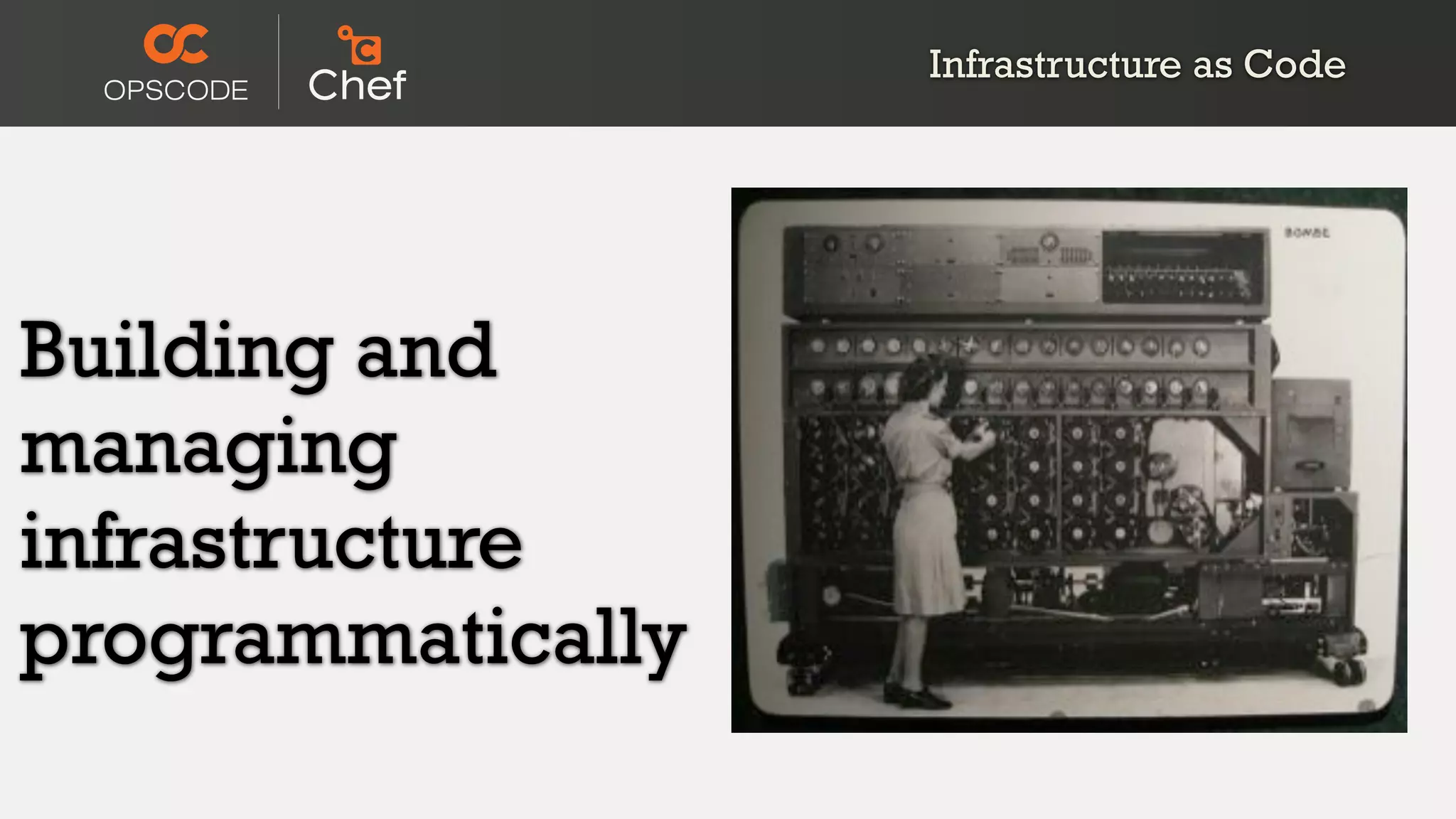
Building and
managing
infrastructure
programmatically
Infrastructure as Code
Enable the reconstruction
of the business from
nothing but a source code
repository, an application
data backup, and bare
metal resources.
Infrastructure as Code
Configuration
Management
The Old Way
Manual Configuration
• Labor intensive
• Error prone
• Hard to reproduce
Scripting
• Very brittle
• Throw away, one off scripts
• grep sed awk perl
• curl | bash
File Distribution
• NFS mounts
• rdist
• scp-on-a-for-loop
• rsync on cron
This does not scale!
for i in `cat servers.txt` ; do scp ntp.conf root@$i:/etc/
ntpd.conf ; done
for i in `cat servers.txt` ; do ssh root@$i /etc/init.d/ntpd
restart ; done
for i in `cat servers.txt` ; do ssh root@$i chkconfig ntpd
on ; done
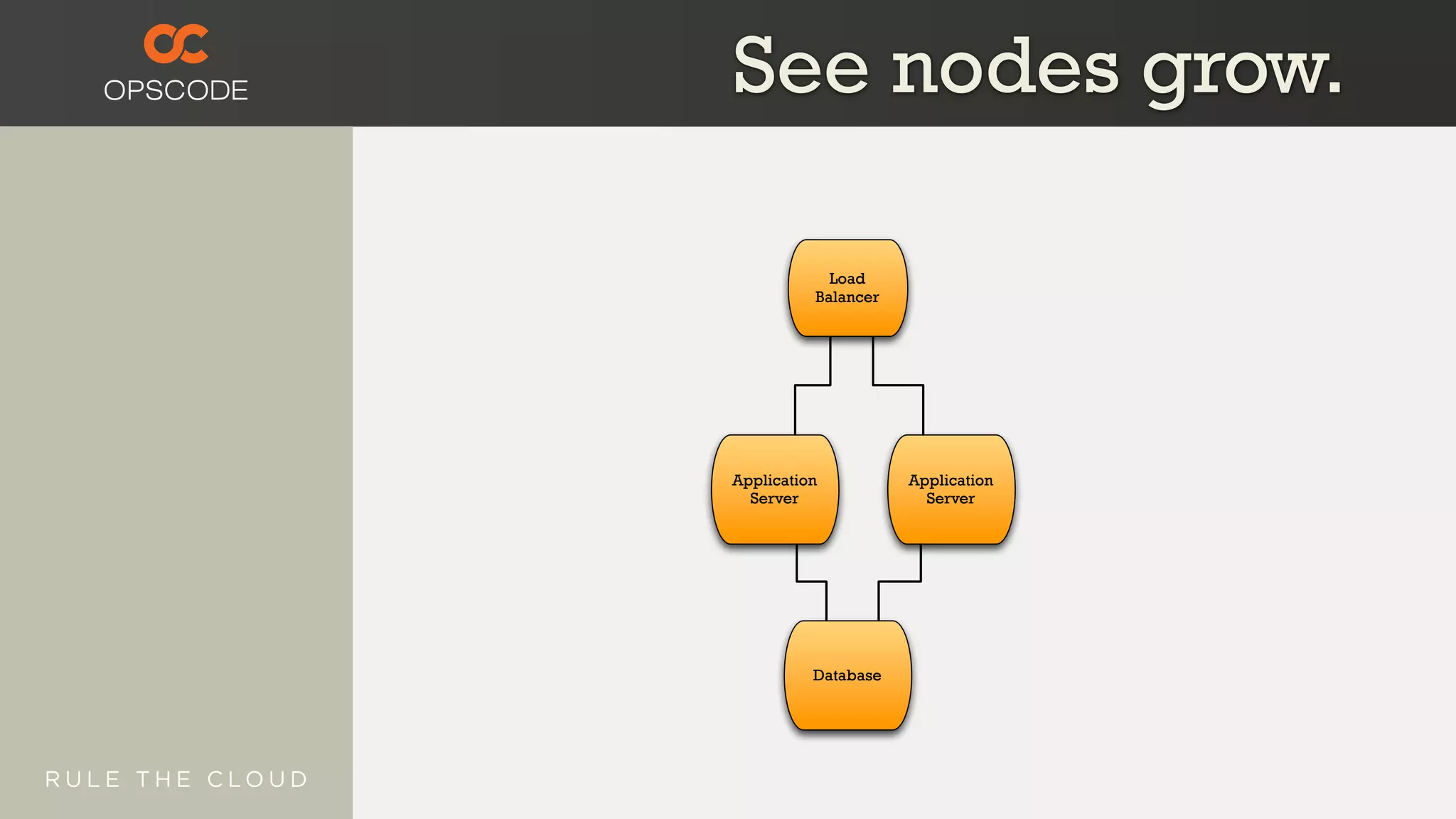
See nodes grow.
Load
Balancer
Application
Server
Database
Application
Server
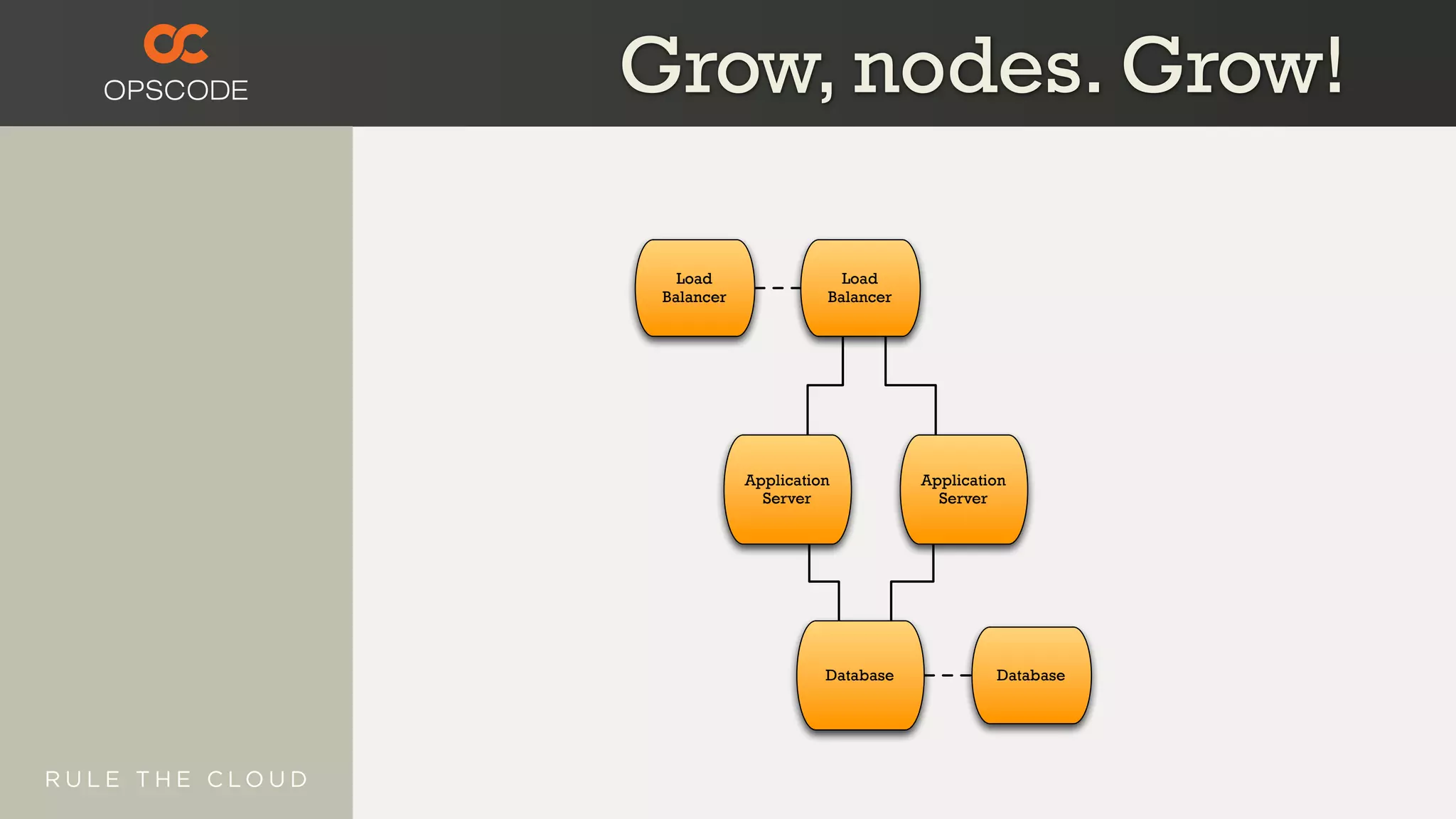
Load
Balancer
Application
Server
Database
Application
Server
Load
Balancer
Database
Grow, nodes. Grow!
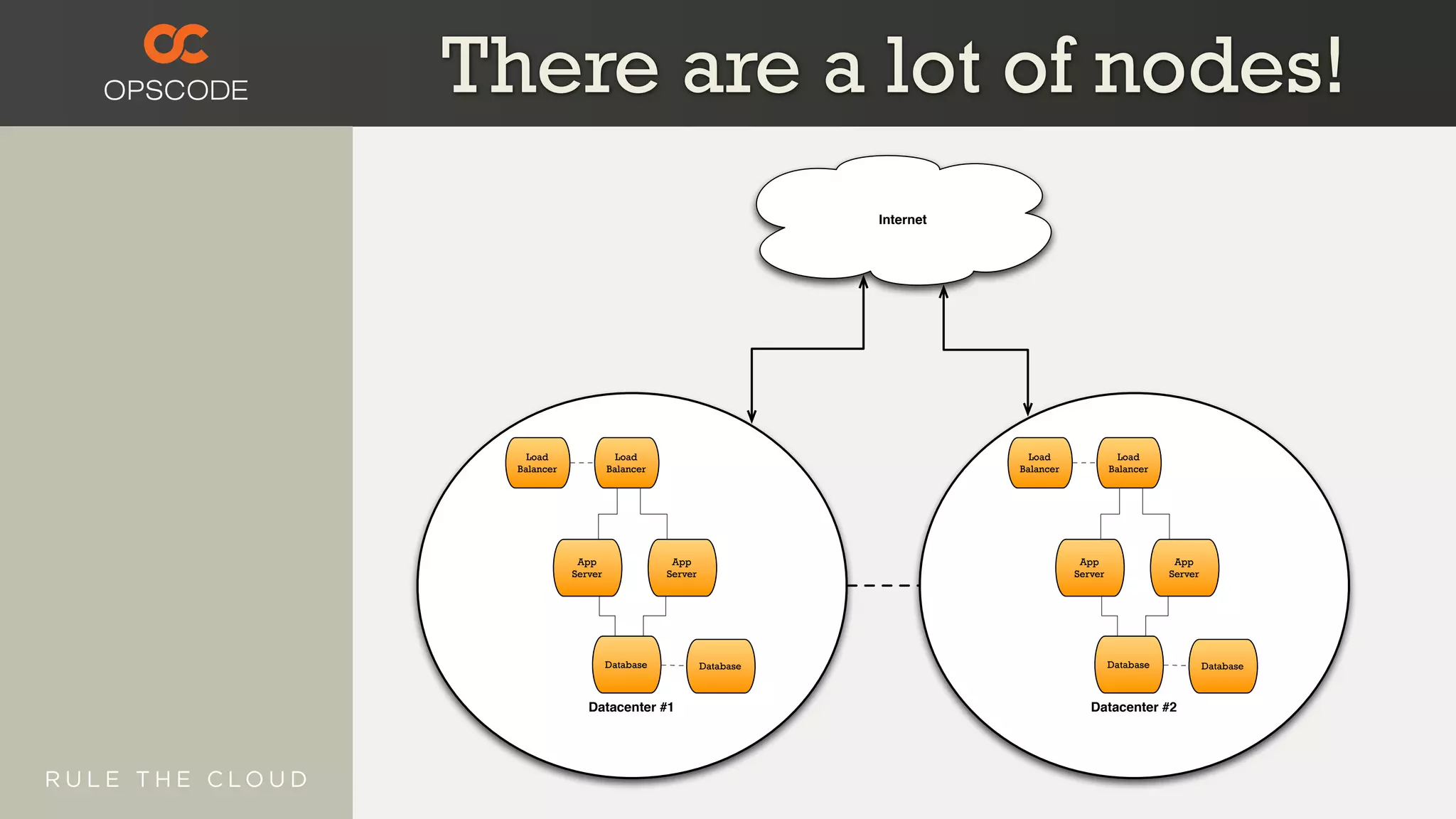
Datacenter #1
Load
Balancer
App
Server
Database
App
Server
Load
Balancer
Database
Datacenter #2
Load
Balancer
App
Server
Database
App
Server
Load
Balancer
Database
Internet
There are a lot of nodes!
A New Way
Declarative Configuration
• Define policy
• Say what, not how
• Abstract interface to resources
Idempotence
• Property of a
declarative interface
• f(x) = x
• Eliminates brittleness
• Safe to run over and
over
package "ntp" do
action :install
end
template "/etc/ntp.conf" do
source "ntp.conf.erb"
owner "root"
group "root"
mode 0644
notifies :restart, "service[ntpd]"
end
service "ntpd" do
action [:enable,:start]
end
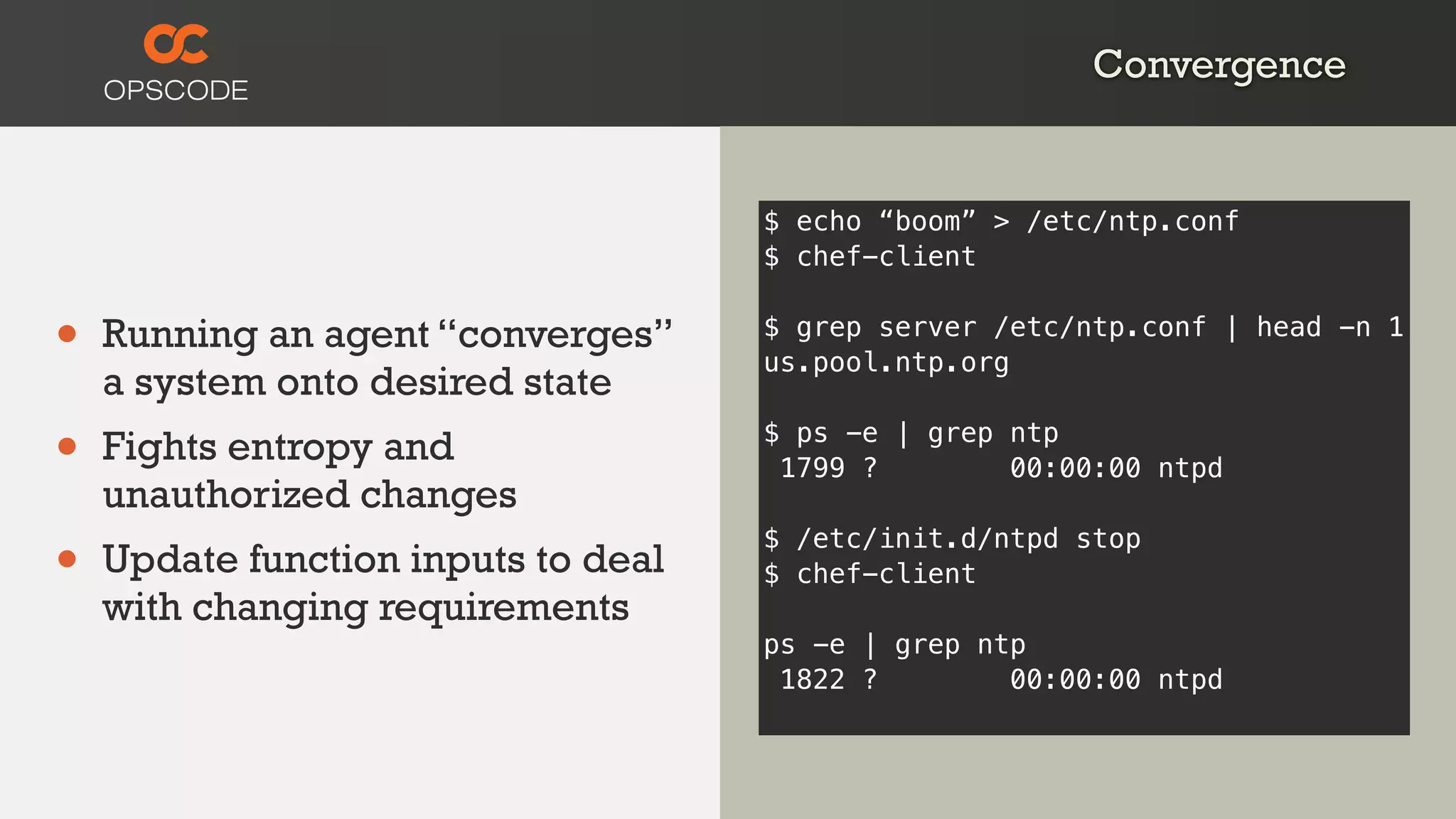
Convergence
• Running an agent “converges”
a system onto desired state
• Fights entropy and
unauthorized changes
• Update function inputs to deal
with changing requirements
$ echo “boom” > /etc/ntp.conf
$ chef-client
$ grep server /etc/ntp.conf | head -n 1
us.pool.ntp.org
$ ps -e | grep ntp
1799 ? 00:00:00 ntpd
$ /etc/init.d/ntpd stop
$ chef-client
ps -e | grep ntp
1822 ? 00:00:00 ntpd
Chef 101
http://www.flickr.com/photos/lapstrake/2711240606/in/photostream/
The chef-client runs on your
systems.
Clients talk to a Chef server.
Client server conversations
are protected with SSL and
RSA signatures.
Each system running Chef is
called a Managed Node.
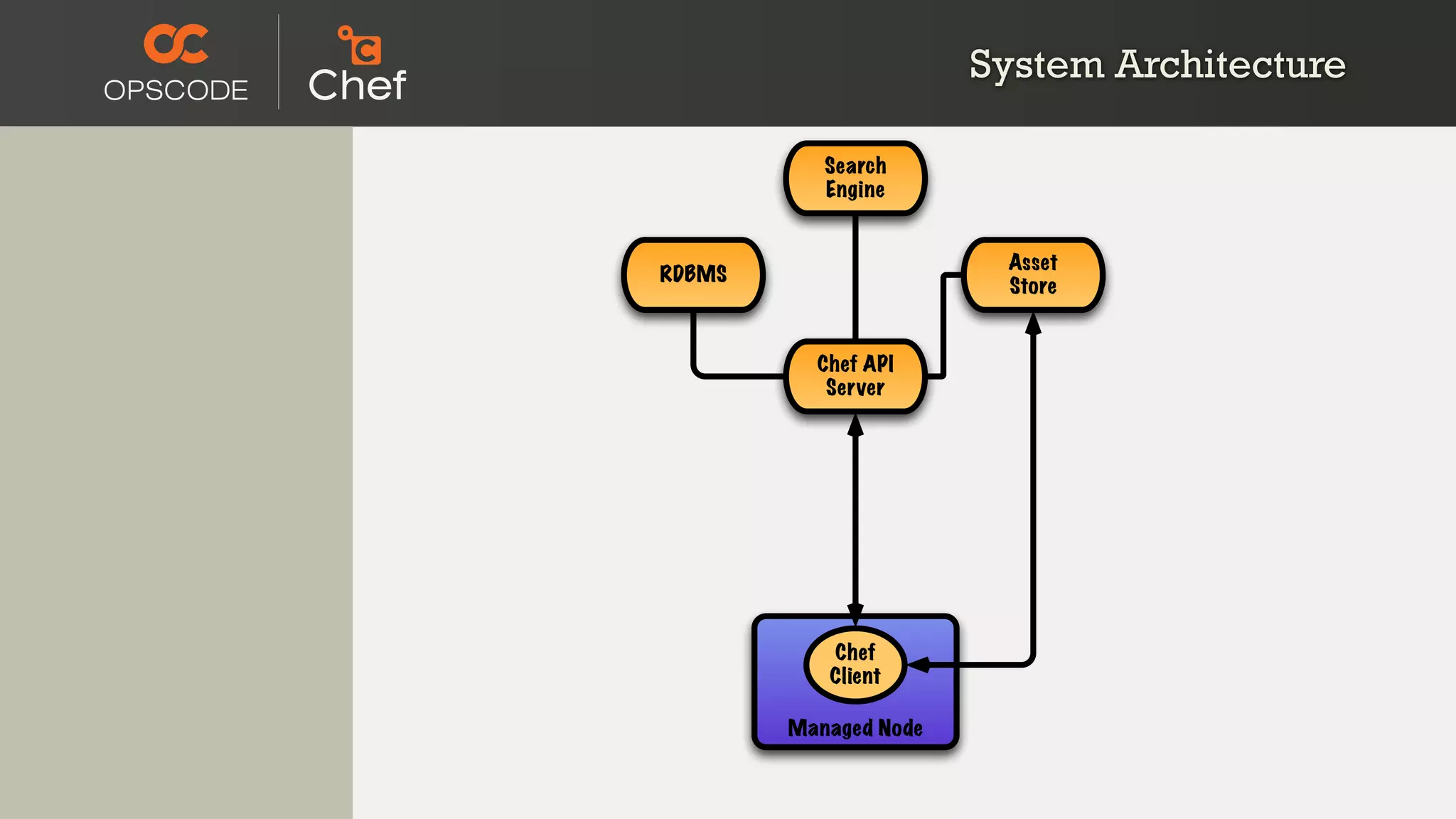
Chef API
Server
RDBMS
Search
Engine
Asset
Store
Managed Node
Chef
Client
System Architecture
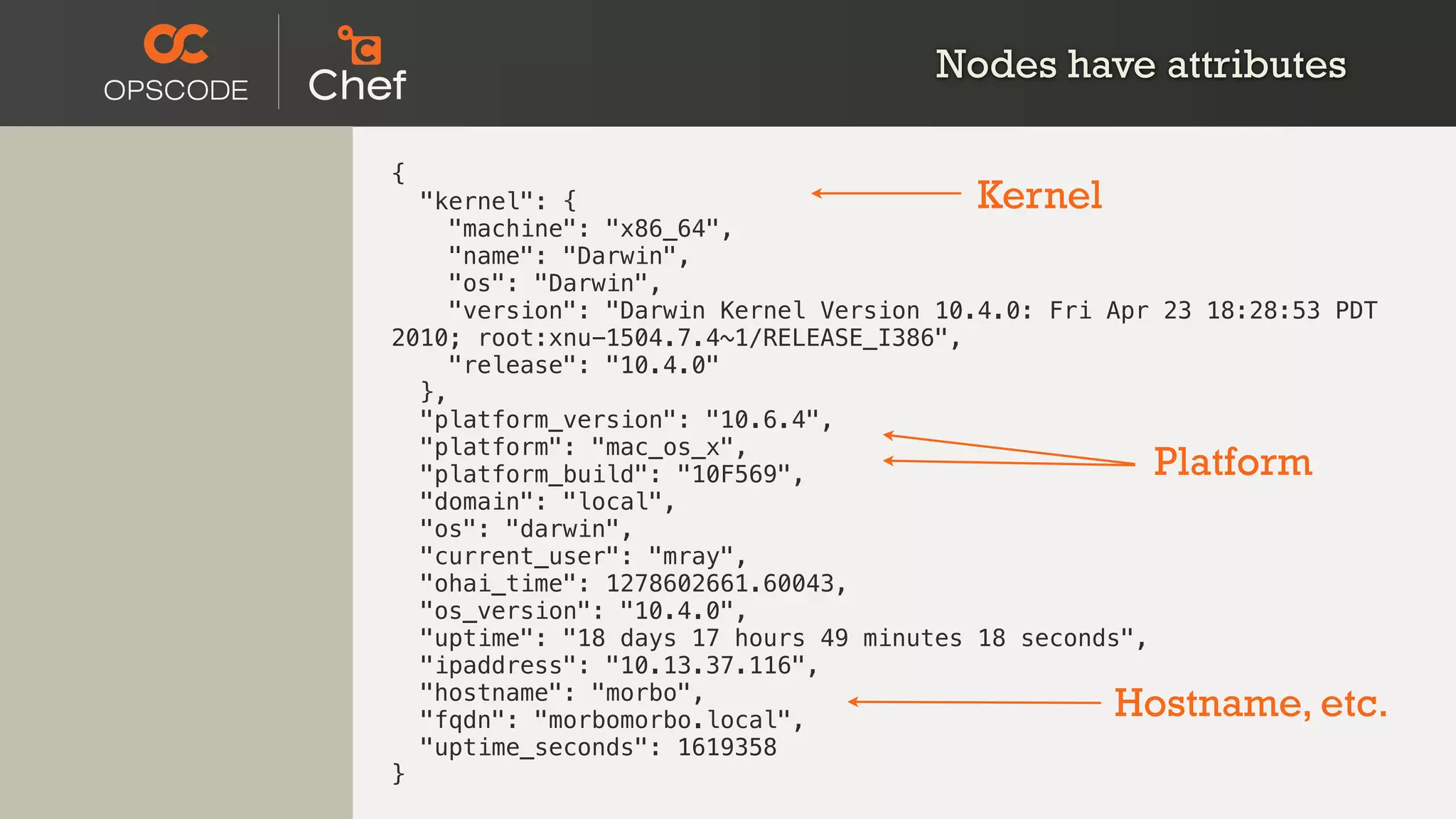
Nodes have attributes
{
"kernel": {
"machine": "x86_64",
"name": "Darwin",
"os": "Darwin",
"version": "Darwin Kernel Version 10.4.0: Fri Apr 23 18:28:53 PDT
2010; root:xnu-1504.7.4~1/RELEASE_I386",
"release": "10.4.0"
},
"platform_version": "10.6.4",
"platform": "mac_os_x",
"platform_build": "10F569",
"domain": "local",
"os": "darwin",
"current_user": "mray",
"ohai_time": 1278602661.60043,
"os_version": "10.4.0",
"uptime": "18 days 17 hours 49 minutes 18 seconds",
"ipaddress": "10.13.37.116",
"hostname": "morbo",
"fqdn": "morbomorbo.local",
"uptime_seconds": 1619358
}
Platform
Kernel
Hostname, etc.
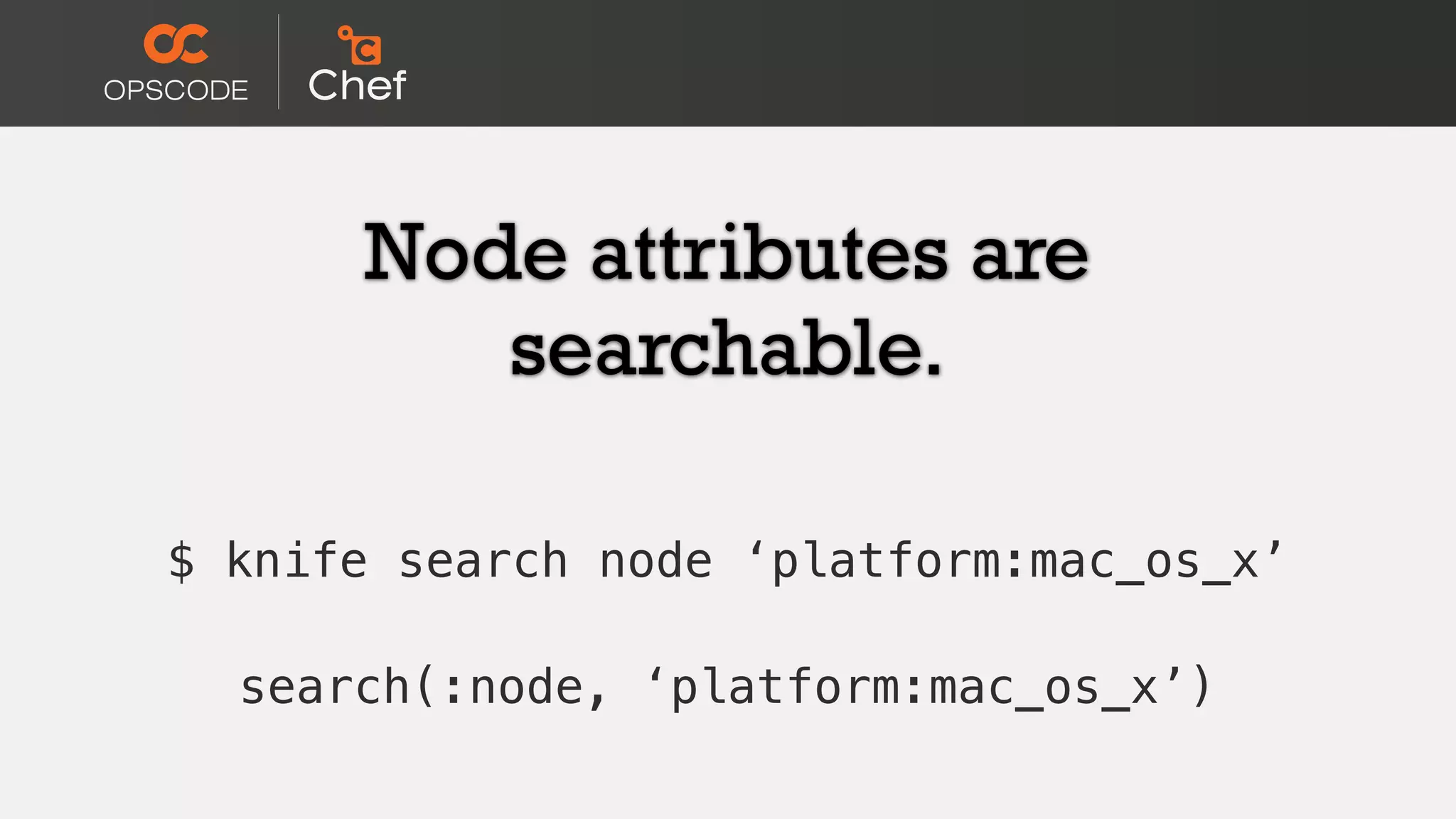
Node attributes are
searchable.
$ knife search node ‘platform:mac_os_x’
search(:node, ‘platform:mac_os_x’)
Nodes have “to do” lists.
Nodes have a Run List
% knife node show hadoop-prod.example.com -r
{
"run_list": [
"role[base]",
"role[hadoop-worker]"
]
}
Nodes can have Roles.
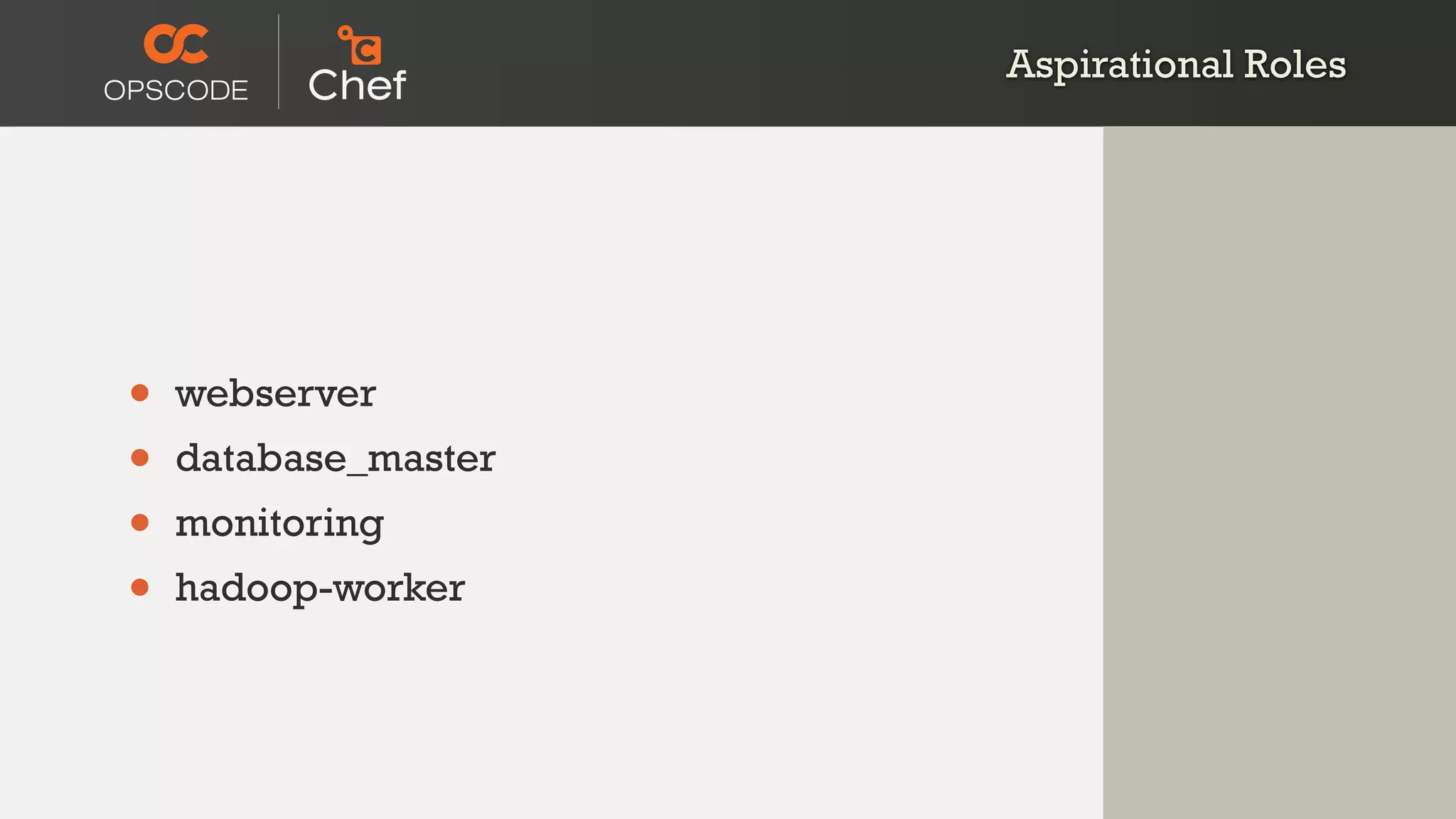
Aspirational Roles
• webserver
• database_master
• monitoring
• hadoop-worker
Roles have Attributes
and a run list.
Roles
name "hadoop-worker"
description "Hadoop cluster member”
run_list(
"role[base]",
"recipe[java]",
"recipe[hadoop]",
“recipe[hadoop-config]"
)
default_attributes(
"hadoop-config" => {
"config_path" => “/etc/hadoop”
}
)
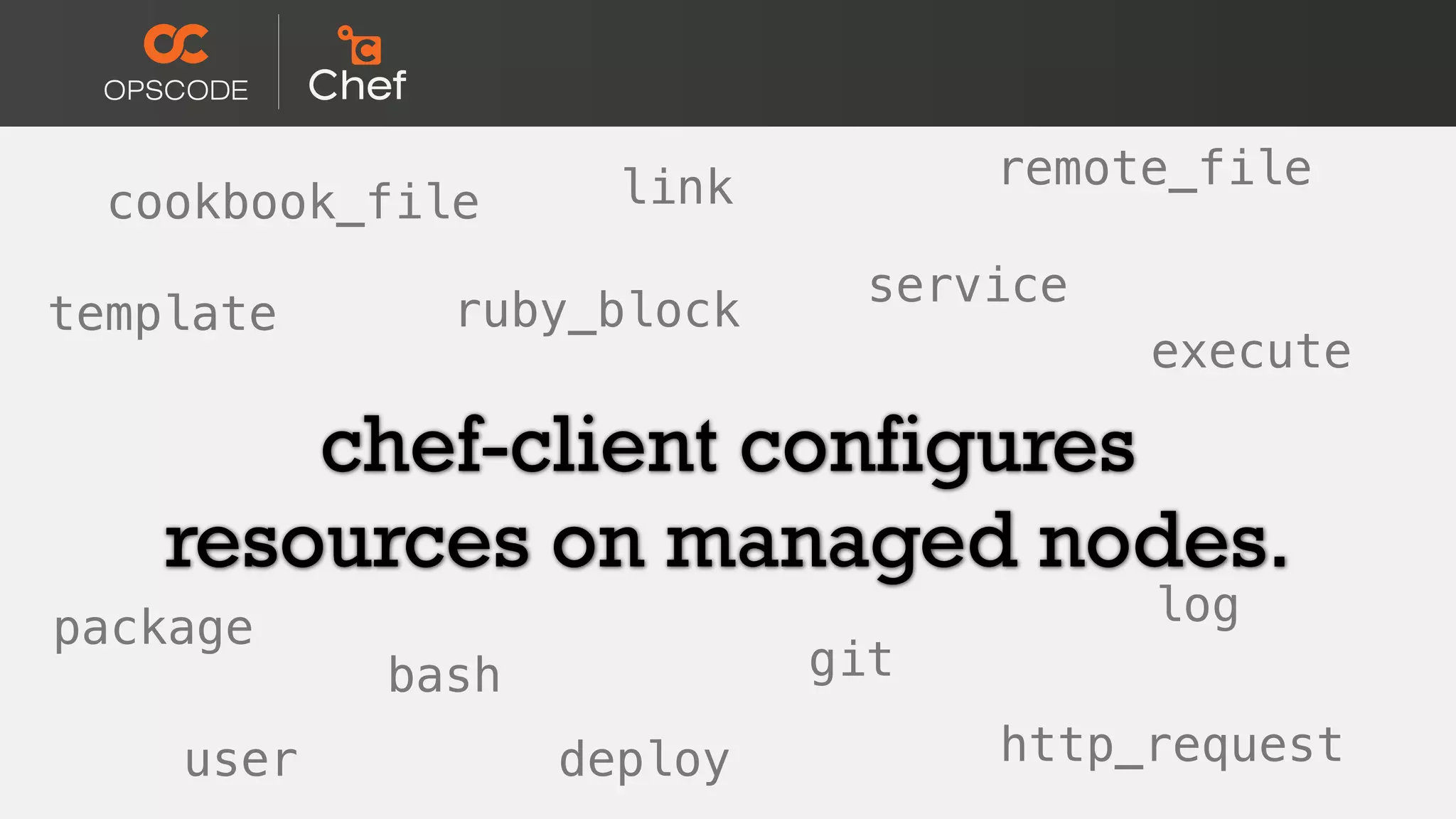
chef-client configures
resources on managed nodes.
cookbook_file
template
service
package
deploy
git
http_request
link
ruby_block
log
bash
execute
remote_file
user
Chef Resources
• Have a type.
• Have a name.
• Have parameters.
• Take action to put the resource
in the declared state.
• Can send notifications to other
resources.
package "apache2" do
action :install
end
template "/etc/apache2/apache2.conf" do
source "apache2.conf.erb"
owner "root"
group "root"
mode 0644
notifies :restart, "service[apache2]"
end
service "apache2" do
supports :restart => true
action [:enable, :start]
end
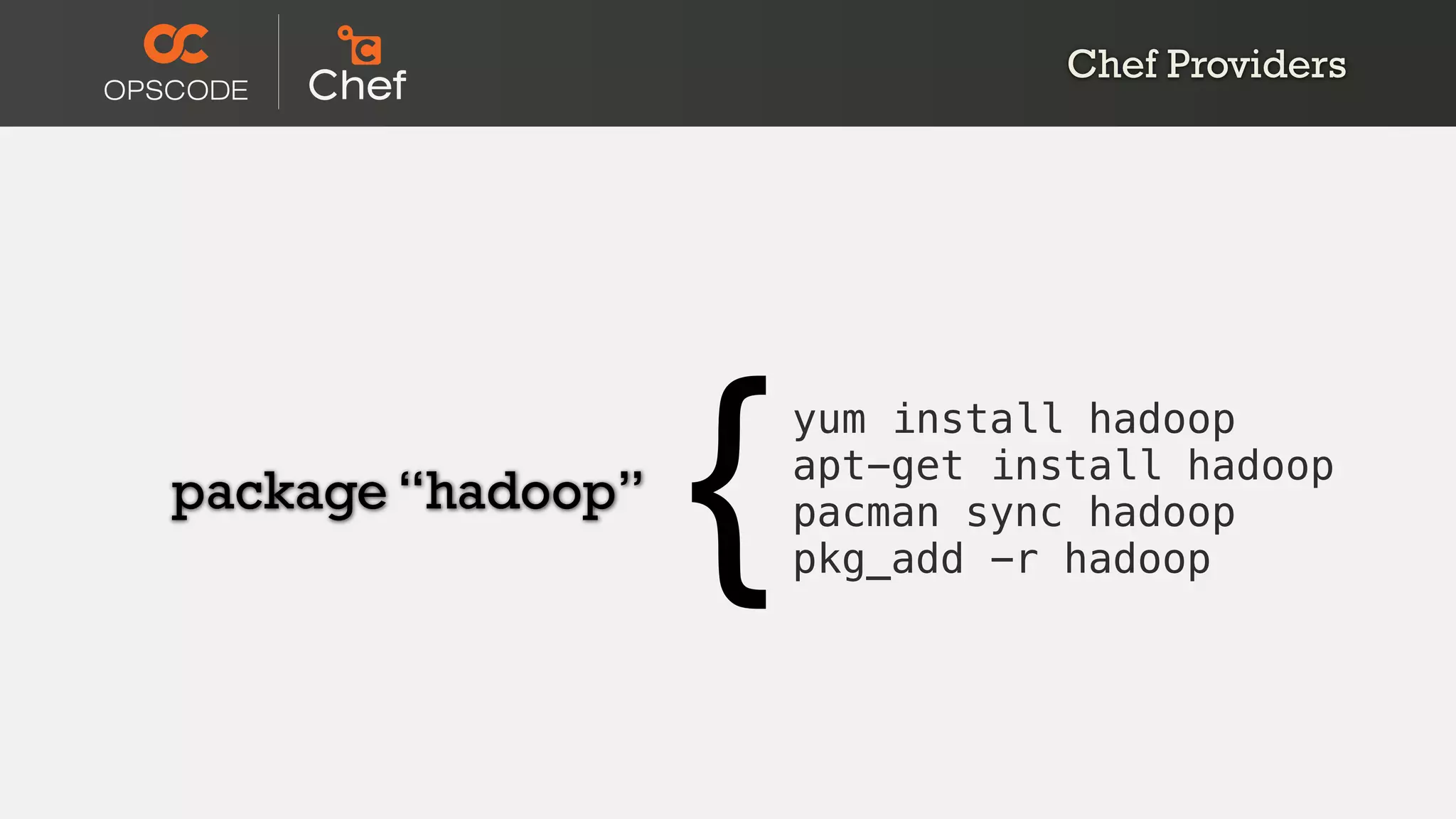
package “hadoop”
{yum install hadoop
apt-get install hadoop
pacman sync hadoop
pkg_add -r hadoop
Chef Providers
Recipes are collections
of resources.
Chef Recipes
• Resources are evaluated in the
order they appear.
package "haproxy" do
action :install
end
template "/etc/haproxy/haproxy.cfg" do
source "haproxy.cfg.erb"
owner "root"
group "root"
mode 0644
notifies :restart, "service[haproxy]"
end
service "haproxy" do
supports :restart => true
action [:enable, :start]
end
Chef Recipes
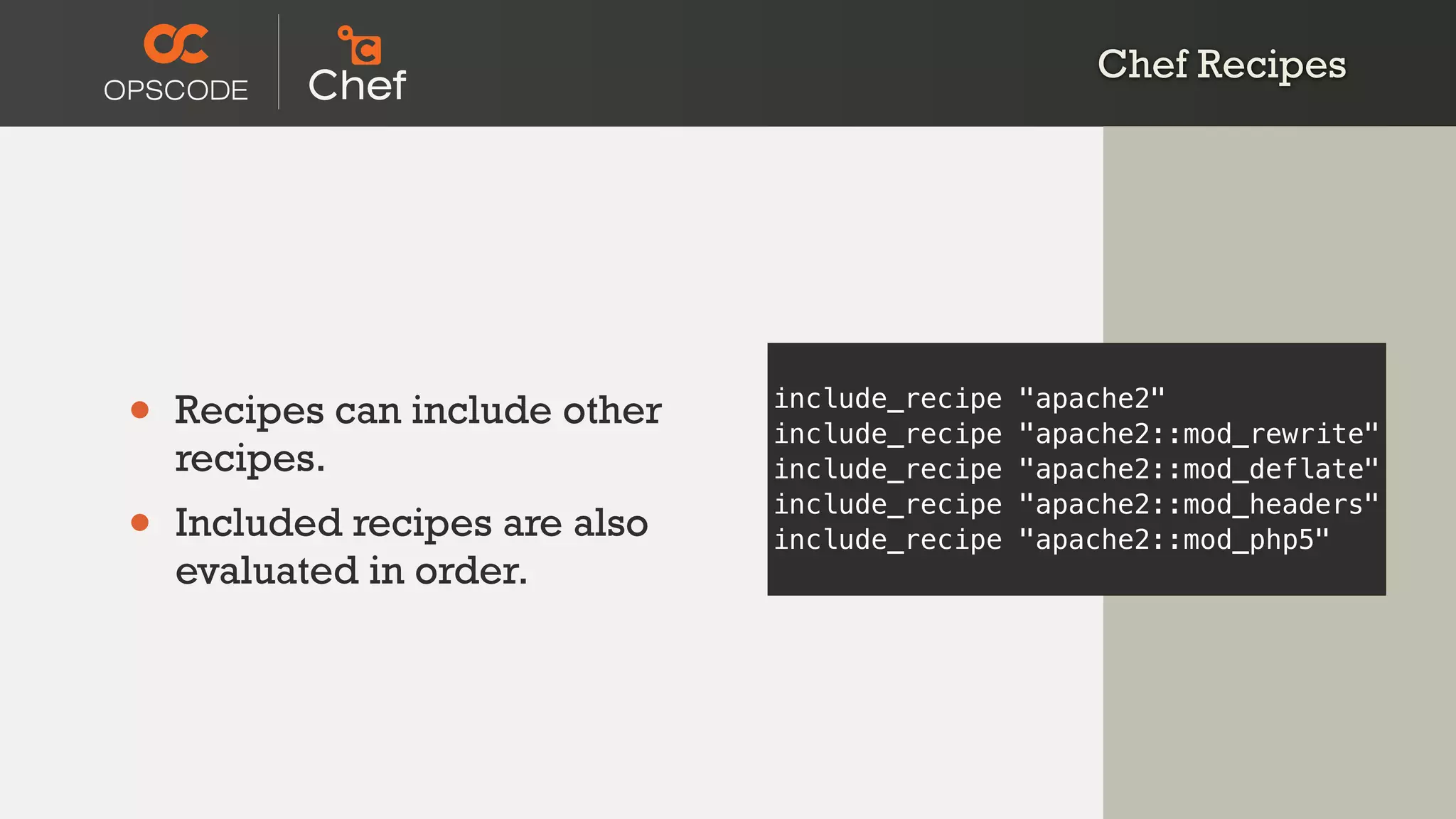
• Recipes can include other
recipes.
• Included recipes are also
evaluated in order.
include_recipe "apache2"
include_recipe "apache2::mod_rewrite"
include_recipe "apache2::mod_deflate"
include_recipe "apache2::mod_headers"
include_recipe "apache2::mod_php5"
Chef Recipes
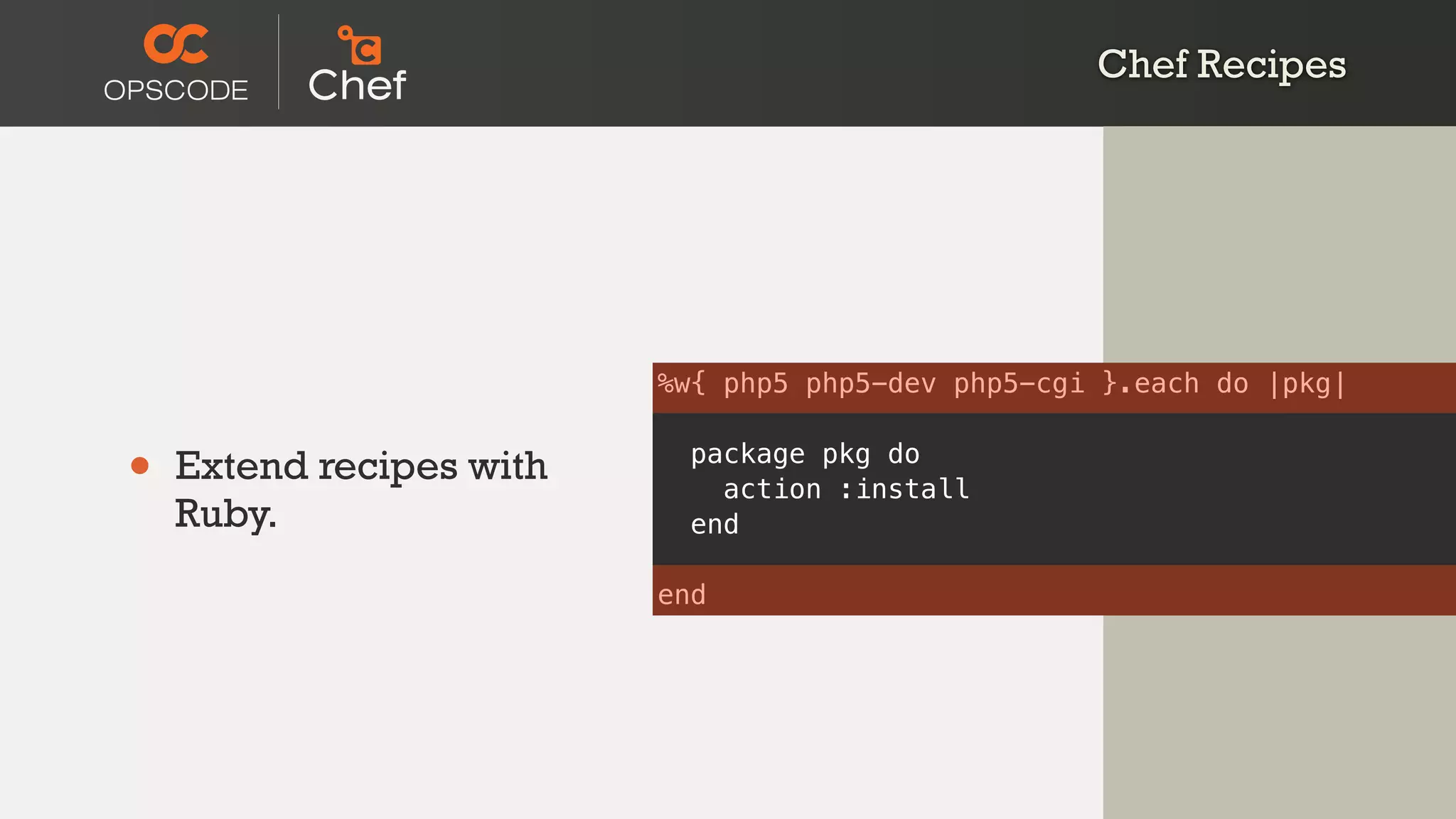
• Extend recipes with
Ruby.
%w{ php5 php5-dev php5-cgi }.each do |pkg|
package pkg do
action :install
end
end
• Dynamic configuration
through search.
pool_members = search("node", "role:app_server")
template "/etc/haproxy/haproxy.cfg" do
source "haproxy.cfg.erb"
owner "root"
group "root"
mode 0644
variables :pool_members => pool_members
notifies :restart, "service[haproxy]"
end
Chef Recipes
Cookbooks are packages for
recipes and related files.
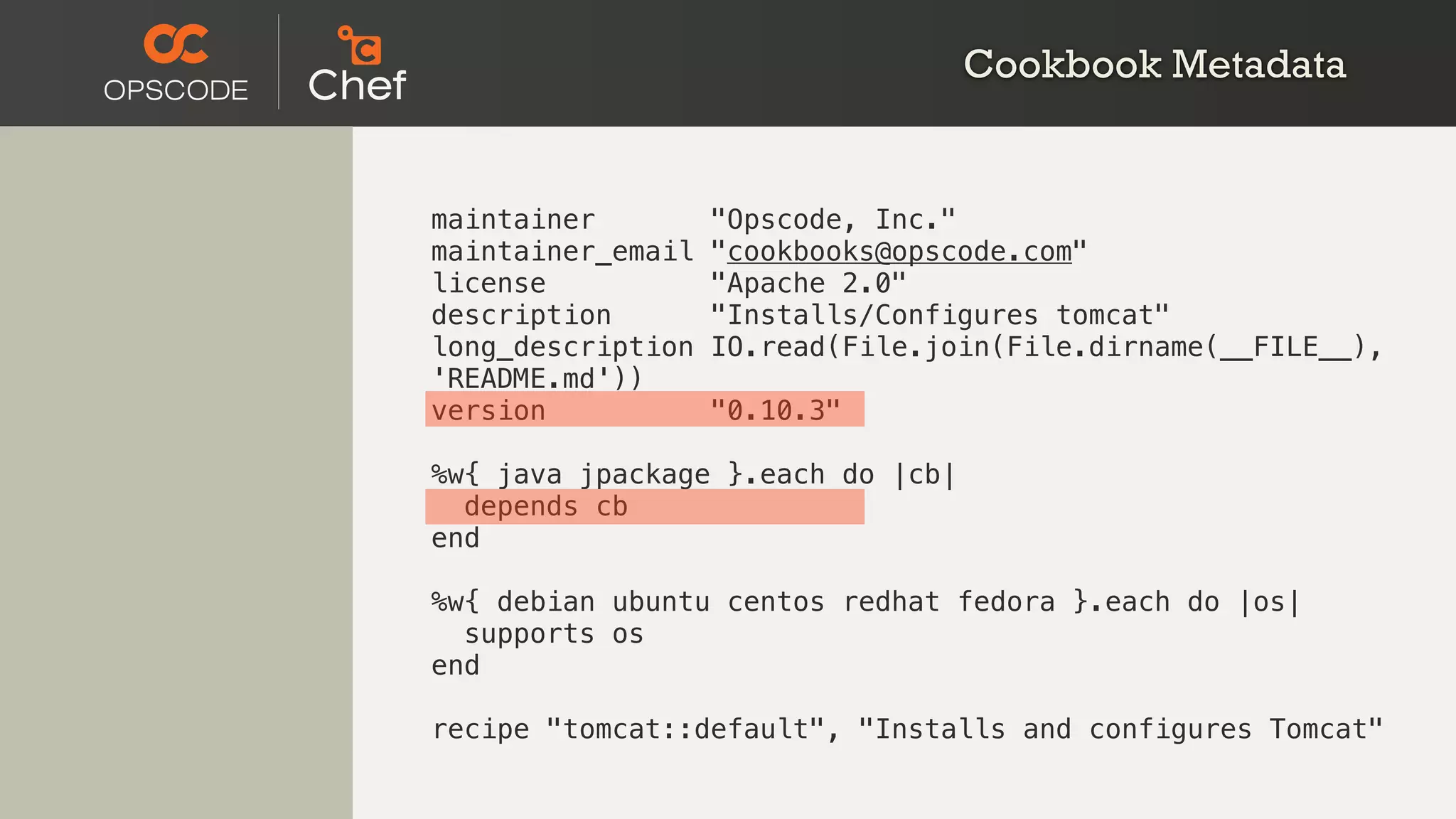
Cookbook Metadata
maintainer "Opscode, Inc."
maintainer_email "cookbooks@opscode.com"
license "Apache 2.0"
description "Installs/Configures tomcat"
long_description IO.read(File.join(File.dirname(__FILE__),
'README.md'))
version "0.10.3"
%w{ java jpackage }.each do |cb|
depends cb
end
%w{ debian ubuntu centos redhat fedora }.each do |os|
supports os
end
recipe "tomcat::default", "Installs and configures Tomcat"
Cookbooks are Source Code
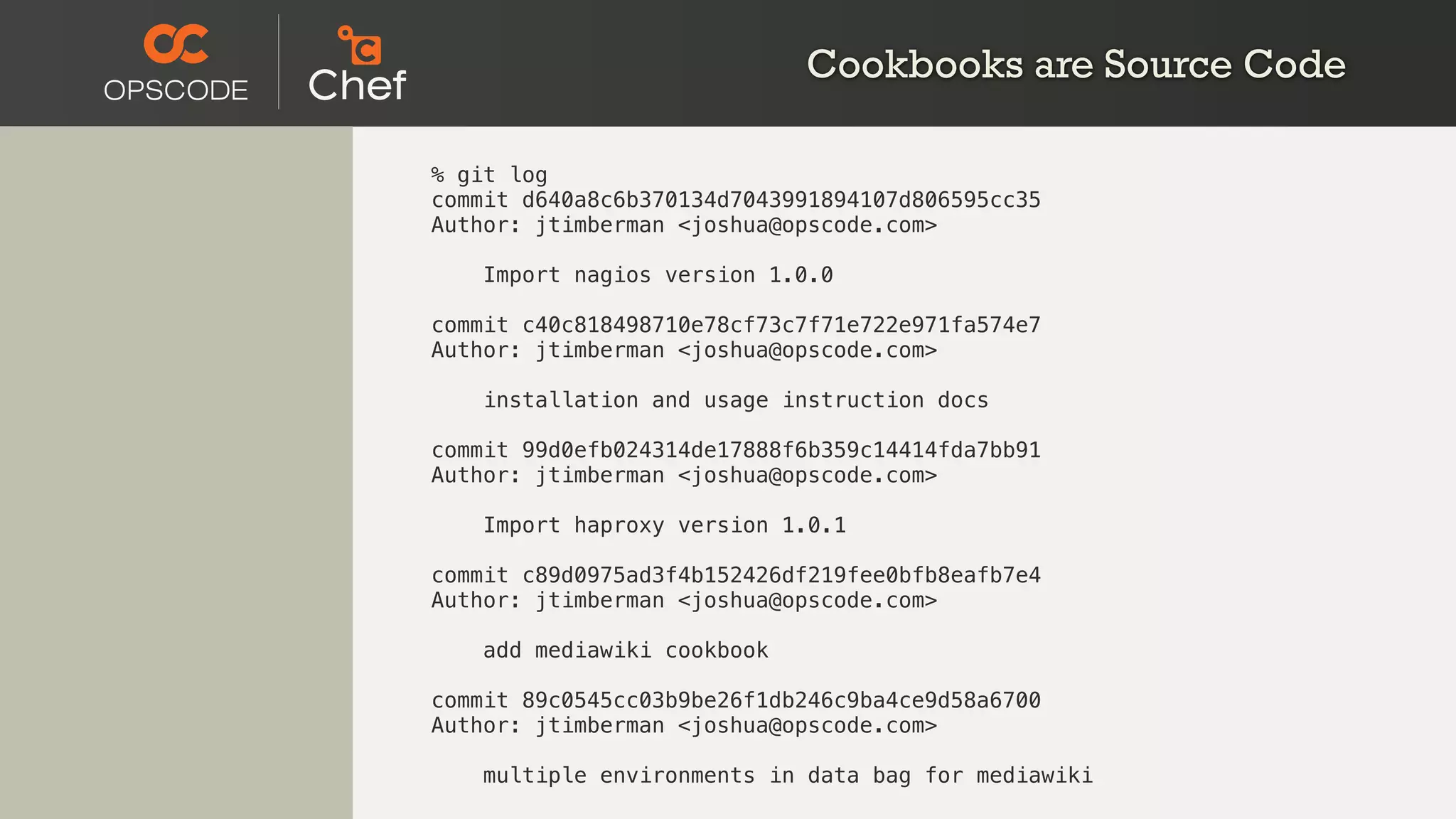
% git log
commit d640a8c6b370134d7043991894107d806595cc35
Author: jtimberman <joshua@opscode.com>
Import nagios version 1.0.0
commit c40c818498710e78cf73c7f71e722e971fa574e7
Author: jtimberman <joshua@opscode.com>
installation and usage instruction docs
commit 99d0efb024314de17888f6b359c14414fda7bb91
Author: jtimberman <joshua@opscode.com>
Import haproxy version 1.0.1
commit c89d0975ad3f4b152426df219fee0bfb8eafb7e4
Author: jtimberman <joshua@opscode.com>
add mediawiki cookbook
commit 89c0545cc03b9be26f1db246c9ba4ce9d58a6700
Author: jtimberman <joshua@opscode.com>
multiple environments in data bag for mediawiki
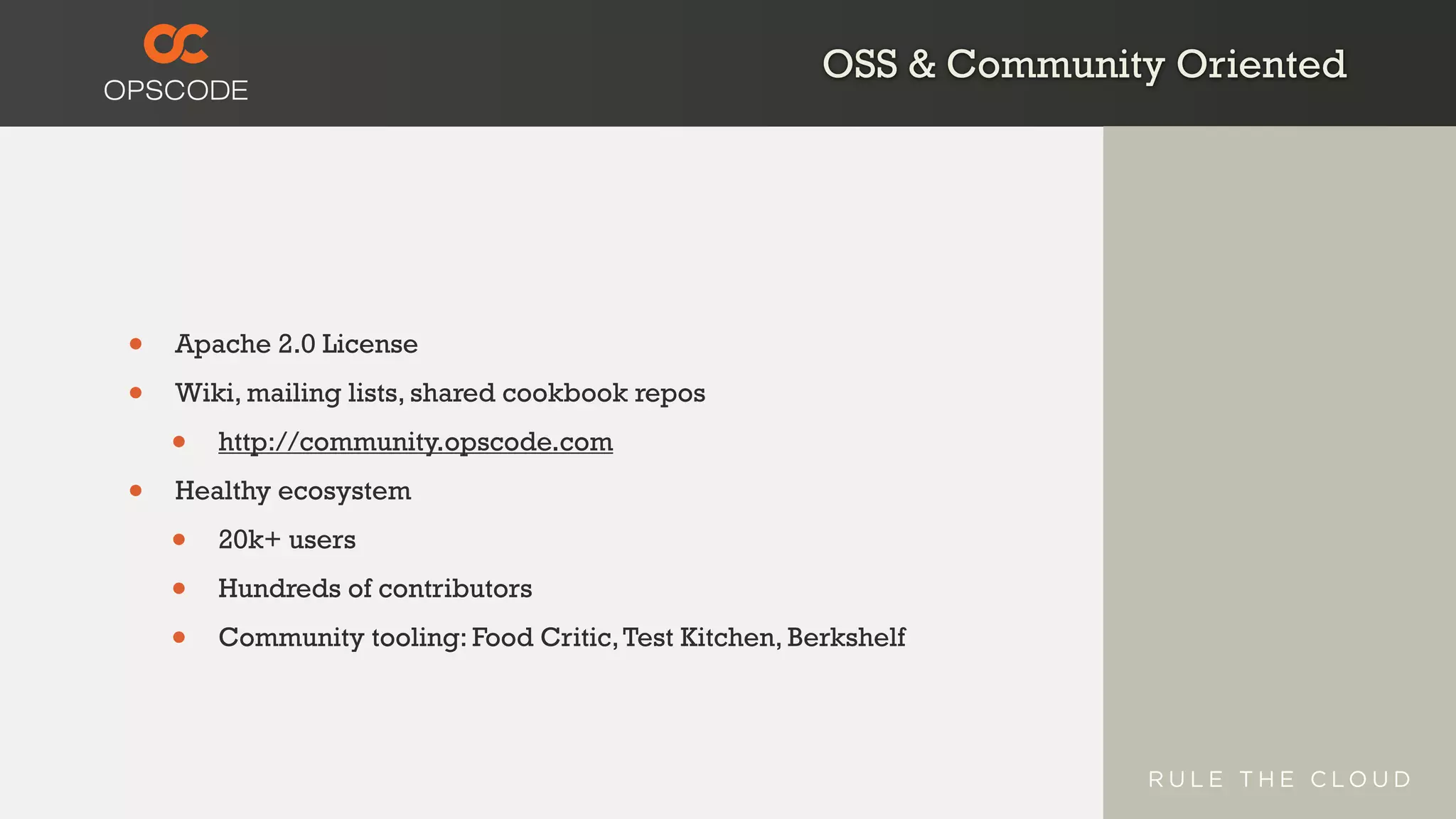
OSS & Community Oriented
• Apache 2.0 License
• Wiki, mailing lists, shared cookbook repos
• http://community.opscode.com
• Healthy ecosystem
• 20k+ users
• Hundreds of contributors
• Community tooling: Food Critic,Test Kitchen, Berkshelf
Chef In
“Large” Environments
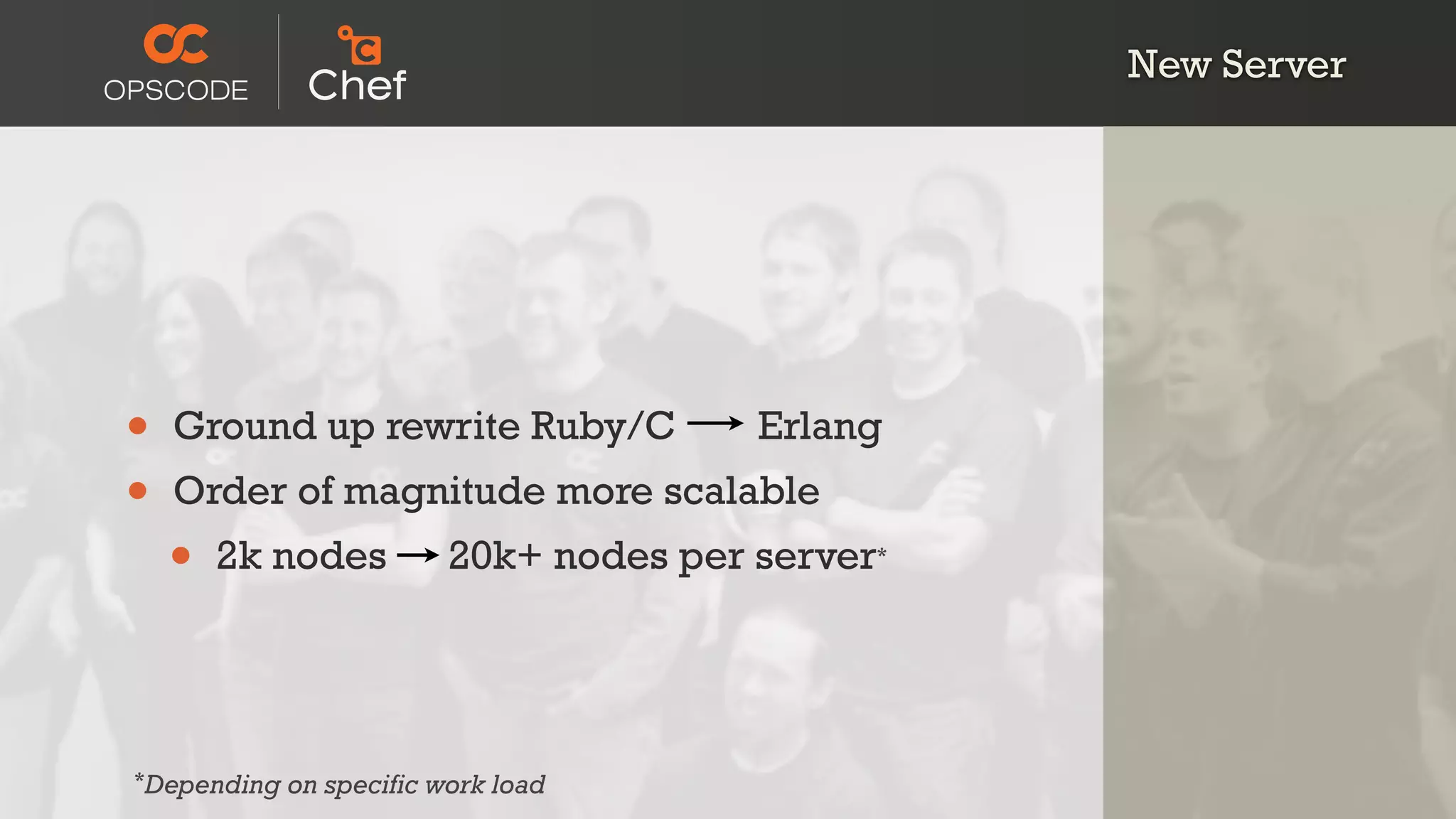
New Server
• Ground up rewrite Ruby/C Erlang
• Order of magnitude more scalable
• 2k nodes 20k+ nodes per server*
*Depending on specific work load
High Scalability Users
• Facebook
• Cycle Computing
• edmunds.com
Push Execution
• Converge infrastructure on demand
• Real-timey view of managed infrastructure
• Reduces change latency
• 4k nodes now, 10k soon
Network Automation
• Network provisioning and configuration
• VLANs, QoS, etc.
• Partnered w/Arista on PoC (Fall 2012)
• More coming soon!
ThankYou

Introduction to Chef