Chef
Introduction and overview to managing your
systems
Adrian Moisey
Why Chef (or puppet or Bcfg2 or
CFEngine)?
- Infrastructure as code
Why Chef (or puppet or Bcfg2 or
CFEngine)?
- Infrastructure as code
- Reproducible
Why Chef (or puppet or Bcfg2 or
CFEngine)?
- Infrastructure as code
- Reproducible
- Version control (SCM)
Why Chef (or puppet or Bcfg2 or
CFEngine)?
- Infrastructure as code
- Reproducible
- Version control (SCM)
- Removes the human factor
Why Chef (or puppet or Bcfg2 or
CFEngine)?
- Infrastructure as code
- Reproducible
- Version control (SCM)
- Removes the human factor
- Tests
Basic Chef Architecture
- Executes various "recipes" which configure
your system in the desired way
Basic Chef Architecture
- Executes various "recipes" which configure
your system in the desired way
- A node definition is required in order for chef
to know which recipes to run and with which
attributes to run them
Basic Chef Architecture
- Executes various "recipes" which configure
your system in the desired way
- A node definition is required in order for chef
to know which recipes to run and with which
attributes to run them
- Allows you to decide what and how
components are configured using attributes,
environment definitions and node definitions.
Basic Chef Architecture
Server/client:
- chef-server stores all your cookbooks,
environments, roles and nodes
Basic Chef Architecture
Server/client:
- chef-server stores all your cookbooks,
environments, roles and nodes
- chef-client connects and gets given the
relevant cookbooks and attributes from chef-
server and executes them
Basic Chef Architecture
Server/client:
- chef-server stores all your cookbooks,
environments, roles and nodes
- chef-client connects and gets given the
relevant cookbooks and attributes from chef-
server and executes them
You can run your own server or use the
opscode hosted chef (for a fee)
Basic Chef Architecture
Chef-solo:
- Standalone, doesn't connect to a server
Basic Chef Architecture
Chef-solo:
- Standalone, doesn't connect to a server
- Uses static cookbooks and nodes on the local
filesystem
Basic Chef Architecture
Chef-solo:
- Standalone, doesn't connect to a server
- Uses static cookbooks and nodes on the local
filesystem
- Unable to perform searches (because nodes
are stand-alone with no central directory)
Cookbook
From the wiki:
A cookbook is the fundamental unit of
configuration and policy distribution in Chef.
Each cookbook defines a scenario, such as
everything needed to install and configure
MySQL, and then it contains all of the
components that are required to support that
scenario.
Cookbook
Can contain:
- recipes
- attributes
- providers
- definitions
- templates
- files
- metadata
http://docs.opscode.
com/essentials_cookbooks.html
Cookbook
$ cat cookbooks/ntp/recipe/default.rb
['openntpd','ntpdate'].each do |p|
package p do
action :install
end
end
template 'ntpd.conf' do
path '/etc/openntpd/ntpd.conf'
source 'ntpd.conf.erb'
owner 'root'
group 'root'
mode 0600
notifies :restart, 'service[openntpd]'
end
Cookbook
$ cat cookbooks/ntp/attributes/default.rb
default[:ntp][:servers] = [
"0.pool.ntp.org",
"1.pool.ntp.org",
"2.pool.ntp.org",
"3.pool.ntp.org"
]
Role
$ cat roles/ntp.rb
name "ntp"
description "Install openntpd"
run_list("recipe[ntp]")
Environment
$ cat environments/cluster01.rb
name "cluster01"
description "Cluster 01"
default_attributes({
:ntp => {
:servers => [
"ntp01.mycorp.com",
"ntp02.mycorp.com"
]
}
})
cookbook_versions({
"ntp" => "0.0.1"
})
Nodes
$ cat nodes/server01.mycorp.com.json
{
"chef_type": "node",
"name": "server01.mycorp.com",
"normal": {},
"default": {},
"chef_environment": "cluster01",
"run_list": [ "role[ntp]" ],
"override": {},
"json_class": "Chef::Node",
"automatic": {}
}
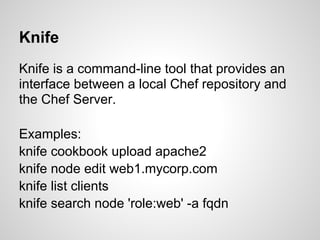
Knife
Knife is a command-line tool that provides an
interface between a local Chef repository and
the Chef Server.
Examples:
knife cookbook upload apache2
knife node edit web1.mycorp.com
knife list clients
knife search node 'role:web' -a fqdn
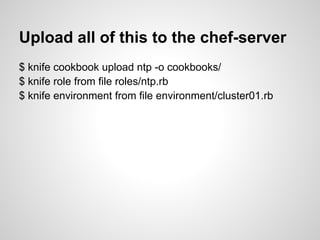
Upload all of this to the chef-server
$ knife cookbook upload ntp -o cookbooks/
$ knife role from file roles/ntp.rb
$ knife environment from file environment/cluster01.rb
Data bags
- global variable
- stored in JSON
- accessible from the chef server
- can be searched
- can also be encrypted
For example: to store all your users
Community cookbooks
https://github.com/opscode-cookbooks/
apache, chef-server, chef-client, mysql, build-
essential, cron, php, nagios, logrotate, erlang,
python, jenkins, squid, iptables, samba,
unicorn, munin, jira, screen, tftp
Community cookbooks - tips
- Use the community cookbooks unmodified
Community cookbooks - tips
- Use the community cookbooks unmodified
- Write wrapper cookbooks around them - most
of them were designed with this in mind
Community cookbooks - tips
- Use the community cookbooks unmodified
- Write wrapper cookbooks around them - most
of them were designed with this in mind
- Send bug fixes upstream
Cookbook versioning
- Cookbooks can contain versions
Cookbook versioning
- Cookbooks can contain versions
- Cookbooks can depend on specific versions
of other cookbooks
Cookbook versioning
- Cookbooks can contain versions
- Cookbooks can depend on specific versions
of other cookbooks
- Different environments can depend on
different versions of cookbooks (allows you to
have 0.0.2 in testing and 0.0.1 in production)
Tests
- foodcritic: linting tool which checks against a
community list of rules
Tests
- foodcritic: linting tool which checks against a
community list of rules
- chef-spec: unit tests for recipe code (not
functional)
Tests
- foodcritic: linting tool which checks against a
community list of rules
- chef-spec: unit tests for recipe code (not
functional)
- test-kitchen: Framework for running
integration tests in an isolated environment (<3
vagrant)
Live demo!
- Remove a Yola employee
- Create a pull request
- Push it to the chef-server
- Ensure that it has been done
- Take a look at some things that knife can do
Some cool things
- chef-solo can run the chef-server cookbook in
order to bootstrap your chef-server
- knife ec2 allows you to create an EC2
instance and configure it as a chef-client
The End
Questions?
Thanks to Jonathan for help with the slides

Chef

  • 1.
    Chef Introduction and overviewto managing your systems Adrian Moisey
  • 2.
    Why Chef (orpuppet or Bcfg2 or CFEngine)? - Infrastructure as code
  • 3.
    Why Chef (orpuppet or Bcfg2 or CFEngine)? - Infrastructure as code - Reproducible
  • 4.
    Why Chef (orpuppet or Bcfg2 or CFEngine)? - Infrastructure as code - Reproducible - Version control (SCM)
  • 5.
    Why Chef (orpuppet or Bcfg2 or CFEngine)? - Infrastructure as code - Reproducible - Version control (SCM) - Removes the human factor
  • 6.
    Why Chef (orpuppet or Bcfg2 or CFEngine)? - Infrastructure as code - Reproducible - Version control (SCM) - Removes the human factor - Tests
  • 7.
    Basic Chef Architecture -Executes various "recipes" which configure your system in the desired way
  • 8.
    Basic Chef Architecture -Executes various "recipes" which configure your system in the desired way - A node definition is required in order for chef to know which recipes to run and with which attributes to run them
  • 9.
    Basic Chef Architecture -Executes various "recipes" which configure your system in the desired way - A node definition is required in order for chef to know which recipes to run and with which attributes to run them - Allows you to decide what and how components are configured using attributes, environment definitions and node definitions.
  • 10.
    Basic Chef Architecture Server/client: -chef-server stores all your cookbooks, environments, roles and nodes
  • 11.
    Basic Chef Architecture Server/client: -chef-server stores all your cookbooks, environments, roles and nodes - chef-client connects and gets given the relevant cookbooks and attributes from chef- server and executes them
  • 12.
    Basic Chef Architecture Server/client: -chef-server stores all your cookbooks, environments, roles and nodes - chef-client connects and gets given the relevant cookbooks and attributes from chef- server and executes them You can run your own server or use the opscode hosted chef (for a fee)
  • 13.
    Basic Chef Architecture Chef-solo: -Standalone, doesn't connect to a server
  • 14.
    Basic Chef Architecture Chef-solo: -Standalone, doesn't connect to a server - Uses static cookbooks and nodes on the local filesystem
  • 15.
    Basic Chef Architecture Chef-solo: -Standalone, doesn't connect to a server - Uses static cookbooks and nodes on the local filesystem - Unable to perform searches (because nodes are stand-alone with no central directory)
  • 16.
    Cookbook From the wiki: Acookbook is the fundamental unit of configuration and policy distribution in Chef. Each cookbook defines a scenario, such as everything needed to install and configure MySQL, and then it contains all of the components that are required to support that scenario.
  • 17.
    Cookbook Can contain: - recipes -attributes - providers - definitions - templates - files - metadata http://docs.opscode. com/essentials_cookbooks.html
  • 18.
    Cookbook $ cat cookbooks/ntp/recipe/default.rb ['openntpd','ntpdate'].eachdo |p| package p do action :install end end template 'ntpd.conf' do path '/etc/openntpd/ntpd.conf' source 'ntpd.conf.erb' owner 'root' group 'root' mode 0600 notifies :restart, 'service[openntpd]' end
  • 19.
    Cookbook $ cat cookbooks/ntp/attributes/default.rb default[:ntp][:servers]= [ "0.pool.ntp.org", "1.pool.ntp.org", "2.pool.ntp.org", "3.pool.ntp.org" ]
  • 20.
    Role $ cat roles/ntp.rb name"ntp" description "Install openntpd" run_list("recipe[ntp]")
  • 21.
    Environment $ cat environments/cluster01.rb name"cluster01" description "Cluster 01" default_attributes({ :ntp => { :servers => [ "ntp01.mycorp.com", "ntp02.mycorp.com" ] } }) cookbook_versions({ "ntp" => "0.0.1" })
  • 22.
    Nodes $ cat nodes/server01.mycorp.com.json { "chef_type":"node", "name": "server01.mycorp.com", "normal": {}, "default": {}, "chef_environment": "cluster01", "run_list": [ "role[ntp]" ], "override": {}, "json_class": "Chef::Node", "automatic": {} }
  • 23.
    Knife Knife is acommand-line tool that provides an interface between a local Chef repository and the Chef Server. Examples: knife cookbook upload apache2 knife node edit web1.mycorp.com knife list clients knife search node 'role:web' -a fqdn
  • 24.
    Upload all ofthis to the chef-server $ knife cookbook upload ntp -o cookbooks/ $ knife role from file roles/ntp.rb $ knife environment from file environment/cluster01.rb
  • 25.
    Data bags - globalvariable - stored in JSON - accessible from the chef server - can be searched - can also be encrypted For example: to store all your users
  • 26.
    Community cookbooks https://github.com/opscode-cookbooks/ apache, chef-server,chef-client, mysql, build- essential, cron, php, nagios, logrotate, erlang, python, jenkins, squid, iptables, samba, unicorn, munin, jira, screen, tftp
  • 27.
    Community cookbooks -tips - Use the community cookbooks unmodified
  • 28.
    Community cookbooks -tips - Use the community cookbooks unmodified - Write wrapper cookbooks around them - most of them were designed with this in mind
  • 29.
    Community cookbooks -tips - Use the community cookbooks unmodified - Write wrapper cookbooks around them - most of them were designed with this in mind - Send bug fixes upstream
  • 30.
    Cookbook versioning - Cookbookscan contain versions
  • 31.
    Cookbook versioning - Cookbookscan contain versions - Cookbooks can depend on specific versions of other cookbooks
  • 32.
    Cookbook versioning - Cookbookscan contain versions - Cookbooks can depend on specific versions of other cookbooks - Different environments can depend on different versions of cookbooks (allows you to have 0.0.2 in testing and 0.0.1 in production)
  • 33.
    Tests - foodcritic: lintingtool which checks against a community list of rules
  • 34.
    Tests - foodcritic: lintingtool which checks against a community list of rules - chef-spec: unit tests for recipe code (not functional)
  • 35.
    Tests - foodcritic: lintingtool which checks against a community list of rules - chef-spec: unit tests for recipe code (not functional) - test-kitchen: Framework for running integration tests in an isolated environment (<3 vagrant)
  • 36.
    Live demo! - Removea Yola employee - Create a pull request - Push it to the chef-server - Ensure that it has been done - Take a look at some things that knife can do
  • 37.
    Some cool things -chef-solo can run the chef-server cookbook in order to bootstrap your chef-server - knife ec2 allows you to create an EC2 instance and configure it as a chef-client
  • 38.
    The End Questions? Thanks toJonathan for help with the slides