Salesforce
Team:
1.Bharat Sirvi
2.Doriya Bhavin
3.Dave Yatharth
4.Patel Anuj
5.Shah Vatsal
Guided By:
Prof. Hiteshri A. Modi
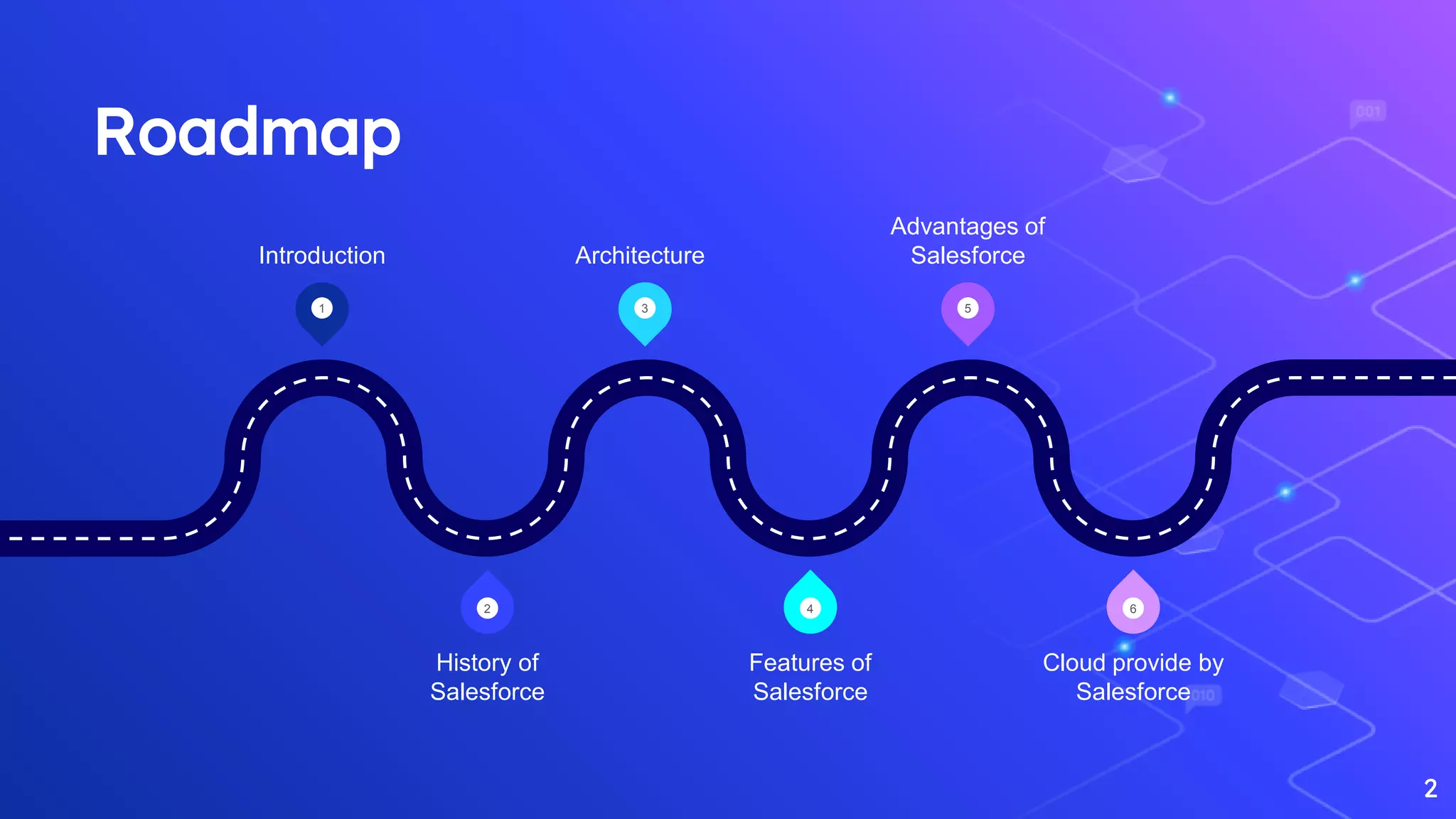
Roadmap
2
1 3 5
6
4
2
Introduction Architecture
Advantages of
Salesforce
History of
Salesforce
Features of
Salesforce
Cloud provide by
Salesforce
What is Salesforce?
3
Salesforce is a cloud-based Customer Relationship Management (CRM) software for managing
customer relationships and integration with other systems.
Salesforce is a cloud computing company which offers a variety of services (SaaS) and products
(PaaS).
This SaaS tool helps to create custom solutions for marketing, sales, services and ecommerce as
per business requirements.
It is designed to manage the organization's data focused on customer and sales details.
History of Salesforce
4
It was founded in March 1999 by ex-Oracle employee Marc Benioff, Frank Dominguez, and
Parker Harris.
In October 2014, Salesforce announced the development of its Customer Success Platform to
merge all the Salesforce's services like sales, service, marketing, analytics, etc.
In 2017, Sales force launched a Facebook Analytics tool.
In 2018, Sales force partnered with Apple for improving apps for businesses.
It currently has 82,400 regular customers and over 2,100,000 subscribers.
Salesforce Architecture
5
Salesforce Architecture
6
Trusted Multi Tenant Cloud : multiple instances of one or multiple applications operate independently in a
shared environment. The instances are referred as tenants and they logically separate from each other while
physically remaining in the same hardware.
Scalable Metadata Platform : The metadata driven platform makes it easy for customization and scaling up
as the amount of data or concurrent user instances increase.
Enterprise Ecosystem : The Enterprise Ecosystem of Sales is very large as a large number of partners
contribute by creating and maintaining applications in this platform.
CRM and Related Functionality : Salesforce includes all aspects of CRM in its list of features and also
extends it by providing features for creation of apps and integrating analytics, etc.
APIs : Salesforce provides powerful suite of APIs. This helps to develop and customize the Salesforce1
Mobile App.
Features of Salesforce
7
Marketing and sales lead: Helps you to measure customer engagement by tracking email activities and
convert them to customers.
Contact management: With the help of this feature you can pull your customer's data like activity
history, frequent contacts, customer communications, etc.
Build and run innovative apps: You can build, scale and manage apps
Analytics: It allows you to access the data, create dashboards and perform analysis
Email integration: It provides integrations devoted to customer service, support and customer
experience
Reports and Dashboards: Dashboards and reporting feature offers a real-time picture of the business
at a glance
Lead Management: This feature helps you to tracks the leads that are in progress
Advantages of Salesforce
8
It is a complete feature-rich solution for marketing, sales, service, partner management, and
community management.
Salesforce data is stored in the cloud so your team can use it from anywhere in the world with the
help of an Internet connection.
Salesforce works on a pay as you go, model so there are no overhead costs.
Accelerates sales productivity
Salesforce can easily integrate with 3rd party apps.
Increase the growth of your business
Cloud provided by Salesforce
9
Sales Cloud Marketing Cloud
Service Cloud
Analytics Cloud
Community Cloud
Commerce Cloud
Sales Cloud
10
Salesforce Sales Cloud manages contact information and integrates social media and real-time
customer collaboration through Chatter.
It supports sales, marketing and customer support in both B2B and B2C contexts. Sales Cloud helps
track customer information and interactions in one place, automates complex business processes,
keeps all information up to date and tracks the effectiveness of marketing campaigns.
Features in Sales Cloud include contact management, opportunity management,Salesforce
Inbox,Salesforce Engage, lead management, reports and dashboards, Wave App for Sales, marketing
automation and more.
Marketing Cloud
11
Salesforce Marketing Cloud is the only integrated Customer Engagement platform to deliver
personalized customer engagement at scale. It is offered across all channels i.e. email to web, social,
mobile, and digital advertising.
Salesforce Marketing Cloud helps personalize email marketing at scale ,engage with mobile messaging
,connect social to marketing, sales and service, manage ad campaigns to help with customer
acquisition,deliver personalized web content that is efficient and create 1-to-1 customer journeys
across channels.
Service Cloud
12
Salesforce Service Cloud is a service platform for customer service and support. It includes a call
center-like case tracking feature and a social networking plug-in for conversation and analytics.
Service Cloud helps agents to solve customer problems faster, gives customers access to answers to
solve problems on their own, helps personalize service, predicts needs, and helps deliver support to
customers
Features in Service Cloud include live agent, communities, LiveMessage, Snap-ins, Field Service
Lightning, Omni Routing, and social customer service.
Analytics Cloud
13
Salesforce Analytics Cloud(Salesforce Wave Analytics) is a business intelligence platform that allows
organizations to instantly get important answers and start making data-driven decisions.
Analytics allows users to act on data instantly, connect easily to Sales and Service cloud data, work
from any device, analyze data for better insights, and utilize analytics apps for every function including
sales, service, marketing, HR and IT.
Community Cloud
14
Salesforce Community Cloud connects and facilitates communication among employees,
customers and partners.
The Community Cloud helps build communities for any needs, provides a platform for customers
to help themselves and each other, builds deeper customer relationships by allowing customers to
interact with each other, allows partners to connect and increase sales, and helps drive employee
productivity through online collaboration.
Some features included in Community Cloud are personalization, Lightning Bolt, case escalation,
e-commerce, Salesforce automation, collaboration and community management.
Commerce Cloud
15
The salesforce commerce cloud service is all about the customer services and experiences. It allows
the companies to provide the best services and experiences to their customers, either online or in-
store. It integrates customer data to provide a better customer experience.
The Salesforce commerce cloud provides the leading B2B(Business to Business) and B2C(Business to
Consumer) e-commerce solutions to the organizations.
It follows the multi-tenant architecture and the cloud-based commerce platform to provide different
powerful abilities to the brands. With the help of commerce cloud, brands can create intelligent, unified
purchasing experiences through all the possible channels, such as mobile, web, social media, and
offline stores.
Thank You !
16

Salesforce

  • 1.
    Salesforce Team: 1.Bharat Sirvi 2.Doriya Bhavin 3.DaveYatharth 4.Patel Anuj 5.Shah Vatsal Guided By: Prof. Hiteshri A. Modi
  • 2.
    Roadmap 2 1 3 5 6 4 2 IntroductionArchitecture Advantages of Salesforce History of Salesforce Features of Salesforce Cloud provide by Salesforce
  • 3.
    What is Salesforce? 3 Salesforceis a cloud-based Customer Relationship Management (CRM) software for managing customer relationships and integration with other systems. Salesforce is a cloud computing company which offers a variety of services (SaaS) and products (PaaS). This SaaS tool helps to create custom solutions for marketing, sales, services and ecommerce as per business requirements. It is designed to manage the organization's data focused on customer and sales details.
  • 4.
    History of Salesforce 4 Itwas founded in March 1999 by ex-Oracle employee Marc Benioff, Frank Dominguez, and Parker Harris. In October 2014, Salesforce announced the development of its Customer Success Platform to merge all the Salesforce's services like sales, service, marketing, analytics, etc. In 2017, Sales force launched a Facebook Analytics tool. In 2018, Sales force partnered with Apple for improving apps for businesses. It currently has 82,400 regular customers and over 2,100,000 subscribers.
  • 5.
  • 6.
    Salesforce Architecture 6 Trusted MultiTenant Cloud : multiple instances of one or multiple applications operate independently in a shared environment. The instances are referred as tenants and they logically separate from each other while physically remaining in the same hardware. Scalable Metadata Platform : The metadata driven platform makes it easy for customization and scaling up as the amount of data or concurrent user instances increase. Enterprise Ecosystem : The Enterprise Ecosystem of Sales is very large as a large number of partners contribute by creating and maintaining applications in this platform. CRM and Related Functionality : Salesforce includes all aspects of CRM in its list of features and also extends it by providing features for creation of apps and integrating analytics, etc. APIs : Salesforce provides powerful suite of APIs. This helps to develop and customize the Salesforce1 Mobile App.
  • 7.
    Features of Salesforce 7 Marketingand sales lead: Helps you to measure customer engagement by tracking email activities and convert them to customers. Contact management: With the help of this feature you can pull your customer's data like activity history, frequent contacts, customer communications, etc. Build and run innovative apps: You can build, scale and manage apps Analytics: It allows you to access the data, create dashboards and perform analysis Email integration: It provides integrations devoted to customer service, support and customer experience Reports and Dashboards: Dashboards and reporting feature offers a real-time picture of the business at a glance Lead Management: This feature helps you to tracks the leads that are in progress
  • 8.
    Advantages of Salesforce 8 Itis a complete feature-rich solution for marketing, sales, service, partner management, and community management. Salesforce data is stored in the cloud so your team can use it from anywhere in the world with the help of an Internet connection. Salesforce works on a pay as you go, model so there are no overhead costs. Accelerates sales productivity Salesforce can easily integrate with 3rd party apps. Increase the growth of your business
  • 9.
    Cloud provided bySalesforce 9 Sales Cloud Marketing Cloud Service Cloud Analytics Cloud Community Cloud Commerce Cloud
  • 10.
    Sales Cloud 10 Salesforce SalesCloud manages contact information and integrates social media and real-time customer collaboration through Chatter. It supports sales, marketing and customer support in both B2B and B2C contexts. Sales Cloud helps track customer information and interactions in one place, automates complex business processes, keeps all information up to date and tracks the effectiveness of marketing campaigns. Features in Sales Cloud include contact management, opportunity management,Salesforce Inbox,Salesforce Engage, lead management, reports and dashboards, Wave App for Sales, marketing automation and more.
  • 11.
    Marketing Cloud 11 Salesforce MarketingCloud is the only integrated Customer Engagement platform to deliver personalized customer engagement at scale. It is offered across all channels i.e. email to web, social, mobile, and digital advertising. Salesforce Marketing Cloud helps personalize email marketing at scale ,engage with mobile messaging ,connect social to marketing, sales and service, manage ad campaigns to help with customer acquisition,deliver personalized web content that is efficient and create 1-to-1 customer journeys across channels.
  • 12.
    Service Cloud 12 Salesforce ServiceCloud is a service platform for customer service and support. It includes a call center-like case tracking feature and a social networking plug-in for conversation and analytics. Service Cloud helps agents to solve customer problems faster, gives customers access to answers to solve problems on their own, helps personalize service, predicts needs, and helps deliver support to customers Features in Service Cloud include live agent, communities, LiveMessage, Snap-ins, Field Service Lightning, Omni Routing, and social customer service.
  • 13.
    Analytics Cloud 13 Salesforce AnalyticsCloud(Salesforce Wave Analytics) is a business intelligence platform that allows organizations to instantly get important answers and start making data-driven decisions. Analytics allows users to act on data instantly, connect easily to Sales and Service cloud data, work from any device, analyze data for better insights, and utilize analytics apps for every function including sales, service, marketing, HR and IT.
  • 14.
    Community Cloud 14 Salesforce CommunityCloud connects and facilitates communication among employees, customers and partners. The Community Cloud helps build communities for any needs, provides a platform for customers to help themselves and each other, builds deeper customer relationships by allowing customers to interact with each other, allows partners to connect and increase sales, and helps drive employee productivity through online collaboration. Some features included in Community Cloud are personalization, Lightning Bolt, case escalation, e-commerce, Salesforce automation, collaboration and community management.
  • 15.
    Commerce Cloud 15 The salesforcecommerce cloud service is all about the customer services and experiences. It allows the companies to provide the best services and experiences to their customers, either online or in- store. It integrates customer data to provide a better customer experience. The Salesforce commerce cloud provides the leading B2B(Business to Business) and B2C(Business to Consumer) e-commerce solutions to the organizations. It follows the multi-tenant architecture and the cloud-based commerce platform to provide different powerful abilities to the brands. With the help of commerce cloud, brands can create intelligent, unified purchasing experiences through all the possible channels, such as mobile, web, social media, and offline stores.
  • 16.